

What do you think?
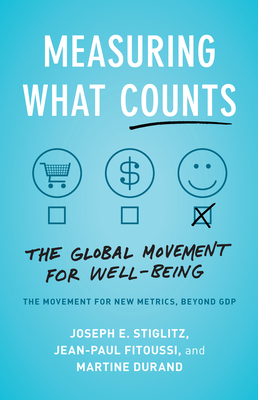
Measuring What Counts: The Global Movement for Well-Being
A bold agenda for a better way to assess societal well-being, by three of the world's leading economists and statisticians "If we want to put people first, we have to know what matters to them, what improves their well-being, and how we can supply more of whatever that is."
―Joseph E. Stiglitz In 2009, a group of economists led by Nobel laureate Joseph E. Stiglitz, French economist Jean-Paul Fitoussi, and Nobel laureate Amartya Sen issued a report challenging gross domestic product (GDP) as a measure of progress and well-being. Published as Mismeasuring Our Lives by The New Press, the book sparked a global conversation about GDP and a major movement among scholars, policy makers, and activists to change the way we measure our economies. Now, in Measuring What Counts , Stiglitz, Fitoussi, and Martine Durand―summarizing the deliberations of a panel of experts on the measurement of economic performance and social progress hosted at the OECD, the international organization incorporating the most economically advanced countries―propose a new, "beyond GDP" agenda. This book provides an accessible overview of the last decade's global movement, sparked by the original critique of GDP, and proposes a new "dashboard" of metrics to assess a society's health, including measures of inequality and economic vulnerability, whether growth is environmentally sustainable, and how people feel about their lives. Essential reading for our time, it also serves as a guide for policy makers and others on how to use these new tools to fundamentally change the way we measure our lives―and to plot a radically new path forward.
―Joseph E. Stiglitz In 2009, a group of economists led by Nobel laureate Joseph E. Stiglitz, French economist Jean-Paul Fitoussi, and Nobel laureate Amartya Sen issued a report challenging gross domestic product (GDP) as a measure of progress and well-being. Published as Mismeasuring Our Lives by The New Press, the book sparked a global conversation about GDP and a major movement among scholars, policy makers, and activists to change the way we measure our economies. Now, in Measuring What Counts , Stiglitz, Fitoussi, and Martine Durand―summarizing the deliberations of a panel of experts on the measurement of economic performance and social progress hosted at the OECD, the international organization incorporating the most economically advanced countries―propose a new, "beyond GDP" agenda. This book provides an accessible overview of the last decade's global movement, sparked by the original critique of GDP, and proposes a new "dashboard" of metrics to assess a society's health, including measures of inequality and economic vulnerability, whether growth is environmentally sustainable, and how people feel about their lives. Essential reading for our time, it also serves as a guide for policy makers and others on how to use these new tools to fundamentally change the way we measure our lives―and to plot a radically new path forward.
224 pages, Paperback
Published November 19, 2019
About the author
Joseph E. Stiglitz
253 books1,875 followersJoseph Eugene Stiglitz, ForMemRS, FBA, is an American economist and a professor at Columbia University. He is a recipient of the Nobel Memorial Prize in Economic Sciences (2001) and the John Bates Clark Medal (1979). He is also the former Senior Vice President and Chief Economist of the World Bank. He is known for his critical view of the management of globalization, free-market economists (whom he calls "free market fundamentalists") and some international institutions like the International Monetary Fund and the World Bank.
In 2000, Stiglitz founded the Initiative for Policy Dialogue (IPD), a think tank on international development based at Columbia University. Since 2001, he has been a member of the Columbia faculty, and has held the rank of University Professor since 2003. He also chairs the University of Manchester's Brooks World Poverty Institute and is a member of the Pontifical Academy of Social Sciences. Professor Stiglitz is also an honorary professor at Tsinghua University School of Public Policy and Management. Stiglitz is one of the most frequently cited economists in the world.
In 2000, Stiglitz founded the Initiative for Policy Dialogue (IPD), a think tank on international development based at Columbia University. Since 2001, he has been a member of the Columbia faculty, and has held the rank of University Professor since 2003. He also chairs the University of Manchester's Brooks World Poverty Institute and is a member of the Pontifical Academy of Social Sciences. Professor Stiglitz is also an honorary professor at Tsinghua University School of Public Policy and Management. Stiglitz is one of the most frequently cited economists in the world.
Ratings & Reviews
Friends & Following
Create a free account to discover what your friends think of this book!
Community Reviews
Displaying 1 - 10 of 10 reviews

May 1, 2022
I'd feel weird rating this as it's a guide for policymakers, I just want to point out that GDP's not accounting for climate change was hardly mentioned. One paragraph that sticks out calls it out as an imminent existential threat, and then barely mentions it again. I guess that's less of a criticism of this specific book and more of Society as a whole, but I was hoping for more discussion of Green GDP and the Sustainable Development Index within the eco-version of Sustainable.
The fact that nearly all life on earth doesn't count towards GDP ("the economy") until it is killed, processed, and sold, should feature a little more prominently in a criticism of GDP, right?
The fact that nearly all life on earth doesn't count towards GDP ("the economy") until it is killed, processed, and sold, should feature a little more prominently in a criticism of GDP, right?
March 8, 2020
Not unexpectedly this reads like an official agency report which is what it is. Criticisms are levied against using GDP as the sole measure of the health of an economy citing various well-known & not so well-known shortcomings. As it is clear that no single parameter will suffice to describe the important aspects of an economy or more importantly a society, a complete dashboard of measures is recommended to cover such aspects as level of economic activity, employment/unemployment, human capital, sustainability, measure of well-being & trust, environmental degradation, etc.
One is tempted to picture white lab coated technocrats at the dials in a control room adjusting the various components of a society with, of course, the corresponding libertarian backlash.
Here's more info from the horse's mouth: https://www.oecd-ilibrary.org/sites/9...
One is tempted to picture white lab coated technocrats at the dials in a control room adjusting the various components of a society with, of course, the corresponding libertarian backlash.
Here's more info from the horse's mouth: https://www.oecd-ilibrary.org/sites/9...

February 13, 2023
GDP isn't everything. It is a poor measure of the wellbeing of a country. The authors explain how most countries judge how they are going economically by measuring GDP but there is more to life than economics. This is not a new idea. The authors quote Robert Kennedy who was talking about the ways that GDP measures a lot of things that don't matter and doesn't measure some of the things that don't matter, back in 1968! These ideas are only just starting to be taken seriously by governments. They've got a long way to go.
The authors are very good at explaining these economic matters in simple language that non-economists can understand. I really appreciated the short simple list of things governments need to do to solve this GDP problem at the end of the book.
The authors are very good at explaining these economic matters in simple language that non-economists can understand. I really appreciated the short simple list of things governments need to do to solve this GDP problem at the end of the book.

January 18, 2020
I have long saw the dysfunction of GDP. In the age of globalization, the measure of 'USA' corporate economic health correlating to any statement of national has been off-base the farther and farther citizen economic health diverges from the corporations with whom they do business and/or employed.
The 2008 Financial Crisis spurred a number of international economists to explore alternatives. This is not the first book, but a good person for layperson to read to gain some exposure to the GDP alternatives.
System of Environmental and Economic Accounting, SEEA, is of particular interest to my advocacy.
The 2008 Financial Crisis spurred a number of international economists to explore alternatives. This is not the first book, but a good person for layperson to read to gain some exposure to the GDP alternatives.
System of Environmental and Economic Accounting, SEEA, is of particular interest to my advocacy.
June 14, 2020
5 stars for content, 3 stars for story-telling talent. Due to the importance of the topic, I weigh the content heavier- so overall 5 stars. The authors are among the pioneers of new measures movement, emphasizing the importance of the well-being of all citizens, not only of the richest 10%. The standard measure GDP (Gross Domestic Product) or GDP growth is not appropriate, since it measures the average. In many countries in the last 40 years GDP growth was not shared with all citizens, going mostly to the richest 10% of the population.

January 16, 2020
Small book, weighty topic. Looking beyond the numbers to improve life for all. Well worth the read.
November 14, 2020
This book was not as expected. It is all about economics.
1 star. I tuned out after the first chapter.
1 star. I tuned out after the first chapter.
February 12, 2021
I was surprised at the lack of rigour.
August 4, 2023
A delve into economics and what measures should go into valuing a healthy economy beyond the metric of GDP.
March 12, 2026
Better perspective than mainstream economics.
Displaying 1 - 10 of 10 reviews