80 of the funniest stories ever written, selected and introduced by Paul Merton. From Anton Chekhov to Ali Smith, from P.G. Wodehouse to Nora Ephron, the greatest writers are those who know how to laugh. Here, award-winning comedian and broadcaster Paul Merton brings together his favourite funny stories of all time. Whether it's the silly, surreal, slap-stick or satirical that makes you smile, there's a story here to tickle every funny bone. From prize-winners and literary giants, to stand-up comedians and the rising stars of funny literature, this brilliant anthology is guaranteed to cheer your day.
80 humorous stories and sketches/skits by 60 authors. Perfect for dipping in and out of, in random order, rather than alphabetically by authors, during Coronavirus Covid-19 lockdown.
Some were more amusing than others. To what extent is humour in the telling or the plot? I was also intrigued to find some that may have been inspiration for better-known pieces - and vice versa.
Paul Merton, a well known British comedian, explains his choices in the introduction. The fact that Saki, Wilde, and Wodehouse are among the seven who merit three pieces was a good sign; the omission of Kafka (yes, some of his shorts are, and were intended to be, funny) was not.
Over half the authors were unknown to Merton when he started. Fewer than half are British, though many of the rest are from the USA or Canada. Nevertheless, there are ~15 from other places, including France, Germany, Russia, Argentina, Nigeria, Italy, Poland, India, Lithuania, Peru, Mexico, and Hungary (some had multiple heritage).
Each story is prefaced by a short bio, but not the publication date.
Atwood, Margaret: There Was Once 5* "There was once a poor girl, as beautiful as she was good, who lived with her wicked stepmother in a house in the forest." Reductio ad absurdum: politically correct lit crit of an innocuous opening sentence of a typical fairytale. You can read the whole dialogue HERE.
Bulgakov, Mikhail: Bohemia, 3* OK as a story of a poor playwright travelling to a new town, but not really humorous.
Carrington, Leonora: The Neutral Man, 3* The only amusing bit is the line Merton quotes in his intro: “I saw a man of such neutral appearance that he struck me like a salmon with the head of a sphinx in the middle of a railway station.”
Carrington, Leonora: The Royal Summons, 4* “She was watering the flowers woven in the carpet.” A surreal story (Carrington was also a surrealist painter). The Queen has gone mad (as has the narrator’s chauffeur), so the narrator has to step in to the role, but gets involved in a strange plot, and is chased by a tree. Fun.
Chekhov, Anton: The Death of a Government Clerk, 3* A very short demonstration of bathos via a dilemma of etiquette and hierarchy. A man accidentally coughs on another man in the theatre, and realising the other man is a senior official, repeatedly tries to apologise for his faux pas.
Chesterton, GK: The Tremendous Adventures of Major Brown, 4* This is the first of six Edwardian stories in The Club of Queer Trades. I enjoyed it so much, I read the others. Each is a little mystery to discover a person’s peculiar (“queer” in the old sense) and unique way of making a living. See my review of all six, including this one, HERE.
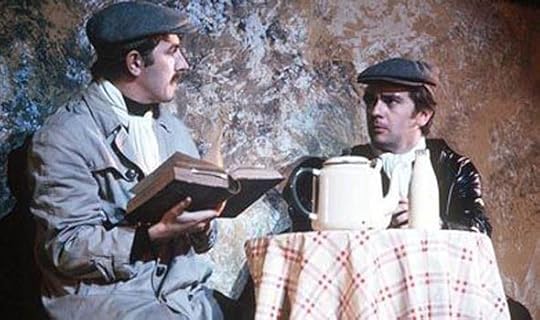
Cooke, Peter and Moore, Dudley: Sex, 4* This is one of several sketches (others are by Galton and Simpson, Joyce Grenfell, Spike Milligan, and Victoria Wood). It reads better if you know Pete and Dud. Watch HERE. Their famous rambling, corpsing (uncontrolled laughter), and apparent ad libs are explained in the bio: they would extemporise then have the audio tape transcribed, edited, and written as a script, which they’d perform with a few more ad libs.
In this, the pair discuss “Blauberger’s Encyclopaedia of Sexual Knowledge”, which Pete found in Dud’s sandwich box. In deadpan style, they (mis)educate each other on the subject, including Adam and Eve and the sort of women they like): “I like the sort of woman who throws herself on you and tears all your clothes off with her rancid [sic] sexuality.”
Reminiscing about schooldays, Pete remembers a bully telling him about “the most disgusting word in the world. It’s so filthy that no one’s allowed to see it except bishops and nobody knows what it means.” He looks it up in the library, leading to a daisy chain of etymological misunderstanding.
I was reminded of my hearing an allegedly filthy joke from older girls at school. It was evidently hysterically funny, but I didn’t get it and didn’t want to let on. So I laughed and I told others, who probably did the same as me. (It’s the one about two nuns in the bath, and one asks the other to pass the soap. It relies on a homophone, so there’s no point writing it down.)
Monty Python acknowledge the inspiration of Pete and Dud, and this particular piece is a clear precursor of Python’s Nudge Nudge sketch, HERE.
Cooke, Peter and Moore, Dudley: Father and Son, 2* This conversation between a working class father and his disappointingly soft middle class son was like a less funny draft of the famous Four Yorkshiremen sketch that premiered a year later. That predates Python, but was made famous by their performances of it (see Wikipedia for Four Yorkshiremen sketch and Not Only... but Also). You can watch the original Four Yorkshiremen HERE.
Ephron, Nora: The Girl Who Fixed the Umlaut, 4* A metafictional send-up of authors and characters, including their “italic thoughts”.
Fforde, Jasper: The Locked Room Mystery, 4* A self-aware, tongue-in-cheek send up of the clichés of murder mysteries. See my review HERE.
Grenfell, Joyce: Story Time and Committee, 4* “Sometimes I don’t think love is enough with children.” I listened to Grenfell’s audio monologues as a small child, especially Nursery School Flowers, with the immortal line, “George, don’t do that”. Here, there’s a nursery school (kindergarten) one, with clear characterisation of each child, and another showing the limits of tact in a committee. You can watch Grenfell performing the start of Story Time HERE.
Grossmith, George and Weedon: Diary of a Nobody, 1* An excerpt featuring the famous painted bath. Still not funny. See my old, very short review HERE.
Guareschi, Giovanni: three Don Camillo stories, 3* Charming vignettes of an imperfect priest in rural Italy, and his nemesis, the Communist mayor. See The Complete Little World of Don Camillo.
Haddad, Saleem: Do I Understand That You are a Homosexual, Sir?, 5* Tragi-comic scenario of a gay British-Libyan man boarding a flight to the USA. He’s questioned by US Homeland Security, as his inner monologue advises how to seem unthreatening. Funny and self-deprecating, and it makes me very aware of my white privilege.
Hamdi, Omar: Islam is not Spiritual, but it is a Useful Identity, 3* “Girls in headscarves can be quite shaggable.” A brave and very recent piece (it mentions Brexit), satirising anti-Islamic rhetoric and highlighting the social advantages of positive discrimination.
Handley, Jack: The Plan, 5* “The plan isn’t foolproof. For it to work, certain things must happen:” This is a list of common (and uncommon - monkeys!) implausibilities of heist movies: “The gold bars must be made out of a lighter kind of gold that’s just as valuable but easier to carry.” A sort of opposite, but serious list, is Elizabeth Span Craig’s update to The Ten Commandments for Detective Fiction, HERE.
Mansfield, Katherine: The Daughters of the Late Colonel, 3* Interesting, well-written, but not particularly funny story of two sisters doing what needs to be done in the aftermath of their widowed father’s death, with his presence and oversight lingering in their lives. See my review HERE.
McCall, Bruce: Hitler’s Secret Dairy, 2* The joke is in the spelling of the title, which I didn’t notice until I wondered why Hitler was so enthusiastic about cattle. It was published in The New Yorker shortly after the (fake) Hitler Diaries in 1983, and is also reminiscent of The Secret Diary of Adrian Mole, Aged 13 3/4 published in 1980 and broadcast on BBC Radio 4 in 1982. Hitler has a fragile ego, is increasingly paranoid, and wants impressive but unrealistic things like “a rocket-powered milking machine”. Many have likened Trump to Hitler by exaggerating Trump, but this “softer” Hitler seems a closer fit.
Mikes, George: How to Take Your Pleasure Sadly, 4*, and How to Die, 3* Mikes was a Hungarian who came to London after WW2 as a journalist, but became known for humorous observations about his new compatriots. Both these are from his 1960 book How to be Inimitable, which was incorporated into How To Be A Brit. The first rejects the saying that “the English take their pleasures sadly” and explains that we “endure them bravely”, giving the example of all the horrors of driving to and spending a typical English seaside holiday (12-hour drive for four-hour journey, queues for ice-creams, deck-chairs, tea, and swings, with crowds and litter everywhere). “If this were meted out as dire punishment, proud, free Englishemen everywhere would rise against it.” In Coronavirus lockdown, that sounds more appealing than intended.
The second piece claims “The English are the only race in the world who enjoy dying”, mainly because we don’t like making a fuss, or being conspicuous or unconventional. Both are funnier than I’ve made them sound!
Oates, Joyce Carol: Welcome to Friendly Skies!, 4* A series of announcements from cabin crew. On each topic (oxygen, life vests, take-off etc), it starts familiar and reassuring, but gets odder and more alarming. Trivia: this was published in 2017 in the Idaho Review, a couple of years before Transport for London adopted a very similar slogan to one here: “If you see something, say something… See it, slay it” from Oates, and “If you see something that doesn’t look right [phone/text]... See it, say it, sorted” from TFL.
O’Brien, Flan: Two in One, 5* The perfect crime, foiled by vanity, ending with karma, and involving taxidermy. It reminded me of Roald Dahl’s Tales of the Unexpected.
Saki, Tobermory, 4* Mocking Victorian hypocrisy, anticipating the surveillance society, karma, or just an enjoyable little fantasy. See my review HERE.
Saki, Toys of Peace, 5* Good intentions about nature and nurture, war and peace are thwarted by the creative imagination of children. See my review HERE.
Simms, Paul: Talking Chimp Gives his First Press Conference, 3* The title tells the story. The humour, such as it is, comes from the incongruity of fluent intelligent speech via an (unreliable) Electronic Larynx Implant and his crude animal urges. I was reminded of various, rather better, explorations of the idea: * 1917, Kafka’s short story, Report to the Academy (see my review of The Country Doctor collection, HERE). * 1980, Not the Nine O’Clock News sketch, Gerald the Gorilla, which you can watch HERE. * 2005, this Paul Simms story published in the New Yorker. * 2013, Colin Teevan wrote Kafka's Monkey, a one-person show, based on Kafka’s story (see my review HERE).
Smith, Ali: The Child, 4* A brilliant little story about lost and found that is amusing, but also increasingly, unsettlingly dark, in unexpected ways. See my review HERE.
Wells, HG: The Man Who Could Work Miracles, 4* The darkly comical story of the unintended consequences of great powers, seemingly acquired from a futile argument between a rationalist and a believer in the supernatural. See my review HERE.
Wilde, Oscar: The Canterville Ghost, 4* A somewhat slapstick YA ghost story that also pokes fun at Americans: See my review HERE.
Willett, Jincy: The Best of Betty, 5* Impressive character development for such a short piece. A small town agony aunt becomes increasingly and amusingly heartless, as her own life quietly unravels. When challenged, “who the hell do you think you are?”, she replies: “I am 147 pounds of despair in a fifty-pound mail sack. Though overpaid I groan with ennui beneath the negligible weight of your all too modest expectations, and when I fail to counter one of your clichés with another twice as mindless I apologize, even though the fault, God knows, is yours.” You can watch a 30-minute film adaptation HERE.
Wodehouse, PG: A Day With the Swattesmore, 4* “Whit Monday, which to so many means merely one more opportunity of strewing Beauty Spots with paper bags.” Satire on hunting. The narrator is enthusiastic about the start of the fly-swatting season, and the associated etiquette and ritual.
Wodehouse, PG: Mulliner’s Buck-U-Uppo, 5* Comic capers and characters. A favourite PGW of many anthologists. Always read the label! See my review HERE.
1 Atwood, Margaret There Was Once 2 Aymé, Marcel The Man Who Walked Through Walls 3 Barry, Kevin Beer Trip to Llandudno 4 Barthelme, Donald- Some of Us had been Threatening our Friend Colby 5 Benchley, Robert "Take the Witness!" 6 Böll, Heinrich Action Will Be Taken 7 BulgakovMikhail, Bohemia 8 Carrington, Leonora The Royal Summons 9 Carrington, Leonora The Neutral Man 10 Chekhov, Anton The Death of a Government Clerk 11 Chesterton, G.K. The Tremendous Adven- tures of Major Brown 12 Cook, Peter & Moore, Dudley sex 13 Cook, Peter & Moore, Dudley Father & Son 14 Coward, Noël The Wooden Madonna 15 Crompton, Richmal- The Show 16 Denevi, Marce The Lord of the Flies 17 Ephron, Nora The Girl who Fixed the Umlaut 18 Fforde, Jasper The Locked Room Mystery mystery 19 Galton, Ray & Simpson, Alan from Hancock in the Police 20 Galton, Ray & Simpson, Alan Sid's Mystery Tours 21 Grenfell, Joyce Story Time 22 Grenfell, Joyce Committee 23 Grenfell, Joyce Thought For Today 24 Grossmith George & Weedon, from The Diary of a Nobody 25 Guareschi, Giovanni- A Sin Confessed 26 Guareschi, Giovanni The Baptism
A fine collection of funny short stories. I laughed out loud at some of them and found plenty of them amusing.
Paul Merton, who selected these stories, is known for his silly and surreal humour, so expect similar types of stories here.
It may be a bit too long (the book is just over 600 pages,) and the majority are good stories but not too funny, but there is a great variety of eclectic literature pleasingly put together that can tickle your funny bone as well as broaden your literary horizons. And that's not a joke.
Having read this book from cover to cover, I wonder if the original title was intended to be "Funny Ha, Ha or Funny Peculiar", before the editorial committee decided either that the title was too long, or too similar to some existing books. Either way, I think a shorter title of "Funny !?!" might have been more indicative of the content. If you're buying this book hoping to laugh out loud, then forget it. There is some amusing content, and some "ha, ha" moments, but they are few and far between. There has been no attempt to curate the content, the stories are included in Alphabetical order by Author. If there had, then subcategories of "Funny: Macarbe", "Funny: Surreal", "Funny: Peculiar" and "Funny: Ha Ha" may have been appropriate, but I suspect that agreeing which stories belonged in which category would be problematic. Mr Merton suggests you dip in and out of this book, selecting stories at random. I'd suggest that to do so risks missing some of the Gems scattered through the book. Overall, I found this book entertaining, but not "Funny Ha, Ha" enough to justify the title.
I assume they wanted to call this "NOT Funny Ha, Ha" but that name was already taken.
All in all, this book actually made me more depressed. If these are "80 of the funniest stories ever written" then - God help us! - there's little hope for mankind.
DISCLAIMER: I got so bored reading this, so in the end I didn't actually read a large proportion of this book. It might just be that I happened to miss all the actually funny stories. But based on what I read, I doubt it. Perhaps I should have known, as I don't particularly rate Paul Merton's sense of comedy.
"Ever written" is pushing it. Merton is an amusing and clever fellow with, no doubt, a wide-ranging and esoteric sense of humour, but some of his selections are frankly utterly bemusing. I'm no curmudgeon, but if ten pages into a tale it can't even raise a smile or you're struggling to find any kind of wit in it, you have to question why it's part of his collection.
Can only imagine it’s 80 of the funniest 8 million stories ever written. Weirdly arranged in alphabetical order (of author) so you get big wodges of one person. A few raised a smile. Wodehouse and Wood (Victoria), together at the end, were the best of the lot, like pudding after 5000 pages of unsauced pasta.
pros ✅ - the Peter Cook & Dudley Moore two-parter was good fun and a relief, because this was the first time i laughed (94 pages in) - Nora Ephron, jolly - Jasper Fforde, clever - Joyce Grenfell three-parter, warm - Giovanni Guareschi three-parter was literally just a priest arguing with jesus about beating up the communist mayor which i enjoyed - Jack Handey’s ‘THE PLAN’ was fun and different and probs my fav of all the stories. i was very happy to see multiple handey stories - Close second fave was BJ Novak’s ‘The Man who invented the calendar.’ very silly, structured like a diary which i liked - plenty of variety. anyone could pick this up and find something they enjoy - Victoria Wood was a lovely one to end on
cons ❌ - took me 100 pages to laugh - a lot of the stories were very dated and therefore very stodgy and hard work to get through - i wish that each story had a date of publication on it. i don’t mind it being ordered alphabetically by authors surname but i want to know when these stories were first written/published/performed - you’re basically fucked if you get three stories by a person you don’t find funny. like i did not need three Oscar Wilde stories they were not readable - some stories are 4 stars and others are 0 so rating this has to be somewhere in the middle
I was given this book as a Christmas present and it is certainly up my street. However, I have decided that this is not a book that I want to read cover to cover and, indeed, it doesn't really seem designed for that. Some of the stories in here are long, others merely a page or two and, to be honest, some of them don't strike me as particularly amusing.
However it is an eclectic mix of styles and eras - some of the authors are venerable and many have passed but there are also quite a few contemporary writers too and these are not all short stories. Some are articles, some scripts. As I say, some didn't strike me as particularly funny whilst others are more to my taste when it comes to humor. Obviously, as every, humor is very much in the eye of the beholder so to speak.
I read most of what I wanted to consume immediately, and I will definitely return to the book and dip into it again.
Comedy is subjective so although I didn't find myself smiling the whole way through, once I got to the second half of the book there was plenty to keep me amused.
I would have liked the stories to have been organised thematically or with a narrative flow rather than alphabetically but as the compiler suggests you can dip in and out as you like and of course you can skip the ones you don't find funny too.
It was neither funny, nor were there many Ha, Ha moments. Some stories were good, but most of those were also far from being funny. A large part of the book was a drag - I had to struggle to reach the end cover and I couldn't be more glad that it's over.
A few stories were funny, a few were okay. Although not overly funny, some were interesting for the complexity of writing. However, in general, it wasn't for me. For the most part, there were long gaps between me even cracking a smile.
A very poor selection of stories. Some just utterly unfunny. I like Paul Merton but too often he seems to confuse odd but dull with quirky. I doubt he even selected these, just lent his name to the title. The best known authors generally stand up apart from the Oscar Wilde selections. How did they manage to find such boring drivel from one of the wittiest men that ever lived? Excerpts from scripts are included too, which while very funny in performance just don’t work as written pieces. Hancock and Woods being an example. Shoddy lazy selection. Avoid.
Great for anyone struggling to settle down to a book and wanting something more light hearted. Bitesize introductions to a wide range of authors, many of whom I'm keen to get better acquainted with. Useful resumes for each author at the start of each short story. Carrington and Ayme were particular favourites.
One or two amusing stories, but quite frankly I struggled, and certainly no laugh out loud bits, except perhaps for Just William. Obviously thrown together for the run up to Christmas to make Paul Merton a bit a cash.
DNF at like 60%. Normally I never even log DNF books but this one was so hard to get through that I feel like I deserve it. These are 80 of the least funny, worst, most tedious stories ever written. Why did I buy this book
Didn’t manage to finish every single story in this book before it was due at the library , but I liked the Chimp Press Conference one and the Man Who Invented the Calendar ones especially.
An anthology of short stories of the humorous variety chosen by Paul Merton. As with any anthology some bits are stronger than others, and there's always the chance of finding someone new. In this case Leonora Carrington, a new name to me certainly seems worth exploring. Of course some of the obvious choices are here, Wodehouse, Dorothy Parker, Saki and Thurber were always going to be included, nice seeing Jasper Fforde, Kurt Vonnegut and Sue Townsend included. There are of course some exclusions, there's no O. Henry for example, and some of the choices seem a little odd. While I can understand including some Hancock scripts, I don't really understand only having one Goon show script to reference Spike Milligan. And it's not even one of the best goon shows. But this is personal. Your mileage may vary according to the mix, and you will find something to raise a smile here