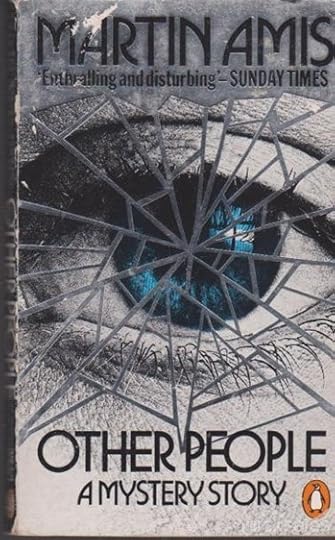
She wakes in an emergency room in a London hospital, to a voice that tells her: "You're on your own now. Take care. Be good." She has no knowledge of her name, her past, or even her species. It takes her a while to realize that she is human — and that the beings who threaten, befriend, and violate her are other people. Some of whom seem to know all about her.
In this eerie, blackly funny, and sometimes disorienting novel, Martin Amis gives us a mystery that is as ambitious as it is intriguing, an investigation of a young woman's violent extinction that also traces her construction of a new and oddly innocent self.
Martin Amis was an English novelist, essayist, and short story writer. His works included the novels Money, London Fields and The Information.
The Guardian writes that "all his critics have noted what Kingsley Amis [his father] complained of as a 'terrible compulsive vividness in his style... that constant demonstrating of his command of English'; and it's true that the Amis-ness of Amis will be recognisable in any piece before he reaches his first full stop."
Amis's raw material is what he sees as the absurdity of the postmodern condition with its grotesque caricatures. He has thus sometimes been portrayed as the undisputed master of what the New York Times has called "the new unpleasantness."
With Other People: A Mystery Story me best mate Martin makes his first adventurous plunge into the depths of metafiction, whereas there were only tentative toeings of those murky but still self-reflective waters in previous works such as The Rachel Papers and Dead Babies. In fact, we have several of the Martin Amis hallmarks on display here: a preoccupation with low-end criminals, femme fatales with preternatural skills at seduction, and a narrative that contains all the trappings of Brian De Palma's early-80’s neo-noirs (oddly enough I just read an article in The Moronic Inferno that Amis wrote about De Palma’s wonderfully sleazy trilogy of slick erotic thrillers--Dressed to Kill, Blow Out and Body Double, featuring the absurdly hot Melanie Griffith—and apparently not only was he not a fan of those movies but thought their content and style were vacuous and trashy…an argument that can be made about Amis’s own books…).
Other People is a Hitchcokian retelling of the Little Red Riding Hood fairy tale which begins with a beautiful amnesiac awaking in a hospital and then venturing out into the cold, cruel streets of London. Amis does a commendable job at being experimental with his bizarre descriptions of how many of the mundane sights we take for granted every day—such as rivers, clouds, cars and, of course, other people—would appear to an adult who suddenly has the mindset of a guileless child. Our heroine, who comes to know herself as Mary Lamb, quickly learns that the woman she used to be was a very bad woman, and as she goes about her Candideian adventures through the different social stratums of the city, the prevailing mystery promised in the subtitle of the novel is if Mary will reclaim her lost former self or will she retain her newfound innocence. Unfortunately, the cards are stacked against her as the male gaze (viz. a zoom in on a pair of lust-crazed and dangerous man eyes) quickly hones in on her in the form of a gauntlet of lowlifes of all stripes who take their turns abusing and/or pretending to help poor Mary. As always, Amis is at his most scathing when it comes to the grossness of misogyny, and the reader is hard-pressed to find a single decent man in the pages of this book. There is a manipulative police man, grab handling bosses, violent criminals, a self-loathing but wealthy cad—even the narrator of the novel, whose voice orbits the text like a menacing, voyeuristic spaceship, shifts back and forth from being sympathetic towards Mary to wanting to watch her suffer.
Add an uncharacteristically abstract and surreal ending, and what you get is an also uncharacteristically fast-paced (Amis’s plots are never swift: it’s his prose that breaks the sound barrier) novel that could just be a nifty neo-noir, or it could also be a nightmare of a metaphysical mind game. Either way, it’s good. Because it’s an Amis.
An amnesiac wandering around a major city? Swap Paris for London and my first thoughts prior to reading this is that it sounded very much in the territory of a Patrick Modiano style mystery. But it's nothing like that really. Modiano always makes Paris part of the furniture, whereas here London is only in the background. Also, this is the type of memory loss where you don't even know your own bodily functions let alone know what day of the week it is - everything from taste and smell to emotions and human interactions are starting from zero almost, and I thought Amis did a terrific job of putting himself in Mary's shoes where everything, even the most obvious, is experienced like new. This, of course, is where other people come in. Though observations, books, her strange temporary adoption by a sexually promiscuous family, her stay at a hostel for young women, her waitressing job, and the policeman convinced she is in fact a missing girl believed to have been murdered, Mary learns life skills again and Amis sets in motion a novel that in the end can be open to a number of interpretations. Hanging over the metaphysical narrative thread is a sinister voice, the narrator, who we learn is Mr. Prince, the very policeman; or supposed policeman, trying to stir memories from Mary's past; a past she would come to realise that as a teenager she was anything but good. Structurally, there are narrative ideas here that Amis would expand even further in London Fields - which, with only two of novels left to read, for me is still his magnum opus. Other People makes for a good companion piece.
Another succulent piece of fiction best summed up by J.G. Ballard: "Powerful and obsessive… Other People is a metaphysical thriller, Kafka reshot in the style of Psycho". Hah, I love that take on this very strange and obsessive piece of work. An amnesiac woman called Mary, finds herself in the company of homeless alcoholics, and as her story progresses, we wait to see if she can really find out anything about her past and who she got where she is now. 8 out of 12. Four Star read.
Amis has said, "The simple idea of the book - as I point out several times in the text - is, why should we expect death to be any less complicated than life ?...The novel is the girl's death, and her death is sort of a witty parody of her life...At the very end of the novel she starts her life again, the idea being that life and death will alternate until she gets it right".
When Moby released Animal Rights in 1996, people didn’t know where to look. The mild-mannered pioneer of electronica and ambient instrumentals was screaming his lungs out over too many overdubbed guitar solos in a sincere attempt to emulate his mate Billy Corgan. People cringed listening to the record. Imagine how his friends and family reacted. “Do you like my new album?” And a mass shuffling of feet occurred. Martin Amis faces this experience from book to book. This isn’t a recent phenomenon. Amis has been inconsistent from the beginning. Perhaps this novel isn’t as embarrassing as releasing a two-disc album of primal screaming during the death of grunge. But it comes close.
This is, in my opinion, Martin Amis's most underrated work. Published long before his more celebrated masterpieces, it is the product of a writer who is experimenting with his power but fully comfortable in his own voice. The protagonist "Mary Lamb" has no idea who she is -- has no idea who or what anything is -- and like almost all of Amis's characters, lives in a world of dualities and counterparts. Except, as we soon learn, her counterpart is the phantom of her past self; and by the time Mary has learned enough about her, it may be too late to keep herself from slipping into her madness again.
At times, I was reminded of Amis's brilliant essay on "Lolita", where he praised Nabokov's ability to twist a sentence mid-way and end it with a stab of cruelty. Such influence is obvious, especially in the second half of the book. "Mary"'s simplicity becomes sinister, her distance becomes chilling, and her gradual awakening doesn't come as a jolt, but instead as a creeping sense of unease. It's a slow process, but as undercurrents of disorder become quiet madness, the book reaches some of its most striking passages, Amis at his most powerful.
The ending will not be to everyone's taste. It's metaphysical, oddly tender, and casts the entire novel -- from its Sartre-referencing title to its final words -- in a new light. (Without giving away spoilers, try reading the opening prologue again after finishing the book, and you'll see what I mean. Amis's fascination with duality has never been more entrenched in the very text than it is here.) Overall, it's a novel that may not have the scope of "London Fields" or the inventiveness of "Time's Arrow", but is a brilliant work of its own: the greatest existential mystery story ever written.
Other People isn't a tale of Visitation. The just sleep of the Elect isn't to be shattered by ghostly moralizing. The world of our entitlement is instead simply upended, allowing the dark bits to pour to the fore. London is revealed through a Ballardian lens. Colors and smells are enhanced, but thinking is pruned, reduced to Money, Sex Death.
The title refers to Hell. We harbor such within. It is nursed at our breast. Martin Amis is astonishing.
I picked out this book out when I was plundering the shelves of my university’s library for something new to read and because the cover, with its fractured great blue eye, reminded me of something out of a cyberpunk novel. Nothing of the kind, though it would be quite hard to label this novel. It starts out somewhat comical, moves into a thriller as we read on trying to know more of the protagonist’s past, and then it’s just plain horrifying and uneasy.
The protagonist is ‘Mary Lamb’, or so she calls herself after reviving from death in a hospital. She has no memory of her past and no grasp of bodily functions - from her amnesiac perspective, everything she knows is on a literal level. She reinvents herself at every moment trying to create some sense, a consequence of rediscovering the world from an alien perspective - and it’s a hauntingly bizarre world Amis shows us through Mary’s eyes. At some point, she discovers she has a mouth while she takes a drink; it’s fascinating.
Once she breaks free from the hospital, she stumbles on a motley crew of fringe people, tramps and squatters, and she is adopted by a prostitute and goes to live in a quiet slum apartment packed with alcoholics. This is seeming more and more like the Wretched and Unlikely Adventures of Mary Lamb, a humorous and miserable story.
It’s only when Mr. Prince enters Mary’s life that I get chills up my spine. He is the narrator and partially responsible for the journey of Mary Lamb from naïveté to awareness. He leads her to question the mystery of her past. He reveals to Mary her resemblance to a teenager, Amy Hide, who was murdered, and insists on taking her to visit Amy's childhood home. Ultimately, Mary does indeed realize she is Amy Hide – and that Amy was not a very nice person. (A short stopping point here: it might have been because I had recently finished the Stevenson’s novel, and a very simplistic interpretation of my part, but I couldn’t stop myself from reading Amy Hide as a Mr. Hyde-like facet of Mary.)
I found the last few pages of the book truly gruesome. Mr. Prince became not only her mentor and lover, but had been her murderer – Amy’s murderer, in fact. Mary accepts that she must die at Mr. Prince’s hand, only to awake in her home, hearing her mother’s voice calling her Amy. This last bit of the book mimics the prologue.
I haven’t touched this book in over four years, so I’m a bit hazy on what my interpretation of both prologue and ending (epilogue?) was at the time, but here goes. Both are narrated by Mr. Prince, the prologue in the past tense and the epilogue in the present tense; I also recalled some mirroring in the speech (a few moments later scavenging the internet for quotes):
Part of the prologue:
"This is a confession, but a brief one. I didn't want to have to do it to her. I would have infinitely preferred some other solution. Still, there we are. It makes sense, really, given the rules of life on earth; and she asked for it. I just wish there was another way, something more self-contained, economical, and shapely. But there isn't. That's life, as I say, and my most sacred duty is to make it lifelike. Oh, hell. Let's get it over with."
Part of the epilogue:
"This is a promise. I won't do anything to her if she doesn't want me to. I won't do anything to her unless she asks for it. And that's not very likely, is it, at her age ? That's not very realistic? Still, at least she's legal - just about, I'm pretty sure...I feel as though I've done these things before, and I am glazedly compelled to do them again. But perhaps all things like this feel like that. I'm - I'm tired. I'm not in control any more, not this time. Oh hell. Let's get it over with."
"This is a promise" and "This is a confession", you couldn't ask for a better parallel between both excerpts. I didn’t read the last part of the novel as a flashback, but as a suggestion of an unending cycle, with Amy’s story and murder taking place off-stage this time. The narrative sequence hints at a lack of control that is stifling and shared by the reader, who witnessing a cycle expects it to keep repeating itself, and Mr. Prince, who seems fated to murder and narrate indefinitely (not quite sure if this knowledge makes me feel any better about him). Only Amy seems to have a small chance of breaking that cycle since, as Mr. Prince keeps repeating, “[He] won't do anything to her unless she asks for it”.
The ending will not be appreciated by everyone, I am sure, but I am a chump for cyclical narratives and I just loved it.
This entire review has been hidden because of spoilers.
A woman wakes up with no memory of her past and no idea who she is. Amnesia. But this is not the amnesia of soap operas; the loss of memory represented in this book goes far beyond forgetting one’s name and address. Most of the narrative is from the woman’s point of view, and because she does not know where she wakes up, we do not either. We do know that it is in a building, and her mention of gurneys and people in white coats suggests that it is a hospital of some sort. Somehow she gets out of the building and into the city, and we begin to see how far her memory loss goes. For instance, while she is aware of the white objects moving in the sky, she has forgotten words like “clouds.” She has not entirely lost her ability to use language, however, and she begins reading books to learn about things she has forgotten, like time, money, and men and women. As she begins to get some of her memories back, she starts thinking that she may done some things for which she must be punished.
The amnesic experience Amis represents here is probably exaggerated for the purpose of the fiction, but it is interesting to read about the subjective experience of a mind that has no memory and is aware only of sensations (in this, Other People is something like the opening pages of James Joyce’s A Portrait of the Artist as a Young Man). At the same time, the tabula rasa of the protagonist’s consciousness functions as a Bertolt Brechtian estranging device, putting a critical distance between the reader and the social milieux—squats, middle-class homes, restaurants, clubs—that Amis describes.
Acquired Nov 20, 2009 Attic Books, London, Ontario
My favourite and first Martin Amis, it's been downhill ever since, even though he is a great writer he's too full of himself. This dates from when he was truly interested in 'other people'. It's mysterious and engaging, from the time he was part of the 'martianism' group (yes also an anagram).For about two months he was my favourite writer. May 2023: RIP Mr Amis.
Other People by Martin Amis is an unsolvable mystery. To fully understand everything that occurs in this novel, and the meaning implied by such events, warrants several readings. Yet, once finished with it there is a strong voice screaming in the reader's mind, "I don't ever want to go back to the world that Martin Amis portrays!" Amis writes a very gritty depiction of people and human nature. The book is split into two parts. The first is the third person novel, following the life and survival of a twenty five year old woman who has lost all memory of her past and, previously assumed, common knowledge. The second part is an interjectory first person narrative by an unknown character who observes and reflects upon the actions of this woman. Other People is worth reading if only to see the provoking insights made by this unknown person. Be warned, however, that this book can be quite disturbing when it comes to the actions of its characters. Without dispute, Other People is a provoking novel about life and how people live it.
Oh, Martin. Really. This...this is murder. You're killing me, Marty. You're simply killing me. * How can Martin Amis do this to me? To me? How can he write such beautiful prose that keeps me home on New Years Eve? You know, this book is really the most honest book I've ever read about those people. You know who. Other people. That's right. That's exactly right. * There are two typos of people, here. Us and them. Divvy up into two types of the two types. Us and them, the dailies, the averages. And us, fucked over. And them, fucked over. And us, we hope we fucked them over. Them, they deserve it. They deserve the courtesy. It's professional: only natural, mate. Fancy myself the waiter, and they sat at me table. Random acts of the universe in motion. Good tippers, though. Them's some good tippers. Brings tears to me eyes, the ways of things. The state of affairs really decks me. Look. Tears. Can't fake that, mate. You just can't. You know who can? Fem. And that's why we got the upper. We got the mandate. Handed down from on high, as light as a Denny's menu and as heavy as a Denny's meal. Uf, we're fucked. From the get-go. That's the way, that's the way. But them, they ain't fucked. Not like us. Charmed, fem. Charmed's the daily average until otherwise. That's why we do the fucking. We've got to. Nature's way. Hand of God. The Grand Slam doesn't float its own way out of the kitchen. No. Never. Breakfast never just appears on its own. Not even on your birfday, mate. That's philosophical finkin' of fings, though. That's just me. That's just me an' me fought patternff.
* Bought this along with Horror of Frankenstein in a...in a consumerist frenzy. Too bad this isn't goodmovies.com, then I'd go into detail about what the Frankenstein movie means to me: the thrill of being eight, and "running away from home" but being back in time for soup, sandwiches...
Mary non si ricorda chi è, si è appena svegliata in un posto e non si ricorda nulla, nemmeno cosa sono le nuvole...si da un nome e subito dopo anche un cognome e affronta la vita un momento alla volta, come pare facciano gli A.A., si trova in mezzo agli ultimi della terra, solo perchè non si ricorda che esiste una scala gerarchica, si fida di una spiantata che la pesca in mezzo a un gruppo di barboni e poi la vende a uno psicopatico, finisce a casa di lei e poi incontra i suoi genitori alcolisti, fa amicizia col fratello gay...e via così...un giorno un poliziotto la contatta e allora lei incomincia a rivivere alcune immagini a ritroso nel tempo...fino a che scopre...
romanzo postmoderno del genere "ammicco al lettore" nella tradizione del saccente Barth, ma si sa che Amis è saccente di suo e postmoderno a ogni libro che scrive, non fosse altro che per sperimentare nuovi modi di irretire il lettore, o forse per evitare la noia di ripetersi, chissà...comunque il libro regge e anche il finale a sorpresa (in senso lato, cioè un tantino un'idea di quel che è accaduto, di tanto in tanto, sfiora la mente del lettore) ha un suo fascino...
Undoubtedly interesting, this mysterious short novel draws you in - the central character a young woman who is struggling with amnesia, trying to remember who she is and piece together her relationship to a murdered woman. There's a lot of observation on people in the messed-up London life of the main character, a collage of characters and histories, an appealing naïve viewpoint on modern life. Kinda compelling.
But disappointing in the sense that I ultimately was left confused and dissatisfied. Perhaps had I read it slowly and with less distraction I would've got more than just a muddled sense of what was going on, but perhaps it just wasn't explicit enough. It was like a David Lynch film, and I felt slightly irritated by being misled and left away from the perceived destination.
One of my favorite things is to solve the mystery of a vivid and influential childhood book or film that shaped my psyche, but whose author and title I have amnesia for. Turns out my weird parents let me see quite a lot of Werner Herzog films--The Enigma of Kaspar Hauser being the most intense.
I read Other People as a teenager. I was surprised and delighted recently to recognize it while on a Martin Amis streak. From a glance inside, I can see I had a good deal more patience then and was possibly smarter (I did accidentally inhale a fair amount of lead from painted kindling in my twenties resulting in, perhaps, a Flowers for Algernon situation).
What I remember liking about Other People and also Kaspar Hauser, was the withholding. Even at the ends, you aren't certain of the identities of the protagonists or how they came to be impaired in their consciousness. In both cases, one wonders about sinister "others" who have been involved in mysterious machinations behind the scenes.
FYI, one or two stars are for nostalgia, check out this hilarious review for more helpful, hilarious and accurate information: https://www.theguardian.com/books/201...
Martin had a little Lamb Her mind was white as snow Every pit where Martin went The Lamb was sure to go.
In which a grubby little misogynist sets out to write a novel about a woman suffering from amnesia, only to forget the terms of his own conceit almost immediately.
Seriously, the entire premise of this nasty, depressing exercise in bitter masculine inadequacy and how to misuse a thesaurus began to go off the rails almost as soon as Mary Lamb awoke in a hospital room with no memory for, apparently, anything.
One moment the 'heroine,' i.e. female pincushion, can't recognise enough of anything to cross the road (in fact she can't even recognise the road, or the sea or the sky), then the next moment Amis tells us how much she likes to read Shakespeare and Jane Austen, only experiencing a problem understanding the moral of each story, not with the detail.
Oh, and she also enjoys reading some of Amis's own favourite, tricksy novels such as The Real Life of Sebastian Knight. Really.
Mary can't comprehend shoes, yet she can characterise the movement of someone in a surgical shoe as being like a 'clockwork hurdler,' two other things she should presumably have no idea about. That's the central flaw in attempting a narrative like this. Someone in Mary's state wouldn't describe these unknown phenomena by referencing other unknown phenomena, nor would they use the vocabulary of a self-important scrabble enthusiast.
I know, I know, it's not a first person narration, but Amis tried to present the world from Mary's point of view, a conceit which he failed to sustain for more than a line here or there. Fair enough, he still could have written a good book, an interesting book, a likeable book. No, no, you must be mistaking him for someone else with the same surname.
Amis junior was cursed with a case of the faux-tough guy blues. I wonder how he feels about this adolescent unpleasantnesses now that he's all grown up? I'm ashamed to admit that I was somewhat impressed with this novel when I first read it, aged fifteen, a sordid mixture of ignorance, hormones and pimples. Impressed enough to merit this reread anyhow.
I can grow a beard now, so this time around it was mostly embarrassing. I considered giving it up during the prologue, all seven lines of it.
This mystery story focuses on a young woman, Mary Lamb, who suddenly wakes up in the streets of London and doesn't seem to remember who she is, apparently knowing nothing about her life. Not even what type of sandwich she last ate - oh dear. As the plot develops, some hints about her backup life start appearing, and slowly she begins to discover some things about herself.
Martin Amis manages to create an intriguing and entertaining story about the development of one's personality and the coming of adulthood, as Mary has to deal with multiple problems and new people that she doesn't seem to understand. With time, she starts changing and turns into a different, stronger, less innocent and naïve person to become a stronger and at times manipulative woman. As she starts recognizing the world that surrounds here, Mary also learns how to deal with "Other People".
The book is engaging for the most part, and Amis writes with a true sense of detailed and credible atmosphere, managing to deliver some witty observations, clever humor and well-crafted characters. I thought the ending was a bit of a dud, though.
For me this book was brilliant. After I finished it I read some reviews and was shocked by the level of dislike for the writer more than the book. It smacked of critical envy from fellow writers who were needled by his brio and output. This book brims with energy, pace and style. Martin Amis is for me one of the finest writers alive. He’s provocative, intellectually arrogant and as far removed from the standard bland social media infected writers and novelists you could wish for.
My rating for the book goes down the longer I think about it. I picked this one up at the same time as Daphne Du Maurier's "The Scapegoat" and was really surprised to find the two books, so very different in many ways, extraordinarily similiar in structure and what they offer the reader. Both rely on "finding the hidden/lost story" to create suspense and both offer the reader a set up, stock anti-hero in such a way the reader can identify with his/her glamour and sanctimoniously judge him or her at the same time. Both seem like pretty widespread and flabby conventions to me and don't speak well for the health of Western Literature.
First in both books, the narrator creates an elaborate and tremendously artificial present situation in order to selectively and often vaguely disclose a more straight forward narrative that takes place in the past. The kernal reality in Other People resides in the self destructive career of Amy Hide, which seems to have reached its ultimate end (her somehow inciting someone else to kill her) just before the narrative begins. Instead of just telling her story, Amis uses the past event as a suspense device to draw us through a series of more mundane (though still melodramatic, including rape and suicide) events in the narrative's present. In order to do this, he has to create a highly artificial and unlikely frame e.g. that Amy Hide has lost her memory and is wandering about London as an amnesiac who calls herself Mary Lamb (either actually or in some fantastic heaven/hell). I think this structure is a something of a cheap trick. The dramatic weight of Mary Lamb's situation surely rests on her dark and dramatic past, and yet the reader is never clearly informed what happened. We are given one incident clearly--Amy Hide pretends to destroy her boyfriend's play--and lots of dark hints about masochistic sexual behaviour and the general consensus among those that report on her that she was really nasty. So I think if the reader is going to buy the drama of Amy Hide it's largely on the basis of his or her belief in stock misogyny. She's a Super Bitch. We don't really need to know more than that. But the narrative device of Mary learning vaguely about her past through the reportage of others obscures the flatness of that underlying reality. The frame tale, Mary Lamb's amnesiac survival and return to upper crust society, is basically just a very sentimental waif story with lots of brutality (the rape and suicide) more or less thrown in (but somehow acceptable and oddly without consequence because of Mary's dark past e.g. this is the kind of thing that happens to her, (the rape), and the kind of thing that happens to people around her (the suicide). If you take away the sex and violence, she more or less gets by on a smile and finds her Prince in the end. Neither story would hold up by itself but Amis's adept misdirection between them allows the reader to convince him or herself that two very deep and gritty stories are being told.
The other convention, relied on heavily in DuMuarier and Amis, is the sentimentalization of the Anti-Hero. In it's best incarnation, the anti-hero's force comes from the discomfort he or she arouses in the reader. We can't excuse his or her conduct but at the same time we feel compelled to identify with him or her in some way. The anti-hero is a lesson in moral humility and guilt. The convention becomes sentimentalized when the narrator has found a way to take the sting out of it such that the reader can simultaneously judge the anti-hero and enjoy his or her glamour. In Other People, Amis manages this by taking away Amy Hide's memory thus turning her into Mary Lamb, the waif. We can sympathize with the waif and at the same time enjoy the glamour of her good looks and previous vaguely dark history, with the additional pleasure of feeling indignant about the injuries she's inflicted in the past. (Amis is very careful to show us any real harm she has done. Her male victims are clownish and unreal. Her sister does show up and despite all that has been suggested about her dark past seems ready to just pick things up as if nothing had happened.)
How does he get away with this? That's the question. He's a really good writer of sentences for one thing. He's incredibly successful in the opening pages of creating this very vivid alienated perspective of a cityscape. One wonders what kind of book this might have been if he had just stuck to the frame, that situation, consciousness slowly coming to grips with memory. What would our world end up looking like if we could re-imagine it from that compelling perspective? I think that would have been cool. (Especially as throughout, he manages at least probably two or three genuinely startling sentences a page). Also, he tries to shoot over the heads of the readers with his outer quasi reflexive frame. The narrator as hostile/benificent authority, policeman and executioner etc... Is it possible that this is a perfect presentation of the ambiguity of authority? Is that concept cutting perfectly and with jagged symetry through all dimensions of the reality depicted? Would we not then be able to accept Amy Hide/Mary Lamb as Waif/Whore, Victim/Corrupter simultaneously? Not really. The whole "she asked me to do it" "I am the narrator" business feels forced and tagged on. Really, the narrator has no universe to live in. He's not convincing on the page (and is even allowed to leave on business as a character while he continues to narrate her story). Really he's just the conventual invisible modernist narrator who has been inexpertly conflated with a character in the story. It's too bad. I think if the book had been allowed to truly go in that direction , it would have been interesting, but of course then it wouldn't sell as well as Daphne DuMaurier.
I enjoyed reading this book without ever really getting into it.
It centres around a girl who has lost her memory. This loss of memory goes beyond the usual amnesia meaning there are many basic aspects of life that are totally new to her, particularly relationships. It starts with her stumbling into a group of homeless alcoholics and her adventures begin therefrom as she moves from place to place, people to people in an attempt to find out where she might belong.
Always edgy, she often finds herself in danger and there are shady characters throughout, not least a policeman who seems to know her history but only ever feeds her snippets of the past.
Despite uncovering a few facts about her previous existence, she seems content to live under the new identity that she created for herself.
There is a likeable quality about her but not enough to really care what actually happens to her, and sadly for me, not really enough to care too much about what had happened in the past either.
Certainly not boring but neither gripping. An ambiguous ending was probably quite apt for a rather ambiguous book. Perhaps it was more poignant when it was written in 1981.
I really liked this line: 'I'm childish. Childless people always are'; and the fact that she started collecting single playing cards she found in the street. I have been doing that myself since 1987 and have got a great collection!
An entertaining metaphysical pageturner, in which a young woman loses her identity and becomes another person entirely — innocent, almost but not quite, pure, incapable of understanding “other people.” Language is great, often an exciting book, and enjoyable, flaws and all.
“Everything in the named world was pressing for admittance to her heart; at the same time she knew that all these things, the trees, the distant rooftops, the skies, had nothing to do with her. Their being was separate from hers, and that was their beauty.”