

What do you think?

France: The Dark Years, 1940-1944
This is the first comprehensive study of the German occupation of France between 1940 and 1944. The author examines the nature and extent of collaboration and resistance, different experiences of Occupation, the persecution of the Jews, intellectual and cultural life under Occupation, and the purge trials that followed. He concludes by tracing the legacy and memory of the Occupation since 1945. Taking in ordinary peoples' experiences, this volume uncovers the conflicting memories of occupation which ensure that even today France continues to debate the legacy of the Vichy years.
690 pages, Paperback
First published March 27, 2001
About the author
Julian T. Jackson
21 books101 followersOne of the leading authorities on twentieth-century France, Julian Timothy Jackson is Professor of History at Queen Mary, University of London. He was educated at the University of Cambridge where he obtained his doctorate in 1982, having been supervised by Professor Christopher Andrew. After many years spent at the University of Wales, Swansea, he joined Queen Mary History Department in 2003. He is a Fellow of the British Academy and of the Royal Historical Society.
Ratings & Reviews
Friends & Following
Create a free account to discover what your friends think of this book!
Community Reviews
Displaying 1 - 30 of 34 reviews

August 15, 2019
Page 23 (my book)
As the historian Rene Remond says about 1940: “those who had never accepted 1789 finally took their revenge.”
This is a thorough examination of the Vichy regime which was, as the quote above says, an attempt to bring France back to conservative traditional values. . The motto “Work, Family, Country” replaced the revolutionary “Liberty, Equality, Fraternity”.
We are given the prelude to this. France suffered not only a tremendous loss of life during World War I, but also a drop in morale, leading to a disillusionment with democracy and liberalism.
Page 62-63
They were a political generation bereft of political anchors, able to pass from surrealism to communism, reformist socialism to fascism, radicalism to fascism, Action francaise to communism with intermediate stages on the way. They all shared a suspicion, even visceral rejection, of liberal democracy.
There was a rejection of democratic values with the ascendancy of communism and Nazism. There was a growing disenchantment with “professional politicians”.
Petain stepped into this void in June 1940 and made an armistice with Hitler.
This book is split into different topics, so it is not chronological. Vichy attempted a “National Revolution” to bring traditional French values that encompassed the land, xenophobia (particularly of Jews), family, anti-modernity… It was opposed to the so-called decadence and individualism of the Third Republic that supposedly led to the humiliation of 1940.
Page 250-51
When prefects listened to popular opinion [in the Vichy years], the loudest sounds they heard were not political slogans but rumbling stomachs. It undermined Petain’s claim that by signing the Armistice he had saved France from the deprivations of war; and it subverted Vichy’s rhetoric of moral unity.
There were many in France who collaborated in different ways, just like those who resisted. There was only a small number in France who made up an “army of resistance”.
France was essentially divided into two sections – Occupied France which included Paris – and unoccupied France (Vichy France) which used the small town of Vichy for its capital and whose leader was Marshall Petain. (This breakdown is somewhat simplified because the Atlantic coastal areas were another zone controlled by the German Army).
The resistance was different in both areas. In Vichy it had a strong political dimension because it opposed not only the Germans, but in a various ways the Vichy regime. In the occupation zone the Germans were the enemy. But this too is mis-leading because many French police in both zones worked hand-in-hand with the Germans.
The Vichy leaders (Petain, Laval, Darlan) started to lose credibility for a number of reasons. In November 1942 the German army moved into the Vichy zone when the Allies landed in North Africa. The Vichy regime was seen as impotent because it could do very little to oppose the round-up of French men for forced labour in Germany. Many of these men evaded the round-ups and joined the resistance – or they simply went into hiding.
This book points out the wide diversity of views and groups within France. There was no unified group of collaborators or resistors. There were several factions, each with regional differences as well.
The book discusses the many important figures – DeGaulle of course, Petain, Laval (who was tried and executed at wars end), Jean Moulin – and many different writers. The role of the communist party is brought up – which also reinforced collaboration as there were strong anti-communist parties in France. In fact, there was a fighting right-wing French force that were decimated on the German Eastern front.
Also the horrible and forced evacuation of Jews from all areas of France with the full cooperation of the French police is discussed.
Page 357 Elmar Michel - German civil servant in France
“To make the French authorities participate in the elimination of the Jews. In this way we shall make the French share responsibility for Aryanization and we shall have at our disposal the French administrative apparatus.”
By May 1944, over 40,000 Jewish enterprises had been placed in trusteeship, and of these three-quarters had been sold to “Aryans’.
The author has a strong penchant for name-dropping and the use of acronyms within the same paragraph. This, at times, makes the reading rather tedious.
But we are given an engrossing history of this bleak, difficult period of France. And the epilogue illustrates well how it continues to resound in present-day France.
As the historian Rene Remond says about 1940: “those who had never accepted 1789 finally took their revenge.”
This is a thorough examination of the Vichy regime which was, as the quote above says, an attempt to bring France back to conservative traditional values. . The motto “Work, Family, Country” replaced the revolutionary “Liberty, Equality, Fraternity”.
We are given the prelude to this. France suffered not only a tremendous loss of life during World War I, but also a drop in morale, leading to a disillusionment with democracy and liberalism.
Page 62-63
They were a political generation bereft of political anchors, able to pass from surrealism to communism, reformist socialism to fascism, radicalism to fascism, Action francaise to communism with intermediate stages on the way. They all shared a suspicion, even visceral rejection, of liberal democracy.
There was a rejection of democratic values with the ascendancy of communism and Nazism. There was a growing disenchantment with “professional politicians”.
Petain stepped into this void in June 1940 and made an armistice with Hitler.
This book is split into different topics, so it is not chronological. Vichy attempted a “National Revolution” to bring traditional French values that encompassed the land, xenophobia (particularly of Jews), family, anti-modernity… It was opposed to the so-called decadence and individualism of the Third Republic that supposedly led to the humiliation of 1940.
Page 250-51
When prefects listened to popular opinion [in the Vichy years], the loudest sounds they heard were not political slogans but rumbling stomachs. It undermined Petain’s claim that by signing the Armistice he had saved France from the deprivations of war; and it subverted Vichy’s rhetoric of moral unity.
There were many in France who collaborated in different ways, just like those who resisted. There was only a small number in France who made up an “army of resistance”.
France was essentially divided into two sections – Occupied France which included Paris – and unoccupied France (Vichy France) which used the small town of Vichy for its capital and whose leader was Marshall Petain. (This breakdown is somewhat simplified because the Atlantic coastal areas were another zone controlled by the German Army).
The resistance was different in both areas. In Vichy it had a strong political dimension because it opposed not only the Germans, but in a various ways the Vichy regime. In the occupation zone the Germans were the enemy. But this too is mis-leading because many French police in both zones worked hand-in-hand with the Germans.
The Vichy leaders (Petain, Laval, Darlan) started to lose credibility for a number of reasons. In November 1942 the German army moved into the Vichy zone when the Allies landed in North Africa. The Vichy regime was seen as impotent because it could do very little to oppose the round-up of French men for forced labour in Germany. Many of these men evaded the round-ups and joined the resistance – or they simply went into hiding.
This book points out the wide diversity of views and groups within France. There was no unified group of collaborators or resistors. There were several factions, each with regional differences as well.
The book discusses the many important figures – DeGaulle of course, Petain, Laval (who was tried and executed at wars end), Jean Moulin – and many different writers. The role of the communist party is brought up – which also reinforced collaboration as there were strong anti-communist parties in France. In fact, there was a fighting right-wing French force that were decimated on the German Eastern front.
Also the horrible and forced evacuation of Jews from all areas of France with the full cooperation of the French police is discussed.
Page 357 Elmar Michel - German civil servant in France
“To make the French authorities participate in the elimination of the Jews. In this way we shall make the French share responsibility for Aryanization and we shall have at our disposal the French administrative apparatus.”
By May 1944, over 40,000 Jewish enterprises had been placed in trusteeship, and of these three-quarters had been sold to “Aryans’.
The author has a strong penchant for name-dropping and the use of acronyms within the same paragraph. This, at times, makes the reading rather tedious.
But we are given an engrossing history of this bleak, difficult period of France. And the epilogue illustrates well how it continues to resound in present-day France.
August 25, 2024
I have long had an interest in the history of France during the Second World War. Beyond the complex politics of Pétain’s collaborating regime, I have always been fascinated by the cultural life and literary scene that persisted under German occupation and the Vichy regime, as well as the quiet, daily struggle of ordinary people trying to survive. Over the years, I have read widely on the period, including established academic histories, personal accounts, and memoirs.
Recently, my interest was rekindled by La Terrasse de Malagar , Claude Mauriac’s account of the French war years published as part of his monumental “journal monté,” Le Temps Immobile. This sparked a sudden urge to revisit Julian Jackson’s France: The Dark Years, 1940–1944, which I read a few years ago but never reviewed.
When my brother gave me the book as a birthday present some two decades ago, it was acclaimed as the definitive synthesis of the period. My expectations were high, though the volume sat on my shelf for quite some time before I got round to reading it. I am glad I finally did, as it fully deserves the praise it received upon publication.
Jackson delivers a panoramic account of the occupation. He meticulously charts the aftermath of the 1940 collapse, the rise of Pétain’s authoritarian Révolution Nationale, and Vichy’s active, self-initiated policy of state collaboration—culminating in the regime's complicity in antisemitic persecution and deportations.
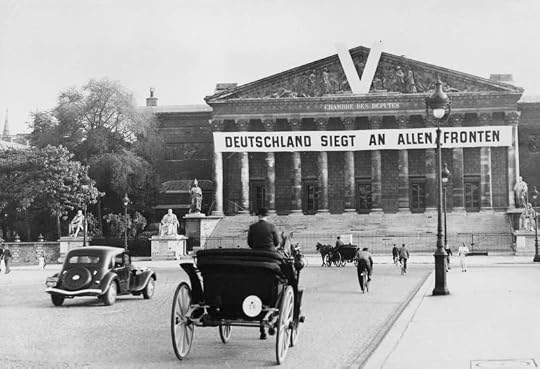
German propaganda at the Palais Bourbon pendant l'occupation nazie
If you’ve read Robert Paxton’s landmark Vichy France, you know how the latter dismantled the myths surrounding Pétain and laid bare the political mechanics of collaboration. But where Paxton focuses sharply on political history and the regime's ideology, Jackson’s ambition is much broader. While not going so far as to refute Paxton’s central theses, he significantly refines them and expands the scope of his narrative to encompass the entire political, social, and cultural French ecosystem.
Where Paxton presents a somewhat binary narrative opposing state collaboration and civilian resistance, Jackson introduces the concept of "accommodation"—demonstrating how ordinary citizens, civil servants, and intellectuals adapted out of necessity rather than ideological alignment. He explores this grey zone with exceptional care, painting a nuanced picture while resisting an impulse that too many historians succumb to: the temptation of moral score-settling with the past. (Yes, Tony Judt, I am looking at you... ;-).
The chapter dedicated to “Intellectuals, artists and entertainers” provides some good examples. Jackson makes it very clear that for leading conservative intellectuals such as Abel Bonnard, Henry Bordeaux and others as well as for the collaborationist press in Paris, “Vichy represented the chance for revenge on the literary avant-garde represented by the NRF”. The virulent and abject attacks on Proust, Cocteau, Gide (the supposed “corruptor of youth”), and Mauriac (a “muddy, false, satanic, degenerate [writer]”) illustrate the long-harboured resentment that fuelled the violent cultural politics of the period.
At the same time, Jackson also makes it very clear “that the post-war reputations of those who stayed in France have been based more on rumour and innuendo than a balanced assessment of their conduct during the Occupation.” Paul Claudel provides a case in point. While the latter is often portrayed as a “Pétainist who opposed collaboration”, Jackson shows that the reality is more complex still and that, while he was one of those conservatives who applauded the religious revival under Pétain, Claudel very early on became more hostile towards the Marshall and openly and very forcibly condemned anti-Semitic persecution.
Conversely, Jackson demonstrates that those authors post-war history remembers as the "good guys" often displayed far more ambivalent behavior than their pristine postwar reputations suggest. Rather than uncompromising dissidents, many leading progressive or neutral figures navigated the Occupation through a web of moral compromises, opportunistic adaptations, and quiet compliance. Jean-Paul Sartre and Simone de Beauvoir continued writing and had plays like Les Mouches staged under German approval, navigating censorship to maintain their careers. Jean Cocteau cultivated relationships with influential Germans like Arno Breker to protect his artistic projects, while Sacha Guitry continued staging high-society theatre productions attended by German elites. Even André Gide initially published in the reopened Nouvelle Revue Française before stepping back. Jackson shows how these writers worked within the system without necessarily endorsing Nazism, underlining the insufficiency of binary moral judgments.
Jackson also offers a far more fluid view of public opinion, showing how popular attitudes shifted over time rather than remaining static. He traces how initial, widespread "Pétainism"—where much of the population viewed the Marshal as a protective, paternal figure—gradually collapsed. According to Jackson the turning point came through the introduction of the Service du Travail Obligatoire (STO) in 1943, which forcibly drafted young French men to work in German factories. By directly threatening French families and stripping away local youth, the STO shattered remaining illusions about Vichy's protection, driving thousands to flee into the countryside and join the armed Maquis resistance.
I also very much liked the way in which Jackson delves into the complex internal dynamics of the Resistance itself, highlighting the deep political friction between internal underground networks, the Communists, and Charles de Gaulle’s external Free French movement. He shows that far from being a monolithic movement, resistance was a fractured effort marked by clashing ideological visions for post-war France, held together only by Jean Moulin’s painstaking work to forge a unified national council.
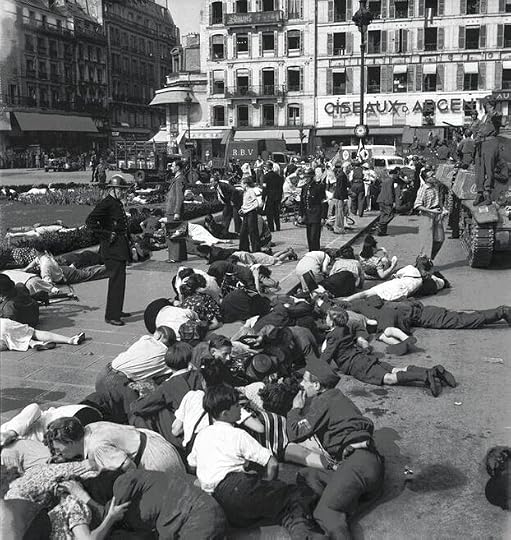
Civilians lying on the ground to avoid being shot during the libération of city hall - August 1944
To sum up, France: The Dark Years is a massive, meticulously researched text, but Jackson writes with a clarity and pacing that keeps you hooked throughout. While historical research on the period has undoubtedly evolved since 2001, this remains a landmark achievement.
Recently, my interest was rekindled by La Terrasse de Malagar , Claude Mauriac’s account of the French war years published as part of his monumental “journal monté,” Le Temps Immobile. This sparked a sudden urge to revisit Julian Jackson’s France: The Dark Years, 1940–1944, which I read a few years ago but never reviewed.
When my brother gave me the book as a birthday present some two decades ago, it was acclaimed as the definitive synthesis of the period. My expectations were high, though the volume sat on my shelf for quite some time before I got round to reading it. I am glad I finally did, as it fully deserves the praise it received upon publication.
Jackson delivers a panoramic account of the occupation. He meticulously charts the aftermath of the 1940 collapse, the rise of Pétain’s authoritarian Révolution Nationale, and Vichy’s active, self-initiated policy of state collaboration—culminating in the regime's complicity in antisemitic persecution and deportations.
German propaganda at the Palais Bourbon pendant l'occupation nazie
If you’ve read Robert Paxton’s landmark Vichy France, you know how the latter dismantled the myths surrounding Pétain and laid bare the political mechanics of collaboration. But where Paxton focuses sharply on political history and the regime's ideology, Jackson’s ambition is much broader. While not going so far as to refute Paxton’s central theses, he significantly refines them and expands the scope of his narrative to encompass the entire political, social, and cultural French ecosystem.
Where Paxton presents a somewhat binary narrative opposing state collaboration and civilian resistance, Jackson introduces the concept of "accommodation"—demonstrating how ordinary citizens, civil servants, and intellectuals adapted out of necessity rather than ideological alignment. He explores this grey zone with exceptional care, painting a nuanced picture while resisting an impulse that too many historians succumb to: the temptation of moral score-settling with the past. (Yes, Tony Judt, I am looking at you... ;-).
The chapter dedicated to “Intellectuals, artists and entertainers” provides some good examples. Jackson makes it very clear that for leading conservative intellectuals such as Abel Bonnard, Henry Bordeaux and others as well as for the collaborationist press in Paris, “Vichy represented the chance for revenge on the literary avant-garde represented by the NRF”. The virulent and abject attacks on Proust, Cocteau, Gide (the supposed “corruptor of youth”), and Mauriac (a “muddy, false, satanic, degenerate [writer]”) illustrate the long-harboured resentment that fuelled the violent cultural politics of the period.
At the same time, Jackson also makes it very clear “that the post-war reputations of those who stayed in France have been based more on rumour and innuendo than a balanced assessment of their conduct during the Occupation.” Paul Claudel provides a case in point. While the latter is often portrayed as a “Pétainist who opposed collaboration”, Jackson shows that the reality is more complex still and that, while he was one of those conservatives who applauded the religious revival under Pétain, Claudel very early on became more hostile towards the Marshall and openly and very forcibly condemned anti-Semitic persecution.
Conversely, Jackson demonstrates that those authors post-war history remembers as the "good guys" often displayed far more ambivalent behavior than their pristine postwar reputations suggest. Rather than uncompromising dissidents, many leading progressive or neutral figures navigated the Occupation through a web of moral compromises, opportunistic adaptations, and quiet compliance. Jean-Paul Sartre and Simone de Beauvoir continued writing and had plays like Les Mouches staged under German approval, navigating censorship to maintain their careers. Jean Cocteau cultivated relationships with influential Germans like Arno Breker to protect his artistic projects, while Sacha Guitry continued staging high-society theatre productions attended by German elites. Even André Gide initially published in the reopened Nouvelle Revue Française before stepping back. Jackson shows how these writers worked within the system without necessarily endorsing Nazism, underlining the insufficiency of binary moral judgments.
Jackson also offers a far more fluid view of public opinion, showing how popular attitudes shifted over time rather than remaining static. He traces how initial, widespread "Pétainism"—where much of the population viewed the Marshal as a protective, paternal figure—gradually collapsed. According to Jackson the turning point came through the introduction of the Service du Travail Obligatoire (STO) in 1943, which forcibly drafted young French men to work in German factories. By directly threatening French families and stripping away local youth, the STO shattered remaining illusions about Vichy's protection, driving thousands to flee into the countryside and join the armed Maquis resistance.
I also very much liked the way in which Jackson delves into the complex internal dynamics of the Resistance itself, highlighting the deep political friction between internal underground networks, the Communists, and Charles de Gaulle’s external Free French movement. He shows that far from being a monolithic movement, resistance was a fractured effort marked by clashing ideological visions for post-war France, held together only by Jean Moulin’s painstaking work to forge a unified national council.
Civilians lying on the ground to avoid being shot during the libération of city hall - August 1944
To sum up, France: The Dark Years is a massive, meticulously researched text, but Jackson writes with a clarity and pacing that keeps you hooked throughout. While historical research on the period has undoubtedly evolved since 2001, this remains a landmark achievement.

January 26, 2015
This book is a magnificent study of the grimmest period in France's history. Yet as Julian Jackson demonstrates, the origins of France's "dark years" lay not with Germany's defeat of France in 1940, but with the divisive and polarizing politics of the 1930s, during which many of the trends that played out during the Vichy years were established. Many conservative politicians saw France's humiliation as a product of social and political trends fostered by the Third Republic. Under Marshal Petain the Vichy regime sought to forge a stronger nation, only to be frustrated by the demands of the German war economy and the threat to French sovereignty it posed. The Resistance would eventually serve as a more enduring ideal for France, yet Jackson shows just how complicated its legacy became, with Charles de Gaulle seeking to assert a degree of control so as to cement his own claims to post-Liberation rule. Jackson draws upon decades of memoirs and historical research to recount this, providing what is likely to be the best English-language account of France's years of division, occupation, and humiliation for decades to come.

January 5, 2026
Politologul Stanley Hoffmann a făcut distincție între "colaborarea involuntară" și "colaborarea voluntară" a statului, cea dintâi implicând o concordanță meticuloasă cu punctele din scrisoarea armistițiului, dar nu mai mult, iar cea din urmă reprezentând o încercare de a trece dincolo de cerințele armistițiului și de a oferi mai mult decât e necesar. După război, apărătorii lui Petain (seful de stat al Franței Neocupate, numit și Regimul de la Vichy) au susținut că acesta a favorizat o politică minimalistă a colaborării involuntare.
Regimul de la Vichy a colaborat cât se poate de voluntar cu cuceritorul german. Colaborarea s-a extins în plan politic, administrativ, economic și militar. Pe plan militar, colaborarea s-a concretizat în "Protocoalele de la Paris", prin care anumite baze din coloniile franceze erau puse la dispoziția armatei germane și prin care se ofereau "mijloacele de a justifica opiniei publice eventualitatea unui conflict armat cu Marea Britanie sau cu Statele Unite". În timpul campaniei lui Rommel din Africa de Nord francezii au ajutat cu peste 1700 de vehicule și mii de tone de combustibil. În plus, în fabricile franceze au fost produse peste 1500 de avioane germane, ceea ce fusese interzis înainte, prin Armistițiu.
De ce au colaborat francezii? Colaborarea a pornit de la premisa rațională că Germania a câștigat războiul. Deși premisa s-a dovedit a fi greșită, nu a fost una absurdă între anii 1940 și 1942. Chiar și pornind de la o premisă greșită, colaborarea s-a dovedit a fi o himeră, deoarece Vichy a supraestimat foarte mult gradul în care Franța conta pentru Hitler. Francezii își doreau un loc sub Soare în viitoare ordine mondială controlată de germani. Vichy Realpolitik a reprezentat o gândire optimistă, bazată pe o interpretare complet greșită a intențiilor Germaniei. În realitate, Hitler intenționa să distrugă Franța, negându-i chiar și rolul de stat-satelit.
Recomand
Regimul de la Vichy a colaborat cât se poate de voluntar cu cuceritorul german. Colaborarea s-a extins în plan politic, administrativ, economic și militar. Pe plan militar, colaborarea s-a concretizat în "Protocoalele de la Paris", prin care anumite baze din coloniile franceze erau puse la dispoziția armatei germane și prin care se ofereau "mijloacele de a justifica opiniei publice eventualitatea unui conflict armat cu Marea Britanie sau cu Statele Unite". În timpul campaniei lui Rommel din Africa de Nord francezii au ajutat cu peste 1700 de vehicule și mii de tone de combustibil. În plus, în fabricile franceze au fost produse peste 1500 de avioane germane, ceea ce fusese interzis înainte, prin Armistițiu.
De ce au colaborat francezii? Colaborarea a pornit de la premisa rațională că Germania a câștigat războiul. Deși premisa s-a dovedit a fi greșită, nu a fost una absurdă între anii 1940 și 1942. Chiar și pornind de la o premisă greșită, colaborarea s-a dovedit a fi o himeră, deoarece Vichy a supraestimat foarte mult gradul în care Franța conta pentru Hitler. Francezii își doreau un loc sub Soare în viitoare ordine mondială controlată de germani. Vichy Realpolitik a reprezentat o gândire optimistă, bazată pe o interpretare complet greșită a intențiilor Germaniei. În realitate, Hitler intenționa să distrugă Franța, negându-i chiar și rolul de stat-satelit.
Recomand

July 21, 2023
Feels a bit too much like a textbook to me. The first 130 pages were pretty dense and hard going. With too much prior knowledge assumed by the author. I'll keep going, but not the best of starts.
I'm still going, but finding it frustrating. Because it's a textbook, and because it tries to cover everything, there's only 2 to 3 pages spent on a particular aspect. You've just had your interest piqued and then the story moves on. Will keep going, though.
I've added an extra star. Because there's no doubting Jackson's scholarship and expertise on the subject. And it's comprehensive and - the many typos aside - well-written. But sometimes it does become a tad heavy going. And as can be seen from my updates, I'm not rushing through it.
p.393 - 'De Gaulle bit the hand that fed him because it was his only way of showing that France still had teeth'. Great line.
The chapters on the Resistance get bogged down with too many technical details. Important details, I'm sure, but they do clog up the narrative. I'm getting near to the end now. And to be honest it'll be a relief. Not because this is a bad book - it isn't - but neither is it an easy or entertaining read. I know it's not Jackson's job to make it easy or entertaining, but for the general reader like myself it's probably too dense. Time for another break - and another book - before I finish this one off.
Yes, as anyone reading the above can tell, I found this to be a bit of a slog. If I could, I think I would rate it a 3.5. It's an important book. And it's very comprehensive. But it does have a textbook feel. And it is quite a dense read. The Sumption book I'm reading at the moment is a good example of a complicated subject, written in an academic style, which can be both educational and entertaining. It's a difficult act to get right. Jackson almost gets it. But not quite. I'd still urge people to give it a go.
I'm still going, but finding it frustrating. Because it's a textbook, and because it tries to cover everything, there's only 2 to 3 pages spent on a particular aspect. You've just had your interest piqued and then the story moves on. Will keep going, though.
I've added an extra star. Because there's no doubting Jackson's scholarship and expertise on the subject. And it's comprehensive and - the many typos aside - well-written. But sometimes it does become a tad heavy going. And as can be seen from my updates, I'm not rushing through it.
p.393 - 'De Gaulle bit the hand that fed him because it was his only way of showing that France still had teeth'. Great line.
The chapters on the Resistance get bogged down with too many technical details. Important details, I'm sure, but they do clog up the narrative. I'm getting near to the end now. And to be honest it'll be a relief. Not because this is a bad book - it isn't - but neither is it an easy or entertaining read. I know it's not Jackson's job to make it easy or entertaining, but for the general reader like myself it's probably too dense. Time for another break - and another book - before I finish this one off.
Yes, as anyone reading the above can tell, I found this to be a bit of a slog. If I could, I think I would rate it a 3.5. It's an important book. And it's very comprehensive. But it does have a textbook feel. And it is quite a dense read. The Sumption book I'm reading at the moment is a good example of a complicated subject, written in an academic style, which can be both educational and entertaining. It's a difficult act to get right. Jackson almost gets it. But not quite. I'd still urge people to give it a go.

August 1, 2022
По време на Втората световна война Франция преживява четири "тъмни години" под нацистка власт. След като е превзета само за шест седмици, страната първоначално бива разделена разделена на две части. Северозападната зона, където попада Париж, е окупирана от германците, а южната "свободна" зона запазва привидна автономност под управлението на "героя от Вердюн" маршал Петен в курортното градче Виши. След десанта на американски войски в северна Африка през ноември 1942 г. (операция "Факел") цялата територия на Франция, заедно с колонията Тунис, попада под директен контрол на Третия райх.
Основна тема по време и след окупацията е същността на колаборационизма и съпротивата. Значителен брой французи решават да сътрудничат на германците. Причините са твърде разнообразни и комплексни - от чист опортюнизъм и кариеризъм, през разчистване на стари сметки с неприятели до идеологическа поддръжка и примирение с новия ред, наложен от очакваната германска победа във войната. Относително малък процент от населението дори стават информатори на тайната полиция Гестапо. В първите години съпротивата е спорадична, фрагментирана и не координира действията си със "свободните французи" на Дьо Гол в Лондон. Ежедневието в първите години на окупацията остава сравнително спокойно за разлика от териториите на Гърция и Югославия, където постоянно се водят партизански военни действия. Учудващо е колко малоброен административен и репресивен апарат е бил нужен на германците за контрол на огромна страна като Франция. Този "административен подвиг" не би бил възможен без без френския колаборационизъм.
Книгата навлиза в изключителни детайли за разглеждания период - пропаганда, култура, търговия и черен пазар, формиране, консолидиране и вътрешни борби в съпротивата, Холокост във Франция, равносметка след освобождението.
Искаше ми се подобна книга да има и за тъмните години в България между 1944 и 1989 г. За разлика от нас, французите не се страхуват да разглеждат позорния период и да назоват директно виновните за катастрофата. Проблемите на френското общество са подложени на безмилостна дисекция, колабораторите са посочени директно, а най-дейните от тях - осъдени и екзекутирани. У нас обичаме да игнорираме проблемите, защото така е най-лесно.
Основна тема по време и след окупацията е същността на колаборационизма и съпротивата. Значителен брой французи решават да сътрудничат на германците. Причините са твърде разнообразни и комплексни - от чист опортюнизъм и кариеризъм, през разчистване на стари сметки с неприятели до идеологическа поддръжка и примирение с новия ред, наложен от очакваната германска победа във войната. Относително малък процент от населението дори стават информатори на тайната полиция Гестапо. В първите години съпротивата е спорадична, фрагментирана и не координира действията си със "свободните французи" на Дьо Гол в Лондон. Ежедневието в първите години на окупацията остава сравнително спокойно за разлика от териториите на Гърция и Югославия, където постоянно се водят партизански военни действия. Учудващо е колко малоброен административен и репресивен апарат е бил нужен на германците за контрол на огромна страна като Франция. Този "административен подвиг" не би бил възможен без без френския колаборационизъм.
Книгата навлиза в изключителни детайли за разглеждания период - пропаганда, култура, търговия и черен пазар, формиране, консолидиране и вътрешни борби в съпротивата, Холокост във Франция, равносметка след освобождението.
Искаше ми се подобна книга да има и за тъмните години в България между 1944 и 1989 г. За разлика от нас, французите не се страхуват да разглеждат позорния период и да назоват директно виновните за катастрофата. Проблемите на френското общество са подложени на безмилостна дисекция, колабораторите са посочени директно, а най-дейните от тях - осъдени и екзекутирани. У нас обичаме да игнорираме проблемите, защото така е най-лесно.

February 28, 2014
By no means easy reading but certainly a very detailed history of what happened- politically, socially and in many other ways- in France under Nazi and Vichy rule. Doesn't shy away from the complications and contradictions inherent to this time and place. Highly recommended.

December 6, 2013
My Kindle conked out half way through reading France: The Dark Years. Amazon were very good and replaced it but it took a while so reading this book took longer than I expected.
Having said that, this certainly was a tough read. I've seldom seen so many acronyms, used mostly for the myriad of political parties, resistance groups, church and education systems and uniformed organisations that appeared in occupied France. Some of these had been operating during the run-up to war and could account for both France's political turmoil and unpreparedness for war.
It takes until the completion of about a third of the text before it becomes possible to understand why the French behaved as they did under German occupation, from the Vichy government under Petain to the passive collaborators, the collaborationists, horizontal collaborators and the numerous resistance groups. As the liberation approached, everyone was jockeying for power in the post-war world.
France: The Dark Years is a superb history of those troubled times with an excellent system of notes and a very thorough index. It's also an indispensable work of reference for anyone who needs to understand those times which many French people still prefer to forget.
David Lowther. Author of The Blue Pencil (thebluepencil.co.uk)
davidlowtherblog.wordpress.com
Having said that, this certainly was a tough read. I've seldom seen so many acronyms, used mostly for the myriad of political parties, resistance groups, church and education systems and uniformed organisations that appeared in occupied France. Some of these had been operating during the run-up to war and could account for both France's political turmoil and unpreparedness for war.
It takes until the completion of about a third of the text before it becomes possible to understand why the French behaved as they did under German occupation, from the Vichy government under Petain to the passive collaborators, the collaborationists, horizontal collaborators and the numerous resistance groups. As the liberation approached, everyone was jockeying for power in the post-war world.
France: The Dark Years is a superb history of those troubled times with an excellent system of notes and a very thorough index. It's also an indispensable work of reference for anyone who needs to understand those times which many French people still prefer to forget.
David Lowther. Author of The Blue Pencil (thebluepencil.co.uk)
davidlowtherblog.wordpress.com

May 10, 2014
Excellent survey of the war years with discussion of the numerous entities involved in the Resistance, Vichy, Free French, and Germans. Balanced approach relative to Paxton. Sets up the complexity and difficulty for those who had to navigate these ignominious, treacherous, competitive, and morally corrupt waters. Damned if you do and damned if you don't. The conflicts and complexities are laid out with plenty of facts in support, France continues to struggle uncomfortably with these issues and arguments, even in light of the declining first hand participants...and you better believe that the political parties of today are the offspring of Vichy and the war and France's attitudes and actions during this period.
January 19, 2026
This book will forever haunt me. Not my sought of history but I smashed my book review on it so it served me well I guess
August 14, 2012
This was tough going at times, the level of detail is extremely high. It is overwhelmingly a political history of the Vichy time in France and I found the mass of names and organisations confusing and difficult to keep up with.
That said, I now understand much more about Vichy and how it came about, what it meant and still means to the French, a sad and at times grim tale.
That said, I now understand much more about Vichy and how it came about, what it meant and still means to the French, a sad and at times grim tale.

April 12, 2014
Jackson writes accessible history for historians of all skill levels. France: The Dark Years, 1940-1944 is an excellent work on the occupation, resistance, and Vichy France. Jackson's strength is found in his ability to find unique people and stories from various perspectives to bring the past to life.

Read
April 8, 2010Great treatment of the Vichy regime

August 9, 2012
Astonishing for the number of three letter acronyms Jackson could fit on a single page and still retain control of the narrative. Research is immensely deep and argumentative at every turn.
July 26, 2014
Brilliant! Un-put-downable. Superb social and political analys of Vichy and the Resistance. A huge tome I'd intended to just dip into, but found myself absolutely gripped.

March 30, 2020
Being Dutch I know a bit about how quickly the Netherlands got overrun by Nazi Germany in May 1940, followed by the government and royal family escaping abroad, occupation, collaboration, the rounding up of Jewish citizens and the growth of resistance. This is the story of the same in France, apart from some massive differences...
France was massively prepared for this conflict, the Netherlands were not. The French were expected to hold out against the Germans (with British help), they did not. Julian Jackson's book is probably the most in-depth book by a UK author on this dark and difficult period in French history, and was translated into French and got French praise, which must say something.
Jackson starts in the 1920 and moves on to the political and socio-economic history of France in the 1930s, so we know the names of the actors that played a part in the 1940-1945 period once we get to it.
Lots of things stand out: How divided France was during this pre-war period of the 3rd Republic, how common and virulent anti-semitism was, and how quite a few French intellectuals and politicians were reaching out to 1930s Germany to try and prevent another deadly conflict, often at the cost of seeing the emerging Nazi regime with cold clear eyes.
The striking difference with the Netherlands after losing the war was the constitutional outcome: the legal, internationally recognised Dutch government was in exile, the French government ended up doing a deal with Nazi Germany, and as a result early resisters to this deal like general De Gaulle were therefore rebels against their own government, and could be described as terrorists at its worst. This deal with the Germans no doubt saved parts of France from war damage and more war deaths, but was hugely confusing to the French people, who as a result were quite slow in starting to resist their own (Vichy) government and the Germans.
A complicating factor was the communists, who appear to have been unflinchingly loyal to Moscow, therefore played a negligable role in the early resistance, only to become an important force in the resistance after Germany tore up the Ribbentrop-Molotov pact and invaded the Soviet Union in 1941.
The book being thorough is full of the histories of the various branches of the resistance with an awful lot of hard to remember acrynoms. Luckily there is an alphabetical list of these at the beginning and a good index to look them up if you've forgotten who is who.
The cultural history of collaboration and resistance gets a good look-in too, with collaborating writers mentioned (apart from Celine now mostly forgotten) as well as better known resisters (to varying degrees) such as Camus, Mauriac and Sartre.
As stated above, there was much anti-semitism in France before the war and the Vichy regime was embarrassingly helpful to the Germans when they started to ask for the rounding up of Jewish people (particularly foreign born Jews, often already refugees from Germany or Eastern Europe). Many Jews were sheltered by other French people however, particularly by the Protestant minority in southern France. Many jews and foreign refugees (Poles and Spaniards) joined the resistance, and made a difference around the time of liberation, which ultimately could only be achieved by the force of foreign armies.
A good read if you don't mind getting your teeth into detail.
France was massively prepared for this conflict, the Netherlands were not. The French were expected to hold out against the Germans (with British help), they did not. Julian Jackson's book is probably the most in-depth book by a UK author on this dark and difficult period in French history, and was translated into French and got French praise, which must say something.
Jackson starts in the 1920 and moves on to the political and socio-economic history of France in the 1930s, so we know the names of the actors that played a part in the 1940-1945 period once we get to it.
Lots of things stand out: How divided France was during this pre-war period of the 3rd Republic, how common and virulent anti-semitism was, and how quite a few French intellectuals and politicians were reaching out to 1930s Germany to try and prevent another deadly conflict, often at the cost of seeing the emerging Nazi regime with cold clear eyes.
The striking difference with the Netherlands after losing the war was the constitutional outcome: the legal, internationally recognised Dutch government was in exile, the French government ended up doing a deal with Nazi Germany, and as a result early resisters to this deal like general De Gaulle were therefore rebels against their own government, and could be described as terrorists at its worst. This deal with the Germans no doubt saved parts of France from war damage and more war deaths, but was hugely confusing to the French people, who as a result were quite slow in starting to resist their own (Vichy) government and the Germans.
A complicating factor was the communists, who appear to have been unflinchingly loyal to Moscow, therefore played a negligable role in the early resistance, only to become an important force in the resistance after Germany tore up the Ribbentrop-Molotov pact and invaded the Soviet Union in 1941.
The book being thorough is full of the histories of the various branches of the resistance with an awful lot of hard to remember acrynoms. Luckily there is an alphabetical list of these at the beginning and a good index to look them up if you've forgotten who is who.
The cultural history of collaboration and resistance gets a good look-in too, with collaborating writers mentioned (apart from Celine now mostly forgotten) as well as better known resisters (to varying degrees) such as Camus, Mauriac and Sartre.
As stated above, there was much anti-semitism in France before the war and the Vichy regime was embarrassingly helpful to the Germans when they started to ask for the rounding up of Jewish people (particularly foreign born Jews, often already refugees from Germany or Eastern Europe). Many Jews were sheltered by other French people however, particularly by the Protestant minority in southern France. Many jews and foreign refugees (Poles and Spaniards) joined the resistance, and made a difference around the time of liberation, which ultimately could only be achieved by the force of foreign armies.
A good read if you don't mind getting your teeth into detail.
September 23, 2023
Very interesting but poorly written
The book starts well before 1940, to give sufficient background to understand the actual period of 1940-1944, and covers the evolution of the French interpretation of the war period until several decades later. The main focus of the book, 1940-1944, is covered from different points of view (collaboration, resistance, "ordinary" people,...). All of these aspects are covered in a very thorough and comprehensive way, but not in a very balanced way.
The main problem is a lack of readability for the general public, even for readers with a rather good knowledge of France and of WWII. For instance, several acronyms per page are thrown at the reader, and although their full meaning is of course introduced the first time they appear, one cannot be supposed to remember these when they reappear, sometimes several hundred pages later. More importantly, Jackson focuses mainly on the "feeling" amongst the French population and on the interplay between all the political actors, but barely mentions the actual military events of the war, even those that took place in France and are crucial to understand the political and societal development of the period. It is as if the reader is supposed to be an expert on WWII events in France before reading the book. Something similar happens with the main actors: The book focuses on how their behaviour has evolved before, during and after the war, but Jackson seems to assume that the reader already knows who they are, and the political or military role they played.
All in all, I cannot really recommend this book, unless you indeed have a very strong prior knowledge about WWII and how it developed in France, and are willing to make a very serious effort to struggle through hundreds of pages of tough reading. If you do, I certainly recommend to have wikipedia at hand, you will need it.
The book starts well before 1940, to give sufficient background to understand the actual period of 1940-1944, and covers the evolution of the French interpretation of the war period until several decades later. The main focus of the book, 1940-1944, is covered from different points of view (collaboration, resistance, "ordinary" people,...). All of these aspects are covered in a very thorough and comprehensive way, but not in a very balanced way.
The main problem is a lack of readability for the general public, even for readers with a rather good knowledge of France and of WWII. For instance, several acronyms per page are thrown at the reader, and although their full meaning is of course introduced the first time they appear, one cannot be supposed to remember these when they reappear, sometimes several hundred pages later. More importantly, Jackson focuses mainly on the "feeling" amongst the French population and on the interplay between all the political actors, but barely mentions the actual military events of the war, even those that took place in France and are crucial to understand the political and societal development of the period. It is as if the reader is supposed to be an expert on WWII events in France before reading the book. Something similar happens with the main actors: The book focuses on how their behaviour has evolved before, during and after the war, but Jackson seems to assume that the reader already knows who they are, and the political or military role they played.
All in all, I cannot really recommend this book, unless you indeed have a very strong prior knowledge about WWII and how it developed in France, and are willing to make a very serious effort to struggle through hundreds of pages of tough reading. If you do, I certainly recommend to have wikipedia at hand, you will need it.

October 16, 2025
Ciekawe i skrupulatne przedstawienie tematu. oceniając z polskiej perspektywy okupacja i ruch oporu we Francji wydają się być mniej ciekawe i 'ważne' od polskich jednak po bliższym zapoznaniu się z tematem można się dowiedzieć że jest równie zawiła i pełna zarówno bohaterskich jak i zdradzieckich i podłych historii. Jedynym minusem, zrozumiałym w przypadku tej tematyki dlatego nie wpłynęła na wysokość wystawionej przeze mnie oceny, była mnogość francuskojęzycznych nazw i skrótów. Nie znam tego języka i miejscami trudno było mi się odnaleźć w gąszczu obco brzmiących nazw, zwłaszcza gdy danej postaci lub organizacji był poświęcony zaledwie akapit lub dwa.

June 29, 2026
Incredibly detailed history of an incredibly complicated part of the history of France under German occupation in World War 2. The many different players with many different, and often changing, motives and opinions are carefully analysed by the author. The author doesn't make the mistake of trying to simplify the story to make it easier for readers to understand and goes to a lot of trouble to critique some of the simple stories that have been spread over the years to exonerate the story-tellers and shift blame onto others.
August 24, 2026
This is history with a capital HIS. A deep and occasionally dense look at the Nazi occupation of France during Work War II, and how the French resisted or, more frequently, failed to. My biggest quibble is that the author presupposes a knowledge of pre-WWII French political history that even I, a self-proclaimed history geek, lack. My biggest takeaway is that there are more than a few eerie parallels between Vichy France and Trump America.

October 23, 2025
An extensive and exhaustive analysis of French society under the impact of Nazi occupation during WW2. Provides the background on state of all levels of French society leading up to the collapse of France and thereafter. The exhaustive nature of the author's research can be prohibitive at times. Remains an insightful read.
June 27, 2019
Educational!!

October 16, 2024
Not my favorite book and not an easy read although I am a World War 2 historian.

July 13, 2024
I’ve always been fascinated with history. I enjoyed studying it as a youngster through school and am now gradually adding more books about the past to my extensive library, which has many heavily laden shelves.
This book by Julian Jackson has recently been acquired. When you consider the title, you can’t help but think that it is going to be a substantial tome. And it is. With its 684 pages it takes some time to get through. But what a fascinating read it is.
Jackson has broken his subject down into chunks, and the book is organised in a logical and chronological set of sections that begin with the roots of the conflict in the republic, the origins and lead-up to the outbreak of war, the occupation, liberation and finally, and perhaps the most interesting section, an exposé of how France’s dark years have influenced, and continue to influence society and culture in Europe from the end of the conflict through to the present day.
Because of the book's structure, it is possible to look at only one aspect—the role of the Maquis, for example—and follow through with any references of interest. I started at page one and kept reading until I reached the very end. Although it took me about a month to read, I found that I had great difficulty putting it down. The narrative voice flows really well and conveys the impression of reading a very long story.
The book must have taken a monumental amount of research, as is evidenced by the extensive bibliography at the back. So, there are plenty of references for further reading about specific aspects covered for those who want to delve deeper. But I think it is only fair to say that Jackson is a historian who assumes the reader has a basic understanding and knowledge of the period. Luckily for me, I have numerous books covering these years, so I could easily make comparisons. But, it’s possible some readers may find this book a little difficult.
For me, this is one of the most comprehensive examinations of les années noires that I have encountered thus far. I imagine that it will be the ‘go-to’ book for this period of French history for decades to come. It is certainly going to be given a place on my bookshelves that is easily reachable so that I can consult its pages or the extensive indices for any relevant research I undertake in the future.
This book by Julian Jackson has recently been acquired. When you consider the title, you can’t help but think that it is going to be a substantial tome. And it is. With its 684 pages it takes some time to get through. But what a fascinating read it is.
Jackson has broken his subject down into chunks, and the book is organised in a logical and chronological set of sections that begin with the roots of the conflict in the republic, the origins and lead-up to the outbreak of war, the occupation, liberation and finally, and perhaps the most interesting section, an exposé of how France’s dark years have influenced, and continue to influence society and culture in Europe from the end of the conflict through to the present day.
Because of the book's structure, it is possible to look at only one aspect—the role of the Maquis, for example—and follow through with any references of interest. I started at page one and kept reading until I reached the very end. Although it took me about a month to read, I found that I had great difficulty putting it down. The narrative voice flows really well and conveys the impression of reading a very long story.
The book must have taken a monumental amount of research, as is evidenced by the extensive bibliography at the back. So, there are plenty of references for further reading about specific aspects covered for those who want to delve deeper. But I think it is only fair to say that Jackson is a historian who assumes the reader has a basic understanding and knowledge of the period. Luckily for me, I have numerous books covering these years, so I could easily make comparisons. But, it’s possible some readers may find this book a little difficult.
For me, this is one of the most comprehensive examinations of les années noires that I have encountered thus far. I imagine that it will be the ‘go-to’ book for this period of French history for decades to come. It is certainly going to be given a place on my bookshelves that is easily reachable so that I can consult its pages or the extensive indices for any relevant research I undertake in the future.
May 23, 2018
In this account of the Vichy years, the author examines French experiences of occupation in the years 1940-1944. Ranging from the high politics of the Vichy regime of Marshal Petain to the experience of ordinary French people under occupation, it incorporates all the most recent research on the subject. Arguing that France's history between 1940 and 1944 needs to be placed in a context of political and social conflict and cultural crisis stretching back to the World War I and beyond, it uncovers the long-term roots of the Vichy regime in French society. The author shows how under the occupation the responses of civil society thwarted many of the objectives of the Vichy regime and the Germans. Considerable attention is devoted to cultural and intellectual life under occupation - cinema, art, and literature - demonstrating how the contradictions of German policy offered a surprising autonomy to writers and artists.
March 20, 2015
The Dark Years -- a perfect description of France during the Vichy and Occupation years of WWII. The author does an excellent job of laying out the ugly reality of the Vichy collaboration with the Nazi regime, where French killed French who would tried to undermine the Vichy rule. And Jackson also describes the myth of the Resistance, which DeGaulle later admitted privately was a gamble that paid off. The Free French Forces, though courageous as individuals had little actual impact on the final defeat of Nazi Germany. The Resistance was DeGuale's only pathway to the table of the Victors, the only evidence that France had never given up. Otherwise France would have been treated only as a formerly occupied country to be divided much as Germany was among the victorious allies. Definitely a valuable addition to any shelf on WWII history.

December 12, 2016
Exposing the conditions of Vichy law on the French population, regardless of the side of the Demarcation Line, addressing the struggle of memory, and discussing the long pre-occupation history of anti-Semitism in France and how the country couldn't be 'restored' post-WWII makes this a vital book for an examination of the Holocaust, France during WWII, memory, and anti-Semitism. Just an all-around engrossing read.
December 14, 2012
Difficult to keep track of all the acronyms of resistance organizations and leaders at times. But probably it is fair to say the French didn't do much except for quarrel among themselves and wait for allied invasion. So much for the romantic myth of the French resistance. Even the Greeks showed more balls.

August 9, 2020
Somme historique impressionnante de rigueur et de précision sur une des périodes les plus explosives de l'histoire française. Sans simplifier ni relativiser, un livre qui montre l'importance du travail historique.

Want to Read
November 1, 2010recommendation from five books site
Displaying 1 - 30 of 34 reviews