Jump to ratings and reviews
Rate this book

Give Them an Argument: Logic for the Left

Rate this book
Many serious leftists have learned to distrust talk of logic and logical fallacies, associated with right-wing "logicbros". This is a serious mistake. Unlike the neoliberal technocrats, who can point to social problems and tell people "trust us", the serious Left must learn how to argue and persuade. In Give Them an Argument, Ben Burgis arms his reader with the essential knowledge of formal logic and informal fallacies.

128 pages, Paperback

First published April 18, 2019

216 people are currently reading
1857 people want to read

About the author

Ben Burgis

17 books103 followers
Ben Burgis is a graduate of Clarion West, and he has an MFA in Creative Writing from the Stonecoast program in Maine. He writes speculative fiction and realist fiction and grocery lists and Facebook status updates and academic papers. (He has a PhD from the University of Miami, and currently holds a post-doctoral fellowship at Yonsei University in South Korea.) His work has appeared in places like Podcastle and GigaNotoSaurus and Youngstown State University’s literary review Jenny. His story “Dark Coffee, Bright Light and the Paradoxes of Omnipotence” appeared in Prime Books’ anthology People of the Book: A Decade of Jewish Science Fiction & Fantasy.

Ratings & Reviews

What do you think?
Rate this book

Friends & Following

Create a free account to discover what your friends think of this book!

Community Reviews

5 stars
169 (20%)
4 stars
331 (40%)
3 stars
249 (30%)
2 stars
50 (6%)
1 star
9 (1%)
Displaying 1 - 30 of 83 reviews
Profile Image for Charlie.
21 reviews2 followers
June 7, 2019
This book was a rollercoaster. Its premise is excellent, and the first few sections follow an educational, easy to understand pattern: introduction of a fallacy or logical term, real life examples, conclusion. His takedown of Ben Shapiro, especially his dissection of Shapiro's debate advice, is where Burgis is most in his element.

Bafflingly, however, Burgis inserts a four page meander into Soviet history and Trotskyism in the middle of the book, and never quite recovers his initial message. One chapter uses Nate Silver as a case study, but comes off more as a hit piece against him. The book ends suddenly with little conclusion, which was a letdown.

While this book has a lot of promise, Burgis could stand to tighten up his message, get a better copyeditor and tone down the "Chapo Trap House" style of writing. If made more accessible, "Logic For The Left" could be a powerful tool.
Profile Image for Jason P.
68 reviews13 followers
June 3, 2019
I had been looking forward to reading this since I first heard about it on the Zero Books YouTube channel. I've also enjoyed several of Ben's appearances on the channel as well as The Michael Brooks Show.

The idea is actually quite brilliant. I have been long tired with how many people on the left have more or less surrendered logic to the center and right. The Ben Shapiro's of the world are deemed the rational and logical actors and the left emotional and irrational actors. Instead of combatting the center and right with superior logic many of us have conceded it to them and instead chosen to ridicule those which claim to use logic.

Now, for the book what Ben does great is providing a very good beginner's introduction to logic. He also does a great job of breaking down where many right wing thinkers such as Ben Shapiro and Ayn Rand get logic wrong. This will be a very useful tool for many leftists as they learn to construct better arguments against the right.

If I had some criticisms, I'd argue there are two main ones:

1. It was probably too simple of a book. This very well might have been intentional, and it might also be beneficial in some ways as well. It's simplicity may make it more accessible. However, there are tons of different nuanced aspects of logic which are regularly applied in political conversations which just don't get touched on much at all. There are also things in which he mentions I would have liked him to add a bit more.

2. I think Ben was way too easy on the left for conceding logic to the center and right. He puts a very large emphasis on the center and right using logic incorrectly, but there aren't quite as many strong criticisms of where leftists get it completely wrong here. It might be that I'm being a bit harsh, but I tend to hold my own to a higher standard. I have noticed an extremely common practice among the left to completely abandon logic and allow emotions and ideology to control the narrative. This allows for easy rhetorical victories for many of our opponents. For this reason I really think it might be of some use to take a harder position against our own faults and explain how we can correct them.

Overall, this is worth a read. It's really short and I finished it in a couple of hours.
Profile Image for Billie Pritchett.
1,198 reviews119 followers
September 28, 2019
The thesis of the book is that a lot of leftists fail to give other people reasons for why they believe what they believe when disagreeing with others. This book is a reminder to explain the reasons. At the outset, the book addresses some of the sociological reasons why leftists have ceded logic and reason to centrists and right-wingers. Some of the reasons have to do with the annoyance of protracted arguments on social media, libertarian arguments from first principles that no one but libertarians would have. The author Ben Burgis is willing to admit that some of these arguments will be pointless and so it might be better not to get involved in them. But he points out that in situations where there is an audience, the point of carrying out the argument logically is not to convince the person you're arguing with of your beliefs but rather to convince the audience, those people who eavesdrop on the argument. Fair enough.

The book is fine.
371 reviews
June 10, 2019
I like the idea behind the book but the writing seems to be a bit rushed.
Profile Image for Christopher.
252 reviews64 followers
April 18, 2021
I've probably given this book a rating somewhat unfair in its lowness, but I can't bring myself to go any higher. It is a book that gives some very important advice that very many people need to hear, but containing that advice is essentially the sole positive.

My childhood was devoted to Spockian logic-life and I went through a phase of libertarianism, out of which I phased over a few years before making a decisive break with the reading of The Anti-Capitalist Mentality by Ludwig von Mieses. That book was just so far outside anything that can be called rational, being as it is nothing but a juvenile armchair psychological polemic against communism, which von Mieses seemed to define as anything but extreme hardcore capitalism.

Those early teen years were the closest I have ever come to flirting with ideology, a concept which I repudiate almost entirely. Instead, I believe in what works and think that we should be thrilled when different ideas about how to run society are experimented with around the world and the nation. If I have an ideology, I'd call it humanism and say that whatever serves to promote the wellness of mankind is good.

This book, however, has an ideological bent and the author wears it on his sleeve, as they say. He's a communist. I'm thrilled, no problem there. Well, there didn't have to be any problem there, if only Ben Burgis would have justified that position and made more concrete discussion on it and why he thinks it's the most logical choice (what's more, he believes in peaceful democratic socialism, which seems to me like a paradox, not at all because communism must be violent by nature, but because communism must be violent to survive the certain attacks, some genocidal, by the forces of capitalism allied against the concept; that is, capitalism is necessarily violent to protect the interests of capital, and so communism cannot exist without the ability to counter that threat).

That's just one of various ways that this book suffers for its brevity. Everything just feels so stunted and incomplete. More examples were in order, more sample dialogues, more fallacies and better explanations of formal logic. If it were 300 pages, it probably would've better held my interest. Instead, it really feels like it was rushed and meant for an audience of true believers, not like it was really meant to get people thinking. Well, now that I think of it, maybe the title warned me about that already?

I certainly agreed with a lot of what he said, like his repugnance for Ben Shapiro (I've never understood what people see in him, he's a total stranger to rigorous thinking), his belief in the utility of having an underpinning of logic to one's ideas and beliefs, especially in the political realm, and the ridiculousness of a lot of what passes for smarts these days. But I have never been one to get too crazy about a writer or speaker who says what I want to hear, there's no challenge in that, nothing to be learned.

As is often the case with books which might be classifiable as self-improvement, there were a few aphorisms which many people could benefit from reflecting on, and I'll include some below. The only problem for me was that they were mostly of an elementary nature and succeeded only in capturing things I already say all the time, such as the inanity of arguing against people instead of what they say, or against how they said it, neither of which are likely to serve the purpose of discussion in the first place, which is to bring the interlocutors to a higher state of understanding.

Well, here are a few of the lines I highlighted as I read. There are some more, but I can't give them all away:

knocking downa poorly constructed presentation of an argument doesn’t prove anything one way or the other about the underlying line of thought.


When you respond to a counterexample to a general principle by waxing indignant about how it’s an offensive analogy, you’re just revealing yourself as someone who doesn’t understand how counterexamples work.


Okay, maybe they aren't the best aphorisms, but I only decided to write this review in the last ten pages and picked out some of the best lines from them. Read the book and you will find better ones. It's short, it might not be perfect, but it's worth a read regardless.
Profile Image for Daniel.
120 reviews6 followers
June 14, 2019
The general idea presented here is fantastic: expropriating logic from right wing pundits. Fighting the idea that the right is logical while the left is emotional, which would make the right more correct. More than that, it has a message of intelectual honesty about debating as a means to understanding and truth and not just as some sort of mental wrestling with a goal to destroy and crush your opponent.
Ben Burgis writes in a very informal and friendly way while still presenting various important topics from logic and reasoning: from informal fallacies to the truth tables and symbolic logic while avoiding silly textbook examples that don't help you understand those concepts in the wild. Ben uses examples that answer to people like Ben Shapiro, Steven Molyneux and Ayn Rand that claim to be logical by using real logic to dissect their arguments and attempting to get his points through with logical validity or at least inductive strength.
That being said, the informality in the presentation sometimes makes it feel like a collection of blog posts which might feel off-putting now and then and the sequence and flow of ideas feel somewhat disconnected.
Overall, it is a must read to leftists who wish to engage in debate and not be instantly considered overtly emotional and illogical.
10 reviews4 followers
November 27, 2020
It's a brief overview of common arguments and fallacies leftists might encounter or commit. The big picture is logic and argumentation, but the examples and explanations are in a leftist context and/or perspective. It is generally an entertaining book and can be informative to people like me who are not experts in logic and the art of debate, but does not have much to offer to more experienced readers.
Profile Image for David Stephens.
785 reviews15 followers
June 30, 2019
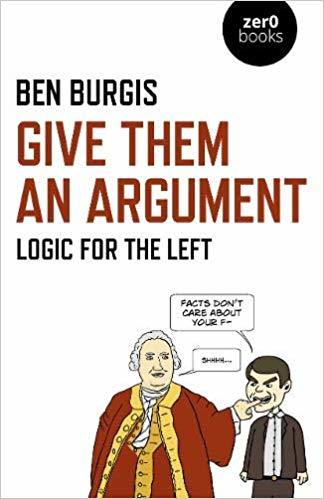
Considering the cover of this book shows a picture of the famous eighteenth century philosopher David Hume shushing conservative commentator Ben Shapiro as he tries to say "Facts don't care about your f—," it would be easy to assume that author Ben Burgis will use this book as an excuse to bash right-wing ideas using the most hyperbolic language, as seems to be the trend. However, one of his main arguments ends up being just the opposite. While he agrees that the left should continue to "shame, call out, privilege-check, and diagnose the allegedly unsavory motivations" of those on the right, he argues they must go beyond this. They must also avoid the sloppy reasoning often involved in "destroying" the other side and learn to sharpen their logical thinking, both because they will maintain more logically consistent arguments and have better answers to challenges from the right.

Burgis showcases this kind of logical and even tempered thinking throughout. He strikes a nice balance between making arguments against common right-wing views (e.g., the left is too emotional, taxation is theft, altruism is destructive) and explaining logical forms and fallacies. This is not merely a book that uses politics to highlight logical frameworks, but one meant to allow readers to begin applying logic to the political discourse.

His writing is clear and down to earth. As a professor of logic and philosophy, he is well aware how pedantic, theoretical, and downright dorky some of these logical exercises seem, and he addresses these issues head on with both self-deprecating wit and clear real world examples. He also distinguishes some of the key differences between socialists, liberals, and centrist technocrats in a way that often gets ignored, particularly by those on the right.

While there are many enlightening moments, the best part of the book is the chapter on Ben Shapiro. His popular slogan—"facts don't care about your feelings"—is rooted in the idea that "'Liberals' . . . get their moral judgments from feelings [while] Steely-eyed conservatives like Ben Shapiro get their moral judgments from facts." However, this is fallacious because facts, in and of themselves, cannot make moral judgments. People who make arguments must do so through a combination of fact and value, and, whether they realize it or not, both liberals and conservatives do this.

The only real problem I had with this book was the list of twelve rules for reasoning listed at the end. I often find that books like this offer advice that is just too general to be of much use, and, unfortunately, this book is not much different in that regard. While there are helpful examples in each chapter, I think the ending would have been better had in gone in more depth. Even so, there is a lot to be learned here. I will almost certainly be revisiting this book periodically to grapple even further with some of these ideas and recharge my reinvigorated interest in logic.
Profile Image for Andrew.
2,252 reviews931 followers
Read
July 29, 2021
Probably like most readers of this book, I'm familiar with Ben Burgis through his thoughtful Youtube channel where he discusses left organizing and the like with various luminaries of the Jacobin/DSA/Zero Books/Chapo left, and which constitutes a modern incarnation of the sort of voice that I became familiar with as a youth reading The Baffler. I also have a decent grounding in styles of argument, and I can wave my hand towards my box of Mock Congress trophies from high school, dork that I am. So this isn't really for me, per se, even if it was an entertaining, light read, written in Burgis' smart, often funny voice.

So who would this actually be a useful text for, in the way I think Burgis intends it to be? I'm not really sure. Maybe my teenage nephew? I think for this to be in any way illustrative, you need to be a complete novice to the left, a complete novice to rhetoric, or both, and not a total doomer to boot.
Profile Image for Jason.
4 reviews
August 16, 2019
Give Them and Argument is not an exhaustive explanation of logic, nor is it an exhaustive logical defense of leftist ideas. What it is, though, is a great primer on both formal and informal logic, and how leftist concepts can be argued such that they aren't supported by fallacies of either type.

If you're tired of "logic" being the apparent sole domain of internet libertarians, then consider reading this. Whether you agree with Ben Burgis's politics or not, this will help you fortify your arguments for your positions, and help you understand that just because an argument is logically rigorous, does not mean it is right.

If you already have a background in both in formal and informal logic, then consider giving it a view, as the text is brief, clear, and entertaining enough given the subject matter.
Profile Image for Laya.
133 reviews29 followers
November 27, 2019
Quick and good read. Both the right and the left are equally subjective ideologies and there isn't anything 'objective' or 'purely logical' on the part of the 'rationalist libertarians.' Burgis gives ammunition for the left to beat the right at their own game.
1 review
August 28, 2019
I had Ben Burgis as my philosophy professor for multiple semesters at University of Miami and his worldviews and ability to reason always captivated me. This book is no exception, as it was a partial recap of a lot of the logical fallacies discussed in our Intro to Logic classes as well as an update on them relating to our current political landscape.

It has everything one would want as a supporter of the Left who wants to increase their ability to argue rational political points without leaning on emotions. Very witty, intellectual book that I am sure to read again. Also Burg, I'm gonna need your John Hancock on my copy of the book next time I see you!! Good stuff man.
Profile Image for Humphrey J.
32 reviews7 followers
August 20, 2019
Aside from the disappointing cover illustration, this is a very solid read that equips the reader with incredibly useful tools for debate & discussion, whilst remaining entertaining throughout.
Bizarre detours are abound but all ultimately feed into the discussion (Trotsky, Rand, Nate Silver...).
The chapters on Symbolic Logic, Probabalistic fallacies and Right Libertarianism are of particular note, will definitely revisit in the future.
Profile Image for D'Juan Eastman.
4 reviews
July 21, 2019
I would pick at the authors YouTube channel for not doing what this does to mastery. Focusing on building arguments. While not a complete logic class the book is complete, because it does what other logic books and near 8 years of schooling at the college level didn't do as well. Teaches you to use logic.
Profile Image for Giorgio.
326 reviews3 followers
July 18, 2019
Great clarifications about fallacies and logical argumentation!
Profile Image for Victor Lopez.
53 reviews9 followers
November 7, 2024
Meh.

I personally like Ben Burgis, even though we would likely disagree on many things, and think that he usually is a net positive for the American left wing movement. That said, this book seems to not be very rigorous and more a stream of consciousness blog post with minimal editing and I think a logic textbook may genuinely be a better introduction to this topic.

There isn't much that is outstanding about the text, except for chapter four, which reveals a lack of understanding of "dialectical logic". While I agree that Trotsky's example about bags of sugar demonstrating A=/= A is long winded, incorrect and muddled, Burgis then proceeds to makes a questionable assertion based off of this: that logical reasoning is supposed to be concise. This seems like a silly thing to say given the context of the argument that Burgis himself points out, which is that of the actual existence of types of social organization in a given historical context which circumscribes their function. The author he quotes saying something to the effect that Hegel's dialectic is about relational contradictions and not logical contradictions. That's cool, but how does this then invalidate Trotsky's arguments about the interwar USSR? Burgis' response is a winding explanation of American Trotskyist lore which while interesting is of little relevance to his thesis of said chapter. There's also, unless I misread the passage, a defense of Michael Harrington's very complacent position on the Vietnam War... Which was baffling.


There were some good moments, but they were lost among the unpolished majority of the text.
256 reviews
January 4, 2020
This is exactly what i needed to kickstart the new year - a rare example of clearly written book with actual understanding of the topic and with good structure; most people can learn a lot from it. A rule of thumb here is if a book on arguments mentions Hume's Law, it's likely to be well researched. Internal consistency alone means very little, and to anybody who has little experience in building a theory (even just a theory of mind) will benefit from learning that internal consistency is only a prerequisite for validity, not the only necessary and sufficient condition. A descriptive premise must be combined with a normative one, to get a conclusion about what you should do, and most books by people who seem to think they know about arguing conveniently omit that. There are Amerian-specific discussions that are also interesting, like the Loving v. Virginia ruling, as well as some good info on the American Communist party, that i personally found interesting (i know very little American history). On the funny side, i know at least one person who thinks third book can't be right that the deductive concept of validity is binary, because we "live in progressive times". If nothing else, this book taught that person that two member of Congress voting "the same" 93% of the time can be absolutely different in the policies they fight for.
Profile Image for Jordan.
99 reviews9 followers
March 28, 2022
Decent intro to the very basics of mostly informal logic for socialists. I would have liked a longer case for the role of sound argumentation and intellectual virtues in political projects

I'd still opt for critical thinking: the basics by hanscombe
Profile Image for Pete Judge.
111 reviews1 follower
February 13, 2023
good analysis of arguments within US politics , argument for logic used in political debate by socialists, deconstructing man anti socialist arguments. Second of his books i’ve read in the last few days. some views i disagree with about socialist states but case is argued well
Profile Image for Ben Arzate.
Author 34 books132 followers
June 25, 2020
A good primer or refresher on basic logic. A bit better on that than it is making a case for why it's important for leftists specifically, but it uses some good contemporary political examples. It's also pretty entertaining and readable. I finished it in one sitting.
Profile Image for Antony Monir.
305 reviews
February 5, 2023
Interesting book but a little bit too short. Would’ve liked a longer version of it. Still, it provided some interesting bits of logic. Final rating: 4/5.
Author 1 book13 followers
April 30, 2023
This book really does what it intends to do, and that project is something admirable, so I don’t see how I can’t give it five stars (given that it’s also readable and entertaining). Burgis isn’t explaining how to destroy the right in a debate, nor how to warp logic to your advantage. Nor are the tips presented specifically for the left. It’s a guide to reasoning, that happens to aim itself towards the current tide of “debate me, bro” and “prove me wrong” style shitehawks that would typically be in the football team if roofies were still socially acceptable. Fun, readable, informative. As a philosophy teacher, I’d give chapters of this to my students in their first week if the current government here in the UK hadn’t made it so that we’re not allowed to present anything deemed “anti-capitalist”.
Profile Image for Theresa.
108 reviews3 followers
November 18, 2023
I'm shocked I'm not giving this a mindless four stars because it's someone I like saying things I *guess* I like?

This book is an absolute mess and it makes me angry. It has so much potential, and so many mistakes in organization and clarity. I am done wrestling with this trying to make sense of these choices. He really has an issue with clarity. It's a huge blind spot for him.

Usually, examples given for material like this, unless they have a flaw, are clear, concise, light up the darkness and slice through an opaque fog, where drawn out language fails. It's hard to write out simple things, without making them sound more complex.

BB does not like examples overall, and he doesn't seem to like good explicit ones. He does not like explaining things in a clear manner, pausing for clarity or summations, and he goes off on tangents he only appears to explain. They are not explained to any satisfaction. Yes, let's take down Shapiro, no let's not complicate things.

That whole deal in the middle with Trotsky made me want to physically throw this book. First of all I don't know all that history but am decent at picking things up contextually and not having to know every detail to get a larger point, but this was bad. From what I gather, Trotsky had a potentially interesting position about whether to grant premises like A is A.

Instead of giving real world examples of how this comes up, Ben Burgis just writes about what Trotsky said about sugar. He does not give any other example or a single application of this.

(Egads the original example given for 'A is A', is 'Man is Man' I mean how apropos is that!? We discuss what "man" is all the time now. What an opportunity to live up to the title of this book by talking about loaded premises on the trans issues.)

But the issue in arguing and debate is that we have to start with some agreement on a point of reality, like a pile of sugar is equal to itself. We have to be able to say something is itself equal to the same thing.

FOR EXAMPLE A is A.
A = A.

(see what I did there? In case you get confused reading "something itself is something and the same thing"... I give an example and lo and behold it's like magic you can see A is A is the point. That means something is the same as itself. Boom there ya go!) A dog is a dog. Man is man. BB will only do things like this if it's completely unnecessary, but never to make a windy sentence of his pointed or clear in any way.

But at this premise stage is where people try to enact their shell games. The debater might start, 'We agree a man is a man and a woman is a woman right?' This is one example of how we cannot accept loaded premises we do not break down for clarity because then something gets smuggled in. Yes this is covered in other fallacies where they address smuggled in premises, but I'm thinking this is exactly why Trotsky was wary of premises. Burgis gives an unclear sentence or two about Capitalism used as a premise, which I can see why someone would protest that. If two people have completely different ideas of what's going on in that broad category, they can smuggle in inappropriate assertions about the system. This is logical, Ben acts like it's super off base. OK, so maybe it is, I would have no idea how from reading this book. He gives no clear answer on this, just assertions, and not even too many of those, that would be too clear.

The fact is, that right wingers assert LOADED PREMISES most of the time. Hence the fundamental disagreements. I thought this is where that would be discussed. No, instead we get something else about how Trotsky is silly because we have to start with A is A and not assert that a bag of sugar in this world is never like a bag of sugar, because they will never be the same. Ok that's interesting to assert, but the obvious application of this would be to make sure someone is not playing loose with their A is A assertions, which the right does routinely.

I have no idea what I was supposed to get out of that section. There was no clear summation. Ben, please get used to the idea of spelling out and repetition, for example, literally saying, "So you see..." with an explanation, and "here is an example" or "here is a counter example" This is sorely lacking in this book.

But yes, in order to talk about anything we have to start with A is A. But we don't have to allow any sort of A is A statement. And that's so easy it makes me think OK I'm missing a point here. But what?

If this book was written better, I would know what my confusion is.

I read the Trotsky section over and over and over and over again. I have margin notes.
I know what he's trying to say but not completely. People wanted out when Stalin decided to team up with fascists and workers rights evaporated and was now thought of as 'workers prison'.

BB also admits finally, maybe Trotsky wanted more nuance and detail, but then BB asserts he was entirely wrong. But why is he wrong? I can't tell. The next bit after that just does not tie in clearly. He says we have ways of indicating in casual conversation "yes and no" complexity, ok I have zero clue what that has to do with this. He does not connect these ideas in any way that I can see. Is Ben saying that later in a debate these things can be handled but we have to get past the very start, and allow for potentially bad A is A statements? I don't know because he never says, never clarifies, never ties points together. I have literally no idea what was wrong with Trotsky's position. No examples, no analogies... nothing.

Ben's point that people had divergent reasons for dissenting and dissolving their political associations may speak to some sort of point, but it's not clear to me. He says well it can't all be due to this logic issue they refer to. But why not? I'm with you, you know more than me, but no point has been made here, I am still lost even if I fully trust the author.

He states various reasons and scenarios existed at the time of dissent, implying various causes of dissent. Trotsky people are trying to say it's because people were not using logic. I pieced together what was going on, but Ben does not write clearly. There should be many statements of clarity along the way, paragraph breaks in more places, and I even spotted where a comma should go, not solely determined by rules, but for the intended purpose of a comma, which is help for the reader.

When you think you see a clear statement that will surely be followed by more of that, you get a tangent in to something completely different. When you go to read the paragraph again, you are like OMG I forgot this paragraph started this way, how the hell did we get here? Just when you think you're going to get "Here are the reasons that's wrong." you absolutely don't get any clarity following. It's so frustrating.

He talks about Max Planck in a weird place, that should be arranged differently or left out, but after he explains the Planck moment, he says Marxists should not reject scientific results, even controversial ones because they sound "undialectical".

This would be a great place to put in an example. He just moves on.

There are ideas in here that make sense in their own paragraph but there is no way to really understand how the ideas fit in. Ben says the most important mistake of Trotskyists was that people were using words differently. He reminds us the word contradiction means something different in logic than it does in other contexts, where it can mean two opposing views.

Ok so what? He explains things that need absolutely no explanation and skips over things that need to be fleshed out. The things he does explain, he doesn't necessarily connect to an idea. I know that words can mean different things. He does not explain in any way how the Trotsky arguments are ignoring that words are used differently in different contexts. I would need an example of them doing that, because I can't picture that in my head. What is actually being described here? He claims is this the 'most important' point.

That whole bit he says is a great example of the Post Hoc fallacy, so you think he'd go in that. No he went in to the dynamics between the factions and not the fallacy. There were no lines drawn and no connections made. He never made a point and then said, so you see boys and girls that's why this Post Hoc fallacy is so perfect here. Like I really don't know exactly what he means. It's just one sentence, like they are putting things together after the fact, ok move on...

I think talking more about the fallacy and less about what happened in 1940 or whatever would speak to the point of the book more. It is just such a frustrating read, I cannot convey just how much.
Profile Image for Debra Daniels-Zeller.
Author 3 books13 followers
January 15, 2020
This book was a bad pick for me possibly because I dropped logic in college. I didn't finish it so can't really comment on it only to say I prefer to read more narrative based books.
Profile Image for Inbetween.
13 reviews5 followers
June 28, 2020
This is not a book that teaches you how to destroy or annihilate your political opponents. Its aim is not to help you score points, dominate and finish your intellectual confrontation with a victory lap. A reasonable debate is not about power. It’s not about winning an argument just because you can leave that impression by being overconfident and bullying your way through. If you compare this book to Ben Shapiro’s infamous book “How to debate leftists and destroy them: 11 rules for winning the argument“ you can easily tell the difference between someone who actually cares about getting the arguments right and someone who is interested in appearances and face-saving.

“This book is about reclaiming logic for the left. That doesn’t mean training leftists to go round for round with the far-right Stefan Molyneuxs of the world in the game of mindlessly tossing the names of logical fallacies at each other like dung being thrown back and forth in the chimpanzee cage at the zoo. One of the purposes of what I’ve written here is to explain what’s wrong with this way of using logic and to try to model something better. Good reasoning isn’t primarily about being loud and confident and good on your feet. Those are skills worth developing—as humans, we’re built to respond to all of that—but those aren’t the things that make people good reasoners.”

Brilliant book. Putting aside his socialist views (if not for logical reasons, at least for emotional ones since I live in Eastern Europe – the scalded cat fears even cold water) I found his intellectual honesty astonishing. Highly recommended.
Profile Image for Terry Clague.
281 reviews
December 23, 2019
Zipped through this, which probably comes in more handy if you find yourself debating whack job libertarians more often than this reader does. Here's the author, for example, on dealing with the intellectual void that is Ayn Rand fandom:

"Atlas Shrugged might sound like a fairly juvenile exercise in political wish fulfilment [but] Rand and her followers see it as an expression of deep commitment to Reason... Rand's devotees call her 'Mrs. Logic'."

Burgis calls out the reasoning vacuum in "reactionaries like Rand... why not demand [to see] just how [does logic] enter into the debate about whether self-sacrificing altruism is better or worse than Rand's moral individualism? Is it really plausible that the debate between the radical left and apologists for capitalism hinges on the question of whether A occasionally fails to be A [the Law of Identity], or is it vastly more likely that the two camps are separated by a divergence in substantive premises about history and morality and economic theory? To ask this question is to answer it."
Profile Image for Chet.
274 reviews44 followers
July 26, 2020
I still don't know what "logic for the left" is. Nor do I know for that matter what a "logic for the right" is. Nor "logic for the center." While I'm at it, I'm not sure anymore what "the left" is, nor "the right", nor "the center." One thing I do feel pretty certain about: Ben Burgis and I do not share the same politics.
Profile Image for Zack.
61 reviews5 followers
June 21, 2019
Really useful stuff to be found here.
Displaying 1 - 30 of 83 reviews

Can't find what you're looking for?

Get help and learn more about the design.