

What do you think?

Simone
Dos escrituras se entrecruzan en las calles de San Juan, la capital puertorriqueña. Un escritor anota en un cuaderno el frágil contenido de sus días de supervivencia, mientras recibe anónimos que no sabe si son mensajes, citas u obras de arte. Desde estos extremos se narra esta novela lo que no se sabe si es persecución o búsqueda y que al final resultará en un amor truncado y conmovedor.
Eduardo Lalo
Ganador del Premio Internacional de Novela Rómulo Gallegos 2013 por su libro Simone, el puertorriqueño Eduardo Lalo es también fotógrafo y artista plástico, autor del libros en los que reúne su pasión por palabra y la imagen: La isla saliente, Los pies de San Juan, La inutilidad, donde, Los países invisibles, El deseo del lápiz, Intemperie, Necrópolis, Intervenciones e Simone. Dirigió, además, los mediometrajes donde y La ciudad perdida. Su obra visual se ha reunido en múltiples exposiciones nacionales e internacionales.
191 pages, Kindle Edition
First published December 1, 2012
Ratings & Reviews
Friends & Following
Create a free account to discover what your friends think of this book!
Community Reviews
Displaying 1 - 30 of 85 reviews

February 12, 2017
Set in Puerto Rico and translated from the Spanish. The main character is a 30-ish male, a writer and professor. He’s unattached but has an on-again off-again relationship with a woman who has a kid by another man. Suddenly, perhaps through his writing, he attracts an admirer who stalks him. He assumes correctly that it’s a woman who leaves him cryptic coded notes saying things like “Hi, I’m Lena,” but signing the note ‘Simone.’ He gets notes in his mailbox, under his office and apartment doors, by email, phone messages, flyers taped to his car, notes in books in bookstores, chalked messages on the sidewalk. He starts to become as obsessed with his stalker as she is with him, but there is a bit of humor because he can’t always tell what a coded message from her is and what is just an ad or random graffiti. But pretty early on she stops the game and introduces herself to him.
She is a young woman of Chinese ethnicity living in Puerto Rico. So we enter an ethnic world within an ethnic world, with its own rules, traditions and expectations. She’s a waitress and an artist and they begin a “random art” campaign, posting anonymous art works around the city. The little plot there is revolves around these two lonely people from different cultures dancing around each other, like a couple of octopi reaching out in the dark. (And one of the characters turns out to be bisexual as well.)
The book has no chapters, and at times comes across as a series of disconnected paragraphs of random, but worthwhile thoughts. A lot is about Puerto Rico as in limbo between nation and colony. (Which, with its unusual American Commonwealth status, it is.) The main character compares Puerto Rico to Spain from his time in Madrid. Puerto Rico he thinks is or was “…a stop on an empire’s bus route.” Some more thoughts to give an idea of the literary quality of the writing:
“For many years, I thought what I missed the most about Europe were the cafes, he said. But when I had a chance to go back there, after a ton of years, I found that even those no longer held up to my memories of them. … Europe, the Europe you have in your head, which is basically an invention of literature, may have once existed…”
“My life has passed me by in this ‘Colonial Economy,’ rehearsing the coffee ritual as if it were some kind of barrier against a torrent of history that overwhelms me and defines me. What is left of the men and women of this country? What remains but the coffee and the centuries, ground down and percolated, flowing through steel tubes, pouring from plastic spigots?”
“Most of what’s called depression consists of store-bought feelings…. Our emotions pop off the assembly line, you can pick them up anywhere. There’s a mass distribution network. Like so many other things we buy and sell, they’re cheap knockoffs. They exist because we adopt specific ways of being and feeling to face specific events.”
“A curious phenomenon: if I don’t jot down a memory or an idea, it loses all its power, as if the substance of the thought had dried up, leaving it forever inert. It’s as if I could only discern life through ink.”
“I’ve reread The Stranger after many years, focusing on Camus’s use of the sun. Meursault, the protagonist, authentically perceives things the way someone suffering from too much sun would, someone who’d even kill because of it. His is not the tourist’s sun; there’s no paradise here. His sun is simply what one has to endure day after day, week after week, month after month, year after year. It heightens poverty, despondency, the neighbors’ shouting.”
Of an obscure local book by an unknown author, he notes: “It is also clear that the book was written to be read by no one, merely to exist.”
There is one interesting extended discussion/argument about Spanish literature that takes place between two Puerto Rican writers/professors and a visiting writer/lecturer from Spain. It revolves around a thesis: Latin American has taken over the literary title in Spanish language literature from Spain. It makes me think this may be true: If someone asked me to name great modern Spanish language writers it’s easy to come up with New World writers like Marquez, Borges, Vargas Llosa, Fuentes, Cortazar, Isabel Allende, Roberto Bolano, Octavio Paz, Neruda. Is Spain still riding on Cervantes and Unamuno? Carlos Ruiz Zafron?
A good read; relatively short, some humor, a few surprises and it kept my attention.
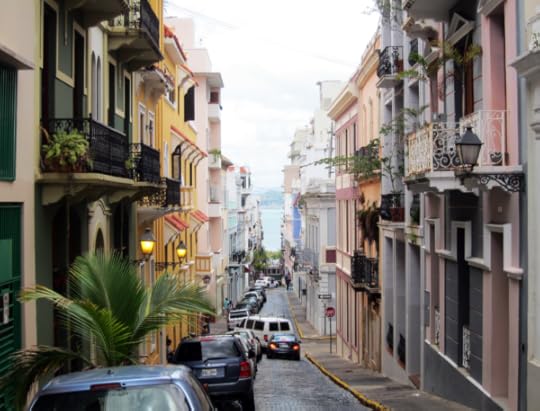
Photo of Old Town San Juan from blog @TOURIST2TOWNIE
She is a young woman of Chinese ethnicity living in Puerto Rico. So we enter an ethnic world within an ethnic world, with its own rules, traditions and expectations. She’s a waitress and an artist and they begin a “random art” campaign, posting anonymous art works around the city. The little plot there is revolves around these two lonely people from different cultures dancing around each other, like a couple of octopi reaching out in the dark. (And one of the characters turns out to be bisexual as well.)
The book has no chapters, and at times comes across as a series of disconnected paragraphs of random, but worthwhile thoughts. A lot is about Puerto Rico as in limbo between nation and colony. (Which, with its unusual American Commonwealth status, it is.) The main character compares Puerto Rico to Spain from his time in Madrid. Puerto Rico he thinks is or was “…a stop on an empire’s bus route.” Some more thoughts to give an idea of the literary quality of the writing:
“For many years, I thought what I missed the most about Europe were the cafes, he said. But when I had a chance to go back there, after a ton of years, I found that even those no longer held up to my memories of them. … Europe, the Europe you have in your head, which is basically an invention of literature, may have once existed…”
“My life has passed me by in this ‘Colonial Economy,’ rehearsing the coffee ritual as if it were some kind of barrier against a torrent of history that overwhelms me and defines me. What is left of the men and women of this country? What remains but the coffee and the centuries, ground down and percolated, flowing through steel tubes, pouring from plastic spigots?”
“Most of what’s called depression consists of store-bought feelings…. Our emotions pop off the assembly line, you can pick them up anywhere. There’s a mass distribution network. Like so many other things we buy and sell, they’re cheap knockoffs. They exist because we adopt specific ways of being and feeling to face specific events.”
“A curious phenomenon: if I don’t jot down a memory or an idea, it loses all its power, as if the substance of the thought had dried up, leaving it forever inert. It’s as if I could only discern life through ink.”
“I’ve reread The Stranger after many years, focusing on Camus’s use of the sun. Meursault, the protagonist, authentically perceives things the way someone suffering from too much sun would, someone who’d even kill because of it. His is not the tourist’s sun; there’s no paradise here. His sun is simply what one has to endure day after day, week after week, month after month, year after year. It heightens poverty, despondency, the neighbors’ shouting.”
Of an obscure local book by an unknown author, he notes: “It is also clear that the book was written to be read by no one, merely to exist.”
There is one interesting extended discussion/argument about Spanish literature that takes place between two Puerto Rican writers/professors and a visiting writer/lecturer from Spain. It revolves around a thesis: Latin American has taken over the literary title in Spanish language literature from Spain. It makes me think this may be true: If someone asked me to name great modern Spanish language writers it’s easy to come up with New World writers like Marquez, Borges, Vargas Llosa, Fuentes, Cortazar, Isabel Allende, Roberto Bolano, Octavio Paz, Neruda. Is Spain still riding on Cervantes and Unamuno? Carlos Ruiz Zafron?
A good read; relatively short, some humor, a few surprises and it kept my attention.
Photo of Old Town San Juan from blog @TOURIST2TOWNIE

December 8, 2022
I came across an article about this book because I read it had been adapted into a film retitled "Art of Love" starring veteran character actor Esai Morales.
Intrigued, I wanted to read this book because I have not read any books in a long while, that are set in Puerto Rico, or that the protagonist is often grappling with identity, culture and politics because Puerto Rico is still heavily steeped into the American lexicon and reeling from postcolonial repercussions and trauma.
The protagonist is a lonely lecturer, aging alone into the twilight. He spends time wandering in cafes, writing in his journal, at odds with loving and hating his country, the lack of culture, and intellectualism that made him become a writer and teacher.
He suddenly receives mysterious messages taped into locations he goes to, and finds himself pursued (I would call this stalked) by a so called admirer of his work.
Her identity is revealed and she is a Chinese immigrant named Li who is a student at the university, and lives a lonely life working for her family's Chinese restaurant.
Yes, you can fill in the blanks to this self indulgent novel. The narrator and Li fall in love and have crazy amounts of sex.
It is his wet dream come true! And let me add- she's a lesbian who is exploring her identity and is torn between the narrator and a rival academic named Carmencita!
When I got to the love affair part of the novel, my empathy for Lalo's narrator disappeared. It seemed to me that Li's sexual identity and exploration was somehow linked to the idea of shifting identities and community, but it became nothing more than a straight man's fantasy come true- meeting a mysterious stranger who tapes messages for him to piece together, then having lots of sex, with the perverse sense of pleasure that he is making her want men again.
Talk about straight, male glaze.
There's so much description of the narrator's fluids on Li that I howled with laughter because it became a book that was incomprehensible. After howling with laughter, I was also completely disgusted by this cliched novel.
It read to me as this is another narrator who's life is changed after a bout of writer's block and frustration of not being seen as the true artiste he fancies himself to be.
What was supposed to be erotic came across as crude. I wanted to like this book, but I cannot bring myself to find anything redeeming about it because all the redemption it had was in the first 30 pages. I wonder if the film version is anything like this book, because it does read as low budget, 1990s erotic thriller.
Intrigued, I wanted to read this book because I have not read any books in a long while, that are set in Puerto Rico, or that the protagonist is often grappling with identity, culture and politics because Puerto Rico is still heavily steeped into the American lexicon and reeling from postcolonial repercussions and trauma.
The protagonist is a lonely lecturer, aging alone into the twilight. He spends time wandering in cafes, writing in his journal, at odds with loving and hating his country, the lack of culture, and intellectualism that made him become a writer and teacher.
He suddenly receives mysterious messages taped into locations he goes to, and finds himself pursued (I would call this stalked) by a so called admirer of his work.
Her identity is revealed and she is a Chinese immigrant named Li who is a student at the university, and lives a lonely life working for her family's Chinese restaurant.
Yes, you can fill in the blanks to this self indulgent novel. The narrator and Li fall in love and have crazy amounts of sex.
It is his wet dream come true! And let me add- she's a lesbian who is exploring her identity and is torn between the narrator and a rival academic named Carmencita!
When I got to the love affair part of the novel, my empathy for Lalo's narrator disappeared. It seemed to me that Li's sexual identity and exploration was somehow linked to the idea of shifting identities and community, but it became nothing more than a straight man's fantasy come true- meeting a mysterious stranger who tapes messages for him to piece together, then having lots of sex, with the perverse sense of pleasure that he is making her want men again.
Talk about straight, male glaze.
There's so much description of the narrator's fluids on Li that I howled with laughter because it became a book that was incomprehensible. After howling with laughter, I was also completely disgusted by this cliched novel.
It read to me as this is another narrator who's life is changed after a bout of writer's block and frustration of not being seen as the true artiste he fancies himself to be.
What was supposed to be erotic came across as crude. I wanted to like this book, but I cannot bring myself to find anything redeeming about it because all the redemption it had was in the first 30 pages. I wonder if the film version is anything like this book, because it does read as low budget, 1990s erotic thriller.

June 9, 2020
Με βάση τον έρωτα,σαν απώτερο ζητούμενο της ύπαρξης, κ τις δυσκολίες συνύπαρξης που δεν μπορούν πάντα να αντιμετωπιστούν, έχουμε μια εικόνα του σύγχρονου Πουέρτο Ρίκο κ των προβληματισμών διαφόρων κοινωνικών ομάδων του; αστών, διανοουμένων, μεταναστών είτε από κοντά ή κ πολύ μακρύτερα
Αν ξεπεράσεις τη στριφνη αρχή, μια φοβερά ενδιαφέρουσα κριτική προσέγγιση της ισπανικής λογοτεχνίας αναπτύσσεται στο τέλος, που αν μη τι άλλο ακονίζει της γωνίες, κ σε κάνει να πάρεις συγκεκριμένη θέση
Αν ξεπεράσεις τη στριφνη αρχή, μια φοβερά ενδιαφέρουσα κριτική προσέγγιση της ισπανικής λογοτεχνίας αναπτύσσεται στο τέλος, που αν μη τι άλλο ακονίζει της γωνίες, κ σε κάνει να πάρεις συγκεκριμένη θέση

July 23, 2013
Para mí esta novela fue un premio Rómulo Gallegos bien merecido. Eduardo Lalo es talentosísimo y de los mejores escritores puertorriqueños de la época. El estilo de la primera parte de la novela, previo al tema principal de la misma, me voló la cabeza. Incomprensible a ratos con sus anotaciones al azar de su vida errante mezclados con la entrega de mensajes misteriosos. Poesía, amor, crítica social y un paseo por áreas de mi islita entre otros temas hacen de esta una lectura difícil de soltar. Altamente recomendada.

August 15, 2015
the first of eduardo lalo's books to appear in english translation, simone won the prestigious rómulo gallegos prize in 2013 (a now biannual award bestowed previously upon the likes of vargas llosa, garcia márquez, fuentes, marías, bolaño, vila-matas, and piglia). a short novel by the puerto rican author (professor, photographer, and video artist as well), simone is the story of a long-toiling and frustrated writer courted enigmatically by a young chinese woman via a series of cryptic messages, carefully crafted notes, and graffitied phrases. the nameless writer, "condemned to corners, to cupboards, to nothingness," tantalized by both the attention and his pursuer's identity, eventually meets and falls in love with his huntress (equally battered by life's experiences).
*translated from the spanish by david frye (yoss, lizardi, barceló, et al.)
love was, i realized on this beach, the impossible and failed attempt to protect someone from her own life story.simone follows the trajectory of the pair's doomed love affair, before veering into a statement on the perceived (or imposed) provincialism of puerto rican letters (as well as that of the smaller latin american countries) and the formulaic commercialism and inflated reputation of post-franco literature originating in spain. lalo's main character, simone's only fully fleshed figure, resigned as he is to but a marginal role on the peripheries of his country's literary milieu, seems, at times, bitter, ornery, and defeated — however accepting he is of his unavoidable fate. ennui and estrangement abound, yet simone is a work of both passion and conviction, if not also disaffection and desolation. lalo's novel mixes the political and the personal, offering a fetching tale that raises more questions than it answers about identity, individualism, love, loyalty, and a global marketplace that often favors artifice over art.
it was ridiculous, a half-baked idea, but i became convinced that their stupidity was negatively affecting my life. it was aggressive, in a way. i know such people exist in every society, but in this society, practically everything seems to cater to them, to keep them from realizing how childish, inept, and miserable they are. the purpose of our government is to let them go through all the stages of their lives without facing their shortcomings. shopkeepers design sales with them in mind. that's why hardly anyone makes demands, why a handful of ideas are lauded everywhere: family, the illusion of democracy, consumer appeal. i am excluded because these people exist.
*translated from the spanish by david frye (yoss, lizardi, barceló, et al.)
August 29, 2021
With cryptic notes delivered in creative ways, a young woman stalks a poet. This game of hidden identity which morphs into a pursuit of a search for a deeper identity forms a skeleton for the narrator to drape extensive philosophical musings.

March 25, 2019
Bien de male gaze en general, exotización y sexualización de las chinas en particular, porno barato con intentos (muy fallidos) de resultar poético y pedantería a gran escala. Y lo peor, un aburrimiento de principio a fin.

December 14, 2015
This dark novel set in san juan is told from perspective of a literary writer hitting the wall of indifference to his work, and all thinking work, along with crushing confusion and sadness of being alone, bereft, and asking, why do I even do this? but then, someone, a mystery admirer? A nut? A man? A woman? Starts leaving the professor/author chalked notes, quotes stuck under his windshield wiper, envelopes slipped under his doors. That perks him up… this quote from page one and two set his attitude before his ‘stalker’ starts in on him
“Another Sunday morning. The quiet street, a few kids shouting, a brief gust of wind swirling leaves down the sidewalk. The restless day of rest. Blessed are the birds that sing today like any other day---that is, without hope.”
“Most of what’s called depression consists of store-bought feelings. I call them that for good reason: I’m speaking from experience. Our emotions pop off the assembly line, you can pick them up anywhere. There’s a mass distribution network. Like so many other things we buy and sell, they’re cheap knockoffs. They exist because we adopt specific ways of being and feeling to face specific events. That’s about all.”
“But sometime your depression stirs up no feelings, so it hardly deserves the name. It’s just what’s left when time’s up and so many things have been lost or will never be gained, and you know there’s nothing to hope for in the end but this: this Sunday morning.”
“That may sound stark, but I find it comforting to think this way.”
This little bit actually sets up this whole novel and the plot, the characters, the writer himself, turn all this pontificating on its head. Fun read, really.
“Another Sunday morning. The quiet street, a few kids shouting, a brief gust of wind swirling leaves down the sidewalk. The restless day of rest. Blessed are the birds that sing today like any other day---that is, without hope.”
“Most of what’s called depression consists of store-bought feelings. I call them that for good reason: I’m speaking from experience. Our emotions pop off the assembly line, you can pick them up anywhere. There’s a mass distribution network. Like so many other things we buy and sell, they’re cheap knockoffs. They exist because we adopt specific ways of being and feeling to face specific events. That’s about all.”
“But sometime your depression stirs up no feelings, so it hardly deserves the name. It’s just what’s left when time’s up and so many things have been lost or will never be gained, and you know there’s nothing to hope for in the end but this: this Sunday morning.”
“That may sound stark, but I find it comforting to think this way.”
This little bit actually sets up this whole novel and the plot, the characters, the writer himself, turn all this pontificating on its head. Fun read, really.

January 19, 2014
Es un libro que te atrapa desde el primer párrafo. El premio Rómulo Gallegos, lo ganó con cada una de sus palabras.

July 6, 2024
This came highly recommended from the bookstore, it won the Gallegos Prize in 2013, and has remained popular enough to be reissued several times. Expectations were high on my end.
Arguably the most prominent theme: it’s a book about the writing process. I really like that it’s mostly told in short fragments—that helps us get to know the protagonist’s opinions on a variety of matters. Especially San Juan. He rants and rails against San Juan as a cultural wasteland. Having known some Puerto Rican authors, this makes me want to pick their brains and get their takes.
A secondary theme is the role and value of Hispanic literature that isn’t from one of the large countries (Mexico, Argentina, or, most notably and—in this novel—obnoxiously, Spain). The parts that touch on this theme are highlights, IMO. That’s where the book reaches beyond itself and moves it beyond the mid-life crisis that occupies a good portion of its narration.
The romantic element has not completely won me over. It’s not quite as over the top as I found El síndrome de Ulises to be, but it gives it a run. Through the romantic element, however, Lalos touches on the vast world of Chinese immigrants to PR. Sexuality is one of the windows through which we learn about Chinese culture in PR. The (relatively) little that we get to know about Li’s biography are also highlights, although the protagonist does not delve much beyond the topic’s surface level. I don’t know much about this topic, but it makes me wonder if others have written about it.
In general, I found the secondary characters (Li and Max in particular) to be more compelling than the protagonist.
This is a worthwhile book—my strong encouragement is that, if you start it, read it through till the end. It gets better the longer it goes.
Arguably the most prominent theme: it’s a book about the writing process. I really like that it’s mostly told in short fragments—that helps us get to know the protagonist’s opinions on a variety of matters. Especially San Juan. He rants and rails against San Juan as a cultural wasteland. Having known some Puerto Rican authors, this makes me want to pick their brains and get their takes.
A secondary theme is the role and value of Hispanic literature that isn’t from one of the large countries (Mexico, Argentina, or, most notably and—in this novel—obnoxiously, Spain). The parts that touch on this theme are highlights, IMO. That’s where the book reaches beyond itself and moves it beyond the mid-life crisis that occupies a good portion of its narration.
The romantic element has not completely won me over. It’s not quite as over the top as I found El síndrome de Ulises to be, but it gives it a run. Through the romantic element, however, Lalos touches on the vast world of Chinese immigrants to PR. Sexuality is one of the windows through which we learn about Chinese culture in PR. The (relatively) little that we get to know about Li’s biography are also highlights, although the protagonist does not delve much beyond the topic’s surface level. I don’t know much about this topic, but it makes me wonder if others have written about it.
In general, I found the secondary characters (Li and Max in particular) to be more compelling than the protagonist.
This is a worthwhile book—my strong encouragement is that, if you start it, read it through till the end. It gets better the longer it goes.
January 18, 2014
Me encantó. Primero que todo, Eduardo Lalo es un genio. Me encanta como escribe. Es una novela que aunque es bastante corta, pero a su vez profunda. Un escritor empieza a recibir mensajes y citas anónimos; no sabiendo específicamente de quién es. Es una novela que en esencia trata sobre la invisibilidad y la parte importante que juega la cuidad con ese sentimiento. Como puedes vivir en una sociedad y a la misma vez no sentirte parte de el. Sentirte como nada, como si fueras uno más del montón. De igual manera se combinan temas del amor y como este sentimiento puede subsistir a través de la cultura y específicamente la literatura. A través del texto existen varías criticas a la percepción literaria contemporánea, pero, sobretodo como una cuidad puede literalmente ser un personaje de cierta manera, convertirse en un espacio literario. En verdad que me disfrute muchísimo está novela, se la recomiendo. Totalmente merecido el premio Rómulo Gallegos. Me he quedado con ganas de leer más de Lalo.

August 16, 2022
I don't even know where to start with what I don't like about this.

November 29, 2022
This short novel set in San Juan was the Puerto Rican choice for the World Literature group I'm in on Goodreads, which is finishing up a year devoted to Hispanic American writers. It begins with the first-person narrator, a depressed schoolteacher and sometime author, writing short unconnected fragments in a notebook about his daily life in the city, his observations about the things he sees and hears around him. About a fifth of the way through the novel, he begins getting strange messages, in his school mailbox, e-mail, stuck under his windshield and so forth, which are or seem to be quotations from books, and strike him as being mysteriously connected to his thoughts and situations. Some appear to be signed by someone named Simone. One message refers to Walter Benjamin (again, Walter Benjamin!): "Walther Benjamin says that in our time the only work really endowed with sense — critical sense as well — would be a collage of quotations, fragments, echoes of other works" (my translation), which is a kind of key to the style of the novel (and even more so, to the last book we read for the group, Yo, el Supremo).
Simone is unapologetically an intellectual book, dealing with ideas and literature (although it has a great parody of the pseudo-intellectual academic elite at a literary conference, with the obligatory and generally irrelevant quotations from Lacan and Derrida — two names which will usually cause me to drop a book very quickly.) While it covers several themes, including the condition of Puerto Rico in general, the problems of the small Chinese community of San Juan, and the psychology of relationships, it always returns to literature, and the last few pages (the book is not divided into chapters), where the reader would expect the climax of the action, are given over to a dialogue which amounts to a literary manifesto of a sort.
Simone is unapologetically an intellectual book, dealing with ideas and literature (although it has a great parody of the pseudo-intellectual academic elite at a literary conference, with the obligatory and generally irrelevant quotations from Lacan and Derrida — two names which will usually cause me to drop a book very quickly.) While it covers several themes, including the condition of Puerto Rico in general, the problems of the small Chinese community of San Juan, and the psychology of relationships, it always returns to literature, and the last few pages (the book is not divided into chapters), where the reader would expect the climax of the action, are given over to a dialogue which amounts to a literary manifesto of a sort.
Read
June 21, 2021oceanic ennui overcome by intrusive love.
I didn’t like this book at first (third). Fragmentary storytelling like plodding through dry, hot sand; every paragraph, each stray observation more listless than the last. Nothing being built, no vector drawn...or so I thought.
Seguí porque me rendí. Me rendí en la búsqueda de sentido. Encontré alivio en las rupturas. La vida (el libro) pasaba más rápido a través de la atención intermitente, en lugar de la absorción "imperial y anárquica" que era la penetración de Simone en el ser y el devenir de este hombre anónimo. Ejecutaba su fastidio con tanta facilidad. As if of ocean.
A continuity (albeit ephemeral) ultimately dominates. La trama surge con el eslabón fraguado por Li Chao.
Es una producción artística única que me hace pensar tanto en la literatura como en la sociedad puertorriqueña contemporánea de forma novedosa.
The city, San Juan, is the page upon which Lalo(?) walks: las letras son sus huellas.
I didn’t like this book at first (third). Fragmentary storytelling like plodding through dry, hot sand; every paragraph, each stray observation more listless than the last. Nothing being built, no vector drawn...or so I thought.
Seguí porque me rendí. Me rendí en la búsqueda de sentido. Encontré alivio en las rupturas. La vida (el libro) pasaba más rápido a través de la atención intermitente, en lugar de la absorción "imperial y anárquica" que era la penetración de Simone en el ser y el devenir de este hombre anónimo. Ejecutaba su fastidio con tanta facilidad. As if of ocean.
A continuity (albeit ephemeral) ultimately dominates. La trama surge con el eslabón fraguado por Li Chao.
Es una producción artística única que me hace pensar tanto en la literatura como en la sociedad puertorriqueña contemporánea de forma novedosa.
The city, San Juan, is the page upon which Lalo(?) walks: las letras son sus huellas.

April 16, 2017
El primer tercio de este libro para mi fue como una asignacion. Todo lo que leia se sentia como sin ton ni son y sin que me puediera agarrar la prosa. Luego de eso, todo se puso mucho mas interesante y los personajes comenzaron a vivir y me senti interesado por la historia. La prosa de Lalo es genial y sus observaciones sobre la soledad en sus personajes y el estado de la literatura en la cultura son tremendos. Admito que queria dejar de leerlo al principio y que, al final, me alegra no haberlo hecho.

January 20, 2026
This is why you pick up a random book from the bookstore with no expectations! 👏 I bought this right before I went to San Juan just because it was set there. And this really was great. So many great quotes about being a struggling writer, about finding a love you can’t quite get right, and feeling overall trapped both physically and mentally to your environment.
March 4, 2021
The story of two very different lives coming together does well but the book is filled with many moments of authors speaking about writing and publishing privileges - unrelated to plot mostly.

May 4, 2026
read this book to get closer to Lily and IT WORRRRRKKKEEEDDD!!!!!

April 22, 2024
I’m heading to Puerto Rico and wanted to check out some Puerto Rican fiction before my trip. I see why Simone topped so many lists of best Puerto Rican literature - it entranced me from the first page. At only 150ish pages I recommend reading in one sitting.

August 15, 2021
"ink flows like magic on cheap paper"
"So I spent hours on foot and in the car, wandering through city, refusing any contact, my heart scabbed over. In this partial asphyxiation, I sought to dispense with other people, absenting myself from relationships, yet still inflicting my morbid disposition and baleful glares on everyone I met along the way."
"Chinese restaurants provided the local version of fast, lonely food. The one in Avenida Esmeralda was like any other: formica-top tables, false ceiligs, neon signs, the small plastic altar behind the counter with a fake incense stick crowned by a tiny red bulb pretending to make a perpetual offering."
"it(cities) was constructed along a model that didn't correspond to life."
" I lit the cigar and, as I inhaled the smoke, the walls of my mouth awakened from a long sleep."
"...the resignation of a man,
who was, yet again, witnessing a problem arise."
"this absurd absence..."
"So I spent hours on foot and in the car, wandering through city, refusing any contact, my heart scabbed over. In this partial asphyxiation, I sought to dispense with other people, absenting myself from relationships, yet still inflicting my morbid disposition and baleful glares on everyone I met along the way."
"Chinese restaurants provided the local version of fast, lonely food. The one in Avenida Esmeralda was like any other: formica-top tables, false ceiligs, neon signs, the small plastic altar behind the counter with a fake incense stick crowned by a tiny red bulb pretending to make a perpetual offering."
"it(cities) was constructed along a model that didn't correspond to life."
" I lit the cigar and, as I inhaled the smoke, the walls of my mouth awakened from a long sleep."
"...the resignation of a man,
who was, yet again, witnessing a problem arise."
"this absurd absence..."
This entire review has been hidden because of spoilers.

April 5, 2020
Simone tells the story of a Puerto Rican writer / university lecturer and his seduction by, and relationship with, a Chinese-Puerto Rican student. The novel won the Rómulo Gallegos Prize—an award for Spanish-language literature that Marquez’s One Hundred Years of Solitude and Bolaño’s The Savage Detectives also won.
I ended up liking this book notwithstanding the fact that it drips with angsty pretentiousness. I found the book’s narrator insufferable. He is filled with pain—Lalo constantly reminds us—but it is an inchoate suffering, one that seems self-absorbed and navel-gazey rather than authentically political or personal. “I left the theater with the sensation I’ve had so often: the pain that never goes away, that I hardly even feel any more. But it’s always there." (25) “Even before I turned thirty, I knew that what I most wanted was to put my life into a book. I suffered so I could write my suffering.” (58) It is a ubiquitous pain, but one that seems more the pain of an artist in love with his own pain than anything truly authentic. When the narrator does tie this suffering to Puerto Rico’s status or to the role of the author in society, these arguments seem superficial, secondary—an excuse for the narrator’s self-center emo-dom.
Adding to this sense of vapid angst is the fact that the narrator is filled with scorn for nearly everything around him. Sure, the final chapter offers an interesting critique on the publishing industry and on how he feels that literature of Spain looks down on Carribean literature. But these more legitimate debates are undermined by ridiculous, self-serious critiques, like the narrator's review of Kangaroo Jack: "On the screen, a kangaroo was running away with a jacket and a wad of cash belonging to a cartoon gangster (this was the exquisite confection that we had paid money to subject ourselves to). The appalling plot struck me as both unreal and predictable...” With critiques like this, the narrator's deeper questions and opinions just seem laughably pretentious and moody.
What redeemed this book for me is that it’s a love story and a pretty good one at that. About a third of the way into the book, we are introduced to Li Chao, a Chinese-Puerto Rican student at the narrator’s university who works full time at a Chinese restaurant in the city. She is a mysterious character who seduces the narrator with bird-seed type notes with quotes from obscure literature, left around the city. After a game of cat-and-mouse, they meet and a relationship that is built around their love of art and books and feeling of otherness (her as a Chinese-Puerto Rican and his as a sulky underappreciated artist) blossoms. Sometimes the writing about their love and sex is overwrought—“Love was, I realized on this beach, the impossible and failed attempt to protect someone from her own life story.” (109) “...looking at one another with a gaze harder than an erect member, and more memorable.” (75) And I found it sort of frustrating that the narrator seems to regard his own pain as equal to Li’s pain. But for the most part, the narrator and Li’s love felt true, real. Their immersion in each other and the complexity of Li (her love for the narrator and her desire to escape) comes through in a thoughtful and at times poignant way.
There is also some nice poetry to the writing. The way the book closes is particularly powerful, with the narrator realizing that Li has created a piece of art, made up of his name written and crossed out so many times it's blocks of black on white. Her attempt to forget is an memorable image.
And the book does prompt interesting insights into the psyche of a Puerto Rican artist, especially towards the end of the book when the narrator and his friend debate a commercially popular but artistically bankrupt Spanish author. But in the end, even this debate felt more reflective of the narrator’s own maudlin self-obsession than with anything truer and deeper about Puerto Rico’s colonial present or the role of the author in society. He articulates a view of the artist that is so austere—as a sort of cultured prince, alone on his island of sadness, creating art for truth’s sake and spurning any commercial success or connection to a broader audience—that the book's finer moments. At the end, Simone felt more an immersion into pretentious self-obsession than true love or political critique.
I ended up liking this book notwithstanding the fact that it drips with angsty pretentiousness. I found the book’s narrator insufferable. He is filled with pain—Lalo constantly reminds us—but it is an inchoate suffering, one that seems self-absorbed and navel-gazey rather than authentically political or personal. “I left the theater with the sensation I’ve had so often: the pain that never goes away, that I hardly even feel any more. But it’s always there." (25) “Even before I turned thirty, I knew that what I most wanted was to put my life into a book. I suffered so I could write my suffering.” (58) It is a ubiquitous pain, but one that seems more the pain of an artist in love with his own pain than anything truly authentic. When the narrator does tie this suffering to Puerto Rico’s status or to the role of the author in society, these arguments seem superficial, secondary—an excuse for the narrator’s self-center emo-dom.
Adding to this sense of vapid angst is the fact that the narrator is filled with scorn for nearly everything around him. Sure, the final chapter offers an interesting critique on the publishing industry and on how he feels that literature of Spain looks down on Carribean literature. But these more legitimate debates are undermined by ridiculous, self-serious critiques, like the narrator's review of Kangaroo Jack: "On the screen, a kangaroo was running away with a jacket and a wad of cash belonging to a cartoon gangster (this was the exquisite confection that we had paid money to subject ourselves to). The appalling plot struck me as both unreal and predictable...” With critiques like this, the narrator's deeper questions and opinions just seem laughably pretentious and moody.
What redeemed this book for me is that it’s a love story and a pretty good one at that. About a third of the way into the book, we are introduced to Li Chao, a Chinese-Puerto Rican student at the narrator’s university who works full time at a Chinese restaurant in the city. She is a mysterious character who seduces the narrator with bird-seed type notes with quotes from obscure literature, left around the city. After a game of cat-and-mouse, they meet and a relationship that is built around their love of art and books and feeling of otherness (her as a Chinese-Puerto Rican and his as a sulky underappreciated artist) blossoms. Sometimes the writing about their love and sex is overwrought—“Love was, I realized on this beach, the impossible and failed attempt to protect someone from her own life story.” (109) “...looking at one another with a gaze harder than an erect member, and more memorable.” (75) And I found it sort of frustrating that the narrator seems to regard his own pain as equal to Li’s pain. But for the most part, the narrator and Li’s love felt true, real. Their immersion in each other and the complexity of Li (her love for the narrator and her desire to escape) comes through in a thoughtful and at times poignant way.
There is also some nice poetry to the writing. The way the book closes is particularly powerful, with the narrator realizing that Li has created a piece of art, made up of his name written and crossed out so many times it's blocks of black on white. Her attempt to forget is an memorable image.
And the book does prompt interesting insights into the psyche of a Puerto Rican artist, especially towards the end of the book when the narrator and his friend debate a commercially popular but artistically bankrupt Spanish author. But in the end, even this debate felt more reflective of the narrator’s own maudlin self-obsession than with anything truer and deeper about Puerto Rico’s colonial present or the role of the author in society. He articulates a view of the artist that is so austere—as a sort of cultured prince, alone on his island of sadness, creating art for truth’s sake and spurning any commercial success or connection to a broader audience—that the book's finer moments. At the end, Simone felt more an immersion into pretentious self-obsession than true love or political critique.

September 15, 2016
A sad, moody, little gem of a novel about a melancholic, maybe depressive author and college professor in San Juan, Puerto Rico, who starts receiving mysterious notes, phone messages, chalked quotations on the sidewalk, from an unknown stalker/admirer that starts him off on a random chase all over urban San Juan in search of the stranger who always stays one step ahead. Told in the first person, the novel is a series of diary entries and notebook jottings by the professor. For the first 60 pages, the writings are fragmentary and desultory musings about the past and the present, impressions of places and things, reports of conversations--reflective of the psyche of the narrator, who is at an impasse in his career, writing books he thinks no one cares about, alienated from social contacts, living in a city dead to all culture, and carrying on an off-and-on relationship with a single mother, only because neither of them has the initiative to move on.
SPOILER ALERT FOR THIS PARA : But once the narrator meets his stalker/admirer, a beautiful romance flowers between them, the lonely author and the Chinese immigrant who works in her family's restaurant while dreaming of literature and finer things. But she has a terrible secret in her past, that makes her unable to have normal relationships with men, preferring women instead -- but even those relationships are emotionally empty and masochistic. But with the author, she senses a fellow sufferer, and they poignantly seek to establish a human connection despite their disparate lives, and the emotional sterility (and physical violence in Li's case) that marred their pasts. In the end, the accumulated weights of their pasts make it impossible to stay together, but Li gives the professor a parting gift that tears her apart.
The city of San Juan, just as much as the narrator and his lover, is a character in this book. The sprawling cityscape, the sudden drenching rains, the trash strewn streets and the sudden gusts of sea air, the oppressive heat and humidity, the mix of peoples and cultures, and the pall of decay and decrepitude that overlays it all, are all critical parts of the story. And yet, the novel ends with a sort of reconciliation between the narrator and his city, which is in a way a reconciliation between his aspirations and his present lot in life.
What could be improved? The set up takes too long -- the narrator's fragmented psyche, his alienation, disillusion and quiet despair are illustrated through episodic diary entries - like a scene reflected in shattered glass. But it occupies 60 pages of this short novel and many readers would have quit before then (though those who persisted would have been richly rewarded). Second, there is an unnecessarily long conversation between the narrator, his author friend and a visiting Spanish novelist at a critical time close to the end when we are eagerly anticipating the outcome of the narrator's quest to win back a lost love. Lalo clearly has strong feelings about the disdain with which critics and publishers view the literature of the "provinces," versus that from Spain itself. But an inquiry into its causes and consequences could have been better placed elsewhere in the novel. But overall, a thoroughly enjoyable reading experience.
SPOILER ALERT FOR THIS PARA : But once the narrator meets his stalker/admirer, a beautiful romance flowers between them, the lonely author and the Chinese immigrant who works in her family's restaurant while dreaming of literature and finer things. But she has a terrible secret in her past, that makes her unable to have normal relationships with men, preferring women instead -- but even those relationships are emotionally empty and masochistic. But with the author, she senses a fellow sufferer, and they poignantly seek to establish a human connection despite their disparate lives, and the emotional sterility (and physical violence in Li's case) that marred their pasts. In the end, the accumulated weights of their pasts make it impossible to stay together, but Li gives the professor a parting gift that tears her apart.
The city of San Juan, just as much as the narrator and his lover, is a character in this book. The sprawling cityscape, the sudden drenching rains, the trash strewn streets and the sudden gusts of sea air, the oppressive heat and humidity, the mix of peoples and cultures, and the pall of decay and decrepitude that overlays it all, are all critical parts of the story. And yet, the novel ends with a sort of reconciliation between the narrator and his city, which is in a way a reconciliation between his aspirations and his present lot in life.
What could be improved? The set up takes too long -- the narrator's fragmented psyche, his alienation, disillusion and quiet despair are illustrated through episodic diary entries - like a scene reflected in shattered glass. But it occupies 60 pages of this short novel and many readers would have quit before then (though those who persisted would have been richly rewarded). Second, there is an unnecessarily long conversation between the narrator, his author friend and a visiting Spanish novelist at a critical time close to the end when we are eagerly anticipating the outcome of the narrator's quest to win back a lost love. Lalo clearly has strong feelings about the disdain with which critics and publishers view the literature of the "provinces," versus that from Spain itself. But an inquiry into its causes and consequences could have been better placed elsewhere in the novel. But overall, a thoroughly enjoyable reading experience.

July 26, 2020
"Simone" reads as a writer's novel--it feels as though it's about the author himself and his perspective on the process (and industry of writing). For me, this defining feature comes with its pros and cons. As to the former, it's well-written--both spare but thoughtful--and an interesting view into a perspective and profession different from my own. Describing the fruitless compulsion to write, the narrator comments: “So many men and women have believed in the possibility of changing history, yet all they ever did was suffer. . . . I've taken the blows and I'm still standing. That's about all I've accomplished." On the clarity of life provided through writing: “A curious phenomenon: if I don’t jot down a memory or an idea, it loses all its power, as if the substance of the thought had dried up, leaving it forever inert. It’s as if I could only discern life through ink.” I enjoyed these reflections, even if they didn't directly speak to me. As to the latter, the novel is a little opaque in its critique and, whether intentional or not, the narrator comes across as unlikeably pretentious. Towards the end, the protagonist and another writer get into a heated argument with an author from Spain, wherein they criticize his work and perspective (and that of other Spanish authors) as representing publishing industry values, rather than literary ones. The dialogue in the scene is great; but the issue was mostly beyond me. And although I kind of liked the protagonist's consistently dismissive perspective of others, there were times where it felt like too much (dwelling on Carmen Lindo's mispronunciation of Derrida; describing a popular beach, "everything smacks of plastic, of sun, of double-A batteries for a machine made in China").
Overall, this book made me want to know the author's world more. To better understand Puerto Rico's place in the world ("Nothing that I or people like me could do would create more than passing waves in a pond. Our place in history, our efforts to live and leave a mark, a narrative, were not permitted to exist. We claimed to be a country, but in reality even many of those who were convinced of that fact acted as if we were nothing but a stop on an empire’/ bus route"); to read more Puerto Rican fiction, and better understand its standing in relation to other Spanish literature, and other literature generally. The writing was good enough to make me feel those things. I also enjoyed the plot--Li Chao's mysterious pursuit of the narrator and her understandable inability to commit to being with him. It's a good, sad love story (“I had gotten carried away, such was the measure of my helplessness, by a charade of anonymous messages and had ended up getting burned by someone else’s grotesque history.”); and that, by itself, is a good reason to read it.
Overall, this book made me want to know the author's world more. To better understand Puerto Rico's place in the world ("Nothing that I or people like me could do would create more than passing waves in a pond. Our place in history, our efforts to live and leave a mark, a narrative, were not permitted to exist. We claimed to be a country, but in reality even many of those who were convinced of that fact acted as if we were nothing but a stop on an empire’/ bus route"); to read more Puerto Rican fiction, and better understand its standing in relation to other Spanish literature, and other literature generally. The writing was good enough to make me feel those things. I also enjoyed the plot--Li Chao's mysterious pursuit of the narrator and her understandable inability to commit to being with him. It's a good, sad love story (“I had gotten carried away, such was the measure of my helplessness, by a charade of anonymous messages and had ended up getting burned by someone else’s grotesque history.”); and that, by itself, is a good reason to read it.
This entire review has been hidden because of spoilers.

October 23, 2023
I seldom read love stories. I don’t seek them out, because they are mostly unfulfilling, ending formulaically either as romance fulfilled or tragedy. Stripped down to either a warm feeling of satisfaction or catharsis, it never seems like love stories are worth reading, because they don’t provide much beyond the same old SOS. I almost put Simone aside when I pulled it out of the box. The book, though, was published by the University of Chicago Press, and there is a back cover blurb from Ricardo Piglia, one of the many intriguing writers to come out of Argentina in the last four decades, so I read on, hoping for more, and Lalo really does write much more than a love story in Simone. It is a story of alienation, disillusionment, immigration, marginalization, identity, literature, books, art, place, geography, stalking, and so much more. The love story is simply the vector through which Lalo explores the (dis)satisfactions of lives lived in San Juan, Puerto Rico.
The protagonist is a writer who has published a few books, has a local reputation, but is still struggling. He’s a college professor, has had various relations with women, none of which has worked out, and his best male friend spends most of his time off island. He is lonely and doesn’t find the job satisfying. He doesn’t like San Juan much, except when he does. He feels stuck, and yet he also feels like he is where he belongs: alienated and marginalized as he is, San Juan is still the place for him, his alienated familiar. The plot begins when the writer discovers that he is being stalked. He finds artfully written messages on the sidewalk, on pieces of paper posted where he will see them or left in mailboxes or under doors. The messages are most often quotations from other authors, philosophers, or theorists–particularly Simone Weill–which resonate with the protagonist’s own doubts, insecurities, questions, and perceived truths/untruths. The stalker seems to know the protagonist, which both freaks him out and intrigues him. The stalker leads him to her. She is a Chinese immigrant, Li Chao, who has worked in a family restaurant since she was 11 but succeeded in school and now studies Comparative Literature at UPR. She read his books and found a resonant soul. He writes of his dissatisfaction with San Juan and Puerto Rico, his marginalization and invisibility, the loneliness and emptiness of his life. Literature is a powerful force, and it leads her to instigate the message campaign. Perhaps it is cliché to say that two lost souls find each other, but such is the case here. What interesting is that Lalo connects his Puerto Rican protagonist with a Chinese immigrant and then uses that connection to explore the invisible lives of that population as well as present Li Chao as the acme of non-belonging. She steps out of the invisible role of a Chinese woman (doubly invisible, really) to become educated and integrate herself in the larger world through her interests in literature, intellect, and art, but that larger world doesn’t know what to do with an educated, artistic Chinese woman. She doesn’t fit, so she becomes doubly alienated/doubly invisible from both Puerto Rican and Chinese culture.
The protagonist finds Li Chao through the labyrinths she creates for him, and they remain together despite or because of all the spoken but mostly unspoken restrictions she puts on the relationship. The relationship flourishes physically, aesthetically, and intellectually, but despite their intimacy something remains hidden/invisible, which Li resists revealing because she knows that this fragile relationship of two isolated individuals without the backing of family and society will end in failure. Everything that Li does, despite whatever joys that the relationship brings, is prefigured on her expectation that the relationship fail. The protagonist resists this fatalism but can do little about it. When Li reveals her trauma, Lalo would seem to be setting the novel on a path of repair and reconciliation–it’s a love story after all–but Li continues to hold onto the trauma and the alienation from self and body that it engenders. The alienated self continues to reproduce itself no matter what Li does.
As a counter to this doomed love story, Lalo develops a friendship between the protagonist and another Puerto Rican writer, Maximo Noguera, whom the protagonist admires and is very much like him: bookish, alienated, invisible but feels like he belongs in Puerto Rico. Both have published locally but achieved no wider fame; both are full of frustration and resentment. The labyrinthine invisibility that ultimately separates Li and the protagonist functions as a stable bond between the protagonist and Maximo. At a university-sponsored party, both go after the Spanish writer who is the guest of honor on a book tour, criticizing contemporary Spanish literature and subverting any notion of a universal Spanish language culture. An academic party gone bad, but the protagonist finds both common cause and friendship. When Li makes a final attempt at saying good-bye, reconciling with the protagonist, explaining herself, or reproducing her alienation–it’s unclear what she intends–the protagonist does not answer the door and pulls the plug on the phone. This reaction certainly seems to be cruel and cutting, and it certainly forgoes the possibility of any kind of reconciliation (romantic fulfillment). On the other hand, I can’t help thinking that he found a more satisfying emotional connection at the party and thus is willing to forgo the insecure and undependable happiness he had had with Li. In the end, I think Lalo finds a way out of the love story binary with a friendship that allows the protagonist to maintain his old sense of alienated belonging.
The protagonist is a writer who has published a few books, has a local reputation, but is still struggling. He’s a college professor, has had various relations with women, none of which has worked out, and his best male friend spends most of his time off island. He is lonely and doesn’t find the job satisfying. He doesn’t like San Juan much, except when he does. He feels stuck, and yet he also feels like he is where he belongs: alienated and marginalized as he is, San Juan is still the place for him, his alienated familiar. The plot begins when the writer discovers that he is being stalked. He finds artfully written messages on the sidewalk, on pieces of paper posted where he will see them or left in mailboxes or under doors. The messages are most often quotations from other authors, philosophers, or theorists–particularly Simone Weill–which resonate with the protagonist’s own doubts, insecurities, questions, and perceived truths/untruths. The stalker seems to know the protagonist, which both freaks him out and intrigues him. The stalker leads him to her. She is a Chinese immigrant, Li Chao, who has worked in a family restaurant since she was 11 but succeeded in school and now studies Comparative Literature at UPR. She read his books and found a resonant soul. He writes of his dissatisfaction with San Juan and Puerto Rico, his marginalization and invisibility, the loneliness and emptiness of his life. Literature is a powerful force, and it leads her to instigate the message campaign. Perhaps it is cliché to say that two lost souls find each other, but such is the case here. What interesting is that Lalo connects his Puerto Rican protagonist with a Chinese immigrant and then uses that connection to explore the invisible lives of that population as well as present Li Chao as the acme of non-belonging. She steps out of the invisible role of a Chinese woman (doubly invisible, really) to become educated and integrate herself in the larger world through her interests in literature, intellect, and art, but that larger world doesn’t know what to do with an educated, artistic Chinese woman. She doesn’t fit, so she becomes doubly alienated/doubly invisible from both Puerto Rican and Chinese culture.
The protagonist finds Li Chao through the labyrinths she creates for him, and they remain together despite or because of all the spoken but mostly unspoken restrictions she puts on the relationship. The relationship flourishes physically, aesthetically, and intellectually, but despite their intimacy something remains hidden/invisible, which Li resists revealing because she knows that this fragile relationship of two isolated individuals without the backing of family and society will end in failure. Everything that Li does, despite whatever joys that the relationship brings, is prefigured on her expectation that the relationship fail. The protagonist resists this fatalism but can do little about it. When Li reveals her trauma, Lalo would seem to be setting the novel on a path of repair and reconciliation–it’s a love story after all–but Li continues to hold onto the trauma and the alienation from self and body that it engenders. The alienated self continues to reproduce itself no matter what Li does.
As a counter to this doomed love story, Lalo develops a friendship between the protagonist and another Puerto Rican writer, Maximo Noguera, whom the protagonist admires and is very much like him: bookish, alienated, invisible but feels like he belongs in Puerto Rico. Both have published locally but achieved no wider fame; both are full of frustration and resentment. The labyrinthine invisibility that ultimately separates Li and the protagonist functions as a stable bond between the protagonist and Maximo. At a university-sponsored party, both go after the Spanish writer who is the guest of honor on a book tour, criticizing contemporary Spanish literature and subverting any notion of a universal Spanish language culture. An academic party gone bad, but the protagonist finds both common cause and friendship. When Li makes a final attempt at saying good-bye, reconciling with the protagonist, explaining herself, or reproducing her alienation–it’s unclear what she intends–the protagonist does not answer the door and pulls the plug on the phone. This reaction certainly seems to be cruel and cutting, and it certainly forgoes the possibility of any kind of reconciliation (romantic fulfillment). On the other hand, I can’t help thinking that he found a more satisfying emotional connection at the party and thus is willing to forgo the insecure and undependable happiness he had had with Li. In the end, I think Lalo finds a way out of the love story binary with a friendship that allows the protagonist to maintain his old sense of alienated belonging.
September 14, 2018
Simone, de Eduardo Lalo, parece ser la historia de amantes malhadados: el narrador y una joven china, Li, que se mudó a Puerto Rico cuando era niña. Algunas de las descripciones de esa relaciόn son conmovedoras. Por ejemplo, he aquí una de las mejores descripciones que he leído del regreso a la vida normal después del final de una relación:
“Al final, me levanté con sed y ganas de ir al baño. El silencio de la mañana era distinto. Era esponjoso y hacía lentos mis movimientos. Había algo familiar en él. Era lo que vivía antes de Li. Comprobé entonces que la esperanza ya sólo producía vergüenza….Era la congestión de los años que había vivido.” (págs. 199, 201)
Pero la historia con Li no es el eje del libro porque lo que más le interesa al narrador es otra relación--la suya con San Juan. Además, si bien el escritor es talentoso, no se retrata, por lo general, a las mujeres excepto de una forma unidimensional y/o poco halagüeña. Por ejemplo:
-“Mi opinión favorita es la de una publicista de Carolina, joven y atractiva segύn la foto, idiota segύn todo lo demás.” (pág. 24)
-“En Río Piedras, dos mujeres hablan en la calle. ‘Quiero estar más rubia.’ ‘Pero es que tuerces el pelo bien finito y el tinte te coge bien.’ Sé lo que dicen, pero en realidad ¿qué dicen? ¿Cómo son posibles las palabras para lo que no quiero entender.” (pág. 37)
-“¿Pero por qué me hice pasar por paraguayo si para esa mujer esto era incluso menos ubicable, menos real [que Puerto Rico]?” (pág. 38)
“la aterradora sociόloga Carmen Lindo, que en vez de decir Derrida, como se pronuncia en francés, con acento en la última sílaba, hizo alusión al filósofo tres o cuatro docenas de veces en quince páginas tupidas e intransitables, con acento en la primera y una solitaria erre.” (pág. 55)
Y, a veces, la relación entre el narrador y Li raya en una telenovela. Por ejemplo: “Algún día sabría de ella, cuando ya no contáramos nada para el otro.” (pág. 198)
Entendemos mejor a Li que a las otras mujeres en el libro, pero hasta el narrador reconoce en la última parte del libro que Li era “un amasijo de cosas que no podía comprender” y que “no sabía quién era.” (pág. 155) Al final del libro, Li se convirtió en “[e]sa absurda ausencia de [un] cuerpo.” (pág. 201)
Desde el principio hasta el final del libro, el enfoque es San Juan. La novela comienza con instantáneas verbales de la ciudad--una conversación en la calle entre jóvenes sobre la homosexualidad, una mujer adinerada haciendo compras en una repostería, un vendedor de helado en la calle. Hasta Li tiene más sentido cuando se ve como una parte de San Juan; por ejemplo, como un símbolo de los misterios que se hallan en San Juan...que los sanjuaneros ven cada día sin entender. Y Li, como inmigrante rechazada por una parte de la sociedad puertorra, ofrece una crítica de la isla: una sociedad que, a la vez, es cerrada hacia los de “afuera” mientras se queja (como un colega del narrador hacia el fin del libro) que el resto del mundo no le hace caso a Puerto Rico.
La ciudad es una parte integral del narrador y, paradójicamente, una fuente constante de frustración y decepción. El narrador es un escritor en una ciudad que respeta poco la palabra escrita. Como escribe Lalo durante un festival de libros, “[e]ra uno de los pocos lugares y momentos en que los libros parecían contar en la ciudad.” (pág. 131) Y el narrador es un nómada urbano--un flâneur--vagabundeando a pie y en carro por todos lados de una ciudad donde la población se había “acostumbrado a vivir puertas adentro.” (pág. 165).
El amor del narrador tanto por San Juan como por Li destaca la relaciόn complicada que tiene el narrador con la isla. Repetidamente, el narrador hace hincapié en su aislamiento de otros puertorriqueños. Por ejemplo:
-”Una estudiante me entrega una nota en la que al final pone su nombre, sin añadir el apellido. Se llama Cindidet. Los dos vivimos en la misma ciudad. Sin embargo, ese nombre inventado y absurdo parecería abrir entre nosotros una distancia infranqueable.” (pág. 26)
-”Mi imagen en un centro comercial: un hombre solo sentado ante una mesa….” (pág. 28)
-”Sólo tenía que imaginar lo que significaba nacer y crecer en una urbanización de Bayamón, ser llamado por esos nombres, pasar años entre el Canton Mall y Plaza Río Hondo, militar en el partido político que permitiera el mayor auto odio disfrazado de progreso y esperanza, ser un vendedor de productos que prometen grandes músculos o lustrosas carrocerías y asistir los domingos a la iglesia de todas las respuestas y la música sabrosa. Era en definitiva tan de este lugar como ellos. Eran, a pesar de las apariencias, mis compatriotas.” (pág. 48)
Además, el narrador (o, por lo menos, un colega en la novela), rechaza “la superstición de una historia común de valores incuestionables” en el mundo hispanohablante. (p.185)
El narrador siente una conexión cultural más fuerte con su novia de China (su “media naranja”) que con sus compatriotas o con otros hispanohablantes. Sin embargo, él “[n]o podría ir[s]e nunca de la ciudad” de San Juan. (pág. 202) No porque fuera la mejor ciudad del mundo, sino simplemente porque “[l]a ciudad era lo que quedaba, el territorio, al que pese a todo, continuaba perteneciendo.” (pág. 201)
En un libro lleno de conexiones multiculturales y intelectuales, esta explicación es sorprendentemente tribal y materialista.
“Al final, me levanté con sed y ganas de ir al baño. El silencio de la mañana era distinto. Era esponjoso y hacía lentos mis movimientos. Había algo familiar en él. Era lo que vivía antes de Li. Comprobé entonces que la esperanza ya sólo producía vergüenza….Era la congestión de los años que había vivido.” (págs. 199, 201)
Pero la historia con Li no es el eje del libro porque lo que más le interesa al narrador es otra relación--la suya con San Juan. Además, si bien el escritor es talentoso, no se retrata, por lo general, a las mujeres excepto de una forma unidimensional y/o poco halagüeña. Por ejemplo:
-“Mi opinión favorita es la de una publicista de Carolina, joven y atractiva segύn la foto, idiota segύn todo lo demás.” (pág. 24)
-“En Río Piedras, dos mujeres hablan en la calle. ‘Quiero estar más rubia.’ ‘Pero es que tuerces el pelo bien finito y el tinte te coge bien.’ Sé lo que dicen, pero en realidad ¿qué dicen? ¿Cómo son posibles las palabras para lo que no quiero entender.” (pág. 37)
-“¿Pero por qué me hice pasar por paraguayo si para esa mujer esto era incluso menos ubicable, menos real [que Puerto Rico]?” (pág. 38)
“la aterradora sociόloga Carmen Lindo, que en vez de decir Derrida, como se pronuncia en francés, con acento en la última sílaba, hizo alusión al filósofo tres o cuatro docenas de veces en quince páginas tupidas e intransitables, con acento en la primera y una solitaria erre.” (pág. 55)
Y, a veces, la relación entre el narrador y Li raya en una telenovela. Por ejemplo: “Algún día sabría de ella, cuando ya no contáramos nada para el otro.” (pág. 198)
Entendemos mejor a Li que a las otras mujeres en el libro, pero hasta el narrador reconoce en la última parte del libro que Li era “un amasijo de cosas que no podía comprender” y que “no sabía quién era.” (pág. 155) Al final del libro, Li se convirtió en “[e]sa absurda ausencia de [un] cuerpo.” (pág. 201)
Desde el principio hasta el final del libro, el enfoque es San Juan. La novela comienza con instantáneas verbales de la ciudad--una conversación en la calle entre jóvenes sobre la homosexualidad, una mujer adinerada haciendo compras en una repostería, un vendedor de helado en la calle. Hasta Li tiene más sentido cuando se ve como una parte de San Juan; por ejemplo, como un símbolo de los misterios que se hallan en San Juan...que los sanjuaneros ven cada día sin entender. Y Li, como inmigrante rechazada por una parte de la sociedad puertorra, ofrece una crítica de la isla: una sociedad que, a la vez, es cerrada hacia los de “afuera” mientras se queja (como un colega del narrador hacia el fin del libro) que el resto del mundo no le hace caso a Puerto Rico.
La ciudad es una parte integral del narrador y, paradójicamente, una fuente constante de frustración y decepción. El narrador es un escritor en una ciudad que respeta poco la palabra escrita. Como escribe Lalo durante un festival de libros, “[e]ra uno de los pocos lugares y momentos en que los libros parecían contar en la ciudad.” (pág. 131) Y el narrador es un nómada urbano--un flâneur--vagabundeando a pie y en carro por todos lados de una ciudad donde la población se había “acostumbrado a vivir puertas adentro.” (pág. 165).
El amor del narrador tanto por San Juan como por Li destaca la relaciόn complicada que tiene el narrador con la isla. Repetidamente, el narrador hace hincapié en su aislamiento de otros puertorriqueños. Por ejemplo:
-”Una estudiante me entrega una nota en la que al final pone su nombre, sin añadir el apellido. Se llama Cindidet. Los dos vivimos en la misma ciudad. Sin embargo, ese nombre inventado y absurdo parecería abrir entre nosotros una distancia infranqueable.” (pág. 26)
-”Mi imagen en un centro comercial: un hombre solo sentado ante una mesa….” (pág. 28)
-”Sólo tenía que imaginar lo que significaba nacer y crecer en una urbanización de Bayamón, ser llamado por esos nombres, pasar años entre el Canton Mall y Plaza Río Hondo, militar en el partido político que permitiera el mayor auto odio disfrazado de progreso y esperanza, ser un vendedor de productos que prometen grandes músculos o lustrosas carrocerías y asistir los domingos a la iglesia de todas las respuestas y la música sabrosa. Era en definitiva tan de este lugar como ellos. Eran, a pesar de las apariencias, mis compatriotas.” (pág. 48)
Además, el narrador (o, por lo menos, un colega en la novela), rechaza “la superstición de una historia común de valores incuestionables” en el mundo hispanohablante. (p.185)
El narrador siente una conexión cultural más fuerte con su novia de China (su “media naranja”) que con sus compatriotas o con otros hispanohablantes. Sin embargo, él “[n]o podría ir[s]e nunca de la ciudad” de San Juan. (pág. 202) No porque fuera la mejor ciudad del mundo, sino simplemente porque “[l]a ciudad era lo que quedaba, el territorio, al que pese a todo, continuaba perteneciendo.” (pág. 201)
En un libro lleno de conexiones multiculturales y intelectuales, esta explicación es sorprendentemente tribal y materialista.
April 29, 2014
El principio me pareció un poco lento, ¡pero me
encantó! Eduardo Lalo elige sus palabras y estructura sus oraciones de una manera hermosa, transmitiendo a la perfección el mensaje propuesto, además de que las imágenes de Puerto Rico son nítidas y entrañables. Bien merecido el Rómulo Gallegos.
encantó! Eduardo Lalo elige sus palabras y estructura sus oraciones de una manera hermosa, transmitiendo a la perfección el mensaje propuesto, además de que las imágenes de Puerto Rico son nítidas y entrañables. Bien merecido el Rómulo Gallegos.
January 1, 2015
Interesante y sorpresiva esta compleja historia de amor.
Pulcramente escrita con muy atinados cambios de ritmo, siempre fiel a la clara visión del narrador.
Da gusto comprobar el talento proveniente de los llamados países chicos de Latinoamérica.
Pulcramente escrita con muy atinados cambios de ritmo, siempre fiel a la clara visión del narrador.
Da gusto comprobar el talento proveniente de los llamados países chicos de Latinoamérica.

Read
March 11, 2016This book was featured in the Nota Benes section of the January/February 2016 issue of World Literature Today Magazine.
http://www.worldliteraturetoday.org/2...
http://www.worldliteraturetoday.org/2...
December 13, 2017
As a child, I spent summers getting to know San Juan. For ten years, I grew from an adolescent into a young man, and alongside me, the city of San Juan also began to age. I returned there just last year, to finds the birthplace of my mother unrecognizable. Gone was the romance of its cobbled streets and tiny late-night markets where you could fetch a drink and chopped chicken platters for cheap. Gone was most of the history of its music and folklore, now zoned into a central place in “Old San Juan” for tourists to dump their money. Reading Eduardo Lalo’s amazing love story Simone, which calls back to the beauty and mystery of the San Juan I knew, albeit through unconventional means, excited me with the prospect of rekindling lost memories, and filled me with dread: maybe that San Juan is gone.
The unnamed narrator in Simone is seduced by the prospect of a possible lover, a woman who has hidden notes for him throughout the gorgeous city. Prior to his mysterious courtship, he is unconnected to the streets and citizens he passes every day. Though the love affair between the two characters, upon their eventual meeting, turns into something that the narrator (as well as the reader) cannot foresee, the true essence of the book, the entire lesson carefully crafted by Lalo’s patience and language, is revealed in stunning prose. When it is asked, “What are these streets but my own life?” we realize that Lalo has personified the long forgotten voice of the city.
Though he does not spin romance into the streets of San Juan; Lalo sets the city into the skin of the narrator. This new world, invigorated by the mystery of a deep connection to another person, is set to hold its ground when it compared to the deterioration of the commonwealth’s capital. It is not until the narrator enters the Chinese minority slums— a place nearly invisible and yet highly important when discussing Puerto Rico’s declining economic culture— does the story take an amazingly dark turn. Lalo has crafted a rich tapestry of lives for us to discover, weaved into the history of the island. Both the narrator and his admirer are “survivors” of an entire culture dealing with disconnection and loss.
There was only one time in which less could have been more. One major debate erupts between the narrator and two other writers in the later chapter of the book— one which drives head-on into colonialism and the weight of influence given to Puerto Rican artists. Though this is a vital topic to delve into, and indeed the perfect setting to attempt a proper discussion (mainly because it reinforces what Lalo himself is trying to accomplish by writing Simone), it is the only time in the entire book where what the author is trying to say steps too much into the forefront, obscuring our view of the characters and their plight.
I find hints of the San Juan I knew in the quiet lives of the characters Lalo has revealed to us in the pages of this amazing story. The most poignant line in the entire book evokes my own personal divorce from the city I use to love, a tragedy he forces us to claim within the narrow streets of San Juan. “Escribo para reivindicar nuestro derecho a la tragedia”.
Read my full review here: http://www.fjordsreview.com/reviews/s...
The unnamed narrator in Simone is seduced by the prospect of a possible lover, a woman who has hidden notes for him throughout the gorgeous city. Prior to his mysterious courtship, he is unconnected to the streets and citizens he passes every day. Though the love affair between the two characters, upon their eventual meeting, turns into something that the narrator (as well as the reader) cannot foresee, the true essence of the book, the entire lesson carefully crafted by Lalo’s patience and language, is revealed in stunning prose. When it is asked, “What are these streets but my own life?” we realize that Lalo has personified the long forgotten voice of the city.
Though he does not spin romance into the streets of San Juan; Lalo sets the city into the skin of the narrator. This new world, invigorated by the mystery of a deep connection to another person, is set to hold its ground when it compared to the deterioration of the commonwealth’s capital. It is not until the narrator enters the Chinese minority slums— a place nearly invisible and yet highly important when discussing Puerto Rico’s declining economic culture— does the story take an amazingly dark turn. Lalo has crafted a rich tapestry of lives for us to discover, weaved into the history of the island. Both the narrator and his admirer are “survivors” of an entire culture dealing with disconnection and loss.
There was only one time in which less could have been more. One major debate erupts between the narrator and two other writers in the later chapter of the book— one which drives head-on into colonialism and the weight of influence given to Puerto Rican artists. Though this is a vital topic to delve into, and indeed the perfect setting to attempt a proper discussion (mainly because it reinforces what Lalo himself is trying to accomplish by writing Simone), it is the only time in the entire book where what the author is trying to say steps too much into the forefront, obscuring our view of the characters and their plight.
I find hints of the San Juan I knew in the quiet lives of the characters Lalo has revealed to us in the pages of this amazing story. The most poignant line in the entire book evokes my own personal divorce from the city I use to love, a tragedy he forces us to claim within the narrow streets of San Juan. “Escribo para reivindicar nuestro derecho a la tragedia”.
Read my full review here: http://www.fjordsreview.com/reviews/s...
August 17, 2018
I’m not sure what I’ve just read. If I had to oneliner it I might go with “midlife-crisis wish-fulfillment fantasy”, but that’s awfully demeaning for a novel I quite enjoyed. Since I’m not constrained by sound-bite limitations, but I am constrained by a wish not to spoil plot elements, I’ll find a balance.
We begin with a somewhat pretentious middle-aged male writer who starts receiving stalky notes: written in chalk on the sidewalk, placed on his windshield, soon even left on his answering machine by a robotic voice. The notes are literary quotations over which he swoons; he then proceeds to fall in love, sight unseen, with the sender. (That would totally work if the genders were reversed, wouldn’t it?) They manage to meet, spend time together, and of course end up in bed together despite him not being her usual type except he’s so darn irresistible; then have a breakup fight because—this is not a huge spoiler—neither of them is actually very good at communicating f2f; reune despite great odds thanks to convenient authorial license; and you’ll need to read the book to find out the rest.
You know what surprises me? That I do recommend reading it despite my glib dismissive comments. The plot doesn't work, and many of the Mary Sue moments don’t either, but dammit the novel does. Lalo writes beautifully, with rich attention to setting details and, more importantly, tantalizing hints of the profound inner lives of the characters. Just glimpses, mind you, but I found them effective. There are deep struggles here: cross-cultural acceptance, women's rights, immigration, colonialism, societal pains as well as personal ones. Lalo shows us struggles that feel heartbreakingly real but he never focuses too closely on them; and in this way I think his writing is more effective than if he came off preachy. This book will leave you thoughtful.
So... I dunno. I'll stand by my initial oneliner, with the caveat that, as midlife-crisis wish-fulfillment fantasies go, it’s possibly the best I’ve read. And it has a lot more going for it. Do give it a chance. (And do feel free to skip the incongruous diatribe on literature, publishing, and Hispanic inferiority complexes near the end.)
We begin with a somewhat pretentious middle-aged male writer who starts receiving stalky notes: written in chalk on the sidewalk, placed on his windshield, soon even left on his answering machine by a robotic voice. The notes are literary quotations over which he swoons; he then proceeds to fall in love, sight unseen, with the sender. (That would totally work if the genders were reversed, wouldn’t it?) They manage to meet, spend time together, and of course end up in bed together despite him not being her usual type except he’s so darn irresistible; then have a breakup fight because—this is not a huge spoiler—neither of them is actually very good at communicating f2f; reune despite great odds thanks to convenient authorial license; and you’ll need to read the book to find out the rest.
You know what surprises me? That I do recommend reading it despite my glib dismissive comments. The plot doesn't work, and many of the Mary Sue moments don’t either, but dammit the novel does. Lalo writes beautifully, with rich attention to setting details and, more importantly, tantalizing hints of the profound inner lives of the characters. Just glimpses, mind you, but I found them effective. There are deep struggles here: cross-cultural acceptance, women's rights, immigration, colonialism, societal pains as well as personal ones. Lalo shows us struggles that feel heartbreakingly real but he never focuses too closely on them; and in this way I think his writing is more effective than if he came off preachy. This book will leave you thoughtful.
So... I dunno. I'll stand by my initial oneliner, with the caveat that, as midlife-crisis wish-fulfillment fantasies go, it’s possibly the best I’ve read. And it has a lot more going for it. Do give it a chance. (And do feel free to skip the incongruous diatribe on literature, publishing, and Hispanic inferiority complexes near the end.)
Displaying 1 - 30 of 85 reviews