

What do you think?

Time of the Great Freeze
2650 AD. The earth has been buried beneath a sheet of ice for 300 years. In cities miles beneath the surface humanity huddles, waiting for release.
Dr. Raymond Barnes waits with passion, and listens daily for evidence of life on the still Earth. Finally, a voice from across the void hails his open frequency...the surface awaits mankind.
But not all men are anxious to return to what was...those in power are determined to keep man in his new place, to retain their order of fear and oppression. Barnes and his courageous group of scientists and adventurers are arrested for possession of forbidden technology; the radio is destroyed! Their punishments is swift ejection from the underground city, their only hope is to reach London—3000 desolate miles across a frozen wasteland!
Dr. Raymond Barnes waits with passion, and listens daily for evidence of life on the still Earth. Finally, a voice from across the void hails his open frequency...the surface awaits mankind.
But not all men are anxious to return to what was...those in power are determined to keep man in his new place, to retain their order of fear and oppression. Barnes and his courageous group of scientists and adventurers are arrested for possession of forbidden technology; the radio is destroyed! Their punishments is swift ejection from the underground city, their only hope is to reach London—3000 desolate miles across a frozen wasteland!
224 pages, Mass Market Paperback
First published January 1, 1964
About the author
Robert Silverberg
2,411 books1,670 followersThere are many authors in the database with this name.
Robert Silverberg is a highly celebrated American science fiction author and editor known for his prolific output and literary range. Over a career spanning decades, he has won multiple Hugo and Nebula Awards and was named a Grand Master by the Science Fiction and Fantasy Writers of America in 2004. Inducted into the Science Fiction and Fantasy Hall of Fame in 1999, Silverberg is recognized for both his immense productivity and his contributions to the genre's evolution.
Born in Brooklyn, he began writing in his teens and won his first Hugo Award in 1956 as the best new writer. Throughout the 1950s, he produced vast amounts of fiction, often under pseudonyms, and was known for writing up to a million words a year. When the market declined, he diversified into other genres, including historical nonfiction and erotica.
Silverberg’s return to science fiction in the 1960s marked a shift toward deeper psychological and literary themes, contributing significantly to the New Wave movement. Acclaimed works from this period include Downward to the Earth, Dying Inside, Nightwings, and The World Inside. In the 1980s, he launched the Majipoor series with Lord Valentine’s Castle, creating one of the most imaginative planetary settings in science fiction.
Though he announced his retirement from writing in the mid-1970s, Silverberg returned with renewed vigor and continued to publish acclaimed fiction into the 1990s. He received further recognition with the Nebula-winning Sailing to Byzantium and the Hugo-winning Gilgamesh in the Outback.
Silverberg has also played a significant role as an editor and anthologist, shaping science fiction literature through both his own work and his influence on others. He lives in the San Francisco Bay Area with his wife, author Karen Haber.
Robert Silverberg is a highly celebrated American science fiction author and editor known for his prolific output and literary range. Over a career spanning decades, he has won multiple Hugo and Nebula Awards and was named a Grand Master by the Science Fiction and Fantasy Writers of America in 2004. Inducted into the Science Fiction and Fantasy Hall of Fame in 1999, Silverberg is recognized for both his immense productivity and his contributions to the genre's evolution.
Born in Brooklyn, he began writing in his teens and won his first Hugo Award in 1956 as the best new writer. Throughout the 1950s, he produced vast amounts of fiction, often under pseudonyms, and was known for writing up to a million words a year. When the market declined, he diversified into other genres, including historical nonfiction and erotica.
Silverberg’s return to science fiction in the 1960s marked a shift toward deeper psychological and literary themes, contributing significantly to the New Wave movement. Acclaimed works from this period include Downward to the Earth, Dying Inside, Nightwings, and The World Inside. In the 1980s, he launched the Majipoor series with Lord Valentine’s Castle, creating one of the most imaginative planetary settings in science fiction.
Though he announced his retirement from writing in the mid-1970s, Silverberg returned with renewed vigor and continued to publish acclaimed fiction into the 1990s. He received further recognition with the Nebula-winning Sailing to Byzantium and the Hugo-winning Gilgamesh in the Outback.
Silverberg has also played a significant role as an editor and anthologist, shaping science fiction literature through both his own work and his influence on others. He lives in the San Francisco Bay Area with his wife, author Karen Haber.
Ratings & Reviews
Friends & Following
Create a free account to discover what your friends think of this book!
Community Reviews
Displaying 1 - 30 of 53 reviews

June 30, 2015
Almost 50 years before Hugh Howey published Wool Omnibus, Robert Silverberg wrote about a post-apocalyptic world where people lived in great underground silos.
Silverberg’s catastrophe, though, was an ice age.
First published in 1964 by a 29-year-old author (who was nonetheless a recognized talent in the sci-fi field) Time of the Great Freeze is one of his earlier novels. Set a few hundred years in the future, the world has been transformed by an ice age and glaciers have locked up most of the world, except for a strip of civilization around the equator. Cities like London and New York have gone underground and have been isolated for hundreds of years and the governments of those hives have developed suspicious and protectionist policies. Our intrepid heroes in New York have achieved radio contact with London and set out to explore and to begin the thawing of international relations. Along the way, Silverberg describes the post-apocalyptic world that has developed on the ice.
There are certainly some pulp elements to his writing and even some campy scenes, but all is forgiven from a very young writer and in an early time for science fiction. A good read.

Silverberg’s catastrophe, though, was an ice age.
First published in 1964 by a 29-year-old author (who was nonetheless a recognized talent in the sci-fi field) Time of the Great Freeze is one of his earlier novels. Set a few hundred years in the future, the world has been transformed by an ice age and glaciers have locked up most of the world, except for a strip of civilization around the equator. Cities like London and New York have gone underground and have been isolated for hundreds of years and the governments of those hives have developed suspicious and protectionist policies. Our intrepid heroes in New York have achieved radio contact with London and set out to explore and to begin the thawing of international relations. Along the way, Silverberg describes the post-apocalyptic world that has developed on the ice.
There are certainly some pulp elements to his writing and even some campy scenes, but all is forgiven from a very young writer and in an early time for science fiction. A good read.

June 21, 2020
I cannot properly describe how much I love the work of Robert Silverberg - which falls broadly under “science-fiction”, but it’s much more, especially thanks to the author’s love for history and ancient literature.
I probably enjoyed this wonderful 1964 novel even more because it’s fundamentally a very clever adventure story, and boy, my spirit was craving some adventure (even the vicarious, literary type) after these 4 months of slippers and pajamas!
The novel concerns a group of explorers, living around year 2600 AD in an underground city somewhere in North America, three hundred years after an environmental catastrophe has triggered a new Ice Age. They decide to leave their haven after making contact with London via radio transmissions.
Once on the surface, they set out across the mostly frozen wasteland of North America, and eventually across the icy surface of the Atlantic Ocean, and along the way encounter descendants of survivors of the original catastrophe who were unable to seek refuge underground.
Silverberg’s passion for anthropology shines through the description of the various tribes of human beings who somehow have been able to survive in this ice world. The part where we see a new oral tradition having been born in a human tribe where writing is dead is very plausible.
Simple, but smart and affecting fun.
I probably enjoyed this wonderful 1964 novel even more because it’s fundamentally a very clever adventure story, and boy, my spirit was craving some adventure (even the vicarious, literary type) after these 4 months of slippers and pajamas!
The novel concerns a group of explorers, living around year 2600 AD in an underground city somewhere in North America, three hundred years after an environmental catastrophe has triggered a new Ice Age. They decide to leave their haven after making contact with London via radio transmissions.
Once on the surface, they set out across the mostly frozen wasteland of North America, and eventually across the icy surface of the Atlantic Ocean, and along the way encounter descendants of survivors of the original catastrophe who were unable to seek refuge underground.
Silverberg’s passion for anthropology shines through the description of the various tribes of human beings who somehow have been able to survive in this ice world. The part where we see a new oral tradition having been born in a human tribe where writing is dead is very plausible.
Simple, but smart and affecting fun.

May 27, 2021
"It's time to come up out of the ground. Time for men to breathe the air again, to walk under the open sky."
The sun and all its planets had been engulfed by a vast cloud of cosmic debris, and dust motes were screening and blocking the sun's radiation from Earth. And so immense was the cloud that it would take centuries for the Solar System to pass entirely though it! The result is a new Ice Age. Self-contained, atomic-powered cities were built, capable of surviving under the ice for an indefinite length of time. The underground city of New York was ready for occupancy in the year 2297, about a century after the Earth had entered the cloud of cosmic dust. And now it was 2650 a.d., and the underground cities were more than three hundred years old. They had long since lost contact with one another, and by now all such contact was taboo. The New Yorkers, whose number had grown to 800,000 and then had been fixed there by law, were warm and happy in their underground hive. But after 300 years the ice is finally rolling back. Who cared for the outside world? Why go back to that vale of tears? ⠀
⠀
Silverberg's post-apocalyptic adventure story was really good for me. A nice piece of fiction from one of the Grand Masters of the genre. This is the kind of book that makes me love speculative fiction even more, and in this case not only because of the global reaction to an impending ice age but also because of the anthropological implications. Human beings can get used to everything, right? Give resilience some time and new standards will emerge, we might even forget the surface and open spaces and become agoraphobic beings living comfortably in underground cities (which reminds me of Asimov's "The Caves of Steel"). Fortunately, some would not settle. Some would try to search for other survivors and even surface and travel thousands of miles across frozen lands and oceans just for the sake of human contact. This is their story.
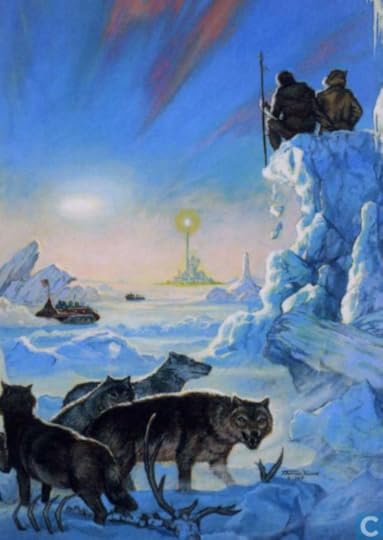
The sun and all its planets had been engulfed by a vast cloud of cosmic debris, and dust motes were screening and blocking the sun's radiation from Earth. And so immense was the cloud that it would take centuries for the Solar System to pass entirely though it! The result is a new Ice Age. Self-contained, atomic-powered cities were built, capable of surviving under the ice for an indefinite length of time. The underground city of New York was ready for occupancy in the year 2297, about a century after the Earth had entered the cloud of cosmic dust. And now it was 2650 a.d., and the underground cities were more than three hundred years old. They had long since lost contact with one another, and by now all such contact was taboo. The New Yorkers, whose number had grown to 800,000 and then had been fixed there by law, were warm and happy in their underground hive. But after 300 years the ice is finally rolling back. Who cared for the outside world? Why go back to that vale of tears? ⠀
⠀
Silverberg's post-apocalyptic adventure story was really good for me. A nice piece of fiction from one of the Grand Masters of the genre. This is the kind of book that makes me love speculative fiction even more, and in this case not only because of the global reaction to an impending ice age but also because of the anthropological implications. Human beings can get used to everything, right? Give resilience some time and new standards will emerge, we might even forget the surface and open spaces and become agoraphobic beings living comfortably in underground cities (which reminds me of Asimov's "The Caves of Steel"). Fortunately, some would not settle. Some would try to search for other survivors and even surface and travel thousands of miles across frozen lands and oceans just for the sake of human contact. This is their story.

January 11, 2018
I would have probably liked this book very much had I read it back when I was twelve - though I read very little back then. Maybe if it was handed to me at that time instead of the other dull stuff that was, I might have gotten into reading before I reached my forties. Anyway, this neat little action novel was exactly that. Action. It had some problems for me: Motivation to cross the Atlantic when not invited, simplistic society groups along the way, all needlessly suspicious of each other... Reading it as an adult was so so, but I would definitely recommend to any young one in my world who had an inkling of interest in this sort of thing. It wasn't quite up to a Heinlein juvenile standard as there wasn’t much depth or bigger issues discussed here, but still, an entertaining yarn that would hold up just fine to any young reader today.

February 9, 2015
Given that global warming seems to be an almost universally accepted fact of life these days (except by obstinate conspiracy theorists such as my buddy Ron, who also denies that men ever walked on the moon), it might strike a reader as strange to come across a sci-fi novel that posits the advent of a new Ice Age in the early 23rd century. And yet, such is the case with Robert Silverberg's "Time of the Great Freeze," a novel that first saw the light of day as a Holt, Rinehart & Winston hardcover in 1964. This was right in the middle of Silverberg's supposed "retirement" period from science fiction, which began in '59 and ended when editor Frederik Pohl induced the author to come roaring back in '67. The year 1964 saw Silverberg release only one other sci-fi novel, "Regan's Planet," in addition to 28 "adult" novels (with such marvelous titles as "Orgy Isle," "Passion Pair," "Sin Partners" and "The Flesh Seekers"), one sci-fi short story ("Neighbor"), and nine nonfiction books on such varied topics as the pharaoh Akhenaten, the city of Nineveh, and Antarctica. (Despite being semi-retired at this point, Silverberg apparently could not stop writing if he tried.)
As revealed on the author's "Quasi-Official Web Site," Silverberg first got the idea for "Time of the Great Freeze" during the especially frigid winter of '62 – '63, but didn't actually sit down to write the book until the especially hot following summer. Written as a "young adult" novel, the book yet retains a strong appeal for older readers, a la the great Robert A. Heinlein's 12 "juveniles" of 1947 – '58. This was hardly Silverberg's first novel for young readers--his first book, 1954's "Revolt on Alpha C," as well as 1960's "Lost Race of Mars," had been geared toward the YA group, too--and demonstrates forcefully how the author could write a fast-moving work that would strike a sympathetic chord in all age groups. Take it from this rapidly aging baby boomer: The book is a blast!
In "Time of the Great Freeze," the year is 2650, and Earth has been in the grip of its fifth Ice Age for well over 300 years. Silverberg makes this new Ice Age seem plausible to the early 21st century reader when he tells us that after several centuries of global warming, the planet had suddenly begun to cool down at the onset of the 23rd century. The cause: our solar system passing through "a vast cloud of cosmic debris," which blocks off the sun's warming radiations. Thus, by 2300, the vast bulk of mankind huddles beneath the glaciated world's surface in vast underground cities. Against this claustrophobic backdrop the reader meets Jim Barnes, a 17-year-old redhead who is studying to be a hydroponics engineer in New York City, one mile beneath the surface, and with a population of 800,000. Jim's father--a history professor--and a small band of other science-minded men have lately been engaged in the highly illegal activity of attempting communication via radio with another underground city; London, to be exact. The men are caught in the act and summarily tried and sentenced by the City Council. Their punishment: permanent exile!
And so young Jim, his Dad, and six others find themselves on the frozen surface for the first time in their lives, and resolve to make the 3,000-mile trip to London using their solar-powered sleds as conveyances. And after encountering several communities of surface dwellers--from the troglodyte variety, to the less primitive but still violent, to the peaceable Jersey folks who live on the frozen Atlantic fringes, to the Viking sorts who give the exiles a lift over the open water--and facing down feral wolves and much climatic harshness, the team does make it across the ocean...but their welcome is far different from what they’d anticipated....
The host of Silverberg’s website, Jon Davis, writes that "Time of the Great Freeze" is "not really a 'juvenile' but not really an adult book either," and he is assuredly correct in that regard. Though the book is basically a straightforward adventure tale written in simple yet elegant prose, it features occasional verbiage that might even throw an adult (such as "gimbals" and "withers"). The book is hardly sugarcoated, and our band of heroes is shown having a very tough time of it throughout. Silverberg makes his supposed "juvenile" quite grim in spots by killing off no less than three of his eight lead characters; these deaths come suddenly and unexpectedly when they occur and are invariably shocking, especially the first one, which alerts the reader that anything might happen to any given character in this gripping tale. Despite the 27th century setting, the sci-fi trappings in the book are minimal and are confined to some futuristic medical gizmos, those solar-powered sleds, and the "power torches" that our team utilizes as weapons.
In addition to Barnes senior and junior, the other members of the expedition--a Native American electronics expert, a linguist, a lawyer, a zoologist, a young police officer and a meteorologist--are all likable men (there are NO female characters in the book); though somewhat sketchily drawn, the reader still feels an affection for them all, and admires both their pluck and spirit. That elusive "sense of wonder" that is the hallmark of all good sci-fi is very much in abundance here, especially when Jim steps foot onto the Earth's surface and sees the moon, and the stars, and the sun, and a moose, and a fish for the first time. Silverberg gives his young readers--and, I suppose, his older readers, as well--some nice take-away lessons during the course of his book; for example, take these gems of wisdom: "There was time to confront trouble when it came to plague them; no need to fret ahead of time"; "Fighting, killing, that wasn’t the answer. It never was"; and "When you had done your best...there was no shame in failure."
"Time of the Great Freeze" is a wonderful novel, all told, and wraps up marvelously and unexpectedly after a rather grim final quarter. The book is nothing deep or terribly demanding, but should certainly provide several evenings of top-notch entertainment. This reader started the book during a blizzard and ended it a few days later, when the wind chill temperature in (the aboveground) New York City was -15 Fahrenheit, and I found it a perfect companion. To tell the truth, despite the fact that I am hardly a "young adult" anymore, I could not put the darn thing down.
(By the way, this review originally appeared on the FanLit website, a most excellent destination for all fans of Robert Silverberg: http://www.fantasyliterature.com/ )
As revealed on the author's "Quasi-Official Web Site," Silverberg first got the idea for "Time of the Great Freeze" during the especially frigid winter of '62 – '63, but didn't actually sit down to write the book until the especially hot following summer. Written as a "young adult" novel, the book yet retains a strong appeal for older readers, a la the great Robert A. Heinlein's 12 "juveniles" of 1947 – '58. This was hardly Silverberg's first novel for young readers--his first book, 1954's "Revolt on Alpha C," as well as 1960's "Lost Race of Mars," had been geared toward the YA group, too--and demonstrates forcefully how the author could write a fast-moving work that would strike a sympathetic chord in all age groups. Take it from this rapidly aging baby boomer: The book is a blast!
In "Time of the Great Freeze," the year is 2650, and Earth has been in the grip of its fifth Ice Age for well over 300 years. Silverberg makes this new Ice Age seem plausible to the early 21st century reader when he tells us that after several centuries of global warming, the planet had suddenly begun to cool down at the onset of the 23rd century. The cause: our solar system passing through "a vast cloud of cosmic debris," which blocks off the sun's warming radiations. Thus, by 2300, the vast bulk of mankind huddles beneath the glaciated world's surface in vast underground cities. Against this claustrophobic backdrop the reader meets Jim Barnes, a 17-year-old redhead who is studying to be a hydroponics engineer in New York City, one mile beneath the surface, and with a population of 800,000. Jim's father--a history professor--and a small band of other science-minded men have lately been engaged in the highly illegal activity of attempting communication via radio with another underground city; London, to be exact. The men are caught in the act and summarily tried and sentenced by the City Council. Their punishment: permanent exile!
And so young Jim, his Dad, and six others find themselves on the frozen surface for the first time in their lives, and resolve to make the 3,000-mile trip to London using their solar-powered sleds as conveyances. And after encountering several communities of surface dwellers--from the troglodyte variety, to the less primitive but still violent, to the peaceable Jersey folks who live on the frozen Atlantic fringes, to the Viking sorts who give the exiles a lift over the open water--and facing down feral wolves and much climatic harshness, the team does make it across the ocean...but their welcome is far different from what they’d anticipated....
The host of Silverberg’s website, Jon Davis, writes that "Time of the Great Freeze" is "not really a 'juvenile' but not really an adult book either," and he is assuredly correct in that regard. Though the book is basically a straightforward adventure tale written in simple yet elegant prose, it features occasional verbiage that might even throw an adult (such as "gimbals" and "withers"). The book is hardly sugarcoated, and our band of heroes is shown having a very tough time of it throughout. Silverberg makes his supposed "juvenile" quite grim in spots by killing off no less than three of his eight lead characters; these deaths come suddenly and unexpectedly when they occur and are invariably shocking, especially the first one, which alerts the reader that anything might happen to any given character in this gripping tale. Despite the 27th century setting, the sci-fi trappings in the book are minimal and are confined to some futuristic medical gizmos, those solar-powered sleds, and the "power torches" that our team utilizes as weapons.
In addition to Barnes senior and junior, the other members of the expedition--a Native American electronics expert, a linguist, a lawyer, a zoologist, a young police officer and a meteorologist--are all likable men (there are NO female characters in the book); though somewhat sketchily drawn, the reader still feels an affection for them all, and admires both their pluck and spirit. That elusive "sense of wonder" that is the hallmark of all good sci-fi is very much in abundance here, especially when Jim steps foot onto the Earth's surface and sees the moon, and the stars, and the sun, and a moose, and a fish for the first time. Silverberg gives his young readers--and, I suppose, his older readers, as well--some nice take-away lessons during the course of his book; for example, take these gems of wisdom: "There was time to confront trouble when it came to plague them; no need to fret ahead of time"; "Fighting, killing, that wasn’t the answer. It never was"; and "When you had done your best...there was no shame in failure."
"Time of the Great Freeze" is a wonderful novel, all told, and wraps up marvelously and unexpectedly after a rather grim final quarter. The book is nothing deep or terribly demanding, but should certainly provide several evenings of top-notch entertainment. This reader started the book during a blizzard and ended it a few days later, when the wind chill temperature in (the aboveground) New York City was -15 Fahrenheit, and I found it a perfect companion. To tell the truth, despite the fact that I am hardly a "young adult" anymore, I could not put the darn thing down.
(By the way, this review originally appeared on the FanLit website, a most excellent destination for all fans of Robert Silverberg: http://www.fantasyliterature.com/ )

March 27, 2025
Time of the Great Freeze is a kids' (pardon me, "YA") novel that Holt, Rinehart, & Winston released in hardback 1964, and then it came out in a mass market edition from Dell in 1966 as part of their Mayflower line for young readers. (I still have the copy I got from the school book fair when I was in grade school.) It's set in 2650, as an ice age which has almost wiped-out civilization on Earth is beginning to draw to a close. Jim Barnes and his father have to make their way across the ice from New York to London. (Many years later I loved Foster's Icerigger.) I thought it was an exciting story, more challenging that Tom Swift, though not quite as good as the Heinlein books I'd book recently reading. Nine-year-old me would have given it four stars...

August 22, 2014
I'm putting this on my list as "read" but a re-reading would definitely be in order. I've been racking my brain for awhile, wondering just what science fiction novel my 4th grade teacher read to us in school. I remember I liked it. It was about a time in the future when there was another ice age and everyone lived underground underneath New York City. Then some people came out to go on a journey and that's where my memory stops. Looking through books that fit this description (and were written in the 60's/70's) and were geared toward young adults (though not necessarily children) I found this book and I believe this is it.
My 4th grade teacher read us some very good books!
My 4th grade teacher read us some very good books!
June 24, 2012
I loved it when I read it for the first time when I was 12 and I loved it again reading it ten years later. It is a cute short little book, the science in it is decent, and it is a really quick read. I really enjoyed reading it. If you like post-apocalyptic novels then this might be one for you.
July 1, 2008
Read this back in High School for fun. It was a fun, quick read that was different science fiction from what I was reading at the time (mostly Star Wars novels and Fantasy books).

August 6, 2008
Silverberg's early books were great adventures. This one has to do with a new ice age.

March 17, 2012
Read this when I was in middle school and hated most books. But this one was different, I totally got into this world, it was awesome!

August 7, 2013
One of my favorite juveniles. I must have been 10 or 11 at the time and recall being totally entranced with the new world Silverberg created. A great step up from Tom Swift.

January 23, 2019
A straight forward yarn of a red-blooded American boy vs. post-apocalyptic winter where everyone is still pretty nice.

April 28, 2011
I was searching through my shelves for something small to read and came across this book. Which I don't even remember buying actually.
Set in a post apocalyptic world, the Northern hemisphere is all frozen and many live under the ice in large, highly regimented communities. When a group of men from the underground city of New York are evicted, they decide to travel across the ice to the underground city of London. Along the way they meet people who have survived on the surface and enjoy the freedom, fresh air and food available.
For such a short book it sure packed in a lot. I found it a highly enjoyable few hours of reading.
Set in a post apocalyptic world, the Northern hemisphere is all frozen and many live under the ice in large, highly regimented communities. When a group of men from the underground city of New York are evicted, they decide to travel across the ice to the underground city of London. Along the way they meet people who have survived on the surface and enjoy the freedom, fresh air and food available.
For such a short book it sure packed in a lot. I found it a highly enjoyable few hours of reading.

September 21, 2013
An Arthur C. Clarke-like expeditionary adventure story in an inconveniently glaciated, Reverse-Al Gore world, in the melodramatic writing style of a Hardy Boys mystery, with all the environmental and racial sensitivity of a James Fenimore Cooper frontier epic. That said, it does make you think about climate change on a global scale.

January 27, 2013
The good old days. Back when global warming was global cooling.

February 28, 2014
Young Adult sci fi for the 70's teenager! I still remember pulling this one from the Twin Valley High bookshelves....

July 9, 2011
I wrote a screenplay for this book in the 5th grade.

June 19, 2023
"There was something about living under the ground that changed a man's soul. You hid, cowering, from the air, from the sun and the sky and the clouds and the rain and the snow, and fright crept into your bones, so that you saw enemies on all fronts. Fear obsessed you. These Londoners were sick with fear. New York had been no better. Hide! Bar the doors, block up the tunnels! Beware the unknown!"
In the year 2200, the Fifth Ice Age begins, caused not by man-made global warming but by a cloud of solar dust that blocks the sun's radiation. The great cities burrow into massive underground silos and shut themselves under the ice. Totalitarian governments with strict population control laws are elected to maintain the delicate balance necessary to ensure the survival of the species…
By the year 2600, mankind has become comfortable living like rabbits in their safe, warm warrens. It is treason to go up top or even to establish radio communication with other cities. However, seventeen-year old Jim Barnes is one of a group of eight conspirators who believe the earth is warming again. They are willing to face exile and brave a 3000-mile journey over the frozen Atlantic Ocean in order to make face-to-face contact with other survivors…
It is time for man to reclaim the planet once again…
Silverberg wrote this book In 1963, and it came out the following year in hardcover. I suspect his publishers were looking for a way to cash in on the YA sci-fi market that had been created by Robert Heinlein in the previous decade. After Starship Troopers marked Heinlein's permanent transition to adult novels, a bevy of talented up-and-coming authors tried to fill the void--and Silverberg was one of the best of that group with juveniles like Lost Race of Mars, The Seed of Earth, and Conquerors from the Darkness.
One of the more interesting aspects of the plot concerns the nomadic tribes that never moved underground and how their cultures and speech evolved differently depending on their proximity to the ocean.
The book excels at world building and establishing the rigors of an ice-bound planet. The only concessions to this being a story for juvenile boys is there are no female characters and most of the secondary characters are underdeveloped. Otherwise, this book can easily be enjoyed by adults as well as preteens.
The most striking aspect of the story, to me, is its uncannily similarity to the bestselling 2012 sci-fi adventure Wool by Hugh Howey, which I just happened to read a few weeks ago. While the latter has been adapted into an awesome television show with high production values, Silverberg's book is actually better written and a lot more fun. It is a reminder just how talented Silverberg is as a storyteller and how many of his older works have been unjustly forgotten.
In the year 2200, the Fifth Ice Age begins, caused not by man-made global warming but by a cloud of solar dust that blocks the sun's radiation. The great cities burrow into massive underground silos and shut themselves under the ice. Totalitarian governments with strict population control laws are elected to maintain the delicate balance necessary to ensure the survival of the species…
By the year 2600, mankind has become comfortable living like rabbits in their safe, warm warrens. It is treason to go up top or even to establish radio communication with other cities. However, seventeen-year old Jim Barnes is one of a group of eight conspirators who believe the earth is warming again. They are willing to face exile and brave a 3000-mile journey over the frozen Atlantic Ocean in order to make face-to-face contact with other survivors…
It is time for man to reclaim the planet once again…
Silverberg wrote this book In 1963, and it came out the following year in hardcover. I suspect his publishers were looking for a way to cash in on the YA sci-fi market that had been created by Robert Heinlein in the previous decade. After Starship Troopers marked Heinlein's permanent transition to adult novels, a bevy of talented up-and-coming authors tried to fill the void--and Silverberg was one of the best of that group with juveniles like Lost Race of Mars, The Seed of Earth, and Conquerors from the Darkness.
One of the more interesting aspects of the plot concerns the nomadic tribes that never moved underground and how their cultures and speech evolved differently depending on their proximity to the ocean.
The book excels at world building and establishing the rigors of an ice-bound planet. The only concessions to this being a story for juvenile boys is there are no female characters and most of the secondary characters are underdeveloped. Otherwise, this book can easily be enjoyed by adults as well as preteens.
The most striking aspect of the story, to me, is its uncannily similarity to the bestselling 2012 sci-fi adventure Wool by Hugh Howey, which I just happened to read a few weeks ago. While the latter has been adapted into an awesome television show with high production values, Silverberg's book is actually better written and a lot more fun. It is a reminder just how talented Silverberg is as a storyteller and how many of his older works have been unjustly forgotten.

April 8, 2021
I recall reading this book long ago and thinking it was pretty good.
I wanted to see if it held up so I read it again.
And it doesn't hold up.
There is actually very little plot and the characters were hard to tell apart.
Most of the Earth is under a mile of ice and our heroes are exiled to the surface from New York
because they dared to communicate with people in London.
While traveling across the ice to England, they meet a surprising number of people living on the ice.
They encounter people who have reverted back to early hominid culture, another group who are similar to pre-Columbian Native Americans and some Vikings.
Somehow these people live exclusively on moose and/or walruses (the moose somehow live on algae)
and have fires and wooden ships even though there are no trees on the ice.
Most of these encounters are violent but luckily one of our heroes knows Judo and they have some
kind of combination flame thrower/disintegrator ray.
They travel in solar powered sleighs where they are exposed to the elements, kind of like a
big snowmobile.
All of this sounds silly to me now, but teenage me thought it was a cool adventure.
Young me was also oblivious to the sexism in the book.
A lot of SF books from the 1960s and before and women in only stereotypical roles.
But this book essentially has no women in it.
About the only reference to women is when one of the primitive peoples they encounter is described as 'screaming like a woman'.
So I was disappointed in the book and can't recommend it.
I have a few others that I am rereading and I hope they hold up better.
I wanted to see if it held up so I read it again.
And it doesn't hold up.
There is actually very little plot and the characters were hard to tell apart.
Most of the Earth is under a mile of ice and our heroes are exiled to the surface from New York
because they dared to communicate with people in London.
While traveling across the ice to England, they meet a surprising number of people living on the ice.
They encounter people who have reverted back to early hominid culture, another group who are similar to pre-Columbian Native Americans and some Vikings.
Somehow these people live exclusively on moose and/or walruses (the moose somehow live on algae)
and have fires and wooden ships even though there are no trees on the ice.
Most of these encounters are violent but luckily one of our heroes knows Judo and they have some
kind of combination flame thrower/disintegrator ray.
They travel in solar powered sleighs where they are exposed to the elements, kind of like a
big snowmobile.
All of this sounds silly to me now, but teenage me thought it was a cool adventure.
Young me was also oblivious to the sexism in the book.
A lot of SF books from the 1960s and before and women in only stereotypical roles.
But this book essentially has no women in it.
About the only reference to women is when one of the primitive peoples they encounter is described as 'screaming like a woman'.
So I was disappointed in the book and can't recommend it.
I have a few others that I am rereading and I hope they hold up better.

May 6, 2025
Between middle school and high school, I moved from living with my mother in the burbs to living with my father in the city. Public school to Catholic school. Moved away from all my friends.
My father owned a corner store (in Michigan, we call them "Party Stores," and we lived behind it. Every morning, he'd make coffee and walk down a set of stairs to open up. He had made a little office for me under those stairs, and I spent all summer hiding there reading books. As an only child and one of divorce, I had found reading as an easy escape when I was very young, so it only made sense to try to cope with all the life changes by going deep into books.
Time of the Great Freeze was one of thirty or so books I read that summer. Many of those books were science fiction and postapocalyptic in one way or another. Silverberg's world of another Ice Age, people living underground, and the unknown dangers of the new world outside -- well this little book spoke to my own living experience and it ends on a hopeful note.
I suppose this is why the book was a fond memory and coming across it at a used bookstore a while back...seeing that cover art was a minor emotional experience. I snagged it right away. As an adult reader, it's more of a three. Fairly basic concept and linear plot. The characters aren't terribly developed. It was considered a Young Adult book when originally published, but ultimately I think it is fairly typical for pulp adventure.
I've given it four stars, because that's what 12-year-old me thought of it and that just seems proper.
My father owned a corner store (in Michigan, we call them "Party Stores," and we lived behind it. Every morning, he'd make coffee and walk down a set of stairs to open up. He had made a little office for me under those stairs, and I spent all summer hiding there reading books. As an only child and one of divorce, I had found reading as an easy escape when I was very young, so it only made sense to try to cope with all the life changes by going deep into books.
Time of the Great Freeze was one of thirty or so books I read that summer. Many of those books were science fiction and postapocalyptic in one way or another. Silverberg's world of another Ice Age, people living underground, and the unknown dangers of the new world outside -- well this little book spoke to my own living experience and it ends on a hopeful note.
I suppose this is why the book was a fond memory and coming across it at a used bookstore a while back...seeing that cover art was a minor emotional experience. I snagged it right away. As an adult reader, it's more of a three. Fairly basic concept and linear plot. The characters aren't terribly developed. It was considered a Young Adult book when originally published, but ultimately I think it is fairly typical for pulp adventure.
I've given it four stars, because that's what 12-year-old me thought of it and that just seems proper.

May 19, 2021
A fun story, but clearly for a boyscout audience. Anderson wrote it for the young readers’ division of Holt, Rinehart & Winston. It was also a selection of the Junior Literary Guild. I realised this as soon as I was several chapters in. But still I wanted to see how it ended. A very easy read.
The world entered a new ice age and people north of the Tropic of Cancer retreated into underground cities. From one of them a group goes on a journey over the ice to another city on the other side of the Atlantic,
The main protagonist, Jim, is 17 years old. And thru his eyes we follow this journey. Is it a coincidence that the main character of Treasure Island is also called Jim? Also a young adult fiction book. But where the characters in Treasure Island had some depth, here the characters are extremely thin and not fleshed out. I have great memories of Treasure Island. I read that when I was in my teens.
But ok, since Anderson wrote for a young audiance I should not be too harsh I suppose.
So for junior readers this could be 4*, but for me this is only 2*. It’s too predictable and full of cliches.
The world entered a new ice age and people north of the Tropic of Cancer retreated into underground cities. From one of them a group goes on a journey over the ice to another city on the other side of the Atlantic,
The main protagonist, Jim, is 17 years old. And thru his eyes we follow this journey. Is it a coincidence that the main character of Treasure Island is also called Jim? Also a young adult fiction book. But where the characters in Treasure Island had some depth, here the characters are extremely thin and not fleshed out. I have great memories of Treasure Island. I read that when I was in my teens.
But ok, since Anderson wrote for a young audiance I should not be too harsh I suppose.
So for junior readers this could be 4*, but for me this is only 2*. It’s too predictable and full of cliches.
August 10, 2024
I rated this novel "C" when I read it in 1966. This translates to a Goodreads score of 2 stars.
Apparently, Silverberg used to pump out lots and lots of science fiction of limited quality in the old days. This novel would be an example of that earlier period of (too?) high-productivity. At a certain point, he reportedly re-invented himself as an author of significance. He is considered by many to be one of the best SF authors. Despite receiving an incredible number of award nominations over the years for fiction at varying lengths, he has had poor luck at being selected as the winner for Hugos, Nebulas and the like.
I have a number of his novels on my bookshelf. I am looking forward to bearing down and reading more of them.
My rating system:
Since Goodreads only allows 1 to 5 stars (no half-stars), you have no option but to be ruthless. I reserve one star for a book that is a BOMB - or poor (equivalent to a letter grade of F, E, or at most D). Progressing upwards, 2 stars is equivalent to C (C -, C or C+), 3 stars (equals B - or B), 4 stars (equals B+ or A -), and 5 stars (equals A or A+). As a result, I maximize my rating space for good books, and don't waste half or more of that rating space on books that are of marginal quality.
Apparently, Silverberg used to pump out lots and lots of science fiction of limited quality in the old days. This novel would be an example of that earlier period of (too?) high-productivity. At a certain point, he reportedly re-invented himself as an author of significance. He is considered by many to be one of the best SF authors. Despite receiving an incredible number of award nominations over the years for fiction at varying lengths, he has had poor luck at being selected as the winner for Hugos, Nebulas and the like.
I have a number of his novels on my bookshelf. I am looking forward to bearing down and reading more of them.
My rating system:
Since Goodreads only allows 1 to 5 stars (no half-stars), you have no option but to be ruthless. I reserve one star for a book that is a BOMB - or poor (equivalent to a letter grade of F, E, or at most D). Progressing upwards, 2 stars is equivalent to C (C -, C or C+), 3 stars (equals B - or B), 4 stars (equals B+ or A -), and 5 stars (equals A or A+). As a result, I maximize my rating space for good books, and don't waste half or more of that rating space on books that are of marginal quality.

April 12, 2019
For what it was, this book was a fun read. It is super plot driven. It is nearly inconsequential who the characters actually are. They are not really developed at all. The main group of characters that travel together meet a lot of interesting "clans" along their journey. It is certainly a fun adventure story. The pacing is excellent. Right when one encounter ends another begins. I would say that the pacing is the strength of the book. There are no drawn out inner monologues or overly descriptive passages to pull you away from the actual events of the story. The descriptions are vivid and succinct, not overly wordy. They create a vivd picture, then move on. I think that is what made it fun to read. There wasn't much extra language to pull you away from the guts of the story.

August 6, 2021
I always enjoy a Silverberg book. That said, this isn't his greatest work. Even though I gave it 3 stars as well, I liked Michael Moorcock's Ice Schooner a little better--a book along the same lines of an ice age gripping earth. Moorcock wrote his book 5 years later and I can't help but wonder if this book was an influence.
I digress though. As always, Silverberg uses alternate realities to create a story around fundamental human questions, but does it well. He is always as concerned with telling a story as he is with making a point and I appreciate that. However, in this case, he didn't do as well with the story telling and it shows.
I wouldn't pick this up as your first Silverberg book, but if you enjoy him as an author, it is a fun quick read. Solid 3 stars.
I digress though. As always, Silverberg uses alternate realities to create a story around fundamental human questions, but does it well. He is always as concerned with telling a story as he is with making a point and I appreciate that. However, in this case, he didn't do as well with the story telling and it shows.
I wouldn't pick this up as your first Silverberg book, but if you enjoy him as an author, it is a fun quick read. Solid 3 stars.

August 21, 2021
It was exactly as expected: pulpy and dated, fun and skipable.
Minor spoilers in the notes below.
This was pretty clearly a story built around an idea. Why do they need to cross the Atlantic? What does the ending have to do with anything leading up to it? Best not to ask too many questions.
In Chapter 3 (titled "To the Surface!"), the elevator goes all the way to the top of the ice. How does that work, given the city was built before the ice's depth had maxed out, and given that even the pre-surface-taboo New Yorkers had no desire to leave the city prior to the ice receding?
The book's description of Ted Callison's Native American ancestry has not aged well.
my favorite quote: "Their faces showed a mingling of fear and defiance, always a bad combination."
Minor spoilers in the notes below.
This was pretty clearly a story built around an idea. Why do they need to cross the Atlantic? What does the ending have to do with anything leading up to it? Best not to ask too many questions.
In Chapter 3 (titled "To the Surface!"), the elevator goes all the way to the top of the ice. How does that work, given the city was built before the ice's depth had maxed out, and given that even the pre-surface-taboo New Yorkers had no desire to leave the city prior to the ice receding?
The book's description of Ted Callison's Native American ancestry has not aged well.
my favorite quote: "Their faces showed a mingling of fear and defiance, always a bad combination."

June 4, 2020
Full review: https://sciencefictionruminations.com...
"Silverberg’s young adult (juvenile) science fiction novel Time of the Great Freeze (1964) is a by the numbers with few extra frills pulp adventure with a time-worn but still seductive premise: underground cities! Unlike Heinlein’s best juvenile sci-fi works (Starman Jones, Citizen of the Galaxy, etc), Silverberg’s work fails to conjure the same wonder. Silverberg’s portrayal of his youthful hero is dull even by 50s/60s juvenile [...]"
"Silverberg’s young adult (juvenile) science fiction novel Time of the Great Freeze (1964) is a by the numbers with few extra frills pulp adventure with a time-worn but still seductive premise: underground cities! Unlike Heinlein’s best juvenile sci-fi works (Starman Jones, Citizen of the Galaxy, etc), Silverberg’s work fails to conjure the same wonder. Silverberg’s portrayal of his youthful hero is dull even by 50s/60s juvenile [...]"

May 6, 2019
Great story.
This story tells of an ice age that forced people to take refuge underground in the Northern and Southern countries. Leaving only the countries around the Equator free of ice. A story of distrust after living 300 years in underground cities. Distrust of outsiders and of change. Very well written.
This story tells of an ice age that forced people to take refuge underground in the Northern and Southern countries. Leaving only the countries around the Equator free of ice. A story of distrust after living 300 years in underground cities. Distrust of outsiders and of change. Very well written.
December 17, 2025
It’s like an arctic expedition episode of Star Trek. It’s a short simple read that isn’t the most thrilling book in the world but like a good Star Trek episode the premise and world building is good enough to make a simple story worth reading. If you are looking for a cheap sci-fi novella from the 60s then this is a the perfect book for you.

April 8, 2026
This is science fiction, although compared to his later epics, it reads more like a Jack London novel, with its focus on survival in severe cold and hunting. The year is 2650 AD, when an Ice Age has covered most areas with glaciers and a mile of ice, and survivors from NYC have created a deep underground city that houses 800,000. Over three hundred years, following the start of underground living, the New York leaders became insular, fearful of change, and less tolerant of differing viewpoints.
The city government also becomes more authoritarian. The main characters (Dr Barnes and son Jim, Ted Callison, Roy Veeder, Dave Ellis, Dom Hannon, Chet Farrington) are a group of science geeks, with skills in electronics, law, languages, zoology and hydroponics. They discover the Ice Age is ending, so they want to contact other cities to talk about returning to the surface, and rebuilding societies. With their homemade wireless, they briefly connect to someone in London, who are less than friendly, and do not respond positively when the New Yorkers discuss plans to return to the surface. Their use of wireless radio tech is considered illegal, so they are arrested and charged with treason. They are quickly convicted by a corrupt and paranoid New York City Council, and their sentence is banishment to the earth’s surface.
The rest of the book describes how they travel to London, over the ice in solar-powered sleds, with other provisions given to them by the city, and the tribal groups and wild animals they encounter. Having lived underground all their lives, they have never seen or experienced the earth’s biosphere, have never seen the sun or stars. Silverberg is adroit at sharing their excitement, wonder and astonishment, but probably overuses the exclamation mark in doing so.
The Missing Gender
Females are strangely absent from this book. I can understand that the seven exiled men had common interests that excluded their significant others, but mothers, wives or girlfriends are not even mentioned. On their trek eastward, the New Yorkers learn the Atlantic Ocean is not frozen over, and their solar sleds are not seaworthy. Along come The Sea People, whom they eventually parlay (after some macho dueling, of course) to sail to London. The only Sea People they meet are male, because women and children are not allowed on the main deck of their ship. Consequently, not a single female character utters a single word throughout the book. Part of this, I think, is because Silverberg clearly enjoys the machismo of warfare, weapons, heated arguments and personal conflict. There is plenty of that here, and perhaps he thought female characters would get in the way of his story.
Devolution
The Ice Age glaciers travelled only so far, and the peoples, called Inlanders or Jerseys, that stayed on the surface, instead of burrowing underground, were assumed to originate from points south of New York, where the ice and cold were diminished, allowing humans to survive above ground. What is strange, though, is how these peoples are described as primitive, and lacking a language that the New Yorkers could understand. Some spoke in grunts. How can that be? It’s a stretch to believe that kind of devolution could happen in only three hundred years time, and that they would devolve into primitive savages.
Perils of Isolation
Instead of welcoming the arriving New Yorkers with open arms, the London government considers them as threats or spies that are not to be trusted. Not only did their underground isolation make them more fearful and suspicious, but London was also recently invaded by raiders. So, to the New Yorkers’ surprise, the underground Londoners don’t send a friendly welcoming committee, but a military force. They are under orders to execute these New York spies, and a gun battle ensues. However, cooler heads prevail, and the visitors are allowed to continue to London. On the way, the weather turns cold and snowy, to the point where the sleds run out of charge. Jim Barne’s (the central character) sled is separated from the group, and Jim and his cohorts eventually pass out from exhaustion and starvation.
When Jim wakes up, he finds himself in Rio de Janeiro, Brazil. The Brazilians had flown their planes north over New York, searching for any people needing help. Since their city has thrived during the Ice Age, they look to help others. Jim is suspicious of their intentions at first, because he realizes that living underground has made him fearful and distrusting of outsiders. Once he regains his health, he plans to fly to London to join his other New Yorkers, who made it to London OK, and become ambassadors, travelling to city after city, helping people adjust to the end of the Ice Age, and living above ground again.
Conclusion
Very worthy early novel from Silverberg, which most sci-fi fans would enjoy, if you’re willing to overlook a few things. For instance, his storyline has 20 US cities gradually moving underground, as the Ice Age emerged slowly. Yet after 300 years, none of the cities were even in radio contact with each other? At the time of this writing (1964), perhaps Silverberg’s vision of the future could not conceive of communication advancements. The New Yorkers were able to develop ray guns and solar powered vehicles, however.
The city government also becomes more authoritarian. The main characters (Dr Barnes and son Jim, Ted Callison, Roy Veeder, Dave Ellis, Dom Hannon, Chet Farrington) are a group of science geeks, with skills in electronics, law, languages, zoology and hydroponics. They discover the Ice Age is ending, so they want to contact other cities to talk about returning to the surface, and rebuilding societies. With their homemade wireless, they briefly connect to someone in London, who are less than friendly, and do not respond positively when the New Yorkers discuss plans to return to the surface. Their use of wireless radio tech is considered illegal, so they are arrested and charged with treason. They are quickly convicted by a corrupt and paranoid New York City Council, and their sentence is banishment to the earth’s surface.
The rest of the book describes how they travel to London, over the ice in solar-powered sleds, with other provisions given to them by the city, and the tribal groups and wild animals they encounter. Having lived underground all their lives, they have never seen or experienced the earth’s biosphere, have never seen the sun or stars. Silverberg is adroit at sharing their excitement, wonder and astonishment, but probably overuses the exclamation mark in doing so.
The Missing Gender
Females are strangely absent from this book. I can understand that the seven exiled men had common interests that excluded their significant others, but mothers, wives or girlfriends are not even mentioned. On their trek eastward, the New Yorkers learn the Atlantic Ocean is not frozen over, and their solar sleds are not seaworthy. Along come The Sea People, whom they eventually parlay (after some macho dueling, of course) to sail to London. The only Sea People they meet are male, because women and children are not allowed on the main deck of their ship. Consequently, not a single female character utters a single word throughout the book. Part of this, I think, is because Silverberg clearly enjoys the machismo of warfare, weapons, heated arguments and personal conflict. There is plenty of that here, and perhaps he thought female characters would get in the way of his story.
Devolution
The Ice Age glaciers travelled only so far, and the peoples, called Inlanders or Jerseys, that stayed on the surface, instead of burrowing underground, were assumed to originate from points south of New York, where the ice and cold were diminished, allowing humans to survive above ground. What is strange, though, is how these peoples are described as primitive, and lacking a language that the New Yorkers could understand. Some spoke in grunts. How can that be? It’s a stretch to believe that kind of devolution could happen in only three hundred years time, and that they would devolve into primitive savages.
Perils of Isolation
Instead of welcoming the arriving New Yorkers with open arms, the London government considers them as threats or spies that are not to be trusted. Not only did their underground isolation make them more fearful and suspicious, but London was also recently invaded by raiders. So, to the New Yorkers’ surprise, the underground Londoners don’t send a friendly welcoming committee, but a military force. They are under orders to execute these New York spies, and a gun battle ensues. However, cooler heads prevail, and the visitors are allowed to continue to London. On the way, the weather turns cold and snowy, to the point where the sleds run out of charge. Jim Barne’s (the central character) sled is separated from the group, and Jim and his cohorts eventually pass out from exhaustion and starvation.
When Jim wakes up, he finds himself in Rio de Janeiro, Brazil. The Brazilians had flown their planes north over New York, searching for any people needing help. Since their city has thrived during the Ice Age, they look to help others. Jim is suspicious of their intentions at first, because he realizes that living underground has made him fearful and distrusting of outsiders. Once he regains his health, he plans to fly to London to join his other New Yorkers, who made it to London OK, and become ambassadors, travelling to city after city, helping people adjust to the end of the Ice Age, and living above ground again.
Conclusion
Very worthy early novel from Silverberg, which most sci-fi fans would enjoy, if you’re willing to overlook a few things. For instance, his storyline has 20 US cities gradually moving underground, as the Ice Age emerged slowly. Yet after 300 years, none of the cities were even in radio contact with each other? At the time of this writing (1964), perhaps Silverberg’s vision of the future could not conceive of communication advancements. The New Yorkers were able to develop ray guns and solar powered vehicles, however.
This entire review has been hidden because of spoilers.
Displaying 1 - 30 of 53 reviews