

What do you think?

The Black Iron Legacy #2
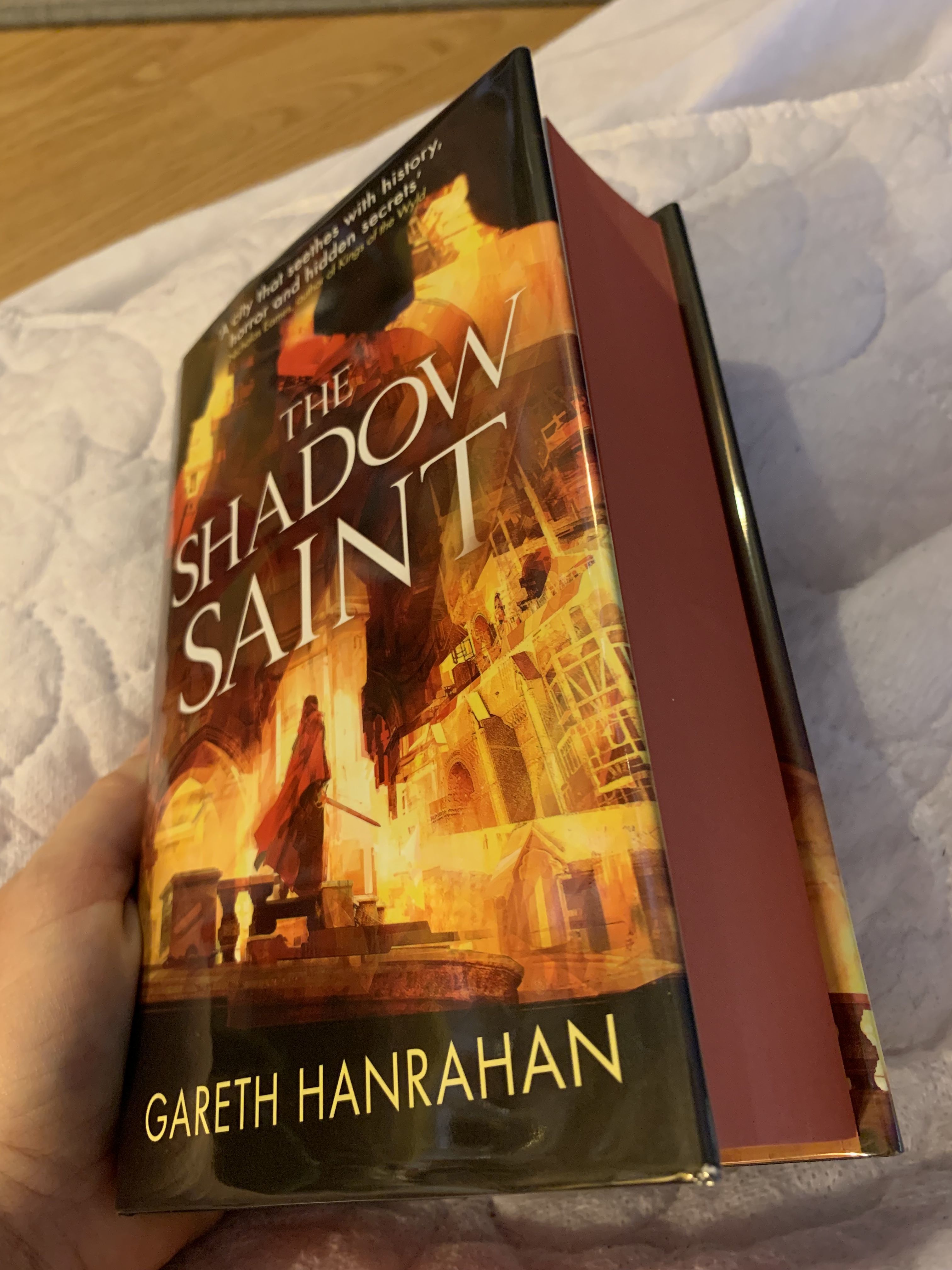
The Shadow Saint
Thieves, dangerous magic, and a weapon built with the power to destroy a god clash in this second novel of Gareth Hanrahan's acclaimed epic fantasy series, The Black Iron Legacy.
Enter a city of spires and shadows . . .
The Gutter Miracle changed the landscape of Guerdon forever. Six months after it was conjured into being, the labyrinthine New City has become a haven for criminals and refugees.
Rumors have spread of a devastating new weapon buried beneath the streets - a weapon with the power to destroy a god. As Guerdon strives to remain neutral, two of the most powerful factions in the godswar send agents into the city to find it.
As tensions escalate and armies gather at the borders, how long will Guerdon be able to keep its enemies at bay?
The Shadow Saint continues the gripping tale of dark gods and dangerous magic that began with Hanrahan's acclaimed debut The Gutter Prayer.
Enter a city of spires and shadows . . .
The Gutter Miracle changed the landscape of Guerdon forever. Six months after it was conjured into being, the labyrinthine New City has become a haven for criminals and refugees.
Rumors have spread of a devastating new weapon buried beneath the streets - a weapon with the power to destroy a god. As Guerdon strives to remain neutral, two of the most powerful factions in the godswar send agents into the city to find it.
As tensions escalate and armies gather at the borders, how long will Guerdon be able to keep its enemies at bay?
The Shadow Saint continues the gripping tale of dark gods and dangerous magic that began with Hanrahan's acclaimed debut The Gutter Prayer.
608 pages, Paperback
First published January 7, 2020
Ratings & Reviews
Friends & Following
Create a free account to discover what your friends think of this book!
Community Reviews
Displaying 1 - 30 of 312 reviews

November 25, 2019
ARC provided by the publisher—Orbit—in exchange for an honest review.
4.5/5 stars
The Shadow Saint, the sequel to my favorite debut of 2019, is here and it successfully met my high expectations with so much energy.
Firstly, a shout out to one of my favorite artists, Richard Anderson, for creating another gorgeous cover art. Remember what I said at the beginning of my review of The Gutter Prayer? I tend to find the content of an SFF book with Anderson’s cover art to be as good as the cover, and this statement holds incredibly well once again. Secondly, if it's been a while since you've read the first book, please remember that the author has a detailed recap (thank god!) of the previous book on his website. I finished reading The Gutter Prayer almost exactly a year ago. Back then, despite the book being released this year, I made a bold claim that The Gutter Prayer would be my favorite debut published in 2019, and seeing there are only five weeks left in 2019, I don’t see any possibility of this claim being proven wrong. I loved The Gutter Prayer so much, and with that in mind, The Shadow Saint managed to not only live up to my high expectation but also, once again, become one of my favorite reads of the year.
The Shadow Saint is the second book in The Black Iron Legacy series by Gareth Hanrahan. Some of you may remember that The Black Iron Legacy was planned to be a duology, as it turns out, that’s longer the case because there will be a third book. The story in The Shadow Saint begins months after The Gutter Miracle/The Crisis that changed the landscape of Guerdon that occurred at the end of the first book. Rumors of a new weapon being hidden inside the New City have spread, and now the two most powerful factions in the upcoming Godswar are sending their agents respectively to retrieve the destructive weapon.
I think it will be beneficial for many readers to know—I definitely would’ve preferred knowing about this—that the majority of the events in The Shadow Saint are told from the perspectives of Eladora and two new characters, especially in the first half of the book. The Gutter Prayer ended in a completely standalone fashion that the The Shadow Saint, in a way, felt like a standalone sequel that follows a new set of characters with a new storyline to explore. A side character from the previous book—Eladora—do take the central stage here, and her development was superb, but it did take me a while to find myself invested in the new characters; throughout the first 30% I was genuinely scared that I won’t meet any of the main characters from the previous book here because I want to know more about what happened to them. The Shadow Saint is a book that progressively gets better and better, and thankfully, the new characters gradually became more interesting, more fascinating, and empathizing as the story progressed.
Hanrahan did a terrific job in developing Eladoras and the new main characters: Terevant and The Spy. The Spy, in particular, was an incredibly fascinating character to read due to his capability to shift into a different persona at his own will. No one knows his real name and identity; being inside his head as he changed his persona repeatedly made his perspective super intriguing to read. For example, The Spy goes by the name/character of Alic, Sanhada Baradhin, or X84, to name a few; all of them have different personalities and backgrounds despite being essentially the same character. I feel like this is such a great take on a character with the role of a spy, and the moral dilemmas the character had due to being in that role was complex and believable. However, as enamored I was with Eladoras, Terevant, and The Spy, I must admit that I have a soft spot for the main characters from the previous book. I do personally think that the majority of the top highlights of the novel involved the appearances of the main characters from The Gutter Prayer. I am a sucker for well-told characterizations and character development, I love that the feeling I get when I look back to the beginning of a series and I’m able to see how much has changed for the characters, that’s what I get with the returning characters in this book. When I think about the beginning of The Gutter Prayer compared to the ongoing chaotic events in The Shadow Saint, it truly felt like so many pivotal moments have happened and changed the characters—both mentally and physically—that was there since the beginning; this situation can be applied to Eladoras as well, and I’m happier for it.
Speaking of characters, I’ve mentioned how the setting, the City of Guerdon, has become a character with proper development and personality on its own before; I can vouch that the same circumstances are still applicable in The Shadow Saint. Honestly speaking, when it comes to world-building and visualizations, not many authors can describe scenes and settings as vivid, dark, and good as Hanrahan. Hanrahan has an imagination, that when put on a page, gives a breath of fresh air to the fantasy genre. Here’s a small example of his writing:
He did the same thing in the first book, describing and comparing architecture to body parts, and it just worked so damn well for me somehow; I could easily imagine myself seeing the same things that the characters see from his writing. Here’s another example that adds more immersion to the visualization and reading experience:
Just within one paragraph, the atmosphere, the sound, the setting, were set with immediate effectiveness that ended up escalating the sense of immersion in the specific chapter. It’s efficient, it’s powerfully vivid, and it’s darkly delightful to read.
I loved reading Hanrahan’s prose; the choices and structure of words he constructed clicked with me remarkably well, and this is most evident when I’m reading his action sequences that are full of blasting devastations. Following the previous book’s tradition, the final quarter of this book was bloody magnificent and heart-pounding, Hanrahan’s depicted a gathering of madness where humans, divinities, machinery, sorcery, and monstrosities all clashed diabolically for supremacy or survival. The Shadow Saint did sacrifice the appearances of some alchemical hell from the previous book in exchange for more tempestuous fury brought by the gods and humans. For instance, this gigantic spider:
The feeling of doom birthed from the gargantuan desolation was amplified by the gloom and color of the sky that’s filled with vengeful gods; the battling Gods and Saints—an avatar of Gods—under the cloud of darkness conjured destructive lightning and a maelstrom of horror. In the face of a blazing burning sword and an indestructible holy armor, it’s safe to say that when the gods meddle, the mortals tremble. In the words of Saint Aleena: “Fucking fuckers are trying to fuck us.”
I’m going to end my review here; it’s 1.5k words already and this review has taken me four hours to write. The Shadow Saint is an unconventional, unpredictable, and undeniably brilliant sequel to the best fantasy debut of 2019. Count on Hanrahan to deliver an imaginative, refreshing, and explosive reading experience and he shall distribute it to you mercilessly. Same as The Gutter Prayer, the stellar and intelligently crafted nature of The Shadow Saint left a mind-blowing impression on me. With The Shadow Saint, Hanrahan cemented his spot as one of the most inventive storytellers in the genre. I honestly don’t know where the story will go from here, but I’m definitely excited to find out as soon as possible.
Official release date: 9th January 2020 (UK) and 7th January 2020 (US)
You can pre-order the book from: Amazon UK | Amazon US | Book Depository (Free shipping)
The quotes in this review were taken from an ARC and are subject to change upon publication.
You can find this and the rest of my reviews at Novel Notions
4.5/5 stars
The Shadow Saint, the sequel to my favorite debut of 2019, is here and it successfully met my high expectations with so much energy.
Firstly, a shout out to one of my favorite artists, Richard Anderson, for creating another gorgeous cover art. Remember what I said at the beginning of my review of The Gutter Prayer? I tend to find the content of an SFF book with Anderson’s cover art to be as good as the cover, and this statement holds incredibly well once again. Secondly, if it's been a while since you've read the first book, please remember that the author has a detailed recap (thank god!) of the previous book on his website. I finished reading The Gutter Prayer almost exactly a year ago. Back then, despite the book being released this year, I made a bold claim that The Gutter Prayer would be my favorite debut published in 2019, and seeing there are only five weeks left in 2019, I don’t see any possibility of this claim being proven wrong. I loved The Gutter Prayer so much, and with that in mind, The Shadow Saint managed to not only live up to my high expectation but also, once again, become one of my favorite reads of the year.
The Shadow Saint is the second book in The Black Iron Legacy series by Gareth Hanrahan. Some of you may remember that The Black Iron Legacy was planned to be a duology, as it turns out, that’s longer the case because there will be a third book. The story in The Shadow Saint begins months after The Gutter Miracle/The Crisis that changed the landscape of Guerdon that occurred at the end of the first book. Rumors of a new weapon being hidden inside the New City have spread, and now the two most powerful factions in the upcoming Godswar are sending their agents respectively to retrieve the destructive weapon.
“The way the Godswar is going, the whole world will be consumed sooner or later, every living soul devoured in the hungers of the mad deities.”
I think it will be beneficial for many readers to know—I definitely would’ve preferred knowing about this—that the majority of the events in The Shadow Saint are told from the perspectives of Eladora and two new characters, especially in the first half of the book. The Gutter Prayer ended in a completely standalone fashion that the The Shadow Saint, in a way, felt like a standalone sequel that follows a new set of characters with a new storyline to explore. A side character from the previous book—Eladora—do take the central stage here, and her development was superb, but it did take me a while to find myself invested in the new characters; throughout the first 30% I was genuinely scared that I won’t meet any of the main characters from the previous book here because I want to know more about what happened to them. The Shadow Saint is a book that progressively gets better and better, and thankfully, the new characters gradually became more interesting, more fascinating, and empathizing as the story progressed.
Hanrahan did a terrific job in developing Eladoras and the new main characters: Terevant and The Spy. The Spy, in particular, was an incredibly fascinating character to read due to his capability to shift into a different persona at his own will. No one knows his real name and identity; being inside his head as he changed his persona repeatedly made his perspective super intriguing to read. For example, The Spy goes by the name/character of Alic, Sanhada Baradhin, or X84, to name a few; all of them have different personalities and backgrounds despite being essentially the same character. I feel like this is such a great take on a character with the role of a spy, and the moral dilemmas the character had due to being in that role was complex and believable. However, as enamored I was with Eladoras, Terevant, and The Spy, I must admit that I have a soft spot for the main characters from the previous book. I do personally think that the majority of the top highlights of the novel involved the appearances of the main characters from The Gutter Prayer. I am a sucker for well-told characterizations and character development, I love that the feeling I get when I look back to the beginning of a series and I’m able to see how much has changed for the characters, that’s what I get with the returning characters in this book. When I think about the beginning of The Gutter Prayer compared to the ongoing chaotic events in The Shadow Saint, it truly felt like so many pivotal moments have happened and changed the characters—both mentally and physically—that was there since the beginning; this situation can be applied to Eladoras as well, and I’m happier for it.
Speaking of characters, I’ve mentioned how the setting, the City of Guerdon, has become a character with proper development and personality on its own before; I can vouch that the same circumstances are still applicable in The Shadow Saint. Honestly speaking, when it comes to world-building and visualizations, not many authors can describe scenes and settings as vivid, dark, and good as Hanrahan. Hanrahan has an imagination, that when put on a page, gives a breath of fresh air to the fantasy genre. Here’s a small example of his writing:
“The New City rises above them, a sheer cliff of unlikely architecture… Fractal shapes frozen in stone, great plazas that end in abrupt cliffs, towers like fingers on the hand of a petrified giant, all growing from the same root structure.”
He did the same thing in the first book, describing and comparing architecture to body parts, and it just worked so damn well for me somehow; I could easily imagine myself seeing the same things that the characters see from his writing. Here’s another example that adds more immersion to the visualization and reading experience:
“In Jaleh’s house, Alic and his son share a room with a man who wakes up screaming every night, and another who has roots and branches growing from his flesh. There are other prodigies in other rooms; a dying man whose innards are turning to gold, a woman whose skin blisters when she speaks the name of any god but the one who’s claimed her, a child who laughs and dances on the ceiling. It’s a refuge for those damaged by the war.”
Just within one paragraph, the atmosphere, the sound, the setting, were set with immediate effectiveness that ended up escalating the sense of immersion in the specific chapter. It’s efficient, it’s powerfully vivid, and it’s darkly delightful to read.
“Alchemical weapons inflicted terrible casualties on the armies of Ishmere. Saints dying in agony, their bones transmuted to lead, their lungs seared by poisonous gas. Phlogiston fires that cannot be quenched still burn on the battlefield.”
I loved reading Hanrahan’s prose; the choices and structure of words he constructed clicked with me remarkably well, and this is most evident when I’m reading his action sequences that are full of blasting devastations. Following the previous book’s tradition, the final quarter of this book was bloody magnificent and heart-pounding, Hanrahan’s depicted a gathering of madness where humans, divinities, machinery, sorcery, and monstrosities all clashed diabolically for supremacy or survival. The Shadow Saint did sacrifice the appearances of some alchemical hell from the previous book in exchange for more tempestuous fury brought by the gods and humans. For instance, this gigantic spider:
“Eight legs arch from horizon to horizon, arching higher than the sky. Eight eyes like moons blaze with madness and hatred. Mandibles quiver as they taste the secret thoughts of every living soul in the city, and fangs drop godly venom that splashes on the southern wall of the fort, melting the stones. The sun does not set – it flees the master of shadows, the lord of whispers.”
The feeling of doom birthed from the gargantuan desolation was amplified by the gloom and color of the sky that’s filled with vengeful gods; the battling Gods and Saints—an avatar of Gods—under the cloud of darkness conjured destructive lightning and a maelstrom of horror. In the face of a blazing burning sword and an indestructible holy armor, it’s safe to say that when the gods meddle, the mortals tremble. In the words of Saint Aleena: “Fucking fuckers are trying to fuck us.”
“Victory means a slow and bloody grind: kill every worshipper, tear down every temple, break every relic, dispel every miracle – and do it all again, over and over, until the god’s a forgotten shadow, shrieking in the void.”
I’m going to end my review here; it’s 1.5k words already and this review has taken me four hours to write. The Shadow Saint is an unconventional, unpredictable, and undeniably brilliant sequel to the best fantasy debut of 2019. Count on Hanrahan to deliver an imaginative, refreshing, and explosive reading experience and he shall distribute it to you mercilessly. Same as The Gutter Prayer, the stellar and intelligently crafted nature of The Shadow Saint left a mind-blowing impression on me. With The Shadow Saint, Hanrahan cemented his spot as one of the most inventive storytellers in the genre. I honestly don’t know where the story will go from here, but I’m definitely excited to find out as soon as possible.
Official release date: 9th January 2020 (UK) and 7th January 2020 (US)
You can pre-order the book from: Amazon UK | Amazon US | Book Depository (Free shipping)
The quotes in this review were taken from an ARC and are subject to change upon publication.
You can find this and the rest of my reviews at Novel Notions

January 3, 2020
I would first like to say that The Black Iron Legacy series by Gareth Hanrahan has officially become one of my favorite current dark fantasy series going, to the extent that I anticipate each new release now with bated breath. The world that Hanrahan has created in these books is so incredibly cool and unique that it almost defies explanation. I had an inkling that I would enjoy THE SHADOW SAINT, but I wasn't prepared to love it so much that I would alienate myself from my family for nights on end as I flew through its 560 pages. I just had to find out how it ended as quickly as possible. I will try my best to put this experience into words although I am sure that I will fail in that endeavor.
The events that culminated book one of this series, The Gutter Prayer, left much of Guerdon and its surrounding territories in a state of flux. A once great land has now become a stomping ground for all types of miscreants and criminals, as well as various poor and downtrodden inhabitants. Lawlessness reigns supreme and the only rule that governs at the moment is one where there are no rules. What was unleashed in the previous book has literally decimated Guerdon and created a destitute New City in its wake. Yet inexplicably that may not be the worst thing to have happened to the beleaguered city of spires, labyrinths, and shadows.
For word has slowly leaked out that there may be a secret weapon buried inside this New City that may turn the tide for anyone who can claim it and harness its power. And as the struggle for power between the two most prominent factions in the godswar grows and intensifies, it is incumbent upon each to send agents into a city of abominations and creatures beyond imagining to recover it for their own deadly ambitions. The problem may not be so much in finding this doomsday weapon, but rather in making it back out alive past the ghouls that lurk among Guerdon's ghostly catacombs and gloomy crevices.
What is becoming even more clear with each passing moment is that the godswar is indeed coming to a head, and whoever is able to possess this most vaunted weapon capable of obliterating a god will most-likely declare victory. In its attempt to remain neutral, Guerdon has also left itself exposed to attacks that could change the face of its history for ages to come. Yet there continue to be those sandwiched between the closing vice of these invading armies who hold out hope that they may fend off the oncoming war. But how can mere mortals compete in a scenario where ruthless gods are the main combatants and horrific magic is wielded without mercy.
Wow, was this just an unbelievable read. I thought that The Gutter Prayer was very good, but this book takes the story to an entirely new level and alludes to a potentially phenomenal final installment. Middle books are usually known for being a bit slower as the plot normally shifts in some way and sometimes even crawls as things are set up for the climactic third book, but that is nowhere near the case with THE SHADOW SAINT. I actually thought the action was even more intense in this book and the pace was a good deal faster.
I applaud Gareth Hanrahan for once again formulating some of the most spectacular world-building that I've read in a really long time. As someone who appreciates exceptional world-building and a deeply textured history in my fantasy reads (almost to the exclusion of everything else), you can't get much better than this series. Usually the characters are what drive the story, and I'm not saying that Hanrahan doesn't write great characters, but Guerdon itself is such an intricate and amazing construct that it evolves into a main character unto itself. As such it is really interesting to explore this world through the eyes of the narrator and each individual character.
And speaking of characters, things are slightly different in THE SHADOW SAINT in that the viewpoint characters are entirely different from The Gutter Prayer. We do get to revisit our familiar favorites and they do impact this particular story significantly, but they are not the main characters here. I thought it was a refreshing change and it made this book feel somewhat separate from book one, while still advancing the story in an effective and fascinating way. I truly can't say enough about this book and series as Hanrahan has taken what he established in the first book and given us another absolute winner of a book to savor.
If you are looking for one of the best dark fantasy series being published today, look no further than The Black Iron Legacy. It's so difficult to find a book with such a stark and ominous subject matter, yet makes you feel utterly delighted and entertained while you're reading it. I'd say that is a talent that few writers have the ability to master, but Hanrahan has done so in spades in my opinion. You can preorder THE SHADOW SAINT right now on Amazon, as the official release date isn't until January 7th (just a few days away!). While you are waiting I recommend that you grab book one, The Gutter Prayer and dive into this brilliantly inventive series as soon as possible. I'm not sure how Gareth Hnrahan is going to top THE SHADOW SAINT, but I'm eager to find out.
The events that culminated book one of this series, The Gutter Prayer, left much of Guerdon and its surrounding territories in a state of flux. A once great land has now become a stomping ground for all types of miscreants and criminals, as well as various poor and downtrodden inhabitants. Lawlessness reigns supreme and the only rule that governs at the moment is one where there are no rules. What was unleashed in the previous book has literally decimated Guerdon and created a destitute New City in its wake. Yet inexplicably that may not be the worst thing to have happened to the beleaguered city of spires, labyrinths, and shadows.
For word has slowly leaked out that there may be a secret weapon buried inside this New City that may turn the tide for anyone who can claim it and harness its power. And as the struggle for power between the two most prominent factions in the godswar grows and intensifies, it is incumbent upon each to send agents into a city of abominations and creatures beyond imagining to recover it for their own deadly ambitions. The problem may not be so much in finding this doomsday weapon, but rather in making it back out alive past the ghouls that lurk among Guerdon's ghostly catacombs and gloomy crevices.
What is becoming even more clear with each passing moment is that the godswar is indeed coming to a head, and whoever is able to possess this most vaunted weapon capable of obliterating a god will most-likely declare victory. In its attempt to remain neutral, Guerdon has also left itself exposed to attacks that could change the face of its history for ages to come. Yet there continue to be those sandwiched between the closing vice of these invading armies who hold out hope that they may fend off the oncoming war. But how can mere mortals compete in a scenario where ruthless gods are the main combatants and horrific magic is wielded without mercy.
Wow, was this just an unbelievable read. I thought that The Gutter Prayer was very good, but this book takes the story to an entirely new level and alludes to a potentially phenomenal final installment. Middle books are usually known for being a bit slower as the plot normally shifts in some way and sometimes even crawls as things are set up for the climactic third book, but that is nowhere near the case with THE SHADOW SAINT. I actually thought the action was even more intense in this book and the pace was a good deal faster.
I applaud Gareth Hanrahan for once again formulating some of the most spectacular world-building that I've read in a really long time. As someone who appreciates exceptional world-building and a deeply textured history in my fantasy reads (almost to the exclusion of everything else), you can't get much better than this series. Usually the characters are what drive the story, and I'm not saying that Hanrahan doesn't write great characters, but Guerdon itself is such an intricate and amazing construct that it evolves into a main character unto itself. As such it is really interesting to explore this world through the eyes of the narrator and each individual character.
And speaking of characters, things are slightly different in THE SHADOW SAINT in that the viewpoint characters are entirely different from The Gutter Prayer. We do get to revisit our familiar favorites and they do impact this particular story significantly, but they are not the main characters here. I thought it was a refreshing change and it made this book feel somewhat separate from book one, while still advancing the story in an effective and fascinating way. I truly can't say enough about this book and series as Hanrahan has taken what he established in the first book and given us another absolute winner of a book to savor.
If you are looking for one of the best dark fantasy series being published today, look no further than The Black Iron Legacy. It's so difficult to find a book with such a stark and ominous subject matter, yet makes you feel utterly delighted and entertained while you're reading it. I'd say that is a talent that few writers have the ability to master, but Hanrahan has done so in spades in my opinion. You can preorder THE SHADOW SAINT right now on Amazon, as the official release date isn't until January 7th (just a few days away!). While you are waiting I recommend that you grab book one, The Gutter Prayer and dive into this brilliantly inventive series as soon as possible. I'm not sure how Gareth Hnrahan is going to top THE SHADOW SAINT, but I'm eager to find out.


January 14, 2020
This is the second instalment in The Black Iron Legacy series, which is fast becoming one of my favourites!
Guerdon was destroyed at the end of The Gutter Prayer and a partially new city placed directly atop of the old. The two are at war for dominance but the gods are circling ever closer and put the petty whims of mortals beneath them in their quest for power. Spies are sent to learn the secrets of those wishing to govern this divided city, but they become increasingly embroiled in more than mere political schemes as they infiltrate the inner-circle of the elite and the hearts of those around them.
I'm actually in awe of how convoluted the religious and political systems were in this book! Book one focused primarily on the abundance of religions that humans devoted their lives to. The dead were fed to them, lives given to their honour, temples constructed in devotion, and daily prayers made. The Gods returned these favours by imbuing their powers into select mortals, breaking their minds and bodies apart as they forced their way into the lesser beings. Wars were fought in their name and future ones forever impending.
This threat is carried over into book two. It still heavily features these religious aspects but as the reader becomes more aware of them and the world surrounding it, political schemings begin to take central focus. I found it a fascinating insight to campaigning and the vying of the power-hungry, complex and ever altering.
Beloved characters returned from the first book and took their place even more firmly in my heart. New characters were introduced and as their paths intermingled and the story-line forever upped the ante, this book set itself up for an action-packed and thrilling third series instalment I am impatient to get my hands upon!
I received this book in exchange for an honest review. Thank you to the author, Gareth Ryder-Hanrahan, and the publisher, Orbit, for this opportunity.
Guerdon was destroyed at the end of The Gutter Prayer and a partially new city placed directly atop of the old. The two are at war for dominance but the gods are circling ever closer and put the petty whims of mortals beneath them in their quest for power. Spies are sent to learn the secrets of those wishing to govern this divided city, but they become increasingly embroiled in more than mere political schemes as they infiltrate the inner-circle of the elite and the hearts of those around them.
I'm actually in awe of how convoluted the religious and political systems were in this book! Book one focused primarily on the abundance of religions that humans devoted their lives to. The dead were fed to them, lives given to their honour, temples constructed in devotion, and daily prayers made. The Gods returned these favours by imbuing their powers into select mortals, breaking their minds and bodies apart as they forced their way into the lesser beings. Wars were fought in their name and future ones forever impending.
This threat is carried over into book two. It still heavily features these religious aspects but as the reader becomes more aware of them and the world surrounding it, political schemings begin to take central focus. I found it a fascinating insight to campaigning and the vying of the power-hungry, complex and ever altering.
Beloved characters returned from the first book and took their place even more firmly in my heart. New characters were introduced and as their paths intermingled and the story-line forever upped the ante, this book set itself up for an action-packed and thrilling third series instalment I am impatient to get my hands upon!
I received this book in exchange for an honest review. Thank you to the author, Gareth Ryder-Hanrahan, and the publisher, Orbit, for this opportunity.

January 6, 2020
ARC received from the publisher, Orbit, in exchange for an honest review.
The Gutter Prayer had been constantly lauded as one of the best debuts of 2019. Hanrahan's imaginative and extraordinary dark fantasy worldbuilding, as well as his unique voice, continued to impress in its sequel, The Shadow Saint.
The city of Guerdon itself remained the highlight of the story to me. Again, Hanharan imbued his writing with such an vivid and evocative imagery of Guerdon that it felt like a living, breathing thing. If you've read The Gutter Prayer, you would've known that Guerdon has undergone a marvellous transformation arising from the climactic ending of that book. New City has arisen on top of the old - beautiful, white and pearly marble towers, spires and bridges covered half of the slums of the Wash. And New City continues to shift and change as necessity arises.
I believe it is also important to highlight that although The Shadow Saint followed fairly closely after the events in the previous book, the main characters are not the same. Two of the three are completely new to the readers, being characters from different parts of the world. One is an unnamed spy who has an agenda which remained opaque for a large part of the story. The other, Terevant, is the second-in-line heir to the House Erevesic of the Haith who worshipped a death-god; death is not wholly permanent for these people. One the previous supporting cast, Eladora, who is the cousin to Carillion, is now a main POV character. The key cast of Cari, Spar and Rat from the previous book did not appear until about one third into the book. Similar to The Gutter Prayer, it took me quite a while to feel invested in the new characters. Fortunately, the narrative involving the spy and Terevant kept me intrigued as it gave me new information about the gods; the power of the Houses of Haith is so fascinating.
The key plot of this book is about the impending Godswar that is due to arrive on the shores of Guerdon, which is also now on the brink of a political upheaval. I was torn between these two dominant storylines. I loved all the worldbuilding around the gods and saints. Very much less so with the political intrigue. However, testament to Hanrahan's writing and plotting skill, the story kept transforming as it progresses - getting better and better - as both major plotlines coalesce seamlessly when the paths of our three main characters finally collide. It was about slightly halfway into the book where it became really engaging and interesting for me. The climactic finale was exhilarating and explosive to say the least.
The Shadow Saint is an intriguing and fantastic continuation of The Black Iron Legacy. As all sequels should do, it built upon the world, escalated the tension and increased the stakes. It's purely my lack of interest in any politics-heavy narrative that made me enjoy this instalment less than its predecessor.
You can purchase the book from: Amazon UK | Amazon US | Book Depository (Free shipping)
You can find this and my other reviews at Novel Notions.
The Gutter Prayer had been constantly lauded as one of the best debuts of 2019. Hanrahan's imaginative and extraordinary dark fantasy worldbuilding, as well as his unique voice, continued to impress in its sequel, The Shadow Saint.
The city of Guerdon itself remained the highlight of the story to me. Again, Hanharan imbued his writing with such an vivid and evocative imagery of Guerdon that it felt like a living, breathing thing. If you've read The Gutter Prayer, you would've known that Guerdon has undergone a marvellous transformation arising from the climactic ending of that book. New City has arisen on top of the old - beautiful, white and pearly marble towers, spires and bridges covered half of the slums of the Wash. And New City continues to shift and change as necessity arises.
I believe it is also important to highlight that although The Shadow Saint followed fairly closely after the events in the previous book, the main characters are not the same. Two of the three are completely new to the readers, being characters from different parts of the world. One is an unnamed spy who has an agenda which remained opaque for a large part of the story. The other, Terevant, is the second-in-line heir to the House Erevesic of the Haith who worshipped a death-god; death is not wholly permanent for these people. One the previous supporting cast, Eladora, who is the cousin to Carillion, is now a main POV character. The key cast of Cari, Spar and Rat from the previous book did not appear until about one third into the book. Similar to The Gutter Prayer, it took me quite a while to feel invested in the new characters. Fortunately, the narrative involving the spy and Terevant kept me intrigued as it gave me new information about the gods; the power of the Houses of Haith is so fascinating.
The key plot of this book is about the impending Godswar that is due to arrive on the shores of Guerdon, which is also now on the brink of a political upheaval. I was torn between these two dominant storylines. I loved all the worldbuilding around the gods and saints. Very much less so with the political intrigue. However, testament to Hanrahan's writing and plotting skill, the story kept transforming as it progresses - getting better and better - as both major plotlines coalesce seamlessly when the paths of our three main characters finally collide. It was about slightly halfway into the book where it became really engaging and interesting for me. The climactic finale was exhilarating and explosive to say the least.
The Shadow Saint is an intriguing and fantastic continuation of The Black Iron Legacy. As all sequels should do, it built upon the world, escalated the tension and increased the stakes. It's purely my lack of interest in any politics-heavy narrative that made me enjoy this instalment less than its predecessor.
You can purchase the book from: Amazon UK | Amazon US | Book Depository (Free shipping)
You can find this and my other reviews at Novel Notions.

March 23, 2020
I believe we are living in something of a golden age of fantasy. There's so much being published and with such a variety of worlds and styles on display, that I feel honoured to be part of it. When I picked up The Gutter Prayer last year, this sentiment was really hit home for me. The level of imagination and world building and characterisation on display was so damned impressive! So I've been itching to start reading the sequel. Well I finally got around to it!
The Shadow Saint picks up a few months after the Crisis (which is what the city of Guerdon is calling the mind-bending finale of book 1). A lot has changed in the city, and yet not a lot has changed. There's still plenty of politicking, back stabbing, god-touched violence, and mysteries to be solved. Only now there's a few new players to the game... Because the Godswar is coming to Guerdon.
This book once again displays Hanrahan's imagination in full force. It helps by the fact that the gods are such a dominant presence on the world and through their saints and their miracles, almost anything is possible. We get the empire of Haith, necromancers extraordinaire, added to the mix. The dragons of Lyrix, and the entire warlike pantheon of Ishmere. It all gets a bit nuts!
I do have one little issue. It had a very slow start. It's a long book, 560 pages in paperback form, and it wasn't until about page 200 that the pace really picked up and it felt like things were happening. This is partly because we're given a largely new cast of characters, with histories to explore. And partly because the concept and players behind the Godswar needed expanding upon and much of it was done via exposition. It all just made for a bit of a slow start... but when it got going... IT GO GOING!
All in, I'm giving this book 4 stars. I loved it and cannot wait for book 3!
The Shadow Saint picks up a few months after the Crisis (which is what the city of Guerdon is calling the mind-bending finale of book 1). A lot has changed in the city, and yet not a lot has changed. There's still plenty of politicking, back stabbing, god-touched violence, and mysteries to be solved. Only now there's a few new players to the game... Because the Godswar is coming to Guerdon.
This book once again displays Hanrahan's imagination in full force. It helps by the fact that the gods are such a dominant presence on the world and through their saints and their miracles, almost anything is possible. We get the empire of Haith, necromancers extraordinaire, added to the mix. The dragons of Lyrix, and the entire warlike pantheon of Ishmere. It all gets a bit nuts!
I do have one little issue. It had a very slow start. It's a long book, 560 pages in paperback form, and it wasn't until about page 200 that the pace really picked up and it felt like things were happening. This is partly because we're given a largely new cast of characters, with histories to explore. And partly because the concept and players behind the Godswar needed expanding upon and much of it was done via exposition. It all just made for a bit of a slow start... but when it got going... IT GO GOING!
All in, I'm giving this book 4 stars. I loved it and cannot wait for book 3!

January 10, 2020
Rating: 9.5/10
Thanks to Hachette Audio, Libro.fm, the author, and the narrator for an advance listening copy of The Shadow Saint (The Black Iron Legacy #2) in exchange for an honest review. Receiving this ALC did not influence my thoughts or opinions.
The Gutter Prayer (The Black Legacy #1) was one of my favorite debuts of 2019. It was unlike any fantasy story I’d ever read before and felt like the beginning of something ground-breaking. It checked off all of the boxes of what I enjoy in a fantasy novel and left its hook deep inside me once the final page was turned. To say I utterly enjoyed it is an understatement.
But now we have The Shadow Saint, and if I utterly enjoyed the predecessor, I was absolutely enamored with the sequel. This is one of those sophomore novels you dream about reading; one that takes all of the components of the freshman hit and doubles down, shattering any preconceived notions about where the author was going to steer the adventure. I don’t know that I can say I have ever read a better second book in a series.
While Book 1 had a steady focus on three young thieves (Cari, Rat, and Spar), Book 2 shifts the perspectives to two (2) brand new characters (Terevant Erevesic and The Spy) and one (1) that we were introduced to the first time around (Eladora Duttin). While this may be a disappointment to some, and was to me prior to cracking open the book, that thought process changes rather quickly. The author did a fantastic job of instantaneously bringing said characters to the forefront, giving the reader ample opportunities to become emotionally involved with each, and maybe even one to find a new favorite character. On top of that, Hanrahan wastes zero time catching the reader up to speed with the state of things after “The Gutter Miracle” sprouted the New City and changed everything we knew about Guerdon, and the characters we became so familiar with the first time around.
The world-building that I found to be spectacular in The Gutter Prayer was nothing compared to the ever-expanding, miraculous landscapes Hanrahan poses in The Shadow Saint. If you can’t see his background in RPGs whilst reading this novel, you need to reassess what you know about the genre. From the buildings and sewers to the cobblestones that make up the streets, nothing is left boring or barren. Nothing is left to the imagination except for picturing yourself running alongside the protagonists.
I could go on and on all day about this novel, but you really just need to experience it for yourself. If you enjoyed The Gutter Prayer, I feel that you will fall in love with The Shadow Saint as I did. If you haven’t given this series a go, what are you waiting for?
I also want to give a much deserved shoutout to the narrator, John Banks. He became one of my favorite narrators while working my way through Josiah Bancroft’s The Books of Babel series, and even onto listening to Jon Hollins’ Fool’s Gold (The Dragon Lords #1). If you enjoy audiobooks at any level at all, definitely check out his library. He will always be a Top 5 for me, alongside the likes of Jim Dale, Joe Jameson, Tim Gerard Reynolds, and Roy Dotrice (RIP).
Thanks to Hachette Audio, Libro.fm, the author, and the narrator for an advance listening copy of The Shadow Saint (The Black Iron Legacy #2) in exchange for an honest review. Receiving this ALC did not influence my thoughts or opinions.
The Gutter Prayer (The Black Legacy #1) was one of my favorite debuts of 2019. It was unlike any fantasy story I’d ever read before and felt like the beginning of something ground-breaking. It checked off all of the boxes of what I enjoy in a fantasy novel and left its hook deep inside me once the final page was turned. To say I utterly enjoyed it is an understatement.
But now we have The Shadow Saint, and if I utterly enjoyed the predecessor, I was absolutely enamored with the sequel. This is one of those sophomore novels you dream about reading; one that takes all of the components of the freshman hit and doubles down, shattering any preconceived notions about where the author was going to steer the adventure. I don’t know that I can say I have ever read a better second book in a series.
While Book 1 had a steady focus on three young thieves (Cari, Rat, and Spar), Book 2 shifts the perspectives to two (2) brand new characters (Terevant Erevesic and The Spy) and one (1) that we were introduced to the first time around (Eladora Duttin). While this may be a disappointment to some, and was to me prior to cracking open the book, that thought process changes rather quickly. The author did a fantastic job of instantaneously bringing said characters to the forefront, giving the reader ample opportunities to become emotionally involved with each, and maybe even one to find a new favorite character. On top of that, Hanrahan wastes zero time catching the reader up to speed with the state of things after “The Gutter Miracle” sprouted the New City and changed everything we knew about Guerdon, and the characters we became so familiar with the first time around.
The world-building that I found to be spectacular in The Gutter Prayer was nothing compared to the ever-expanding, miraculous landscapes Hanrahan poses in The Shadow Saint. If you can’t see his background in RPGs whilst reading this novel, you need to reassess what you know about the genre. From the buildings and sewers to the cobblestones that make up the streets, nothing is left boring or barren. Nothing is left to the imagination except for picturing yourself running alongside the protagonists.
I could go on and on all day about this novel, but you really just need to experience it for yourself. If you enjoyed The Gutter Prayer, I feel that you will fall in love with The Shadow Saint as I did. If you haven’t given this series a go, what are you waiting for?
I also want to give a much deserved shoutout to the narrator, John Banks. He became one of my favorite narrators while working my way through Josiah Bancroft’s The Books of Babel series, and even onto listening to Jon Hollins’ Fool’s Gold (The Dragon Lords #1). If you enjoy audiobooks at any level at all, definitely check out his library. He will always be a Top 5 for me, alongside the likes of Jim Dale, Joe Jameson, Tim Gerard Reynolds, and Roy Dotrice (RIP).

Did Not Finish
January 4, 2020DNF @10%
★ I am going to be honest here, It is my fault that I requested an ARC of this, I take full responsibility for that. The truth is that almost all my friends loved book 1 and I requested this while barely reading a few pages of book 1. I wanted the motivation to read the book and having book 2 always help me to do that.
★ But the truth is that I found that book 1 is good but the writing style is not for me, I think it is a bit dense (subjectively speaking) and this is really an unpopular opinion. I have to concentrate very much to understand what I am reading and when I do that I enjoy it but I can't do that for more than a few paragraphs. I think that defeats the purpose because it makes it more like a chore than fun for me.
★ The book started with an awesome prologue and I decided that I will give it a chance, but soon it was my experience with book 1 all over again. I decided that I am not going to continue this series for now and I wish nothing but the best for the author as he seems like a very nice person.
★ I am not going to give this a rating because I don't want to negatively rate a book for a mistake that I made!!! I think you should take this review with a grain of salt and focus on the positive reviews because there are way more of those! If you read this or book 1, I really hope you like them and happy reading :D
★ I am going to be honest here, It is my fault that I requested an ARC of this, I take full responsibility for that. The truth is that almost all my friends loved book 1 and I requested this while barely reading a few pages of book 1. I wanted the motivation to read the book and having book 2 always help me to do that.
★ But the truth is that I found that book 1 is good but the writing style is not for me, I think it is a bit dense (subjectively speaking) and this is really an unpopular opinion. I have to concentrate very much to understand what I am reading and when I do that I enjoy it but I can't do that for more than a few paragraphs. I think that defeats the purpose because it makes it more like a chore than fun for me.
★ The book started with an awesome prologue and I decided that I will give it a chance, but soon it was my experience with book 1 all over again. I decided that I am not going to continue this series for now and I wish nothing but the best for the author as he seems like a very nice person.
★ I am not going to give this a rating because I don't want to negatively rate a book for a mistake that I made!!! I think you should take this review with a grain of salt and focus on the positive reviews because there are way more of those! If you read this or book 1, I really hope you like them and happy reading :D

February 4, 2022
4.0 Stars
I absolutely love the worldbuilding which was expanded in this second book. The book was dense with multiple perspectives to follow. I would certainly benefit from a reread to soak up all the small details. I'm really looking forward to finishing out this trilogy.
I absolutely love the worldbuilding which was expanded in this second book. The book was dense with multiple perspectives to follow. I would certainly benefit from a reread to soak up all the small details. I'm really looking forward to finishing out this trilogy.

September 21, 2020
This second book in the Black Iron Legacy was, IMHO, a better book. More interesting.
I'm sure some mileage will vary, but I was a lot more fascinated by the reconstruction following the war, the politics, the spy-stuff, and the total aftermath of all the god-stuff suffusing the world than I was for the previous book's build-up and explosion.
Overall, I think the entire novel was very entertaining.
What would I compare it to? The Powder Mage trilogy. There are a ton of similarities. I'm sure most fans of Epic Fantasy who LOVE the big magic throughout the worldbuilding will be tickled as hell by this.
Just be forewarned, this Epic Fantasy stems from a grimdark root, has everything from guns to god bombs, and let's not forget the city itself. It has personality. And anger issues. Fun stuff!
I'm sure some mileage will vary, but I was a lot more fascinated by the reconstruction following the war, the politics, the spy-stuff, and the total aftermath of all the god-stuff suffusing the world than I was for the previous book's build-up and explosion.
Overall, I think the entire novel was very entertaining.
What would I compare it to? The Powder Mage trilogy. There are a ton of similarities. I'm sure most fans of Epic Fantasy who LOVE the big magic throughout the worldbuilding will be tickled as hell by this.
Just be forewarned, this Epic Fantasy stems from a grimdark root, has everything from guns to god bombs, and let's not forget the city itself. It has personality. And anger issues. Fun stuff!

January 8, 2020
Hanrahan takes a new approach in this follow-up to The Gutter Prayer, which was one of my favorite reads from 2019. While The Gutter Prayer had a nice mix of world-building, action, and character development, The Shadow Saint changed focus and spent about half the book on politics. Guerdon's leadership is in ruins after suffering so much damage from The Crisis about ten months before when The Shadow Saint picks up. Eladora, a supporting character from tGP, is thrust into the spotlight this time around, as her intelligence and family's (and personal) involvement in the Crisis has given her a unique perspective on Guerdon's history and how to best recover.
The city struggles to stay neutral during the War of the Gods, which is raging in all the surrounding nations. Gods of War are leading nations to rise and conquer above others, and Guerdon's defenses and historic neutrality may no longer be able to withstand the horrors and side effects of what a God War would have when brought to the doorstep of their remote nation.
We are introduced to two new POVs: Terevant, the younger brother to an important mililtary and political leader, but pales in comparison and track record to his esteemed and famous sibling; and my personal favorite, The Spy, who wears personalities like clothes, and is able to change them just as easily. Terevant is called in to Guerdon to investigate the murder of an ambassador, while The Spy brings his ward, a young boy who is mentally linked to the Spider God, into the city for unknown purposes. The Spy is incredibly resourceful, and his agenda and purpose remains mysterious, but I will say that the end of the story has some huge implications for what the trilogy's conclusion may bring.
But fans of Cari, Rat, and Spar need not worry -- all appear, in some form or another, and of varying degrees, in The Shadow Saint. The implications of Spar's fate at the end of The Gutter Prayer was one of the most interesting things I was looking forward to exploring in this sequel, and it did not disappoint. And once Eladora, Terevant, and The Spy's paths start to converge around the halfway mark of the book, it almost feels like it becomes a completely different story. There is breathless action, incredibly creative set pieces, and, a *massive* ending that spans 150+ pages that you'll want to put aside a full evening to read so you won't have to put it down.
The Shadow Saint at times felt like a political thriller, a noirish murder mystery, a James Bond/Mission Impossible mashup, and a dash of Clash of the Titans. It's a weird combination of things, but it works. Really, really well. Hanrahan reminds me of Robert Jackson Bennett in terms of deep and rich world-building with a lot of thought put into how the supernatural affects various aspects of society. It's a ripping read, and recommended.
The city struggles to stay neutral during the War of the Gods, which is raging in all the surrounding nations. Gods of War are leading nations to rise and conquer above others, and Guerdon's defenses and historic neutrality may no longer be able to withstand the horrors and side effects of what a God War would have when brought to the doorstep of their remote nation.
We are introduced to two new POVs: Terevant, the younger brother to an important mililtary and political leader, but pales in comparison and track record to his esteemed and famous sibling; and my personal favorite, The Spy, who wears personalities like clothes, and is able to change them just as easily. Terevant is called in to Guerdon to investigate the murder of an ambassador, while The Spy brings his ward, a young boy who is mentally linked to the Spider God, into the city for unknown purposes. The Spy is incredibly resourceful, and his agenda and purpose remains mysterious, but I will say that the end of the story has some huge implications for what the trilogy's conclusion may bring.
But fans of Cari, Rat, and Spar need not worry -- all appear, in some form or another, and of varying degrees, in The Shadow Saint. The implications of Spar's fate at the end of The Gutter Prayer was one of the most interesting things I was looking forward to exploring in this sequel, and it did not disappoint. And once Eladora, Terevant, and The Spy's paths start to converge around the halfway mark of the book, it almost feels like it becomes a completely different story. There is breathless action, incredibly creative set pieces, and, a *massive* ending that spans 150+ pages that you'll want to put aside a full evening to read so you won't have to put it down.
The Shadow Saint at times felt like a political thriller, a noirish murder mystery, a James Bond/Mission Impossible mashup, and a dash of Clash of the Titans. It's a weird combination of things, but it works. Really, really well. Hanrahan reminds me of Robert Jackson Bennett in terms of deep and rich world-building with a lot of thought put into how the supernatural affects various aspects of society. It's a ripping read, and recommended.

February 11, 2020

Second books are where good series go to die.
Whereas The Gutter Prayer hits the ground running, The Shadow Saint struggled to find it's voice and direction.
🖤
Well this was an unexpected disappointment.
One of the biggest problems i had with this book was the repetition. Honestly, maybe putting a recap at the start of this book would have helped. As it is, every opportunity that presented itself to remind readers of something that happened in book 1 was taken and it was tiring.
🖤🖤
The political scheming was weak.
Look, if we were going down the political route eventually and Haith was going to be introduced & play a major role in this series with all these shenanigans, we really should have gotten more than a passing mention of Haith in book 1.
We're supposed to care about Haith trying to run rings around Guerdon now because.....? Where are the Black Iron gods? Where are the gods?
Basically everything that made Gutter Prayer impressive, is scraped in favour of all these political machinations that if we're being honest, would get more of a "why are we going down this route?" than an "i'm impressed" thought.
🖤🖤🖤
Hanrahan brings Guerdon, the city, the home, to the fore front of things in this book. So unlike the last book where you're rooting for Cari and Spar, you're basically rooting for Guerdon in this book and i have to say, the connection just wasn't there. And it's not like book 1 wasn't a fight for Guerdon when all was said and done, but it was done with such finesse that you were able to appreciate it at the end.
Here, the characters', the plot, basically everything, is unable to convey the sense of urgency that everything was about to go belly up and that was my main grouse with this book.
I suppose Hanharan is trying to make continuity more seamless as the series progresses and expands. Given the wider scope of the world & the direction he's decided to take in book 2, but i definitely would have appreciated more of the flow of book 1. 
All in all, just not a worthy sequel for me.

January 9, 2020
The Shadow Saint is the second book in The Black Iron Legacy trilogy, but I would recommend reading The Gutter Prayer prior to this as it doesn't stand well on its own and the events will make so much more sense having completed the series opener. I must say that I found this even more engrossing than TGP which I certainly wasn't expecting and much of the confusion over the Godswar was clarified leaving you with a much deeper understanding of where the story is heading. The fact that Hanrahan has brought in new and interesting characters is a stroke of genius and ensures that the plot evolves and moves in several fascinating and previously unexplored directions; whether you end up enjoying this second instalment will depend largely on whether you connect to the new cast of characters or not.
Although this particular Hanrahan series is all but done and dusted I eagerly await his next majestic story and richly-imagined world. And you can always wholeheartedly trust and rely on him to produce an original, complex plot, descriptive prose, powerful characters and breathtaking worldbuilding. If you enjoy novels with a potent mixture of all of those stunning aspects this will appeal to you. It very much had me partaking in the literary equivalent of angel v devil on the shoulder, with one telling me to keep devouring it and another telling me to savour it more, just like the during previous instalments except the closer we get to the climax of the series the more intensely and rapidly the consuming was that I did. Definitely a testament to Hanrahan's story weaving. Highly recommended. Many thanks to Orbit for an ARC.
Although this particular Hanrahan series is all but done and dusted I eagerly await his next majestic story and richly-imagined world. And you can always wholeheartedly trust and rely on him to produce an original, complex plot, descriptive prose, powerful characters and breathtaking worldbuilding. If you enjoy novels with a potent mixture of all of those stunning aspects this will appeal to you. It very much had me partaking in the literary equivalent of angel v devil on the shoulder, with one telling me to keep devouring it and another telling me to savour it more, just like the during previous instalments except the closer we get to the climax of the series the more intensely and rapidly the consuming was that I did. Definitely a testament to Hanrahan's story weaving. Highly recommended. Many thanks to Orbit for an ARC.

January 9, 2019
Editing to add my proper review:
Okay, I've got to admit to bias just like with "The Gutter Prayer", but it's my opinion that "The Shadow Saint" is actually a *better* book than the first in "The Black Iron Legacy" series. Way more becomes clear about The Godswar and we get to the see the growth of previous characters (particularly Eladora and Cari) in the wake of the events at the end of "The Gutter Prayer". There's a new and interesting PoV character who's got a mysterious background with a very satisfying twist.
Now the only problem with reading this one so early is that I've a longer wait for Book 3!
(No, I'm not going to say anything. You'll all just have to wait until December - and it mightn't even be called this by then.)
Okay, I've got to admit to bias just like with "The Gutter Prayer", but it's my opinion that "The Shadow Saint" is actually a *better* book than the first in "The Black Iron Legacy" series. Way more becomes clear about The Godswar and we get to the see the growth of previous characters (particularly Eladora and Cari) in the wake of the events at the end of "The Gutter Prayer". There's a new and interesting PoV character who's got a mysterious background with a very satisfying twist.
Now the only problem with reading this one so early is that I've a longer wait for Book 3!
(No, I'm not going to say anything. You'll all just have to wait until December - and it mightn't even be called this by then.)

December 21, 2019
Originally posted to I Should Read That
I received a copy of this book in exchange for an honest review. This review is spoiler-free, but may contain spoilers for The Gutter Prayer.
The Gutter Prayer tied for my #1 book of 2019, alongside The Bone Ships, and I was eagerly awaiting the release of The Shadow Saint. I was worried that the second book wouldn’t live up to Hanrahan’s incredible debut, however I should have had more faith! The Shadow Saint is a very different, but equally brilliant book.
The Shadow Saint takes place a few months after the events of The Gutter Prayer, and the city is still reeling from the Gutter Miracle. The Shadow Saint doesn't feel like a traditional sequel for a number of reason -- it is a little more dense than the first book and we follow new themes and story lines. Most prominently, however, we do not follow the three point of view characters -- Cari, Rat, and Spar -- from the first book. Instead, the story is told mainly from the perspective of a spy with many names and identities, a washed-up younger son of the Haith nobility, and former historian Eladora Duttin -- a side character from the first book and one of my favourite fantasy characters ever. At first, their stories seem disconnected from the plot of the first book and I was wondering if I had mistaken a companion novel for a sequel, however the points of view eventually begin to intertwine and each character's motivations become more and more clear. In this way, The Shadow Saint is a direct sequel that manages to feel like it has grown well beyond the first book.
While The Gutter Prayer gave the reader an intensive look into the city of Guerdon as a setting, The Shadow Saint spreads beyond Guerdon’s walls. We get to see and learn much more of the wider world, especially in the context of the ongoing God’s War. The book still primarily takes place in Guerdon, however The Spy has connections to foreign saints and Terevant's begins the story in Haith and his culture and traditions play an important role in his actions and thought processes. Eladora, while a resident of Guerdon, also adds a layer of rich context to the story with her connection to the Gods and the Keepers. Each of these characters is so wildly different and intriguing that I had no issue shifting between their points of view. Once their storylines begin to merge, The Shadow Saint kicks into high gear and is a masterpiece. The way that Hanrahan builds upon the world in the first book is wonderful and so characteristically unique.
I went into this book knowing very little and it was an absolute pleasure to unpick the layers of Hanrahan’s story. Beautifully written and expertly plotted, The Shadow Saint is a magnificent sequel and an absolute joy to read. If you liked the first book, you'll love the sequel.
I received a copy of this book in exchange for an honest review. This review is spoiler-free, but may contain spoilers for The Gutter Prayer.
The Gutter Prayer tied for my #1 book of 2019, alongside The Bone Ships, and I was eagerly awaiting the release of The Shadow Saint. I was worried that the second book wouldn’t live up to Hanrahan’s incredible debut, however I should have had more faith! The Shadow Saint is a very different, but equally brilliant book.
The Shadow Saint takes place a few months after the events of The Gutter Prayer, and the city is still reeling from the Gutter Miracle. The Shadow Saint doesn't feel like a traditional sequel for a number of reason -- it is a little more dense than the first book and we follow new themes and story lines. Most prominently, however, we do not follow the three point of view characters -- Cari, Rat, and Spar -- from the first book. Instead, the story is told mainly from the perspective of a spy with many names and identities, a washed-up younger son of the Haith nobility, and former historian Eladora Duttin -- a side character from the first book and one of my favourite fantasy characters ever. At first, their stories seem disconnected from the plot of the first book and I was wondering if I had mistaken a companion novel for a sequel, however the points of view eventually begin to intertwine and each character's motivations become more and more clear. In this way, The Shadow Saint is a direct sequel that manages to feel like it has grown well beyond the first book.
While The Gutter Prayer gave the reader an intensive look into the city of Guerdon as a setting, The Shadow Saint spreads beyond Guerdon’s walls. We get to see and learn much more of the wider world, especially in the context of the ongoing God’s War. The book still primarily takes place in Guerdon, however The Spy has connections to foreign saints and Terevant's begins the story in Haith and his culture and traditions play an important role in his actions and thought processes. Eladora, while a resident of Guerdon, also adds a layer of rich context to the story with her connection to the Gods and the Keepers. Each of these characters is so wildly different and intriguing that I had no issue shifting between their points of view. Once their storylines begin to merge, The Shadow Saint kicks into high gear and is a masterpiece. The way that Hanrahan builds upon the world in the first book is wonderful and so characteristically unique.
I went into this book knowing very little and it was an absolute pleasure to unpick the layers of Hanrahan’s story. Beautifully written and expertly plotted, The Shadow Saint is a magnificent sequel and an absolute joy to read. If you liked the first book, you'll love the sequel.
December 26, 2019
Full review is here, on my blog!~
This book carries on, more or less, from The Gutter Prayer, though it does follow different characters, for the most part.
The city of Guerdon has changed since the events of the last book. There is a New City that has sprouted in the midst of everything, and it has become a refuge for the poor and the seedier residents of the city.
There are rumours abound that hiding somewhere in the ghoul-filled tunnels of Guerdon, a weapon capable of killing the gods themselves can be found. While Guerdon tries very hard to stay neutral in the Godswar between the neighboring nations (and the gods therein) of Haith and Ishmere, both countries have sent people into the city to try and find this mysterious weapon and claim it for their side.
Our story (mostly) follows Eladora Duttin, a woman who we met a little bit in The Gutter Prayer; Terevant Erevesic, the second son of a noble house in Haith, and the brother of the current ambassador of Haith in Guerdon; and a spy from Ishmere, who has several identities that he slips into when required.
This one was just as fantastically written as its predecessor, with all kinds of awesome worldbuilding and twists and turns. While it was ever-present in the Guerdon of The Gutter Prayer, the vibe that I got from The Shadow Saint was very similar to that of China Miéville’s New Crobuzon. The city has a dirty, corrupt and ultimately otherworldly and weird feel to it, and boy, did Gareth Hanrahan really made me feel it. Like I once said about Perdido Street Station, this one gave me actual tangible reactions to the dangers or conditions of the city it takes place in. Things like disgust, repulsion, and fear. It should also be noted that in this case, just as in the case of New Crobuzon, I don’t mean this in a bad way. Not at all. Guerdon is supposed to feel corrupt and dangerous, and it does. A well told story can often make me emote for characters that I like or that I relate with, but it’s far more rare for me to have this sort of immersion in a world. Very well done.
I rather liked Terevant as a character, and the spy. Eladora wasn’t my favorite, just as she really wasn’t in the first book, but it was still entertaining to read her parts of the story. Enough that I really never wanted to put the book down no matter who was moving the story forward. Alas, real life stuff always interrupts my reading time these days.
All told, I thought this was a fantastic book in the Black Iron Legacy series, and I am excited to read more in the future!
Thanks to the author, as well as Orbit via NetGalley for the review copy.
This book carries on, more or less, from The Gutter Prayer, though it does follow different characters, for the most part.
The city of Guerdon has changed since the events of the last book. There is a New City that has sprouted in the midst of everything, and it has become a refuge for the poor and the seedier residents of the city.
There are rumours abound that hiding somewhere in the ghoul-filled tunnels of Guerdon, a weapon capable of killing the gods themselves can be found. While Guerdon tries very hard to stay neutral in the Godswar between the neighboring nations (and the gods therein) of Haith and Ishmere, both countries have sent people into the city to try and find this mysterious weapon and claim it for their side.
Our story (mostly) follows Eladora Duttin, a woman who we met a little bit in The Gutter Prayer; Terevant Erevesic, the second son of a noble house in Haith, and the brother of the current ambassador of Haith in Guerdon; and a spy from Ishmere, who has several identities that he slips into when required.
This one was just as fantastically written as its predecessor, with all kinds of awesome worldbuilding and twists and turns. While it was ever-present in the Guerdon of The Gutter Prayer, the vibe that I got from The Shadow Saint was very similar to that of China Miéville’s New Crobuzon. The city has a dirty, corrupt and ultimately otherworldly and weird feel to it, and boy, did Gareth Hanrahan really made me feel it. Like I once said about Perdido Street Station, this one gave me actual tangible reactions to the dangers or conditions of the city it takes place in. Things like disgust, repulsion, and fear. It should also be noted that in this case, just as in the case of New Crobuzon, I don’t mean this in a bad way. Not at all. Guerdon is supposed to feel corrupt and dangerous, and it does. A well told story can often make me emote for characters that I like or that I relate with, but it’s far more rare for me to have this sort of immersion in a world. Very well done.
I rather liked Terevant as a character, and the spy. Eladora wasn’t my favorite, just as she really wasn’t in the first book, but it was still entertaining to read her parts of the story. Enough that I really never wanted to put the book down no matter who was moving the story forward. Alas, real life stuff always interrupts my reading time these days.
All told, I thought this was a fantastic book in the Black Iron Legacy series, and I am excited to read more in the future!
Thanks to the author, as well as Orbit via NetGalley for the review copy.

December 31, 2019
This review and others can be read on my blog, Black Forest Basilisks.
The Shadow Saint is a devastatingly brilliant new installment in the Black Iron Legacy series by Gareth Hanrahan. Although the initial book, The Gutter Prayer, had a few weaknesses in the character development department, these were beautifully resolved and a complete nonissue in this sequel. Eladora is the primary focus of this novel, with Cari as a side character. Several new characters are also introduced: Alic, the spy, and Terevant, a man of Haith. As the Godswar closes in on Guerdon, the goals and aims of these three will align in unexpected ways. Fans of the worldbuilding from the previous novel won’t be disappointed; the expanded scope brings in a great deal of new information and helps fill in the cracks from the previous book.
If it’s been a while since you last read The Gutter Prayer, the author has courteously uploaded a quick refresher summarizing the most important plot points on his blog . I highly recommend it. My review of The Gutter Prayer can be found here , if you’re entirely new to the series.
Eladora was a fan favorite from the first book, and I suspect many readers will be excited to know that she’s the main protagonist of the sequel. Although I had trouble connecting with her initially, I found myself engaged and drawn in to her new narrative. She struggles with her desire to help her city and the lingering fears and trauma from The Crisis. Thoughts of Miren haunt her dreams, and she feels the shadows watching her at every turn. She’s landed in Effro Kelkin’s political sphere, a man who formerly controlled Guerdon’s parliament. She is a political canvasser, specifically focused on The New City created by Spar’s sacrifice and The Gutter Miracle.
Everyone else in Guerdon’s ruling elite sees the New City as a threat to public safety, a monstrous aberration that must be excised. Kelkin’s seen it for what it is – enough new votes to topple the balance of power in parliament. He hasn’t crashed his ship on the rocks. He’s beached it on a virgin shore.
The New City, however, has a vigilante saint lurking in its depths. The Saint of Knives is well-known amongst the populace, protecting the locals from criminal syndicates and foreign saints. To some, she’s a figure of shadows and fear. To Eladora…. She’s her cousin, Carillon. Cari has much less screen time in this sequel, but I was much more interested in her nevertheless. I felt cheated by Spar’s death in The Gutter Prayer, but as it turns out, he’s not entirely gone. Spar has been transfigured, stretched, and contorted into becoming a part of the New City, nearly godlike, with Carillon as his erstwhile saint. Together, they change the very landscape to suit their needs. Unlike the true gods, however, Spar is unable to regenerate himself with souls or though any other magical means. Each expenditure of power lessens his ability to interact with the New City, and Carillon struggles with doing what is needed when the price is her friend.
Alic, or X84, or Sanhada Baradhin, or simply “the spy,” is perhaps the best embodiment of The Black Iron Legacy’s primary theme: change and transfiguration. Alic sheds identities like we should shed a coat. He lives in limbo, never fully committing to any one personality. Although he is, ostensibly, a spy for Ishmere, it quickly becomes apparent that his motivations are muddy and unclear at best. His loyalties are uncertain, but as he lives his Alic identity, he becomes more and more enmeshed into it until it’s difficult for him to know where Alic ends and the spy begins. His ward, a saint of Fate Spider, becomes important to Alic… and ultimately Alic begins to overcome and change the spy, in his own turn.
Taking on the roles of refugees from the Godswar was easy for both of them. Walk like you’re hollow. Keep your voice low, as though speaking too loud might attract the attention of some mad deity. Shudder when the weather changes, when light breaks through the clouds, when certain noises are too loud, too charged with significance. Flinch at portents. The man whose name is not Sanhada Baradhin and the boy who didn’t have a name arrived on board the steamer a week ago with bowed heads, shuffling up the gangplank with a crowd of other survivors.
What we see of Ishmere, largely through Alic, is horrifying. Ishmere’s pantheon is currently set to win the Godswar; to the lion-headed goddess, Pesh, the Lion Queen, war is holy. War is endless, To conquer in war is her only purpose, and she will fulfill it at all costs. Every soul that dies on the battlefield goes to her, grows her, expands her. With support of the Kraken, Cloud Mother, and the rest of the pantheon… the Kept Gods of Guerdon, starved of soul-stuff and with only a handful of saints to their name, have little hope of defending their shores.
The goddess Pesh, Lion Queen, war-goddess of the Ishmeric pantheon – or rather her avatar, made from Captain Isigi – purrs in satisfaction and settles back onto her seat. The spy notes without alarm that the simple wooden chair is now a throne of skulls, that the trestle table has become a blood-soaked altar. The hearts begin to beat again, squirting jets of crimson across the floor. The file folder, though, is still a file folder. Isigi – or is the overlapping entity in front of him more Pesh than Isigi now? – picks it up, extends a claw and slices through the metal seal holding it shut. The spy shudders at the grace of the movement, knowing that those selfsame claws recently tore a half-mile rent in the hillside below. Isigi removes the papers, reviews them in silence. The tent reverberates with her divine breath, which smells of meat and sandalwood. Everything comes down to this.
Through Terevant, brother to the Erevesic, we see a glimpse of the other side of the Godswar. Haith has been the primary opponent of Ishmere thus far, holding the front lines. Their god of death isn’t exactly present in the same way as Ishmere’s pantheon, but the undead Vigilant who hold front lines of the war are existence enough. In Ishmere, you’re no one one until you’re dead, after all. The great houses hold phylacteries, such as the Sword Erevesic, that allow, once again, a soul to be transfigured into a piece of a greater whole upon death. Terevant is still alive, and is very much hoping to remain that way. The political situation in Guerdon is fraught with danger for him, as his brother and his brother’s wife pull him in opposing directions.
The biggest and most important change between The Shadow Saint and the Gutter prayer lies in the characters. Here, the characters feel less like they exist to support and a plot, and more like agents who create the plot as their actions and decisions impact the world around them. They all interweave beautifully, creating an intricate web of cause and effect that I felt was missing in the first book. The worldbuilding, which previously became a bit of an infodump at times, now happens organically through the knowledge and experiences of the characters. Terevant and Alic, in particular, showcase Guerdon from an outsider’s perspective. To them, The Crisis was distant history; they weren’t a part of it like Cari and Eladora. It’s a fresh, new perspective on the city as it currently exists vs the perspective of those who have lived through its most recent incarnation.
I’ll confess, I was slightly hesitant when I picked up this book based on my experience with The Gutter Prayer; I was worried that it would drag, that the hefty page count would feel slow. Instead, I found myself anxious to pick up the book each time I had to set it down, constantly on the edge of my seat, and unable to wait to find out what the characters would do next. The final third of the book, in particular, had me curious and guessing. There was a small portion in the middle that felt a little slow, but it paid off in the end. Hanrahan’s growth as a writer is deeply impressive, and I am eagerly awaiting the next installment in The Black Iron Legacy.
If you enjoyed this review, please consider reading others like it on my blog, Black Forest Basilisks.

February 21, 2020
"Uncertainty leads to fear. Fear leads to a desire to own weapons of terror and irresistible fury."
This was an excellent read! Although the story built tension slowly through out the first two thirds of the book - I was not at all bored. I was absorbed by the attention to detail in the world building and the in depth exploration of all the political maneuvering and religious factions at play in the city of Guerdon. A city on the cusp of the Godswar.
The final third of the book delivered plenty of excitement and I particularly loved seeing the character growth of Eladora Duttin, from a somewhat shy and awkward scholar to something of a political mastermind!
"You can't bear the weight of a sword forever. Sooner or later, you have to put it down." - Eladora Duttin.
Can not wait to see where things will go in Book Three of the Black Iron Legacy!
This was an excellent read! Although the story built tension slowly through out the first two thirds of the book - I was not at all bored. I was absorbed by the attention to detail in the world building and the in depth exploration of all the political maneuvering and religious factions at play in the city of Guerdon. A city on the cusp of the Godswar.
The final third of the book delivered plenty of excitement and I particularly loved seeing the character growth of Eladora Duttin, from a somewhat shy and awkward scholar to something of a political mastermind!
"You can't bear the weight of a sword forever. Sooner or later, you have to put it down." - Eladora Duttin.
Can not wait to see where things will go in Book Three of the Black Iron Legacy!

October 11, 2020
I UTTERLY ADORED The Gutter Prayer. It’s one of the best books I’ve ever read. Captivated me from page one and refused to let go the whole way through. The characters were fantastic. The world building was epic. There was so much depth, history, lore, and meaning to everything.
I loved it so much that I immediately bought the sequel.
The prose in this book, much the same as the first, is phenomenal. So much beauty and lyricism in something that’s overall very dark, tainted, and quite a bit mad. I generally dislike present tense novels, but something about this writing is too fantastic to put down. It’s a joy to read.
However, I didn’t adore The Shadow Saint, and I’m gutted that’s the case. I wanted to love this. I wanted more of what I adored in the first book. While we do spend time with new characters, those from the first book do make an appearance. But unfortunately I just cared so much less for the new ones.
There are a LOT more politics in the sequel, some of which feels a little out of left-field. I would have like it to be included more in the first book so I knew that they were pieces on the board to be aware of, kind of thing?
Instead of Tallowmen, shape-shifting Ravellers, and Crawling ones, we have legions of the dead (undead? They’re skeletons!), a little sorcery (but never explained) and a little alchemy (there was more in the first book).
The Stone Men (and their curse, and the alchemy that keeps them alive) was one of my favourite parts of the first book. It felt like an important part of the world. But they have only a few passing mentions in the sequel.
Everything felt tense in the first book. You could end up on the wrong side of a ghoul or saint and end up in a bad place.
In the sequel, everything gets turned up a notch - but there’s so much of it that the tension disappears (at least for me).
Overall I felt a lot of what made the first one brilliant was missing. It felt more like another book set in the same universe, rather than a continuation of the story. Even the Black Iron Gods, which the series is named after, took more of a back seat. They were more of a thing in the background that the characters were motivated by, rather than front-and-centre. I know that’s for plot reasons, but it felt like they could have been talking about any other “thing” than the black iron gods.
There are plenty of gods. Ishmeric gods. Kept gods. Dragon gods. Pretty much all of them act without rhyme or reason - except when they do. There is a lot going on in the background. A lot of things that characters know or learn or discover, but without telling the reader. It left me feeling confused and “just going with the flow” because I didn’t really understand how/why some decisions were made. Perhaps that’s on me for not being clever enough. I followed The Gutter Prayer very well - to the point I had those “OMG NO!” Moments when I realised what was about to happen. I had none of that with The Shadow Saint, and that significantly affected my enjoyment.
Again, it’s more on me than on the book. From the plethora of glowing 4 and 5 star reviews, it really hit the mark for a lot of people, expanded on what we had to start with, and took the narrative in a new direction.
For me, I was left flailing at the start, not sure what was going on for significant chunks of time, and missing the things I loved from the first.
There are plenty of saints in the sequel, which I suppose is aptly named. But there’s almost too many things happening at once, it’s chaotic, it’s scary, and I lose track of what’s going on, who I’m supposed to care for, and details of what people are plotting (and why).
Will I read the third book? Yes. I’d like to see where it all ends. And, of course, the dragons.
Perhaps it was just a tricky book for me for this time of year. I kept flitting between three and four stars, but as this is a personal read and a personal review, I’m going to leave it at 3 because it impacted my enjoyment a little too much.
I loved it so much that I immediately bought the sequel.
The prose in this book, much the same as the first, is phenomenal. So much beauty and lyricism in something that’s overall very dark, tainted, and quite a bit mad. I generally dislike present tense novels, but something about this writing is too fantastic to put down. It’s a joy to read.
However, I didn’t adore The Shadow Saint, and I’m gutted that’s the case. I wanted to love this. I wanted more of what I adored in the first book. While we do spend time with new characters, those from the first book do make an appearance. But unfortunately I just cared so much less for the new ones.
There are a LOT more politics in the sequel, some of which feels a little out of left-field. I would have like it to be included more in the first book so I knew that they were pieces on the board to be aware of, kind of thing?
Instead of Tallowmen, shape-shifting Ravellers, and Crawling ones, we have legions of the dead (undead? They’re skeletons!), a little sorcery (but never explained) and a little alchemy (there was more in the first book).
The Stone Men (and their curse, and the alchemy that keeps them alive) was one of my favourite parts of the first book. It felt like an important part of the world. But they have only a few passing mentions in the sequel.
Everything felt tense in the first book. You could end up on the wrong side of a ghoul or saint and end up in a bad place.
In the sequel, everything gets turned up a notch - but there’s so much of it that the tension disappears (at least for me).
Overall I felt a lot of what made the first one brilliant was missing. It felt more like another book set in the same universe, rather than a continuation of the story. Even the Black Iron Gods, which the series is named after, took more of a back seat. They were more of a thing in the background that the characters were motivated by, rather than front-and-centre. I know that’s for plot reasons, but it felt like they could have been talking about any other “thing” than the black iron gods.
There are plenty of gods. Ishmeric gods. Kept gods. Dragon gods. Pretty much all of them act without rhyme or reason - except when they do. There is a lot going on in the background. A lot of things that characters know or learn or discover, but without telling the reader. It left me feeling confused and “just going with the flow” because I didn’t really understand how/why some decisions were made. Perhaps that’s on me for not being clever enough. I followed The Gutter Prayer very well - to the point I had those “OMG NO!” Moments when I realised what was about to happen. I had none of that with The Shadow Saint, and that significantly affected my enjoyment.
Again, it’s more on me than on the book. From the plethora of glowing 4 and 5 star reviews, it really hit the mark for a lot of people, expanded on what we had to start with, and took the narrative in a new direction.
For me, I was left flailing at the start, not sure what was going on for significant chunks of time, and missing the things I loved from the first.
There are plenty of saints in the sequel, which I suppose is aptly named. But there’s almost too many things happening at once, it’s chaotic, it’s scary, and I lose track of what’s going on, who I’m supposed to care for, and details of what people are plotting (and why).
Will I read the third book? Yes. I’d like to see where it all ends. And, of course, the dragons.
Perhaps it was just a tricky book for me for this time of year. I kept flitting between three and four stars, but as this is a personal read and a personal review, I’m going to leave it at 3 because it impacted my enjoyment a little too much.

May 17, 2022
Disfruté muchísimo de La Plegaria de la Calle cuando la leí, aunque el enorme hype que tenía por leerla hizo que algunos puntos no me gustaran tanto, aún y así fue una muy buena lectura.
Para esta segunda parte, el listón estaba alto, pero, en mi opinión, Los Santos de Sombra es incluso mejor que la primera parte. Continuamos la historia un tiempo después de los sucesos del primer libro.
En esta ocasión, conocemos mucho más del mundo creado por Hanrahan. Pese a que casi toda la trama sucede de nuevo en la ciudad de Guerdon, descubriremos nuevas culturas y nuevas deidades. Sigo destacando el gran worldbuilding como punto fuerte de la obra.
También considero que la trama evoluciona y es mucho más completa (y más política) que en la primera parte. Con un ritmo constante la acción no para en ningún momento.
El trio protagonista es diferente, aunque a una de ellos ya la conocemos del primer libro. Aunque me han gustado como protagonistas, no han conseguido convencerme como Cari, Spar y Rata. Para mí, el único pero del libro. Por lo demás, un libro excelente.
Deseando leer El Dios Caído en 2023.
Para esta segunda parte, el listón estaba alto, pero, en mi opinión, Los Santos de Sombra es incluso mejor que la primera parte. Continuamos la historia un tiempo después de los sucesos del primer libro.
En esta ocasión, conocemos mucho más del mundo creado por Hanrahan. Pese a que casi toda la trama sucede de nuevo en la ciudad de Guerdon, descubriremos nuevas culturas y nuevas deidades. Sigo destacando el gran worldbuilding como punto fuerte de la obra.
También considero que la trama evoluciona y es mucho más completa (y más política) que en la primera parte. Con un ritmo constante la acción no para en ningún momento.
El trio protagonista es diferente, aunque a una de ellos ya la conocemos del primer libro. Aunque me han gustado como protagonistas, no han conseguido convencerme como Cari, Spar y Rata. Para mí, el único pero del libro. Por lo demás, un libro excelente.
Deseando leer El Dios Caído en 2023.

July 18, 2022
Lo abandono a los 10 capítulos. No se si es problema de traducción (no lo creo porque ahora me he fijado y he leído bastantes trabajos del mismo traductor), pero no puedo mas. Le echaré un ojo en otro momento al inglés a ver si tiene mas sentido porque me parece que está muy lejos de la calidad de la primera novela. He probado también el audiolibro en castellano en storytel y es también pésimo, seguramente porque de donde no hay no se puede sacar.
Quizás soy yo, no lo se, pero no puedo perder el tiempo de esta manera.
Quizás soy yo, no lo se, pero no puedo perder el tiempo de esta manera.

December 7, 2023
The second instalment in Gareth Ryder-Hanrahan's Black Iron Legacy solidifies it as one of the best fantasy series out there at the moment.
It's a sequel that does everything a sequel should do. It blows open the doors of the original's story, expanding the mythos, world and politics, making everything that happened in the first book feel even larger and more consequential.
Character rich, very high in imagination nutrients that are good for your brain meats. Full of strange worlds, magic, alchemy and lore you won't find anywhere else. Even the tangential stories we hear about the effects of the oncoming Godswar are riveting.
Really spectacular work. I look forward to reading the next one.
8/10
It's a sequel that does everything a sequel should do. It blows open the doors of the original's story, expanding the mythos, world and politics, making everything that happened in the first book feel even larger and more consequential.
Character rich, very high in imagination nutrients that are good for your brain meats. Full of strange worlds, magic, alchemy and lore you won't find anywhere else. Even the tangential stories we hear about the effects of the oncoming Godswar are riveting.
Really spectacular work. I look forward to reading the next one.
8/10

September 6, 2025
Love the book
September 10, 2026
An absolute zany sequel of genius. I honestly laugh out loud rarely when reading but this series has done that to me several times.
This sequel is basically a whole new ballgame. New characters, new backdrop but a staggeringly brilliant political mess of gods, creatures and the inhabitants of this maddening world.
I can’t help but think if Steven Erickson, Brent Weeks and Michael Fletcher had a book writing party with Erikson passing out early it would look something like this. Absolutely bonkers. Incredibly witty dialogue where I can’t stop smiling.
Oh and don’t worry. Your old friends from the Gutter Prayer haven’t completely disappeared.
While I usually love the glum, gritty sprawled out epics this is a wonderful breath of fresh air.
Looking forward to book 3
This sequel is basically a whole new ballgame. New characters, new backdrop but a staggeringly brilliant political mess of gods, creatures and the inhabitants of this maddening world.
I can’t help but think if Steven Erickson, Brent Weeks and Michael Fletcher had a book writing party with Erikson passing out early it would look something like this. Absolutely bonkers. Incredibly witty dialogue where I can’t stop smiling.
Oh and don’t worry. Your old friends from the Gutter Prayer haven’t completely disappeared.
While I usually love the glum, gritty sprawled out epics this is a wonderful breath of fresh air.
Looking forward to book 3
April 25, 2020
3.5 Stars~
"So, fuck, there's a zombie chasing her."
The Shadow Saint is the second installment in Gareth Hanrahan's Black Iron Legacy series. The third book is set to be released early next year.
It has been well over a year since I read The Gutter Prayer, which was an exceptional debut! The worldbuilding was mind-blowing and the monsters that littered the pages delighted me immensely!
The Shadow Saint is a heavily ambitious sequel, which wasn't always successful. The story is quite different from The Gutter Prayer and I would be lying if I didn't mention that it threw me off in the beginning.
With a series, you've got a long journey ahead, so it doesn't always work out that each individual installment is as promising as the one before it. A sequel is difficult in many ways, not only having to follow up after such a popular first book, but the extent with which you've got to bridge the story.
The Shadow Saint did this in the end, but it took awhile to get there!
"Eladora stands in the rain, the fiery sword in her hands smokes with her mother's blood. Heaven-forged steel armours her; her heart feels like it's a blazing sun, flooding her with infinite light."
Picking up shortly after the events in the Gutter Prayer, which resulted in the Gutter Miracle aka the Crisis, Guerdon has been thrown into chaos. Rumors swirl about regarding a devastating secret weapon that may be buried beneath the New City. Those factions invested in finding this weapon send agents in to retrieve it before it ends up in the wrong hands.
The Shadow Saint completely flipped the switch in terms of the main POV's, this time focusing on Terevant and the Spy, as well as Eladora who you will remember as the scholar from The Gutter Prayer. My understanding is that Hanrahan means for the series to focus on one of the main characters, like Eladora, and then have the secondary cast of characters taking turns as the other POV's.
One of the main reasons I am drawn to a series is because I form an attachment to the characters. I found it jarring, changing up the original characters in the second book. I couldn't help but feel the loss of the group that I had grown fond of. Something always felt like it was missing, although I did warm up to this cast eventually.
The Spy is one such character, who is actually many different characters! Going by various names (X84, Alic and Sanhada Baradhin), the Spy is brilliantly written. I couldn't shake the image of him being similar to Jaqen H'ghar, the faceless man from Game of Thrones. It did take a hot second to process everything with his story, but I ended up digging him a lot! Perhaps because I'm a fan of movies that involve spies and espionage, which is front and center in this installment.
The worldbuilding in the Black Iron Legacy is vivid and large in scope. Immersing the reader into something atmospheric and effective, similar to something you may expect from China Miéville, while still wholly original.
Mercenaries, ghouls, goddesses, caustic fog, DRAGONSSS. There aren't any Tallowmen in this though, unfortunately. Although there *are* reanimated skeletons! One in particular that I just adored! I mean.. who doesn't enjoy some necromancy with their fantasy books?!?
Overall, there's a severe lack of monsters that were so prevalent in the first book. That, along with the character focus change, created such a different vibe with this volume. Taking itself a little too seriously, in some ways. This isn't uncommon, especially with sequels. However, a bit of the magic has been lost for me. Some of the raw, unfiltered zaniness is no longer. The Gutter Prayer was fucking bonkers and The Shadow Saint is.. dense with politics. I dig political fantasies, I'm all about a rebel alliance overthrowing the greedy corporations and what not. But damn! There is just such a large focus on politicking within this sequel that it often felt dry and uneven.
The last 200 pages were by far the most compellling. Tension escalated, progress was made, the characters started to truly ramp shit up. This last third reinvigorated my curiousity regarding how the series will play out, without a doubt.
(Thanks to Orbit Books for sending me a copy!)
"So, fuck, there's a zombie chasing her."
The Shadow Saint is the second installment in Gareth Hanrahan's Black Iron Legacy series. The third book is set to be released early next year.
It has been well over a year since I read The Gutter Prayer, which was an exceptional debut! The worldbuilding was mind-blowing and the monsters that littered the pages delighted me immensely!
The Shadow Saint is a heavily ambitious sequel, which wasn't always successful. The story is quite different from The Gutter Prayer and I would be lying if I didn't mention that it threw me off in the beginning.
With a series, you've got a long journey ahead, so it doesn't always work out that each individual installment is as promising as the one before it. A sequel is difficult in many ways, not only having to follow up after such a popular first book, but the extent with which you've got to bridge the story.
The Shadow Saint did this in the end, but it took awhile to get there!
"Eladora stands in the rain, the fiery sword in her hands smokes with her mother's blood. Heaven-forged steel armours her; her heart feels like it's a blazing sun, flooding her with infinite light."
Picking up shortly after the events in the Gutter Prayer, which resulted in the Gutter Miracle aka the Crisis, Guerdon has been thrown into chaos. Rumors swirl about regarding a devastating secret weapon that may be buried beneath the New City. Those factions invested in finding this weapon send agents in to retrieve it before it ends up in the wrong hands.
The Shadow Saint completely flipped the switch in terms of the main POV's, this time focusing on Terevant and the Spy, as well as Eladora who you will remember as the scholar from The Gutter Prayer. My understanding is that Hanrahan means for the series to focus on one of the main characters, like Eladora, and then have the secondary cast of characters taking turns as the other POV's.
One of the main reasons I am drawn to a series is because I form an attachment to the characters. I found it jarring, changing up the original characters in the second book. I couldn't help but feel the loss of the group that I had grown fond of. Something always felt like it was missing, although I did warm up to this cast eventually.
The Spy is one such character, who is actually many different characters! Going by various names (X84, Alic and Sanhada Baradhin), the Spy is brilliantly written. I couldn't shake the image of him being similar to Jaqen H'ghar, the faceless man from Game of Thrones. It did take a hot second to process everything with his story, but I ended up digging him a lot! Perhaps because I'm a fan of movies that involve spies and espionage, which is front and center in this installment.
The worldbuilding in the Black Iron Legacy is vivid and large in scope. Immersing the reader into something atmospheric and effective, similar to something you may expect from China Miéville, while still wholly original.
Mercenaries, ghouls, goddesses, caustic fog, DRAGONSSS. There aren't any Tallowmen in this though, unfortunately. Although there *are* reanimated skeletons! One in particular that I just adored! I mean.. who doesn't enjoy some necromancy with their fantasy books?!?
Overall, there's a severe lack of monsters that were so prevalent in the first book. That, along with the character focus change, created such a different vibe with this volume. Taking itself a little too seriously, in some ways. This isn't uncommon, especially with sequels. However, a bit of the magic has been lost for me. Some of the raw, unfiltered zaniness is no longer. The Gutter Prayer was fucking bonkers and The Shadow Saint is.. dense with politics. I dig political fantasies, I'm all about a rebel alliance overthrowing the greedy corporations and what not. But damn! There is just such a large focus on politicking within this sequel that it often felt dry and uneven.
The last 200 pages were by far the most compellling. Tension escalated, progress was made, the characters started to truly ramp shit up. This last third reinvigorated my curiousity regarding how the series will play out, without a doubt.
(Thanks to Orbit Books for sending me a copy!)

February 3, 2020
The plot of The Shadow Saint follows on from the aftermath of The Gutter Prayer, which was my favourite book of 2019. However, the main narrative voices do not follow the same characters as the previous book, although they do feature in the story. It was a great experience watching one of the minor characters from The Gutter Prayer develop their own strong sense of identity and endure their own journey, whilst also catching up with what our previous characters are doing now. The story line continues to follow the war of the Gods and the politicking and scheming that goes on alongside this. Gareth's world building remains amazing throughout and, for me, his writing style is hard to beat. I am already looking forward to the next instalment.

January 20, 2020
The Gutter Prayer by Gareth Hanrahan was one of my favourite reads last year and I can honestly say that The Shadow Saint is even better and I am sure will find a place in my top 10 of 2020. Yes, it starts slow, but it is understandable, because we are introduced to new characters and we are filled with more information about the world.
But after that the pace gets a lot faster and doesn't slow to the end. We have three main PoV's in this book and only one of them we met in previous book. Our new friends are Terevant a disgraced brother of the ambassador from the important family of Haith, and Alic (or the spy) who is much more mysterious. Terevant I liked from the start but I needed time to feel warmth to Alic (maybe because his chapters were the slowest), but then he grew up on me, and after that ... well, I'm not gonna spoil anything but things got interesting.
The main protagonist is Eladora who we met before. After finishing The Gutter Prayer I thought that she's a character with a most potential and I wasn't wrong. I wthink I like her as a protagonist more than I liked Cari. I love her character development thorugh this book, we can see as she finds a an inner strength and becomes a hero of the story. Now I think that she has even more potential to become someone legendary.
As for characters from the previous book, we meet them. Cari plays quite a role and Rat is present, too, though mostly at the end of the book. There's even a little of Spar but unfortunately in another form. I also liked some other characters, like Silkpurse who we meet briefly in the first book and now she became a good ally to our friends.
As for a plot there's a lot going on in the Guerdon. The city is alive, but it is not safe. There is much more politics in this book. There are people who want to take care of the city and make it whole again but the danger from foreign gods is present and the threat of war is real.
The Shadow Saint is brilliant book, full of the great atmopshere of previous novel, but richer with worldbuilding and details. Characters are great and memorable. It was one of those books you want to finish to know how it ends but don't want to finish because you don't want to say goodbye to the world.
I think it fully deserves 5 stars,
But after that the pace gets a lot faster and doesn't slow to the end. We have three main PoV's in this book and only one of them we met in previous book. Our new friends are Terevant a disgraced brother of the ambassador from the important family of Haith, and Alic (or the spy) who is much more mysterious. Terevant I liked from the start but I needed time to feel warmth to Alic (maybe because his chapters were the slowest), but then he grew up on me, and after that ... well, I'm not gonna spoil anything but things got interesting.
The main protagonist is Eladora who we met before. After finishing The Gutter Prayer I thought that she's a character with a most potential and I wasn't wrong. I wthink I like her as a protagonist more than I liked Cari. I love her character development thorugh this book, we can see as she finds a an inner strength and becomes a hero of the story. Now I think that she has even more potential to become someone legendary.
As for characters from the previous book, we meet them. Cari plays quite a role and Rat is present, too, though mostly at the end of the book. There's even a little of Spar but unfortunately in another form. I also liked some other characters, like Silkpurse who we meet briefly in the first book and now she became a good ally to our friends.
As for a plot there's a lot going on in the Guerdon. The city is alive, but it is not safe. There is much more politics in this book. There are people who want to take care of the city and make it whole again but the danger from foreign gods is present and the threat of war is real.
The Shadow Saint is brilliant book, full of the great atmopshere of previous novel, but richer with worldbuilding and details. Characters are great and memorable. It was one of those books you want to finish to know how it ends but don't want to finish because you don't want to say goodbye to the world.
I think it fully deserves 5 stars,

January 6, 2020
3.5 of 5 stars at The BiblioSanctum https://bibliosanctum.com/2020/01/09/...
Here’s what you need to know about The Shadow Saint: it is the second book of The Black Iron Legacy series by Gareth Hanrahan, but it doesn’t really follow the tradition of a direct sequel. While the story picks up soon after the events of The Gutter Prayer, the focus has mostly shifted to another set of characters, though a lot of familiar faces from the first book return. Not surprisingly, when it comes to these types of sequels, it’s also common for a shift in tone, and indeed we see a little bit of that happening here. Obviously, your experience will differ based on your own personal preferences, but it was because of this shift that I felt The Shadow Saint was not as strong as The Gutter Prayer, which had a plot and themes that suited me better. That said, this was still a good book and a respectable follow-up. It just felt different, which can be either a negative or a positive depending on your tastes.
Also keep in mind that because this is a review to a sequel, it may contain plot details from the previous book, and I recommend being caught up first if you want to avoid any possible spoilers. In the aftermath of the chaotic events at the end of The Gutter Prayer, Guerdon is left in shambles with a power vacuum waiting to be filled. Amidst the lawlessness left by what is now known as the Gutter Miracle, the area has become a neutral haven for all manner of displaced groups, from roving bands of brigands to exiled saints and other magical creatures. In a move to bring some semblance of order back into their lives, residents of the newly created neighborhood known as New City are gearing up for the upcoming election to gain representation in the parliament.
Found in the middle of all this is Eladora Duttin, a returning character from the first book, who is now a political operative for the Industrial Liberal party working on behalf of Kelkin. While Guerdon is in the process of being rebuilt, the city’s many factions are all vying to gain the upper hand while rumors abound of a godswar looming on the horizon. Terevant Erevesic, newly appointed guard captain, is assigned the task of recovering Guerdon’s god bombs, powerful weapons said to be buried beneath the city which would make anyone who controlled them an unstoppable force. Sliding into whatever role is required for him, an unnamed man only known as “The Spy” also adopts the persona of a refugee named Alic Nemon, whose secret agenda will remain shrouded in mystery until such time that the plot chooses to reveal all.
Since Eladora was one of my favorites from the first book, I was excited to discover she was one of the main perspective characters. As a matter of fact, settling in with our new protagonists was certainly not an issue for me. Instead, I had a difficult time developing an interest in the story, which has shifted heavily into the political sphere and focusing on the destabilizing effect of clashing factions. These themes play a big role in The Shadow Saint, and to put it bluntly, they aren’t the most engaging or entertaining of topics, even with the fascinating setting of Guerdon as a backdrop. To be honest, I’d much rather be reading more about the god and the saints, the rich history of the city, its extraordinary cultures and magic and creatures and pretty much everything that made the first book such an eye-opening experience. But it seems Hanrahan had other plans, continuing at length with the comings and goings within a politically charged New City.
If intrigue and machinations are your bag, I think you will love The Shadow Saint. But if you are like me, having loved the world-building and originality from The Gutter Prayer, then you might end up feeling the elements of magic, action, and lore craft in this sequel are lacking. It’s ironic, really, how I felt that the world-building almost overshadowed everything else in the first book, whereas in this one I couldn’t seem to get enough. Thankfully, I think the more time you spend with the book, the easier it is to feel invested, especially once the new characters like Terevant and Alic start giving you more reasons to care about what happens to them. It helps too that the familiar trio of Cari, Spar, and Rat show up for the last section of the book in their various capacities. This development meshes well with the overall crux of the novel, which relates to the impending godswar, culminating in a conclusion that will make you glad you saw things through to the end.
Ultimately, if The Shadow Saint feels like a slight departure from The Gutter Prayer, that’s because it sort of is. Still, that itself is not a complaint; I think it’s refreshing for sequels to be a little different than their predecessors so that we don’t get a repeat of the same old, same old. However, this time around, the narrative was steeped in the politics of this world, and while this may have added a thought-provoking and suspenseful touch to the story, it also made some earlier parts of the book a bit slow and dull. That being said, sooner or later you do get drawn into the plot, but the sloggier, denser sections also meant things took longer to get off the ground. Personally, I thought the first book was better, but this was a solid sequel nonetheless, and I look forward to see where the third installment will take us next.
Audiobook Comments: This was a long audiobook, coming in at nearly twenty hours, and I daresay some of the slower sections would have been more of a struggle to get through had it not been for a fantastic narrator. John Banks’ performance was strong and confident, and I think narrators like him possess a certain timbre and tone in their voices that make them perfectly suited to reading dark gritty fantasy.
Here’s what you need to know about The Shadow Saint: it is the second book of The Black Iron Legacy series by Gareth Hanrahan, but it doesn’t really follow the tradition of a direct sequel. While the story picks up soon after the events of The Gutter Prayer, the focus has mostly shifted to another set of characters, though a lot of familiar faces from the first book return. Not surprisingly, when it comes to these types of sequels, it’s also common for a shift in tone, and indeed we see a little bit of that happening here. Obviously, your experience will differ based on your own personal preferences, but it was because of this shift that I felt The Shadow Saint was not as strong as The Gutter Prayer, which had a plot and themes that suited me better. That said, this was still a good book and a respectable follow-up. It just felt different, which can be either a negative or a positive depending on your tastes.
Also keep in mind that because this is a review to a sequel, it may contain plot details from the previous book, and I recommend being caught up first if you want to avoid any possible spoilers. In the aftermath of the chaotic events at the end of The Gutter Prayer, Guerdon is left in shambles with a power vacuum waiting to be filled. Amidst the lawlessness left by what is now known as the Gutter Miracle, the area has become a neutral haven for all manner of displaced groups, from roving bands of brigands to exiled saints and other magical creatures. In a move to bring some semblance of order back into their lives, residents of the newly created neighborhood known as New City are gearing up for the upcoming election to gain representation in the parliament.
Found in the middle of all this is Eladora Duttin, a returning character from the first book, who is now a political operative for the Industrial Liberal party working on behalf of Kelkin. While Guerdon is in the process of being rebuilt, the city’s many factions are all vying to gain the upper hand while rumors abound of a godswar looming on the horizon. Terevant Erevesic, newly appointed guard captain, is assigned the task of recovering Guerdon’s god bombs, powerful weapons said to be buried beneath the city which would make anyone who controlled them an unstoppable force. Sliding into whatever role is required for him, an unnamed man only known as “The Spy” also adopts the persona of a refugee named Alic Nemon, whose secret agenda will remain shrouded in mystery until such time that the plot chooses to reveal all.
Since Eladora was one of my favorites from the first book, I was excited to discover she was one of the main perspective characters. As a matter of fact, settling in with our new protagonists was certainly not an issue for me. Instead, I had a difficult time developing an interest in the story, which has shifted heavily into the political sphere and focusing on the destabilizing effect of clashing factions. These themes play a big role in The Shadow Saint, and to put it bluntly, they aren’t the most engaging or entertaining of topics, even with the fascinating setting of Guerdon as a backdrop. To be honest, I’d much rather be reading more about the god and the saints, the rich history of the city, its extraordinary cultures and magic and creatures and pretty much everything that made the first book such an eye-opening experience. But it seems Hanrahan had other plans, continuing at length with the comings and goings within a politically charged New City.
If intrigue and machinations are your bag, I think you will love The Shadow Saint. But if you are like me, having loved the world-building and originality from The Gutter Prayer, then you might end up feeling the elements of magic, action, and lore craft in this sequel are lacking. It’s ironic, really, how I felt that the world-building almost overshadowed everything else in the first book, whereas in this one I couldn’t seem to get enough. Thankfully, I think the more time you spend with the book, the easier it is to feel invested, especially once the new characters like Terevant and Alic start giving you more reasons to care about what happens to them. It helps too that the familiar trio of Cari, Spar, and Rat show up for the last section of the book in their various capacities. This development meshes well with the overall crux of the novel, which relates to the impending godswar, culminating in a conclusion that will make you glad you saw things through to the end.
Ultimately, if The Shadow Saint feels like a slight departure from The Gutter Prayer, that’s because it sort of is. Still, that itself is not a complaint; I think it’s refreshing for sequels to be a little different than their predecessors so that we don’t get a repeat of the same old, same old. However, this time around, the narrative was steeped in the politics of this world, and while this may have added a thought-provoking and suspenseful touch to the story, it also made some earlier parts of the book a bit slow and dull. That being said, sooner or later you do get drawn into the plot, but the sloggier, denser sections also meant things took longer to get off the ground. Personally, I thought the first book was better, but this was a solid sequel nonetheless, and I look forward to see where the third installment will take us next.
Audiobook Comments: This was a long audiobook, coming in at nearly twenty hours, and I daresay some of the slower sections would have been more of a struggle to get through had it not been for a fantastic narrator. John Banks’ performance was strong and confident, and I think narrators like him possess a certain timbre and tone in their voices that make them perfectly suited to reading dark gritty fantasy.

May 22, 2020
This review can also be found on my blog The Tattooed Book Geek: https://thetattooedbookgeek.wordpress...
The Shadow Saint is the second book in The Black Iron Legacy and starts six months after the conclusion of the first book, The Gutter Prayer. But, it isn’t a direct sequel, the focus is changed and we mostly follow a new set of characters (for those wondering Carillon/Cari, Rat and Spar the trio of main PoV characters from The Gutter Prayer all appear) and a story that is built on the foundation of the events of The Gutter Prayer. The new perspectives come from the trio of PoV characters Eladora Duttin who was a bit part character in The Gutter Prayer and who, this time around has been promoted to a PoV character. Eladora is still coming to terms with what happened to her during the Crisis and is now working for Effro Kelkin, the Industrial Liberal party and the emergency committee that was formed in the aftermath of the Crisis and the Gutter Miracle as Kelkin’s chief advisor. Terevant Erevesic, a noble, a war veteran, the second son and younger brother to the current ambassador of Haith in Guerdon. And, ‘The Spy‘ whose own name and identity are cloaked in shadow, are unknown and who, instead is a man of many masks, who has a multitude of different aliases all complete with their own created backstories and personalities that he uses throughout the course of the story.
There are rumours and whispers that buried, hidden in the labyrinthine underground beneath Guerdon there is a weapon that is capable of killing the gods. Wanting the advantage that such a powerful weapon would bring to the Godswar both Haith and Ishmere have sent people to infiltrate Guerdon, to learn the truth and to venture into the depths and attempt to find the weapon.
Guerdon has always remained neutral in the Godswar between the neighbouring nations (each with their own pantheon of mad gods) of Haith and Ishmere, trading and selling alchemical weapons to both. But, the Godswar is closing in, drawing nearer. Guerdon is a city that is suffused with a long history, it has changed countless times since its inception and it is a city that has been built and rebuilt over time and time again. The Guerdon of the present is built on the detritus, the remnants of the past and, for its current iteration, the latest change, the next evolution occurred recently at the end of The Gutter Prayer where, after the Crisis what is now referred to as ‘The Gutter Miracle‘ altered the streets, changed the landscape and reshaped a large portion creating the ‘New City‘ that has become a refuge to the poor of Guerdon, a home for those with nowhere else to go and a sanctuary for the refugees fleeing from the Godswar. On the surface Guerdon, with its festering and rotting core is a corrupt and grimy hellhole full of anarchy and disorder with an abundance of degenerates and miscreants who populate the dangerous streets. Whilst under the surface, in the catacombs miles below, lurks the dark unknown, a vast network of ghoul infested tunnels and ruins that are home to lost secrets and forgotten eldritch horrors. In Hanrahan’s hands, Guerdon is far more just a city, it is just as important to the story and the unfolding events as the flesh and blood characters are. It’s not simply ‘the location‘ where the story takes place, it is integral to the story.
The characters created by Hanrahan are well-developed and distinctive with their own personalities. Throughout the story they continue to develop and grow, those who are returning and those who we are seeing for the first time too, the main, the secondary and those who are on the periphery of the story. I liked all three of the PoV characters and felt that they were woven together really well. My favourite out of the trio would have to be ‘The Spy‘ who, with his myriad of identities is absolutely fascinating as at the core he is the same person but through him, we get to see a variety of different characters.
The scope of the imagination on display by the creative genius that is Hanrahan is hugely impressive and the world-building is in-depth, rich and of a very high standard. This time around Hanrahan goes deeper, we learn more and by having PoV characters from both Haith and Ishmere situated in Guerdon it really serves to open up the wider world, giving you a deeper look at the two cultures, their gods and their way of life.
The writing by Hanrahan, his stellar use of dialogue between the characters and his sublime turns of phrase are detailed and descriptive and serve to offer the reader an immersive reading experience. His words are terrific at creating atmosphere, tension and offer some outstanding and vivid imagery that bring his creatures, characters and locations all to life upon the pages.
Throughout The Shadow Saint, the pacing is terrific, nothing is rushed, the story builds and it all culminates in what is an exhilarating final hundred pages featuring a huge showdown and a running battle between deranged deities, mechanical monstrosities, alchemical horrors, the god-touched, warrior saints, miracles, creatures from the underground, sorcery and humans.
The Shadow Saint is a complex tapestry of many woven threads that fit together perfectly featuring action, drama, espionage, politics, religion, mystery, intrigue, secrets and various cultures all in a story that demands your attention and fully deserves it. It is an insanely original and mayhem-filled dark creation that is entertaining, twisted and brilliant. I loved The Gutter Prayer. Simply, I thought that The Shadow Saint was better.
The Shadow Saint is the second book in The Black Iron Legacy and starts six months after the conclusion of the first book, The Gutter Prayer. But, it isn’t a direct sequel, the focus is changed and we mostly follow a new set of characters (for those wondering Carillon/Cari, Rat and Spar the trio of main PoV characters from The Gutter Prayer all appear) and a story that is built on the foundation of the events of The Gutter Prayer. The new perspectives come from the trio of PoV characters Eladora Duttin who was a bit part character in The Gutter Prayer and who, this time around has been promoted to a PoV character. Eladora is still coming to terms with what happened to her during the Crisis and is now working for Effro Kelkin, the Industrial Liberal party and the emergency committee that was formed in the aftermath of the Crisis and the Gutter Miracle as Kelkin’s chief advisor. Terevant Erevesic, a noble, a war veteran, the second son and younger brother to the current ambassador of Haith in Guerdon. And, ‘The Spy‘ whose own name and identity are cloaked in shadow, are unknown and who, instead is a man of many masks, who has a multitude of different aliases all complete with their own created backstories and personalities that he uses throughout the course of the story.
There are rumours and whispers that buried, hidden in the labyrinthine underground beneath Guerdon there is a weapon that is capable of killing the gods. Wanting the advantage that such a powerful weapon would bring to the Godswar both Haith and Ishmere have sent people to infiltrate Guerdon, to learn the truth and to venture into the depths and attempt to find the weapon.
Guerdon has always remained neutral in the Godswar between the neighbouring nations (each with their own pantheon of mad gods) of Haith and Ishmere, trading and selling alchemical weapons to both. But, the Godswar is closing in, drawing nearer. Guerdon is a city that is suffused with a long history, it has changed countless times since its inception and it is a city that has been built and rebuilt over time and time again. The Guerdon of the present is built on the detritus, the remnants of the past and, for its current iteration, the latest change, the next evolution occurred recently at the end of The Gutter Prayer where, after the Crisis what is now referred to as ‘The Gutter Miracle‘ altered the streets, changed the landscape and reshaped a large portion creating the ‘New City‘ that has become a refuge to the poor of Guerdon, a home for those with nowhere else to go and a sanctuary for the refugees fleeing from the Godswar. On the surface Guerdon, with its festering and rotting core is a corrupt and grimy hellhole full of anarchy and disorder with an abundance of degenerates and miscreants who populate the dangerous streets. Whilst under the surface, in the catacombs miles below, lurks the dark unknown, a vast network of ghoul infested tunnels and ruins that are home to lost secrets and forgotten eldritch horrors. In Hanrahan’s hands, Guerdon is far more just a city, it is just as important to the story and the unfolding events as the flesh and blood characters are. It’s not simply ‘the location‘ where the story takes place, it is integral to the story.
The characters created by Hanrahan are well-developed and distinctive with their own personalities. Throughout the story they continue to develop and grow, those who are returning and those who we are seeing for the first time too, the main, the secondary and those who are on the periphery of the story. I liked all three of the PoV characters and felt that they were woven together really well. My favourite out of the trio would have to be ‘The Spy‘ who, with his myriad of identities is absolutely fascinating as at the core he is the same person but through him, we get to see a variety of different characters.
The scope of the imagination on display by the creative genius that is Hanrahan is hugely impressive and the world-building is in-depth, rich and of a very high standard. This time around Hanrahan goes deeper, we learn more and by having PoV characters from both Haith and Ishmere situated in Guerdon it really serves to open up the wider world, giving you a deeper look at the two cultures, their gods and their way of life.
The writing by Hanrahan, his stellar use of dialogue between the characters and his sublime turns of phrase are detailed and descriptive and serve to offer the reader an immersive reading experience. His words are terrific at creating atmosphere, tension and offer some outstanding and vivid imagery that bring his creatures, characters and locations all to life upon the pages.
Throughout The Shadow Saint, the pacing is terrific, nothing is rushed, the story builds and it all culminates in what is an exhilarating final hundred pages featuring a huge showdown and a running battle between deranged deities, mechanical monstrosities, alchemical horrors, the god-touched, warrior saints, miracles, creatures from the underground, sorcery and humans.
The Shadow Saint is a complex tapestry of many woven threads that fit together perfectly featuring action, drama, espionage, politics, religion, mystery, intrigue, secrets and various cultures all in a story that demands your attention and fully deserves it. It is an insanely original and mayhem-filled dark creation that is entertaining, twisted and brilliant. I loved The Gutter Prayer. Simply, I thought that The Shadow Saint was better.

January 29, 2020
Series: The Black Iron Legacy # 2
Published by: Orbit
Genre: Dark Fantasy, Grimdark, High Fantasy
Pages: 567
Format: e-book
Review Copy Courtesy of NetGalley
If you haven’t read The Gutter Prayer and don’t know if you want to, read my review of it here.
The Gutter Prayer was an exceptional debut – no matter how hard I thought about the story, I couldn’t find anything wrong with it! In The Shadow Saint, Gareth Ryder-Hanrahan opens up Guerdon to all-new existential threats, which our cast of new and returning heroes are sorely lacking in preparation for; while some characters were dearly missed, their absence keenly felt at one time or another, the cast swells with memorable new names.
I spoke last time of how Guerdon was akin to a living being, a city of immense character equalled by Dickens’ London in Bleak House, for example; what I had not foreseen back when I first drew the comparison was that one of the major characters of the first novel would literally transform into a large part of the city. Following the Gutter Miracle which took place during the culmination of the first novel, Guerdon has undergone a transformation; the so-called New City is a triumph of one man’s will, an organism made of stone with a benevolent will of its own. But some things remain the same:
"Feverish, pugnacious, the city is alive in a way she hasn’t seen since before the Crisis. She can almost forget that, less than a year ago, this square was besieged by monsters. When the gutters ran with blood, and the sky filled with vengeful gods."
Time and again, Hanrahan shows mastery over character voice. Eladora’s introspections are an academic’s curiosity through and through (I would know); the spy, meanwhile, thinks exactly as a spy would, studying every angle, observing every situation, looking always for an edge to gain on everyone else for his own purposes. His masks take on a life of their own, personas he puts on and then discards. Some stick, however, and this allows us to touch upon a topic of great interest to me – just when does pretense turn to reality? The spy’s point of view is masterful – not since Sins of Empire have I come across such a compelling shadow operative. And this one, with all due respect to Brian, would run circles around Michel.
The Haithian, Terevant’s, way of viewing the world is that of a poet in a soldier’s uniform. I adored the story of this failed officer, a failed younger scion of the powerful Everesic family, as he sought to redeem himself in the eyes of kin and country, only to realize…but no, that would spoil something, wouldn’t it? “He dislikes feeling hollow. He wants to be on his way already, to fill himself with purpose.” Terevant has a lot going for him, and his storyline is satisfying from beginning to end.
I took great pleasure in Eladora’s stolen moments of thaumaturgical studies, the magic system Hanrahan employs is interesting and costly to the caster:
"She clenches her first, slowly, imagining the spell paralyzing a target, holding them in unseen chains of sorcery- but then she loses control, the magic slipping through her fingers. For a moment, her hand feels like she’s thrust it into an open fire, the unseen chains suddenly turned to molten metal, her skin blistering. A spell gone awry can discharge unpredictably – if she swallows the power she’s drawn down, she can ground it inside her body, risking internal damage. If she lets it go, she might ignite something, and this cramped backroom in the IndLib’s parliamentary office is crammed with papers and books."
But a little magic is far from the most interesting skill Eladora acquires. Her evolution through The Shadow Saint marks the best character arc Hanrahan has written yet and I look forward to seeing how it’ll resolve in the third book of the series. There’s a lot of her former teacher Ongent in Eladora – as much, perhaps, as the effects of the Thay blood she was so uncomfortable with, in The Gutter Prayer.
The spy – his endgame is such a good fucking mystery. I’m proud of calling his true identity about mid-way through. Still there was plenty to surprise me, and I wish, I really wish I could gush about how cool all of it is – but I dare not.
What I missed, more than anything else, was the active part the Alchemists’ guild previously took in the political and social life of Guerdon. The horrid Tallowmen are gone, and so are the other vat-grown monstrosities that so chilled and thrilled me and many others. A little something was teased out towards the end of the novel, to do with a certain alchemist who appeared previously – which gives me hope that this most devious of players on Guerdon’s political board will make her return before all is said and done.
The Keeper Church, meanwhile, features prominently throughout. I, like Eladora, missed Aleena, the fuming, cursing, flame-wielding saint of the Church; the Keeper Gods have kept busy after her fall, and have made themselves a fair amount of crazy idiot saints. Fanatics, plenty of fanatics – and you’ll love to hate them, just as I did.
I appreciated what Hanrahan showed us of the world outside the city of Guerdon – the necromantic empire of Haith, a place in which the dead have long since outnumbered the living, once the greatest power in the world - now in retreat before an enemy that defies even their countless undead hordes; glimpses of Ishmere, with their mad gods, thirsty for ever greater expansion. Oh, and a cartel ran by dragons is a thing. Wicked, I know.
Supporting character, whether new or returning ones, left an impression. Politician and reformist Effro Kelkin makes a return after his miraculous survival, attempting to finagle his way back to power. I love the man, and this description encapsulates everything great about his character: “He manages to be simultaneously the wily old trickster who knows how to pull every lever and work every cheat in the system, and the firebrand who’s going to burn it all down and build something better…A better tomorrow, if only you’ll believe in him – and yourself. No guilds, no gods – just honest hard work, charity and integrity.” Great character, possibly born in the wrong world. Other supporting characters I cheered for include the Haithian war hero Olthic, brother to Terevant, who works to make an ally of Guerdon, no matter the results of the oncoming election; a career politician who switches affiliations faster than I switch hairstyles; Ramegos, a brilliant thaumaturgist whose knowledge is indispensable to the IndLibs and Eladora alike; and Emlyn, a child-saint whose story is intricately linked to that of the spy.
I continue to fall in love with this world and characters, the more I think about them. As I revisit the hundred passages I’ve highlighted for one reason or another, I am awed by the mastery Hanrahan shows – in quality of his prose, in the mastery of voice, in the deep worldbuilding he’s woven into this story of saints and mad gods. This is my book of January 2020, no doubt about it. My score for The Shadow Saint is 5/5 stars. The Black Iron Legacy series is worth every hour you’ll put into it, every minute. Every fucking second.
Published by: Orbit
Genre: Dark Fantasy, Grimdark, High Fantasy
Pages: 567
Format: e-book
Review Copy Courtesy of NetGalley
If you haven’t read The Gutter Prayer and don’t know if you want to, read my review of it here.
The Gutter Prayer was an exceptional debut – no matter how hard I thought about the story, I couldn’t find anything wrong with it! In The Shadow Saint, Gareth Ryder-Hanrahan opens up Guerdon to all-new existential threats, which our cast of new and returning heroes are sorely lacking in preparation for; while some characters were dearly missed, their absence keenly felt at one time or another, the cast swells with memorable new names.
I spoke last time of how Guerdon was akin to a living being, a city of immense character equalled by Dickens’ London in Bleak House, for example; what I had not foreseen back when I first drew the comparison was that one of the major characters of the first novel would literally transform into a large part of the city. Following the Gutter Miracle which took place during the culmination of the first novel, Guerdon has undergone a transformation; the so-called New City is a triumph of one man’s will, an organism made of stone with a benevolent will of its own. But some things remain the same:
"Feverish, pugnacious, the city is alive in a way she hasn’t seen since before the Crisis. She can almost forget that, less than a year ago, this square was besieged by monsters. When the gutters ran with blood, and the sky filled with vengeful gods."
Time and again, Hanrahan shows mastery over character voice. Eladora’s introspections are an academic’s curiosity through and through (I would know); the spy, meanwhile, thinks exactly as a spy would, studying every angle, observing every situation, looking always for an edge to gain on everyone else for his own purposes. His masks take on a life of their own, personas he puts on and then discards. Some stick, however, and this allows us to touch upon a topic of great interest to me – just when does pretense turn to reality? The spy’s point of view is masterful – not since Sins of Empire have I come across such a compelling shadow operative. And this one, with all due respect to Brian, would run circles around Michel.
The Haithian, Terevant’s, way of viewing the world is that of a poet in a soldier’s uniform. I adored the story of this failed officer, a failed younger scion of the powerful Everesic family, as he sought to redeem himself in the eyes of kin and country, only to realize…but no, that would spoil something, wouldn’t it? “He dislikes feeling hollow. He wants to be on his way already, to fill himself with purpose.” Terevant has a lot going for him, and his storyline is satisfying from beginning to end.
I took great pleasure in Eladora’s stolen moments of thaumaturgical studies, the magic system Hanrahan employs is interesting and costly to the caster:
"She clenches her first, slowly, imagining the spell paralyzing a target, holding them in unseen chains of sorcery- but then she loses control, the magic slipping through her fingers. For a moment, her hand feels like she’s thrust it into an open fire, the unseen chains suddenly turned to molten metal, her skin blistering. A spell gone awry can discharge unpredictably – if she swallows the power she’s drawn down, she can ground it inside her body, risking internal damage. If she lets it go, she might ignite something, and this cramped backroom in the IndLib’s parliamentary office is crammed with papers and books."
But a little magic is far from the most interesting skill Eladora acquires. Her evolution through The Shadow Saint marks the best character arc Hanrahan has written yet and I look forward to seeing how it’ll resolve in the third book of the series. There’s a lot of her former teacher Ongent in Eladora – as much, perhaps, as the effects of the Thay blood she was so uncomfortable with, in The Gutter Prayer.
The spy – his endgame is such a good fucking mystery. I’m proud of calling his true identity about mid-way through. Still there was plenty to surprise me, and I wish, I really wish I could gush about how cool all of it is – but I dare not.
What I missed, more than anything else, was the active part the Alchemists’ guild previously took in the political and social life of Guerdon. The horrid Tallowmen are gone, and so are the other vat-grown monstrosities that so chilled and thrilled me and many others. A little something was teased out towards the end of the novel, to do with a certain alchemist who appeared previously – which gives me hope that this most devious of players on Guerdon’s political board will make her return before all is said and done.
The Keeper Church, meanwhile, features prominently throughout. I, like Eladora, missed Aleena, the fuming, cursing, flame-wielding saint of the Church; the Keeper Gods have kept busy after her fall, and have made themselves a fair amount of crazy idiot saints. Fanatics, plenty of fanatics – and you’ll love to hate them, just as I did.
I appreciated what Hanrahan showed us of the world outside the city of Guerdon – the necromantic empire of Haith, a place in which the dead have long since outnumbered the living, once the greatest power in the world - now in retreat before an enemy that defies even their countless undead hordes; glimpses of Ishmere, with their mad gods, thirsty for ever greater expansion. Oh, and a cartel ran by dragons is a thing. Wicked, I know.
Supporting character, whether new or returning ones, left an impression. Politician and reformist Effro Kelkin makes a return after his miraculous survival, attempting to finagle his way back to power. I love the man, and this description encapsulates everything great about his character: “He manages to be simultaneously the wily old trickster who knows how to pull every lever and work every cheat in the system, and the firebrand who’s going to burn it all down and build something better…A better tomorrow, if only you’ll believe in him – and yourself. No guilds, no gods – just honest hard work, charity and integrity.” Great character, possibly born in the wrong world. Other supporting characters I cheered for include the Haithian war hero Olthic, brother to Terevant, who works to make an ally of Guerdon, no matter the results of the oncoming election; a career politician who switches affiliations faster than I switch hairstyles; Ramegos, a brilliant thaumaturgist whose knowledge is indispensable to the IndLibs and Eladora alike; and Emlyn, a child-saint whose story is intricately linked to that of the spy.
I continue to fall in love with this world and characters, the more I think about them. As I revisit the hundred passages I’ve highlighted for one reason or another, I am awed by the mastery Hanrahan shows – in quality of his prose, in the mastery of voice, in the deep worldbuilding he’s woven into this story of saints and mad gods. This is my book of January 2020, no doubt about it. My score for The Shadow Saint is 5/5 stars. The Black Iron Legacy series is worth every hour you’ll put into it, every minute. Every fucking second.
Displaying 1 - 30 of 312 reviews