

What do you think?

Bard of Avon: The Story of William Shakespeare
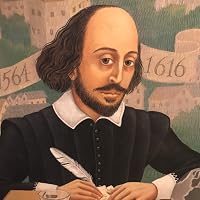
William Shakespeare was the son of a glovemaker, a small-town boy with a grammar school education. Yet he grew up to become the greatest English-speaking playwright in the world. Bard of The Story of William Shakespeare is both his story and that of a great art rediscovered in the modern world. Drama had been forgotten since the days of ancient Greece, but it reemerged in Elizabethan London with the building of the first modern theater. Its impact can still be imagined today. There were the theaters, open to the weather and featuring neither sets nor curtains, but equipped with dramatic special effects. There were the companies of actors--the leading men, the comedians, the boys who played women's roles--and the playwrights who gave them all lines to say. Best of all, there was William Shakespeare, who rubbed shoulders with noblemen and royalty as well as with the rowdy crowds at the foot of the stage. He was suspected of involvement in a treasonous rebellion, and his last play literally brought down the house when cannon effects set fire to the famous Globe theater and it burned to the ground. Award-winning collaborators Diane Stanley and Peter Vennema have once again created a feast of words and pictures to celebrate the life of a remarkable person from the pages of William Shakespeare, a man for all time."
48 pages, Paperback
First published January 1, 1992
About the author
Diane Stanley
75 books184 followersDiane Stanley is an American children's author and illustrator, a former medical illustrator, and a former art director for the publisher G.P. Putnam's Sons. Born in 1943 in Abilene, Texas, she was educated at Trinity University (in San Antonio, TX) and at Johns Hopkins University. She is perhaps best known for her many picture-book biographies, some of which were co-authored by her husband, Peter Vennema. (source: Wikipedia)
Ratings & Reviews
Friends & Following
Create a free account to discover what your friends think of this book!
Community Reviews
Displaying 1 - 30 of 92 reviews

February 19, 2014
This is such a well-written and inspiring book. Thank goodness we own it. It’s a good one to re-read.

July 24, 2012
While I don't think this book would likely grab a young child's attention (lots of words, good pictures but not fascinating), it is a well done short biography of the life of Shakespeare.
The authors did a great job of taking what little "fact" there is about the Bard and condensing it into a readable little book to read aloud to youngsters. Despite that they felt it necessary to mention that Will & Anne's first child was born a mere 6 months after their wedding (would that even cause a child to bat an eye? Like most kids know how long gestation is!), the information is well chosen and seems to lack superfluity. It's a nice little intro not only to Shakespeare, but to his times.
I'll be using it this year in Shakespeare class.
The authors did a great job of taking what little "fact" there is about the Bard and condensing it into a readable little book to read aloud to youngsters. Despite that they felt it necessary to mention that Will & Anne's first child was born a mere 6 months after their wedding (would that even cause a child to bat an eye? Like most kids know how long gestation is!), the information is well chosen and seems to lack superfluity. It's a nice little intro not only to Shakespeare, but to his times.
I'll be using it this year in Shakespeare class.

April 24, 2024
Another exquisite volume from the pen and brush of Diane Stanley (+ Peter Vennema). This one seems particularly impressive in that comparatively little is known of Shakespeare's life—and yet we still get a rich biography that allows us to know and love him, his times, and his craft. Perhaps in order to pad out the scanty details of his life, there is a lot of information about the Elizabethan theatre, acting, patronage, and Shakespeare's own artistic conventions. It all adds up to a beautifully rounded portrait of the playwright and his oeuvre.
We read this book for school, four or five pages at a time. I enjoyed seeing the children connect with and get excited about certain ideas through their narrations: especially the special stage effects (pig's blood!), boy actors playing female parts, Elizabethan fashion, categorization of plays (comedy, tragedy, history), and the mechanics of the printing press. All wonderful things to take away from the book, adding up to a pretty great feel for the time period.
The Post Script about early modern English and Shakespeare's linguistic innovation was a special and surprising delight. I told them no narration was needed...but my boys talked eagerly about their own (idiosyncratic) spelling conventions and different ways they could spell their names (Shakespeare had eight possible spellings!).
Anselm (or should I say Onssellme?) was especially taken with the list of Shakespeare's coinages, asked me to reread it, and kept saying "I had no idea!" that Shakespeare had invented words like "hurry" and "excellent." He also asked how these new words caught on, because he wants to invent words himself. And he seems to have practically memorized the list on two hearings. (Gotta love it when narration becomes not a chore but a natural and joyous activity you can't prevent even when you said it wasn't required!)
We read this book for school, four or five pages at a time. I enjoyed seeing the children connect with and get excited about certain ideas through their narrations: especially the special stage effects (pig's blood!), boy actors playing female parts, Elizabethan fashion, categorization of plays (comedy, tragedy, history), and the mechanics of the printing press. All wonderful things to take away from the book, adding up to a pretty great feel for the time period.
The Post Script about early modern English and Shakespeare's linguistic innovation was a special and surprising delight. I told them no narration was needed...but my boys talked eagerly about their own (idiosyncratic) spelling conventions and different ways they could spell their names (Shakespeare had eight possible spellings!).
Anselm (or should I say Onssellme?) was especially taken with the list of Shakespeare's coinages, asked me to reread it, and kept saying "I had no idea!" that Shakespeare had invented words like "hurry" and "excellent." He also asked how these new words caught on, because he wants to invent words himself. And he seems to have practically memorized the list on two hearings. (Gotta love it when narration becomes not a chore but a natural and joyous activity you can't prevent even when you said it wasn't required!)

May 24, 2024
Great introduction of Shakespeare's life, career & Elizabethean times . I could have done without some of the biographical fallacy comments, but overall this series is well done.
February 23, 2022
Read this as a read-aloud with the boys. They were really interested and when I had finished for the day they wanted me to continue on, always a good sign. The illustrations were wonderful. We had an Usborne book of Shakespeare's World and they poured over that when I wouldn't read more of this. I also learned a great deal. I would say I liked this one better than the Joan of Arc book, but I realize that it is preference. There was a great Postscript about the challenges of accurately getting the spellings right when the spellings of his time were not solid but fluid.

September 15, 2020
Today I read this with Aria and I enjoyed it so much. It is a digestible account of Shakespeare's life and it left along many little tempting crumbs about characters and plots that prompted Aria to immediately to read some graphic novel adaptions of plays.

January 27, 2026
Excellent introduction to the life of Shakespeare. Did you know he came up with the word ‘excellent’? The postscript shared fascinating details on his impact on words and phrases in the English language. My 8yo daughter enjoyed all the behind the scenes info on how his plays came together. Apparently, not much is known of him, but this book pulls together a nice, child friendly, narrative of the life of this renowned playwright.
‘He was not for an age, but for all time’ - Ben Jonson
‘He was not for an age, but for all time’ - Ben Jonson
April 21, 2021
Really good, long picture book.

August 17, 2023
A concise biography of the great playwright. I do wish it would have had a timeline of when he wrote the plays though.

Currently Reading
November 10, 2021“He was not for an age, but for all time.”

December 9, 2015
While reading this to be ready to discuss with my son next year as part of his school work, I discovered I had some things to learn about Shakespeare and the times in which he lived. I wondered what my own reaction might have been in attending one of his plays: or would I have boycotted them like the Puritans? I enjoyed learning about some of the reasons Shakespeare's writing style changed as historical events shaped him or available actors changed. The beautiful illustrations make these pages delightful to look through!

June 3, 2014
Both boys groaned when I said, "Come on, let's read this," but when we were interrupted partway through Toby said, "Keep reading, Mom." I think this is a good entry to Shakespeare's biography and also throws in some details about the Elizabethan theaters.

January 5, 2015
this is a great biography of shakesper
and his life. this is a really good book. shakesper fasenates me sooo much.
and his life. this is a really good book. shakesper fasenates me sooo much.

September 20, 2016
Feeling the need to read more about William Shakespeare.

May 10, 2022
Read to my child for grade 3 biography. He liked it much better than Shakespeare’s writing! 😄
November 3, 2025
Bard of Avon is a great addition for anyone that teaches Shakespeare and is looking for a source for background information on this notable playwright. It has all the information you may need all in one convenient, easy to understand story. I would recommend this to the educators or students that may not want to have to go around reading several articles to get all this information.
The only critique I have for this is that it felt a little too dramatized for something that is supposed to be non-fiction, even if the events they were mentioning seemed to line up with some of my previous research. I still think students will find this more interesting than a typical article, especially if you pair this with a video or too. All in all, it was a nice read, and I may consider adding this to my own rotation for Shakespeare information.
The only critique I have for this is that it felt a little too dramatized for something that is supposed to be non-fiction, even if the events they were mentioning seemed to line up with some of my previous research. I still think students will find this more interesting than a typical article, especially if you pair this with a video or too. All in all, it was a nice read, and I may consider adding this to my own rotation for Shakespeare information.

April 11, 2022
The story of William Shakespeare by Diane Stanley and Peter Vennema was a great read. I enjoyed learning about Shakespeare as a boy and the hardships his family fell upon. Who would of thought that the son of a glove maker, a small town boy, who only went to grammar school, could have written these amazing plays. I think that my students were astonished to find out that the actors were all men in this time period. The women were not considered proper for the parts. Can you imagine that now in this era? Shakespeare became a famous and wealthy man and wrote numerous plays. He wrote tragedies comedies, and histories.
The illustrations are well done in gouache, opaque watercolor paint on Fabriano watercolor paper.
The illustrations are well done in gouache, opaque watercolor paint on Fabriano watercolor paper.
February 23, 2020
Given the sketchy information we have about Shakespeare this biography for children knocks it out of the park! They are up front about how little is known, they include other theories about the man, and still make the whole book interesting and cohesive! The illustrations are very good. My favorite part of the book is the 2 page Postacript where they talk about spelling and give a brief history of English as well as note the impact Shakespeare had on words and phrases we use today. Excellent addition to our personal library.

July 9, 2020
This was really enjoyable and informative. I recommend this for anyone wanting to learn basic information about Shakespeare. This book is geared towards kids, but it is great for anyone of any age.
Good things:
- Great illustrations.
- A lot of great facts.
- I like how it acknowledges that we don't know everything about Shakespeare and it addresses the conspiracy theories surrounding Shakespeare.
Good things:
- Great illustrations.
- A lot of great facts.
- I like how it acknowledges that we don't know everything about Shakespeare and it addresses the conspiracy theories surrounding Shakespeare.

September 22, 2021
When I was in college, I took a whole course on Shakespeare, but some of the facts in this book were nevertheless new to me. It is a very interesting and well-written book; I particularly enjoyed the postscript at the end, which describes the spelling inconsistencies of the time period, and also lists some of the many Shakespearean phrases we often quote without knowing it. The illustrations are beautiful and full of life. Excellent!

August 11, 2018
It was a very interesting read about the life and time of Shakespeare that I read with my kids for school. I think they got a lot out of it, including what the life and times were like for theater troops in Shakespeare's time.

July 25, 2022
A bit long for the picture book format, but my daughter found the book informative. A good read for older kids looking for more information on the life and works of the Bard. Her favorite part was the postscript in the back that talked about the nearly two thousand words Shakespeare gave us.
March 28, 2023
It’s a great book and it talks about the history of Shakespeare all the way from when he was born to when he died. But it does tell a little bit of what the plays are about so I don’t recommend reading it if you don’t want any spoilers
Signed,
An 11 year old reader. So don’t trust my judgment.
Signed,
An 11 year old reader. So don’t trust my judgment.
This entire review has been hidden because of spoilers.

April 20, 2024
I really enjoyed this children's book introduction to Shakespeare. From interesting comments on spelling and historiography, to allusions to what was going on in the world around Shakespeare, I thought it was really helpful and well done.

May 25, 2017
Fascinating to me as an adult, but way too text-heavy for a picture book. Definitely for the higher end of the age range-or better yet, middle-schoolers.

June 8, 2017
Solid overview of Shakespeare's life. I would recommend for homeschool/classroom use for any age level (young children as a read-aloud up to adult).
July 12, 2017
Good history of Shakespeare for a 1 time read...krb 7/12/17

February 20, 2018
Its good

March 2, 2018
This is a great introduction to upper elementary aged children on who Shakespeare was, and the impact he has had.

May 8, 2019
I read this to 7 and 9 year olds and they LOVED IT. Great images, great general info about theater as well as the bard. Well done.
Displaying 1 - 30 of 92 reviews