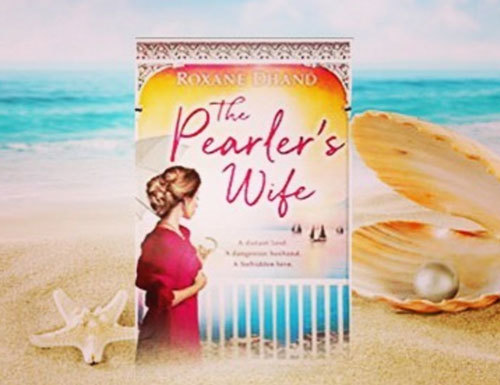
Meisei Porter devyniolika. Ji pirmąkart visiškai viena stovi ant garlaivio denio ir stebi tolumoje nykstančius gimtosios Anglijos krantus. Tėvai ją siunčia į Australiją, kur Meisės laukia būsimasis jos vyras – niekad neregėtas perlų magnatas pusbrolis Meitlandas Sinkleris.
Ilga ir varginanti kelionė nedžiugina: amžinas supimas, alinantis karštis ir per vakarienes nuolat įkyrintis ponas Smolis. Tačiau vieną vakarą trečiosios klasės denyje Meisės žvilgsnį prikausto išraiškingas, nepaaiškinamai patrauklus vyriškis. Tai Viljamas Kuperis, geriausias Karališkojo jūrų laivyno naras, Australijos valdžios paliepimu keliaujantis keisti iki šiol galiojusių perlų žvejybos tradicijų.
Meisė nė neįtaria, kad jos ir charizmatiškojo naro keliai susikirs dar ne kartą, kad šaltas sutikimas naujuose namuose nenoromis pastūmės į aukštuomenei nepriimtiną Viljamo draugiją ir su trenksmu išjudins ilgai slėptas tolimo Australijos kampelio paslaptis.
Rox Dhand is an acclaimed historical fiction author. Her passion for storytelling began in childhood, spinning tales for her sisters in the back of the family car. Today, that same curiosity drives her to unearth forgotten fragments of history, asking "what if?" until she has to write the full story down.
Dhand is particularly drawn to giving a voice to the voiceless, especially the untold stories of women left out of the history books. Her meticulously researched work, which includes The Pearler's Wife, The Orphan of Good Hope, and The Trouble with Tigers, weaves compelling narratives with a rich sense of time and place. A seasoned traveler, she grounds each of her books in a kernel of truth discovered on her journeys.
Her next book, set in Poland during the Nazi occupation, is based on a true story, with every scene grounded in real historical events and personal accounts.
An assured debut by author Roxane Dhand, The Pearler’s Wife is a sweeping romance set in a little-known corner of Australian history, the pearling industry in the far north of Western Australia. The heroine, nineteen-year-old Maisie, is sent to Australia from England to marry a man she has never met. Her new home is called Buccaneer Bay, which sounds like something out of a pirate novel but is in fact a real place (the Buccaneer Archipelago was named after the English buccaneer and privateer William Dampier, who charted the area in 1688).
Maisie’s new husband is a cruel and ruthless man who treats his employees with reckless disregard. Lonely and bored, Maisie finds herself drawn to a British diver named William Cooper. The sensual tension between them, and the slow realisation of dangerous secrets hidden by her husband, add slow-burning suspense to the narrative. The claustrophobic setting of a small pearling town in 1912 is superbly evoked, and the story is full of action, drama and romance, making it perfect escape reading for a long, hot summer.
I’ve read quite a few novels of late that have widened the retelling of Australia’s history to incorporate indigenous and immigrant experiences, and instead of glossing over our white Australia past, they’ve shone a spotlight onto it, warts and all. Fiction plays an important part in telling the stories of the past and I am thrilled to be reading more and more of these tales of truth.
The Pearler’s Wife surprised me with its depth and scope. I thought this was going to be a story about an English girl coming to Australia to marry an unpleasant man and we would follow her journey of adjustment and there would be some mystery and then it would all finish up with a big happily ever after bow. I underestimated this novel and have subsequently enjoyed it immensely.
Now, there is an English girl and she does arrive in Australia with the sole purpose of marrying a man she’s never met (who far surpasses unpleasant), and there is some adjusting, however, that’s just the tip of the iceberg. This novel hosts an incredibly varied and authentic cast, and the vivid re-creation of the setting, particularly the oppressive humidity and heat, was sublime. It’s a story that doesn’t hold back, especially with the entrenched racism and deplorable treatment of non-whites. Based on historical fact, we are plunged, along with Maisie – our English girl – into a world of ruthless money making, corruption, class consciousness, racist national policy, and unchecked violence. It’s the wild west, but in Australia, and in the 20th century, and it’s a remarkable depiction of the north WA coast during the period when pearling and the White Australia policy intersected.
Up until the point she immigrates, Maisie had lived a sheltered existence where all of her needs had been taken care of by staff. Pampered, but not spoilt, she was a young woman who was well practised at being ignored, preferable to her mother’s constant disdain. I believe this countered her luxurious existence, tempering her nature to a more empathic response. Prior to arriving in Australia, Maisie had never encountered such explicit racism and her natural inclination was to reject it. She hires an aboriginal housekeeper when no other residents allow aborigines into their homes (inside positions normally given to Asians, while outside work is left to aborigines, although they were never paid for their contributions). Maisie makes a decision early on to not perpetuate community racism within her own home, a big challenge considering her husband is an incredibly despicable man with no regard for anyone other than himself. Marjorie, Maisie’s housekeeper, is such a card, a truly excellent character. The two women, along with Duc, the Chinese cook, form a unit, the three of them banding together against the master of the house. There’s some really excellent dialogue exchanged throughout the novel between these three and the loyalty runs deep as time goes by.
The story revolves around this experiment by the government, where 12 British divers were brought over to the north WA coast to replace the use of Japanese divers, who had over time proved themselves the most hardy at diving without diver’s sickness. The problem was, these British divers had to be paid a lot more, cutting into the profits of the pearling magnates. A plot unfolds whereby the magnates band together to sabotage the British diving experiment as a means of continuing with the use of the more experienced and hardy Japanese divers. Underpinning this British diving experiment was the White Australia Policy. The sociologist within me threw its arms around the modern history enthusiast and we all settled in for an incredible read. Roxane Dhand has pulled all of these threads together in order to bring this pivotal moment within Australian history into the spotlight. Consultation of the author notes in the back of the book confirm just how much of this story contains fact. It was very well done, complex social and political issues entwined with a domestic plot; my engagement with this novel never wavered.
Alongside this, Maisie is attempting to unravel the mystery of her husband. Why he married her when he has no interest in having a wife; the hold he has over her parents; the secret business dealings he is at helm of; and his curious relationship with the town mayor. Maisie digs deep into her own character and begins to emerge as a young woman worth reckoning with, far more so than her husband ever anticipated.
One of the English divers brought over for the experiment is a young man named Cooper. He falls in love with Maisie very early on and she is drawn to him also from the moment that she meets him. When it comes to historical fiction, I’m not a fan of romance, but I do love what I like to call, ‘restrained passion’, where two people are prevented from being together because of circumstances out of their control, and yet their love becomes consuming and impossible to turn away from. It’s not easy to pull off, Jane Eyre is the best example of this, but a more recent one that comes to mind would be The Wild Girl by Kate Forsyth. Roxane Dhand pulls this off beautifully with Maisie and Cooper and I really did love this aspect of the story.
I’m fascinated that a British author chose to write this Australian story as her debut novel. Roxane talks of visiting Broome and being intrigued by the history on display there. I’m truly glad that this caught her eye because this resulting novel is an exceptionally good retelling of a little known history of a far flung corner of our vast continent. This is a novel with wide appeal and is a guaranteed good read. As long as you have an interest in Australian history, you can’t go wrong with The Pearler’s Wife.
Thanks is extended to Penguin Random House Australia for providing me with a copy of The Pearler’s Wife for review.
What a fascinating read! It’s all based around a history I knew little about – the birth and development of the pearl industry in Australia. This was a tough time as the natives and Asian workers who had been the best divers for years, were replaced by the white men brought over from England especially to take charge of this new source of wealth. Of course, because of this, the novel has to evoke the racism and awful treatment of the workers and families of the time who were of a certain colour. But it’s an important story to tell.
The main plot of a girl who is forced to go to Australia to marry a distant cousin creates a thread which weaves throughout the novel to heighten the emotions of a girl on her own. Her marriage is a sham and she has to navigate this environment with a heavy heart. I was with her all the way and it was a fascinating journey to go on.
The language evokes a time and place of pearl diving and the art and efforts behind it. There’s a dark side to even the brightest pearl however but the picture overall, gleams with honesty and rich history.
I got the feeling this book was written from a snug parlour, by the fire, in England - after reading some historical accounts of Pearling history in Broome. And guess what? The final chapter of the book confirms that was the case. The story lacks authenticity of experiencing life in that town during summers (The Wet) - there are so many things glaringly wrong. I think the author had something, but overall it really needed more work - several more drafts and a lot more authenticity in language of the times.
Dialogue between characters was poorly executed - often leaving me wondering what had just been said. Relationships were not realistic, characters were not consistent.
And what the heck was that ending??? Evidently the author was as sick of it all as I was and could not be bothered drawing her story to a conclusion.
If I were rating this as a school assignment, I would say "Could do better".
I wasn’t sure I’d be able to stick with this novel because the first quarter of the book was so flat and boring. Once I was halfway things picked up - the characters cane to life , the main character grew her backbone. I enjoyed the twists and small plot mysteries throughout I felt they worked very well.
My only reason for the loss of a star I felt the author spent a lot of time describing character interactions with very little dialogue - which as a reader - I think sometimes the dialogue would of flowed better and been more appropriate .
Po visų holokaustų ir šiurpokų trilerių jau buvau bepradedanti sapnuoti visai kraupius sapnus, tad supratau, kad net organizmas arba pasąmonė liepia pailsėti nuo rimtų ir skaudžių istorijų. Viršelis tiesiog alsuoja vasara, gaiva ir karščiu viename... numaniau, kad laukia visai nesunkaus turinio romanas apie jauną merginą ir jos meiles. Visa tai buvo, bet buvo ir kiek daugiau: dar viena istorija, parašyta pasirėmus tikrais istoriniais faktais – ir vėl maloniai nustebau. Apie Australiją, jos apgyvendinimą ir vietinių genocidą jau buvo skaityta ne viena knyga, tačiau šioji buvo kažkas kitokio. Šįkart viskas sukosi apie perlus, pinigus ir rasizmą.
Devyniolikmetė Meisė niekieno neklausta įsodinama į laivą, paliekantį gimtosios Anglijos krantus ir plaukiantį link Australijos. Laive mergina kovoja su netašytais mergišiais, o atvykus paaiškėja, kad pusbrolis, už kurio ji turi būti ištekinta, yra frigidiškas bjaurybė. Dar laive Meisė sutinka vieną iš nardytojų – perlų žveją – Kuperį. Vos iš pirmo žvilgsnio jauna mergina nujaučia, kad viskas čia taip paprastai nepasibaigs. Australijoje tuo metu vykdoma „gryninimo“ politika ir bandoma atsikratyti visų azijiečių ir tiesiog „spalvotųjų“. Netrukus Meisė pastebi, kad naujuosius nardytojus, atvežtus iš pačios Anglijos, pradeda ištikti netikėtos mirtys.
Istorinė knygos dalis buvo labai įdomi. Apie Australijos istoriją jau žinojau nemažai, bet ir vėl kažkas naujo ir intriguojančio. Ir visai skaudaus. Nuolatinė diskriminacija, rimbai, grandinės, sudėtingos darbo sąlygos. Bet vis tik man patiko, kad šiame romane akcentuojami buvo būtent šie dalykai, o ne meilės seilės, kurios buvo labai nuspėjamos.
Skaitydama piktinausi ne kartą ir ne du, o feministė manyje tiesiog kunkuliavo, nes čia ir vėl buvo rašoma apie laikus, kai moteris buvo beveik niekas, turėjo būti nematoma ir negirdima. O Meisė, kita vertus, man priminė Margaretą iš romano „Šiaurė ir pietūs“ – merginą su nuomone ir aštriu liežuviu. Ir man visai patinka kai rašytojai sukuria į jokius laikmečio rėmus neįsipaišančius veikėjus, tokius, kurie nori daugiau, nori geriau, nori kitaip. Taip juk ir vyksta revoliucijos pasaulyje – kai kas nors supranta, kad gali būti geriau. Juk niekas negimėme, kad kentėtume, nesvarbu, kokios lyties mus tas gandras į kopūstų lysvę nudrėbė.
Nesakyčiau, kad tai labai įsimintina knyga, tikrai ne. Būtent dėl to neįsimintinumo gerai vertinti negaliu. Nežinau kodėl, bet kol skaitai, gerai, tik jauti, kad skysta. Toks vienas lengvesnių atostogų romanų. Yra ir geresnių.
A commendable first novel. I bought this in the lovely book shop in Broome as it seemed an appropriate choice. The descriptions of Buccaneer Bay (Broome), the pearling industry and the weather during the Wet, are brilliantly done. The characters are well drawn although some parts of the plot seem a tad melodramatic. I love that the basis of the story is a little known, but pivotal, moment in the history of pearling.
Mano nuomonė: Romanas „ Perlų žvejo žmona“ -tikrais, mažai žinomais XX a. pradžios Australijos istorijos faktais paremtas debiutinis autorės romanas. „Perlų žvejo žmona“ - tai ne tik meilės istorija, bet apie atkaklią ir drąsią moterį. Knygoje pasakojama apie tikrus įvykius, nutikusius viename Australijos miestelyje. Perlų žvejybos verslo užkulisiai ir intrigos, to meto visuomenės normos ir luomų santykiai, rasinė įtampa - visa tai neišvengiamai kyla žemyne, kuriame susimaišo įvairios kultūros ir skirtingi gyvenimo būdai. Gana įtraukiantis, gyvas ir vaizdingas istorinis romanas, sakyčiau toks pažintinis, kuris duoda nemažai informacijos apie tuomentinį Australijos gyvenimą ir perlų gavėjus. Knygai gal kiek trūksta įtampos ir kvapą gniaužiančių įvykių ir aistrų, bet visumoje, knygą vertinu aukštais balais ir labai rekomenduoju perskaityti. Sužinosit tikrai nemažai.
From reading the blurb to this story, I expected a story of a naive English girl, being forced to marry a cruel man in a wild and unforgiving setting. While this is true, what I didn't expect was the racist language that dominates the story and the barbaric treatment of the indigenous population. I accept that this is probably an accurate representation of the culture at this time, but I found it offensive and not the escapist read that I imagined. If you can get past this, there is a story of forbidden romance. The character development of Maisie, as she comes to terms with her life and stands up to her husband is interesting, and she becomes a strong character and likeable woman, but this is not a book I could recommend. I received a copy of this book from Harper Impulse via NetGalley in return for an honest review.
Oh dear, I feel cheated. The synopsis promised a good read but I didn't find that to be the case. So much more could have been made of the three central characters instead of which I found them without any true depth. The backdrop of the pearlling industry could have been used to much better effect as could the significance of the annual Wet. I appreciate this was a first novel but the prose was more akin to a preliminary outline or very early draft but not a fully finished and fleshed out manuscript. As I said, I feel cheated.
Imdama šią knygą, tikėjausi tokio easy-peasy romaniuko. Na, žinot, kur yra moteriškė, yra vyrukas, kuris pakelia pirštą, moterytei jau tiutiu, viskas įsielektrina, vyksta drama, pasijuoki skaitydamas, kaip viskas kvaila ir vis tiek pabaigi... Viršelis gi panašiai ir žada?
O ką gavau čia – biški net nesupratau. :)
Pradžia skaitės žiaaaauriai sunkiai. Gal dėl to, kad apskritai niekas nesiskaitė ir šiaip turiu per daug knygų pradėtų ir per mažai susikaupimo likučių, bet nu su... hm, gal trečdaliu tampiausi mėnesį. Tada vis labiau ir labiau įsitraukiau, ir galiausiai sulapnojau per keletą dienų.
Apie ką knyga? Apie labai įdomius dalykus. 20 a. pradžia, Australija. Čia įsikūrę anglai jaučiasi visiški dievai, nors yra paskutiniai durneliai, kopijuojantys kažkada girdėtas madas Anglijoje. Viskas sukasi apie perlų žvejojimo verslą ir užsuktas machinacijas susijusias su šia žvejyba. Taip pat čia didelį vaidmenį žaidžia skirtingos rasės ir jų santykis. „Modernioji“ kultūra susiduria su vietine ir kitomis, tikinčiomis kitais dalykais. Labai ryškus skirtumas tarp to kas sava ir svetima – mes ir kiti.
Tad knygos tema – jėga, grįsta tikrais faktais ir mažai kam žinoma informacija. Paliečia dar ir tam tikras santykių problemas bei kaip vieni ar kiti išgyvenimai praeityje, daro įtaką suaugusiam žmogui. Žodžiu, nėra toks paviršutiniškas ir viensluoksnis reikalas.
Bet visa kita knygoje toks didelis EHHHH. Pagrindinė veikėja nuo pat pradžių tragiškai erzino, vėliau kad ir šiek tiek pagerėjo, bet man vis tiek neaišku, kokia ji. Nepasakyčiau, kas būtų jau out fo character, o kas ne. Jos romantiškoji linija irgi nei šiokia, nei tokia. Augo augo įtampa ir lyg ir pasiekė kulminaciją, bet ji taip ir liko plevėsuoti vėjyje. Dar labai kliuvo veikėjos tiesmukiškas minčių perteikimas kabutėse. Bet čia gal tiesiog skonio reikalas.
Tad apibendrintai – neblogai, paskaityti įdomu ir gal net verta.
Huh, gerai strategiškai parinktas viršelis – imi tikėdamasis fuflo, gauni tikrai geriau ir gaunasi visai liuks. ;)
3.5*, This was an introduction (to me) on the pearling industry in Australia in the early 1900's. An industry apparently rife with prejudice against the Asian immigrants that came to work . Maisie Porter an 18 year old was sent there from England to marry her wealthy distant cousin Maitland , a pearling magnate. On board the ship however she met William Cooper. Cooper was on his way to Australia following a directive from the Australian government to replace the Asian pearling crews with white men. This was a good read although by the end I hoped there would be a book #2 to finish up some loose ends that wanted completion.
Pasirinkau šią knygą atostogoms ir neapsirikau- lengvai skaitoma, gražiai papasakota jaunos moters gyvenimo pradžios istorija, primenanti Pelenės pasaką. Veikėja nugali tėvų ir pirmojo vyro nemeilę ir klastas, o tada atsiranda Jis. Geras laikas pliaže ant smėlio, kai reikia galvai ilsėtis
Australija, karštis, jauna mergina tėvų atiduota ištekėti už niekada nematyto despoto pusbrolio(niekaip nesuprantu tokios praktikos ). Mergina nieko nekaltina, o galvoja kaip gyventi su tuo ką gyvenimas davė. Aišku atsiranda horizonte tų kurie palaiko, padeda ir pamokina kaip prisitaikyti prie kitokios kultūros. Nu ir kaip meilės romanas be meilės yra jos čia ir nemažai. Meilė draugams, meilė tėvams, priverstinė meilė, "nederama" meilė ir žinoma romantiškoji meilė. Knyga patiko, sužinojau daug apie perlų gavybą tolimoje Australijoje.Kiek ten sukosi gyvenimų kiek jų ten pasibaigė, ir kokia maža saujelė iš to pralobo. Pabaigoje knygos netgi yra šiek tiek statistikos apie tą laikmetį.
-Aš nekenčiu visko, kas yra nuobodu.Bijau, kad mano gyvenimas taps blankus ir nuobodus, be kontūrų ir spalvų, todėl aviu ryškias kojines, kad nepamirščiau, jog visada reikia kopti į kalną.
I enjoy reading books set in my home state, so I was excited to read The Pearler’s Wife which primarily takes place in the north west of Western Australia in a fictional town based on the pearling town of Broome. It’s set in the early 1900s and combines an arranged marriage with skulduggery, secrets, ruthless actions and a touch of romance. It’s a lot more jam-packed that the serenity of the cover suggests! It took me a little while to get into the novel, but ultimately I was engrossed in the secret undercurrents of a small town far removed from the law and social niceties.
The central character is Maisie, sent to marry a distant cousin at his request. Maisie’s not entirely happy about it but it appears that her family is determined to see her leave England. With a large amount of luggage, she’s on a boat to Australia with her chaperone Mrs Wallace, who resides on a station in the north of Western Australia. On board, Maisie learns some things about her new home and notices with interest the British navy’s divers who will be joining her in Buccaneer Bay to try to displace the Asian pearling crews. Maisie is particularly intrigued by one diver, William Cooper and they eventually become friends. That’s lucky, because Maisie’s new husband Maitland isn’t anything to write home about. He’s rude, a heavy drinker and has very little interest in Maisie. She gradually works out she’s there for appearance’s sake and tries to settle into this hot, wet town. She finds friendships in her house staff but female friends are hard to find. But Maisie gradually finds out some of the secrets Maitland has been keeping from her. There are issues on the personal front, but most of all the pearling merchants are trying to sabotage the British divers any way they can…
I did find The Pearler’s Wife a little hard going at first, particularly the part where Maisie docked in Fremantle. Being familiar with that area, it didn’t really ring true for me with the constant mentions of ‘Port Fremantle’ (it’s always been Fremantle, the port bit is just the passenger terminal) and some of the language used by Mrs Wallace felt like contrived Aussie slang (like when she was speaking about the Aboriginal people). I felt the story greatly improved once the story moved to Buccaneer Bay. Even though it’s a fictional town, you could easily feel and relate to the town of Broome from the description of the Japanese cemetery to Anastasia’s Pool. There was a lot more action in the story than I expected and really liked! I honestly thought it would be a love story, but it isn’t. The descriptions of life in town and the lawlessness of a remote area were very well done. You could feel the humidity and the desperation of the townspeople who tried to create a little England in the middle of nowhere. Even though he’s meant to be the villain, I quite enjoyed Maitland’s exploits and plots. He’s bluntly evil, out to become the best no matter what it takes. His friend Blair, the town mayor, was nearly as bad with his lies. Did they both get what they deserved in the end?
The Pearler’s Wife is a powerhouse of a read, full of drama. Read it and be swept away!
Thank you to Penguin for the copy of this book. My review is honest.
What a read, set in the early 1900s , masie is sent on a boat to Australia to marry a man whom she has never met. On the way she befriends mrs Wallace whom she regards as a second mother. The pearling industry is a cruel one the divers face a lot of trials and can die of the bends. Cooper is an English diver who travels on the same boat as masie. There’s a spark from the start, however Maitland Maisie’s soon to be husband is a brute. The class war is evident as well as the racial discrimination, as well as homosexuality. Masie soon grow up to be a strong young woman who can tackle anything. Not a book to be underestimated it has everything and leaves nothing out a good read got me from the first chapter.
This entire review has been hidden because of spoilers.
For a first novel the author has done very well here. It tends a little too much towards a 'Mills and Boon' effort for me, but for the most part the plot unfolds well, and the setting provides an authentic view into the life and times of the early years of pearling in far north Western Australia. A few threads of this story's plot do border on flimsy and implausible, but there is enough convincing material to keep the reader interested. As I approached the last couple of chapters, I recalled thinking, ''How will this possibly end with so few pages left?" Well the fact is, it doesn't. Somehow I was was left wondering where the rest of the story had gone.
The Pearler’s Wife is the debut novel of Australian author Roxane Dhand. It is an ambitious tale told in the third person of the pearling industry set in the early 1900s that takes place in Bucaneer Bay, North Western Australia. I know very little about this period in history so I found it to be an eye-opening experience. It is evident from the start that Roxane has researched this period in history as she provides great detail into the daily life of those living in the harsh, tropical conditions. Roxane doesn’t hold back as she deals with themes of women in society, homosexuality, racism and paedophilia in the church. As a result of Roxane’s hard work, I feel that I now have some basic facts about this time in Australia’s past.
The protagonist in The Pearler’s Wife is Maisie, an English woman who is sent to Bucaneer Bay to marry her cousin, a man in the pearling industry, as arranged by her parents. Right from the time she sets sail on the ship, Maisie begins to make small changes to her life, such as no longer wearing her corset. From one small moment her courage grows as she steps foot on Aussie soil. Maisie needs all the courage she can muster as she discovers a climate radically different her to own home but surrounded by people who believe they are following old English traditions.
Maisie also must deal with a husband who has no interest in her, sexual or otherwise, and she is often left to her own devices. Even though I knew what was happening in Maisie’s relationship before she did, it was still a heartbreaking situation to observe. It was a pleasure to see Maisie become independent, especially when another man, William enters her life. Unfortunately, I think the potential for a great love story between two different classes was lost as it took too long to happen. Despite this small flaw, I believe Maisie never would have had become the woman she did had she remained under the watchful eyes of her Victorian parents.
Through Maisie’s eye I got to live the racism that was experienced by the Indigenous people and the Australian immigrants, such as the Japanese. The early 1900s was the beginning of the White Australian policy so it was very difficult in the beginning as I was quite shocked by the language used and the physical abuse suffered by these groups of people. Time and time again I had to remind myself that I cannot impose my morals or values onto the past and this helped me get through the tough scenes.
I also learnt a little about the pearling industry at the time and I found it fascinating, I’ve come to appreciate how difficult being a pearl diver would be in a time of little technical innovation in this area. The competition was fierce amongst the Japanese, who were excellent divers, and the men brought over from England who were trying to take the place of the Japanese. Men died in this field, whether from accidents or the sheer belief that they could be better than the next man.
If you’d like to learn about Australia’s history in the pearling industry this is a book to add to your to be read pile.
La moglie del cacciatore di perle Di Roxane Dhand.
Masie viene spedita dai genitori in Australia per sposare un lontano cugino della madre ma le cose non andranno come previsto. La trama di questo libro mi aveva entusiasmato abbastanza ma purtroppo il libro è stato assolutamente deludente, la scrittrice ha messo troppa carne sul fuoco senza riuscire poi a tracciarne una linea concreta. Il personaggio di Maise era assolutamente senza spina dorsale, si è semplicemente lasciata in qualche modo trascinare dagli eventi. Il marito, Maitland Sinclair, è un uomo squallido e gretto, di cui riusciamo a capire ben poco. Anche Cooper, il palombaro di cui Maise si innamora, ha poco spazio all'interno del romanzo e non si riesce neanche a capire bene come e quando i due si siano innamorati. L'unico merito che io personalmente riesco a dare all'autrice è quello di essersi documentata abbastanza sulla madreperla e sul lavoro dietro la raccolta ma a parte questo purtroppo non ho trovato altro che mi piacesse. Tutti i personaggi che abbiamo incontrato non hanno fatto nessun risalto e le domande non hanno riscontrato nessuna risposta. Il finale è un finale aperto ma personalmente senza capo ne coda e soprattutto mi ha dato l'impressione che il libro fosse stato chiuso in fretta, il capitolo prima siamo ancora nella storia e il successivo si apre con un salto temporale di quasi un anno senza che si sia ben capito nulla di quello che è successo precedentemente. Sconsiglio assolutamente questo libro a meno che non vogliate informazioni sulla raccolta della madreperla ma anche per quello credo si possa trovare di meglio.
This was an easy to get through book that included romance, mystery, violence and racism all sent in early 1900s Australia. I know very little about the pearling industry history in Australia so enjoyed reading about that world. Although I wasn't surprised by the racism and intolerance of the fictional community, I was glad that it was included. I felt really frustrated for the main character Maisie in her forced marriage to the horrible Maitland. I liked the way she conducted herself though and attempted to stand up to him and the system. While overall I enjoyed the read, there were parts that I couldn't get in to. I got over the description of the weather pretty quickly, I don't think it particularly added to the story but took away from some of the deeper issues that could've been explored. I don't think enough time was spent on Maisie's family and the mystery and controversy surrounding them. How Maisie was treated by one the male characters (no spoilers) wasn't really explored at all and Maisie didn't really seem to have a reaction. There also didn't seem to be much of a reaction to a number of violent incidents either. Maybe at the time extreme violence, assault and attempted murder were common but surely characters, like Maisie, would have some reaction to it? Overall, I thought it was a good read that included a bit of everything including some little-known Australian history.
In 1912 Maisie is sent from England to Australia to marry her cousin Maitland, a pearling magnate. On the same ship is William, a Navy diver who is being sent to be on a pearling crew to replace the predominantly Asian current crew. Maisie arrives to a cold shoulder from Maitland while feeling drawn to William. William along with the other 'white divers' are in danger from more than the ocean, and Maitland has some dark secrets.
I found this novel fairly average to be honest. I liked the idea of the story but found the majority of the characters to be quite stereotypical (the upperclass young English girl, the nasty older businessman she is forced to marry, the handsome young lower class diver she is attracted to, and so on). I think the plot was just not as engaging as I thought it would be so I was a little disappointed. I did find the parts of the novel about the pearling industry, in particular the descriptions of the diving and issues faced by the crews in relation to this, quite interesting. I also found the storylines around the different cultures in the community thought-provoking however the various storylines felt a bit all over the place and not enough depth in them. For a debut novel it is well written and I'm sure many will enjoy it.
Maisie has been sent to Australia to marry a distant cousin. The story begins with her on board ship, accompanied by a friend of the family, travelling for weeks. She has no idea of the man she is to meet, knows nothing much of Australia and is bewildered at the speed with which the whole plan had been put in place.
Arriving in Buccaneer Bay she quickly realises her perception of married life is like nothing in reality. Her husband shows little interest in her. The townspeople have Victorian values and there are standards to be met however. She tries her best to fit in.
She starts to fall for a British diver who has been set to work for her husband. The idea is improper but she can't stop herself. The boat owners have reluctantly started using British Navy divers to do the same job as their usual Asian divers. The boat owners don't actually want the change and the divers aren't always up to the job.
The idea of this story is based on truths. Set in 1912, before the regular use of specialised diving equipment there were all sorts of issues. There really was a government led experiment sending British divers to Australia to replace Asian workers. The north west of Australia seemed to live with it's own rules.
Call me silly, but I did not go out to seek this book at all. In fact, I've not even heard of it until I saw a lady holding the book for purchase, at my local KMart. "What a gorgeous cover!", whispered my heart.
The Pearler's Wife certainly lived up to its beautiful cover. This one is an engaging read, set in 1900s Australia outback. It carries themes of white superiority, racial discrimination and privilege, on the back of a romance cum mystery novel.
In fact, I am very surprised that The Pearler's Wife went quite detailed with its breadth and scope, especially about the early days of the Australian pearling industry.
The Pearler's Wife is centred on the story of Maisie, an English girl who was forced to come to Australia to marry her cousin, whom she barely knew - that turned out to be an obnoxious of a man, full of his own dark secrets. She found herself increasingly drawn to William Cooper, a British diver she met on board the ship. Will the infatuation lead to something more? What will happen to her husband? You have to grab this book and read on.
A delightful, page turner of a historical romance with a little bit of mystery, set in the early 1900s of Australia. Not to be missed!
While a little Mills & Boonish in parts this was an easy book to read. Set in the flourishing pearling industry in northern Western Australia in the early 1900s, it is an informative insight into that industry. The author deals with the so called “civilised white population’s” racism and unfair treatment of anyone who’s skin is any colour other than white. She uses various offensive racist terms which I feel were probably indicative of the times. Most of the characters were likeable but I found Maisie’s character a little too saintly at times. Overall this was quite a good debut novel which I enjoyed.
After my last foray into Historical Romance...... I swore not to return. This one however, had a completely different tone. It seemed flippant to me ......and I enjoyed that it didn’t take itself too seriously.
The conversations between Maisie and her chaperone, Mrs Wallace, were often amusingly candid and enlightening about ‘woman’s issues’ of the time. Marjorie and Duc were a lively support cast and the draining humidity of north west Western Australia played its own part in the tale.
Although enjoyable, it wasn’t perfect. The ending felt rushed and awkward.....but not so much as to detract from the overall charm of the book.
Beautiful cover...(the blue cover...not the red cover).
Pretty good beach read, a step up from Mills and Boone with some interesting info about the pearling industry in Broome just prior to First World War. The love at first sight smouldering love takes the book to resolve with the lovers finally walking into the sunset on the last page. In between there are lots of twists and turns and many issues touched upon including homosexuality and racism - both against the indigenous population and the Asian pearl divers - and the class division in Australia.