A deep and radically original exploration of Taoist and Ch'an (Zen) Buddhist wisdom through the lens of the life and work of Tu Fu, widely considered China's greatest classical poet.
What is consciousness but the Cosmos awakened to itself? This question is fundamental to the Taoist and Ch'an (Zen) Buddhist worldview that shapes classical Chinese poetry. A uniquely conceived biography, Awakened Cosmos illuminates that worldview through the life and work of Tu Fu (712-770 C.E.), China's greatest classical poet. Tu Fu's writing traces his life from periods of relative normalcy to years spent as an impoverished refugee amid the devastation of civil war. Exploring key poems to guide the reader through Tu Fu's dramatic life, Awakened Cosmos reveals Taoist/Ch'an insight deeply lived across the full range of human experience.
Each chapter presents a poem in three first, the original Chinese; then, an English translation in Hinton's masterful style; and finally, a lyrical essay that discusses the untranslatable philosophical dimensions of the poem. The result is nothing short of a biography of the Cosmos awakened to itself in the form of a magisterial poet alive in T'ang Dynasty China.
Thirty years ago, David Hinton published America's first full-length translation of Tu Fu's work. Awakened Cosmos is published simultaneously with a newly translated and substantially expanded version of that landmark The Selected Poems of Tu Expanded and Newly Translated (New Directions).
David Hinton has published numerous books of poetry and essays, and many translations of ancient Chinese poetry and philosophy—all informed by an abiding interest in deep ecological thinking. This widely-acclaimed work has earned Hinton a Guggenheim Fellowship, numerous fellowships from NEA and NEH, and both of the major awards given for poetry translation in the United States: the Landon Translation Award (Academy of American Poets) and the PEN American Translation Award. Most recently, Hinton received a lifetime achievement award by the American Academy of Arts and Letters.
David Hinton refers to Tu-Fu, while others use Du-Fu. It’s worth noticing.
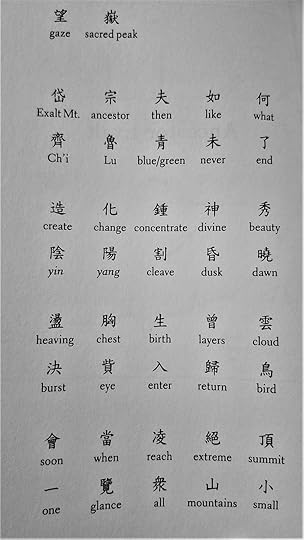
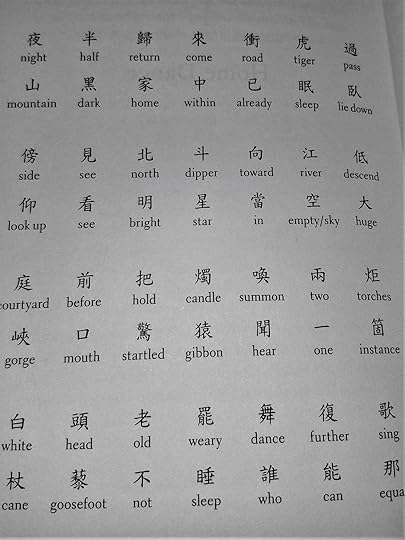
This has been one of my favourite books this year and I warmly recommend it. It picks out 19 poems and presents them as follows: the original poem using Chinese characters; a possible one or two word translation beneath each Chinese character; a proposed English poem translating the Chinese into readable verse; an essay of several pages exploring the poem and relating this to two things – the biography of Tu-Fu and the philosophy of Taoism / Ch’an Buddhism – which are illustrated by the poems and which permit a deeper appreciation of them.
Each step enriches the appreciation of the poetry. Even without any understanding of the Chinese characters, they serve an important purpose, indicating the possibility (for a Chinese reader) of considering them without necessarily starting to use language itself, or at least remaining at the fuzzy boundary between words and thought. Any glib attempt to turn the words beneath these characters into a sensible poem is quickly frustrated, and the later text explains that there are other possible interpretations for most characters; it becomes evident that such a poem could only ever be appreciated by staring at it for a while and contemplating possible associations and connections. I certainly also had in mind that such poems would be produced using thick calligraphy with a brush, and as such they were often a work of visual art (something that can also be true for Arabic poetry). Printed characters in a tiny font have little of the original appeal in this respect. Hinton’s own translation into a readable poem certainly does change things, and it is hard not to turn back to the source material and question if a slightly (or significantly) different wording would be preferable. As the clues multiply, the possible readings become more rich. The subsequent essays beneath each poem turn the exercise into a much more ambitious programme of interpretation. In particular, one starts to see that an excessively polished rendering in modern English would sometimes probably harm rather than enhance the translation.
The book turns out primarily to be an introduction to the underlying Tao / Ch’an philosophy inherent in these poems. This is excellent, and clarifies a number of concepts that I have always found obscure, with the exception of an attempt in the opening pages of the introduction to associate classical Chinese cosmology with that of 20th century science; it does not work, it is more than a little bizarre, and it was never desirable. Neither ancient Chinese nor ancient Judeo/Christian/Islamic nor ancient Vedic [Hindu] or Buddhst philosophies anticipated the findings of modern science and more than a few advocates for all of them have tried to pretend they did, by playing a game in which selected old writings are given new meanings that were never there in the original. Even the Ancient Greeks have to be considered cautiously in this context. In every case, the real achievements of their respective philosophies are quite sufficient in themselves. In fact, it is misleading and confusing to suggest that classical Chinese cosmology was like modern science – no it bloody wasn’t, saying it was does not help, and it is instead an interesting and self contained body of ideas which can be studied for their own sake. Happily, this aberration is confined to the opening pages; perhaps I over react.
Tu-Fu (or Du-Fu) wrote a huge number of poems and the selection in this volume is, I think, a little (a lot) on the serious, sober side. Hinton does not make an effort to advise (reassure) readers that Tu-Fu was just as likely to produce entertaining and often truly hilarious poems, with more than a few references to drunken revelry. I enjoyed a good many in a collection translated by Stephen Owen. https://www.goodreads.com/book/show/2... I say that not to denigrate this excellent volume, but to say there are many sides to Tu-Fu and encourage anyone interested in Tu-Fu to read more.
Quotes from the book:
...language is the medium of self-identity ... that seems to look out at and think about the Cosmos as if from some outside space. But ... for classical Chinese poetry, shaped as it is by Taoist and Ch’an (Zen) Buddhist thought, ... In its deepest possibilities, its inner wilds, poetry is the cosmos awakened to itself... [ix]
To cultivate mind as wholly empty in the Taoist/Ch’an sense, the act of perception becomes a spiritual practice: it is perhaps first and foremost to cultivate a direct engagement with one’s immediate experience, as opposed to being consumed in the machinery of mental events. Tu describes cultivating such landscape practice like this: “In a river’s clarity you can polish the mind jewel-bright.” ... This empty-mind mirroring led to a poetry made of clear and concise images, ... where this Ch’an imagist strategy integrates consciousness and landscape / Cosmos by making landscape the content of the mind. This is the imagism that migrated via Japanese haiku into Ezra Pound’s poetics, from which it shaped much of modern American poetry... “mind” in Chinese ... means both “heart” and “mind” simultaneously. There is no ingrained distinction between the two. So that empty-mind integration of consciousness into the cosmological whole was also an emotional experience, an experience of the heart. [p17]
The generative space of empty mind is brought into focus and animated in the empty space infusing and surrounding the words of classical Chinese poems ... a space created by the poem’s grammar, which is minimal in the extreme. This grammar allows a remarkable openness and ambiguity that leaves a great deal unstated, leaves it as an absent presence. All words can function as any part of speech. Prepositions and conjunctions are rarely used, leaving relationships between lines, phrases, ideas and images unclear. ... But perhaps the most remarkable feature of this empty grammar is that it embodies the original nature of consciousness as empty-mind, that generative tissue from which words and thoughts emerge. It embodies consciousness as wild, as always already awakened, consciousness in the open, the awakened consciousness open to itself ... The empty grammatical space surrounding and infusing the words of the poem is, then, that same generative emptiness from which the ten thousand things are born. And it is no less the empty-mind from which thought is born, the same empty-mind that hears the bell incite awakening. [p18-19].
Ch’an offers no answers to life’s problems. Ancient China’s artist-intellectuals weren’t interested in the delusions and easy answers of religious thinking. Indeed, the purpose of Ch’an practice is to free the mind of meaning-making, explanation, values, ideas, answers – to liberate it into wild original nature as empty and integral to the generative tissue of the dragon Cosmos. What that liberation offers Tu ... is the simple thusness of a full moon, utterly itself and utterly beyond words, the resounding completeness and sufficiency of it alive in the mirror-deep perception of Ch’an empty-mind for which the content of perception is itself identity. [p55-56]
In the literate West, language is a mimetic structure in which words refer to things by pointing at them as if from some transcendental outside realm, the same outside realm in which the Western spirit-centre seems to exist. This assumption about language began with the advent of writing, when thought began to feel like a timeless realm outside the world of change, creating our sense of being a centre of identity separate from natural process (hence mimetic language and the spirit-centre are practically synonymous). ... When language functions in a mimetic sense, as it does for us, it embodies an absolute ontological separation between material reality and an immaterial spirit-centre. That separation structures the most fundamental level of our experience, but a poem like Tu-Fu’s shapes experience very differently. Such a poem is a spiritual practice that returns us to a primal level of experience wherein consciousness is woven wholly into the Cosmos. To read a poem in its native conceptual context is to empty mind of all assumption and belief, all thought and idea, emptying it finally of language with its meaning making and naming. .. There lie the mirror-deep dimensions of empty-mind that shape a typical Chinese poem with its focus on Ch’an imagist clarity. ... the poem returns us to a place where language functions non-mimetically, and that changes everything. [p60-61]
In this radically different conception of language, we encounter the tantalizing fact that to translate a Chinese poem into English is to fundamentally misrepresent it, because the mimetic function of English inevitably erases that generative cosmology with its altered sense of time. It also conjures our illusory transcendental spirit-center, and that erases the wide-open form of consciousness that is inherent to Chinese poetry. In other words, it forecloses the Taoist/Ch’an inner wilds, ... [p63]
If empty mind is the Cosmos aware of itself, thought is the Cosmos thinking itself, feeling is the Cosmos feeling itself. This is the insight cultivated in the wu-wei practice of acting with the spontaneous energy of the Cosmos. The full constellation of selfhood – it is too wild, the Cosmos experiencing itself in a singular way, from a particular point of view, thereby opening new possibilities for itself. It does this anew with each person, each centre of consciousness... this is the perspective of most all classical Chinese poems, for they are at once selfless (the grammatically absent “I”) and full of the concerns of selfhood. [p120,121]
Translation of Chinese poetry fails fundamentally because English grammar itself erases everything that is embodied in the minimal and empty grammar of Chinese poetry... This failure seems most dramatically evident in the need to insert a first-person pronoun: I. [p121]
It was this distrust of language with its explanation and story that gave rise to Ch’an-imagist poems in the Chinese tradition. ... It renders the opening of consciousness and lets the ten thousand things speak for themselves as part of that opening, that wild identity. It remains true that we can say nothing about the world without opening in some sense a breach between consciousness and landscape, but thoroughgoing Ch’an-imagist poems ... come as close as language can to silence as integration of consciousness and the existence-tissue Cosmos. [p128]
While I read this book because of my interests in translation and classical Chinese poetry, it wound up offering much more. David Hinton is well known as probably the preeminent translator of Tu Fu, Wang Wei, and Li Po, but, as the introduction to Awakened Cosmos makes clear, his sense of the poetry reflects a profound understanding of the spiritual world view infusing the tradition. He does a brilliant job articulating the ways in which individual beings (human and otherwise) represent centers of a consciousness that connects, quite literally, everything. Chinese poetry isn't individualistic in a western sense--the poems don't include a character representing the word "I"--but they are very much grounded in the location of the poet moving through a changing world.
From the introduction: "Although ancient Chinese poets and philosophers didn't describe it in these scientific terms, this same sense of consciousness as the Cosmos open to itself was an operating assumption for them--though perhaps here existence is a better word than Cosmos, as it suggests the sense of all reality as a single thing...Lao Tzu used [the term "The Way" or Tao] to describe the empirical Cosmos as a single living tissue that is inexplicably generative--and so, female in its very nature. As such, it is an ongoing cosmological process--an ontological pathWay by which thiings emerge from the existence-tissue as distinct forms, evolve through their lives, and then vanish back into that tissue, only to be transformed and reengage in new forms."
With that in mind, he builds the book around translations of, and short essays on, 19 poems by the poet Tu Fu, who spent much of his life struggling to find a place of peace in security in a China torn by war and rebellions. He provides the Chinese character for each word in the poem, accompanied by a one or two word English translation, often explaining the inadequacy of western vocabulary and grammar. Hinton follows up with solid, poetic translations, but as I read I found myself responding primarily to the characters and single words, building the connections myself, which, if I understand Hinton's essays correctly, is more attuned to the way they were written. (Not that I'm in a position to really critique his approach, but often Hinton comments on how "we"--the western readers--"have to" provide an I that's not there in the original. As often as not, however, I found that adjusting his translation to remove the pronoun worked without creating undue confusion.)
To provide a sample of a complete translation that I find particularly relevant to conditions in the US in 2021:
Facing Snow by Tu Fu (trans. David Hinton)
Enough new ghosts to mourn any war, and a lone old grief-sung man. Broken
clouds at twilight’s ragged edge, wind buffets a dance of frenzied snow. Ladle
beside my jar drained of emerald wine, flame-red illusion lingers in the stove.
News comes from nowhere. I sit spirit- wounded, trace words empty onto sky.
A wonderful book: a study of translation, of poetry, and of the cultural history surrounding Tu Fu's work. Awakened Cosmos contains twenty poems by Tu Fu: Hinton gives the Chinese characters, alongside a literal translation, followed by an interpretive translation. Then Hinton discusses the poem, giving us insight into Zen and Toaist thought, as well as Tu Fu's life, and the influences on Tu Fu's work. Coming from a reasonably well-off family, Tu Fu was an artist-intellectual born in 712 CE, but became a refugee in his middle-age, when a devastating civil war broke out. From then on, his existence was precarious, and his health suffered. His poetry reflects how Taoist thought and his experiences in Zen monasteries helped to prepare him for tragedy. The uncaring nature of the cosmos does not offer solace, but Tu Fu can reach a place of composure and acceptance when his consciousness becomes at one with the universe around him.
I found his work particularly moving because it reflects real tragedy, and the ways in which Taoism provides a context for that tragedy. Hinton's writing about translation also offers a lot of insight into the poems: he describes how certain characters appear on the page, the etymology of words, and the ways in which Chinese grammar is completely different from English grammar and allows for a different way of thinking, one that doesn't see the self as separate from the landscape around the self. I found it devastating and comforting in equal measures.
As I read each poem, I thought, "This! This is my favourite poem!" but then when I came to the next one, that became my favourite. Below are two that are in my mind today, but it's hard to privilege any one. **
Leaving the City
It's bone bitter cold, and late, and falling frost traces my gaze all bottomless skies.
Smoke trails out over distant salt mines. Snow-covered peaks slant shadows east.
Armies haunt my homeland still, and war drums throb in this far-off place. A guest
overnight here in this river city, I return again to shrieking crows, my old friends.
**
Returning Late
Past midnight, eluding tigers on the road, I return home in mountain darkness. Family asleep inside,
I watch the Northern Dipper drift low to the river, and Venus lofting huge into empty space, radiant.
Holding a candle in the courtyard, I call for more light. A gibbon in the gorge, startled, shrieks once.
Old and tired, my hair white, I dance and sing out: goosefoot cane, no sleep... Catch me if you can!
I was so so skeptical of this book when I came in, thought it would not in the slightest be interesting. However, Tu Fu’s life has brought me some pleasure, and I’ve found a new passion for poetry like no other. Hintons analyses are quite varied. Some are insightful and some are straight bogus. Although, his final chapters are quite powerful, and I actually found Tu Fu’s death at the end of the book described very beautifully.
On a deep, nearly inscrutable level, Hinton is a translator/philosopher and writes and thinks at a higher plane that is not intuitive, and that makes his writing hard to follow at times. One example is the term “dark-enigma” instead of mystery, and another example, the concept of “tissue” being the Tao itself, the source of the cosmos, and us. I found this article helpful for context: https://www.lionsroar.com/the-root-of...
I have loved Chinese characters for what feels like millennia, so enjoyed the beauty of these images as well as the imagery and history.
Gazing at the Sacred Peak
What is this ancestor Exalt Mountain like? Endless greens of north and south meeting
Where Changemaker distills divine beauty, Where yin and yang cleave dusk and dawn.
Chest heaving breathes out cloud, and eyes Open dusk bird-flight home. One day soon,
On the summit, peaks ranging away will be small enough to hold, all in a single glance.
“Exalt Mountain was one of China’s five sacred peaks, and in its popular sense, Exalt-Mountain Ancestor refers to the mountain as a deity. But given the cosmological ways Tu Fu describes Exalt Mountain, it’s clear he sees something quite different. That mountain cosmology begins here in this poem with Changemaker, which also sounds like a kind of deity. But it is in fact Tao, that generative existence-tissue that is the maker of change. In gazing at the mountain, Tu Fu is gazing at a dramatic manifestation of the wild Taoist Cosmos; he sees Exalt Mountain as a center-point where space stretches endlessly away north and south, where the divine beauty of all existence is condensed into a single dramatic sight by Changemaker Tao. But changemaker, the Tao, is not separate from the mountains. Instead the mountain is an intensification or distillation of Tao.
We would expect this “landscape awakening” of mirror mind (empty mind cultivated in Ch’an meditation) to happen after a long difficult climb, on the summit where vast views open away, but Tu’s awakening comes as he confronts day’s end, and the failure of his reaching the summit. And it deepens in his description of what he will one day find on the summit, his “single glance” and all these small mountains analogous to the Western conceptual framework of “soul” separate from landscape, and nearly impossible to render in the structures of English grammar…Here, Tu encounters the vastness of his wild mirror-deep mind- for in its depths, horizon-wide expanses of imposing mountain peaks seem small.”
“Tu’s wandering through the thousands of miles of ancestor peaks was always the Tao/Cosmos open to itself- ancestor wandering itself and gazing into itself; thinking itself and feeling itself, lamenting itself, and celebrating itself, writing poems about itself.” Meditation practice:
Wildgrass. Frost. More. much. Wet. Spider. Silk. still. Not. Yet. Gathered in.
Heaven. Loom. Enter. Human. Affairs. Alone. Stand. ten thousand. Source. Sorrow. ____________________________ My attempt:
Empty sky soon filled with a hawk, A river where a pair of while gulls
Float peacefully, and the hawk kills one The peace gone, the other off to wander
The frost in the wild grass gleaming, The silk of the spiderweb awaiting,
Heaven does not enter into our affairs, And we stand alone, with the ten thousand sorrows. _______________________________ True:
Empty skies. And beyond, one hawk. Between river banks, two white gulls
Laze, wind-drifted. Fit for an easy kill, To and fro, they follow contentment.
Grasses all frost-singed. Spiderwebs Still hung. Heaven’s loom of origins
Tangling our human ways too, I stand Facing sorrow’s ten thousand sources. ________________________ Discussion: I chose some of the poems which were presented in characters and words, and then translated on the next page, and once I had read through some, I attempted to make my own poems; I was spectacularly bad at it! But it was a beautiful meditation, and so much fun. I learned to be more succinct, and combine different words in unique ways. There were a few things I would get right about each poem, for example, the paradox of an empty sky with a hawk ready to kill to eat; that the pair of gulls were floating peacefully along, perhaps not knowing their potential fate; and the idea that the frost gleamed on the grasses. The translator knows esoteric knowledge I could not, like loom-enter-human- affairs refers to “the ten thousand sources of sorrow all emerge from a loom of origins and they all vanish back into it.”
I like the different imagery of ten thousand sorrows (mine) and the actual true “sorrow’s ten thousand sources,” both true in their ways; one, same, universal sorrow caused by ten thousand different things versus the particular sorrow of losing a parent, a child, a pet, a dream.
The beauty of these poems and this explication, the process itself, reminds us of the beauty of being alive, the ways of saying it, the ways of being human, and really worth our time. Tu Fu, the author, was said to have lived from 712 to 770 of the Common Era and is considered China’s greatest poet, and his imagery resides in the philosophy of Buddhism and Taoism working on each other creating Ch’an ( now Zen since it marinated in Japan for a thousand years). ________________________________ 2. Inscribed on a Wall
Spring mountain absence friend alone for you search Chop tree crack crack mountain again/ more Quiet mystery
Creek. Pathway. Remnant cold pass ice snow Stone gate. slant sun reach forest place
Ride. Burgeon. Dark. Thus. Confuse. Leave. place. Facing. You. Suspect. This/is. Drift. Empty. Boat. _________________________________ In the mountains in spring, you are not here, and I search for you alone. The sharp crack of chopping the trees breaks the quiet mystery of the mountain,
I follow the creek that makes a path through the remaining ice and snow of the cold mountain pass. There is a place where the slant of sunlight reaches the forest floor like a gateway.
In the night we have no desire to know silver and gold but chi calls us. I wander far and ask for you, and seeing so many deer, know I may be on the right path.
I gallop into the building darkness and become confused, almost lost, so I give up. I find you drifting on an empty boat, and think you were meant to stay lost. ________________________________ Amid spring mountains, alone, I set out to find you. Axe strokes crack-crack, and quit. Quiet mystery
Deepens. I follow a stream up into last snow and ice And beyond, dusk light aslant, to Stone Gate forests.
Deer roam all morning here, for you harm nothing. Wanting nothing, you know chi gold and silver all
Night. Facing you on a whim in such dark, the way Home lost- I feel it drifting, this whole empty boat. _______________________________ 3. Facing Snow
War. wail many new ghosts Grief Chant Alone ancient old man
Several. Prefectures. Flow. Ebb. Cut off Grieving. Sit. Simply. Write. Empty. _______________________________ After the war, I hear the ghostly wailing of those who died, The grief chanted aloud, alone, from an ancient old man.
They pass like clouds at dusk above me, As the wind causes the snow to dance in a frenzy,
I seek to gather them into a wine jar, but they disappear into green sparks And the stove holds the residual heat of the fires.
Several places the snow comes downs and stops, comes and goes. I am grieving but we must sit and write this empty loss on our hearts. ________________________ Enough new ghosts to mourn any war And a lone old grief-sung man. Broken
Clouds at twilights ragged edge, wind Buffets a dance of frenzied snow. Ladle
Beside my jar drained or emerald wine, Flame-red illusion lingers in the stove.
News come from nowhere. I sit spirit- Wounded, trace words empty onto sky. ________________________ 4. First Moon
River. Star River. Not. Change. Color. Borderland. Mountain. Empty. Of itself. Cold.
Courtyard. Before. Has. White Frost. Dark. Whole. Chrysanthemum. Blossom. Clump. __________________________ A glowing crescent moon begins to rise, Shadow covers the whole moon, barely risen.
The small slice ascends and goes beyond the ancient frontier, That evening clouds hide, but we know it is there,
The sky’s river of stars never changes, It exists as a borderland, a cold mountain empty of meaning,
Just as the courtyard once had white frost, Now has a dark blooming chrysanthemums. __________________________ Thin slice of ascending light, radiant arc Tipped aside bellied dark- the first moon
Appears, and barely risen beyond ancient Frontier passes, edges into clouds. Silver,
Changeless, the Star River spreads across Mountains empty in their own cold. Lucent
Frost dusts the courtyard, chrysanthemum Blossoms clotted there with solemn dark. _________________________ Quotes/Poems :
8th Moon, 17th Night: Facing the Moon
The autumn moon is still round tonight. In this river village, isolate old wanderer
Hoisting blinds, I return to its brilliance, And propped on a cane, follow it further:
Radiance rousing hidden dragons, bright Scatters of birds aflutter. Thatched study
Incandescent, I trust to this orange grove Ablaze: clear dew aching with fresh light.
Night at the Tower
Yin and yang cut brief autumn days short. Frost and snow Clear, leaving cold night wide-open at the edge of heaven.
Marking the fifth watch, grieving drums and horns erupt. Star River, shadows trembling, drifts deep depths.
Dawn Landscape
The last watch has sounded in the Amble-Awe. Radiant color spreads above Solar-Terrace
Mountain, then cold sun clears high peaks. Mist and cloud linger across layered ridges,
And earth split-open hides river sails deep. Leaves clatter at heaven’s clarity. I listen,
And face deer at my bramble gate-so close Here, we touch our own kind in each other.
Returning Late
Past midnight, eluding tigers on the road, I return Home in mountain darkness. Family asleep inside.
I watch the Northern Dipper drift low to the river, And Venus lofting huge into empty space, radiant.
Holding a candle in the courtyard, I call for more Light. A gibbon in the gorge, startled, shrieks once.
Old and tired, my hair white, I dance and sing out: Rickety cane, no sleep… Catch me if you can!
“At its deepest level, the generative “tissue” of Tao is described by the cosmology in terms of two fundamental element: Absence and Presence. Presence is simply the empirical universe, the ten thousand things in constant transformation, and Absence is the generative void from which this ever-changing realm of Presence perpetually emerges. In Chinese landscape painting, all the empty space- mist and cloud, sky, lakewater- depicts Absence, the generative emptiness from which the landscape elements (Presence) are seemingly just emerging into existence or half vanished back into the emptiness. At the same time, the landscape elements seem infused with Absence, because they are drawn as outlines… Absence and Presence are simply different ways of seeing Tao either as a single formless tissues that is somehow always generative, or as that tissue in its ten thousand distinct and always changing forms.”
“The generative space of empty-mind is brought into focus and animated in the empty space infusing and surrounding the words of classical Chinese poems like this- a space created by the poem’s grammar, which is minimal in the extreme. This grammar allows a remarkable openness and ambiguity that leaves a great deal unstated, leaves it as an absent presence. All words can function as any part of speech. Prepositions and conjunctions are rarely used, leaving relationships between lines, phrases, ideas, and images unclear. Verbs are not uncommonly absent, and when present they have no tenses, so temporal location and sequence are vague. And very often subjects and objects are absent, which creates the sense of individual identities blurred together in a shared space of consciousness. But perhaps the most remarkable effect of this empty grammar is that it embodies the original nature of consciousness as empty-mind, that generative tissue from which words and thoughts emerge. It embodies, therefore, consciousness as wild, as already awakened: consciousness in the open, the awakened Cosmos open to itself."
As much as I admire Hinton, this book was a big miss for me. I have massive respect for Hinton's translation skills, which are unique and rare. That said, this book reads more as his personal quest to connect Zen (Ch'an) and Taoism with Tu Fu's poems, than a balanced analysis of the texts. Let me unpack this a bit.
One of the issues I found with this book is that Hinton uses his own definitions to talk about Zen and Buddhist concepts. Zen symbology and metaphors are already complicated as they stand. Hinton makes it harder by introducing his own definitions and nomenclature for well know concepts in the Zen literature.
My second issue with the book is the constant and forceful connection Hinton tries to establish between Tu Fu and his philosophical views. As a translator myself, I fully understand where he's coming from. He's very right in claiming how much we erase when translating classical Chinese, a higher dimensional language, into lower-dimensional languages like English. It's in those gaps between semantics that Tu Fu resides and plays. He's not the only one and other poets like Han Shan are good exponents of this type of poetry too.
However, more often than not, Hinton projects his own personal desires into the text. Reading, maybe, too much into them, and ironically, rendering the ambiguity of Zen and Daoism, mute. I enjoy contextual explanations and some parts of the book are very well balanced, but I felt he was a man with a staff (khakkhara) hitting every poem with it and trying to convert them into Zen koans.
I really appreciate Hinton's effort with this book, but overall I felt it was too overdone and too personal.
A beautiful cosmological journey. I cannot describe this radiant feeling I have throughout my mind and heart and soul, it would be useless to do so. Complete admiration for Tu Fu and the way he saw the world, composed the world with his words, became one with the world and the expanses of heaven.
I am a big fan of David Hinton and his project to uncover more alternative understandings of being that can be discovered within ancient texts. This is not unlike what Heidegger did with Greek and German poetry. In examining the original understanding and linguistic origins of words, we can catch sight of how the ancients mapped the world. Within these poems, are ontological, metaphysical and epistemological gaps in understanding with our own worldview. And that is incredibly interesting!
Even in modern translations from Japan and China, so much Cartesian philosophy and Japanese "Zen" creeps in... and Hinton is great in interrogating what a lack of pronouns can actually do in a poem.
In this volume, he does this in the textual analysis of the life and work of my favorite poet Du Fu.
My usual big complaint about his work, though: in using the Wades-Giles system, he is making it very hard for anyone not coming from that learning system to understand--but worse is when he refuses to use people ad place names, instead we have "Amber Awe" for Chengdu?? I have no idea because it made reading challenging in a bad way.
Quotes:
“Dawn Landscape.” But the Chinese title suggests in advance that there is more here than meets the eye. In addition to “dawn,” 曉 means “to understand,” or more fully: “to understand with lit clarity.” And as we’ve seen, 望 has two different meanings: “to gaze” and the “landscape seen”—a remarkable conflation reflecting the spiritual dimensions of perception, that Ch’an mirroring in which inner and outer (gaze and landscape) are indistinguishable: the Cosmos awakened and open to itself.
The poetics of Ch’an-imagism, empty-mind mirroring the world perfectly, shapes the poem’s first three couplets. The images animating these lines describe a Ch’an landscape-practice meant to open that empty-mind awareness, consciousness in its primal nature as the Cosmos open to itself, preparing for the insight that appears at the end of the poem. And this primal nature of consciousness is embodied, again, in the structure of the poetic language itself, where things exist in the open space of empty-mind grammar.
And finally, Tu simply states the terms of that exposure with almost spine-tingling clarity, the grammar clear and direct: “I am emptiness aware at the edge of heaven.” This line fails absolutely in translation, where we need to add “I” with all the metaphysics that entails. In the original, Tu appears as that absent-presence typical of classical Chinese poetry and accurate to the inner wilds of Ch’an awakening: “Emptiness aware at the edge of heaven.” And here it is worth remembering the Ch’an resonances in 空 (“empty”), and how it is a Taoist/Ch’an synonym for Absence. Tu is home on an ordinary night at his farm out beyond Amble-Awe. He is standing outside under a clear autumn sky. And yet, he isn’t there at all. Awakened to his original-nature in its fullest cosmological/ontological dimensions, he inhabits his absence: Ch’an empty-mind mirroring that is perhaps unnerving, but also exhilarating and exquisite in its beauty and boundless dimensions. The awakened Cosmos, in other words, open to its own immensity.
If empty-mind is the Cosmos aware of itself, thought is the Cosmos thinking itself, feeling is the Cosmos feeling itself. This is the insight cultivated in the wu-wei practice of acting with the spontaneous energy of the Cosmos (this page ff.). The full constellation of selfhood—it too is wild, the Cosmos experiencing itself in a singular way from a particular point of view, thereby opening new possibilities for itself. It does this anew with each person, each center of consciousness. So it’s true of anyone, but especially of those whose lifework is engaging with mind and Cosmos, with creating new possibilities for our human experience of the Cosmos: poets like Tu Fu, painters, Ch’an adepts, philosophers, calligraphers. And again, this is the perspective of most all classical Chinese poems, for they are at once selfless (the grammatically absent “I”) and full of the concerns of selfhood. landscape poetry of images weaves the center into landscape as accurately as language can, by rendering a larger identity, an identity that is made of landscape. It renders the opening of consciousness and lets the ten thousand things speak for themselves as part of that opening, that wild identity. It remains true that we can say nothing about the world without opening in some sense a breach between consciousness and landscape, but thoroughgoing Ch’an-imagist poems like this (and, for example, “First Moon” on this page) come as close as language can to silence as integration of consciousness and the existence-tissue Cosmos.
In this book, David Hinton showed me how to love poetry, and most everything else, more.
pg 16: "... minimalism allows a remarkable openness and ambiguity that leaves a great deal unstated, leaves it as an absent presence." [this space between speaks volumes] pg 20: "This awakening is the nature of everyday experience, the very fabric of our lives, for the actual moment of pure perceptions, there is no self involved."
An exceptional and unique book on Tu Fu with each chapter structured as follows: a raw rendering of a poem in Chinese (with English words beneath each character) as a means of breaking free from English grammar to convey the Daoist / Ch'an realization, Hinton's lyrical English rendering, followed by commentary that usually addresses Tu Fu's life, Daoist and Ch'an concepts and the idiosyncratic contributions Tu Fu made, and the shortcomings of translation.
As a huge fan of Hinton, it somewhat pains me to rate this book lower than five, because it truly is a labor of love and of high quality at that. However, the work often feels apologetic regarding the shortcomings of translation, where the pith of realization is lost. Hinton remedies this somewhat with his musicality, but the enlightening effect of the original works is lost in most of the poems. The essays are intelligent and thorough, but their secondhand-ness doesn't pack the same punch I assume the original work does. However, the effort is commendable and worthwhile despite the perennial issues of translation. For these reasons, the companion volume published by New Directions isn't especially enticing at the moment, though it's acquisition seems inevitable given my admiration of Hinton.
For the reader well versed in Daoism and / or Ch'an Buddhism, this is an easy recommendation.
This book is a small selection of Tu Fu's poetry, each as its own chapter. Hinton explores some of the translation possibilities associated with each poem, and puts the poem into context with respect to Tu Fu's personal experiences during a tumultuous time in China's history as well as his Taoist orientation.
The book is intended as an accompaniment to another book containing Hinton's selection and translations of Tu Fu's poetry. I had wondered whether it would have been more appropriate to read the other book first, but I am convinced this was a far better book to have read first.
Tu Fu was a Taoist poet, presumably 'enlightened', who writes from a perspective that differs radically from our modern 'normal' experience. Hinton's translations and explanations of the poems are mind-blowing. Each one is interpreted within a Taoist/Zen framework, and each chapter/poem is a very thoughtful and thought-provoking exercise. Reading these chapters felt like an experience with an adept who is coaching one towards an experience of awakening. They are not necessarily difficult to read, but require a level of attention that sometimes becomes challenging. Interestingly, the book ends up feeling somewhat redundant, but this is perhaps a reflection of the fact that each poem essentially points in a similar direction?
Here are my thoughts when I was reading as a review cause nothing changed:
No offense to my ancestors but this book is garbage, like utterly horrible. AND HAS CAUSED MY GRADES TO TANK BECAUSE MY TEACHER DOESNT UNDERSTAND THE CONCEPT OF BIAS AND CRITICAL THINKING, so I don't think I'll be enjoying anything of this. Also, the interpretation and translation to the poems could be completely freaking wrong because of how old this is. It's just pointless.
This book makes no sense. I do not understand how this guy could've interpreted these poems when they have no structure and cohesion between the words (for context, the poems are in ancient English making me believe this book is extremely not reliable and probably a scam)
Many years ago I decided to start every day by reading a scripture or devotional work -- Buddhist, Hindu, Christian, Taoist. This practice gave me a lot of happiness. I was so assiduous, however, that after about a decade I started to feel like a walking library of comparative religion.
Somehow I decided to try ancient poetry. I started with Hinton’s translation of Tu Fu, then Li Po, then Wang Wei. I was hooked. Life, it seemed to me, was 20% better, more beautiful, more bearable, simply because I was reading classical Chinese poetry. However, as I am an agricultural worker, I feared my pricey poetry habit might become unmanageable.
Fortunately, Hinton’s thick ‘Anthology of Classical Chinese Poetry’ kept me occupied for several months. Finally I made my way to this book, ‘Awakened Cosmos’, and I recommend it very highly, especially if you have also become smitten with this extraordinary poetry, and wish to understand it better.
The book sketches the harrowing life of Tu Fu while discussing, briefly but incisively, 19 of his poems. Hinton admits bluntly that the basics of English grammar are fundamentally opposed to the insights and world view of these poems. For starters, verbs, in classical Chinese, have no tense. There are radically more possibilities for multiple meanings and the blurring of subject and object. He gives a sense of the myriad possibilities available to the translator and why he made the choices he did. (Side note: finally I understand why every translation of the ‘Tao Te Ching’ reads like a freakin’ different book!)
This is high-power, poetic, philosophical, linguistic stuff. I will need another 400 years of study (and complete, unsurpassed enlightenment) to understand all of Hinton’s points, and yet -- he does it so charmingly, so encouragingly. It’s like he’s your super-cool genius uncle, sitting at your elbow to help you understand the poem. It’s just a delightful little book. I’m grateful Hinton is so prolific. I want to read everything, the translations and essays too, a few pages at a time, with a cup of strong coffee, at the start of every day.
I read a poem on FB the other day that claimed poetry about the moon was part of the classist British pastoral tradition, as if moon-poems weren't just another thing those colonialists stole (like tea).
I encourage American & other English-language poets to read Chinese poetry, including this book. Hinton's commentary is so helpful for people who don't read Chinese; he talks about what is difficult or impossible to translate in essays about each poem in the book. His thoughts on language are useful for all poets, i think.
One of the things I appreciate most about Hinton's book is that he does not try to simplify or reduce the Taoist/Ch'an worldview to a set of easy-to-digest concepts. Instead, he presents the worldview in all its complexity and nuance. He shows how the Taoist/Ch'an worldview can be applied to all aspects of life, from the mundane to the profound.
Awakened Cosmos is a book that I have reread many times. It is a book that continues to challenge and inspire me. I highly recommend it to anyone interested in classical Chinese poetry, Taoism, or Ch'an Buddhism.
David Hinton provides depth and context by sharing information about, Tu Fu’s life, breaking down layers of meaning embedded in Chinese pictographs, and linking the poet’s observations on his life and environment to key Ch’an (Zen) teachings and concepts. For anyone with a love of poetry and the power of imagery, or for students of Buddhism, this book is indispensable.
Brilliantly conceived, and pretty well executed, though some of Hinton's expositions seem a bit... overdetermined might be the right word. Awakened Cosmos illuminates some of the key philosophical and grapho-linguistic structures that inform classical Chinese poetry, and I intend to share it with friends who struggle to appreciate that tradition.
It doesn't have pinyin for the poems which is a weird choice for a book about poetry in Chinese translated into English for people who are probably not the best at speaking and reading Chinese and want to get a better grasp of the original way the poem might have sounded. Of course, it doesn't have an accurate guide for Tang Dynasty Chinese for the poems either.
Classical Chinese philosophy is my most favorite in terms of how consciousness and existence is expressed, whether through the I Ching or concepts of Yin/Yang, I find it as being the best expression of the cosmos. While poetry isn't my taste, I still got a deal out of Hinton's commentaries of Tu and the Chinese worldview that I admire so much.
Awakened Cosmos is a good book that is well written and that is easy to read. It has some interesting information and the author clearly knows his subject.
Did not finish. I got about 2/5 through. Having read other translators of Tu Fu, I enjoyed theirs more than Hinton's. And I didn't get much from the commentaries either.
Reading "Awakened Cosmos," going deeper into the translations of Tu Fu, made this awareness spring forth: that translations match us with the poet/poem, for our time. That makes reading translations of, especially, Chinese poetry almost superficial unless read side-by-side and with historical biographical information at hand. Reading an ancient Chinese poem should take about as much time as it did to write it. Unless one just wants to be lightly brushed, entertained, of course.
These translations are almost the poem-between-the-lines... and that's a good thing. Hinton does the best translation work of anyone to site the poem "in situ," and this work places the poems within a spiritual (Taoist/Chan) perspective which renders them almost evanescent. I really can't read ancient Chinese poetry by any other translator anymore (such romantic, wordy delusions). Granted, his explanations and annotations can bog you down, but just pick up the poem again and read it after you've "paid your dues" - you'll find the effort rewarded.
David Hinton won me over with the first line of the Introduction to this book.
"POETRY IS THE COSMOS AWAKENED TO ITSELF"
As a poet, this stood out to me as such a revelation, that I simply wanted to devour this book.
Hinton focuses on 19 of Tu Fu's poems in the light of Taoist/Ch'an spirituality and it's real soul food for the reader. I'll write a fuller review when I've finished, but this is one of those slow-reads, as each page offers the reader something to chew on for a while.
I have read his Selected Poems of Tu Fu and that book for me was an introduction to the Poet's work. Awakened Cosmos offers us a deeper cast of the net and is a great companion to that expansive edition.