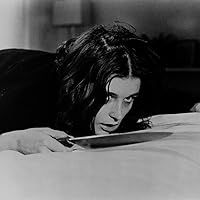
Jean Genet was a French novelist, playwright, poet, essayist, and political activist. In his early life he was a vagabond and petty criminal, but he later became a writer and playwright. His work, much of it considered scandalous when it first appeared, is now placed among the classics of modern literature and has been translated and performed throughout the world.
Do you dust, darling? Well, that's not good enough. We're s'posed to be lemmings and praise Genet. Role-playing (The Maids) was hotcha topic in the 50s, how tiresome today. But so is Genet with his queer brawls. Having just seen the $300-a-tic thingie w Blanchett-Huppert, lemme say : see Chabrol's Le Ceremonie.
"The Maids" excited me with its phenomenal (submerged) representation of BDSM dyke roleplay and its class critique.
Sartre's gender analysis in the introduction, however, can fly a kite. Jean-Paul's examination of self-punishment and consciousness in "The Maids" sparked my interest in brief spurts, only to be undermined entirely by incomprehensible claims about "real" and "unreal" masculinity/femininity in Genet's plays.
• Thirty years on, I'd forgotten the febrile aridity of existentialist literature.
• The age of the criminal as both proletarian hero and vicious, living negation seems like a long, long time ago.
• For what it's worth The Maids struck me as much the more interesting play. Deathwatch reads like Sartre's No Exit relocated to a prison setting and given a slight homoerotic frisson. I suspect Sartre felt the same way; in his introduction, he only mentions it in passing, by way of drawing out some element of The Maids.
• "You louse!" is not terribly impressive invective in English translation in 2018. I doubt it was all that much better in French in 1948. I would be tickled to learn that the fearsome Genet shied away from profanity for some reason.
• Sartre's introduction is significantly Sartrean, to wit: "Translated into the language of Evil: Good is only an illusion; Evil is a Nothingness which arises upon the ruins of Good."
This Sartrean aperçu is the most memorable line in the book, including both of the plays. That's not good.
The Maids is loosely based on the infamous Paoin sisters who brutally murdered their employer and her daughter, in France (1933), though the play is not the story of the Papin sisters as such. Genet's original intention was that the two maids and Madame, be performed by male actors. کلفت ها، چه در متن، و چه در روابط شخصیت ها، به یک نیایش آیینی در لباس نمایش می ماند. "سولانژ" و "کلر"، دو کلفت خانه، در نقش یکدیگر و در نقش خانم خانه، تمامی آرزوی "دیگری" بودن را، در احساس توامان عشق و نفرت نسبت به شرایطی که در آن زندگی می کنند، نمایش می دهند؛ شرایطی در فاصله ی میان آنچه هست، و آنچه آرزو می شود. گفتگوها به دقت "در انتظار گودو"، شکل دهنده ی یک نمایش بیهودگی (ابزورد)، در چهارچوبی رسم شده، انتخاب شده است. سولانژ و کلر در نهایت تلاش، این چارچوب را می شکافند، و چون از قاب بیرون می افتند، در می یابند که این نیز، بخشی از سهمی ست که بی حضور آنها تقسیم شده، و برایشان کنار گذاشته شده است! آنها پشت ماسک ها پنهان می شوند، به همان صلابتی که انسان پشت آرزوها مانده. اجرای شگرفی از این اثر توسط یک گروه تیاتر مشهور اسپانیایی را در یکی از جشن های هنر شیراز دیده ام و بازی سترگ دو بازیگر نقش های "سولانژ" و "کلر" را فراموش نکرده ام. هیجان زندگی در پس پشت ماسک های متفاوت توسط یک بازیگر، در نقش های دیگر، به مراسمی آیینی می ماند، در حضور دیگران! نمایشی از عشق و نفرت توامان کلفت ها نسبت به خانم خانه، در غیاب شوهرش که در زندان است...
My deepest regret so far in life is that I haven't sat down in an audience to watch a Genet play. "The Maids" is such a classic work from the 50's (?). Also one can't avoid this book in an used bookstore. Every (decent) used bookstore has this title in their Drama section. Get it! Genet is one of the great voices in literature and everything else.
Introduction by Sartre establishes that “for Genet, theatrical production is demoniacal” (10), inclusive of “illusion, betrayal, failure; all the categories that govern Genet’s dreams” (id.).
The first text, The Maids, concerns two servants who plan elaborate rebellions against their master, via acting out the murder. Sartre considers this as “his maids are fake women, ‘women of no gymnaeceum,’ who make men dream not of possessing a woman but of being lit up by a woman-sun” (11). They are “pure emanations of their masters and, like criminals, belong to the order of the Other” (17). Sartre notes correctly their fungibility, the “complete interchangeability” of the two servants in their metatheater (19). We see that one servant feels a time coming, she says, “when no longer a maid, you become vengeance itself” (43), which is some sort of lumpenized reaction to oppression, seeking not justice through class confrontation but rather individuated vengeance, which perhaps exceeds the norms of necessity and proportionality in the desire to kill the master. The other servant can imagine how the master “reckoned without a maid’s rebellion” (45), perhaps not giving the owners of the means of production enough credit for their repeated foresight in managing unruly servile classes. A contrast of relative levels of demystification in how one insists that “I see it as it really is, bare and mean” (50), regarding the shabby living space that the other servant claims to like—and objects that the master “loves us the way she loves her armchair” (52). They note that “grief transfigures her” (regarding the master) (57), buying into a romantic mythology, even while simultaneously wanting to “make up for the poverty of my grief by the splendor of my crime” (id.)—again, private lumpenized vengeance. Definite echo of liberation theory in the proclamation that “when slaves love one another, it’s not love” (61), consistent with the complaint of one servant to the other, “stop trying to dominate me” (48). Regarding the master, who objects that the fawning servants treat her like an “invalid” (68)—mostly because she is, like all worthless wastes of space—she requires the servants, as in Agamben’s recitation on Aristotle’s theory of economic despotism, “to represent me in the world” (97).
The second text is a prison narrative, Deathwatch, involving the politics of inmate hierarchies and how they interface with official authority. It’s conceptually interesting, violent, full of fungible persons and arbitrary confrontations—but perhaps bathetic after reading Our Lady of the Flowers.
Genet’s plays are silly and extreme. They explore the notion of identity as performance; gender, occupation, and emotion are just shades that lay over the aggressive and terrible (terrible in the OLD sense of the word) blank of the unconscious. My bet is that Sartre was reading the Maids, with its illustration of the Self as an interactive theatre constructed by the folly of an audience, when he composed No Exit, which also throws punches at this idea of identity, which he believed to be less hollow, but sacrificed to inauthenticity by man’s need to APPEAR to others. I love the idea that Genet wanted teenage dudes to be cast as the maids to really rub in this idea of how artificial our SELVES are. Real sick, but genius.
I liked the Deathwatch better than the Maids, but after reading Sartre's introduction (I read it in the end on purpose), I was amazed by Sartre's great mind and his understanding of Genet. Very interesting work. It is my first time to read Genet.
The Maids is really a fascinating play that deserves all the praise Sartre gives it. It plays on the falseness of theater and writing and identity in a really unique and uncanny way that continually falls apart, and I can imagine it would be incredible on stage. Deathwatch is no so great and appears even less exciting paired with such a great play.
Highly amusing play about two maid sisters play-acting Master and Servant (cue in Depeche song) sneaking into their boss’ dresses and imitating her. Their banter is bitter and hateful with sneaky, snaky overtones of incest, lesbianism and the inevitable BDSM fetish business the French do so well.
Just when you think you’ve got it all mapped out Madame shows up and proves to be cooler and kinder than they depicted her before her arrival. In fact, Madame derives great pleasure in dressing them up in her designer originals as if they’re a pair of human Barbie Dolls (viva la fetish!).
According to JP Sartre’s prologue Jean Genet wanted to cast teenage boys as the maids, which would have been as interesting as casting Isabelle Huppert and Cate Blanchett in the recent New York production. BTW, let this and The Balcony serve as evidence that Genet wrote just as well for women as he did for underworld Parisian butch homo street toughs.
"The Maids" makes the most sense if you can see a performance of it. For convenience's sake I copped the great Glenda Jackson / Susannah York film version, and that helped it all click for me. We're still grappling as a society with the idea that so much of what we do is performative, that we crowd out spaces in our lives for sincere feeling and leave behind only the simulacra. And that's if we're lucky enough to have anything like a life of our own; it's even worse for those who don't. ("Deathwatch", the second play in this volume, is pretty disposable stuff, and Sartre's intro is annoying.)
Bizarre, eccentric, and visceral. Are the bare bones of the plot slightly silly? Yes. It's Genet's dialogue emphasize that these are stories of class, desire, and the thin line of love and hate. While it's hard to fully immerse yourself into Deathwatch, the Maids really pulls you in with a sense of dread that lingers right up to the denouement.
Honestly, more than the works itself I am intrigued by Jean Genet himself. It's like existentialist ideology came together as a persona and from the preface it's clear Sarte agrees.
I read this to make time, to space out my reading of Cesar Aira's upcoming Five, compiling five 'novels,' of which only two may be considered novels whilst the other three short stories, as I have until May to finish it, and what a shame it'd be to complete it well before the time it's set to release--which isn't so much a problem, but I feel that the effect of a review is greater when it's nearer to the date of the book's arrival--anyhow, I was weighing out my options: a book of three of Henrik Ibsen's later plays, post-Ghosts, released by Oxford press; the Complete Plays of Sarah Kane, released by Methuen Drama (which I'd initially pushed aside to read Beckett's Endgame and Act Without Words a few years ago); or the Maids and Deathwatch by Jean Genet, alongside its preface penned by Jean-Paul Sartre; and while I believe this duo to be a lovely pair for anyone looking to get into Jean Genet's literature, I could only say that I should have opted for Sarah Kane's complete plays.
The Maids confused me somewhat at the opening, as a character called her sister by her own name rather than the given name of her sister, and her sister referred to her as Madame rather than her given name, but as I read, I realized they were roleplaying whilst the true Madame was absent from the scene, which I found to be playful, fun to read, and all the more human; there's not much more I could say about the play without spoiling it or giving away what it's like outside of its mockery of certain characters which could be interpreted as not just killing time but as playing with power dynamics--the dialogue was okay, at turns poetic, at other times just fine, though there were a few funny moments, to me, where one of the characters tells the other that their hands 'befoul the sink,' but apart from that, there wasn't much to be in awe about, it was simply your standard play: and any word about it being disturbing or 'transgressive' must've been commissioned or perhaps it was transgressive for its time, and that's something I'll touch on a little further in my review, because the time this play was written corresponds greatly with a real-world event that took France by storm only six or so years before; I rate the play an [81/100], a fair rating--and as for the ending, I thought it was lovely, lovely but predictable, and while I felt that I'd have went about the play in another way, I appreciate Genet's understanding of it being what it is, just a play, though a play inspired by something true--that's to say I champion realism to an extent, enough so that'd it'd reflect in my own hypothetical reworking of the Maids.
As for Deathwatch, I actually thought this one to be the lesser of both halves--the quality of its writing read as though it suffered from the recency of the Maids (not to mention the fact that Deathwatch was written first chronologically [I assume Genet kicked into gear after his experience writing Deathwatch]), and the setting was less compelling: not because it lacked the fancy-shmancy, rococo-lace French decor that was present in the Madame's department in the Maids, but because, with Genet's experience having been detained throughout his life, I thought there'd be more to it, not more 'grit,' because that's what you'd expect, but something more telling of his several-years-in-length experiences, something more honest--I've read excerpts of Our Lady of the Flowers: where was that at? as in, how could he have written that prior to writing this?--after all, a few years after writing both plays, he evaded a life sentence; the blood in his pen had been waning when he'd written this, and it flowed when he wrote about the maids: it's evident; that aside, this play, while donning one of the hardest titles I've read in a long time, fell short of my expectations, which I've learned to not rely on when beginning any work, but as I've said before, with what excerpts I've read, I expected there to be an edge to this, though I suppose it has more of an emphasis in his later plays, or I suppose nothing until I get to it--the play is winding, it's long, it's also a single act play, consisting mainly of dialogue, which I find to be wonderful, after all, I remember having enjoyed Endgame, and with that being known, you could only surmise that its pacing was slow, and it was, and that's not negative in itself, because the negative is in the fact the ending doesn't at all feel like it fit the play: it ended swiftly, mismatching the rest of the play's steady pacing, and while it could be that if Deathwatch lasted longer, it'd have lost what magic was still beating inside of it, the ending could've been better: this play isn't as fleshed out as one would believe it'd be, as there's still so much to carve, so much to lift and make better; I rate this one a [63/100], for there are worse plays floating about.
And now, for Jean-Paul Sartre's preface: it doesn't need to be there--no, not in the sense of its placement in the book, well, that too, but it doesn't need to be in the book whatsoever; I didn't bother to read it first, and the plays second, because what one knows after reading books for a while is that any preface or introduction or foreward by anyone who's not the author tends to spoil the plays prior to your beginning them, and after finishing this book, that's exactly what I saw, but there's more to it: Sartre tries to tell you what to think of them before you read them, as though it's going to put more emphasis on your experience of them--he tries to paint them his preferred colors rather than to leave them to your own interpretation as you read: yeah, that doesn't work so well--and the further I read, skipping over a passage or so, it seemed that Sartre was grasping for straws, psychoanalyzing without any real purpose than to be included in the publication; and if you remember what I said about the context of the time in which these plays were published, this is where it matters: the Maids is a play based on the real-life murder perpetrated by two sister maids, who murdered their employer's wife and daughter; so rather than psychoanalyze the reality, the inspiration behind the play, Sartre decides to analyze the play alone: there'd be more to derive from the real thing than some retelling of the reality of it, there'd be more substance, it'd be grounded further in the truth than any abstraction you apply to it--he talks about a moment in the text as being a 'black Mass,' and it's just, no, that wasn't at all the implication, and his refusal to acknowledge the real-life people in his analysis further drives the point home for me, the point that there is no point, and not in the existential idea of a lack of a true point in life itself but in the point that the preface is aimless.
[71/100]
Lovely--I found this copy of Genet's two plays in person: it's become my first time reading his works, and while I'm aware that his novels may be more visceral, I'm waiting to find one in person, or maybe I'll cave inward and find a dollar inside of me worth giving to the internet, but that's going to wait, because I've a few chunkers I'd like to buy that I think would be more worth my while--not to slight Genet, it's just that, well, what do you find in two hundred pages that you won't five times over in a thousand?
I'm going to read Sarah Kane's plays next, or Ibsen's, I'm not sure, because I know Ibsen's plays will provide the context necessary to understand Jon Fosse's works, to an extent, whose Melancholy I-II I'll be reading this year, but I'm in need of reading a work written by a woman so as to make myself all the more better: perspectives matter, and Sarah's works have interested me for so terribly long, and with what I've skimmed in the past, I'll appreciate these much more.
My first Genet. The Maids is a very compelling two person play about mad sisters who work as servants for a rich woman. They plan on killing her. This was partially based, if I'm not mistaken, on an actual French case where two sisters gruesomely murdered their masters. But this isn't a straightforward femme fatale thriller. Rather its a disorienting psychological study of love and hate, and how the two really are the same. Also about the degeneracy of being a maid, if you think yourself not in that class. The play opens with the sisters enacting out a role-playing game where one pretends to be their mistress and the other pretends to be the other sister. Then the they do this again at the end. I think Genet is making points about levels of power in master-servant relationships, also in husband-wives relationships, but the play is disturbing and visceral enough that those points get subsumed in a horror film.
Deathwatch was a little hard to understand, even though I read it twice. (It's probably me--a diet of pop culture with little reading of poetry and drama will do that to you. I Should rectify that.) There are three characters here, instead of two, all in prison. One of them is on death row and will be executed very shortly. The other two vie for his respect and affections, so they fight each other. There is some latent homoeroticism. Genet was gay, wrote about it, and apparently his work was banned in many countries because of it. Once again, Genet seems to be concerned with the hierarchy of power relationships, but beyond that I have no idea what he's trying to say or why he wrote the play. Which by the way, according to Edmund White's biography, he thought this was his worst work. I plan on reading more of his stuff.
*Disclaimer: I didn't read the edition I'm reviewing, I read The Maids in the Norton Anthology of Drama*
I have a mixed reaction to The Maids. It's quite a good play for the type of play that it is, and I can appreciate its metatheatrical qualities and its ideological/philosophical concerns with issues of power, violence, eroticism, and control. But basically it's not the kind of play I particularly enjoy. So while I appreciate the play and Genet's work as important theatrical influences, I wouldn't say I genuinely enjoyed reading this play. Not even in the sense that many people seem to experience Genet's theatre, which seems to be with a kind of stunned awe. For me this play simply is. I understand it and can appreciate it, but I don't particularly enjoy it, I would probably never choose to teach it, and I would probably be fine if I never read it again or saw it performed.
I did actually see a teleplay version of The Maids a while back, without really knowing much about Genet, his work, or the characteristics of his theatre. I don't remember caring much for the teleplay at the time either.
While their mistress is absent, maids Solange and Claire engage in daily sadomasochistic fantasies in which they enact the death of their employer. However, because these are so stylistically intricate, they fail to ever conclude- or do they? The sisters’ perverse codependence and ability to evoke feelings of hatred, pain, and evil are both disturbing and confusing. While this is not an enjoyable read, it may provide insight to dramatist Genet’s psyche, himself a lifelong criminal who received a life sentence that was later commuted. The second play, Deathwatch is equally dark but ,again, reveals the depths that paranoia and imposed loneliness can drive an individual to sink into even while attempting unsuccessfully to attain some sense of empathy with another doomed soul.
I saw The Maids performed once by the Towson State theater department. I saw them perform an Ionescu play too. & maybe Neil Simon's (?) version of "Awakenings"? A pretty good selection of plays brought to us by Paul (?) Berman (sp?) of sd theater department. Strange to remember b/c I have so little respect for the university or, even more so, the neighborhood in the suburbs of Baltimore. The Maids is a powerful play about the covetousness & vicarious living of people forced into demeaned social positions. Genet is, of course, a 'master' at depicting such things.
just finished "The Maids" because it was first, but I actually started reading this because of a combination of having just read the Patti Smith bio and "Deathwatch" being the name of a song I like a lot which I am assuming is referencing the second play in this edition. "The Maids" was my first dip into Genet and I'm digging it. update: I don't think Deathwatch the play was what Deathwatch the song was referencing. It also wasn't as good as The Maids. Still, interested to read some of Genet's novels.
I don't know why I always subject myself to re-reading "Deathwatch" when I pull this collection off the shelf. It's just awful. It almost feels like a parody of Genet, although he wrote it himself. Meanwhile, "The Maids" is one of my favorite plays of the 20th century. A dizzying ritualization of oppression, Genet's second one-act manages to be both ornate and raw, comedic and cruel. Anyone who's played servant for any length of time will immediately get why the plan to off the mistress is sound, even before we've met her royal highness. Is there a higher accolade than genius? Apply it here.
Genet is brilliant, what can I say. In these two plays he offers a scathing critique of the bourgeoisie, at the same time as identifying the ways in which we all are shaped by our work, and our working conditions. And the context is whirligig (as Sartre would call it) – criminals and saints, love, desire, murder. If you like Genet and haven’t read these I do recommend (I tend to think Maids is better than Deathwatch, incidentally).
The plays were definitely really good and I would love love love to see them performed, but I think one of the things that amused me most was Sartre's introduction. He was of course an admirer of Genet's work and he and a few influential others kept the man out of jail for the latter part of his life because they said Genet was a genius, but from the introduction it totally seems like Sartre's favourite thing about Genet was that he was gay. So avant-garde and anti-establishment! Oh, Sartre.
I'm just not impressed. The Sartre Introduction is long, rambling, and boring. The plays are boring as well. There are a few interesting lines in The Maids, but the plot is silly. Deathwatch makes more sense, but there aren't any specific lines that are notable.
For plays driven by dialogue, I'd recommend Cat On a Hot Tin Roof and Glengarry Glen Ross over the two here.
Both plays were intense and uncomfortable, presumably as they were meant to be. Both end in death. The constant switching of role playing characters - again, in both plays - is fascinating to read. I'm going to see a performance of The Maids this week with Cate Blanchett and Isabelle Huppert. Should be compelling!
My high school Theatre program put on a performance of "The Maids" in spring of 2025, albeit with some edits to the script. With that said, I've read through this play dozens of times. It's tragic, ethereal, and beautiful. I highly recommend either reading "The Maids" or watching a performance of it. You absolutely won’t regret it!
I did this play in HS and I was the understudy for all three roles as well as the stage manager. To this day I find many parts of it to understand but I love it for reasons of nostalgia and because the language is poetic and fresh, even now.
fascinating stuff, but who the hell knows what's going on? i should probably read the sartre essay on genet at the front of the book, but i'm anxious to get to part 2 of the "Death of Captain America," so that might have to wait.
A very interesting take on gender roles, and how people mirror each other, draw from each other, change on the energy of each other, and have no real one identity of their own. Great identity plays. Sartre's introduction is very insightful.