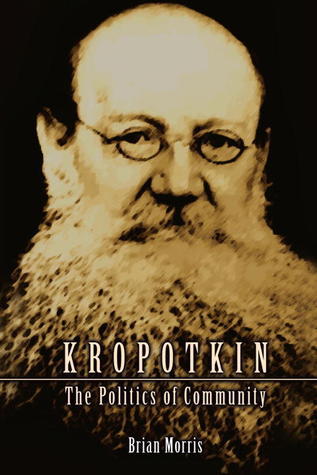
Born into the Russian aristocracy, Peter Kropotkin was one of the most important political and social thinkers of the late nineteenth century. A talented geographer, an explorer in his early youth, Kropotkin was also a revolutionary socialist and has long been considered one of the most influential theoreticians of the anarchist movement. By his exemplary life, and by generating a treasury of fertile ideas, he undoubtedly stirred the imagination of his own generation. Yet although his books are still being published, and he has had a deep influence in many fields, outside of anarchist circles Kropotkin is very much a neglected scholar.
In this pioneering study, Brian Morris seeks to affirm the contemporary relevance of Kropotkin as a political and moral philosopher, and as a social ecologist. Well-researched, wide-ranging, and lucidly written, Morris’s analysis is an important contribution to the history of anarchism and to contemporary debates in political theory and social ecology.
Brian Morris (born 1936) is emeritus professor of anthropology at Goldsmiths College at the University of London. He is a specialist on folk taxonomy, ethnobotany and ethnozoology, and on religion and symbolism.
He has carried out fieldwork among South Asian hunter-gatherers and in Malawi. Groups that he has studied include the Ojibwa.
Leaving school at the age of fifteen, Brian Morris had a varied career: foundry worker, seaman, and tea-planter in Malawi, before becoming a university teacher. Now Emeritus Professor of Anthropology at Goldsmiths College, University of London, he is the author of numerous articles and books on ethnobotany, religion and symbolism, hunter-gatherer societies and concepts of the individual.
His books include Richard Jefferies and the Ecological Vision (2006), Religion and Anthropology: A Critical Introduction(2006), Insects and Human Life (2004) and Kropotkin: The Politics of Community (2004). Black Rose Books is also the publisher of hisBakunin: The Philosophy of Freedom (1993) and the forthcoming Anarchist Miscellany.
I'm guessing this is one of the better synopses of Kropotkin's political beliefs that you'll find out there, short of actually reading his work.
Not a biography, in case you're looking for that. It's an essay collection, with Morris going theme by theme reflecting on Kropotkin's thoughts on each: The French Revolution, anarcho-syndicalism, ecological anarchism, etc. Morris goes into a some biographical detail but the book is definitely not comprehensive in that regard.
The Politics of Community is an uneven mix of well-presented and measured analysis of Kropotkin's political thought--as well as comparisons to his detractors, his antecedents, his successors and those who bastardized his work for their own ends--on the one hand and odd, almost jilted-seeming critiques of Kropotkin critics on the other. Like a weird wavering between rigorously scholarly text and spiteful denunciations.
There's a fair share of typos, nothing earth-shattering, but enough to make me wonder if this wasn't sufficiently proofread.
Buena introducción al pensamiento de Kropotkin, en el estilo dialéctico y sencillo de Brian Morris. A veces se hace un poco redundante, y echo en falta algo más de información sobre la vida (temprana) de Kropotkin, su tiempo en Siberia y sus experiencias etnográficas, que era lo que más me interesaba; aunque, por supuesto, ese no es el tema del libro de por sí.
Anarchists Get Terrible Press ! Anarchists have a bad reputation. Historically they are associated with terrorism, bomb-throwing, assassinations and the wild utopianism of a life without government, in chaos. Admittedly, over the course of centuries, some anarchists have fit this description. More recently, the word “anarchist” conjures images of the black bloc – black-clad rioters in balaclavas, smashing windows, car windshields and pitching rocks at police. In short, to many, anarchism means lunatic violence. But like most stereotypes, the anarchist one is misleading; applied to Proudhon, Bakunin or Kropotkin – three notable anarchist thinkers of the nineteenth and twentieth centuries – these stereotypes are simply piffle, as a new book by Brian Morris, “Kropotkin, the Politics of Community,” amply demonstrates.
DNF about 100 pages in because I finished the assignment tangentially related to it and I considered it a victory when I got through 6 pages before falling asleep in the evening. Fascinating content, dry-as-heck writing.
It's not bad, just... superfluous. As Morris states, Kropotkin was a remarkably clear, concise, and engaging writer; which is to say that the reader gains very little (even time) from reading summaries of his works, and loses access to the immediacy of the original text. The theoretical chapters here tend strongly to deal with only one or two of Kropotkin's works at a time, which consistently made me wonder why I wasn't just reading those.
That's not to say there's no use for an introduction to Kropotkin - but the reader would be far better served by any of the following:
- A book a fraction of the length. - A book that systematically examines connections within Kropotkin's works and the evolution of his thought, instead of examining each text by itself. - Paragraph-length quotations from the original, so the reader still gets the chance to encounter some of Kropotkin's prose firsthand. - A thorough and scholarly apologetics that excavates critiques of Kropotkin in detail and responds point by point, instead of one relying on allusion and perfunctory dismissal.
The goal of a book like this should be to direct the reader to the work of the subject. This book feels ambivalent - on one hand, that's what Morris says he wants to do, but on the other hand the treatment aims for the kind of comprehensiveness where it starts to substitute for engagement with Kropotkin instead of complementing it. I don't know that I would have the urge to go read Kropotkin after this if I didn't already have some under my belt.