

What do you think?

Wine in the Wilderness
Book annotation not available for this Wine in the Childress, Dramatist's Play ServicePublication 1969/10/01Number of Binding PAPERBACKLibrary of
44 pages, Paperback
First published October 1, 1998
About the author
Alice Childress
36 books64 followersAlice Childress (October 12, 1916 – August 14, 1994) was an American playwright, actor, and author.
She took odd jobs to pay for herself, including domestic worker, photo retoucher, assistant machinist, saleslady, and insurance agent. In 1939, she studied Drama in the American Negro Theatre (ANT), and performed there for 11 years. She acted in Abram Hill and John Silvera's On Strivers Row (1940), Theodore Brown's Natural Man (1941), and Philip Yordan's Anna Lucasta (1944). There she won acclaim as an actress in numerous other productions, and moved to Broadway with the transfer of ANT's hit comedy Anna Lucasta, which became the longest-running all-black play in Broadway history. Alice also became involved in social causes. She formed an off-broadway union for actors. Her first play, Florence, was produced off-Broadway in 1950.
Her next play, Just a Little Simple (1950), was adapted from the Langston Hughes' novel Simple Speaks His Mind. It was produced in Harlem at the Club Baron Theatre. Her next play, Gold Through the Trees (1952), gave her the distinction of being one of the first African-American women to have work professionally produced on the New York stage. Her next work, Wedding Band: A Love/Hate Story in Black and White, was completed in 1962. The setting of the show is South Carolina during World War I and deals with a forbidden interracial love affair. Due to the scandalous nature of the show and the stark realism it presented, it was impossible for Childress to get any theatre in New York to put it up. The show premiered at the University of Michigan in Ann Arbor and later in Chicago. It was not until 1972 that it played in New York at the New York Shakespeare Festival. It was later filmed and shown on TV, but many stations refused to play it.
In 1965, she was featured in the BBC presentation The Negro in the American Theatre. From 1966 to 1968, she was awarded as a scholar-in-residence by Harvard University at the Radcliffe Institute for Advanced Study.
Alice Childress is also known for her literary works. Among these are Those Other People (1989) and A Hero Ain't Nothin' but a Sandwich (1973). Also, she wrote a screenplay for the 1978 film based on A Hero Ain't Nothin' but a Sandwich. Her 1979 novel A Short Walk was nominated for a Pulitzer Prize. Childress described her writing as trying to portray the have-nots in a have society. In conjunction with her composer husband, Nathan Woodard, she wrote a number of musical plays, including Sea Island Song and Young Martin Luther King.
(from Wikipedia)
She took odd jobs to pay for herself, including domestic worker, photo retoucher, assistant machinist, saleslady, and insurance agent. In 1939, she studied Drama in the American Negro Theatre (ANT), and performed there for 11 years. She acted in Abram Hill and John Silvera's On Strivers Row (1940), Theodore Brown's Natural Man (1941), and Philip Yordan's Anna Lucasta (1944). There she won acclaim as an actress in numerous other productions, and moved to Broadway with the transfer of ANT's hit comedy Anna Lucasta, which became the longest-running all-black play in Broadway history. Alice also became involved in social causes. She formed an off-broadway union for actors. Her first play, Florence, was produced off-Broadway in 1950.
Her next play, Just a Little Simple (1950), was adapted from the Langston Hughes' novel Simple Speaks His Mind. It was produced in Harlem at the Club Baron Theatre. Her next play, Gold Through the Trees (1952), gave her the distinction of being one of the first African-American women to have work professionally produced on the New York stage. Her next work, Wedding Band: A Love/Hate Story in Black and White, was completed in 1962. The setting of the show is South Carolina during World War I and deals with a forbidden interracial love affair. Due to the scandalous nature of the show and the stark realism it presented, it was impossible for Childress to get any theatre in New York to put it up. The show premiered at the University of Michigan in Ann Arbor and later in Chicago. It was not until 1972 that it played in New York at the New York Shakespeare Festival. It was later filmed and shown on TV, but many stations refused to play it.
In 1965, she was featured in the BBC presentation The Negro in the American Theatre. From 1966 to 1968, she was awarded as a scholar-in-residence by Harvard University at the Radcliffe Institute for Advanced Study.
Alice Childress is also known for her literary works. Among these are Those Other People (1989) and A Hero Ain't Nothin' but a Sandwich (1973). Also, she wrote a screenplay for the 1978 film based on A Hero Ain't Nothin' but a Sandwich. Her 1979 novel A Short Walk was nominated for a Pulitzer Prize. Childress described her writing as trying to portray the have-nots in a have society. In conjunction with her composer husband, Nathan Woodard, she wrote a number of musical plays, including Sea Island Song and Young Martin Luther King.
(from Wikipedia)
Ratings & Reviews
Friends & Following
Create a free account to discover what your friends think of this book!
Community Reviews
Displaying 1 - 9 of 9 reviews
September 27, 2026
Wine, Women and Wilderness*
A review of the Dramatist's Play Service paperback (November 1, 1998) of a play first produced and published in 1969.
This is very much a 1960's period piece, which you could say was built around the "Black is Beautiful" theme. While its message of strong independent womanhood still rings true for the present day, it has too many cringey "baby, baby" and "n" word dialogues to feel contemporary. Still it was great to see it get a recent remount at Canadian Stage's Berkeley St. Theatre here in Toronto with the actors giving stellar performances.
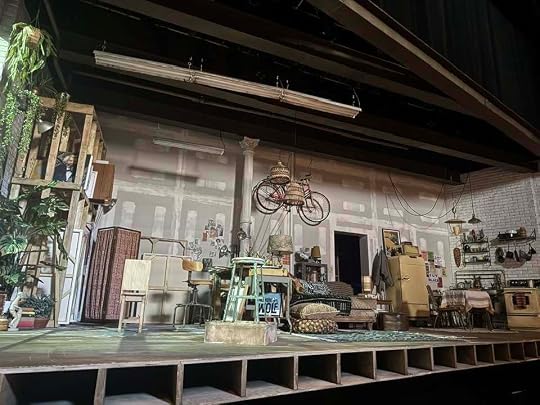
The stage set for the 2026 Canadian Stage production in Toronto. Image from own photo. NOTE: I have no cast curtain call photo as my phone decided to do a system refresh when I turned it on after the show, which locked me out 😠.
Artist Bill is looking to complete his triptych painting of black womanhood and needs what he imagines as a downtrodden country-born black woman to pose for it (the other panels are an innocent child and an African queen). His hipster friends Sonny Boy and Cynthia bring Tommy (nickname for Tomorrow Marie) back to Bill's painting studio / apartment. They found her in a bar during the 1964 Harlem Riots. Her apartment had been burnt out during the looting, along with the restaurant she lived over.
Tommy is unaware of her supposed role in the triptych and when she inadvertently overhears a phone call by Bill (who is describing the African queen painting), she imagines herself as his "Wine in the Wilderness" and allows herself to be seduced. Next morning, the not-too-sober character Old Timer arrives and lets slip what her role actually is in the painting. Tommy is infuriated and confronts the rest of the cast with her disdain about their lack of respect. Bill finally has a moment of awakening.
This was a 3-star "Like" on the page, but thanks to the cast performances I rated the live experience as a 4-star.
Footnote
* My lede header and the play's title are inspired by the lines from The Rubáiyát of Omar Khayyám and Other Writings by Edward Fitzgerald (Edward Fitzgerald translation 1859):
Trivia and Links
See further information, including cast and production photos and interview clips, about the 2026 Toronto production here and read the complete programme booklet here
A review of the Dramatist's Play Service paperback (November 1, 1998) of a play first produced and published in 1969.
BILL. ((On the telephone, we see Tommy and Bill, but they cannot see each other)) You just make sure your exhibition room is big enough to hold the crowds that's gonna congregate to see this fine chick I got here. (This perks Tommy's ears up) You oughta see her. The finest black woman in the world ... No, ... the finest any woman in the world ... This gorgeous satin chick is ... is ... black velvet moonlight ... an ebony queen of the universe ... (Tommy can hardly believe her ears) One look at her and you go back to Spice Islands ... She's Mother Africa.
This is very much a 1960's period piece, which you could say was built around the "Black is Beautiful" theme. While its message of strong independent womanhood still rings true for the present day, it has too many cringey "baby, baby" and "n" word dialogues to feel contemporary. Still it was great to see it get a recent remount at Canadian Stage's Berkeley St. Theatre here in Toronto with the actors giving stellar performances.
The stage set for the 2026 Canadian Stage production in Toronto. Image from own photo. NOTE: I have no cast curtain call photo as my phone decided to do a system refresh when I turned it on after the show, which locked me out 😠.
Artist Bill is looking to complete his triptych painting of black womanhood and needs what he imagines as a downtrodden country-born black woman to pose for it (the other panels are an innocent child and an African queen). His hipster friends Sonny Boy and Cynthia bring Tommy (nickname for Tomorrow Marie) back to Bill's painting studio / apartment. They found her in a bar during the 1964 Harlem Riots. Her apartment had been burnt out during the looting, along with the restaurant she lived over.
Tommy is unaware of her supposed role in the triptych and when she inadvertently overhears a phone call by Bill (who is describing the African queen painting), she imagines herself as his "Wine in the Wilderness" and allows herself to be seduced. Next morning, the not-too-sober character Old Timer arrives and lets slip what her role actually is in the painting. Tommy is infuriated and confronts the rest of the cast with her disdain about their lack of respect. Bill finally has a moment of awakening.
This was a 3-star "Like" on the page, but thanks to the cast performances I rated the live experience as a 4-star.
Footnote
* My lede header and the play's title are inspired by the lines from The Rubáiyát of Omar Khayyám and Other Writings by Edward Fitzgerald (Edward Fitzgerald translation 1859):
A Book of Verses underneath the Bough,
A Jug of Wine, a Loaf of Bread—and Thou
Beside me singing in the Wilderness—
Oh, Wilderness were Paradise enow!
Trivia and Links
See further information, including cast and production photos and interview clips, about the 2026 Toronto production here and read the complete programme booklet here
June 9, 2009
I played the role of Cynthia in this play, my first role, my first audition, I got the part...

January 16, 2017
Absolutely beautiful.

August 21, 2022
Childress crafts a play around Tommy, who only wants to be seen as a fully human Black woman. Tommy’s surrounded by other Black characters—both men and women—who want to paint her as “the messed up chick” because of her circumstances and methods of survival in 1960s riot-ridden Harlem. There’s an element of PYGMALION here, though in the opposite direction, and Childress plays on this theme smartly, as Tommy is depicted with respect and intelligence even as her peers try to box her into a caricature of an ignorant Black woman.

June 24, 2026
Good play about how artists romanticize and stereotype people they don't know. I mean, all people do this to some extent, but this play is specifically about how artists can blind themselves to true human nature when they typecast according to their preconceptions and prejudices.

October 15, 2019
Rock solid play with a great central character, Tommy, just hoping to be seen as fully human and beautiful in a world where even other Black people look down on her.
April 24, 2023
i already know my prof will read all of the n words with the hard r 🤠 why are white profs like this
February 14, 2024
This play was so sad. Bill just wanted to use Tommy (Tomorrow-Marie) and then she basically gave him a verbal scolding and still lets him use her. Ugh!
April 22, 2025
Wonderful piece of writing, loved every line.
Displaying 1 - 9 of 9 reviews