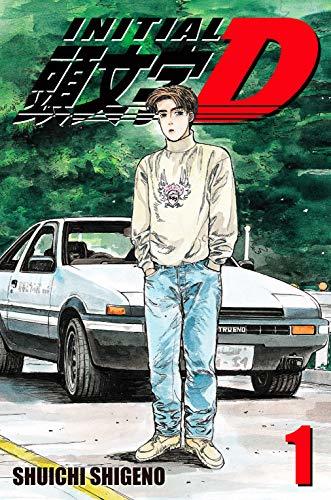
The Ghost of Mount Akina Tak Fujiwara spends a lot of time behind the wheel. His tofu delivery job sends him racing down the treacherous roads of Mount Akina, and without even realizing it, Tak has mastered racing techniques that take most drivers a lifetime to learn. Of course, none of his friends realize this. They're all too busy watching the Akina Speed Stars, the local street racing team. When the legendary Red Suns show up to challenge the Speed Stars, it looks as if the Trueno Eight Six that has been seen racing through the mountain roads. The question remains … who's the driver of this phantom car?
Part of the comiXology Originals line of exclusive digital content only available on comiXology and Kindle. This title is available as part of comiXology Unlimited, Kindle Unlimited and Prime Reading.
Shuichi Shigeno (Japanese author profile: しげの秀一) is a manga artist, best known for the manga series Initial D. Shigeno has also created Bari Bari Densetsu, Dopkan, and Tunnel Nuketara Sky Blue ("First Love in Summer") all prior to the manga that would make him famous in 1995. In 1985, he received the Kodansha Manga Award in shōnen for Bari Bari Densetsu.
It's really really fun, but has the same problem I've felt in most of the (very little) manga I've read, that it was conceived and written by visual artists, not by skilled storytellers. So the story is grounded in hilariously awesome concepts, but isn't very well told, and the dialogue especially is stiff and stale, with some attempts at emulating punkish teenspeak that don't work remotely well. Of course the cheesiness is part of the fun and arguably makes Initial D even more fun to read, but in a shallow way. Still, there is awesome energy and contagious car enthusiasm here, well accomplished subculture vibes and tongue-in-cheek self awareness too. That first moment of the AE86 drifting pass the Mazda RX7 is some of the most badass/hilarious shit ever.
I used to love Initial D., the cars, and the racing this is indeed a true shonen manga. However, I reached a point where I could live without it and I've always found the translation iffy.
Its a racing one in the same line as MF ghost. Again with this one I'm not a fan of the art and the kindle edition looks a little like the paperback pages were copied and pasted. I didn't like the female character, getting sugar daddy vibes from that meetup and if that is the case. Cheating. Tak comes across as bored and it's only the hype from the other characters that keeps things going. Saying that, it's the cliffhangers that made me keep going jumping onto the next one.
This entire review has been hidden because of spoilers.
Initial D focuses on 18 year old Takumi “Tak” Fujiwara and his high speed races down the dangerous mountain tracks of Japan. His story begins in his hometown, Akina, chatting with his best friend Itsuki ” Iggy” Takeuchi. Iggy and Tak one day tag along with their coworker Iketani “Cole” up Mt. Akina to watch the local racing team The Akina Speedstars, of which Cole is the leader. However, things quickly change pace in this remote mountain town as The Akagi Red Suns, neighbouring town racing hotshots, challenge the Speedstars to a race. Akina’s racers quickly find that they are completely outclassed and in a desperate attempt at protecting his teams pride, Cole searches for a mysterious racer who is famed to be the best downhill racer in Akina. His search brings him to a tofu shop with a grumpy owner and his old model 86. Its now the deadline for the race and Cole and his crew wait anxiously at the top of the mountain as an old 86 rolls up the hill with Tak in the drivers seat.
While GTO was a great casual read for comedy, Initial D is a great casual read for sports/racing manga to pick up from time to time and read an arc while enjoying every moment of exhilarating racing action. However, much like how GTO suffered from getting samey over time, Initial D‘s generic approach to the racing too grows tired over time. This is both a strength, the manga is easy to read casually, and a weakness as you can’t really binge read the series without it becoming tiresome by volume 48. But despite this if you take your time and space out your reading of this fantastic manga.
The art of Initial D is a very well mixed bag of being amazing and horrible at the same time. On the one there is the superbly detailed backgrounds and cars, however on the other hand is the immense derpiness of the faces. The beautiful art when concerning the cars and the backgrounds makes the cars jump out of the page and when you see these beasts on the racing track, you’re given a sense of kineticism that gets you recreate these races mentally with ease. The artwork really makes the races in this manga stick out and become memorable despite the limits of the medium and whether you favour the motion lines of the manga or the legendary soundtrack and CGI of the anime, they are both really entertaining. Idk what kind of madman Shuichi Shigeno is but for some reason on his characters everything above the neck is derpy if not down right jarring. For me this was conflicting as there are some really lovable and entertaining characters that fill Initial D, but they all have faces that look down right alien.
And we finally get down to what I found to be the true heart of Initial D, the characters. Characters in Initial D feel very real and relatable, with real to life inner conflicts and thoughts that force the reader to see themselves in the reflection. When I began reading this manga I was wondering how this manga about cars and fish lipped characters could’ve inspired and change the lives of so many people. Initially I didn’t get it as the plot seemed very generic for sports manga and the racing was entertaining but it wasn’t until I started getting invested in the characters that I started to get why this is such an inspirational series. Takumi embodies a lot of the insecurities and worries of a young man who’s finding himself and his path in life and following his journey from a spacey and generic op main character to a passionate racer. Watching his transformation is truly enjoyable and while it may be simple, it remains an inspirational tale for those who it resonates with.
Initial D Vol.1 is a Graphic Novel by Shuichi Shigeno. The book starts off with an ally, Itski talking to the protagonist Takumi, about what car he is going to get. Takumi doesn't understand why Itsuki wants a car, and to drive so bad. they then go to work, and Iketani tells them about their car group's meet up that night, and that they should come along. They then go to the meet and they meet the Agaki Red Suns, another car group, that then challenged them to a time trial battle on the mountain course next Saturday. The next day Natsuki asked Takumi if he wanted to go to the beach on Sunday and he said yes to it. Takumi's dad was met by iketani because he was asking for him to race for him against the red suns. Takumi's dad told Takumi that he has to race against the red suns, to use the car for the beach. Takumi then decided to race, even though he wasn't interested in it, and thought it was pointless. This book has lots of action, and drama consistent throughout the story. The author does this to keep people engaged. the writing in this book is sometimes difficult to keep with because it changes scenes very quickly, and sometimes out of nowhere. This book reminds me of another Manga, called Wangan Midnight where it has similar aspects of writing, and artwork. I would recommend this book to another classmate because it is a very entertaining book if you know whats going on. However I wouldn't recommend this book to my classmates because it can be very confusing at sometimes, and its storyline is complicated.
My review represents the entirety of this series, rather than just this specific volume.
The best way I can sum up Initial D is that it’s first part — the Gunma arc, as I call it — balances fun races, full of twists and racing trivia, with the coming-of-age story of a high schooler trying to find his place in the world. Some of the best moments are in volumes 16 and 17, which concludes the first part of the series in the winter. Focusing on Takumi’s relationship with Natsuki and including an unexpected race gives the series so much life. Those two volumes had me reflect on my high school days and what it meant to move forward, despite the heartbreak and uncertainty of doing so.
The second half, Project D, ended up disappointing me. The races are fun, sure, but the excitement slowly escaped because it lacked any major themes (that is, not until the 39th volume, which later develops in the 41st, 42nd, and the final chapter of the series). The theme of dreams comes in, which births a fantastic, high-tension battle between Ryōsuke and Rin Hōjō. It makes Ryōsuke’s character the most developed, complex, and interesting. Other than the lack of major themes, most of the races fall into a predictable rhythm that rarely breaks. The side arcs are generally not as good, with exception to Fake Project D and the moments between Takumi and Mika. The information about street racing techniques mostly disappears, as most battles come down to tires. The details about types of drifts and the advantages of some cars begin to fade away. The chapters of this arc were essentially cut in half (probably related to the publisher), which makes the pacing feel off at times, while making a 300-340 chapter series into a 719 chapter series. Overall, it has its moments, but it rarely captures the magic of the Gunma arc.
Lastly, I should mention the art: I really like it! The faces have a simpler design, but the author still manages to depict lots of expressions. I also always liked the change in character’s clothing, giving each one a sense of fashion — a fun detail. The cars are drawn exceptionally well, which of course is the main appeal of the series. The depictions of motion and sound are mainstays of the series; I especially love the use of onomatopoeia since it’s everywhere and gives an audial sense that I don’t usually see in other visual/written media (just make sure you can read katakana!). However, towards the end the techniques start to wear out and races feel too similar. Very rarely were there new angles or panels that shook up the flow of a race. I think there could’ve been more shots from really low or high angles, or a faraway shot to give a sense of perspective on the course or the speed. Furthermore, I noticed that the author very rarely shows the actual speed of the cars (via speedometer or audience calculation). Characters always say they’re going fast, but you never really see the speed. I suppose the author found certain limitations and didn’t want break continuity with a noticeably inconsistent course or an unrealistic speed, but I still think he could’ve done it.
TL;DR - I really enjoyed Initial D and recommend it, but you don’t need to read the Project D story.
This entire review has been hidden because of spoilers.
I was supposed to watch initial d, but found out that I could read it instead. As someone who knew very little about cars at the beginning of this series, I learned a lot. I now want to drive an AE86 Trueno or a GTR.
The book is about a high schooler, not at the end of the series, who had an amazing sense of driving but just wasn’t aware of it. His best friend was the one who introduced him into street racing, and that was basically the start of Tak’s career.
Tak had been driving since middle school to make tofu deliveries for his father and saw driving as something trivial in his life. What he did not know, was that his dad had been training him in secret for the past years telling him to drive down Mt. Alina without spilling any water even in the hairpin turns and how to drive faster and all that jazz.
When Tak raced for the first couple times against others, he was recognized as the fastest driver on Mt. Akina and multiple drivers challenged him.
(Taking more about the end of the series)
As this series goes on, you could see Tak develop and find a love for driving. He goes on to be a legend in the street racing world, thanks to the Takahashi brothers, and develops a greater understanding of cars.
This series was mind blowing to say the least and I read every single word. I still have screenshots of pages when parts of cars were being introduced that I had no idea of, like rotary engines or superchargers, turbos, and b-16 engines. This manga is overall hilarious and amazing and I would definitely recomendable reading it, if you have some level of interest in cars.
Προσωπικά μ'αρέσει πολύ αυτή η σειρά γιατί συνδυάζει manga και Ιαπωνικά αυτοκίνητα, κόντρες και drifting.Νομίζω ότι η σειρά παιχνιδιών NFS κράτησε μερικά στοιχεία τα οποία έβαλε στα παιχνίδια της όπως και η σειρά ταινιών Fast and Furious Tokyo Drift,η οποία είναι πρακτικά η υπόθεση του manga σε Americanized version. Δίνει πολλές πληροφορίες σχετικά με διάφορα μοντέλα και πολλές λεπτομέρειες για τεχνικές βελτίωσης, γνώσεις που είναι λογικό να υπάρχουν αν σκεφτούμε ότι και ο δημιουργός του manga ασχολούνταν με το Drifting σε κατάβαση από μικρός, χρησιμοποιώντας το ίδιο αυτοκίνητο με τον πρωταγωνιστή. Κάνει σε μερικά σημεία κοιλιά γιατί το μοτίβο των sub-arc είναι πάντα το ίδιο - κόντρες,street cred,γυναίκες- και οι όποιες διαφοροποιήσεις (που λόγω αντικειμένου είναι περιορισμένες) δεν βοηθούν πολύ την κατάσταση. Το σχέδιο είναι απλό και γραμμικό,τα αυτοκίνητα πολύ καλο-σχεδιασμένα και κατά την διάρκεια κίνησης,μιας και πάνω από το 50% των σχεδίων είναι αγώνες. Λίγο ενοχλητικά είναι τα συννεφάκια με τα ηχητικά εφέ που πιάνουν μεγάλο μέρος του σχεδίου αλλά δεν επηρεάζουν την ανάγνωση. Μεγάλη απογοήτευση η Tokyopop που έκανε το ένα λάθος μετά το άλλο στις μεταφράσεις, στην απόδοση ονομάτων, στην αφαίρεση σελίδων κατά το δοκούν, όλα στο βωμό της αποδοχής από το Αμερικανικό κοινό(το intro τραγουδάκι στο anime είναι επιεικώς απαράδεκτο). Προτείνω για τους λάτρεις των αυτοκινήτων και όχι μόνο!
I watched a pretty hefty amount of the anime for Initial D a few years ago and I really enjoyed it (i got too caught up with life to watch through the final stage if you're curious to why I never got all the way though) I picked up reading the manga and it was an experience to say the least. For the most part, as any source material should be, it was similar to the show. Most of it was the same but there were some pieces that were simply SHOCKING to me. ( I already put this review as having spoilers but now I'm gonna get into it) So,,, Some things were changed with Natsuki Mogi (the girlfriend) for the anime where the manga had me audibly react in the moment, and even now im still a little shook. Mogi i wouldn't say changes too much but there are two things in the first volume that were cut. First: one of Takumi's thoughts about her was shown in one frame which was just full on ecchi. Second: she called the Mercedes man "papa", which i didnt remember in the anime, and we all know what happens with the Mercedes man... All in all though, this was an enjoyable read for me, especially since ive already been a fan of the anine adaptation.
This entire review has been hidden because of spoilers.
Initially loved the series, the car racing theme was cool, the characters superb and the art while different still well suited for the theme. But as the series progressed everything seemed repetitive, the races seemed endless. More story's away from track was needed. Still did end up reading the whole series - 720 chapters in a two weeks. For a fan of cars and racing , this may be a fun manga but rest should stay away. The initial 100 chapters were great for me but after that it was a drag and just wanting to know the ending drove me to finish the series, sad part didn't enjoy the ending.
Just wow. Like not even Fast and Furious could get me interested in cars and racing but this manga sure did!!
I loved everything: the 90s drawing style, the plot (so cool!), the comedy, and the characters (so interesting). There was only one thing I did not like and that was that this manga contains one 18+ scene. It's just one panel, but still, I dont think it was necessary.
I can't wait to read the rest of the series though!!
I'm a fan of Death Race and other car movies but I didn't like Initial D at all. Its story flow was smooth and straightforward which I usually like but the art turned me off and, despite the impressive moves done with the cars, didn't interest me. I might try the anime but sorry, I can only rate the manga 2 stars.
Even though I love the bad cheesiness of "The Fast and the Furious," I found this book a little boring. I do like the fact that an old hatchback is outracing the Skyline GTRs and Japanese sports cars.
This was charming. The writer thought cars were cool, so he made a series about racing cars. It's not that deep. I love the cartoony faces. Everyone's head is weirdly round. It's so funny next to the photorealistic cars.
I don't know what I expected from this series but I didn't expect it to be kind of meh. Then again this is only vol. 1 and 98% of the time I do like to give a series at least 3 volumes depending on how long it is, to see if I like it or not and if I want to continue reading it. This volume wasn't bad, it just felt so-so. I think part of feeling like that is because I don't care about car models, for me a car is just something that takes me from point A to point B. My sisters want certain types of cars and I'm here like "I don't care what kind of car it is or even if it's 6 or 7 years old as long as it's works fine." So maybe reading a manga series about racing cars probably wasn't the best choice but I still wanted to give it a try since some people I watch on youtube really like it and it's one of those classic series that I remember hearing about as a kid. I feel like I might still be able to enjoy this series even if I don't care that much about cars, I was getting a little into the races. Another reason I might not have gotten too into it is because I don't like the art style, so it was very hard to get through some of the chapters, especially the first two. I've noticed that many manga from the 90s don't have good art, whereas immediately from 2001 we start getting series with amazing art, for ex: Fullmetal Alchemist and Bleach. They both came out around 2001 or 2002 and have really great art styles that have gotten even better the more the their mangakas draw manga. I'm not being biased because they're my most favourite series ever, I actually do think they have great art, I even bought the art books. But for this series so far, Boys Over Flowers and a few other series that came out in the 80s and 90s, it's just really hard to get past that because while yeah the words are important, the drawings are also very important, graphic novels and comics are a visual medium after all. I don't like being harsh towards people's art but I feel that it's very important to be honest when critiquing something and I'm trying to nice and respectful towards the creator.
I don't know how I feel about the main character Takumi yet. I am annoyed by that girl (whose name I have already forgotten) who Takumi likes because everyone acts like she's so good looking and amazing but she just looks average to me and whenever she talks, she talks in third person, it's really annoying, I hate it. I think some people might find it cute but it just annoys me. Something about that girl makes me not like her right away, I don't know why except that I just really hate the way she talks. I would also talk about her creepy older "boyfriend" but the age of consent in Japan is 14 (which I think is way too young) so it's not illegal but it still grosses me out, I heard that she won't be with him for long and will probably end up with Takumi. I have also heard that the age of concent might be changed to 16 which is better. Sorry for bringing that into this review, I just thought it was necessary to mention so that everyone is aware and understood that laws are different in other countries (Americans especially forget about that).
I don't think I will buy the rereleases that are coming out or new editions (I'm not really sure what kind of edition they will be) but I will continue reading this series, maybe I'll want to buy them after reading a few more volumes, who knows, we'll see. I will continue reading this because I want to see everyon's reactions when they find out who the mysterious driver is, especially his annoying friend and I'm really curious where this series goes.
Somewhat fun but largely bland street racing story. I mostly found this interesting because of how similar certain aspects felt to THE FAST AND THE FURIOUS: TOKYO DRIFT. If that movie’s downhill mountain drifting finale wasn’t inspired by this, I’d be very surprised. The story surrounding the car action felt muddy to me though, and it doesn’t help that the characters all look very similar to each other. I legitimately couldn’t tell one from another at certain points. There were also some car names that I just never got. ‘Hachiroku’ (or maybe meant to be read as ‘86’) I guess is a model of car? It’s mentioned like 100 times but I never understood what it really represented. Because of stuff like that, I fumbled through this one. Not my best read, though I don’t think I would have loved it, even if I fully understood it.
As with all works I read entirely in Japanese, I will now recount the entire story, so I can check my work later:
========== SPOILERS FOLLOW (maybe) ==========
Our guy is into cars, and he covets one that I’m going to call ‘the 86.’ He works at an auto body shop or gas station or something with his friend who also likes cars. They somehow get turned onto the street racing scene (I forget how, maybe from the other guy who works at their shop) and it’s a whole different world. The kings of the mountain where they race are the Takahashi Brothers.
The other guy who works with them is a racer, and he eventually gets into an accident while practicing on the mountain by himself. He does this because he found some guy who works in a tofu shop (who might be the MC’s relative?) who’s an old master racer guy. But the tofu shop guy doesn’t want any part of it. That plotline didn’t seem to really pan out.
Speaking of plotlines that don’t really pan out, there’s some kind of half-assed insert where the MC asks his female friend out on a date to the beach. There’s a bunch of wasted pages on him mustering up the courage, and the comic even follows her for a bit after she gets the invitation. But I say it’s wasted because we never even see or hear about the date. There’s also some kind of twist where it might turn out that the girl was secretly a street racer too? But I don’t think anyone ever finds that out.
At the end, it’s a drift extravaganza with the Takahashi Brothers while everybody stands around and commentates. You know what’s not really exciting? Experiencing a race through images and descriptive text. Sorry, but it just didn’t work for me. The car artwork was cool though.
Nothing really seemed to happen by the end of this volume, and I was struggling to latch onto anything of interest the whole time. Maybe some of it was due to misunderstanding the text, but I think a lot was also because I just plain stopped caring. I suspect this one is going to be a more long-running series, and less focused on tying up the loose ends within each volume, but that’s not how I like to consume my content.
All in all, I’m not proud of my performance with reading this one. It was a slog, and my eyes would often just glaze over. I have another volume that I got for free in a promotion, but I may not even read it.
I found this to be one of the most influential pieces of fiction in my life. From what starts as a pretty typical battle shonen but with cars manga becomes a very deep personal reflection on how you can be changed through the pursuit of a craft. Every race is a battle of competitive morals on how one ought to pursue racing as an art, and I think the message of it can be best depicted in the Athlete vs Craftsman arc. At least, as a competitor myself, it's probably the most accurate description of how I feel about competition.
I compete in a world that cares a lot about arbitrary rankings, and there's a lot of discussion and debate, and people get fired up over achieving some level of skill that falls on that arbitrary ranking. I've always felt like an odd one out. Maybe it's from being an artist where you can chase after honing one's craft side by side with other artists, not necessarily needing to compare oneself to another, because in such a personal craft, do you have the right to take from someone else's personal journey by ranking it above or below yourself? Melee, like art, is something I do. To an outsider, it may be seen as a hobby, but when I'm doing these things, I want to feel like I'm in full pursuit of sharpening a craft with whatever limited time I have. I think athletes feel more inclined to do whatever is necessary to win in their chosen field, and that kind of mindset is why I admire athletes of all sports. But I find myself feeling more like a craftsman or an artist in my endeavors. A lot of my practice and curiosity feels more selfish and sometimes less utilitarian or practical in the world of competition, but helps me achieve my own personal happiness and shape my own voice.
'Initial D' is perhaps the most popular car-focused manga with western audiences. I picked the first volume up on a whim after seeing it available on Amazon Prime Reading, and ended up going down a rabbit hole exploring the available English translations of this series.
In terms of the story, this first volume does it's job well of introducing the characters and concept. I know that the art style of this series (in particular, the depiction of the characters) is polarising; personally I found it difficult to differentiate between the male characters as many looked similar. The depiction of the cars and racing is the highlight of course, and specific models of car are recognisable.
I read the 2019 Amazon ebook release of this volume, but out of curiosity compared it to the original Tokyopop 2002 physical release. The text and translation are almost identical (complete with westernised character names and 'Fast and Furious' inspired dialogue), but interestingly the 2019 release has uncensored some previously censored content. For some reason, the 2019 version included some typos/minor editing mistakes that were not present in the earlier translation despite the text being largely unchanged. I did not look at the more recent 2024 omnibus release, but this apparently features an all-new and more accurate English translation so I will seek these releases out if I decide to continue on with the series.
Esta es una de esas cosas que te encuentras en el prime reading (si, está la colección completa al menos en el momento en que escribo esto, 48 tomazos), picas por probar y oye... todo un acierto.
Para no entrar en entresijos del argumento se puede explicar diciendo que básicamente esto es un shonen de carreras de coches clandestinas, tenemos un prota despistado y emo pero que tiene un don para conducir, el colega insoportable del prota, la chica que hace de interés romántico que como es habitual esconde algún oscuro secreto, los rivales, los aliados... todo muy típico, pero funciona como un reloj y te bebes las páginas si la temática te calza bien.
El dibujo es resultón aunque se notan los años (este primer tomo se publicó en los 90), el autor emplea mucha referencia fotográfica (como es habitual), especialmente para los fondos y para que los modelos de coches sean fieles a los originales, a veces da un poco el cante porque parecen fotocopias, pero lo importante es que las carreras están muy bien resueltas y el manga fluye bastante bien en general.
Lo dicho, todo un acierto si te llama la temática (que es muy de nicho) y el tono un poco simple propio del shonen no te tira para atrás, ahora a leerlo rápido no vaya a ser que lo quiten del prime reading.
So, this is Initial D: Fast racing cars, boring tofu delivery cars (that turn out to be also moonlight as race cars), teenager car racing machismo, and stereotypical plot with the obligatory reluctant protagonist and the obligatory high school hormones. One-dimensional characters cut from cardboard. I would not call it a great work.
But it does have some charm: this is the most exciting explanation of drifting I've ever read. And everything looks so very 1990s (...as a kid born in early 1990s the aesthetics of the era bring back nostalgic memories!) ...and I admit that I am a little bit intrigued about the plot. How the protagonist will beat the Red Suns (as I trust he will do) in the follow-up volumes?
Unfortunately the local library has only vol 1 available and I'm not intrigued enough to start hunting for vol 2 and beyond.