Ashtavakra Gita is the most instructive spiritual text ever written and should be read and re-read by any sincere seeker of Self-Realization. It gets to the heart of Truth and True Nature more directly and concisely than anything else I’ve encountered, and I agree with its last “No more can be said.” I call this the “bootleg version” because a PDF of my first draft of this translation, which I gave to a small group of friends, made its way onto the internet and subsequently was downloaded and read by a sizeable number of people, judging by the emails I’ve received thanking me for doing it, or requesting permission to translate it into their language—despite having no contact information in the PDF. Several years later I included a slightly revised version in my book, The Perennial Way, which judging by book sales has not reached nearly the same number of people. And so I thought I’d publish the original version separately as a paperback and e-book, on the theory that maybe it had its own mojo for some reason, and might find its way into the hands of a few folks who have not otherwise encountered it. The Translator’s Preface and Introduction are also from the original viral PDF.
To be free, shun the experiences of the senses like poison. Turn your attention to forgiveness, sincerity, kindness, simplicity, truth. Ashtavakra Gita ~~ Translated by Bart Marshall
The Ashtavakra Gita has been described as one the most instructive spiritual text ever written and should be read and re-read by any sincere seeker of Self-Realization. It gets to the heart of Truth and True Nature more directly and concisely than anything else. This is something the reader will have to decided for themselves. But I can affirm after having read this, the Ashtavakra Gita is of the greatest spiritual texts I’ve ever read.
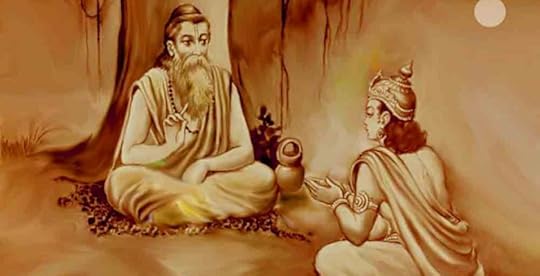
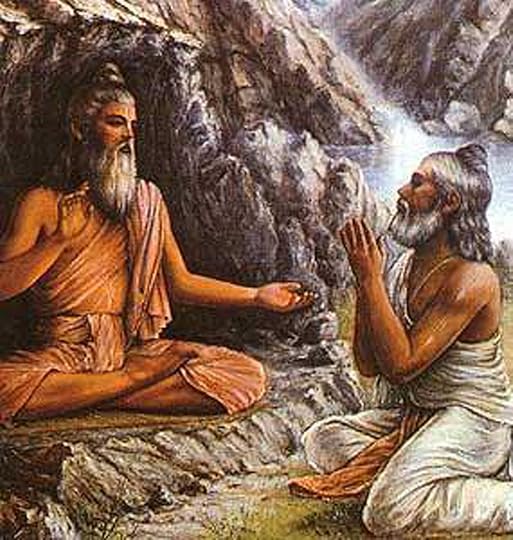
Ashtavakra Gita also known as Song of Ashtavakra is among the greatest scriptures of Hinduism. It is a conversation between the Sage Ashtavakra and King Janaka.
Janaka was the king of Mithila, Sita’s father in Ramayana. Ashtavakra is believed to be a sage with eight deformities in his body. Janaka asked Ashtavakra: Master, how is Knowledge to be achieved, detachment acquired, liberation attained? Ashtavakra’s answer to these question came to be known as the Ashtavakra Gita.
Ashtavakra could be looked upon as an Everyman. The wisdom contained here is meant for the entirety of humanity. King Janaka answers all the questions of the seeker of ultimate truth. Here we learn the whole of selflessness and liberation.
Every single page of the Ashtavakra Gita is filled with wisdom. Marshall's translation is simple and easy to understand. For anyone on a spiritual path, Marshall's version of Ashtavakra Gita is well worth a thoughtful read.
if one wanted to learn more about advaita vedanta, this is it. unlike other philosophies in the dharmic school of thought, advaita vedanta presents a philosophy so direct and absolute that it feels both liberating and unsettling at the same time. this intensity is what makes the text so unique. it may seem nihilistic on the surface, but it's meant to open your eyes to what really matters. sage ashtavakra never says nothing matters, but rather nothing binds you. action still continues, life goes on, but it is all temporary. none of it controls you.
the biggest challenge after reading such a profound piece of literature isn't understanding the words, but experiencing the truth it offers. the bluntness and detatched nature of the truth may be difficult to fathom, especially for people who require more of an emotional connection or instructional guide to feel a philosophy. but for me, someone who has slowly become more of an advaitist since the start of the year, i needed the honesty. i liked learning how there's nothing to achieve, nothing to renounce, and nowhere to go. at my core, i am whole without any change. i am allowed to grow with the realization that i was never lacking in the first place.
whether comforting or contemplative, the ashtavakra gita's message lingers long after the last page, quietly reshaping how i see myself and the world.
quotes that stuck out:
"11.6 “I am not the body, nor is the body my possession— I am Awareness itself.” One who realizes this for certain has no memory of things done or left undone. There is only the Absolute."
"17.19 Though he may perform actions, the man of Knowledge does not act. Desires extinguished, free of thoughts of “I” and “mine,” he knows with absolute certainty that nothing exists."
"18.50 Depending on nothing, one finds happiness. Depending on nothing, one attains the Supreme. Depending on nothing, one passes through tranquility to One Self."
There are many translations of this Hindu classic of Advaita Vedanda, a non-dualist school that teaches the oneness of all things and the illusory nature of the universe that we think we know. “The Song of Ashtavakra” explores self-realization and the path to liberation (i.e. Moksha.) [Ashtavakra was a sage with birth defects from which the name “8 angles” derives. Yoga practitioners will know the name from an arm balance pose that involves balancing the kinked body on bent arms in a manner that was apparently reminiscent of the look of this sage’s body.]
The translation that I read, one by Bart Marshall, is clearly written in readily understandable language. It’s presented as a series of short-form poems arranged into twenty chapters that also form a dialogue between Ashtavakra and Janaka. This version doesn’t contain commentary and analysis as some translations do. Because it’s both highly readable and inexpensively acquired, I’d recommend one give it a chance. If you later decide you’d benefit from commentary, you’ll not be at a loss by having read this version first.
As is common enough in such tracts, the book can be repetitive as it reiterates ideas like the need to avoid desire and aversion and the nature of oneness. That said, there were some quite powerful statements that genuinely expanded on the ideas of the work. (e.g. 18.100: “One of tranquil mind // seeks neither crowds nor wilderness. // He is the same wherever he goes.” Or 3.12 “Why should a person of steady mind, who sees the nothingness of objects, prefer one thing over another?”)
If you’re a student of philosophy or of yoga as a philosophy, I think this is well worth a thoughtful read.
20 repetitive meditations on the nature of the Self.
Due to translation issues, hard to tell what lessons to draw.
For instance, chapter 16 says that wisdom is the opposite of desire. Is this true? It sounds true. But we can’t be sure from the translation.
A few chapters earlier it states that we do not own the body. Again, is this true?
Nuance is bypassed for the sake of clarity. There is no doer but we are still accountable. We don’t own the body but it is still kind and loving to take care of it. Complete non-personalism has replaced all nuance with clarity.
There is no psychology. There is no theology. In many ways it is an anti-intellectual instruction manual for direct experience.
The Bhagavad Gita includes many ways to God. This Ashtavakra Gita is no way at all. It is the shadow or mirror image of the Bhagavad Gita. Read alongside the other more famous text it is illuminating.
The more I read these religious or spiritual scriptures, the more I believe in the fact that all of these boil down to one thing in the end. Oneness!
Ashtavakra Gita is conversational dialogue between King Janaka and the sage Ashtavakra, where the sage gives the king his advise, his wisdom. A very thoughtful and thought provoking scripture, and though shorter in length it gives you the higher insight in the Self. The translation itself was easy to read and leaves no confusion on the reader’s mind, making the message loud and clear.
Been in this game(spiritual) for 5 years—no rituals, no meditation, just tuning into consciousness. Tbh, Ashtavakra Gita is some next-level spiritual stuff, not exactly beginner-friendly. But the main vibe? Absolute neutrality. Unfair treatment? Whatever. Compliments? Doesn’t matter. Happiness, sadness—same energy, different forms. And the kicker? ‘I’ isn’t even real, so my so-called struggles? Yeah, they don’t exist either. Wild af!
Ashtavakra Gita is one of the highly regarded scriptures - the summum bonum of absolute monism. It is a classic dialogue between the sage Ashtavakra and King Janaka. The translator, Bart Marshall, has done a fantastic job in adding a certain rhythm and poetry in it without compromising its essence. Great work. I want to read it again.
73 pages of beautiful poetry of our Lord and how he is one with us all. God is love and so are we. Ashtavakra reminds us of this within this beautiful poem. A Christ like figure from India and an amazing writer. God bless you Ashtavakra