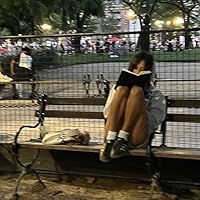
"Conversation enriches the understanding, but solitude is the school of genius."
-Edward Gibbon, Decline and Fall of the Roman Empire
=====
“Reading is that fruitful miracle of a communication in the midst of solitude.”
-Marcel Proust
=================
Marcel Proust, Kipling, P.G. Wodehouse, Graham Greene, Beethoven, Anne Sexton, Beatrice Potter, Goya----are a few examples in Solitude of how creative people benefitted from solitude.
============
"To foster the growth of the child’s imaginative capacity, we should ensure that our children, when they are old enough to enjoy it, are given time and opportunity for solitude. The capacity to be alone is one aspect of an inner security which can be built in the early years. Some children who enjoy the solitary exercise of the imagination may develop creative potential."
Right now, we are caring for our one-year old granddaughter five days a week and have seen this development with her. She likes us to be around, but she will look through books on her own. And stand, for some time, looking out our front window and talk to herself and laugh.
The author observes that the capacity to be alone is linked with self-discovery and becoming aware of one’s deepest needs and feelings.
------
The process of creativity, which I am familiar with from writing, has certain key aspects. First is preparation. One develops some preliminary interest in a particular subject, collects material, and reads everything he can find about it. The next phase is incubation. The material simmers and the brain begins to organize it. Then there is illumination when one develops insights, finds a solution to a problem, and figures out how to order the material into a thesis or a story arc.
=========
Kipling is considered not politically correct to read, but his experiences can be instructive in what I call the creative use of distress....
Kipling, just before his sixth birthday, was left with his sister in the care of a retired naval captain and his wife, Captain and Mrs Holloway. The parents did not inform their children that they were returning to India without them. Kipling was not to see his mother again until April 1877, at age 12.. The five years which he spent in what he later called The House of Desolation’ marked him for life.
He was bullied by the Holloways’ son, a boy some six years older, and ruthlessly punished, both by beatings and by enforced isolation, at the hands of the hateful Mrs Holloway. He was also bullied at the local day-school to which he was sent, and at which he performed badly. Every night he was cross-examined as to how he had spent his day. Each contradiction which the frightened, sleepy child produced was treated as a deliberate lie, and further proof of punishable wickedness.
One of Kipling’s biographers, Charles Carrington, remarks that his long years of suffering at the hands of Mrs Holloway taught him....
"that the mind must make its own happiness, that any troubles can be endured if the sufferer has resources of his own to sustain him."
In his story ‘Baa, Baa, Black Sheep," Kipling gives an undiluted autobiographical account of this dreadfully unhappy part of his life.
Kipling referred to his treatment by Mrs Holloway as ‘calculated torture’; but he also said that its effect was to make him pay careful attention to the lies which he had to tell, and concluded that this was the foundation of his literary effort. He also discovered that, if only adults left him alone, he could, through reading, escape into a world of his own. He was able to cultivate his imagination in solitude.
Like Edward Lear, he was at his best and most relaxed with children. He also exhibited an extraordinary capacity for inspiring confidence in others, who found themselves telling him their troubles in the assurance that he would not betray them.
This particular trait seems to depend upon an unusual capacity to put oneself in other people’s shoes, to identify oneself with others. It often originates in the kind of premature concern with the feelings of others which Kipling describes himself as having had to develop as a child. Kipling became watchful and wary; alert to the changing moods of adults which might presage anger. This prescient awareness of what others were feeling and of how they displayed their emotions probably stood him in good stead when he came to write.
==========
One book I am re-reading as a Covid sheltering book (4/26/2020) is "The Count of Monte Cristo." Dantes, a framed prisoner in solitary confinement in a French dungeon, is a simple, young, uneducated sailor. (Dantes would go on to become the Count many years hence). It would be 10 years in prison before Dantes connects with his fellow solitary, Abbé Faria who saves his life in more ways than one. For the time being, however, Dantes has no real mental resources of his own to sustain him. For a time, he tries religion but gives up in despair. He becomes self-destructive, but eventually resigns himself to death.
This reminded me of a chapter in "Solitude" that I had not discussed above, "Enforced Solitude." The author uses the example of Dr. Edith Bone, who later published a book "Seven Years Solitary." Storr describes from her book how she coped with her predicament.
"Dr Bone was over sixty when she was arrested in Hungary in 1949. A notable linguist, she had been invited to Hungary to translate English scientific books into Hungarian. She herself had joined the Communist Party in 1919. She was accused of being a British agent, but refused to make a false confession or in any way to collaborate with her interrogators. This elderly lady spent seven years in prison before she was finally released in November 1956. For three of those years she was denied access to books or writing materials. The cell in which she was first confined was bitterly cold and had no window. Worse was to come. For five months she was kept in a cellar in total darkness. The walls ran with water or were covered with fungus; the floor was deep in excrement. There was no ventilation.
Dr Bone invented various techniques for keeping herself sane. She recited and translated poetry, and herself composed verses. She completed a mental inventory of her vocabulary in the six languages in which she was fluent, and went for imaginary walks through the streets of the many cities which she knew well. Throughout these and other ordeals, Dr Bone treated her captors with contempt, and never ceased to protest her innocence. She is not only a shining example of courage which few could match, but also illustrates the point that a well-stocked, disciplined mind can prevent its own disruption."
The contrast to Dantes in "Monte Cristo" is the Abbé Faria. When we first encounter him in the novel, he is on the floor of his cell working on a geometric drawing that the author likens to the work of Archimedes.
Years later, the Abbé explains to Dantes how his store of learning has sustained him all these years, much of which he will pass on to his young protege.
“In Rome, I had nearly five thousand volumes in my library. By reading and re-reading them, I discovered that one hundred and fifty books, carefully chosen, give you, if not a complete summary of human knowledge, at least everything that it is useful for a man to know. I devoted three years of my life to reading and re-reading these hundred and fifty volumes, so that when I was arrested I knew them more or less by heart. In prison, with a slight effort of memory, I recalled them entirely. So I can recite to you Thucydides, Xenophon, Plutarch, Livy, Tacitus, Strada, Jornadès, Dante, Montaigne, Shakespeare, Spinoza, Machiavelli and Bossuet; I mention only the most important …’
and further explains what keeps him occupied.....
"I have to admit that my historical work is my favourite occupation. When I go back to the past, I forget the present. I walk free and independently through history, and forget that I am a prisoner.”