

What do you think?
Brexit collection #3
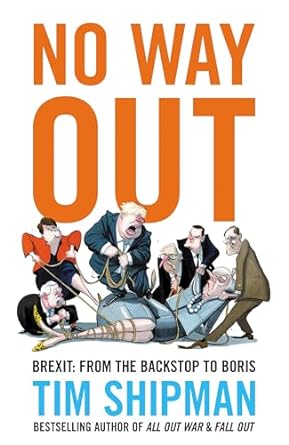
No Way Out: Brexit: From the Backstop to Boris
The unmissable next instalment of Tim Shipman’s #1 bestselling Brexit quartet. To follow his bestselling books All Out War and Fall Out, this book launches off from 2017 to offer an unflinching, unfiltered account of some of the most turbulent years of British politics.
In the company of all the key players and with countless never-before-revealed insights, No Way Out traces the unprecedented disasters and triumphs of Theresa May’s tenure. Spun with characteristic wit and wisdom, Shipman tells the story of May’s three great negotiations – first, with her cabinet, then with the EU and finally with parliament – and chronicles her fall in thrilling detail.
This is the ultimate insider narrative to three of the most turbulent and impactful years of government, revealing the strategies, gambles, mistakes, mindsets and scandals that have shaped and shaken Britain.
As always, political insider and chief political commentator for the Sunday Times Tim Shipman unleashes a slew of insight – and gossip – to reveal the democratic drama as it really happened.
In the company of all the key players and with countless never-before-revealed insights, No Way Out traces the unprecedented disasters and triumphs of Theresa May’s tenure. Spun with characteristic wit and wisdom, Shipman tells the story of May’s three great negotiations – first, with her cabinet, then with the EU and finally with parliament – and chronicles her fall in thrilling detail.
This is the ultimate insider narrative to three of the most turbulent and impactful years of government, revealing the strategies, gambles, mistakes, mindsets and scandals that have shaped and shaken Britain.
As always, political insider and chief political commentator for the Sunday Times Tim Shipman unleashes a slew of insight – and gossip – to reveal the democratic drama as it really happened.
747 pages, Kindle Edition
Published April 25, 2024
About the author
Tim Shipman
11 books151 followersTim Shipman has been a national newspaper journalist for sixteen years and has a wealth of experience reporting on British and American politics and international relations.
Currently the Political Editor of the Sunday Times, Tim has covered four British General Elections and three American elections from the US. Well known in the Westminster political mix, he is a trusted confidant of politicians from all political parties and has a growing following as a witty observer of the political scene @ShippersUnbound.
Currently the Political Editor of the Sunday Times, Tim has covered four British General Elections and three American elections from the US. Well known in the Westminster political mix, he is a trusted confidant of politicians from all political parties and has a growing following as a witty observer of the political scene @ShippersUnbound.
Ratings & Reviews
Friends & Following
Create a free account to discover what your friends think of this book!
Community Reviews
Displaying 1 - 30 of 55 reviews

May 5, 2024
Maybe it shouldn’t surprise me that half a million words on months of esoteric, technocratic grind is a long, dull slog to read. Shippers aims for Caro (whose LBJ books he predictably calls ‘magisterial’, a descriptor he uses again just a few paragraphs later) but the tone here is much more Westminster gossip than a genuine study of power.
I guess the biggest surprise is that despite the prolixity of the text, it did little to illuminate. We can spend pages on the minutiae of an irrelevant back room conversation, and yet skip over apparently decisive events without actually explaining what happened.
For example, we are told that Hunt’s leadership campaign was sunk by an intervention on fox hunting:
> “Within minutes triumph turned to disaster. Buried in the story were comments Hunt had made about fox hunting, in a separate podcast interview with the Telegraph’s Chris Hope. The wily veteran asked whether he would support a free vote on overturning the ban on fox hunting and Hunt walked into the trap. Tory MP WhatsApp groups went into meltdown and every other paper picked up on fox hunting, ignoring the carefully planned story the campaign wanted. It was an unforced error, and one which derailed Hunt’s big interview on the Today programme the next morning, where he had to spend valuable time dealing with hunting. ‘That was a genuine momentum killer,’ an aide recalled. ‘It deflated everyone. We never really recovered, honestly.’”
That's it. The entire bit. I have no idea what Hunt said on fox hunting, even whether he supported a free vote or not. I have no idea why it was so catastrophic, or any real evidence that it was.
The book would benefit from losing at least a quarter of the chaff.
The author makes the same point about the Bismarck quote that forms his epigraph twice. He decries May's unwillingness to 'kick the table over' on at least a dozen occasions.
And it's hard to believe this paragraph made it past a copy editor:
> “They would have been better to oust May in July 2018, rather than wait a year. Instead, the hardliners maintained their polite loyalty to the prime minister until, from their point of view, it was far too late. Had Davis, Johnson and Gove moved against her in December 2017 or earlier in May or June 2018 when it was beginning to become clear that May was on a very different page to them, things might have turned out differently. Even when Davis and Johnson did resign in July 2018, neither made any concerted effort to remove the prime minister. Both could have done so, with Philip Hammond’s assistance, after the general election.”
The profusion of dates is so confusing as to stop the reader in their tracks. "December 2017 or earlier in May or June 2018"?
Anyway, it is fundamentally a very boring book about a very boring Prime Minister engaged in sound and fury signifying, largely, nothing.
I guess the biggest surprise is that despite the prolixity of the text, it did little to illuminate. We can spend pages on the minutiae of an irrelevant back room conversation, and yet skip over apparently decisive events without actually explaining what happened.
For example, we are told that Hunt’s leadership campaign was sunk by an intervention on fox hunting:
> “Within minutes triumph turned to disaster. Buried in the story were comments Hunt had made about fox hunting, in a separate podcast interview with the Telegraph’s Chris Hope. The wily veteran asked whether he would support a free vote on overturning the ban on fox hunting and Hunt walked into the trap. Tory MP WhatsApp groups went into meltdown and every other paper picked up on fox hunting, ignoring the carefully planned story the campaign wanted. It was an unforced error, and one which derailed Hunt’s big interview on the Today programme the next morning, where he had to spend valuable time dealing with hunting. ‘That was a genuine momentum killer,’ an aide recalled. ‘It deflated everyone. We never really recovered, honestly.’”
That's it. The entire bit. I have no idea what Hunt said on fox hunting, even whether he supported a free vote or not. I have no idea why it was so catastrophic, or any real evidence that it was.
The book would benefit from losing at least a quarter of the chaff.
The author makes the same point about the Bismarck quote that forms his epigraph twice. He decries May's unwillingness to 'kick the table over' on at least a dozen occasions.
And it's hard to believe this paragraph made it past a copy editor:
> “They would have been better to oust May in July 2018, rather than wait a year. Instead, the hardliners maintained their polite loyalty to the prime minister until, from their point of view, it was far too late. Had Davis, Johnson and Gove moved against her in December 2017 or earlier in May or June 2018 when it was beginning to become clear that May was on a very different page to them, things might have turned out differently. Even when Davis and Johnson did resign in July 2018, neither made any concerted effort to remove the prime minister. Both could have done so, with Philip Hammond’s assistance, after the general election.”
The profusion of dates is so confusing as to stop the reader in their tracks. "December 2017 or earlier in May or June 2018"?
Anyway, it is fundamentally a very boring book about a very boring Prime Minister engaged in sound and fury signifying, largely, nothing.

June 13, 2024
I was about to embark on a very positive review of this book, but then I read a negative review and it made me reconsider somewhat. I’m such a sheep.
Anyway, I ldid rather enjoy this book. It’s essentially the story of the Theresa May premiership from the 2017 election until her defenestration in 2019. I was following the twists and turns of the Brexit process with great interest at that time so it was, for me, enjoyable to recap it. However, I would remind everyone that I am a lunatic and the things I find interesting may seem to other people to be interminably dull. Basically, if reading about the border in Ireland is not your cup of tea, I’d skip this book. There is a LOT of Irish border action. Along with parliamentary procedure. Woop woop.
As someone who followed the Brexit process very closely, I must say that there isn’t a huge amount in this book that wasn’t visible at the time from reading what passed for journalism. With this book, Shipman seeks to emulate Robert Caro’s “The Years of Lyndon Johnson”, and where it differs is that Caro’s work takes you behind the scenes such that you get a view of Lyndon Johnson that certainly wasn’t obvious to me. Now, of course, I am not American and didn’t live through the LBJ presidency as I lived through the Theresa May government, so it is possible that I learned more from Caro because I knew less about the subject initially. However, I get the strong sense that Caro talks about the intricacies of the power in a fresh and interesting way, whereas Shipman just summarises what happened during the May government and what all the key players were briefing to the lobby anyway. That doesn’t mean it’s not interesting (it certainly was for me) but it does mean that if you already know a lot about this period, it perhaps isn’t especially enlightening. That said, it was an enjoyable holiday read for this particular nerd so read into that what you will.
Anyway, I ldid rather enjoy this book. It’s essentially the story of the Theresa May premiership from the 2017 election until her defenestration in 2019. I was following the twists and turns of the Brexit process with great interest at that time so it was, for me, enjoyable to recap it. However, I would remind everyone that I am a lunatic and the things I find interesting may seem to other people to be interminably dull. Basically, if reading about the border in Ireland is not your cup of tea, I’d skip this book. There is a LOT of Irish border action. Along with parliamentary procedure. Woop woop.
As someone who followed the Brexit process very closely, I must say that there isn’t a huge amount in this book that wasn’t visible at the time from reading what passed for journalism. With this book, Shipman seeks to emulate Robert Caro’s “The Years of Lyndon Johnson”, and where it differs is that Caro’s work takes you behind the scenes such that you get a view of Lyndon Johnson that certainly wasn’t obvious to me. Now, of course, I am not American and didn’t live through the LBJ presidency as I lived through the Theresa May government, so it is possible that I learned more from Caro because I knew less about the subject initially. However, I get the strong sense that Caro talks about the intricacies of the power in a fresh and interesting way, whereas Shipman just summarises what happened during the May government and what all the key players were briefing to the lobby anyway. That doesn’t mean it’s not interesting (it certainly was for me) but it does mean that if you already know a lot about this period, it perhaps isn’t especially enlightening. That said, it was an enjoyable holiday read for this particular nerd so read into that what you will.

May 30, 2024
As other reviews have said it’s different to Shipman’s other books on the post-2015 period: much more granular and focussed on the minutiae of the Brexit negotiations.
It is very difficult to see why - reading this you remember just how protracted and how painfully boring most of this period was, and why people were so desperate to have it end by almost any means necessary. It’s definitely well-sourced, but basically impossible to tell in a way that is engaging which means you end up skimming it more than you intended.
It is very difficult to see why - reading this you remember just how protracted and how painfully boring most of this period was, and why people were so desperate to have it end by almost any means necessary. It’s definitely well-sourced, but basically impossible to tell in a way that is engaging which means you end up skimming it more than you intended.

June 14, 2024
It is now about eight years since the referendum on whether or not Britain should remain in the European Union. The decision to leave has probably been the single most significant political issue in Britain throughout my lifetime, and even though it is now a few years since the final departure, its reverberations are still being felt.
From the outside it might seem simply to have been a fairly straightforward binary option, with followers of either side campaigning against adherents of the other. Oh, if only it had been that straightforward! This is the third volume in Tim Shipman’s comprehensive, and admirably non-partisan account of the Brexit story – he had initially intended that three would be enough, but that was before the unfolding pantomime or farce of the Boris Johnson and Liz Truss premierships, which have merited a separate volume of their own, to be published shortly.
This third instalment follows the ups and downs … well, let’s be serious, the downs and further downs of Theresa May’s attempts to bring Brexit to fruition, and the stalemate that befell parliament. I worked in Whitehall throughout the period covered in the book, and I was simultaneously struck by how much I recalled in pellucid detail … and how much I had forgotten (although it is possible that that reflects the subconscious activation of mental health defence mechanisms). Certainly, reading it again brought back traumatic memories of ‘Meaningful Votes’ and the sheer intransigence and perverseness of characters on either side of the issue. I do remember wondering at the time how Theresa May managed to keep going, and still turn up at Parliament for what seemed to become a daily mauling. Whatever one thinks of her views, her resilience and dignity under unprecedented pressure were phenomenal.
She did seem to have a considerable knack for snatching defeat from the jaws of victory. I remember being in a high level meeting with the Senior Leadership Team of the Department for Education in April 2017 when the news came through that she had called a sudden general election. At that time, her party was riding high in the polls from the local council elections that were imminent around much of the country, and she thought it might be a good opportunity to capitalise on that, and enhance her parliamentary majority. The Opposition at that time was led by Jeremy Corbyn, and his campaign for the local elections had started with a series of ‘car crash’ interviews by him and some of his senior colleagues within the party. What May failed to take into account were the fact that over the last few days, Corbyn and his colleagues had actually improved their campaigning performance, and the fact that the local election schedule meant that the parliamentary elections would have to be deferred longer than usual. I think that campaign exhaustion set in with the public, who showed little appetite for, or interest in, an elongated campaign period.
The outcome was disastrous for Theresa May, and when ballots were counted she found that her previous slender parliamentary majority had been eroded. In order to maintain her government she was required to enter into a ‘confidence and supply agreement’ (essentially a coalition) with the Democratic Unionist Party from Northern Ireland. Having already struggled to secure any practical agreement across Parliament to support her Brexit measures, this left her vulnerable to further dissent within her own party, and pitiless ridicule from the opposition parties facing her. From there on, two years of political stalemate (given the soubriquet ‘Erskine Mayhem’ by one constitution commentator) set in, and the British parliament, hitherto viewed with respect all around the world, descended into farce.
Shipman has drawn on a vast selection of sources, including an impressive journalistic archive and his own (often unattributed) conversations with most of the leading participants. Even though we all know the outcome, the book is gripping throughout, presented almost like a Shakespearean tragedy. At times hilarious, there are also episodes that provoke fury at the utter incompetence of leading figures on both sides of the issue, who frequently displayed emotional illiteracy or an utter incapacity for empathy.
The bitterness and personal enmity (not to mention the Shakespearean similarities) continued throughout, as manifested in the bizarre machinations within the struggle to secure the Conservative leadership. Machiavelli, Iago and Bosola would have been in their element within that farrago of pledges and sleights of hand, as different attempts to resolve the impasse were bruited and then forsaken.
The ‘what if’ counterfactual novel has become very popular over recent years, with works such as Robert Harris’s Fatherland or the late Philip Roth’s the Plot Against America exploring alternative historical outcomes. I feel sure that within a few years we will start seeing novels considering alternative outcomes of the Brexit.
Tim Shipman’s book is both informative and entertaining, proving once again how much stranger fact can be than fiction. Regardless of the political complexion of the government, I have always believed that it is in everyone’s interest that we have a strong opposition. Shipman makes clear that, following the as yet unhealed internal divisions within the Conservatives following their post-Referendum leadership contest, the Government seemed holed below the waterline, and offered an easy target for Her Majesty’s Opposition. Only there was no Opposition. While the Conservative tore themselves apart following David Cameron’s resignation, they did at least manage to appoint a new leader within a matter of a few weeks. Meanwhile, the Labour Party, having gone through one painful leadership contest that resulted with apparent rank outsider Jeremy Corbyn emerging as runaway winner, chose to plunge itself into a second contest, rendering the same result but with an even bigger margin, although it took several months to do so. All of which makes the Labour resurgence in the 2017 general election such a surprise.
The clear lesson from Shipman’s book is the enduring peril of political hubris. Labour centrists refused to believe that the party could appoint a genuinely socialist leader, while Theresa May failed to acknowledge the possibility that she would not be returned to Downing Street with a Thatcheresque landslide majority. As in a Greek tragedy, in which the oracle has offered its occluded prophesy, both those conceits would be punctured in the most brutal fashion. Unfortunately, amusing though such outcomes and fractured vanities might appear in the abstract, the consequent uncertainly was painful for Britain, and indeed Europe, to live through.
From the outside it might seem simply to have been a fairly straightforward binary option, with followers of either side campaigning against adherents of the other. Oh, if only it had been that straightforward! This is the third volume in Tim Shipman’s comprehensive, and admirably non-partisan account of the Brexit story – he had initially intended that three would be enough, but that was before the unfolding pantomime or farce of the Boris Johnson and Liz Truss premierships, which have merited a separate volume of their own, to be published shortly.
This third instalment follows the ups and downs … well, let’s be serious, the downs and further downs of Theresa May’s attempts to bring Brexit to fruition, and the stalemate that befell parliament. I worked in Whitehall throughout the period covered in the book, and I was simultaneously struck by how much I recalled in pellucid detail … and how much I had forgotten (although it is possible that that reflects the subconscious activation of mental health defence mechanisms). Certainly, reading it again brought back traumatic memories of ‘Meaningful Votes’ and the sheer intransigence and perverseness of characters on either side of the issue. I do remember wondering at the time how Theresa May managed to keep going, and still turn up at Parliament for what seemed to become a daily mauling. Whatever one thinks of her views, her resilience and dignity under unprecedented pressure were phenomenal.
She did seem to have a considerable knack for snatching defeat from the jaws of victory. I remember being in a high level meeting with the Senior Leadership Team of the Department for Education in April 2017 when the news came through that she had called a sudden general election. At that time, her party was riding high in the polls from the local council elections that were imminent around much of the country, and she thought it might be a good opportunity to capitalise on that, and enhance her parliamentary majority. The Opposition at that time was led by Jeremy Corbyn, and his campaign for the local elections had started with a series of ‘car crash’ interviews by him and some of his senior colleagues within the party. What May failed to take into account were the fact that over the last few days, Corbyn and his colleagues had actually improved their campaigning performance, and the fact that the local election schedule meant that the parliamentary elections would have to be deferred longer than usual. I think that campaign exhaustion set in with the public, who showed little appetite for, or interest in, an elongated campaign period.
The outcome was disastrous for Theresa May, and when ballots were counted she found that her previous slender parliamentary majority had been eroded. In order to maintain her government she was required to enter into a ‘confidence and supply agreement’ (essentially a coalition) with the Democratic Unionist Party from Northern Ireland. Having already struggled to secure any practical agreement across Parliament to support her Brexit measures, this left her vulnerable to further dissent within her own party, and pitiless ridicule from the opposition parties facing her. From there on, two years of political stalemate (given the soubriquet ‘Erskine Mayhem’ by one constitution commentator) set in, and the British parliament, hitherto viewed with respect all around the world, descended into farce.
Shipman has drawn on a vast selection of sources, including an impressive journalistic archive and his own (often unattributed) conversations with most of the leading participants. Even though we all know the outcome, the book is gripping throughout, presented almost like a Shakespearean tragedy. At times hilarious, there are also episodes that provoke fury at the utter incompetence of leading figures on both sides of the issue, who frequently displayed emotional illiteracy or an utter incapacity for empathy.
The bitterness and personal enmity (not to mention the Shakespearean similarities) continued throughout, as manifested in the bizarre machinations within the struggle to secure the Conservative leadership. Machiavelli, Iago and Bosola would have been in their element within that farrago of pledges and sleights of hand, as different attempts to resolve the impasse were bruited and then forsaken.
The ‘what if’ counterfactual novel has become very popular over recent years, with works such as Robert Harris’s Fatherland or the late Philip Roth’s the Plot Against America exploring alternative historical outcomes. I feel sure that within a few years we will start seeing novels considering alternative outcomes of the Brexit.
Tim Shipman’s book is both informative and entertaining, proving once again how much stranger fact can be than fiction. Regardless of the political complexion of the government, I have always believed that it is in everyone’s interest that we have a strong opposition. Shipman makes clear that, following the as yet unhealed internal divisions within the Conservatives following their post-Referendum leadership contest, the Government seemed holed below the waterline, and offered an easy target for Her Majesty’s Opposition. Only there was no Opposition. While the Conservative tore themselves apart following David Cameron’s resignation, they did at least manage to appoint a new leader within a matter of a few weeks. Meanwhile, the Labour Party, having gone through one painful leadership contest that resulted with apparent rank outsider Jeremy Corbyn emerging as runaway winner, chose to plunge itself into a second contest, rendering the same result but with an even bigger margin, although it took several months to do so. All of which makes the Labour resurgence in the 2017 general election such a surprise.
The clear lesson from Shipman’s book is the enduring peril of political hubris. Labour centrists refused to believe that the party could appoint a genuinely socialist leader, while Theresa May failed to acknowledge the possibility that she would not be returned to Downing Street with a Thatcheresque landslide majority. As in a Greek tragedy, in which the oracle has offered its occluded prophesy, both those conceits would be punctured in the most brutal fashion. Unfortunately, amusing though such outcomes and fractured vanities might appear in the abstract, the consequent uncertainly was painful for Britain, and indeed Europe, to live through.

March 2, 2026
Pretty much perfect political writing. The speed and pace of the information is quite crazy, given it’s over 700 pages long. Some points which felt massive at the time are covered in barely 2 sentences. Lots of detail on the Northern Ireland protocol which is of course very boring, but it keeps your attention.
A couple of thoughts:
- Very funny that all realistic options of deals were presented back to brexiteers and they rejected all of them.
- Anyone at this point who seriously thought no-deal was a viable option should be removed and barred from any senior position in government or any company.
- The chapter on Geoffrey Cox’s legal advice is probably the most insanely complex and interesting chapter of any political book I’ve ever read.
- Also very funny that multiple ministers tried to out-awkward Theresa May and literally couldn’t hack it.
- Geoffrey Cox sunk the deal on purpose because he’s a bad person, and he should never be allowed to forget this.
- Gavin Williamson is a horrible freak, who was born to be an evil whip, and nothing else.
A couple of thoughts:
- Very funny that all realistic options of deals were presented back to brexiteers and they rejected all of them.
- Anyone at this point who seriously thought no-deal was a viable option should be removed and barred from any senior position in government or any company.
- The chapter on Geoffrey Cox’s legal advice is probably the most insanely complex and interesting chapter of any political book I’ve ever read.
- Also very funny that multiple ministers tried to out-awkward Theresa May and literally couldn’t hack it.
- Geoffrey Cox sunk the deal on purpose because he’s a bad person, and he should never be allowed to forget this.
- Gavin Williamson is a horrible freak, who was born to be an evil whip, and nothing else.

November 24, 2024
Volume three of Shipman’s Brexit quartet completes the deathless saga of Theresa May’s disastrous prime ministership, begun in ‘Fall Out’. His thinly masked sympathy for May in that volume quickly disintegrates here (the conclusion is titled Theresa May: A Study in Failure) and his default antipathy towards Labour bristles away in the background. For a chapter or two he flirts with the passel of nobodies who comprised Change UK as unlikely protagonists (his assertion that Anna Soubry has “charisma to burn” is as hilarious as it is nonsensical) before having to admit that they actually were a passel of nobodies. Still, it’s a meticulously detailed account of a couple of years in British politics only marginally less fucked up than the couple of years that preceded them and nowhere near as fucked up as the next few would prove to be.

March 26, 2025
An excellent summary of the May government and the difficulty in delivering Brexit. It goes through all the difficulties in agonising detail - a reminder what it was like to live through it all. The subject matter makes this more of a struggle though.
Three critiques from me: sometimes it assumes knowledge; a large "cast" where you have to remember who is who; and relating to the last one, it is more interested in who said what and giving providing a blow-by-blow account of what happened, but I would have liked more insight into power - how Government works and why actors were doing what they are doing. Theresa May is still rather opaque by the end.
Three critiques from me: sometimes it assumes knowledge; a large "cast" where you have to remember who is who; and relating to the last one, it is more interested in who said what and giving providing a blow-by-blow account of what happened, but I would have liked more insight into power - how Government works and why actors were doing what they are doing. Theresa May is still rather opaque by the end.
May 7, 2024
I skimmed this doorstep-sized book rather than read it properly. As with the two previous books in the series, this is brilliantly sourced, clearly explained and particularly good on the question of who influences events and how. I didn’t enjoy this as much as the previous two, but I think that is because the subject-matter (the failed EU negotiations in 2017-19) is drier and less dramatic than what went before and what came after. I’m looking forward to the final volume.

July 24, 2024
If you can get over Shipman’s pathological hatred of the left (which I could) this is a great account of the Brexit events under May’s tenure. The account of the breakaway change group is particularly interesting.

May 1, 2024
More dry than previous books due to source material, impressive detail and acute analysis.

October 15, 2022
We’ve been promised this book for several years now and it still hasn’t appeared, which is s shame because the author writes brilliantly about political events. He seems to have access, not only to the politicians, but also their staff, so gets the real story (or as close as you’re going to get). With everything that’s happened to the shower of sh*ts that make up our government, he’s surely got material for many books. The rise and fall of Boris, Barnard Castle, parties, alleged Labour antisemitism, idiots and morons of the ERG, alleged tory Russian links, covid fast lane funding… how much manure can you fit in one book?
It was originally promised for around 2021. Then 2022. Now mid 2024. Hence the one star. Annoyance at having to wait years!
It was originally promised for around 2021. Then 2022. Now mid 2024. Hence the one star. Annoyance at having to wait years!
September 23, 2024
This is a masterful piece of work. The detail is often minute, the number of contacts and interviewees Tim Shipman must have used would I'm sure have run into more than a score. The confidence and insight, in the final chapter, to analyse Theresa May's character traits and personality, is extraordinary.
Tim Shipman is without doubt, our best political journalist and writer. His honest assessment of all angles and all characters makes the meandering, longwinded and arduous tale of Brexit a delight to read. There are moments where it requires concentration to follow, because of the various detailed stages and to'ing and fro'ing of the saga but stick with it and the reward is great. There are several moments of revelation where Tim explains what really was going on behind the scenes when at the time, we got just the news reports of the outcome of the various meetings. There's that wonderful feeling of remembering a moment and then the author bringing it fully alive for you with all the stuff which was going on you didn't realise.
There are laugh out loud moments, especially when Penny Morduant managed to beat the system and escape No.10, when Jacob Rees Mogg turns up with his son at Chequers and when Boris tells his team to hide when IDS comes to check up on them.
As well as the first class critique of May and why she failed so dismally as PM despite giving her great credit for her unstinting public service, Tim Shipman builds the full characters of other household political names - David Davis, Dominic Raab, Steve Baker, Boris Johnson and Michael Gove. Davis and Gove come across as straight talking heroes, especially Gove. The author writes how Gove talked common sense at vital moments without unnecessary emotion and how Davis predicted the mayhem May was causing but seemed powerless to stop her during his time in office.
Why? Because she'd frozen him out and given the job of Britain leaving the EU to the civil service and one man in particular - Oliver Robbins who Tim Shipman reveals is deferential, too agreeable to his EU opposites in negotiations and simply trying to do to the letter what the PM has told him to do, which is often confused.
Importantly Tim Shipman reveals how the EU negotiators walked all over the British team from the off, helped by PM May making mistake after mistake in both the order of things and what she wanted. He questions, quite rightly, why the Brexiteer MPs didn't challenge and force her out before the disastrous 2017 General Election, knowing Brexit wasn't going to be delivered under her stewardship.
He is quite clear at the betrayal of the British people by some Conservative MPs and by the Labour Party in not carrying out their promise to abide by the will of the British people in the 2016 referendum. He paints a duplicitous picture of Keir Starmer and relates how, in one meeting with Conservatives to try to find agreement on a Brexit way forward, the future Labour PM was totally caught out by his dreadful behaviour. As for the Labour leader at the time, it's clear from Tim Shipman's analysis that for some reason, Jeremy Corbyn was more interested in other world issues than about Brexit which I found very disappointing, and it has changed my view about him.
Overall this is a sad, embarrassing tale which I knew at the time, and now even more so, shouldn't have been like this. Boris should have been PM after Cameron went and he would have had Brexit sorted, having taken the upper hand with the EU bureaucrats and come away with a deal to be proud of.
Whatever your view of Brexit, you need to read this book to get behind the froth.
Thank you Tim Shipman
Tim Shipman is without doubt, our best political journalist and writer. His honest assessment of all angles and all characters makes the meandering, longwinded and arduous tale of Brexit a delight to read. There are moments where it requires concentration to follow, because of the various detailed stages and to'ing and fro'ing of the saga but stick with it and the reward is great. There are several moments of revelation where Tim explains what really was going on behind the scenes when at the time, we got just the news reports of the outcome of the various meetings. There's that wonderful feeling of remembering a moment and then the author bringing it fully alive for you with all the stuff which was going on you didn't realise.
There are laugh out loud moments, especially when Penny Morduant managed to beat the system and escape No.10, when Jacob Rees Mogg turns up with his son at Chequers and when Boris tells his team to hide when IDS comes to check up on them.
As well as the first class critique of May and why she failed so dismally as PM despite giving her great credit for her unstinting public service, Tim Shipman builds the full characters of other household political names - David Davis, Dominic Raab, Steve Baker, Boris Johnson and Michael Gove. Davis and Gove come across as straight talking heroes, especially Gove. The author writes how Gove talked common sense at vital moments without unnecessary emotion and how Davis predicted the mayhem May was causing but seemed powerless to stop her during his time in office.
Why? Because she'd frozen him out and given the job of Britain leaving the EU to the civil service and one man in particular - Oliver Robbins who Tim Shipman reveals is deferential, too agreeable to his EU opposites in negotiations and simply trying to do to the letter what the PM has told him to do, which is often confused.
Importantly Tim Shipman reveals how the EU negotiators walked all over the British team from the off, helped by PM May making mistake after mistake in both the order of things and what she wanted. He questions, quite rightly, why the Brexiteer MPs didn't challenge and force her out before the disastrous 2017 General Election, knowing Brexit wasn't going to be delivered under her stewardship.
He is quite clear at the betrayal of the British people by some Conservative MPs and by the Labour Party in not carrying out their promise to abide by the will of the British people in the 2016 referendum. He paints a duplicitous picture of Keir Starmer and relates how, in one meeting with Conservatives to try to find agreement on a Brexit way forward, the future Labour PM was totally caught out by his dreadful behaviour. As for the Labour leader at the time, it's clear from Tim Shipman's analysis that for some reason, Jeremy Corbyn was more interested in other world issues than about Brexit which I found very disappointing, and it has changed my view about him.
Overall this is a sad, embarrassing tale which I knew at the time, and now even more so, shouldn't have been like this. Boris should have been PM after Cameron went and he would have had Brexit sorted, having taken the upper hand with the EU bureaucrats and come away with a deal to be proud of.
Whatever your view of Brexit, you need to read this book to get behind the froth.
Thank you Tim Shipman

July 15, 2024
This book is a remarkable achievement - after waiting six years between the opening two volumes and this, the third of a Brexit quartet, Shipman has not disappointed. The balance between granular detail and the bigger picture brings No Way Out to life; we get both the chaos of meaningful vote horse-trading and wider musings (especially in the conclusion) on the necessity of these fraught months of the May premiership to prove that perhaps there was no "soft" Brexit option, and that most of the aces lay in the hands of the EU negotiators.
This is the best study I've read on the character of Theresa May and her suitability for the highest stakes negotiation in the last half century of British history. The line that her public persona drew out her weaknesses and her private persona illuminated her strengths is telling. May's dedication to service, attention to detail and dogged determination to deliver the result of the referendum transmuted into dither followed by rigidity, and a partisan refusal to compromise - despite her fear of the true consequences of Brexit - through our television screens and the eyes of an ever more polarised tranche of MPs. May's blunders and inability even to insulate herself with a proactive team of advisors are all too obvious through this account. And yet despite mismanaging the big beasts of her Cabinet and failing even to calcify her own view on Brexit until two years into the process, it is telling that May's strengths shine through in comparison with her predecessor, and three Conservative successors. Anecdotes such as the retelling of her last Cabinet meeting demonstrate how, in Shipman's words, 'the respect in which she was held was not matched by her political ability'.
At 670 pages, Shipman's narrative drifts from the frenetic pacing of television drama - or farce, in the case of amusing chapters on the short-lived Independent Group and May's last-ditch olive branch to Labour - to more turgid musings on customs arrangements and the vagaries of Geoffrey Cox's legal advice. These are necessary to the story, if a slow-going reminder of the sheer complexity of extricating the United Kingdom from 50 years of entanglement with an economic, social, and latterly political EU. It is to Shipman's credit that such passages are occasional chores in a tome bursting with wit and intrigue for any political nerd like me. I eagerly await the publication of the final instalment, Out, which threatens an even wilder ride through the premiership of Boris Johnson: the author of risk and hardball that May's uncertainty and timidity made necessary.
This is the best study I've read on the character of Theresa May and her suitability for the highest stakes negotiation in the last half century of British history. The line that her public persona drew out her weaknesses and her private persona illuminated her strengths is telling. May's dedication to service, attention to detail and dogged determination to deliver the result of the referendum transmuted into dither followed by rigidity, and a partisan refusal to compromise - despite her fear of the true consequences of Brexit - through our television screens and the eyes of an ever more polarised tranche of MPs. May's blunders and inability even to insulate herself with a proactive team of advisors are all too obvious through this account. And yet despite mismanaging the big beasts of her Cabinet and failing even to calcify her own view on Brexit until two years into the process, it is telling that May's strengths shine through in comparison with her predecessor, and three Conservative successors. Anecdotes such as the retelling of her last Cabinet meeting demonstrate how, in Shipman's words, 'the respect in which she was held was not matched by her political ability'.
At 670 pages, Shipman's narrative drifts from the frenetic pacing of television drama - or farce, in the case of amusing chapters on the short-lived Independent Group and May's last-ditch olive branch to Labour - to more turgid musings on customs arrangements and the vagaries of Geoffrey Cox's legal advice. These are necessary to the story, if a slow-going reminder of the sheer complexity of extricating the United Kingdom from 50 years of entanglement with an economic, social, and latterly political EU. It is to Shipman's credit that such passages are occasional chores in a tome bursting with wit and intrigue for any political nerd like me. I eagerly await the publication of the final instalment, Out, which threatens an even wilder ride through the premiership of Boris Johnson: the author of risk and hardball that May's uncertainty and timidity made necessary.

June 26, 2024
I bought this book as I thoroughly enjoyed Shipman's No Way Out and, to a lesser extent, Fall Out. For context, I was an ardent remain voter.
This is ultimately a book about one person: Theresa May. May assumed the premiership in 2016 after the EU referendum. In 2017, she began the Brexit process by triggering Article 50 and then calling an election which weakened the Conservative Party in Parliament. This book begins shortly after that point, beginning with the Joint Report between the UK and the EU.
If you are familiar with the author's previous work, you know what to expect - meticulous research in the form of interviews with just about anyone remotely relevant to UK politics, a forensic writing style and a little urbane wit here and there. The author is not impartial, however. I get the impression that he is friends with Steve Baker, he absolutely despises Jeremy Corbyn and I don't think he cares much for then Speaker of the House, John Bercow.
The book begins in mid-2017, as mentioned, and ends with May's defenestration in late 2019. We begin with the tortured talks between May's team (namely one Oliver Robbins) and the EU side led by Michel Barnier with strong input from Sabine Weyand, Jean-Claude Juncker and Martin Selmayr.
The main arc of the story is the polarisation of the Brexit debate. Both sides began in 2017 reasonably able to compromise and ended up at each other's throats. May's deal satisfies nobody and her manner of handling things without consultation with cabinet or senior Tories contributes significantly to her problems.
From here, we get a flurry of amendments named after various MPs, two Chequers agreements and a Malthouse compromise I've already become unable to define. I lived through this and it's impossible to keep track! I feel like a glossary would have been helpful.
Overall, I enjoyed the book. I feel like Shipman is a little too kind to May but that's fine.If you've read his previous work, you know what to expect. If you want to know why the UK is the way it is now, begin with All Out War and work your way here. He has his final entry in the quadrilogy due in August.
This is ultimately a book about one person: Theresa May. May assumed the premiership in 2016 after the EU referendum. In 2017, she began the Brexit process by triggering Article 50 and then calling an election which weakened the Conservative Party in Parliament. This book begins shortly after that point, beginning with the Joint Report between the UK and the EU.
If you are familiar with the author's previous work, you know what to expect - meticulous research in the form of interviews with just about anyone remotely relevant to UK politics, a forensic writing style and a little urbane wit here and there. The author is not impartial, however. I get the impression that he is friends with Steve Baker, he absolutely despises Jeremy Corbyn and I don't think he cares much for then Speaker of the House, John Bercow.
The book begins in mid-2017, as mentioned, and ends with May's defenestration in late 2019. We begin with the tortured talks between May's team (namely one Oliver Robbins) and the EU side led by Michel Barnier with strong input from Sabine Weyand, Jean-Claude Juncker and Martin Selmayr.
The main arc of the story is the polarisation of the Brexit debate. Both sides began in 2017 reasonably able to compromise and ended up at each other's throats. May's deal satisfies nobody and her manner of handling things without consultation with cabinet or senior Tories contributes significantly to her problems.
From here, we get a flurry of amendments named after various MPs, two Chequers agreements and a Malthouse compromise I've already become unable to define. I lived through this and it's impossible to keep track! I feel like a glossary would have been helpful.
Overall, I enjoyed the book. I feel like Shipman is a little too kind to May but that's fine.If you've read his previous work, you know what to expect. If you want to know why the UK is the way it is now, begin with All Out War and work your way here. He has his final entry in the quadrilogy due in August.

March 14, 2026
No Way Out by Tim Shipman attempts to provide a detailed account of the political chaos that followed the UK’s vote to leave the European Union. Covering the years after the 2016 referendum, the book focuses on the struggles of the government led by Theresa May as it tried to negotiate and pass a Brexit deal through Parliament. While Shipman clearly conducted extensive research and interviews with insiders, the result is a book that often feels overly long and unnecessarily detailed.
One of the main problems with No Way Out is its sheer length. The book stretches over hundreds of pages and frequently becomes bogged down in minor political conversations and background details that do not significantly add to the overall argument. Shipman includes a huge number of political figures—from Boris Johnson and David Davis to Jeremy Corbyn—but the constant switching between perspectives can make the narrative feel cluttered and hard to follow.
Although Shipman writes with authority as a political journalist for The Sunday Times, the storytelling sometimes lacks focus. Instead of presenting a clear analysis of the Brexit crisis, the book often reads like an extended collection of insider anecdotes. Many chapters repeat similar themes of political disagreement and failed negotiations, which makes the book feel repetitive.
Another weakness is that the depth of detail, while impressive, slows the pace significantly. Long descriptions of meetings, strategy discussions, and internal party disputes can make the reading experience tiring. For readers looking for a concise explanation of the Brexit stalemate, No Way Out may feel more exhausting than enlightening.
Overall, No Way Out is clearly well researched, but its excessive length and dense detail make it difficult to fully enjoy. While it may appeal to readers deeply interested in the intricacies of British politics, others may find that the book would have been far more effective if it had been shorter and more focused.
One of the main problems with No Way Out is its sheer length. The book stretches over hundreds of pages and frequently becomes bogged down in minor political conversations and background details that do not significantly add to the overall argument. Shipman includes a huge number of political figures—from Boris Johnson and David Davis to Jeremy Corbyn—but the constant switching between perspectives can make the narrative feel cluttered and hard to follow.
Although Shipman writes with authority as a political journalist for The Sunday Times, the storytelling sometimes lacks focus. Instead of presenting a clear analysis of the Brexit crisis, the book often reads like an extended collection of insider anecdotes. Many chapters repeat similar themes of political disagreement and failed negotiations, which makes the book feel repetitive.
Another weakness is that the depth of detail, while impressive, slows the pace significantly. Long descriptions of meetings, strategy discussions, and internal party disputes can make the reading experience tiring. For readers looking for a concise explanation of the Brexit stalemate, No Way Out may feel more exhausting than enlightening.
Overall, No Way Out is clearly well researched, but its excessive length and dense detail make it difficult to fully enjoy. While it may appeal to readers deeply interested in the intricacies of British politics, others may find that the book would have been far more effective if it had been shorter and more focused.

May 27, 2024
The perpetual crises that have beleaguered the British government since Theresa May's electoral debacle in 2017 have ignited an extraordinary surge of personal interest in the daily machinations of Westminster. I recall with vivid clarity the experience of following, from afar, through twitter, news channels, and other media, the tragic drama that unfurled before our eyes.
"No Way Out" recounts the narrative of how this drama transpired behind the cameras. The Brexit negotiations, the endeavors to devise a solution that could appease all factions within Parliament, and the internecine conflicts of the Conservative Party serve as the book's gravitational centers.
Though the subject matter may be intricate, replete with various testimonies and tales from numerous statesmen, the prose is engaging, and one could be excused for believing oneself immersed in another chapter of "House of Cards" (whose original narrative, it should be noted, is also British and set within the corridors of Westminster).
However, let not appearances deceive you. While the book explores the myriad webs of interpersonal and governmental strife that constitute Brexit, the most formidable political crisis to beset Britain since the Second World War, the principal theme of this work, as with its two antecedent volumes, is the titanic struggle for a vision of the United Kingdom and its role in the world among the British political elite.
"No Way Out" recounts the narrative of how this drama transpired behind the cameras. The Brexit negotiations, the endeavors to devise a solution that could appease all factions within Parliament, and the internecine conflicts of the Conservative Party serve as the book's gravitational centers.
Though the subject matter may be intricate, replete with various testimonies and tales from numerous statesmen, the prose is engaging, and one could be excused for believing oneself immersed in another chapter of "House of Cards" (whose original narrative, it should be noted, is also British and set within the corridors of Westminster).
However, let not appearances deceive you. While the book explores the myriad webs of interpersonal and governmental strife that constitute Brexit, the most formidable political crisis to beset Britain since the Second World War, the principal theme of this work, as with its two antecedent volumes, is the titanic struggle for a vision of the United Kingdom and its role in the world among the British political elite.

June 18, 2024
I have enjoyed Tim Shipman's previous books and was eager to read his latest, especially as I am going to hear him give a talk at Waterstone's next month.
This is a period of politics that we would probably all like to forget and I include the politicians involved at the time. The endless stories about the Backstop, May losing authority, interminable bargaining, resignations, votes of no confidence, frustrating negotiations, delays and failure. Theresa May seems a very honorable woman, who thought her job was to deliver Brexit, but her heart was never in it. Her lack of belief in what she was doing meant that her colleagues backed away, leading to the power struggles and leadership contests which ultimately led to the reasons why the Conservative Party will lose the coming election.
I look forward to reading the next book by this author, Out: New book from Sunday Times Bestselling author Tim Shipman - How Brexit Got Done - & Four Prime Ministers Were Undone: Uncover the truth about politics in the Johnson years and to hearing his talk. Perfect for politics nerds, such as myself.
This is a period of politics that we would probably all like to forget and I include the politicians involved at the time. The endless stories about the Backstop, May losing authority, interminable bargaining, resignations, votes of no confidence, frustrating negotiations, delays and failure. Theresa May seems a very honorable woman, who thought her job was to deliver Brexit, but her heart was never in it. Her lack of belief in what she was doing meant that her colleagues backed away, leading to the power struggles and leadership contests which ultimately led to the reasons why the Conservative Party will lose the coming election.
I look forward to reading the next book by this author, Out: New book from Sunday Times Bestselling author Tim Shipman - How Brexit Got Done - & Four Prime Ministers Were Undone: Uncover the truth about politics in the Johnson years and to hearing his talk. Perfect for politics nerds, such as myself.

April 30, 2024
No Way Out is a real treasure trove for readers like me who are mesmerised by the twists and turns of UK politics. TLDR: this book isn't just for the political elite—it's for anyone interested in politics and history.
With nearly 670 pages, Shipman uses his extensive experience as a political journalist to weave an engaging narrative that captures the intense political manoeuvres and backstabbing inside Westminster. The book offers a deep dive into the detailed events and personal dynamics that shaped this pivotal period in UK history.
This volume serves as both a historical record and a compelling analysis of political strategy, making it indispensable for those seeking a comprehensive understanding of the Brexit shenanigans that eventually paved the way for Boris Johnson.
For me, No Way Out stands out for its unique blend of in-depth research and Shipman's ability to make complex political processes accessible and engaging to all. Shipman must have more sources than Bernstein and Woodward combined because, with each paragraph, he puts the reader in the room, as if we are eavesdropping on conversations we aren't meant to hear.
No political bookshelf is complete without No Way Out (and the two volumes before it).
With nearly 670 pages, Shipman uses his extensive experience as a political journalist to weave an engaging narrative that captures the intense political manoeuvres and backstabbing inside Westminster. The book offers a deep dive into the detailed events and personal dynamics that shaped this pivotal period in UK history.
This volume serves as both a historical record and a compelling analysis of political strategy, making it indispensable for those seeking a comprehensive understanding of the Brexit shenanigans that eventually paved the way for Boris Johnson.
For me, No Way Out stands out for its unique blend of in-depth research and Shipman's ability to make complex political processes accessible and engaging to all. Shipman must have more sources than Bernstein and Woodward combined because, with each paragraph, he puts the reader in the room, as if we are eavesdropping on conversations we aren't meant to hear.
No political bookshelf is complete without No Way Out (and the two volumes before it).
July 12, 2024
I enjoyed this far more than I was expecting. 700 pages dragging through the weeds of the 2017/19 Brexit negotiations? Pass me the latest Richard Osman please!!
Actually, it was so well written that I found it a fascinating read. But, what a farce the whole Brexit thing has been. Presented as a panacea to solve all ills, it was so vaguely defined as to allow different groups to see it in completely contradictory ways. Delivering it was always going to be a logistical nightmare. The nightmare was compounded by the early triggering of Article 50. (Imagine you want to build a brand new house, all the family disagree what it should look like and you haven’t appointed a builder but you start the process by signing a binding contract to have your old house demolished in exactly 2 years time!) Add to that a PM that can’t set out the agenda and can’t build a consensus, and players who can’t decide whether to do the best for their country or their party and, in some specific cases , for their own personal ambitions. (Actually the latter, and you know who I mean, knew exactly what they were prioritising.) This was never going to end well.
Thanks Tim for another excellent volume. Can’t wait for the final part.
Actually, it was so well written that I found it a fascinating read. But, what a farce the whole Brexit thing has been. Presented as a panacea to solve all ills, it was so vaguely defined as to allow different groups to see it in completely contradictory ways. Delivering it was always going to be a logistical nightmare. The nightmare was compounded by the early triggering of Article 50. (Imagine you want to build a brand new house, all the family disagree what it should look like and you haven’t appointed a builder but you start the process by signing a binding contract to have your old house demolished in exactly 2 years time!) Add to that a PM that can’t set out the agenda and can’t build a consensus, and players who can’t decide whether to do the best for their country or their party and, in some specific cases , for their own personal ambitions. (Actually the latter, and you know who I mean, knew exactly what they were prioritising.) This was never going to end well.
Thanks Tim for another excellent volume. Can’t wait for the final part.
January 15, 2025
Like the other instalments in this series, this is a fascinating, horrifying, and amusing expose of what was really going on throughout the turbulent political wrangles over Brexit.
If you followed politics closely during this time, and particularly if you regularly read Tim Shipman’s insider accounts in The Times, you’re unlikely to learn anything new. There’s also the fact that the chaos described here, we now know, would be dwarfed by the events of 2020-2024. Regardless, whether you want to understand the political history, or whether you just enjoy some good court gossip, there’s plenty here to enjoy.
This entry is covering probably the driest episode in the saga - the endless grappling with the terms of the withdrawal agreement. By necessity, large parts of the narrative are focused on the technical detail of the Northern Ireland backstop and, at times, this does become a slog. But thankfully, the book is structured in such a way that there’s always the light relief of a chapter about machinations, feuds and power struggles just around the corner.
Very much looking forward to getting stuck into the final book, covering the comparatively more exciting events following the 2019 general election.
If you followed politics closely during this time, and particularly if you regularly read Tim Shipman’s insider accounts in The Times, you’re unlikely to learn anything new. There’s also the fact that the chaos described here, we now know, would be dwarfed by the events of 2020-2024. Regardless, whether you want to understand the political history, or whether you just enjoy some good court gossip, there’s plenty here to enjoy.
This entry is covering probably the driest episode in the saga - the endless grappling with the terms of the withdrawal agreement. By necessity, large parts of the narrative are focused on the technical detail of the Northern Ireland backstop and, at times, this does become a slog. But thankfully, the book is structured in such a way that there’s always the light relief of a chapter about machinations, feuds and power struggles just around the corner.
Very much looking forward to getting stuck into the final book, covering the comparatively more exciting events following the 2019 general election.

June 20, 2025
I don't know why I keep putting myself through it. This is a really good book: thoroughly and deeply researched, an authoritative first draft of history from one of the very best political journalists of the age. Deserves its four stars and perhaps even deserves five.
But what on earth possessed me to go back and revisit the years of Brexit misery and Theresa May's time as Prime Minister? When we fired the starting gun on the process of leaving the EU without actually working out what we wanted; when we agreed to settle the bill before negotiating anything else; when we never decided what balance we wanted to strike between preserving economic prosperity at the expense of independence, or attaining 'sovereignty' while crashing the economy. Those years when Britain went ungoverned while the Tories had the mother and father of all domestic disputes and the prize at the end of it was Johnson followed by Truss followed by Sunak.
I am freshly appalled, all over again, by the depth of ineptitude and self-absorption shown in those years by our political leaders.
But what on earth possessed me to go back and revisit the years of Brexit misery and Theresa May's time as Prime Minister? When we fired the starting gun on the process of leaving the EU without actually working out what we wanted; when we agreed to settle the bill before negotiating anything else; when we never decided what balance we wanted to strike between preserving economic prosperity at the expense of independence, or attaining 'sovereignty' while crashing the economy. Those years when Britain went ungoverned while the Tories had the mother and father of all domestic disputes and the prize at the end of it was Johnson followed by Truss followed by Sunak.
I am freshly appalled, all over again, by the depth of ineptitude and self-absorption shown in those years by our political leaders.

October 19, 2024
As withe the previous two books in the series, to say this is a hefty tome would be to understate things.
This latest book covers the post referendum period when the UK was trying to make sense of the vote to leave the EU and plot a way forward of how to put the result into practice.
The book describes the internecine war that was going on inside the Conservative Party in Government between the right and left of the party and the constant arguments between them that caused the Prime Minister to be unable to get a consensus around any particular course of action.
It is difficult not to decide that the PM caused much of this instability herself after a disastrous General Election campaign in 2017 that saw her lose her Parliamentary majority.
If you are fascinated by politics and want to see what was behind the headlines then this book gives you as much information as even the biggest nerd would want.
Brilliant again.
This latest book covers the post referendum period when the UK was trying to make sense of the vote to leave the EU and plot a way forward of how to put the result into practice.
The book describes the internecine war that was going on inside the Conservative Party in Government between the right and left of the party and the constant arguments between them that caused the Prime Minister to be unable to get a consensus around any particular course of action.
It is difficult not to decide that the PM caused much of this instability herself after a disastrous General Election campaign in 2017 that saw her lose her Parliamentary majority.
If you are fascinated by politics and want to see what was behind the headlines then this book gives you as much information as even the biggest nerd would want.
Brilliant again.

March 20, 2025
⭐️⭐️⭐️⭐️ Book 13 of 2025. “No Way Out: Brexit: From the Backstop to Boris” by Tim Shipman.
“To follow his bestselling books All Out War and Fall Out, this book launches off from 2017 to offer an unflinching, unfiltered account of some of the most turbulent years of British politics.
In the company of all the key players and with countless never-before-revealed insights, No Way Out traces the unprecedented disasters and triumphs of Theresa May’s tenure. Spun with characteristic wit and wisdom, Shipman tells the story of May’s three great negotiations – first, with her cabinet, then with the EU and finally with parliament – and chronicles her fall in thrilling detail.
This is the ultimate insider narrative to three of the most turbulent and impactful years of government, revealing the strategies, gambles, mistakes, mindsets and scandals that have shaped and shaken Britain.”
“To follow his bestselling books All Out War and Fall Out, this book launches off from 2017 to offer an unflinching, unfiltered account of some of the most turbulent years of British politics.
In the company of all the key players and with countless never-before-revealed insights, No Way Out traces the unprecedented disasters and triumphs of Theresa May’s tenure. Spun with characteristic wit and wisdom, Shipman tells the story of May’s three great negotiations – first, with her cabinet, then with the EU and finally with parliament – and chronicles her fall in thrilling detail.
This is the ultimate insider narrative to three of the most turbulent and impactful years of government, revealing the strategies, gambles, mistakes, mindsets and scandals that have shaped and shaken Britain.”

May 23, 2024
Do we get the politicians we deserve?
This extremely lengthy account of Theresa May’s efforts to secure Brexit leaves the reader with a clear sense that our politicians think first of themselves, secondly of their Party and a distant third the best interests of the country. And the other main thing I learnt was there are an awful lot of WhatsApp groups in UK politics.
The author begins the book with a quote from Bismarck about politics being the art of the attainable - next best. We then see lots of folk shooting themselves in the foot in uncoordinated attempts to achieve a whole lot worse.
It was bad enough living through all this never mind reading it all over again. I’ll still buy volume 4 though
This extremely lengthy account of Theresa May’s efforts to secure Brexit leaves the reader with a clear sense that our politicians think first of themselves, secondly of their Party and a distant third the best interests of the country. And the other main thing I learnt was there are an awful lot of WhatsApp groups in UK politics.
The author begins the book with a quote from Bismarck about politics being the art of the attainable - next best. We then see lots of folk shooting themselves in the foot in uncoordinated attempts to achieve a whole lot worse.
It was bad enough living through all this never mind reading it all over again. I’ll still buy volume 4 though

February 18, 2025
A defiant, thorough exposé of the Brexit political process from May's shaky post-election Chequers summit to the slapdash rise of Boris Johnson to party leader, Shipman's No Way Out was a fantastically depicted and intensely detailed exploration of the plots and schemes going on behind the black No. 10 door. With unrivalled access to sources - many of whom appear first-hand in this book - Shipman provides the most authentic account of the story as it happened. Although in many places, the book would have benefited from his own seasoned insights into key moments, rather than leaving it for the conclusion at the end. With that being said, the book is stellar and enigmatically told, so is certainly recommendable.
December 15, 2025
Very detailed account. Gets inside views of both sides. Paints a more balanced picture of the 'Bresisters' (as he calls Grieve et al) than was sometimes portrayed. Clear how much the actions of Bercow distorted the process. And reading from this perspective of 2025 it becomes clear how much the dysfunction of Corbyn's Labour wrecked their chance to push through May's BRINO, which would have surely led to a Conservative split and collapse, and high chance of Labour winning (and probably easily rejoining if the UK had remained so close to the EU).
Most of the ire is reserved for Theresa May who comes across as out of her depth throughout, only really at ease in dealing with unrelated matters like the Salisbury murders.
As helpful a record of history as any of these books so far.
Most of the ire is reserved for Theresa May who comes across as out of her depth throughout, only really at ease in dealing with unrelated matters like the Salisbury murders.
As helpful a record of history as any of these books so far.
July 28, 2024
Found this one a bit more of a struggle compared to the first two. Can anyone really say now they care about the intracacies of Brexit negotiations c December 2017 to March 2019?
But the book picked up in terms of interest/drama towards 2019 - there's an element of comedy re the cross-party negotiations, Keir Starmer (perhaps with his subsequent career in mind) comes across as a bit of a pr**k, Corbyn and May are both clueless and it all feels a bit inevitibly Johnsonian (which at the time it wasn't).
Last 50 pages re Boris leadership election very captivating, with only an element of foreshadowing of subsequent developments rather than banging your head with foreshadowing.
But the book picked up in terms of interest/drama towards 2019 - there's an element of comedy re the cross-party negotiations, Keir Starmer (perhaps with his subsequent career in mind) comes across as a bit of a pr**k, Corbyn and May are both clueless and it all feels a bit inevitibly Johnsonian (which at the time it wasn't).
Last 50 pages re Boris leadership election very captivating, with only an element of foreshadowing of subsequent developments rather than banging your head with foreshadowing.
August 24, 2024
Easily the best political book I have read in the last year or so. Tim Shipman is masterful at telling an engaging political narrative. I enjoyed reliving the mad political days of 2017-2019 and realising that it was even more chaotic and insane than I remember. This is a long and detailed book but despite this the author knows how to use his subject matter to tell an engaging and complete narrative. Definitely think this is the best and most complete account of the politics of this period and a must for anyone interested in politics.

June 6, 2024
Worth the wait? Well that was always a very tough ask given how long the wait has been, but it was enjoyable. Enough time has passed now to allow for a bit more reflection on the decisions made by the May government, as well as its strengths and weaknesses to be put in context by what's followed since. Largely a nostalgic(??) look back at the Brexit Wars, but with enough additional colour to make it feel like it was worth reading.

December 2, 2024
Glad I persevered with this book after having doubts at the ~100 page mark.
It is a bit dry and boring...but to be fair so is the subject matter. I think his first Brexit book on the referendum was so good, partially because you could play far more with the content, e.g. different chapters from the perspectives of each campaign then Parliament then government. Whereas here every new chapter is just "Theresa May did xyz".
It is a bit dry and boring...but to be fair so is the subject matter. I think his first Brexit book on the referendum was so good, partially because you could play far more with the content, e.g. different chapters from the perspectives of each campaign then Parliament then government. Whereas here every new chapter is just "Theresa May did xyz".
Displaying 1 - 30 of 55 reviews