ELIZABETH WINTHROP ALSOP (www.elizabethwinthropalsop.com), is the author of over sixty works of fiction for all ages, including ISLAND JUSTICE and IN MY MOTHER'S HOUSE, both available as e-books.
DAUGHTER OF SPIES: Wartime Secrets, Family Lies, her memoir about her parents' love affair during World War II and her own childhood in 1950s Washington as the daughter of a famous journalist, will be published October 25, 2022 by Regal House.
Her short story, The Golden Darters, was selected by Best American Short Stories by Robert Stone and was recently read on SELECTED SHORTS by the renowned actress, Ann Dowd. She is the author of the memoir piece, Don't Knock Unless You're Bleeding; Growing Up in Cold War Washington.The daughter of Stewart Alsop, the political journalist, she divides her time between New York City and the Berkshires.
Her historical novel, COUNTING ON GRACE was chosen as a Notable Book of the Year by the American Library Association, the National Council of Social Studies, the International Reading Association and the Children’s Book Council among others. The novel has also been nominated for state book awards in Vermont, Virginia, Kentucky, Kansas, Missouri,Indiana, Hawaii and Arizona.
THE CASTLE IN THE ATTIC and its sequel, THE BATTLE FOR THE CASTLE, were nominated for twenty-three state book awards and are considered children’s fantasy classics.
Her popular picture books include DUMPY LA RUE, SHOES,DOG SHOW, SQUASHED IN THE MIDDLE and most recently, THE FIRST CHRISTMAS STOCKING and THE BIGGEST PARADE. Two of her recent books for older children are THE RED-HOT RATTOONS, a comic fantasy novel and DEAR MR. PRESIDENT, Letters from a Milltown Girl, a work of historical fiction set in western Massachusetts.
The adaptation of the Russian fairy tale is fine and fairly accurate overall, with no major deviations in the plot that I could see, but I'm no fan of the illustrations done for this edition. Much prefer Ivan Bilibin's art for the Afanasyev edition and Kinuko Y. Craft's art for the Mayer edition when it comes to the Vasilissa tales, personally.
My absolute favourite Vasilissa illustrated book. In this book the illustrator draws Baba Yaga wearing a Kitchka (a cap with horns). When Russia adopted Christianity (in A.D. 988), the church fathers frowned on such caps, as they resembled the horns of the devil."
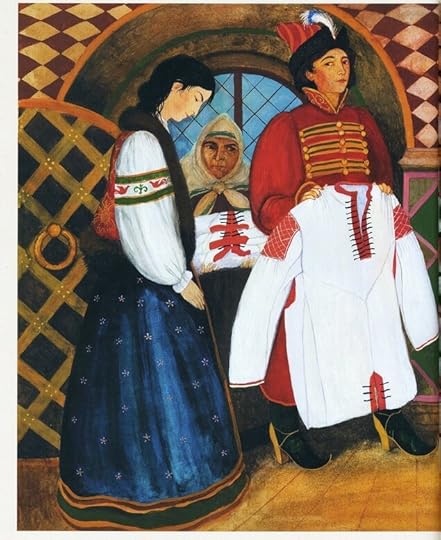
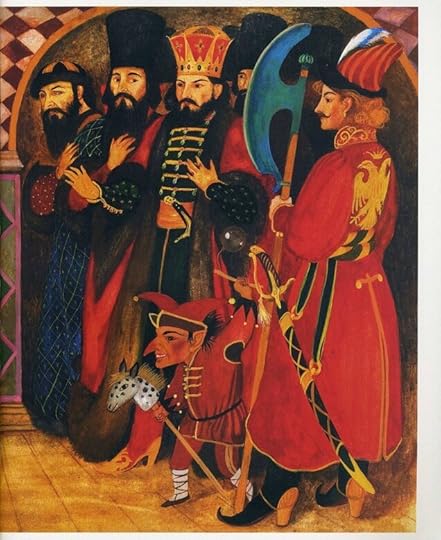
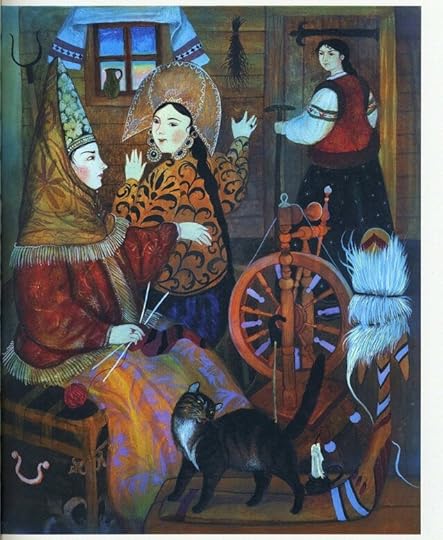
Every child in Russia knows the tale of Vasilissa and now you can too. The illustrations are absolutely beautiful. And I believe they are very true to Russia.
This book will make a great addition to any collection. ✨✨✨✨✨
The story in this book was fabulous! The illustrations were good too but the plot was outstanding. Definitely one of the better retellings by way of writing.
What a wonderful Russian folk tale! I really enjoyed the story (which is similar to Cinderella AND Hansel and Gretel). Of course, Russian baddie Baba Yaga is in it but Vasilissa is up to the challenge. Also, the artwork (by a Russian artist) is fabulous and beautiful. Simple, yet amazingly detailed--probably the best part about the book.
Beautiful paintings by Russian artist Alexander Koshkin help to tell this old tale containing remnants of Cinderella and Hansel and Gretal while featuring the Russian witch Baba Yaga. Winthrop says she loves this story because it is women who challenge Vasilissa to grow and to overcome all troubles to reach her success, wealth and happiness in the end.
I wasn't too caught up in this book. In many ways, it resembled Cinderella. Vasilissa has an evil stepmom and two sisters who are very jealous of her. In the end, Vasilissa overcomes her her troubles and marries the Tsar (Prinse) and lives happily ever after. I most likely wouldn't recommend this, just read Cinderella if you haven't.
The illustrations in this book are very beautiful. It is a very creative story because it combines old Russian folktales with both Hansel and Gretal and Cinderella. It would be interesting to use this book in a study on folk tales or fairy tales with 3-4th grade.
This fairy tale is a cross between Cinderella and Hansel and Gretel. The evil Baba Yaga also figures in this tale. The story is enhanced by the beautiful illustrations of renowned Russian artist Alexander Koshkin.
A beautiful book to say the least. In comparison to it's Western equivalent it's emotional dexterity it is by far the victor without the prospect of even competing.
This is a really good retelling of an old Russian folktale, which I had never heard before. I didn't grow up hearing this as a kid, so I'm not sure which details it kept or omitted in its version of the story, but I thought the narrative had a great blend of fairy tale, wisdom, and horror elements. The art is quite good, with one or two standouts. The image of the Knight of Night dragging time behind him is absolutely incredible, and the image of Vasilissa finding her way home is also quite strong. Overall a really cool folk retelling.
Note: a little doll magically comes to life and acts as a good-luck charm. The witch Baba Yaga, who eats people, is featured. There are glowing, talking skulls. Several people are incinerated.
Do not be afraid, Vasilissa. Say your prayers and go to sleep. Remember, the morning is wiser than the evening.
I wasn't too keen to read Vasilissa the Beautiful: A Russian Folktale because of it being classified as a "children's book" section of goodreads. However, another Goodreads member had read this story as well as, Vassa in the Night and said that if you plan on reading the following book you must read the Russian Folktale first. I am fairly excited to try my hand at reading Vassa in the Night but I don't know when I will start it. I got a lot of "Cinderella" vibes but with spin of the "Hansel and Gretel" fairy tale. It was short and to the point. The illustrations were well done but not by any means perfect.
A women on her death bed gives her daughter a doll for protection. Little does the girl know how useful the doll will become when her father finds another wife with daughters of her own.
The pictures are great. Vasilissa is beautiful, and the times of day are also wonderful. I love that Russian culture personifies time, as in the times of day, the months of the year, and I hope there is a story about the days of the week, though I haven't seen one: mighty Sunday and weakling (pun!) Monday, and the rest.
The change from full-color spreads to stark black-and-white text only is abrupt. It might have been improved with at least small illustrations on the text pages. Illustrations are great.