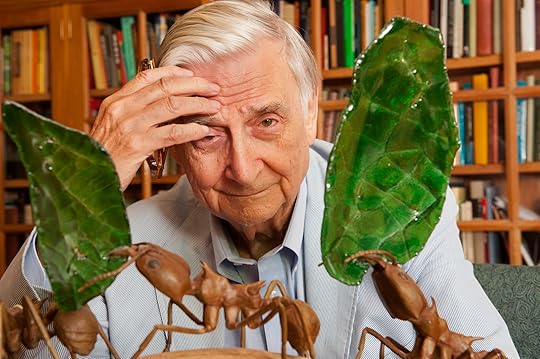
Genesis purports, in 125 generously margined pages of text, to depict in broad strokes the major evolutionary "transitions" in the history of life. There are five (not counting the origin of life itself), the first being the invention of eukaryotic cells and the last the invention of language. As the subtitle indicates, the majority of the book focuses on the penultimate step, the origin of society, and in particular of eusocial societies built by ants, termites, and, Wilson says, people.
Eusocial societies are societies organized into a hierarchy of castes, some of which reproduce, and some of which do not, and which exhibit biological features particular to specific castes. For example, the worker ants of the colonies of certain ant species are sterile females, and these ants have anatomically reduced reproductive organs that make them identifiable as belonging to the worker caste. Similar anatomical differences among castes are found in termites.
Ants and termites with eusocial societies utterly dominate the insect world in terms of population. Two questions thus emerge:
(1) How do eusocial societies emerge to begin with, given the stark reproductive cost they pose to their non-reproductive members, who, defying the expectations of natural selection on the individual level, "altruistically" sacrifice their genes to the collective?
(2) Given that eusocial societies clearly do somehow emerge, and given their enormous success for the organisms that adopt them, why do eusocial societies make up only a sliver of all social structures in the animal world?
The answer to (2) involves the difficulty Wilson perceives in sustaining the conditions required for eusociality to form. Eusociality is thought to first emerge from nests inhabited by parents (or single mothers) and their adult offspring, who for one reason or another--chance genetic mutation?--have failed to leave the nest. The offspring form a de facto non-reproductive caste, by dint of having nobody to reproduce with, while the parents form the smaller reproductive caste (which, extrapolated to the level of an ant society, would be the queen and her harem of five or six males).
This would seem a proto-eusocial situation that could easily slip into eusociality, but the problem is that in all other respects the offspring are still programmed for "solitary living"--they should be off finding mates of their own, not crammed together in a claustrophobic state of arrested development. As a result, the nest as a whole fails to divide labor efficiently and thus cannot compete with other nests, making the continuation of the proto-eusocial structure through future generations unlikely.
The answer to (1) is found in Wilson's evolutionary specialty, group selection. Groups that contain at least one member with strong altruistic tendencies are more likely to survive than groups without them. This means that the relatives of animal altruists--who carry the altruist gene cluster even if they themselves are not altruists--are more likely to survive and reproduce.
For me, the most stunning part of the book is Wilson's observation that at the moment of each transition to a higher order of life, "altruistic" behavior is required of the order which is being superseded. This is true even at the cellular level, and for this reason the first emergence of multi-cellular life forms remains "clouded in mystery":
"Some of the cells [in an organism], for example epidermal cells, red corpuscles, and lymphocytes, are programmed to die at a specified time in order to keep the other cells alive. Failure to do so precisely on time and in the right place can cause a disease that puts all the cells at risk. Suppose that just one of the many kinds of cells chooses to reproduce selfishly. Then, acting like a bacterium dropped into a large pot of nutrients, it multiplies out of turn to produce a mass of daughter cells. In other words, it turns into a cancer. Why should any one or all of your other trillions of cells not follow suit?"
Wilson admits that the problem of altruism at the cellular level remains "clouded in controversy," but I found his explanation of altruism at the level of the organism--powered in part by group selection--to be compelling as a non-expert. That is, I was compelled despite the fact that a quick check of Wikipedia (spurred by a hunch and what little I know about contemporary debates within evolutionary biology) revealed that Wilson's model of multi-level selection (the levels being individual and group) is more controversial than Wilson would have us believe. Fellow biologist and science popularizer Richard Dawkins is an example of someone who emphatically places primacy on individual selection for the continuation of that individual's genes (whence his book The Selfish Gene), and who indeed has written harshly negative reviews of other books of Wilson's arguing for a multi-level model.
Likewise, Wilson's characterization of Hamilton's rule--a formula that aims to predict an animal's performance or non-performance of altruistic behavior on the basis of that animal's relatedness to an animal in need of help, as well as the risk to itself and the benefit to the animal in need of help--seems misleading. Wilson claims that "inclusive fitness", a generalization of Hamilton's rule, is only advocated by a "small school of dedicated [...] theorists" (here "dedicated" reads awfully like a euphemism for "crackpot"), and yet trusty Wikipedia again informs me that in 2010, upon Wilson's attempted demolition of inclusive fitness theory in the journal Nature (along with two co-authors), more than one hundred biologists signed a rebuttal rejecting Wilson and co.'s conclusions. Who's the "small school" again?
My biggest gripe with the book, though, is its failure to convincingly argue for eusociality in humans. The book's reason for being is to demonstrate how social evolution across species can inform us about our own nature, and it wants to do so chiefly through a focus on the eusociality of ants and termites. And yet, the actual argument for human eusociality--which is required for the insect-speak to be of any relevance--is confined to a single paragraph! And not a convincing paragraph, at that. Here it is in full:
"Finally, a plausible case can be made for eusociality in human beings. The strongest evidence is the postmenopausal 'caste' of grandmother helpers. In addition there is the readiness with which individuals join professions and callings useful to society but counter to their own reproduction. Given that homosexuality is uniquely valuable to so many societies, it is not unreasonable to view homosexuals as a eusocial caste, and in the highest possible sense. In further witness is the prevalence of monastic orders in organized religions around the world. In yet another venue must be included the formally established and respected berdache system of the early Plains Indians, in which males dressed and performed as females. It should be kept in mind that the propensity toward homosexuality has a partly genetic basis, and further appears to benefit relatives and larger groups, making its genes more likely to survive. The evidence is indirect but strong: the frequency of homosexual-propensity genes in human populations is above the expected level from mutation alone, a sign that the propensity has been favored by natural selection. The level, in other words, is too high to be explained solely by random changes in genes that affect sexual behavior."
As a paragraph on which to hinge an entire book, this seems pretty weak. When we were defining eusociality earlier on, we made clear that biological differences between castes are a key component of eusociality. What is biologically different about monks that causes them to take vows? Any answer would seem to stretch the definition of "biological" to breaking, conflating sociobiology with plain old sociology. Are grandmothers really a "non-reproductive" caste if, by definition, they reproduced at some point earlier in their lives? And are they a "caste" if they spend their lives doing a great deal of other activities when the grandkids aren't visiting? And what about, as my friend Amanda pointed out to me, the homosexuals of all species (but especially humans!) who have children? Wilson writes as though the eusociality of humans were an interesting footnote to his argument, when it is in fact the main subject.
I am not an entomologist (insect specialist), or an evolutionary biologist, or a scientist of any sort. I therefore risk coming across as arrogant by wagging my finger at Wilson, among the most respected scientist-writers alive, and who is respected as both a scientist and a writer, having more or less founded the (controversial) discipline of sociobiology and written a shelf full of (controversial) books on everything from the complex, "super-organismic" structure of ant societies to a proposed "consilience" between science and the humanities. He's even got a book award named after him, the PEN E.O. Wilson Award for Literary Science Writing--which, again according to Wikipedia, he co-founded with Harrison Ford.
But I will risk the perception of arrogance, because this is just not a very good book. On a sentence level the writing is soporific and technical. It is haphazardly and misleadingly argued, and it is poorly sourced. There are no endnotes, just a set of references for each chapter, which judging by their titles do not evidence all of the claims made in each chapter. And, as other reviewers have informed me, Wilson has covered all of these subjects in more adequate detail (and, one assumes, with greater panache) in the many other books he has written. At the age of ninety, there was no reason for him to write this one. He would have better spent the time with his grandkids, as a member of the elderly helper caste.