Jump to ratings and reviews
Rate this book

Venice

Rate this book
MP3 CD Format Venice stands, as she loves to tell you, on the frontiers of the east and west, halfway between the setting and the rising sun. Goethe calls her ""the marketplace of the Morning and the Evening lands."" Certainly no city on earth gives a more immediate impression of symmetry and unity or seems more patently born to greatness. So Jan Morris remarks, with graceful literary distinction, on the qualities that have made Venice a unique place among the world's great destinations. She has known it intimately for over six decades. She knows its history, its carvings, its idiosyncrasies, its weather, and all the Doges of the past. She returns even now, never tiring of this ""dappled city, tremulous and flickering."" She first wrote Venice in praise of it fifty years ago and has revised the book three times. To open this premiere audiobook recording, Jan Morris reads a personal introduction that perfectly distills a lifetime's fascination with La Serenissima.

1 pages, MP3 CD

First published January 1, 1960

249 people are currently reading
5228 people want to read

About the author

Jan Morris

165 books479 followers
Jan Morris was a British historian, author and travel writer. Morris was educated at Lancing College, West Sussex, and Christ Church, Oxford, but is Welsh by heritage and adoption. Before 1970 Morris published under her assigned birth name, "James ", and is known particularly for the Pax Britannica trilogy, a history of the British Empire, and for portraits of cities, notably Oxford, Venice, Trieste, Hong Kong, and New York City, and also wrote about Wales, Spanish history, and culture.

In 1949 Jan Morris married Elizabeth Tuckniss, the daughter of a tea planter. Morris and Tuckniss had five children together, including the poet and musician Twm Morys. One of their children died in infancy. As Morris documented in her memoir Conundrum, she began taking oestrogens to feminise her body in 1964. In 1972, she had sex reassignment surgery in Morocco. Sex reassignment surgeon Georges Burou did the surgery, since doctors in Britain refused to allow the procedure unless Morris and Tuckniss divorced, something Morris was not prepared to do at the time. They divorced later, but remained together and later got a civil union. On May, 14th, 2008, Morris and Tuckniss remarried each other. Morris lived mostly in Wales, where her parents were from.

Ratings & Reviews

What do you think?
Rate this book

Friends & Following

Create a free account to discover what your friends think of this book!

Community Reviews

5 stars
668 (35%)
4 stars
740 (39%)
3 stars
354 (18%)
2 stars
94 (4%)
1 star
25 (1%)
Displaying 1 - 30 of 199 reviews
Profile Image for Fionnuala.
886 reviews
Read
December 7, 2024
I began reading this book before a recent trip to Venice. I read a little more of it each evening while I was there, and finally finished it after I'd returned home.
That choice of navigation through this long and entertaining book turned out to be perfect. Jan Morris made me keenly interested in the city ahead of arriving there, and she offered me many great 'aha' moments during my visit when she'd mention something I'd seen that very day. And after I returned home, she comforted me by giving me the illusion that I was still wandering the network of passageways and bridges that knit this city of islands together.

She made me so entranced with the place that as soon as I finished her book, I began Cees Nooteboom's Venice, and when I finished that, I read Joseph Brodsky's Watermark: An Essay on Venice.
And during the ten days I spent in the city, I re-read the Venice section of Goethe's Italian Journey, and Henry James's short story, Travelling Companions, both of which Jan Morris mentions. Plus I read a few sections of John Julius Norwich's A History of Venice which I received as a gift from my own two traveling companions—and which has a blurb by Jan Morris on the front cover.

But back to Jan Morris's book. Her Venice was written in the 1960s and based on the year she spent living in the island city while she worked for a British newspaper. Being a reporter as well as a resident, she had access to people and places which the short term tourist can never hope to access, and having an entire year to investigate the city, and her own little boat to nip around in, she was able to seek out all its treasures and linger over every one of them.

You might think that a book from the 1960s would be dreadfully dated, but this is Venice we're talking about, the city where Time has almost stood still and where the noise of traffic can't penetrate. The sounds that you hear are many of the same sounds that have been heard there for centuries. Jan Morris mentions the bird-sound, the bell-peals, the voices of street traders, and especially, 'early in the morning, as you lie in bed in the half-light, the soft fastidious splash of oars outside, the swish of a light boat moving fast, the ripple of the waves.'

Yes, the sound of the waves is much louder than I imagined it would be. The lagoon seems to be in perpetual motion so that even in the smallest side canal, there is a visible surge on top of the water. Jan Morris makes the point that the constant movement of the waters makes the continued existence of the city possible. If the lagoon were to silt up further, and the tide no longer penetrate every minor canal, the city would become unlivable.

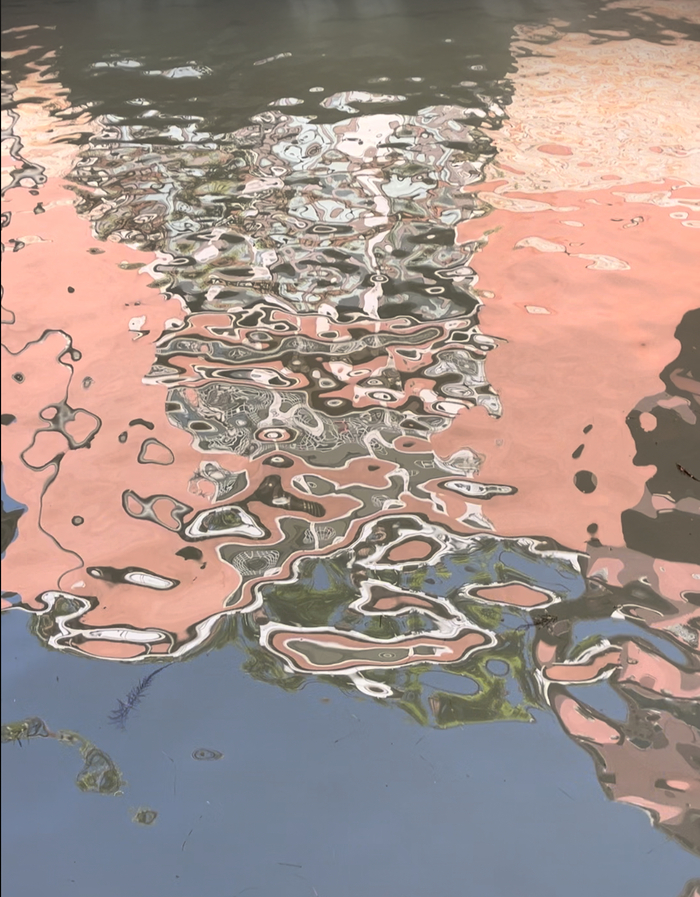
With so much water on every side, there are mirror images everywhere, and you feel that what you see in the water is what others saw before you going back centuries and centuries, back almost as far as when migrant people built churches on the little islets of silt in the lagoon, then linked each islet by means of bridges, and so created this unique city with its beautiful reflections which I couldn't resist photographing.


Those original migrants settled the silt-studded lagoon as early as the fifth century. In her ever humorous way, Jan Morris tells us that 'if we are to believe the old chronicles, the foundation of Venice occurred on 25 March 421, at midday exactly. It was, according to my perpetual calendar, a Friday..'

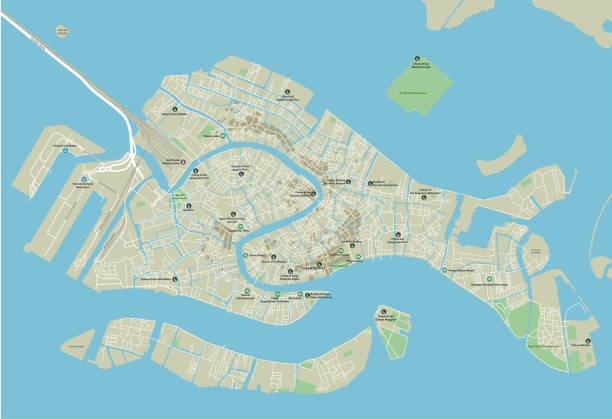
I'm amused by that because if the map of Venice resembles anything, it's a fish—the symbol of the early Christian Church and of course Friday used to be fish day for Roman Catholics (which Venetians technically were although they were more inclined to obey their Doge rather than the Pope).


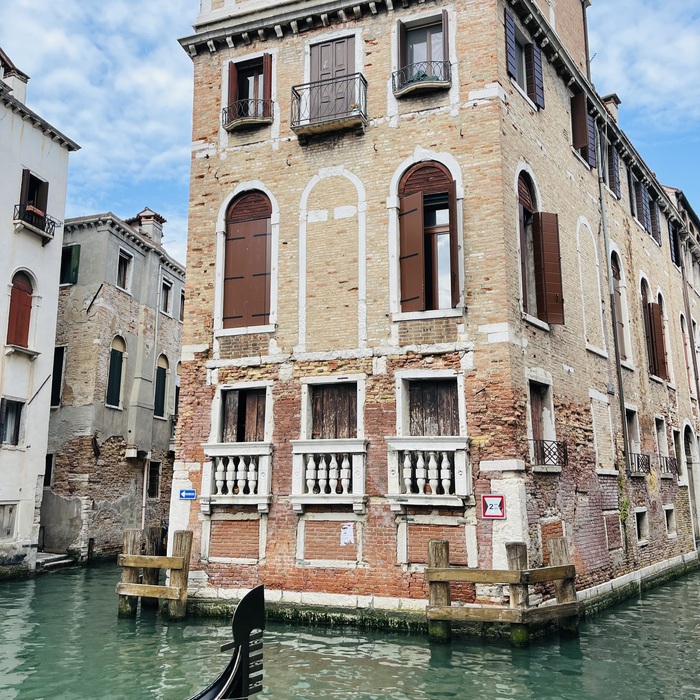
But of course those early settlers didn't only build churches. Little by little, they laid down more foundations into the compacted silt, and eventually built all the elaborate dwellings that line the waterways today. Those buildings are older now certainly, but they have remained mostly unchanged for centuries: 'a multitude of tottering palaces, brooding and monstrous, presses towards its water-front like so many invalid aristocrats jostling for fresh air.'
I love the way Jan Morris describes things and I just happen to have a photo that captures the brooding tottering quality she describes:


How does anyone ever find their way through this maze of canals and alleyways, you might wonder. According to Jan Morris, 'if you ask a local the way somewhere, through the tangled wilderness of the Venetian back-streets, he will summon a wise and helpful look, consider the situation carefully, take you kindly by the arm and usher you to the nearest vantage point; and pointing a finger through the labyrinth of medieval lanes that lies before you, entangled in canals, archways, dead ends, unexpected squares and delusive passages, 'Sempre diretto!’ he will say courteously–‘Straight ahead!''

There's a sense that the local advice is not wrong, and maybe a compass might be as useful as a map. If you want to go to, say, the church of San Pietro in Castello, keep going east even if you have to go a little north or south to find a bridge to cross. And if you want to go to Tintoretto's house, choose alleyways that bear more or less north, etc.
Of course, you can simplify things a little and take a vaporetto or a motorized water taxi, and chug or whizz your way from A to B, especially along the the great width of the Grand Canal where there's room for crafts of many sizes and descriptions.
'But always somewhere on the Grand Canal, drifting pleasantly with the tide, struggling loftily into the lagoon, tossing at a post or protruding its aristocratic beak between a pair of palaces, there stands a high-prowed, lop-sided, black-painted, brass-embellished gondola, the very soul and symbol of Venice.'

Yes, gondolas used to be the way people travelled from place to place but now they are just used to take tourists on little trips that make them think they are discovering the city but simply return them to their starting point, and far too quickly. The main benefit of taking a gondola for me was to watch the skill with which the gondolier avoided other craft, turned very narrow corners, and ducked under low bridges—but to get to know the city you really need to walk it. While walking, we spotted a boatyard where gondolas are made. Jan Morris talks about that boatyard too and says that the measurements of gondolas haven't changed for centuries—'length 36 feet, beam 5 feet'

No matter where we went or what we saw, Jan Morris had been there before us. We took a boat to the island of Murano, not to visit the glass factory but to visit its two beautiful churches—which is exactly what Jan Morris advises: 'The important thing to know about Murano glass-makers is that almost everything they make is, at least to my taste, perfectly hideous...but two great churches survive on the island.'
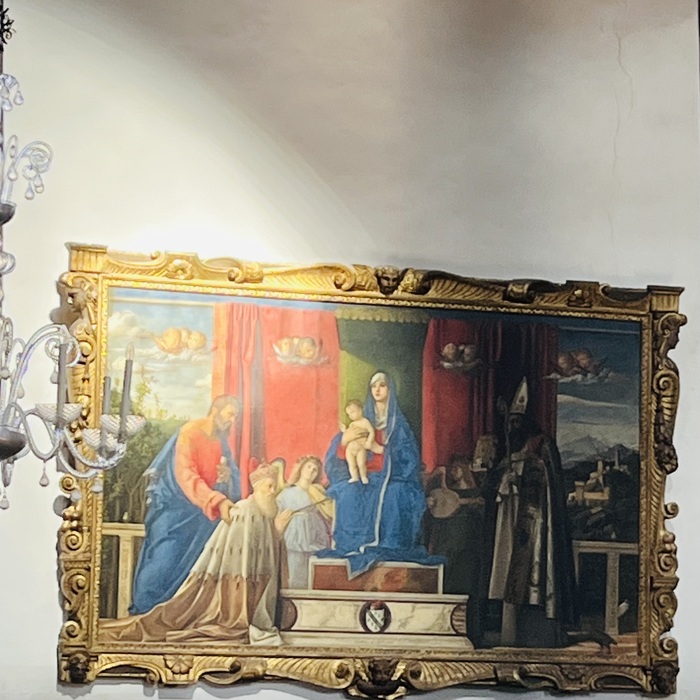
Though one of those churches was closed when we were there, much to our disappointment, the other turned out to offer us the opposite experience: being in exactly the right place at exactly the right time. The church contains a painting by Giovanni Bellini which is still in the same spot the artist chose for it more than six hundred years ago. And it happens that for a certain part of the day, the painting is lit by the light from a small window high on the opposite wall. When we were there, the light from the window was falling on exactly the part of the painting the artist had chosen to light up, and the shadow was falling on the part he had left in shadow. Viewing it like that gave me a huge thrill.


On another day, back in Venice, we visited the house of the 18th century playwright Carlo Goldini, famous for his wit and humour, and what should I find in Morris's book when I opened it up that evening but the following witty tidbit about the palazzos like Goldini's that line the waterfronts: 'Venetians like to preserve their privacy...Nowadays they have warning mirrors attached to their window-sills; in earlier times there used to be grilles in the drawing-room floor, enabling the householder to see in good time what monumental bore was arriving at the water-gate—there is still one in Goldoni’s house, near the church of the Frari.'
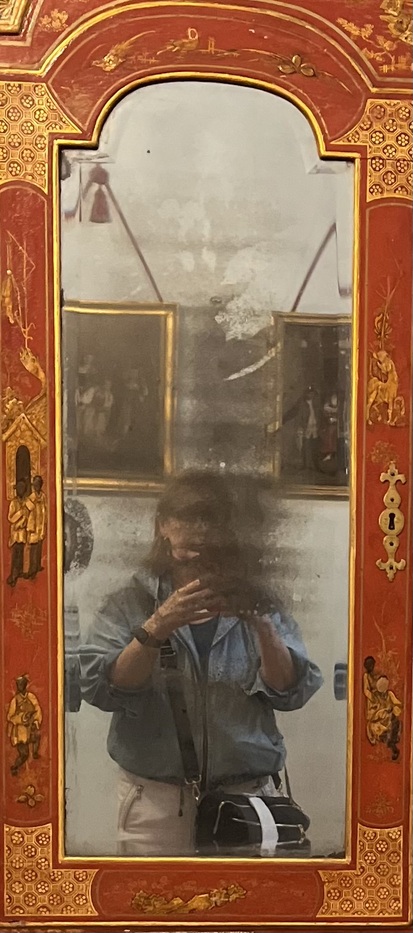
I didn't spot the grille in Goldini's house but I did find this ornate mirror—though it wasnt part of any window-sill warning system:


Venice is full of mirrors, often placed opposite each other, so that you can spy on yourself and everyone else in a room into infinity. It seems there were always spies in Venice:


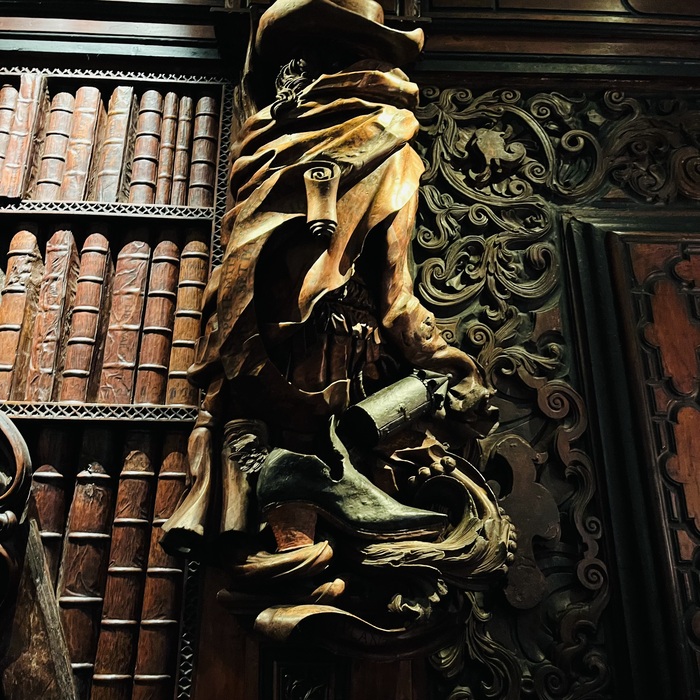
That peculiar spy caught my eye one day—and of course Jan Morris had also taken note of him:
'There is a wood-carving by the seventeenth-century sculptor Francesco Pianta, in the Scuola Di San Rocco which beautifully illustrates these tendencies. It is called The Spy, Or Curiosity, and it represents a conspirator so theatrically shrouded in cloaks, so hungrily peering between his slouch hat and his raised forearm, so slung with bombs and secret documents that the kindest old lady in Cheltenham or New Hampshire, finding him destitute on her doorstep, might be tempted to refuse him a cookie.'

Jan Morris goes on to say that 'the Venetians were encouraged to be busy-bodies by the system of denunciations which supported the autocracy of their Republic. In several parts of the city you may still see the stone boxes or lions’ mouths – bocche di leone – that received citizens’ complaints.'

The canals of Venice were also used as depositories, it seems, though not of secret denunciations:
'There are strict laws against the throwing of rubbish into the canals – punishable, if the offence is repeated, by imprisonment: but a vile mass of refuse is thrown in anyway, and the Venetian housewife thinks nothing of emptying her rubbish-basket and dust-pan out of the open window.'

Goethe, writing in the 1780s in his Italian Journey, has a passage about the same topic. Having complained about the 'intolerable filth' of the streets, and the way the canals are used for waste matter, he says, 'As I walked along I could not refrain from sketching a body of regulations on the subject, anticipating in thought some superintendent of police, who might act in earnest. Thus one always feels an inclination to sweep one's neighbour's door.'

Today, I could only be amazed at the huge team of workers, like so many house elfs, who go around early every morning and collect all the different coloured bags of rubbish from outside every building, load them on trolleys, push them to the waterside then pile them onto boats that cross between the city and the mainland. Perhaps Goethe's ideas on street cleaning did get passed on to someone in authority and were eventually put into practice!

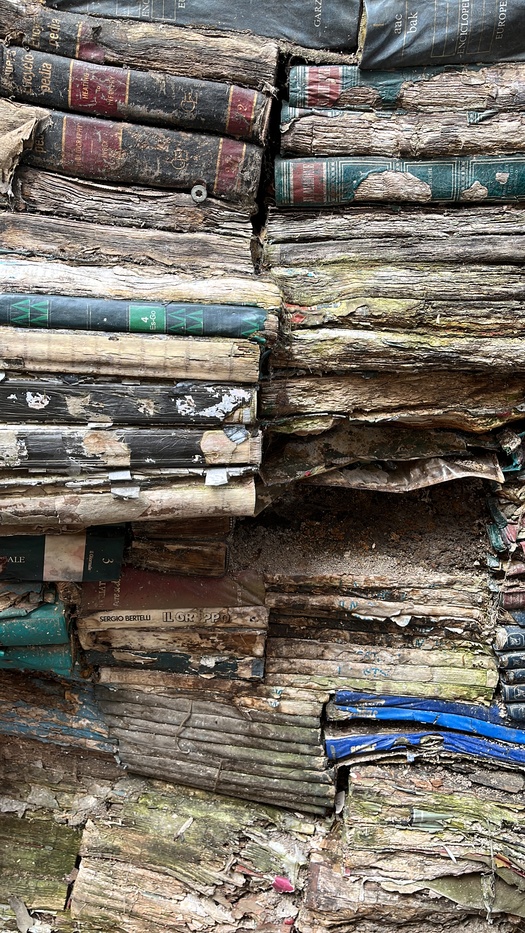
I don't want to give the last word to Goethe in this review of a Jan Morris book so I'll finish with one of her unmatchable sentences—which goes very well with a photo I took in the backyard of an over-stocked bookshop called Aqua Alta (apt for this review, itself overstocked with book titles (and Aqua Alta happens to be the title of a Donna Leon book I read years ago)).

'Venice is a cheek-by-jowl, back-of-the-hand, under-the-counter, higgledy-piggledy, anecdotal city, and she is rich in piquant wrinkled things, like an assortment of bric-à-brac in the house of a wayward connoisseur.'


…………….…………………
Bonus quotes and photos in the comment section...
Profile Image for mark monday.
1,874 reviews6,305 followers
July 27, 2019
What a tangled web they weave, as they practice to deceive. Venice is and was a snare for fools, a smiling whore clad all in jewels. Gilded masks and tourist traps, palaces in slow collapse. Pretty lies told in bloom of youth; old age has turned those lies to truth. We all transform - there is no norm! Morris writes as Morris does, with mournful heart and mind abuzz. Nonfiction rarely rocks my boat, but on a boat my eye took note: This author is this city - loving secrets, lacking pity. Her crowded days hold no surprise, but dusk descends and dreams then rise. This paean is to long-lost past; the power gone, the torch was passed. The city ebbs and flows as with the tide, and so this was a perfect guide.
Profile Image for Michael Finocchiaro.
Author 3 books6,264 followers
December 8, 2016
It may be strange for me to categorise this book as a biography, but Jan Morris treats the city here as a character in a melancholic story of her history, her streets, her canals and her people. It is a fantastic read and should be in your luggage should you ever visit this one of the world's most incredible magical cities (hint: read Invisible Cities by Italo Calvino too!)
Profile Image for Antonomasia.
986 reviews1,490 followers
February 27, 2019
Audiobook, read by Sebastian Comberti.

Is Jan Morris's book responsible for perpetuating a certain idea of Venice through the later 20th century? Venice as elegant, decaying, exotic, a mélange and meeting-point of East and West... Perhaps in Britain at least. In this book, I felt like I'd found a key to where it comes from. When I was younger, I managed to do an entire course on the city without being aware of these ideas: this legend is something that lives in the realms of literature and pop high-culture, not academic texts. In arts it seems overwhelming once you've noticed it, almost the only way Venice is talked about, a given in general-audience writing and TV documentaries.

The book, first published in 1960, was originally titled 'The World of Venice', and the richness of its description makes Venice feel like an enclosed world, intoxicating, enthralling and claustrophobic and crowded: ("the little subsidiary passages that creep padded and muffled among the houses, like the runs of city weasels.") This Venice as a place different and apart from the rest of the world, even from its own hinterland, the idea of it as a place of intrigue and carnival, which is a holiday from normal life more so than most cultural city destinations. (Although the recent level of prominence of the carnival and its masks for tourism are apparently a fairly recent innovation).

It is typical of mid-century upper-middle class British travel writing, with its refined little snobberies, romanticised stereotypes, asides addressed to a readership assumed to be familiar with London and Oxbridge, and breezy recommendations of expensive endeavours, such as motorboats being best way to see Venice. A few days ago I found a BBC Radio 4 retrospective on the programme 'Bookclub' from 2008, which spent half an hour on Venice and compared it with Brideshead Revisited - at the time of writing, Morris had returned to Venice after first seeing it in late 1945 at the end of active duty in the Second World War - and Brideshead is an excellent signpost for the atmosphere of this book. (In there Morris also mentions that the recommendation to see the city by motorboat no longer stands. The presenter's joke against a Scotsman - with an accent reminiscent of Fraser from Dad's Army - for raising the expense of motorboats made even the radio show seem like an artefact from former times.) The reader's liking for Morris's Venice may be heavily dependent on whether they tend to find such patrician tones escapist or grating. Similar attitudes underlie a lot of British children's literature of the same age, which mean it conjures a nostalgic, cosy atmosphere for some of us who grew up on books like and became wired to imagine ourselves in the place of the characters and narrators. But for others who were always conscious of the narrowness of that world, or who did not become accustomed to it early, the faults in this book may be more obvious.

Whilst the book's tone feels very much like a product of sixty years ago, not all the information is (Morris revised the book in the 1990s) and, as my friend Patrick pointed out in his review, there are moments when it is unclear whether the Venice of the early 1960s or of the 90s is being described, as it is all thrown in together. There are times when this does not matter, as the writing is an evocation of a mythic atmosphere - and obviously if one wanted up-to-date travel info, or academic history or geography, one would look at other books - but there are others when it is outright frustrating because it makes it difficult to picture a scene. At times, I wished the revision had been in the form of an extra separate chapter or two, to make it clear how Venice was at which times, and what changed. (There is, incidentally, nothing at all in this book about Morris' transition, or if or how Venice seemed different experienced as a man or a woman. In 'Bookclub', Morris said she visits the city annually - so if that is a long-running custom, differences in what is observed about the place over time and experienced oneself will necessarily be blurred, and not discrete in the manner of visits many years apart.)

When I started listening to audiobooks last summer, I hoped to use them rather like extended radio programmes, and have mostly chosen books on non-fiction subjects with which I already have some degree of familiarity - or where there is another reason not to take notes or worry about remembering as much detail as possible (e.g. a history book already well known as having inaccuracies). But Jan Morris' Venice is the one where I've managed this most effectively, and for which I took fewest notes. A lot of the material I'd already read, albeit it felt distant, and I would have been unable to recount it myself without looking it up; this led to more relaxed listening, the felt, and experienced, sense that the facts are out there in many other sources. This is not a new work that debunks, the sort of thing whose arguments *should* be outlined in a half-decent review: it is the kind of work that gets debunked, but which isn't even positioned as modern or academic information. The point of the book seems to be mood and atmosphere and, as such, whether a given point is legend, or historical truth, or something which has been corrected by recent scholarship, felt fairly irrelevant. It's not a book readers are likely to take as accurate, as might be the concern with a recent popular history that contains errors; people who pick up this book know it's old, and the style is a constant reminder because it feels old, and many of them will read it for that literary style, not as a guidebook. (Though I'd love to know if tour guides in Venice are sick of correcting certain points from it, and if so what those are.)

Even whilst knowing the material is a clichéd selection, I enjoyed hearing about it in this beguiling way: the settlement's emergence from the marshes, a "city of water-peasants" and the safety of the lagoon, acting like a really long-lasting Wonder in a game of Civilization; Doges and the stability and class structure of the Republic and its eventual tragic fall to Napoleon; those intrigues and dungeons on which Pratchett based Vetinari's court, not to mention the officialisation of pickpockets and the Ankh-Morpork Guild of Thieves; there's Ruskin and Byron and 'Baron Corvo'; Dalmatians being pirates not dogs; nuns being courtesans and other such decadence behind the city's "lasting reputation for lascivious charm"; the cats (what is it with Mediterranean cities and cats?); the bazaar-city and caravanserais and bridges reminiscent of willow-pattern; a city of hotels even in the 14th century; the contradictions of race - "in Venice, as a sixteenth-century Englishman observed, it signified nothing ‘if a man be a Turk, a Jew, a Gospeller, a Papist or a believer in the Devil; nor does anyone challenge you, whether you are married or not, and whether you eat flesh and fish in your own home’", but in other instances there is no shortage of racial discrimination; the spooky small islands with exhumation of burials and remains of hospitals; lots of gondolas, more than I ever thought I'd hear about gondolas. Morris loves the word froward: I went from 'how lovely, it's too long since I've heard that' to becoming sick of its overuse in the second half. There is surprisingly little about music - it's implicitly explained why on 'Bookclub': Morris said that she cannot stand Monteverdi.

Many characterisations and generalisations are the of-their-time sort; there are commonplace references to housemaids and housekeepers that sound, in this voice, like a hangover from pre-war Britain; there's apparent romanticisation of Italian corruption as quaint; locals described "like figures from a Goldoni comedy". Indeed the Venetians in the book seem a little too much like a scene which Morris describes being filmed for TV:

The exposure was estimated; the producer approved the arrangements; the script-writer had a look through the viewfinder; the sun shifted satisfactorily; the steamer in the background was nicely framed through the washing; and suddenly the cameraman, pressing his key, bawled ‘Via!’ In an instant that tenement was plunged in frantic activity, the housewives scrubbing furiously, the gossips jabbering, the passers-by vigorously passing, the old ladies leaning energetically from their windows, and a multitude of unsuspected extras, never seen before, precipitately emerging from back-doors and alleyways – an old man in a black hat, sudden coveys of youths, and a clown of a boy who, abruptly appearing out of a passage, shambled across our field of vision like a camel, till the tears ran down the script-writer’s face…

"Sudden coveys of youths" is rather marvellous phrasing. But much later, Chapter 21 hits a stride of particularly striking, almost too-rich descriptions:

"the remains of some Byzantine frescoes that are said to be the oldest works of art in Venice, and which, though not in themselves very beautiful, have a certain hypnotic allure to them, like the goggle-eyes that peer at you out of the middle of cuckoo-spit…

the Renaissance church of Santa Maria dei Miracoli, hidden away behind the Rialto like a precious stone in ruffled satin…

at night, if you take your boat out there through the lamplight, it is as still and dark and luscious as a great lake of plum-juice, through which your bows seep thickly, and into whose sickly viscous liquid the dim shape of the Doge’s Palace seems to be slowly sinking, like a pastry pavilion."


For all the loveliness of this, I only enjoyed hearing about it to an extent. It's like gâteau for every meal. In the later chapters, the brief mentions of the mainland towns in the hinterland, of bridges and industry and Mestre, made me crave to hear about the other Venice, a site of everyday life. (And from a writer who is, perhaps, less rude about Chioggia and Burano.) If the book had been half about the humdrum - about people working in tourist attractions and in jobs which had nothing to do with sightseeing, inside Venice and further away, a little on the hard graft of maintaining the buildings, in the words of those doing the labour, about how local people live around the tourists, about what it feels like to live near Venice but not in it - that could have made a 5-star book, but that would have been a different book. I needed to hear a hint of this stuff to realise there's too little about it here.

With British cities that are tourist attractions, it's easy to find fictional and factual writing that deals with the grimy underbelly or the quotidian grind. But as was mentioned on 'Bookclub', so much of what has been written about Venice (or as they didn't specify, so much of what is available in English about Venice) has been written by visitors, not by people who were born and grew up in the area, that it gives a different (and probably distorted) picture of the place. I listened to another radio programme - a series of excerpts from The Politics of Washing: Real Life in Venice by Polly Coles- but even then, among the material on Moldovan immigrant workers there was the usual modern-rarefied-Venice stuff about Contessas in decaying palazzos. (The phenomenon of Moldovans going to Italy is covered from the other end in Vladimir Lorchenkov's novella The Good Life Elsewhere.)

Comberti's audio reading was entirely in tune with the material: an RP-accented, slightly camp yet serious voice - with perfect pronunciation of Italian - which would have worked perfectly as that of a character in a film about upper-middle class midcentury bohemians. The sense of stepping elegantly back in time was as complete as it could be within the very contemporary format of the digital audiobook. (And unlike a couple of other audiobooks I've listened to recently, the narration was not too fast.)

In Britain at least, Morris's account may be the first or only book a lot of people read about Venice. I can understand why it is loved the way it is, for its atmosphere and style, but as I read it after similar books (Joseph Brodsky and Peter Ackroyd a few years ago), and after academic study of the place (longer ago), it didn't cast quite the same spell. If I'd read Morris before Ackroyd's Venice: Pure City, Ackroyd might have got 4 stars rather than 5. As well as info repeated in both books, there is a similarity in the atmosphere the two authors conjure; I am inclined to prefer Ackroyd's chronological approach because it feels more organised whilst still retaining the literary-narrative spell Morris also weaves. (Ackroyd also isn't a proponent of the absurd theory that Bacon wrote Shakespeare's plays, as Morris sadly appears to be here.) Morris' book feels more like seeing a place as a tourist; as with any visit to a place on which you haven't done a lot of background reading, linear historical time ends up subsumed into the itinerary of places you look at in whatever order you happen to visit them. I think Morris' Venice is a little overrated in literary circles - but that is hardly unique - these are circles in which people often seem to give too much weight to creative non-fiction and to authors respected in the press, instead of to the most accurate, which may require more research to pinpoint. And to some general readers who stumble on the book in libraries, this book may seem old-fashioned and a little pretentious. Within these caveats, I enjoyed it; listening whilst drowsy, it made it feel like it might still be 1983 on an analogue radio, not 2019 on a cheap Android tablet.

(Listened Nov 2018-Jan 2019; reviewed Feb 2019.)
Profile Image for Carol Smith.
111 reviews49 followers
October 25, 2012
The husband and I visited both Trieste and Venice earlier this year (before then setting off for two weeks of fine walking in Slovenia). I read J. Morris' Trieste and The Meaning of Nowhere while in Trieste and lapped up its languid, rich portrayal of that faded Habsburg port. We then fell in love with La Serenissima and I determined to read Morris's classic treatment of Venice upon our return. I was expecting a work of a similar quality and style, but it just can't compare.

It's so....listy. Lists of boats, lists of lions, lists of towers, lists of burial places. The lists go on and on. The description is so exhaustive as to be exhausting. In a word: tedious.

There is, I think, an easy explanation for the vast difference in quality and style between the two books. Trieste and The Meaning of Nowhere was written in 2002, one of her later works. The World of Venice, on the other hand, was written in 1960. I don't think she'd yet found her unique and lovely way of bringing together the eloquent travel essay, the quirks of history, and the expert tour guide into one unified whole.

I think she admits this herself in her forward to the 1974 edition, when she notes that - upon revisiting the book to update and revise it - she'd discovered that she'd fallen out of love with Venice, that the "sad magic" was gone for her. My guess, however, is that she did still love Venice (how can you not?). She just no longer cared for the way her pen had treated it as a younger, less mature writer. Just my guess.
Profile Image for Tim.
245 reviews119 followers
August 2, 2021
A quirky but richly detailed portrait of Venice in all its history and visual splendour by an English woman who has lived there. I can't say I agreed with all her opinions - that all the palaces on the Grand Canal are ugly for example, a rather preposterous bit of snobbery - but I did admire her determination - often conducted in her boat - to ferret out points of interest from almost every corner of the city and its lagoon.
Profile Image for Will Once.
Author 8 books125 followers
August 1, 2014
In many ways this book is like the city itself. It has to be five stars, but with some caveats.

First the good news. Jan Morris has written a magnificent depiction of a fabulous city. She clearly knows the city extremely well and loves it like a mother loves a child. This oozes from every page. It is almost as if she is showing us a photograph of her dearly beloved first-born. This is his first bicycle. Here he is at his fifth birthday party. This is his pet lion.

And that makes for an incredibly dense and rich book. The depth of her knowledge is astounding. You turn the page and find a juicy bit of scandal, an amusing life story, a fascinating custom. It's a bit like wandering the streets. At every turn you find new sights to delight you. A crooked bridge over a minor canal. A pair of porters singing as they deliver flour to local pizza restaurants. A couple snogging in public - he enthusiastically, she trying to paw him away. A stone lion rampant. A faded palace slowly sinking into the grand canal. A pickpocket nipping at your trousers.

But there's a problem. The book, like the city, is frozen in time. Jan Morris's Venice is very much of the 1950s. First published in 1960, which at the time of writing makes it more than 64 years old. And while much of Venice hasn't changed in that time, there is a sense that we are reading two histories - Jan's history of Venice plus her own history.

The book is also densely packed - again just like the city. With no spare land to build on, Venice necessarily has become more compact and dense over the centuries. And now it cheerfully accepts several cruise ships a day in high season. This makes for a closely-packed and at times claustrophobic place. Her text mirrors this, with thousands of stories and characters crammed somewhat haphazardly between the covers. She will start to tell you about the lions in the city ... and then list dozens of different types of lions.

The book like the city is also labyrinthine. There is a kind of logic to how it is arranged, but it's very hard to follow. You will be reading about animals one minute and then torture and murder the next - all linked with a general title of "bestiary". Each page hops from ancient history to architecture to food to the 1950s and then repeat.

In a sense, that doesn't matter. Jan Morris is such an engaging companion that you don't mind getting lost with her. It has been said that the best way to appreciate Venice is to get lost there. Just wander the back streets and let the city unfold in front of you. This marvellous unique crazy city.

Will you like this book? Probably. Some people love it to bits - a book to wallow in. But there's a warning. This book is a fantastic scholarly achievement. It's writing of the highest order from someone who really knows their subject. It is bewitching, unique.

It is also dense, illogical, meandering and highly personal. If you are going to Venice you simply have to read it. You probably have to read it anyway as one of the best examples of a travel book ever written.

But just don't expect to finish it. You may well do. Or you may find, like I did, that your interest wanes after a while.

It has to be five stars. A book this well written could not be anything less. But there's just that little caveat that this book, like the city, has it's own unique way of doing things. Dense, labyrinthine, human, crazy, intense.
Profile Image for Nancy.
416 reviews93 followers
October 13, 2019
This is a rich combination of erudition and the personal, told in sparkling prose. It's almost too much, but that's my problem. The main problems with the book are two revisions that marry poorly with the original text; I'd have preferred leaving it as a snapshot of Venice ca. 1960 - which is all that would excuse some unfortunate racial references that are unacceptable at the date of later revisions. I also question ending the book with a prolonged disquisition on the islands of the lagoon; I get it as a stylistic choice, but for the reader, it's going out with a whimper, not a bang.
Profile Image for Helen Wood.
55 reviews
Read
August 3, 2011
What a disappointment - felt a bit guilty clicking on the 'Yes, I've finished' when I very obviously hadn't, but couldn't read any more. The history bits were interesting, but the current stuff was dated and patronising (still want to go to Venice sometime though, and the book group discussion was a lot more interesting than the book itself)
Profile Image for Patrick.
294 reviews20 followers
December 14, 2017
A slightly strange experience. I'm not sure that the book necessarily benefits from the two updates that Morris has written since the first edition came out in 1960. Perhaps if I were a tourist looking for a literary version of a guidebook, and, more to the point, if I were travelling to Venice in 1993, this would be a positive. But as it is, there's something slightly unsettling about reading Morris' detailed accounts of her visits to Venice at the tail-end of the 1950s, when it appeared that the place was rather more of a backwater than it is now, only to find random references to what has been happening in the city in the early 90s making their way into the text. In the second and third parts of the book, especially, it did sometimes leave me rather confused as to exactly what time period the events she's describing are actually happening in. Which arguably doesn't matter, except it leaves me wondering whether the initial impression I had got of the Venice of 1959 as a romantic, but slightly down-at-heel place was misplaced, and it was, actually, even then, rather more of a tourist trap than the initial chapters suggest, or whether instead, it is simply that her accounts of, for example, the problems associated with managing the sheer volume of visitors the city gets were actually written into the book much later.

As it is, it is good in parts. The first part is the best, and the bit that is most consciously written as a 'visitor's guide', singling out the best sites to visit was the weakest part of the book for me (though perhaps if I was planning to visit, I'd have a different perspective on this). It left me thinking that perhaps what I should really have read was a straight history of Venice, rather than this slightly peculiar mix of travelogue, visitor's guide, memoir and potted history.
Profile Image for Richard Newton.
Author 27 books595 followers
March 20, 2021
My review may be a little unfair, but reflects a level of disappointment with this book. I saw a TV programme on an Morris which I found fascinating. What a fabulous person, what an interesting life story and how many fantastic journeys she had made. I suppose a combination of being impressed by her talking about her life, and the reputation of this book, made me expect far better.

It is a hard book to categorise. It is not a history of Venice, though it does trace out much of its history. It is not a guide book, at least not in a practical sense as you could not use it to guide yourself around Venice. It might be more thought about as a reflection on Venice, or perhaps if you have never been, a preparation for it. It is organised into a whole host of themes, which I suppose make some sort of sense.

It is a pleasant enough read, but its main fault for me is that Morris wants to seem to tell you everything about every aspect of Venice. So for instance, in the section on the secondary forgotten attractions of Venice, rather than describe one or two examples she lists lots and lots of them, and you get lost under the sheer quantity of facts and information. I felt less facts, and more about the mood, might have been better. At times I wanted to skim over the parts when she lists lots of examples.

It is also a bit of a historical guide as it was originally written 60 or more years ago. Morris updated it a few times, but the last of those was almost 30 years ago, and even in as apparently timeless cities as Venice, things change, so again little use as a practical tool.

Many other people rate this book far higher than I do, but to me it is caught between being not enough of a meditation on the feel of the city and not quite practical as a guidebook. I will thought try other books by Morris, as I still have hope of finding a gem!
Profile Image for Caro.
1,519 reviews
October 17, 2012
Usually I reserve 5 stars for a life-changing book - but this deserves it for being so well written. Read it before you go to get a feel for the city, read it afterwards to savor what you and Morris have seen and to mark places you'll need to see next time. I can't resist one quote that exemplifies her sharp eye and love of language (I recommend reading it aloud for the full effect):
And around the corner, beside the Grand Canal, there lies the incomparable fish market of Venice, a glorious, wet, colourful, high-smelling concourse of the sea, to which in the dawn hours fleets of barges bring the day's supply of sea-foods. Its stalls are lined deliciously with green fronds, damp and cool: and upon them are laid, in a delicately-tinted, slobbering, writhing, glistening mass, the sea-creatures of the lagoon. There are sleek wriggling eels, green or spotted, still pugnaciously alive; beautiful little red fish packed in boxes like shampoos, heads upwards; strange tube-like mollluscs, oozing at the orifice; fine red mullet, cruel pseudo-sharks, undefeated crabs and mounds of gem-like shell-fish; skates, and shoals of small flat-fish, and things like water-tarantula, and pools of soft bulbous octopus, furiously ejecting ink; huge slabs of tunny, fish-rumps and fish-steaks, joints of fish, fish kidneys, innards and guts and roes of fish: a multitude of sea-matter, pink, white, red, green, multi-limbed, beady-eyed, sliding, sensuous, shimmering, flabby, spongy, crisp--all lying aghast upon their fresh green biers, dead, doomed or panting, like a grove of brilliant foliage among the tundra of Venetian stone.
Profile Image for Marina Maidou.
494 reviews27 followers
May 1, 2015
It's a travel book, isn't it? Well, yes and no. It's a document about Venice, then and now. From a writer she's a thrill already. Jan Morris is a woman which in past was a man. That's not news, she's not the first or the last. But her view in details, in hidden places and things is precious. A calm voice, just like a gondola slipping gently in the venetian lagoon. It's not the type "go there, see this, do that", but in fact it's like the memoirs of a city as a person. You learn a lot and you enjoy venetians' uniqueness. Venice, which is one of my favorite cities, is like that old precious vases or houses that have been broken, shattered or else but still have this magical beauty that makes any plan for restoration to be very, very careful for not loose its fragile "verdigris". I wish this writer would have write novels about Venice, too, it could be a paradise.
Profile Image for Nicky.
24 reviews
February 14, 2013
I was rather disappointed considering all the positive reviews. I haven't been to Venice and now have no wish to. I thought the writers style very pretentious and boring - especially the endless lists!!!

Maybe if you know Venice you understand what he/she is writing about. I thought it was a travel book but no the author detests those and classes this as ' travel literature'. I recommended this to my book club and now wish I hadn't.
2 reviews
April 12, 2012
I think Jan Morris is the greatest travel writer of all. I've not read enough of her, but this one really introduced me to a genre that I now love.
Profile Image for David.
25 reviews2 followers
March 10, 2013
Too many adjectives, too overblown - another book by an author who wishes the world would never change.
Profile Image for Dave Appleby.
Author 5 books11 followers
July 10, 2021
Jan Morris writes beautiful prose. This hymn to Venice, from someone who has lived there, is, as you would expect, a lyrical and haunting evocation of the beauty of one of the world's most visited tourist destinations, and a fascinating history of a city state that was a republic and maritime empire throughout the middle ages, but it is also shrewd and practical and funny.

This isn't a tourist guide. I have been to Venice as a tourist and I would not have packed this book. This is a piece of the best sort of travel writing, the sort where the traveller becomes part of an alien landscape and has deep interactions with the inhabitants and begins to struggle to an understanding of what it must be like to live in such a place. This is that perfect sort of travel book ... except that it focuses on a single place and it is all the better for that.

There are some fascinating bits about the Venetian language. The word 'Arsenal' which was the name for the Venetian shipyard which used assembly-line techniques (celebrated by Dante in the Inferno) to produce, at peak, a fighting galley every day, comes from the arabic 'dar es sinaa' which means 'house of art'. The Arabic word 'sikka' (a die) became 'zecca' (a mint) and thence 'zecchino' (a coin) which is the origin of the Venetian unot of currency, the sequin. (The City: 17)

It is enlivened with historical anecdotes:

"One bishop playing a double game with such conspicuous ineptitude that he was simultaneously excommunicated both by the Pope and by the Oecumenical Patriarch." (The People: 9)
"The Grand Canal ... follows the course of a river known to the ancients as Rivo Alto - the origin of the Rialto." (The City: 11)
"The earliest of all state banks, the Banca Giro, was opened on the Rialto in the twelfth century." (The City: 19)
"The fashionable eighteenth-century priest who, though courted by the greatest families of the Serenissima, chose to live in a rat-infested garret, and collected spiders' webs as a hobby." (The Lagoon: 26)
"St Nicholas of Myra ... was particularly revered by the Venetians, if only because at the Council of Nicaea he had soundly boxed the ears of the theologian Arius, from whose very heresy, adopted by the Lombards, some of the earliest Venetians had fled into the lagoon." (The Lagoon: 30)
"The silver reliquary of St Nicholas [in Bari] ...has for nine centuries consistently exuded a liquid Holy Manna of such purity as to be indistinguishable from the purest spring water." (The Lagoon: 30)
But the most remarkable thing about this book is the writing. The prose is like wonder washing over one:

There are stupendous descriptions:
"A mesh of nets patterns the walls of a fisherman's islet, and a restless covey of boats nuzzles its water-gate." (Landfall)

There are utterly original metaphors:
"An air of home-spun guile and complacency, as of a man who has made a large fortune out of slightly shady dealings in artichokes." (The People: 2)
"The gondolier ... utters a series of warning cried when he makes a manoeuvre of this sort, throaty and distraught, like the call of an elderly and world-weary sea-bird." (The City: 12)
"Other Venetian waterways ... have an average width of twelve feet, and the average depth of a fair-sized family bath-tub." (The City: 12)
"The modern Venetian ... examines the world's delights analytically, as a hungry entomologist might dissect a rare but potentially edible spider." (The City: 17)
"Sometimes a layer of snow covers the city, giving it a certain sense of improper whimsy, as if you were to dress a duchess in pink ruffles." (The City: 18)

And there are profundities:
"It is a difficult world, is it not, and heavy with disillusionment?" (The City: 18)
"Do we not know them well, whenever we live, the aesthetic conservers on the one hand, the men of change on the other? Which of these two philosophies is the more romantic, I have never been able to decide." (The City: 22)

This is a book of magic with enchantment on every page.
Profile Image for Andrés .
21 reviews
Read
November 23, 2025
«La gloria de Venecia reside en el hecho incontestable de Venecia misma: en la singularidad y el brillo de su historia, en la anchurosa y melancólica laguna que la rodea, en el intrincado esplendor marino que la ha convertido, hasta día de hoy, en única entre las ciudades. Cuando por fin dejas atrás esas aguas, guardas el sombrero de paja y sales al mar, el hechizo de Venecia se te queda pegado a la mente, el olor a barro, incienso, pescado, tiempo, porquería y terciopelo se te queda pegado a la nariz, el suave chapaleo de los canales secundarios se te queda pegado a los oídos y, vayas donde vayas en tu vida, en alguna parte notarás, por encima del hombro, una presencia rosa, almenada, temblorosa: las cúpulas, las jarcias y los pináculos retorcidos de la Serenísima»

«Entonces, a medida que las islas de la laguna van quedando atrás, te sobrecoge una sensación curiosa, una sensación de alivio y tristeza a la vez, fuertemente matizada de asombro. Venecia, como tantas amantes hermosas y tantos vinos fuertes y oscuros, nunca es completamente sincera con nadie. Su pasado es enigmático, su presente, contradictorio, su futuro, envuelto en la bruma de la incertidumbre. La dejas saciado pero confuso, como el joven que, al deshacerse contento de un abrazo, de pronto se da cuenta de que la muchacha está pensando en otra cosa y se pregunta un momento qué demonios ha visto en ella»
Profile Image for Alison S ☯️.
665 reviews31 followers
April 10, 2017
I read this as I am visiting Venice for the first time next month. Some atmospheric passages and fascinating nuggets of information, but far too much detail and too many lists. I skipped through the last third of the book as I was on information overload by then and desperate to finish it so I could read something less dry! Still very excited about my first trip to Venice though ...
159 reviews17 followers
May 3, 2023
For many, this is the travel book, and its hard to disagree. Intimate, yet it has it's finger on the pulse. It's dated in places, yet it's timeless at the same time.
Profile Image for Miguel Alves.
140 reviews1 follower
Read
August 24, 2025
Jan Morris has a register of snappy, smiling ease that is just the thing for a travelogue like this, and a smart fit for a city with a somewhat condescending and imperious air, as is the case with Venice. It allows her to face the city’s portentous frame, put on a sort of witty grin, maybe bow a little to pay respects to the recognized status and importance, and retort something like, “Yes, you are beautiful and fascinating, and you ruled the Mediterranean for centuries, but you also smell a bit like fish and sewers sometimes”.

If you, like me, are looking less for an exhaustive guide than for an overall “vibe”, then the glut of details, names and enumerations might get slightly tedious. This is despite the treasure trove of interesting minor facts and tidbits that populate the pages, and also despite the fact that I enjoy the stylistic effect of an excessive, page-long enumeration as much as anybody.

But when Morris pulls her camera back to the broad descriptions of the city and its lagoon, that’s when the descriptive prose really shines. She captures the two compounding layers of Venice. First, the upper coating of exquisite wealth, plated in gold and marble, encrusted with precious stones, the loot and riches of East and West, traded or plundered by the great Republic. And below, the decayed basis of knotty, rotted wood and crooked stone, eaten away by the lagoon and always growing out to consume more and more. Although Morris breaks down, with pragmatic sobriety, quite a bit of the mythos of the city, in the end she has no choice but to recognize her own ogling fascination with it, and she does surrender to its allure. Really, the entire work is arguably just her building a new and stronger mythos for us.
7 reviews1 follower
April 13, 2024
An exquisite overview of the history, culture and vibes if Venice. Reading this book while in the city really elevated my experience, giving cultural context to the things I was seeing and experiencing.
19 reviews1 follower
April 18, 2022
Spent months reading it in little chunks of delight, beautifully written and full of fascinating stories
118 reviews2 followers
June 28, 2021
Jan Morris died less than a year ago, at the age of 94. What she packed into those 94 years is a better story, I venture to say, than anything she ever wrote, and she wrote well. There will undoubtedly be a flood of biographies, now that she's gone, but whether one will ever do justice to this truth-is-stranger-than-fiction life remains to be seen. Originally from Wales, she was also originally a man. She writes (elsewhere) of the uneasy feeling she was in the wrong body, long before she takes the necessary measures to make good on her determination to become a woman. That she actually did this, and well-before it began to be more accepted, says something fundamental about this rare individual. Whether he or she, this person was daunted by nothing, dissuaded by nothing. It was full speed ahead, male or female. As a man, Morris was an officer in a cavalry regiment. He got the "scoop" that Sir Edmund Hillary had reached the summit of Everest not by waiting politely for him to come down from the mountain and tell him he had. Oh, no. Not James Morris. James Morris climbed three-fourths of the way up the mountain to get the story. Not everybody does this, right? You look at the photograph of him on the mountain, and it would not pop into your head in a thousand years this man was not comfortable in the body the Lord gave him. I have read only "Trieste" and "Venice" by Morris. "Trieste" is a book about a city as unique, in its way, as its big sister down the coast, since it is in Italy but not entirely of Italy. Trieste has a strong Austrian heritage, giving the city its mixed identity. "Venice" is the more substantial book. The Sunday Times has called it, "The best book about Venice ever written." Maybe that's an exaggeration, maybe not. Morris doesn't leave an algae-covered stone unturned in telling the history of the city like no other. He, or she, is smart enough not to let the facts get in the way of a good story, and being an accomplished writer, well, that's a combination you can't beat.

Profile Image for John.
Author 11 books14 followers
February 26, 2021
Heralded as the best book ever written about Venice, I won’t try to read the others. Jan Morris has visited Venice every year for past 40 years or so, and really knows her subject. Too well. Put that together with her mannered language and I discovered she can be profoundly irritating, writing in minute detail about the way the Venetian speaks, acts, eats, drinks (the last two not very well at all), dresses , views himself (men are focused on more than the Venetian woman), all are stereotypes, as are tourists (British men are the best tourists, British women the worst), how they speak, act, wage wars or not, and so on and on in mannered, pretentious detail. I skipped furiously, if guiltily. I checked her book on Hong Kong and while it is her style, it is not nearly so irritating. Her accounts actually put one off Venice – I have been there and liked it a lot – but had I read how filthy with shit some of the canals are, the utter cruelty on Venetians in the past, their huge self-esteem (according to Morris), why would I want to go there? She is dismissive of Venetian food and wine (red or white are the stated options in many cafes). And the last chapter: what famous people have visited Venice. It is chock full of detail and is well written if you like that sort thing. I don’t, hence two stars only.
Profile Image for Carol.
623 reviews
January 27, 2015
From the reviews here, many people rave about this book and others thought it was terrible for various reasons and couldn't finish it. I am squarely on the fence! Generally I don't like stories with excessive descriptive paragraphs or that run on about how lovely the garden is..... I just want a good tale.
Jan certainly is good with words. I had to keep the dictionary handy. She does have a beautiful style of writing but I often started drifting and could only get through this book by skimming over many parts. That said, I learned a lot about Venice history - the kind of stuff you definitely don't get from a history book. I made many bookmarks about the quirks and landmarks, and some history anecdotes, that I will definitely go back and review before my upcoming trip.
I am glad I read it but if you just want an overview before a 3-day visit, this book is not for you. If you already know you love Venice or are truly interested in its social history, then... Go for it! Happy browsing.
Profile Image for Bloodorange.
848 reviews209 followers
December 28, 2018
"(...) if you shut your eyes very hard, and forget the price of coffee, you may see a vision of another Venice. She became great as a market city, poised between East and West, between Crusader and Saracen, between white and brown: and if you try very hard, allowing a glimmer of gold from the Basilica to seep beneath your eyelids, and a fragrance of cream to enter your nostrils, and the distant melody of a cafe pianist to orchestrate your thoughts if you really try, you can imagine her a noble market-place again. In these incomparable palaces, East and West might meet once more, to fuse their philosophies at last, and settle their squalid bickerings. In these mighty halls the senate of the world might deliberate, and in the cavernous recesses of the Basilica, glimmering and aromatic, all the divinities might sit in reconciliation. Venice is made for greatness, a God-built city, and her obvious destiny is mediation. She only awaits a summons."
Profile Image for Renata.
606 reviews3 followers
December 28, 2017
No other book could be filled with as many details about Venice and its environs as this one. Certainly, it made me wish that I could go back to Venice to see all the campos, small churches and artwork that I missed on my previous visits.

It is important to remember that this book was published first in 1960. Even though the Forward indicates that the book has been updated, it still has the the "feel" of something written in the 1960's. This a paragraph about "housewives" picking up their children from school. I don't think a writer completing this in 2017 would use the same terms.

There is so much detail here that it would be difficult to use the book as a modern guidebook as the material is not organzied the way that modern guide books do.
Displaying 1 - 30 of 199 reviews

Can't find what you're looking for?

Get help and learn more about the design.