

What do you think?

Patience
MEET ELLIOTT.
Elliott is something of a genius. He is hugely intelligent. He’s an incredible observer. He is able to memorise and categorise in astonishing detail. He has a beautiful and unusual imagination.
More than that, Elliott is an ideal friend. He is overflowing with compassion and warmth and fun. To know him is to adore him.
But few people do know Elliott, properly. Because Elliott is also stuck. He lives in a wheelchair in an orphanage. It’s 1979. Elliott is forced to spend his days in an empty corridor, either gazing out of the window at the birds in a tree or staring into a white wall – wherever the Catholic Sisters who run the ward have decided to park him.
So when Jim, blind and mute but also headstrong, arrives on the ward and begins to defy the Sisters’ restrictive rules, Elliott finally sees a chance for escape. Individually, the unloved, unvalued orphans will stay just where they are; together, they could achieve a magnificent freedom – if only for a few hours.
But how can Elliott, unable to move or speak clearly, communicate all this to Jim? How can he even get Jim to know he exists?
Patience is a remarkable story of love and friendship, courage and adventure – and finding joy in the most unlikely of settings. Elliott and Jim are going to have some fun.
Elliott is something of a genius. He is hugely intelligent. He’s an incredible observer. He is able to memorise and categorise in astonishing detail. He has a beautiful and unusual imagination.
More than that, Elliott is an ideal friend. He is overflowing with compassion and warmth and fun. To know him is to adore him.
But few people do know Elliott, properly. Because Elliott is also stuck. He lives in a wheelchair in an orphanage. It’s 1979. Elliott is forced to spend his days in an empty corridor, either gazing out of the window at the birds in a tree or staring into a white wall – wherever the Catholic Sisters who run the ward have decided to park him.
So when Jim, blind and mute but also headstrong, arrives on the ward and begins to defy the Sisters’ restrictive rules, Elliott finally sees a chance for escape. Individually, the unloved, unvalued orphans will stay just where they are; together, they could achieve a magnificent freedom – if only for a few hours.
But how can Elliott, unable to move or speak clearly, communicate all this to Jim? How can he even get Jim to know he exists?
Patience is a remarkable story of love and friendship, courage and adventure – and finding joy in the most unlikely of settings. Elliott and Jim are going to have some fun.
260 pages, Paperback
First published August 22, 2019
About the author
Toby Litt
87 books213 followersToby Litt was born in Bedfordshire, England. He studied Creative Writing at the University of East Anglia where he was taught by Malcolm Bradbury, winning the 1995 Curtis Brown Fellowship.
He lived in Prague from 1990 to 1993 and published his first book, a collection of short stories entitled Adventures in Capitalism, in 1996.
In 2003 Toby Litt was nominated by Granta magazine as one of the 20 'Best of Young British Novelists'.
In 2018, he published Wrestliana, his memoir about wrestling, writing, losing and being a man.
His novel, A Writer's Diary, was published by Galley Beggar Press on January 1st 2022.
A Writer's Diary continues daily on Substack.
He lives in London and is the Head of Creative Writing at the University of Southampton.
He lived in Prague from 1990 to 1993 and published his first book, a collection of short stories entitled Adventures in Capitalism, in 1996.
In 2003 Toby Litt was nominated by Granta magazine as one of the 20 'Best of Young British Novelists'.
In 2018, he published Wrestliana, his memoir about wrestling, writing, losing and being a man.
His novel, A Writer's Diary, was published by Galley Beggar Press on January 1st 2022.
A Writer's Diary continues daily on Substack.
He lives in London and is the Head of Creative Writing at the University of Southampton.
Ratings & Reviews
Friends & Following
Create a free account to discover what your friends think of this book!
Community Reviews
Displaying 1 - 30 of 62 reviews

December 11, 2019
Where do I even begin to capture this beautiful, urgent paradox of a book? Paradox, for this is a novel that keeps surprising you at every turn, that suspends you, beautifully, in a state of agony tinged with wonder, that de-anaesthetizes you to life.
Let my try by introducing you to our narrator, Elliott — a most unusual voice. Abandoned to an orphanage for disabled children run by nuns, Elliott suffers from spastic cerebral palsy, a condition which renders him incapable of movement or speech. Much of his time is spent parked in front of a white wall, or, if he is lucky that day, facing a window that overlooks the courtyard below. Despite these physical restrictions, Elliott leads a rich interior life — he hoards words plucked from the conversations around him, he superimposes the sensory world with that of his imagination, he deconstructs moods and events in terms of musical motifs. His insights are acute and piercing, often humorous, sometimes heartbreaking. An example of the latter is his observation that newly abandoned children cry in a manner that is entirely different to seasoned orphans, when they first arrive at the ward:
“Orphans newly-made cry in a way that is in my sadly far from limited experience quite quite different to other children because other mothered-fathered children cry toward the world as if the world might hear and act whereas orphans cry as if they were the world as if they were the world crying in the full knowledge that there is no-one and nothing to hear them...”
One such new arrival is Jim. Blind and mute since birth, Jim too has to navigate his way in the world without verbal speech. Elliott senses an immediate soul-bond with Jim:
“The sound of Jim’s laughter was round like plastic bowls and it did not fly away from itself like a broken thing but turned always back in a gurgle and restart as a giggle and thus I knew for certain Jim had known love and Jim would always know love...”
The two boys strike up an unusual friendship, solidified by an ingenious language of their own invention (the details of which are a delight to unearth while reading). With Jim as his “engine”, Elliott may finally unleash his master plan, “a conspiracy of unprecedented sophistication and magnitude”.
If the above premise sounds emotionally overgreased, let me assure you it is rendered in the most delicious, earnest, unpretentious prose. Elliot’s narrative style – in contrast to his physical confinement – is endlessly playful and unbounded. Words spill onto the page, bump into each other, form spontaneous new associations. Here is a text largely devoid of traditional punctuation – save the occasional full stop – inviting the reader to “shape” it, to wind down a few gears, to enter a different time zone of mind.
Like other exceptional reads that have touched on tenets of Zen Buddhism – such as The Overstory and A Tale for the Time Being – this is a novel ultimately about a way of being in the world that is beyond time, beyond doing:
“There was always more gorgeous detail than I had time or senses for and every caterpillar-of-a-When immediately became a butterfly-of-a-What and flew off into the flock of a thousand interplexing Whats whose air-dance of now being like this and now being like that was too delicate for anybody to remember but a god.”
Do yourself a favour. Get this book.
Mood: Transcendent
Rating: 10/10
Also on Instagram.
Some interesting facts about the work and author:
1. The author’s prior work frequently deals with the concept of paralysis in some form (e.g. characters who are imprisoned or unable to act). Litt has written about his interest in paralysis and his childhood experiences with temporary paralysis / near suffocation here, which he credits as the source of this obsession.
2. The seed for the novel was planted in March 2007 when Litt attended a photography exhibition in Leipzig, a retrospective on the work of Timm Rautert.
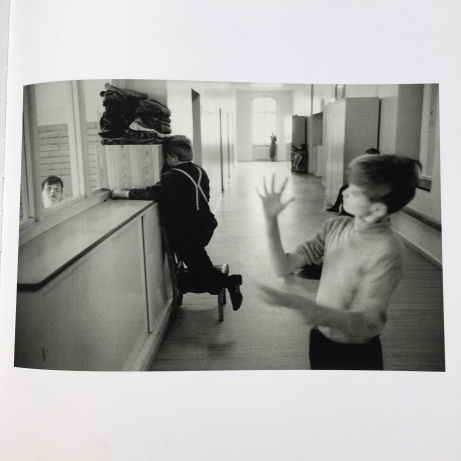
Photographs taken in a children’s hospital from a series called ‘The Children of Ward Block 5, 1974’ particularly struck him.
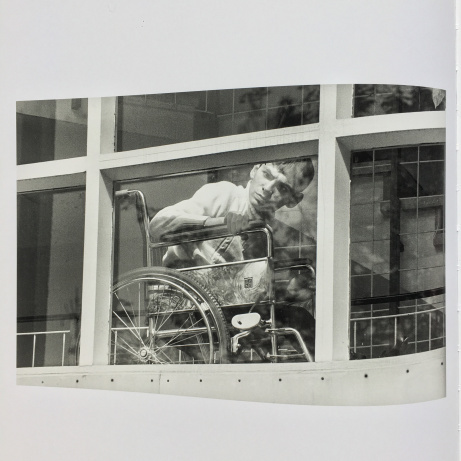
(Image Source)
One photo was of a boy sitting in a wheelchair looking out of a large glass window towards the camera with “an incredibly intense gaze”. The author started writing a short story about that character which eventually turned into this novel, over a very long, 12-year period (Source).
3. Music plays an integral role in Elliott’s narration. A playlist for the book can be found here.
4. Toby Litt is known for writing his books in alphabetical order. You can find the full list here. He is currently working on letters Q and R.
Let my try by introducing you to our narrator, Elliott — a most unusual voice. Abandoned to an orphanage for disabled children run by nuns, Elliott suffers from spastic cerebral palsy, a condition which renders him incapable of movement or speech. Much of his time is spent parked in front of a white wall, or, if he is lucky that day, facing a window that overlooks the courtyard below. Despite these physical restrictions, Elliott leads a rich interior life — he hoards words plucked from the conversations around him, he superimposes the sensory world with that of his imagination, he deconstructs moods and events in terms of musical motifs. His insights are acute and piercing, often humorous, sometimes heartbreaking. An example of the latter is his observation that newly abandoned children cry in a manner that is entirely different to seasoned orphans, when they first arrive at the ward:
“Orphans newly-made cry in a way that is in my sadly far from limited experience quite quite different to other children because other mothered-fathered children cry toward the world as if the world might hear and act whereas orphans cry as if they were the world as if they were the world crying in the full knowledge that there is no-one and nothing to hear them...”
One such new arrival is Jim. Blind and mute since birth, Jim too has to navigate his way in the world without verbal speech. Elliott senses an immediate soul-bond with Jim:
“The sound of Jim’s laughter was round like plastic bowls and it did not fly away from itself like a broken thing but turned always back in a gurgle and restart as a giggle and thus I knew for certain Jim had known love and Jim would always know love...”
The two boys strike up an unusual friendship, solidified by an ingenious language of their own invention (the details of which are a delight to unearth while reading). With Jim as his “engine”, Elliott may finally unleash his master plan, “a conspiracy of unprecedented sophistication and magnitude”.
If the above premise sounds emotionally overgreased, let me assure you it is rendered in the most delicious, earnest, unpretentious prose. Elliot’s narrative style – in contrast to his physical confinement – is endlessly playful and unbounded. Words spill onto the page, bump into each other, form spontaneous new associations. Here is a text largely devoid of traditional punctuation – save the occasional full stop – inviting the reader to “shape” it, to wind down a few gears, to enter a different time zone of mind.
Like other exceptional reads that have touched on tenets of Zen Buddhism – such as The Overstory and A Tale for the Time Being – this is a novel ultimately about a way of being in the world that is beyond time, beyond doing:
“There was always more gorgeous detail than I had time or senses for and every caterpillar-of-a-When immediately became a butterfly-of-a-What and flew off into the flock of a thousand interplexing Whats whose air-dance of now being like this and now being like that was too delicate for anybody to remember but a god.”
Do yourself a favour. Get this book.
Mood: Transcendent
Rating: 10/10
Also on Instagram.
Some interesting facts about the work and author:
1. The author’s prior work frequently deals with the concept of paralysis in some form (e.g. characters who are imprisoned or unable to act). Litt has written about his interest in paralysis and his childhood experiences with temporary paralysis / near suffocation here, which he credits as the source of this obsession.
2. The seed for the novel was planted in March 2007 when Litt attended a photography exhibition in Leipzig, a retrospective on the work of Timm Rautert.
Photographs taken in a children’s hospital from a series called ‘The Children of Ward Block 5, 1974’ particularly struck him.
(Image Source)
One photo was of a boy sitting in a wheelchair looking out of a large glass window towards the camera with “an incredibly intense gaze”. The author started writing a short story about that character which eventually turned into this novel, over a very long, 12-year period (Source).
3. Music plays an integral role in Elliott’s narration. A playlist for the book can be found here.
4. Toby Litt is known for writing his books in alphabetical order. You can find the full list here. He is currently working on letters Q and R.

October 28, 2019
Shortlisted for the Republic of Consciousness Prize 2020
Another gem from Galley Beggar, this is a beautiful and heart-rending story of Elliott, an intelligent boy who lives in a Catholic orphanage, and is wheelchair bound and almost unable to move. He tells his own story as a memoir, occasionally alluding to a doctor who effectively unlocked his memories by teaching him to use a special typewriter. Most of the story takes place in the late 70s, as Elliott is befriended by a new boy Jim, who is blind and dumb, and they develop their own means of communication and plot a brief moment of release from their effective captivity.
Elliott (like Ash, the narrator of another book I read recently, Slip of a Fish) collects words and ideas from various sources, most notably the radio broadcasts that the sisters and other staff listen too, which means his account is far from plain speaking, and many of his comparisons and reference points are musical, both classical and pivotally when he and Jim use Beatles tunes to communicate. The narrative is written in sentences that are often quite long, with no commas, colons, dashes or semicolons, which makes an interesting contrast with Galley Beggar's previous book Ducks, Newburyport - which largely eschewed full stops.
I can't really do justice to the book in this review, but it is a very rewarding read.
Another gem from Galley Beggar, this is a beautiful and heart-rending story of Elliott, an intelligent boy who lives in a Catholic orphanage, and is wheelchair bound and almost unable to move. He tells his own story as a memoir, occasionally alluding to a doctor who effectively unlocked his memories by teaching him to use a special typewriter. Most of the story takes place in the late 70s, as Elliott is befriended by a new boy Jim, who is blind and dumb, and they develop their own means of communication and plot a brief moment of release from their effective captivity.
Elliott (like Ash, the narrator of another book I read recently, Slip of a Fish) collects words and ideas from various sources, most notably the radio broadcasts that the sisters and other staff listen too, which means his account is far from plain speaking, and many of his comparisons and reference points are musical, both classical and pivotally when he and Jim use Beatles tunes to communicate. The narrative is written in sentences that are often quite long, with no commas, colons, dashes or semicolons, which makes an interesting contrast with Galley Beggar's previous book Ducks, Newburyport - which largely eschewed full stops.
I can't really do justice to the book in this review, but it is a very rewarding read.

September 21, 2019
Now shortlisted for the 2020 Republic of Consciousness Prize and recommended by me (as Mr Brown) in the Guardian’s Book of The Year awards
https://www.theguardian.com/books/201...
Elliott suffers from spastic cerebral palsy and has been left by his Mother in the care ward of a 1970s Catholic children’s institution. He can (barely) move his right hand but is otherwise paralysed and incapable of speech (although not of sound), he is however something of a musical savant, devourer and storer of words (both coming mainly from listening to radio and readings by the Nuns) – but almost all of this ability is hidden from others around him and only takes place in his mind, a mind that both we and Elliott visit.
Elliott himself is visiting from his future. The novel is written many years later (during which he is transferred on maturity to an associated male-run institution where he is literally left in a broom cupboard, but later rescued by a horrified Brother and then treated by a Doctor to reduce his muscle spams, enabling him to painstakingly type this account).
It tells of a seminal 50 day period in his younger life, when he forms a fleeting but, for Elliott, epochal friendship with a blind, mute boy Jim – one that enables Elliott to briefly experience some of his wildest (to him – painfully modest to us) wishes for a brief, but, for him, transcendent period .
The situation and abandonment of the children on the ward can be heart tugging. The imagery in this passage will I think stay with me long after most books I have read this year are but vague memories.
Elliott too desperately misses his Mother – counting down years by his annual Christmas card (the only time he learns of the births of other siblings from the addition of a new name to the card), but is a keen observer and consumer of everything around him – noise, sounds, characters, routines, relationships, the play of light and colour and the scattered but to him magical glimpses of the world outside, one he yearns to visit, an ambition he patiently nurtures, seeing Jim as giving him a fleeting opportunity to realise it.
The children on the ward are fed Catholicism alongside their meals – Elliott describing lunches as say “Cardinal Newman and mulligatawny soup with for me the bits strained out”.
At the age of nine and three quarters Elliott reflects that the “spastic and mongoloid and mental” conditions of the children was a sign of “not divine love but divine indiffernence or rather non-divine non-existence” but decides to put his trust “entirely completely” in God and test him by praying for a visit from his Mother in the next 12 months. When this does not materialise, Elliott loses his faith and very nearly his entire purpose for life, despairing of the ”atrocious selfishness of his mode of existence” – his physical condition rendering him he feels unable to offer any form of help to anyone else.
The reader though – particularly a Christian reader – cannot help but observe that Elliott’s life is far closer to the real Gospel, and his understanding of the teaching of Christ far greater, than that of some of the Nuns around him (albeit for many of them their care for the children is clearly sacrificial and motivated by service and mercy).
It is hard not to be reminded though in Elliott’s life of this list: (re ordered to fit the novel): self-control (of his mind, kindness, goodness, faithfulness, gentleness, love (for Jim), finally joy (at the book’s end) and of course (throughout) patience.
Elliott’s greatest abilities and greatest lessons for us are to make so great an experience from so little, to examine even the most mundane and limiting circumstances for their variety, meaning and experience, to approach life with a wonderful mixture of optimism and hope while still being fully aware of its sadness and tragedy.
It says everything about the power of this novel that its most beautifully transcendent moment occurs with Elliott bleeding and dazed, tipped off his wheelchair and lying in a urine stained layby.
This is a desperately beautiful, emotionally intense, and uniquely moving novel.
https://www.theguardian.com/books/201...
I knew that one day all I would have was the memory of Jim and not Jim himself present in my peripheral vision making all my other senses go zing and now that time has indeed come and Jim is not present and has not been present for many years what I remember and want to record in long-hoarded words and word orders is not only the delicious presence of him Jim but also the delicious panic of that time during which I often told myself Calm down and take it all in but there was always too much world to take in because there was always more gorgeous detail than I had time or senses for and every caterpillar-of-a-When immediately became a butterfly-of-a-What and flew off into the flock of a thousand interplexing Whats whose air-dance of now being like this and now being like that was too delicate for anybody to remember but a god.
Elliott suffers from spastic cerebral palsy and has been left by his Mother in the care ward of a 1970s Catholic children’s institution. He can (barely) move his right hand but is otherwise paralysed and incapable of speech (although not of sound), he is however something of a musical savant, devourer and storer of words (both coming mainly from listening to radio and readings by the Nuns) – but almost all of this ability is hidden from others around him and only takes place in his mind, a mind that both we and Elliott visit.
Elliott himself is visiting from his future. The novel is written many years later (during which he is transferred on maturity to an associated male-run institution where he is literally left in a broom cupboard, but later rescued by a horrified Brother and then treated by a Doctor to reduce his muscle spams, enabling him to painstakingly type this account).
It tells of a seminal 50 day period in his younger life, when he forms a fleeting but, for Elliott, epochal friendship with a blind, mute boy Jim – one that enables Elliott to briefly experience some of his wildest (to him – painfully modest to us) wishes for a brief, but, for him, transcendent period .
Of course at the time despite my word-hoard I didn’t think it this way with these sentences in this order because often I was just a mute panic and a fantastic feeler-of-feelings. Even so it turns out didn’t do a bad job of remembering this or that butterfly of present-moment Jim with his warmth and goodwill towards all men but particularly it seemed towards me. And though I do have more language now thanks to the unlocking by Dr Masters and the books I am able to hear and the questions I am able to ask people I still know that even were I time-travelled as I am now back inside myself as I was during the Jim-time I would remember it no better because at the same time as watching air-dances of Whats I would be putting together words I wanted to remember in a particular order with a particular resplendence of rhythm and crumple of sounds and so the world would become lost to me trying to get it right in words rather than simply being the world of deliciously panicked now now galloping now giddily giddily galloping.
The situation and abandonment of the children on the ward can be heart tugging. The imagery in this passage will I think stay with me long after most books I have read this year are but vague memories.
Worship me mummy. Every child is Jesus for a while but every orphan is a single piece from a jigsaw puzzle the rest of which is somewhere else and so wherever it is is itself entirely ruined and frustrating … but the piece of the picture on that jigsaw piece may only be cloud-edge and sky or artificial blue and the orphan will spend useless hours of years of hours worrying over what complete painting or photograph they should form part of. I have seen in front of the doors of the lift as they finally closed I have seen little Jesuses be turned by the gap becoming a dark slit and a number counting down from 3 to 0 turned straight into jigsaw pieces I have seen and then heard them start crying as sons and daughters and finish crying as orphans
Elliott too desperately misses his Mother – counting down years by his annual Christmas card (the only time he learns of the births of other siblings from the addition of a new name to the card), but is a keen observer and consumer of everything around him – noise, sounds, characters, routines, relationships, the play of light and colour and the scattered but to him magical glimpses of the world outside, one he yearns to visit, an ambition he patiently nurtures, seeing Jim as giving him a fleeting opportunity to realise it.
The children on the ward are fed Catholicism alongside their meals – Elliott describing lunches as say “Cardinal Newman and mulligatawny soup with for me the bits strained out”.
At the age of nine and three quarters Elliott reflects that the “spastic and mongoloid and mental” conditions of the children was a sign of “not divine love but divine indiffernence or rather non-divine non-existence” but decides to put his trust “entirely completely” in God and test him by praying for a visit from his Mother in the next 12 months. When this does not materialise, Elliott loses his faith and very nearly his entire purpose for life, despairing of the ”atrocious selfishness of his mode of existence” – his physical condition rendering him he feels unable to offer any form of help to anyone else.
The reader though – particularly a Christian reader – cannot help but observe that Elliott’s life is far closer to the real Gospel, and his understanding of the teaching of Christ far greater, than that of some of the Nuns around him (albeit for many of them their care for the children is clearly sacrificial and motivated by service and mercy).
It is hard not to be reminded though in Elliott’s life of this list: (re ordered to fit the novel): self-control (of his mind, kindness, goodness, faithfulness, gentleness, love (for Jim), finally joy (at the book’s end) and of course (throughout) patience.
Elliott’s greatest abilities and greatest lessons for us are to make so great an experience from so little, to examine even the most mundane and limiting circumstances for their variety, meaning and experience, to approach life with a wonderful mixture of optimism and hope while still being fully aware of its sadness and tragedy.
It says everything about the power of this novel that its most beautifully transcendent moment occurs with Elliott bleeding and dazed, tipped off his wheelchair and lying in a urine stained layby.
This is a desperately beautiful, emotionally intense, and uniquely moving novel.

September 17, 2019

In Toby's Litt's new novel Patience he creates a unique and wonderful narrative voice. He cites the inspiration of the novel as follows (https://www.galleybeggar.co.uk/toby-p...
I made the first note of an idea on March 5th 2007. (I can’t remember whether or not I was sitting at my desk.) I had recently seen a photography exhibition, a retrospective of work by Timm Rautert, in Leipzig. A couple of the photographs moved me a great deal. They were from a series, ‘The Children of Ward Block 5, 1974’. One in particular showed a group of children, all very separate from one another, on a long corridor.
[image error]
Patience is set in 1979 in a Catholic institution for mentally handicapped children and narrated, by Elliott, a pre-pubescent wheel-chair bound sufferer of cerebral palsy.
Elliott spends his days, for years on end, quite literally watching paint dry - typically placed in his chair facing a white wall, which is repainted every year just before Christmas.

He measures the passing of the years via Christmas and birthday cards from his mother, the only communication he receives, learning of his growing list of siblings only from the additions of names at the bottom of the card. But, although unable to communicate this with anyone, he is building up a word-hoard of mental vocabulary, and a growing interest in music, both the Beatles and, via Radio 3, his real love, classical composers.
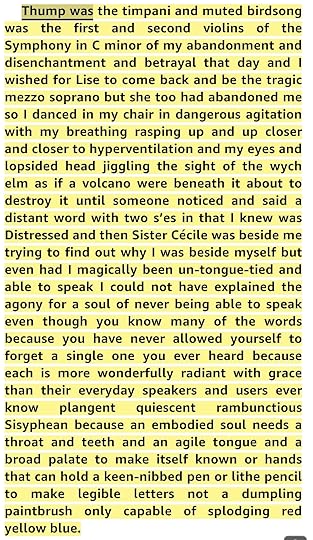
Although after such erudite prose he tells us of course at the time despite my word-hoard I didn't think it this way with these sentences in this order because often I was just a mute panic and a fantastic feeler-of-feelings. The account is instead written some years after the events described, when he is first, after becoming sexually mature, transferred to an nearby institution run by Brothers, where he is mistreated and confined to a mop cupboard, then rescued, and finally given a drug to control his muscle spasms, and which enables him to finally communicate and type this manuscript, albeit slowly, character by character:
after the unlocking by Dr Masters and the miracle drug Lioresal after the fleur-de-lys cupboard years up the road with the Brothers and the mop until the rescue by young Brother Benedict and the embrace of medical science that believed spastic imbeciles who hummed Mozart could have word-hoards and if you just released their muscles from overenthusiasm they could let you know and tell you a story of their lives
The story he tells starts with the arrival of Jim, a blind boy, at the institution, also mute. And the novel goes on to describe, movingly, how the two boys manage with patience and mutual affection, to communicate, and then to act together:
I feel long-gone Jim pushing close behind me and there is something perfect in that arrangement of our particular unfree bodies because I was in front of him but he could not see me because he was blind and he was behind me and I could not see him because I could not turn my neck. Yet yet yet when we were moving forwards into open space together we were both completely expanding into complete freedom.
Recommended, a welcome return to form for Galley Beggar, and I hope to see this on the Goldsmiths Prize list.

September 24, 2019
Patience invites us into the mind of Elliott. We quickly learn that this is a privileged place to be. Seen from the outside, Elliott is disabled by spastic cerebral palsy which has left him with very limited voluntary movement (limited use of his right hand and he is able to paint by holding the brush in his mouth) and some involuntary muscle spasms. But on the inside, the place to which we are invited by this book, he is very active: he is a hoarder of words and a devourer of music - it all goes in even if nothing can physically make its way out, and it is all stored away. When, years later, drugs, therapy and technology have given him some movement and a means of communicating, he is able to write down the thoughts he has stored away and thought about constantly for many years. Specifically, he tells us about a roughly 2 month period of his life in a religious institution where he has been abandoned by his mother into the care of a group of nuns. The significant thing about this period is his friendship with Jim who arrives at the institution blind and mute.
The institution is a heart-breaking place where children struggle with various physical and mental disabilities and where the nuns deliver varying amounts of care and concern but always plenty of religion (”Cardinal Newman and mulligatawny soup…”). What we as readers, we who are privileged to hear Elliott’s internal workings, quickly learn is that even though he feels abandoned by the God the nuns promote, he has an innate grasp of the truth of the Gospel at a much more fundamental level than the nuns themselves. It is Elliott who tells us (the punctuation, or lack of it, is the way Elliott writes):
…I imagined I was saying to him Jim what I would have said if I could have spoken aloud which was that Jesus would not have been the one telling children Thou shalt not pass through this wooden gate He would have been the one saying If you bar this wooden gate to the least of my children you bar this gate to me…
And the religious imagery is often very direct, as in this reference to the Catholic nuns’ beliefs about communion:
…but I felt then with a growing certainty that I was and would become a different better stronger braver boy with some of Jim’s blood working in my body for because it came from him how could it fail to make me more like him?
Elliott has a wonderful ability to take delight in the smallest thing. This is partly forced on him by his physical condition, but it seems to be his underlying character which is that unlikely character in fiction - a genuinely kind, considerate, loving and, of course, patient person. In his book Generosity, Richard Powers wrote, ”Here in front of him, at any event, is one plot no one will ever bother writing down: A happy girl passes through the world’s wretchedness and stays happy.” And he was making the point that happy, satisfied characters don’t normally work in books. Elliott does work as a character and I think that is partly because the reader cannot believe that someone could be so disadvantaged and still find ways to take delight in the world and be caring for his neighbours. Elliott is not blind to the suffering around him, but he finds a way to approach life positively.
There are times when the narrative necessarily drags in the book. At first, I was frustrated by this: having found a new kind of voice and being very intrigued at the start of the book, I found my attention drifting as the book progressed. But then I realised (the title of the book is a clue) that Elliott’s life is built of mundanity that is sometimes reflected in the narrative. It is his optimistic approach to finding a way through this that drives his friendship with Jim that we read about here.
The institution is a heart-breaking place where children struggle with various physical and mental disabilities and where the nuns deliver varying amounts of care and concern but always plenty of religion (”Cardinal Newman and mulligatawny soup…”). What we as readers, we who are privileged to hear Elliott’s internal workings, quickly learn is that even though he feels abandoned by the God the nuns promote, he has an innate grasp of the truth of the Gospel at a much more fundamental level than the nuns themselves. It is Elliott who tells us (the punctuation, or lack of it, is the way Elliott writes):
…I imagined I was saying to him Jim what I would have said if I could have spoken aloud which was that Jesus would not have been the one telling children Thou shalt not pass through this wooden gate He would have been the one saying If you bar this wooden gate to the least of my children you bar this gate to me…
And the religious imagery is often very direct, as in this reference to the Catholic nuns’ beliefs about communion:
…but I felt then with a growing certainty that I was and would become a different better stronger braver boy with some of Jim’s blood working in my body for because it came from him how could it fail to make me more like him?
Elliott has a wonderful ability to take delight in the smallest thing. This is partly forced on him by his physical condition, but it seems to be his underlying character which is that unlikely character in fiction - a genuinely kind, considerate, loving and, of course, patient person. In his book Generosity, Richard Powers wrote, ”Here in front of him, at any event, is one plot no one will ever bother writing down: A happy girl passes through the world’s wretchedness and stays happy.” And he was making the point that happy, satisfied characters don’t normally work in books. Elliott does work as a character and I think that is partly because the reader cannot believe that someone could be so disadvantaged and still find ways to take delight in the world and be caring for his neighbours. Elliott is not blind to the suffering around him, but he finds a way to approach life positively.
There are times when the narrative necessarily drags in the book. At first, I was frustrated by this: having found a new kind of voice and being very intrigued at the start of the book, I found my attention drifting as the book progressed. But then I realised (the title of the book is a clue) that Elliott’s life is built of mundanity that is sometimes reflected in the narrative. It is his optimistic approach to finding a way through this that drives his friendship with Jim that we read about here.

October 8, 2019
Elliott, the main protagonist of Toby Litt’s latest novel, Patience is erudite, has strong opinions about faith, is a connoisseur of classical music, likes The Beatles greatest hits and is creative.
Elliott has cerebral palsy, thus he cannot express all the complicated thoughts in his head due to the fact that it is 1979 and cures for the disability are in it’s infancy. Basically, his life consists of staring at a wall or out of the window. He lives some sort of religious institution run by nuns, which cements his rejection of God and faith. Elliott does have one big dream though.
One day, Jim, a blind mute, walks into his life and for over 50 days a series of events occur which change Elliott’s worldview forever.
Patience is a novel about language and freedom. The language aspect is interesting. The main characters are both people who are unable to communicate in the traditional sense, i.e. vocal conversation. Yet both Elliott and Jim are able to talk through a series of sound effects and humming lines of Beatles lyrics. Ironically the nuns have trouble understanding Elliott and they can see, talk and hear perfectly.
From the first few pages of Patience, Elliott declares that he gave faith and belief in God a chance and it was a failure, yet he does not consider himself free. Since he is in an religious institution, he cannot escape religion. However when Jim arrive he is able to put his plan to break free from the shackles enforced by the nuns. In one poignant scene Elliott and Jim are singing church hymns but then Elliott rejects that and begins to hum Beatles songs, in which Jim joins in and Elliott realises that their mode of communication has gotten richer.
Speaking of poignant scenes, Patience is full of them; Jim and Elliott bonding, The ‘She Loves You’ part and then the final two paragraphs made me reread the passage quite a few times. Since Elliott is sensitive to sounds and smells, there are a couple of humorous moments, plus his world is limited to the ward so when he sees something different, his interpretation of new sights can raise a chuckle . Despite the lack of punctuation and cyclic nature of some of the sentences, Elliott’s way of expressing himself becomes poetic, again proof that language can break all the rules and still get the message across.
I thought Patience was great read. The small cast of characters are endearing and, to use slang, I got the Feels. Constantly and I saw that as a good sign. Once the book is finished you’ll think about Elliott and his quest to break free for quite a while.
Many thanks to Galley Beggar Press for a requested copy of patience, in exchange for an honest review.
Elliott has cerebral palsy, thus he cannot express all the complicated thoughts in his head due to the fact that it is 1979 and cures for the disability are in it’s infancy. Basically, his life consists of staring at a wall or out of the window. He lives some sort of religious institution run by nuns, which cements his rejection of God and faith. Elliott does have one big dream though.
One day, Jim, a blind mute, walks into his life and for over 50 days a series of events occur which change Elliott’s worldview forever.
Patience is a novel about language and freedom. The language aspect is interesting. The main characters are both people who are unable to communicate in the traditional sense, i.e. vocal conversation. Yet both Elliott and Jim are able to talk through a series of sound effects and humming lines of Beatles lyrics. Ironically the nuns have trouble understanding Elliott and they can see, talk and hear perfectly.
From the first few pages of Patience, Elliott declares that he gave faith and belief in God a chance and it was a failure, yet he does not consider himself free. Since he is in an religious institution, he cannot escape religion. However when Jim arrive he is able to put his plan to break free from the shackles enforced by the nuns. In one poignant scene Elliott and Jim are singing church hymns but then Elliott rejects that and begins to hum Beatles songs, in which Jim joins in and Elliott realises that their mode of communication has gotten richer.
Speaking of poignant scenes, Patience is full of them; Jim and Elliott bonding, The ‘She Loves You’ part and then the final two paragraphs made me reread the passage quite a few times. Since Elliott is sensitive to sounds and smells, there are a couple of humorous moments, plus his world is limited to the ward so when he sees something different, his interpretation of new sights can raise a chuckle . Despite the lack of punctuation and cyclic nature of some of the sentences, Elliott’s way of expressing himself becomes poetic, again proof that language can break all the rules and still get the message across.
I thought Patience was great read. The small cast of characters are endearing and, to use slang, I got the Feels. Constantly and I saw that as a good sign. Once the book is finished you’ll think about Elliott and his quest to break free for quite a while.
Many thanks to Galley Beggar Press for a requested copy of patience, in exchange for an honest review.

February 10, 2020
Elliot is confined to a wheelchair by spastic paraplegia and has been cared for in a home run by nuns since he was eight years old. His life is constrained by his lack of movement and inability to speak, but his brain is fully active and he can focus on tiny details to make his life less limited. The nuns care for the residents physical and (as they see it) spiritual needs, but provide very little of the mental stimulus which would make Elliot's life fuller.
Toby Litt's creation of Elliot's mental world is the outstanding strength of this book and completely credible. The story involves the arrival of a new resident and the way Elliot eventually manages to communicate with him, but this would not be sufficient to drive the book without the context of Elliot's inner world.
Toby Litt's creation of Elliot's mental world is the outstanding strength of this book and completely credible. The story involves the arrival of a new resident and the way Elliot eventually manages to communicate with him, but this would not be sufficient to drive the book without the context of Elliot's inner world.

September 5, 2019
3,5
I'm afraid I just couldn't really get into this book. I can see it was well written, original, beautiful, wonderful characters etc etc.(therefore 3,5). It got some good reviews as well. So I really wanted to enjoy it more. But I struggled finishing it. I couldn't focus on the story line and found it kind of slow. Maybe it just wasn't the right time for me reading this book...
Thank you Galley Beggar Press for the ARC.
I'm afraid I just couldn't really get into this book. I can see it was well written, original, beautiful, wonderful characters etc etc.(therefore 3,5). It got some good reviews as well. So I really wanted to enjoy it more. But I struggled finishing it. I couldn't focus on the story line and found it kind of slow. Maybe it just wasn't the right time for me reading this book...
Thank you Galley Beggar Press for the ARC.

December 10, 2019
Synopsis
Hollywood gave us Thelma & Louise and Butch Cassidy & The Sundance Kid. Toby Litt has written an epic tale of adventure, of escape, of derringer- do and sod the consequences. The difference is that this story’s heroes are the severely disabled.
Jim is blind and dumb.
Elliott, the narrator, has a hugely debilitating disease (spastic cerebal palsy, with paralysis of all voluntary muscles).
Their friendship covers fifty days following Jim’s arrival at the home.
The age of the two lead characters, and a number of other children in the care home is mostly between ten and thirteen. It’s an age between puberty and adolescence. A girl (Lise) becomes a third party in an “escape” that is almost like Enid Blyton’s “Famous Five” in its sweet naïveté.
All the children are watched over, and managed, by Catholic Sisters, though the prospect of a relocation (for the boys) up the road to the “Brothers” is an ominous realisation that a “meaty” aura translates into adulthood and the end of innocence.
Throughout the book Elliott draws attention to beautiful, universal sounds, images, of sweeping music, and especially of horses running wild. It’s a wonderful thing to be so in touch with the natural world through the senses.
Highlights
“Jim by his action had made a Here out of a nowhere”(123)
The wooden gates to corridor exit become a significant totem of authority vs free will (Jim vs The Sisters)(122)
The human spirit, and the sense of mischief is central to the book. This is an uplifting story.
“ who among the Sisters ever really knew why we the children gathered ..in congregations of twitchy communion”(191).
The reality of life inside a managed community a depicted, is that there are still goodies and baddies. Charlie the ‘sockball’ scourge, the three Princesses, the uber cool Jim. Theirs is a microcosm of the range of different characters that are recognisable the world over.
Historical & Literary
The book is written with conventional paragraphs, it forms a single chapter, and the punctuation is adapted to our narrator’s thought processes. It benefits from being read aloud. This is very effective in leading the reader to imagine time not as a series of separate daily actions and incidents, but as a continuum of self awareness and as internal monologue.
I was reminded of two other great stories cantered on people with huge physical, and emotional, difficulties
• Christy Brown My Left Foot , his autobiography written in 1954. Brown was a cerebral palsy sufferer who defies expectation and stereotype to live a full life to the age of forty nine. It is a story which gives significant pause for thought among ‘able bodied’ people.
• Ken Kelsey One Flew Over The Cuckoos Nest set in a psychiatric ward. A book whose escape sequences remind me of Patience, and ones which carry the reader towards compelling finales.
Author background & Reviews
I highly recommend visiting Toby Litt’s online blog/website. https://tobylitt.wordpress.com/
As befits an author who doubles up as a creative writing teacher, Toby’s site illuminates his novel with music links, and all the trials and tribulations that provide the backdrop leading to publication.
As he says: “Novel Called Patience Published 4,581 Days After It Was Begun”
Recommend
This is a very inspiring and thought provoking book. It is written with a light touch, and with great humour. It is a book of immense empathy that never over sentimentalises.
An excellent book.
Hollywood gave us Thelma & Louise and Butch Cassidy & The Sundance Kid. Toby Litt has written an epic tale of adventure, of escape, of derringer- do and sod the consequences. The difference is that this story’s heroes are the severely disabled.
Jim is blind and dumb.
Elliott, the narrator, has a hugely debilitating disease (spastic cerebal palsy, with paralysis of all voluntary muscles).
Their friendship covers fifty days following Jim’s arrival at the home.
The age of the two lead characters, and a number of other children in the care home is mostly between ten and thirteen. It’s an age between puberty and adolescence. A girl (Lise) becomes a third party in an “escape” that is almost like Enid Blyton’s “Famous Five” in its sweet naïveté.
All the children are watched over, and managed, by Catholic Sisters, though the prospect of a relocation (for the boys) up the road to the “Brothers” is an ominous realisation that a “meaty” aura translates into adulthood and the end of innocence.
Throughout the book Elliott draws attention to beautiful, universal sounds, images, of sweeping music, and especially of horses running wild. It’s a wonderful thing to be so in touch with the natural world through the senses.
Highlights
“Jim by his action had made a Here out of a nowhere”(123)
The wooden gates to corridor exit become a significant totem of authority vs free will (Jim vs The Sisters)(122)
The human spirit, and the sense of mischief is central to the book. This is an uplifting story.
“ who among the Sisters ever really knew why we the children gathered ..in congregations of twitchy communion”(191).
The reality of life inside a managed community a depicted, is that there are still goodies and baddies. Charlie the ‘sockball’ scourge, the three Princesses, the uber cool Jim. Theirs is a microcosm of the range of different characters that are recognisable the world over.
Historical & Literary
The book is written with conventional paragraphs, it forms a single chapter, and the punctuation is adapted to our narrator’s thought processes. It benefits from being read aloud. This is very effective in leading the reader to imagine time not as a series of separate daily actions and incidents, but as a continuum of self awareness and as internal monologue.
I was reminded of two other great stories cantered on people with huge physical, and emotional, difficulties
• Christy Brown My Left Foot , his autobiography written in 1954. Brown was a cerebral palsy sufferer who defies expectation and stereotype to live a full life to the age of forty nine. It is a story which gives significant pause for thought among ‘able bodied’ people.
• Ken Kelsey One Flew Over The Cuckoos Nest set in a psychiatric ward. A book whose escape sequences remind me of Patience, and ones which carry the reader towards compelling finales.
Author background & Reviews
I highly recommend visiting Toby Litt’s online blog/website. https://tobylitt.wordpress.com/
As befits an author who doubles up as a creative writing teacher, Toby’s site illuminates his novel with music links, and all the trials and tribulations that provide the backdrop leading to publication.
As he says: “Novel Called Patience Published 4,581 Days After It Was Begun”
Recommend
This is a very inspiring and thought provoking book. It is written with a light touch, and with great humour. It is a book of immense empathy that never over sentimentalises.
An excellent book.

March 8, 2020
I did need some patience to get through this book. It's heartbreaking, delightful, and funny. And Beatles.

February 4, 2020
I read this book as a part of the 2020 Republic of Consciousness book prize for small presses. The story of a young man with cerebral palsy, the reader sees all events from his viewpoint. I think it has a great chance to make the ROC short list which is good because I really need to read it again with more “Patience” and thoughtfulness!

February 18, 2020
On the Longlist for the 2020 Republic of Consciousness Prize.
This is a uniquely wonderful novel narrated in the first person from inside the head of Elliott. He is imprisoned in a wheelchair inside a children’s home run by nuns. He cannot feed himself, has to be lifted around and is often left looking at a white wall. These long hours looking at the same thing have given him some very unique perspectives on life. Inside, everything is working well and his brain is a sponge for anything that can be learned, overheard or packed away for future use. Do not feel sorry for Elliott. As he says of himself ‘I am never bored.’
In truth Elliott is one of the most perceptive thinkers I have come across. Allow me to illustrate: “I have no particular virtue or claim to virtue and anything I might think theologically would have been outthought long ago by the thinkers who the Sisters chose to do their thinking for them such as the miraculous and inexhaustible Saint Augustine from whom we often heard at lunchtime but that is the big difference because although you can choose to get great thinkers to do your thinking for you you cannot in any way get great believers to do your believing for you neither your major nor minor believing because that is a private matter between you and the deity however much you might pray to the Virgin Mary for faith and I am one who has frequently beseeched the Virgin Mary for just about everything for which the Virgin Mary can be beseeched healing health friendship faith.”
Something that you might pick up from this quote is the dearth of punctuation. There are full stops and paragraphs, but no commas. No chapters, or breaks of any kind, for that matter. One straight unbroken narrative from Elliott. But at least with paragraphs it is not impossible to read. Time is measured not by years or months but by birthday and Christmas cards. Lunchtimes often contain Cardinal Newman, whose writings are read out and absorbed in much the same way as the food – “lunch of tomato soup with potato chunks of Cardinal Newman”. The closest thing you will get to a running gag in this book.
Into Elliott’s restricted world comes Jim, an older boy who is blind and dumb. The presence of Jim in Elliott’s life is an excitement and a revelation. When Jim takes hold of the handles of the wheelchair and lifts the front wheels off the ground, this is Elliott’s reaction:
“It was not that I hadn’t known even as Jim was walking away from me that I I I was too excited and that was a perilous thing for me because soon I wouldn’t be excited any more but would just be back at being normally there with myself and what was in front of me with my head to the left and only being able to lift my right hand half an inch but apart from that I wouldn’t be able to change anything and so I knew quite quickly I needed to watch myself meaning watch me being whee-eee-eee and all excited but also watch that I didn’t let landing back on all four wheels make me sad when there was no good reason to be sad nothing had changed except potentially everything.”
I love Elliott for his unfettered imagination, so for example when one of his room mates snores all night he “…transposed his snoring when it was loud into the creaking of an imaginary sailing ship crossing a wide sea and sometimes his breath was the sail moving in its wooden fastenings and sometimes it was the hammock of a fellow sailor creaking as it swung back and forth with the rocking of the sea waves as we journeyed onwards purposefully through the oceanic night and thus Finn’s snoring had become for me an adventure story that often continued into dreams…”
Elliott and Jim discover how to communicate with each other through tunes and humming songs that carry meanings. In this way Jim is able to steer the wheelchair and Elliott is able to guide them towards the lift out of the building and into the great outdoors.
I’ll leave you with another of Elliott’s descriptions of being overexcited by what is happening:
“I felt a gush of joy like when I once was given orangeade at a ward party by a young Sister who didn’t know me and who poured it into me too fast so it fizzed everywhere inside my mouth and throat and then bounced out in an explosion of orange and foam closely followed by yellow cake in custard.”
I love Elliott.
This is a uniquely wonderful novel narrated in the first person from inside the head of Elliott. He is imprisoned in a wheelchair inside a children’s home run by nuns. He cannot feed himself, has to be lifted around and is often left looking at a white wall. These long hours looking at the same thing have given him some very unique perspectives on life. Inside, everything is working well and his brain is a sponge for anything that can be learned, overheard or packed away for future use. Do not feel sorry for Elliott. As he says of himself ‘I am never bored.’
In truth Elliott is one of the most perceptive thinkers I have come across. Allow me to illustrate: “I have no particular virtue or claim to virtue and anything I might think theologically would have been outthought long ago by the thinkers who the Sisters chose to do their thinking for them such as the miraculous and inexhaustible Saint Augustine from whom we often heard at lunchtime but that is the big difference because although you can choose to get great thinkers to do your thinking for you you cannot in any way get great believers to do your believing for you neither your major nor minor believing because that is a private matter between you and the deity however much you might pray to the Virgin Mary for faith and I am one who has frequently beseeched the Virgin Mary for just about everything for which the Virgin Mary can be beseeched healing health friendship faith.”
Something that you might pick up from this quote is the dearth of punctuation. There are full stops and paragraphs, but no commas. No chapters, or breaks of any kind, for that matter. One straight unbroken narrative from Elliott. But at least with paragraphs it is not impossible to read. Time is measured not by years or months but by birthday and Christmas cards. Lunchtimes often contain Cardinal Newman, whose writings are read out and absorbed in much the same way as the food – “lunch of tomato soup with potato chunks of Cardinal Newman”. The closest thing you will get to a running gag in this book.
Into Elliott’s restricted world comes Jim, an older boy who is blind and dumb. The presence of Jim in Elliott’s life is an excitement and a revelation. When Jim takes hold of the handles of the wheelchair and lifts the front wheels off the ground, this is Elliott’s reaction:
“It was not that I hadn’t known even as Jim was walking away from me that I I I was too excited and that was a perilous thing for me because soon I wouldn’t be excited any more but would just be back at being normally there with myself and what was in front of me with my head to the left and only being able to lift my right hand half an inch but apart from that I wouldn’t be able to change anything and so I knew quite quickly I needed to watch myself meaning watch me being whee-eee-eee and all excited but also watch that I didn’t let landing back on all four wheels make me sad when there was no good reason to be sad nothing had changed except potentially everything.”
I love Elliott for his unfettered imagination, so for example when one of his room mates snores all night he “…transposed his snoring when it was loud into the creaking of an imaginary sailing ship crossing a wide sea and sometimes his breath was the sail moving in its wooden fastenings and sometimes it was the hammock of a fellow sailor creaking as it swung back and forth with the rocking of the sea waves as we journeyed onwards purposefully through the oceanic night and thus Finn’s snoring had become for me an adventure story that often continued into dreams…”
Elliott and Jim discover how to communicate with each other through tunes and humming songs that carry meanings. In this way Jim is able to steer the wheelchair and Elliott is able to guide them towards the lift out of the building and into the great outdoors.
I’ll leave you with another of Elliott’s descriptions of being overexcited by what is happening:
“I felt a gush of joy like when I once was given orangeade at a ward party by a young Sister who didn’t know me and who poured it into me too fast so it fizzed everywhere inside my mouth and throat and then bounced out in an explosion of orange and foam closely followed by yellow cake in custard.”
I love Elliott.

April 29, 2022
It’s 1979 and Elliott is an ordinary pre-pubescent boy. Except that he’s locked into his body by cerebral palsy and he’s locked into a hospital ward by a stultifying regime.
But, while he can barely move a muscle, his mind is a powerhouse. Plus he has oodles of patience and a plan. First he is going to make a friend of the new boy. Then, although neither has speech, his friend is blind and the nuns forbid it, they’re going to venture outside.
This is a lovely rebellious coming-of-age story. If you’re still unsure if it’s for you, follow the link to my review
https://annegoodwin.weebly.com/annecd...
But, while he can barely move a muscle, his mind is a powerhouse. Plus he has oodles of patience and a plan. First he is going to make a friend of the new boy. Then, although neither has speech, his friend is blind and the nuns forbid it, they’re going to venture outside.
This is a lovely rebellious coming-of-age story. If you’re still unsure if it’s for you, follow the link to my review
https://annegoodwin.weebly.com/annecd...

June 5, 2020
This is just simply a marvellous book. I’ve never read anything quite like it, brilliant!

December 16, 2019
Two (or Three) Flew Over the Nun's Nest
Review of the Galley Beggar Press general release (grey cover) edition (2019)
This was an extraordinary caper comedy about Elliott, a boy in a wheelchair with cerebral palsy, and his blind friend Jim and how they work towards an escape into the outdoor world from the orphanage / institution where they live under the care of several nuns. I don't want to overstate my Cuckoo's Nest parallel too much, so I'll quickly say here that the nuns are pretty benign and there is no dominant evil Nurse Ratched character, although Sister Britta is the one most flagged as the disciplinarian. There is another older boy Charlie though, who is a bully and the main antagonist.
The extraordinary element is that Elliott can't speak beyond several wordless approximations of language and can only slightly move one hand and somewhat jiggle his wheelchair and Jim, as stated, is blind. These two still manage to create a means of communication about which it would be somewhat spoilery to get into details. Suffice it to say that Elliott is very gifted musically and is able to hum melodies quite easily and Jim is pretty good at that as well. Also there are a few reasons the book is set in 1979 in a pre-digital age. One of these reasons is that the main early Beatles Greatest Hits collections were the so-called Red Album (Beatles 1962-1966) and Blue Album (Beatles 1967-1970) issued in 1974 in various formats including cassette tapes.
I will confess to a bit of hesitancy when I started this book as stream-of-consciousness novels can often require a lot of concentration in order to keep up with the mental leaps. But it all flowed so naturally and smoothly that there were really few issues in keeping up with Elliott (who you have to accept is writing this as a memoir having the added advantage of later technological and medical breakthroughs that he refers to towards the end of the book). Also, don't be put off by the back cover blurb that refers to "30 to 40 pages of tears". This book is not a tragedy and your tears may be those of joy or laughter.
This was easily one of my top reads of 2019 and I also took advantage of a recent Galley Beggar Press sale offering to pick up additional copies as future gifts for reading friends who might otherwise miss it.
Patience was one of the selections in Shakespeare and Company's 2019 Year of Reading subscription which is an excellent annual curated series. You can see the variety of the 2019 selections on this tagged shelf.
Review of the Galley Beggar Press general release (grey cover) edition (2019)
This was an extraordinary caper comedy about Elliott, a boy in a wheelchair with cerebral palsy, and his blind friend Jim and how they work towards an escape into the outdoor world from the orphanage / institution where they live under the care of several nuns. I don't want to overstate my Cuckoo's Nest parallel too much, so I'll quickly say here that the nuns are pretty benign and there is no dominant evil Nurse Ratched character, although Sister Britta is the one most flagged as the disciplinarian. There is another older boy Charlie though, who is a bully and the main antagonist.
The extraordinary element is that Elliott can't speak beyond several wordless approximations of language and can only slightly move one hand and somewhat jiggle his wheelchair and Jim, as stated, is blind. These two still manage to create a means of communication about which it would be somewhat spoilery to get into details. Suffice it to say that Elliott is very gifted musically and is able to hum melodies quite easily and Jim is pretty good at that as well. Also there are a few reasons the book is set in 1979 in a pre-digital age. One of these reasons is that the main early Beatles Greatest Hits collections were the so-called Red Album (Beatles 1962-1966) and Blue Album (Beatles 1967-1970) issued in 1974 in various formats including cassette tapes.
I will confess to a bit of hesitancy when I started this book as stream-of-consciousness novels can often require a lot of concentration in order to keep up with the mental leaps. But it all flowed so naturally and smoothly that there were really few issues in keeping up with Elliott (who you have to accept is writing this as a memoir having the added advantage of later technological and medical breakthroughs that he refers to towards the end of the book). Also, don't be put off by the back cover blurb that refers to "30 to 40 pages of tears". This book is not a tragedy and your tears may be those of joy or laughter.
This was easily one of my top reads of 2019 and I also took advantage of a recent Galley Beggar Press sale offering to pick up additional copies as future gifts for reading friends who might otherwise miss it.
Patience was one of the selections in Shakespeare and Company's 2019 Year of Reading subscription which is an excellent annual curated series. You can see the variety of the 2019 selections on this tagged shelf.

October 28, 2019
A radiant, vibrant, tragically warm novel. Loved it, and cried my eyes out.
June 8, 2025
Extremely charming book that was funny but would occasionally sneak up and sucker punch you with emotion. And there were very exciting sentences

February 2, 2020
This isn't a spoiler in the traditional sense but if you are aware of my criticism, it will be hard to ignore and might make the reading less enjoyable.
I'm not convinced the lack of punctuation within paragraphs was necessary. It seems a gimmick which bothered me throughout. Why is there a full stop at the end of each paragraph but not within? If it is because this is a slow typing exercise, why is every word spelled correctly? Why are some words and phrases repeated?
I'm not convinced the lack of punctuation within paragraphs was necessary. It seems a gimmick which bothered me throughout. Why is there a full stop at the end of each paragraph but not within? If it is because this is a slow typing exercise, why is every word spelled correctly? Why are some words and phrases repeated?
This entire review has been hidden because of spoilers.

January 31, 2020
Mixed feelings bij dit boek. Hele mixed feelings. Het onderwerp sprak me direct aan (en deed me wat denken aan One Flew Over The Cuckoo's Nest), maar ik had me niet verder verdiept in het boek. En ik was dus best onaangenaam verrast toen ik erachter kwam dat het boek geschreven was als een soort stream of consciousness. Met alleen punten als leestekens, en geen enkele hoofdstuk- of alinea-indeling. Dat is vermoeiend lezen, moet ik bekennen, en leidde voor mij ook echt af van het verhaal. Hoewel deze vorm wel goed gekozen is als je bedenkt dat het de gedachten zijn van een jongen die niet kan praten. En gedachten schieten nu eenmaal alle kanten op. Bovendien vond ik hoofdpersoon Elliott ook te wijs geportretteerd, zijn algemene ontwikkeling was veel te groot, zeker voor een kind dat zelf helemaal niets kan (een boek pakken, een televisie aanzetten, een krant lezen). Hoe komt hij aan die kennis?
Wat wel goed gevonden was, vond ik de manier waarop hij uiteindelijk, zonder te kunnen praten, toch communiceert met Jim, een jongen op zijn afdeling. Een van de zusters van de afdeling luistert dagelijks naar het rode en blauwe album van de Beatles, en de kinderen kennen dus ook alle liedjes daarvan uit hun hoofd. Ook Elliott en Jim. Jim is blind, maar kan wel praten en horen, Elliott kan zien maar niet praten, en bedenkt dan dat hij door een van de liedjes van de Beatles te neuriën, hij Jim duidelijk kan maken wat hij wil (I Want To Hold Your Hand, bijvoorbeeld). En zo krijgt hij hem ook zover dat hij hem zijn rolstoel kan laten besturen waarheen hij maar wil, met als doel om uiteindelijk te ontsnappen en wat van de wereld te zien. Mooie vondst!
De vorm bleek uiteindelijk wel een te grote belemmering voor mij om echt van het boek te genieten, vandaar die twee sterren.
Wat wel goed gevonden was, vond ik de manier waarop hij uiteindelijk, zonder te kunnen praten, toch communiceert met Jim, een jongen op zijn afdeling. Een van de zusters van de afdeling luistert dagelijks naar het rode en blauwe album van de Beatles, en de kinderen kennen dus ook alle liedjes daarvan uit hun hoofd. Ook Elliott en Jim. Jim is blind, maar kan wel praten en horen, Elliott kan zien maar niet praten, en bedenkt dan dat hij door een van de liedjes van de Beatles te neuriën, hij Jim duidelijk kan maken wat hij wil (I Want To Hold Your Hand, bijvoorbeeld). En zo krijgt hij hem ook zover dat hij hem zijn rolstoel kan laten besturen waarheen hij maar wil, met als doel om uiteindelijk te ontsnappen en wat van de wereld te zien. Mooie vondst!
De vorm bleek uiteindelijk wel een te grote belemmering voor mij om echt van het boek te genieten, vandaar die twee sterren.

Read
April 22, 2025Not rating because I ended up speeding through it. I understand the creative choice and reasoning for no punctuation and run-on stream of consciousness style writing, but that prevented me from getting engaged in the story. The majority of the book is the inner monologue of the main character - a special needs child in the care of a Catholic/nun-led facility. Not too much happens ultimately though it picks up toward the end, and there is a fair amount of symbolism throughout. A unique story creatively presented, but it wasn’t for me.

January 9, 2020
I've been a fan of Toby Litt since Adventures in Capitalism, and he just gets more adventurous with each work. I was gripped by Elliott's painstaking efforts to make friends and communicate with Jim, with the goals of wheelchair wheelies and, ultimately, escape from the ward altogether.
Would be unbearably sad if it wasn't also very funny.
Would be unbearably sad if it wasn't also very funny.

November 16, 2024
It took me a long time to get in this book, and I stalled at 28% for three years before returning to it but I'm so glad I did! 250 pages of continuous prose with no chapter breaks is not for everyone and it was definitely a struggle to retain focus on it at times but once I got into the story of Elliot I felt so immersed in his world that it was easy to pick up and I was so eager to read to the end.
An odd, charming, funny little book and a nice one to finally finally finish.
An odd, charming, funny little book and a nice one to finally finally finish.

July 13, 2022
Challenging book to read being in the mind of this kid, the story is fairly slight but given the constraints of our narrator, they take on epic proportions. Painting a cane, taking an elevator are the great ambitions of our narrator and the challenges accomplishing them were surprisingly riveting. Learning to communicate via humming Beatles lyrics was an inspired touch.

February 28, 2020
This young man's rich interior life made me feel as though I'm sleep-walking through mine!

May 21, 2020
You might not think that a story about 53 days in the life of a wheelchair-bound boy who can’t move or speak makes for a scintillating read, but in Toby Litt’s skilfully told tale the adventures of Elliott – who suffers from spastic cerebral palsy – are a real page-turner. For me the strength of this book as with all great works of literary fiction is how beautifully it shines a light on what it is to be human. Without a doubt, its central character – cruelly abandoned to be cared for by Catholic nuns – has every reason to be angry with his lot, but by drawing on his vast reserves of humour and patience and his incredible knowledge and image bank of memories he is able to delight in existence and even views the white wall where the sisters meanly face him each day with good grace. What we are privileged to learn about Elliott – despite him being locked in his own body – is how kind, lovable and intelligent he is and his determination is sure to humble any reader into never wanting to complain of the trivial irritations of everyday life again.
The action centres around the arrival of new boy Jim and Elliott’s quest to befriend him despite the fact that Jim is mute and blind. Their mutual struggle to communicate and their mission to rebel against the nuns are both heart-wrenching as well as comic gold. Elliott has long held a dream of escaping from the ward and out into the world beyond and the plan he makes to fulfil this ambition is as exciting as any action adventure and the stakes as thrillingly high. It’s simply impossible not to end up rooting for Elliott and Jim to succeed with every breath in your body and, in fact, I raced to the end to find out if the boys could pull off their own mission impossible. As a lesson in endurance, Patience is the perfect book for these challenging times and one that I found immensely uplifting. Hats off to the author who has shown how a world with limitations can be one of endless possibilities for those such as Elliott with joy in their heart and a rich inner life.
The action centres around the arrival of new boy Jim and Elliott’s quest to befriend him despite the fact that Jim is mute and blind. Their mutual struggle to communicate and their mission to rebel against the nuns are both heart-wrenching as well as comic gold. Elliott has long held a dream of escaping from the ward and out into the world beyond and the plan he makes to fulfil this ambition is as exciting as any action adventure and the stakes as thrillingly high. It’s simply impossible not to end up rooting for Elliott and Jim to succeed with every breath in your body and, in fact, I raced to the end to find out if the boys could pull off their own mission impossible. As a lesson in endurance, Patience is the perfect book for these challenging times and one that I found immensely uplifting. Hats off to the author who has shown how a world with limitations can be one of endless possibilities for those such as Elliott with joy in their heart and a rich inner life.

February 23, 2020
It took me a longer than usual to finish this extraordinary novel because I kept resisting its end. I stretched out the last 50 or so pages as much as I could - even the last 3. I found every page gorgeous, suspenseful, tender, and often surprising.
The story is told from the perspective of a severely disabled boy, Elliot. He can't speak. He can't move unassisted. He spends most of the day in his head working to comprehend the world around him in profound ways and working to carry out a secret plan.
Getting to know Elliot and his relationships with other wards of a Catholic orphanage in 1979 is a special experience. The love he has for the people around him is overwhelming, particularly for the blind and mute boy, Jim, for whom he has a particular fondness.
Toby Litt's prose style ranges from highly poetic to invisible depending on how it needs to serve the narrative. His story construction, however, is exceptionally brilliant. Alluding to the Christian Bible, Mark Twain, German opera, and Ken Kesey is no small thing. Weaving these allusions into the service of his own story, making each greater, demonstrates Litt's mastery. Despite its heady, intellectual project the novel never veers away from the emotional center of its protagonist. It is astounding.
I highly recommend this to anyone who can get their hands on a copy. This is an exceptional novel.
The story is told from the perspective of a severely disabled boy, Elliot. He can't speak. He can't move unassisted. He spends most of the day in his head working to comprehend the world around him in profound ways and working to carry out a secret plan.
Getting to know Elliot and his relationships with other wards of a Catholic orphanage in 1979 is a special experience. The love he has for the people around him is overwhelming, particularly for the blind and mute boy, Jim, for whom he has a particular fondness.
Toby Litt's prose style ranges from highly poetic to invisible depending on how it needs to serve the narrative. His story construction, however, is exceptionally brilliant. Alluding to the Christian Bible, Mark Twain, German opera, and Ken Kesey is no small thing. Weaving these allusions into the service of his own story, making each greater, demonstrates Litt's mastery. Despite its heady, intellectual project the novel never veers away from the emotional center of its protagonist. It is astounding.
I highly recommend this to anyone who can get their hands on a copy. This is an exceptional novel.

May 14, 2020
Exquisite writing. Beautifully told story . Could only process small ‘bites’ at a time

January 26, 2020
It is often said that the universal language is science. I love the idea that the universal earth language is The Beatles.

May 22, 2025
I've never read a book quite like this and am in awe of the author who was able to bring to life not only Elliott as the narrator, but also the setting at the ward, the Sisters and the other children. Through the eyes of Elliott at a later stage in life, we get to see his experiences as a disabled boy unable to move a lot or speak, but intelligent and eager to experience life beyond the Christian institution run by nurses where he lived in the late 1970s. The writing style resembles stream of consciousness, because it is meant to reflect Elliott communicating his memories via a special machine after medical treatment later in life. The sentences are often long and don't have much punctuation, which made me feel like the narrator took me along with him into his train of thought, his imagination and perceptions of his environment and the people around him.
"It was not just that I had never seen anything quite so perfectly what it was no it was that I felt that by its being there I too was allowed fleetingly to participate in perfection because my eyes my gorgeous-seeing eyes were able to see the details in the details of the greenfinch at the same time as seeing the greenness of its greens and as much as it was outside on the window sill above the radiator so much more was it inside my eyes and so creating a perfect greenfinch forever in my head." (p. 71)
There is not a lot happening in this book thinking back on it. The majority of the book is really about the mind-numbing routine in an institution for disabled children, but through the eyes of Elliott, even the smallest changes in his life and the lives of the children around him was momentous.
"I looked at the white wall and I looked at the white wall and I looked at the white wall and then I looked some more at the white wall and then instead I looked as things developed quite quite beyond my control at the white of the wall and then at the whiteness of the white of the wall and then only at the whiteness as if it could exist independently of the wall and I continued to look at the whiteness of the whiteness until I began to look into the whiteness and then through the whiteness..." (p. 11)
"I waited as nothing happened and then all of a sudden nothing happened again but if I am good at anything I am good at nothing meaning I am good at being where or on the fringes of where nothing is happening or anyway where nothing seems to be happening because something really is always happening even when it seems to most people who do more than me that what is happening is nothing and I am definitely excellent at living with achieving nothing no gift no assistance…" (p. 86)
This book is about friendship and finally finding someone who you can communicate with and who is able and willing to listen to you, but it is also about risking everything to finally experience more of the world around you. Elliott liked Jim, but also saw in him a means to an end, because of his mental and physical capabilities that made it possible for him to finally follow his dreams.
"(…) when I think of anyone's freedom for example when I think of an orphan adopted away from the ward into a family I feel long-gone Jim pushing close behind me and there is something perfect in that arrangement of our particular unfree bodies because I was in front of him but he could not see me because he was blind and he was behind me and I could not see him because I could not turn my neck. Yet yet yet when we were moving forwards into open space together we were both completely expanding into complete freedom." (p. 214)
The treatment of disabled children of all kinds at this Christian institution was presented through Elliott's eyes as a fact and normality. The nuns' lack of understanding for the children in their care, as well as the complete lack of consideration that some of them might be able and willing to communicate with them beyond expressions of their basic needs was frustrating to read at times, especially when Elliott himself sometimes couldn't help but feel angry and frustrated about his helplessness as well. It was also heartbreaking to read about how much he knew about all the caretakers, the painters coming once a year to paint a wall white and the children around him, without being able to communicate with them or them even perceiving him as a person potentially able to perceive them.
While not physically abusive for the most part, the fact that these nuns were using the Chapel as a place of punishment and isolation for minor infractions of basic routines and for behaviour that showed lack of understanding for rules made me so angry at times.
"I have no particular virtue or claim to virtue and anything I might think theologically would have been outthought long ago by the thinkers who the Sisters chose to do their thinking for them such as the miraculous and inexhaustible Saint Augustine from whom we often heard at lunchtime but that is the big difference because although you can choose to get great thinkers to do your thinking for you you cannot in any way get great believers to do your believing for you neither your major nor minor believing because that is a private matter between you and the deity…" (p. 23)
"(…) we all went directly across the shiny blue lino in the bright light of morning just as if we did it all the time because we were allowed to because we were trusted valued children and not imprisoned children who had to spend days repenting for standing in front of a wooden gate." (p. 229)
"(…) and so within our danger we were strangely warmly safe because although the worst had not yet begun it was guaranteed to being.
If we were already damned then why not sin the more?
But we were not damned because in such a world as the immortal layby and in all the human world there was no such thing as damnation." (p. 246)
Elliott constantly counselling himself to be patient and not to feel too much or too excited, in order to be able to cope with the lack of stimulation when the nuns would inevitably put his wheelchair in front of a blank wall again to ensure that he'd stay calm was horrible to think about. The way his imagination made it possible for him to remain present was incredible to read about.
"By the afternoon Jim arrived I had become very good at being patient so good that I expected to be able to live out the rest of my time on that ward and whichever ward followed it for it would of course be a ward with equanimity a lovely word if not contentment a cosy word just so long as Charlie or another knife-loving bully did not decide particularly to focus upon me as the object of his cruelty for no apparent reason." (p. 36)
"It was not that I hadn't known even as Jim was walking away from me that I I I was too excited and that this was a perilous thing for me because soon I wouldn't be excited any more but would just be back to being normally there with myself and what was in front of me with my head to the left and only be able to lift my right hand half and inch but apart from that I wouldn't be able to change anything and so I knew quite quickly I needed to watch myself meaning both watch me being whee-eee-eee and all excited but also watch that I didn't let landing back on all four wheels make me sad when there was no good reason to be sad nothing had changed except potentially everything." (p. 69)
The author conveyed Elliott's innocence so well, but also understanding for a lot of the things going on around him, even if he often didn't fully comprehend the reasons for certain events. His knowledge of music and composers through listening to the radio programs of the nuns, as well as animals through nature documentaries was touching, especially when he connected this to his own environment and the sights and sounds around him.
"As the spoon flew to my mouth I could feel Sister Cécile assessing me in preparation for deciding white or window or paint or clay and so I was the most perfect little horse I could ever be (…) and it must have worked despite my fears that the lion of anxiety and rage I was covering over with the skin of the timid antelope would give its golden self away with a powerful twitch or magnificent grrr (…)" (p. 204)
I found this book incredibly well written and was just blown away by the ingenuity of concept and execution. Some of the tangents Elliott would go on when considering a matter or his attempts at comparing a situation to something he'd seen or heard of before would go on a bit too long for me, but in general, I think this book is an incredible achievement.
"Every afterwards for as long as I was on the ward (…) I was always able to turn the whiteness of the white wall at will into the whiteness with green centres and circles of pink dots on yellow sticks later stalks stamens that made up this absolute close vision of the harmony of the beauty of nature and this vision was enough to justify not just our escape but my entire life of seeing rather than doing." (p. 244)
"It was not just that I had never seen anything quite so perfectly what it was no it was that I felt that by its being there I too was allowed fleetingly to participate in perfection because my eyes my gorgeous-seeing eyes were able to see the details in the details of the greenfinch at the same time as seeing the greenness of its greens and as much as it was outside on the window sill above the radiator so much more was it inside my eyes and so creating a perfect greenfinch forever in my head." (p. 71)
There is not a lot happening in this book thinking back on it. The majority of the book is really about the mind-numbing routine in an institution for disabled children, but through the eyes of Elliott, even the smallest changes in his life and the lives of the children around him was momentous.
"I looked at the white wall and I looked at the white wall and I looked at the white wall and then I looked some more at the white wall and then instead I looked as things developed quite quite beyond my control at the white of the wall and then at the whiteness of the white of the wall and then only at the whiteness as if it could exist independently of the wall and I continued to look at the whiteness of the whiteness until I began to look into the whiteness and then through the whiteness..." (p. 11)
"I waited as nothing happened and then all of a sudden nothing happened again but if I am good at anything I am good at nothing meaning I am good at being where or on the fringes of where nothing is happening or anyway where nothing seems to be happening because something really is always happening even when it seems to most people who do more than me that what is happening is nothing and I am definitely excellent at living with achieving nothing no gift no assistance…" (p. 86)
This book is about friendship and finally finding someone who you can communicate with and who is able and willing to listen to you, but it is also about risking everything to finally experience more of the world around you. Elliott liked Jim, but also saw in him a means to an end, because of his mental and physical capabilities that made it possible for him to finally follow his dreams.
"(…) when I think of anyone's freedom for example when I think of an orphan adopted away from the ward into a family I feel long-gone Jim pushing close behind me and there is something perfect in that arrangement of our particular unfree bodies because I was in front of him but he could not see me because he was blind and he was behind me and I could not see him because I could not turn my neck. Yet yet yet when we were moving forwards into open space together we were both completely expanding into complete freedom." (p. 214)
The treatment of disabled children of all kinds at this Christian institution was presented through Elliott's eyes as a fact and normality. The nuns' lack of understanding for the children in their care, as well as the complete lack of consideration that some of them might be able and willing to communicate with them beyond expressions of their basic needs was frustrating to read at times, especially when Elliott himself sometimes couldn't help but feel angry and frustrated about his helplessness as well. It was also heartbreaking to read about how much he knew about all the caretakers, the painters coming once a year to paint a wall white and the children around him, without being able to communicate with them or them even perceiving him as a person potentially able to perceive them.
While not physically abusive for the most part, the fact that these nuns were using the Chapel as a place of punishment and isolation for minor infractions of basic routines and for behaviour that showed lack of understanding for rules made me so angry at times.
"I have no particular virtue or claim to virtue and anything I might think theologically would have been outthought long ago by the thinkers who the Sisters chose to do their thinking for them such as the miraculous and inexhaustible Saint Augustine from whom we often heard at lunchtime but that is the big difference because although you can choose to get great thinkers to do your thinking for you you cannot in any way get great believers to do your believing for you neither your major nor minor believing because that is a private matter between you and the deity…" (p. 23)
"(…) we all went directly across the shiny blue lino in the bright light of morning just as if we did it all the time because we were allowed to because we were trusted valued children and not imprisoned children who had to spend days repenting for standing in front of a wooden gate." (p. 229)
"(…) and so within our danger we were strangely warmly safe because although the worst had not yet begun it was guaranteed to being.
If we were already damned then why not sin the more?
But we were not damned because in such a world as the immortal layby and in all the human world there was no such thing as damnation." (p. 246)
Elliott constantly counselling himself to be patient and not to feel too much or too excited, in order to be able to cope with the lack of stimulation when the nuns would inevitably put his wheelchair in front of a blank wall again to ensure that he'd stay calm was horrible to think about. The way his imagination made it possible for him to remain present was incredible to read about.
"By the afternoon Jim arrived I had become very good at being patient so good that I expected to be able to live out the rest of my time on that ward and whichever ward followed it for it would of course be a ward with equanimity a lovely word if not contentment a cosy word just so long as Charlie or another knife-loving bully did not decide particularly to focus upon me as the object of his cruelty for no apparent reason." (p. 36)
"It was not that I hadn't known even as Jim was walking away from me that I I I was too excited and that this was a perilous thing for me because soon I wouldn't be excited any more but would just be back to being normally there with myself and what was in front of me with my head to the left and only be able to lift my right hand half and inch but apart from that I wouldn't be able to change anything and so I knew quite quickly I needed to watch myself meaning both watch me being whee-eee-eee and all excited but also watch that I didn't let landing back on all four wheels make me sad when there was no good reason to be sad nothing had changed except potentially everything." (p. 69)
The author conveyed Elliott's innocence so well, but also understanding for a lot of the things going on around him, even if he often didn't fully comprehend the reasons for certain events. His knowledge of music and composers through listening to the radio programs of the nuns, as well as animals through nature documentaries was touching, especially when he connected this to his own environment and the sights and sounds around him.
"As the spoon flew to my mouth I could feel Sister Cécile assessing me in preparation for deciding white or window or paint or clay and so I was the most perfect little horse I could ever be (…) and it must have worked despite my fears that the lion of anxiety and rage I was covering over with the skin of the timid antelope would give its golden self away with a powerful twitch or magnificent grrr (…)" (p. 204)
I found this book incredibly well written and was just blown away by the ingenuity of concept and execution. Some of the tangents Elliott would go on when considering a matter or his attempts at comparing a situation to something he'd seen or heard of before would go on a bit too long for me, but in general, I think this book is an incredible achievement.
"Every afterwards for as long as I was on the ward (…) I was always able to turn the whiteness of the white wall at will into the whiteness with green centres and circles of pink dots on yellow sticks later stalks stamens that made up this absolute close vision of the harmony of the beauty of nature and this vision was enough to justify not just our escape but my entire life of seeing rather than doing." (p. 244)

October 25, 2019
A story narrated in prose that just won't leave me alone, as I fall asleep, or stand waiting for the bus to work. The title says a great deal about it: just stand and look at the world, a greefinch, a spider's web, or even a urine-scented lay-by. And listen again to Schubert and Mahler and Wagner with new ears. And the undertone: even a kindly-meant tyranny is still tyranny. Let my people go.
Displaying 1 - 30 of 62 reviews