

What do you think?

«Аполлон-8»: Захватывающая история первого полета к Луне
Goodreads Choice Award
Nominee for Readers' Favorite History & Biography (2017)В августе 1968 г. НАСА приняло смелое решение: запустить первый обитаемый космический корабль к Луне. Всего год назад три астронавта погибли в пожаре во время испытаний, и с тех пор программа «Аполлон» терпела одну неудачу за другой. Тем временем СССР выигрывал космическую гонку, холодная война становилась все жарче с каждым месяцем, и обещание президента Кеннеди отправить человека на Луну к концу десятилетия казалось несостоятельным. Но когда Фрэнка Бормана вызвали на секретную встречу и предложили его экипажу опасную миссию, он без колебаний согласился. Эта книга — первая подробная история «Аполлона-8». Джеффри Клугер предлагает читателю захватывающую исто
Kindle Edition
First published May 16, 2017
About the author
Jeffrey Kluger
32 books229 followersJeffrey Kluger is Editor at Large at Time, where he has written more than 45 cover stories. Coauthor of Lost Moon: The Perilous Voyage of Apollo 13, which was the basis for the movie Apollo 13, he is also the author of 13 other books including his latest book Gemini: Stepping Stone to the Moon, the Untold Story.
Ratings & Reviews
Friends & Following
Create a free account to discover what your friends think of this book!
Community Reviews
Displaying 1 - 30 of 809 reviews

January 5, 2026
And so, dear readers, somehow over the years I stopped even trying to resist reading everything about the US space program - all these Mercuries and Gemini and Apollos - that comes my way. Whatever the ulterior motives underlying the Space Race may have been, the result was something beautiful and daring and incredibly clever. We’ll undoubtedly screw it up soon, that knowledge and perseverance that let a few of us briefly escape Earth’s gravity and do some science in space, but even then it will remain one of those few things humanity should actually be proud of.
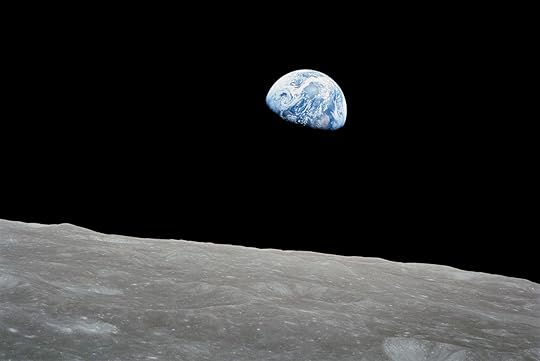
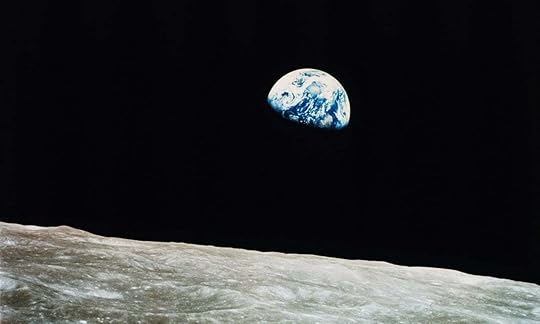
Earthrise. Image credit: NASA
On December 21, 1968 Apollo 8 with three astronauts on board - Frank Borman, Jim Lovell and Bill Anders - left on the mission to orbit the Moon. They did not land there, leaving this feat and resulting fame just a few months later to Neil Armstrong and Buzz Aldrin (and Mike Collins, orbiting above to give these two a safe return) — and no wonder, as this mission was cobbled together at the last moment, in an attempt to beat the Soviets.
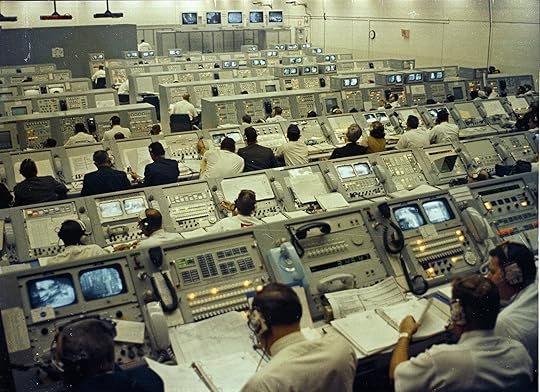
Launch Control Center. Image credit: NASA
Kluger includes a lot of background material in the history of the Apollo program, going back to Mercury and Gemini, and the story of NASA itself. And given that it’s my umpteenth book on the space program and I’ve just recently read Kluger’s book about Gemini program with a lot of focus on the same events, a lot of it was familiar — but not in the annoying “oh, I already know this!” way but rather in the comforting way of meeting an old friend again. Apparently there’s no limit on how many times reading about the same events makes me excited and happy.
Although I realized I didn’t know how bad Frank Borman’s space sickness actually was. And by extension, what horror it was for the other two men to share the tiny space of command module with him and his bodily fluids.
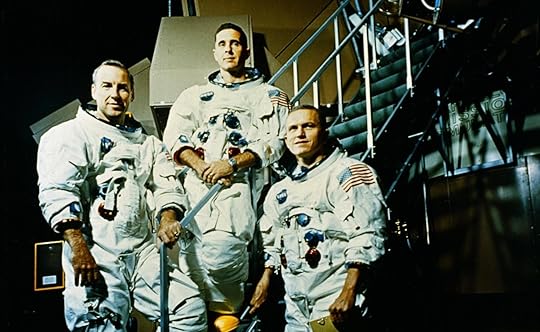
Apollo 8 crew: Lovell, Anders, Borman. Image credit: NASA
This book focuses quite a bit on the mission commander, Frank Borman, who so far has been on the periphery in the books I’ve read, and it was nice to learn a little bit more about him. He was a disciplined rule-following kind of a man (until it came to fighting for his right to fly despite a minor eardrum mishap) who seemed made of solidity and reliability to his very core. And as always, Kluger takes a very respectful approach to the astronaut stories, and I appreciate it since I can’t stand yellow journalism.
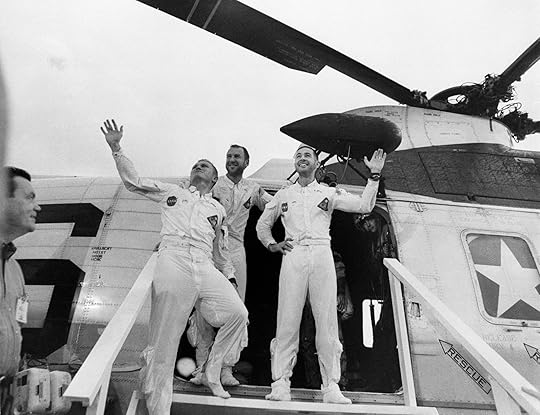
Apollo 8 crew after returning from the Moon: Borman, Lovell, Anders. Image credit: NASA
I really loved it, and it was a lovely start to a cold and rainy New Year’s vacation.
4.5 stars, rounding up.
Earthrise. Image credit: NASA
“The Earth was no longer the soil beneath their feet or the horizon below their spacecraft. It was an almost complete disk of light suspended in front of them, a delicate Christmas tree ornament made of swirls of blue and white glass. It looked impossibly beautiful—and impossibly breakable.”
On December 21, 1968 Apollo 8 with three astronauts on board - Frank Borman, Jim Lovell and Bill Anders - left on the mission to orbit the Moon. They did not land there, leaving this feat and resulting fame just a few months later to Neil Armstrong and Buzz Aldrin (and Mike Collins, orbiting above to give these two a safe return) — and no wonder, as this mission was cobbled together at the last moment, in an attempt to beat the Soviets.
Launch Control Center. Image credit: NASA
“But Borman does remember one telegram—from a sender he didn’t know—and he still likes to talk about it. The telegram said, simply, “Thank you, Apollo 8. You saved 1968.” That, Borman realized, made him feel happier than gazing up at the moon ever did.”
Kluger includes a lot of background material in the history of the Apollo program, going back to Mercury and Gemini, and the story of NASA itself. And given that it’s my umpteenth book on the space program and I’ve just recently read Kluger’s book about Gemini program with a lot of focus on the same events, a lot of it was familiar — but not in the annoying “oh, I already know this!” way but rather in the comforting way of meeting an old friend again. Apparently there’s no limit on how many times reading about the same events makes me excited and happy.
Although I realized I didn’t know how bad Frank Borman’s space sickness actually was. And by extension, what horror it was for the other two men to share the tiny space of command module with him and his bodily fluids.
Apollo 8 crew: Lovell, Anders, Borman. Image credit: NASA
“There was no established way for a man to tell his wife he was going to the moon. A man could tell his wife he was going to sea or going to war; men had been doing that for millennia. But the moon? It was a whole new conversation.”
This book focuses quite a bit on the mission commander, Frank Borman, who so far has been on the periphery in the books I’ve read, and it was nice to learn a little bit more about him. He was a disciplined rule-following kind of a man (until it came to fighting for his right to fly despite a minor eardrum mishap) who seemed made of solidity and reliability to his very core. And as always, Kluger takes a very respectful approach to the astronaut stories, and I appreciate it since I can’t stand yellow journalism.
Apollo 8 crew after returning from the Moon: Borman, Lovell, Anders. Image credit: NASA
I really loved it, and it was a lovely start to a cold and rainy New Year’s vacation.
4.5 stars, rounding up.

July 4, 2021
As a young girl, when I was asked what I would like to be when I grow up, my answer was an astronaut. I have always been enamored with the stars and galaxies and planets. To this day I am still obsessed with space travel. My library is filled with astronomy coffee table books and science fiction space operas. Apollo 8: The Thrilling Story of the First Mission to the Moon hoisted my geek flag a thousand miles above the earth (well actually more like 238,900 miles).
I loved every single moment of this book!! This was an America that was still progressing, striving to achieve national goals that had very little to do with chasing wealth. Asserting intellectual dominance in space the rather than nuclear weapons. The Vietnam War, civil rights struggles, the cold war this was a time of tremendous turbulence and worldwide unrest. The craziness of technology before we were able to create computer models. This was test pilot territory. Very risky business. Thousands of designs and tests and iterations and a few deaths before they come up with a functional spacecraft. The excessive tests and details with the astronauts to include collecting their underwear to determine how much water loss was taking place in their nether regions. I mean it was just mindboggling that these folks were collecting every possible piece of data manually. Incredible. And the technology, the rocket science, the atmosphere in the capsule, the way they had to fill expended rocket fuel tanks with nitrogen so that they didn't implode and damage the space craft (basically there could not be empty space in the fuel tank once the fuel was expended). It was all so incredibly interesting. This Apollo mission does not enjoy the reverence of the Apollo 11 mission, but it really should. This was first time humans had left earth orbit. The first time we were able to see earth as a planet, a celestial object; and it was awe inspiring. I had never heard about the perceptions of these first men to see the moon up close and the earth at a distance. It shook me that they found the moon so lonely, uninviting, and desolate. Frank Borman said he was enamored with the earth at that point because it the only thing of color in view. That space flight forever changed his view of Earth.
The book also goes into a great bit of detail about the crew: Frank Borman, Bill Anders and Jim Lovell and the politics of the time and the history of NASA. Wehner von Braun a Nazi engineer designed the Saturn 5 rocket that delivered the Apollo missions to the moon. There are also quite a bit of history about the NASA ground crew: Chris Kraft, Gene Krantz, Deke Slayton and many more. This was straight forward, compact, and riveting writing. Apollo 8 is most remembered for the iconic photo that really captures the notion of the earth teaming with life in contrast the barrenness of the moon and no stars in view.

"Earthrise" (this is a re-creation. The actual photo is more stark and dramatic, less detailed and has rigorous copyright protections- but you should seek it out)
For me, Borman's remarks hearkened to the damage we have been doing to the planet (though I doubt that was his intent). All in all, a fantastic journey back to a time when American spirit, ingenuity and can do-ism was indulged…at least with respect to space travel (I mean it was 1968). Jeffrey Kluger is establishing himself as the premiere historian of the Apollo space program and a really great writer to boot!
4.5 Stars rounded up
Listened to the audio book. Brian Troxell was a fantastic narrator. He was entertaining and engaging! Additionally, the audiobook version featured a recent interview with Frank Borman and some recording of the communication between Apollo 8 and NASA back in 1968. The additional content was amazing!!!
I loved every single moment of this book!! This was an America that was still progressing, striving to achieve national goals that had very little to do with chasing wealth. Asserting intellectual dominance in space the rather than nuclear weapons. The Vietnam War, civil rights struggles, the cold war this was a time of tremendous turbulence and worldwide unrest. The craziness of technology before we were able to create computer models. This was test pilot territory. Very risky business. Thousands of designs and tests and iterations and a few deaths before they come up with a functional spacecraft. The excessive tests and details with the astronauts to include collecting their underwear to determine how much water loss was taking place in their nether regions. I mean it was just mindboggling that these folks were collecting every possible piece of data manually. Incredible. And the technology, the rocket science, the atmosphere in the capsule, the way they had to fill expended rocket fuel tanks with nitrogen so that they didn't implode and damage the space craft (basically there could not be empty space in the fuel tank once the fuel was expended). It was all so incredibly interesting. This Apollo mission does not enjoy the reverence of the Apollo 11 mission, but it really should. This was first time humans had left earth orbit. The first time we were able to see earth as a planet, a celestial object; and it was awe inspiring. I had never heard about the perceptions of these first men to see the moon up close and the earth at a distance. It shook me that they found the moon so lonely, uninviting, and desolate. Frank Borman said he was enamored with the earth at that point because it the only thing of color in view. That space flight forever changed his view of Earth.
The book also goes into a great bit of detail about the crew: Frank Borman, Bill Anders and Jim Lovell and the politics of the time and the history of NASA. Wehner von Braun a Nazi engineer designed the Saturn 5 rocket that delivered the Apollo missions to the moon. There are also quite a bit of history about the NASA ground crew: Chris Kraft, Gene Krantz, Deke Slayton and many more. This was straight forward, compact, and riveting writing. Apollo 8 is most remembered for the iconic photo that really captures the notion of the earth teaming with life in contrast the barrenness of the moon and no stars in view.
"Earthrise" (this is a re-creation. The actual photo is more stark and dramatic, less detailed and has rigorous copyright protections- but you should seek it out)
For me, Borman's remarks hearkened to the damage we have been doing to the planet (though I doubt that was his intent). All in all, a fantastic journey back to a time when American spirit, ingenuity and can do-ism was indulged…at least with respect to space travel (I mean it was 1968). Jeffrey Kluger is establishing himself as the premiere historian of the Apollo space program and a really great writer to boot!
4.5 Stars rounded up
Listened to the audio book. Brian Troxell was a fantastic narrator. He was entertaining and engaging! Additionally, the audiobook version featured a recent interview with Frank Borman and some recording of the communication between Apollo 8 and NASA back in 1968. The additional content was amazing!!!

July 10, 2022
Although this is focused on Apollo 8 (you know, the first one to orbit the moon) and its commander Frank Borman, Jeffrey Kluger manages to pack a lot of interesting NASA history into a relatively short book. It’s an enjoyable, fast-paced and occasionally exciting read. However somehow this book manages to be detailed, yet also quite superficial. For example we’re introduced to NASA’s Wernher von Braun, former Nazi rocket designer, but almost nothing is said about such a fascinating and morally complex situation. And the astronauts are treated with respect verging on reverence (deservedly so!), but as a result they somehow appear slightly one-dimensional. Those aren’t really criticisms. This is a good book, it’s just one that doesn’t ask any difficult questions.

March 24, 2017
I admit I was space crazy as a girl, and forty-nine years later I am still thrilled when reading about the time 'when dreams came true' and men first went into space.
Apollo 8: The Thrilling Story of the First Mission to the Moon by Jeffrey Kluger didn't disappoint. Although Apollo 8 doesn't have the inherent drama of the Apollo 13 mission, which Kluger and Lovett wrote about, the narrative is engrossing and riveting.
NASA badly needed a success after the deaths of astronauts Grissom, White, and Chaffee in 1967 while testing Apollo 1. And so did an America entrenched in a spiraling war, enduring multiple assassinations, and experiencing civic unrest. Getting to the moon by 1970, as President Kennedy had challenged, seemed more unlikely than ever. Apollo 1 and the Saturn V rocket had both failed. The Vietnam war was draining our coffers and the space program was losing support. NASA had to buckle down and recommit to excellence.
Gemini 7 astronauts Borman and Lovell were slated to spend fourteen days in space as human 'lab rats'. Then came the idea of sending Gemini 6 up after launching Gemini 7, a joint mission that would allow the spacecraft to approach each other to prove that docking could be possible.
It was just the huge success NASA, and the country needed.
As I read about Borman and Lovell and Gemini 6 and 7 I remembered my scrapbook with clippings and pages of articles.
Next up was Apollo 8, the second manned Apollo mission, which was to orbit the moon in December 1968, paving the way for Apollo 11 and a lunar landing. Anders, Borman, and Lovett had sixteen weeks to prepare. It was a crazy risk.
It was so interesting to read about the astronaut's life in space: motion sickness, meals, personal needs, illness, accidents, boredom--and the wonder of being the first humans to see Earth wholly suspended in the infinite universe. "This must be what God sees," Borman thought when he saw Earth.
The amazing astronaut's wives stories are also impressive, accepting the risks of their husband's career and keeping home and children 'normal' in spite of legions of news reporters surrounding their homes.
By the time of Apollo 8 my scrapbook days were over. But that mission had changed how my generation saw the world, spurring a new environmental awareness. Ander's photograph Earthrise was the first to impact Earthling's view of their place in the universe, a lesson was have sadly forgotten. This fragile, amazing planet is our home.
I received a free ebook from the publisher through NetGalley in exchange for a fair and unbiased review.
Apollo 8: The Thrilling Story of the First Mission to the Moon by Jeffrey Kluger didn't disappoint. Although Apollo 8 doesn't have the inherent drama of the Apollo 13 mission, which Kluger and Lovett wrote about, the narrative is engrossing and riveting.
NASA badly needed a success after the deaths of astronauts Grissom, White, and Chaffee in 1967 while testing Apollo 1. And so did an America entrenched in a spiraling war, enduring multiple assassinations, and experiencing civic unrest. Getting to the moon by 1970, as President Kennedy had challenged, seemed more unlikely than ever. Apollo 1 and the Saturn V rocket had both failed. The Vietnam war was draining our coffers and the space program was losing support. NASA had to buckle down and recommit to excellence.
Gemini 7 astronauts Borman and Lovell were slated to spend fourteen days in space as human 'lab rats'. Then came the idea of sending Gemini 6 up after launching Gemini 7, a joint mission that would allow the spacecraft to approach each other to prove that docking could be possible.
It was just the huge success NASA, and the country needed.
As I read about Borman and Lovell and Gemini 6 and 7 I remembered my scrapbook with clippings and pages of articles.
Next up was Apollo 8, the second manned Apollo mission, which was to orbit the moon in December 1968, paving the way for Apollo 11 and a lunar landing. Anders, Borman, and Lovett had sixteen weeks to prepare. It was a crazy risk.
It was so interesting to read about the astronaut's life in space: motion sickness, meals, personal needs, illness, accidents, boredom--and the wonder of being the first humans to see Earth wholly suspended in the infinite universe. "This must be what God sees," Borman thought when he saw Earth.
The amazing astronaut's wives stories are also impressive, accepting the risks of their husband's career and keeping home and children 'normal' in spite of legions of news reporters surrounding their homes.
By the time of Apollo 8 my scrapbook days were over. But that mission had changed how my generation saw the world, spurring a new environmental awareness. Ander's photograph Earthrise was the first to impact Earthling's view of their place in the universe, a lesson was have sadly forgotten. This fragile, amazing planet is our home.
I received a free ebook from the publisher through NetGalley in exchange for a fair and unbiased review.

June 30, 2017
This book was so interesting, previously my knowledge about space travel was limited to knowing the we did reach the moon but not much else...which is funny seeing how much i like science fiction..but this book is the real deal...Apollo 8 was not the mission that would get to the moon but it would be the first mission that will orbit the moon while manned by three astronauts , this was an extreme important feat before NASA could hope to send men to land in the moon, that privilege would fall to Apollo 11 but that is something we are all familiar with it . This book will grant you knowledge about the formation of NASA , the political tensions that contributed to it and some aspects of the Cold war in the 1960's. Highly recommend it if you are interested in space exploration ...but be warned this is a dense work and there are big chapters with no or very small interruptions.

November 12, 2019
Хох, мені аж сльози накочувалися на очі останні сто сторінок. Від сили, масштабності та відваги всіх залучених. Це книга про неймовірну подорож та неймовірні зусилля кожного працівника, хто зробив цю справу не фантастикою, а реальністю.
Яка ж чудова у нас земля, люди!
Яка ж чудова у нас земля, люди!

March 7, 2023
Apollo 8 was the first crewed spacecraft to reach the Moon. It was also the first crewed spacecraft to ever leave Earth's orbit. It was a truly amazing feat of intelligence and effort.
This is a very well thought out book; well-researched and well-written. The physical copy of the book has beautiful pictures from the preparations for the mission and the mission itself. And the audiobook has a great narrator.
This author also co-wrote "Lost Moon: The Perilous Voyage of Apollo 13", which I highly recommend.
This is a very well thought out book; well-researched and well-written. The physical copy of the book has beautiful pictures from the preparations for the mission and the mission itself. And the audiobook has a great narrator.
This author also co-wrote "Lost Moon: The Perilous Voyage of Apollo 13", which I highly recommend.

May 13, 2017
Very well written pop history. Kluger also co-write
Lost Moon: The Perilous Voyage of Apollo 13
with Astronaut Jim Lovell that the movie Apollo 13 is based on. He is a clear fan of the space program and that shows through in this book. There is very little here NASA's public relations office would disapprove of.
It is a straight ahead history of the December 1968 mission of Apollo 8, focusing primarily on Frank Borman, commander of the mission, with a somewhat lesser focus on the other crew members - Jim Lovell and Bill Anders. He also spotlights some of the managers, technicians, and engineers at NASA who made the mission possible, particularly Cris Kraft, Gene Kranz, and Jim Webb
Kluger does a nice job with the narrative that does keep you interested throughout. If your sole interest is the mission itself and not the messy crap that happens behind the scenes when human beings are involved, this is the book for you. It was engrossing in that sense.
If you are looking for more behind the scenes stuff, the political and turf wars at NASA, how the Astronauts interacted with each other and with NASA, the finger pointing after the Apollo 1 fire, and more than a superficial look at the private lives of those involved, there isn't too much here.
If you are looking for an deeper analysis of Apollo 8's impact on America and the world, you won't get much of that here either; Kluger begins with the assumption that the mission had a positive, even transcendent impact.
An example of this is his treatment of the Astronauts' famous Christmas message from the moon in which they read passages from the Book of Genesis. Kluger treats this as a defining moment in the flight, and doesn't even attempt to question whether it was appropriate. In fact Madalyn Murray O'Hair, America's most hated atheist, sued the U.S. Government claiming it violated the establishment clause of the 1st Amendment. And while the suit was dismissed due to lack of jurisdiction, NASA never allowed it to happen again. As an atheist myself I have to say I wince a bit when I hear those transmissions, and in my view O'Hair had a case. But in truth I was not all that bothered by it. It was a different time, a dangerous time, and though the passages have no effect on me (other than eye rolls), I can see they were welcomed by a weary world at the end of a very bad year!
In any case, the point is Kluger is not attempting to provoke a debate, or to look at the space program in a wider context. He is telling the story of the Apollo 8 flight to the moon, and that's it.
In this he succeeds admirably. If that is all you are looking for, it is well worth a read.
Note: I listened to the audio version of this book. Besides the book, Kluger's recorded interview with Frank Borman is included as well as an edited version of mission transmissions. A nice bonus!
It is a straight ahead history of the December 1968 mission of Apollo 8, focusing primarily on Frank Borman, commander of the mission, with a somewhat lesser focus on the other crew members - Jim Lovell and Bill Anders. He also spotlights some of the managers, technicians, and engineers at NASA who made the mission possible, particularly Cris Kraft, Gene Kranz, and Jim Webb
Kluger does a nice job with the narrative that does keep you interested throughout. If your sole interest is the mission itself and not the messy crap that happens behind the scenes when human beings are involved, this is the book for you. It was engrossing in that sense.
If you are looking for more behind the scenes stuff, the political and turf wars at NASA, how the Astronauts interacted with each other and with NASA, the finger pointing after the Apollo 1 fire, and more than a superficial look at the private lives of those involved, there isn't too much here.
If you are looking for an deeper analysis of Apollo 8's impact on America and the world, you won't get much of that here either; Kluger begins with the assumption that the mission had a positive, even transcendent impact.
An example of this is his treatment of the Astronauts' famous Christmas message from the moon in which they read passages from the Book of Genesis. Kluger treats this as a defining moment in the flight, and doesn't even attempt to question whether it was appropriate. In fact Madalyn Murray O'Hair, America's most hated atheist, sued the U.S. Government claiming it violated the establishment clause of the 1st Amendment. And while the suit was dismissed due to lack of jurisdiction, NASA never allowed it to happen again. As an atheist myself I have to say I wince a bit when I hear those transmissions, and in my view O'Hair had a case. But in truth I was not all that bothered by it. It was a different time, a dangerous time, and though the passages have no effect on me (other than eye rolls), I can see they were welcomed by a weary world at the end of a very bad year!
In any case, the point is Kluger is not attempting to provoke a debate, or to look at the space program in a wider context. He is telling the story of the Apollo 8 flight to the moon, and that's it.
In this he succeeds admirably. If that is all you are looking for, it is well worth a read.
Note: I listened to the audio version of this book. Besides the book, Kluger's recorded interview with Frank Borman is included as well as an edited version of mission transmissions. A nice bonus!

November 9, 2017
This was a really well-written account of the Apollo 8 mission, offering lots of insight into it's significance, preparation, people involved and the journey as a whole. I would highly recommend it to anybody interested in space exploration.

December 30, 2017
I grew up during the 1960's. It was an eventful time. There was the Vietnam war, protests, assassinations, and the Cold War. And there was the space race between the United States and Russia. President Kennedy had challenged us to put a man on the moon and return him safely before the end of the decade. When there was a space launch or splashdown it was an event. People stopped what they were doing and watched it on television. Many made the trip to Florida to watch the launch in person. In bedrooms and classrooms there were posters of the moon. In school there were model rocket clubs. Magazines like Life and Time were filled with stories of the astronauts and the missions.
It wasn't all glory and success. There was tragedy. On January 27, 1967 astronauts Virgil I. "Gus" Grissom, Ed White, and Roger B. Chaffee were killed in a cabin fire that destroyed the Apollo 1 command module during a launch rehearsal test. Manned Apollo flights were suspended for 20 months while the accident was investigated. The United States badly needed something positive. Apollo 8 provided that when it was most needed.
The crew on Apollo 8 was Frank F. Borman, Jim Lovell, and Bill Anders. They had originally been slated to fly an Earth orbit in early 1969 but the mission profile was changed in August 1968. Apollo 8 launched on December 21, 1968. It took 68 hours to travel the distance to the Moon and orbited the Moon ten times over the course of twenty hours. On Christmas Eve the crew read the first ten verses from the Book of Genesis in a television broadcast which at the time was the most watched TV program ever. When the spacecraft came out from behind the Moon on it's fourth orbit they witnessed an "Earthrise" in person for the first time in human history. This event was captured in a color photograph by Bill Anders and has become one of the most famous photographs in history. The mission was summed up in a telegram Frank Borman received from a stranger ... "Thank you Apollo 8. You saved 1968".
Jeffrey Kluger does an excellent job of providing an inside story of the space program. Frank Borman is the central character but you meet many of the astronauts and their families as well as the members of Mission Control. It isn't just the story of Apollo 8 or even the Apollo space program. You learn about earlier flights during the Gemini missions. You learn about some of the less glamorous aspects of space flight. Even astronauts get space sick and being sealed in a capsule for long periods can have negative times. An excellent story that takes you inside and gives you a glimpse never seen before and brings to life a special time in history.
As I write this review we are once again experiencing turbulent times. Having read this book I am hopeful that we can experience something as positive.
It wasn't all glory and success. There was tragedy. On January 27, 1967 astronauts Virgil I. "Gus" Grissom, Ed White, and Roger B. Chaffee were killed in a cabin fire that destroyed the Apollo 1 command module during a launch rehearsal test. Manned Apollo flights were suspended for 20 months while the accident was investigated. The United States badly needed something positive. Apollo 8 provided that when it was most needed.
The crew on Apollo 8 was Frank F. Borman, Jim Lovell, and Bill Anders. They had originally been slated to fly an Earth orbit in early 1969 but the mission profile was changed in August 1968. Apollo 8 launched on December 21, 1968. It took 68 hours to travel the distance to the Moon and orbited the Moon ten times over the course of twenty hours. On Christmas Eve the crew read the first ten verses from the Book of Genesis in a television broadcast which at the time was the most watched TV program ever. When the spacecraft came out from behind the Moon on it's fourth orbit they witnessed an "Earthrise" in person for the first time in human history. This event was captured in a color photograph by Bill Anders and has become one of the most famous photographs in history. The mission was summed up in a telegram Frank Borman received from a stranger ... "Thank you Apollo 8. You saved 1968".
Jeffrey Kluger does an excellent job of providing an inside story of the space program. Frank Borman is the central character but you meet many of the astronauts and their families as well as the members of Mission Control. It isn't just the story of Apollo 8 or even the Apollo space program. You learn about earlier flights during the Gemini missions. You learn about some of the less glamorous aspects of space flight. Even astronauts get space sick and being sealed in a capsule for long periods can have negative times. An excellent story that takes you inside and gives you a glimpse never seen before and brings to life a special time in history.
As I write this review we are once again experiencing turbulent times. Having read this book I am hopeful that we can experience something as positive.

April 16, 2018
Outstanding account of the Apollo 8 mission to orbit the moon. Extremely well-written and captures the intensity and emotion of the times.
Highly recommended!
Highly recommended!

May 11, 2020
The Earth from here is a grand oasis in the big vastness of space - Jim Lovell, Apollo 8 astronaut
If you asked me, before I started this book, to name a few Apollo missions, I of course would have mentioned Apollo 11 and - perhaps after some deep thinking - Apollo 13, the one from Houston, we have a problem.
Apollo 8 definitely would not come to mind, which is why is was so pleasantly surprised by this book. After all, it was the Apollo 8 mission which really laid the groundwork for Armstrong’s first steps on the moon by sending the first humans in flight beyond the earth and around the moon. And return, lest we forget.
The main focus is on commander Frank Borman who is followed from early youth until his application at NASA and his subsequent career as an astronaut.
The Apollo 8 crew was the first to launch atop the powerful Saturn V rocket, lifting off from NASA's Kennedy Space Center in Florida bringing them to the moon, and the far side of the moon which no human eyes had ever seen. It was this mission that produced the famous earthrise picture.
The book never becomes to technical, explaining most concept in such a way that even I could understand them. Also, by sharing the stories of the wives left behind, it is here and there emotional. I never knew that each astronaut’s wife would get a squawk box on which they could listen in on the conversation, although NASA, thoughtfully, had built in a 2 second delay, so they could shut it down if their husbands would crash and die.
I listened the audiobook, so the interview between the author and Frank Bormann was a plus.
All in all, I liked the book. Anyone that is interested in space travel, or science in general, should give this book certainly attention.
If you asked me, before I started this book, to name a few Apollo missions, I of course would have mentioned Apollo 11 and - perhaps after some deep thinking - Apollo 13, the one from Houston, we have a problem.
Apollo 8 definitely would not come to mind, which is why is was so pleasantly surprised by this book. After all, it was the Apollo 8 mission which really laid the groundwork for Armstrong’s first steps on the moon by sending the first humans in flight beyond the earth and around the moon. And return, lest we forget.
The main focus is on commander Frank Borman who is followed from early youth until his application at NASA and his subsequent career as an astronaut.
The Apollo 8 crew was the first to launch atop the powerful Saturn V rocket, lifting off from NASA's Kennedy Space Center in Florida bringing them to the moon, and the far side of the moon which no human eyes had ever seen. It was this mission that produced the famous earthrise picture.
The book never becomes to technical, explaining most concept in such a way that even I could understand them. Also, by sharing the stories of the wives left behind, it is here and there emotional. I never knew that each astronaut’s wife would get a squawk box on which they could listen in on the conversation, although NASA, thoughtfully, had built in a 2 second delay, so they could shut it down if their husbands would crash and die.
I listened the audiobook, so the interview between the author and Frank Bormann was a plus.
All in all, I liked the book. Anyone that is interested in space travel, or science in general, should give this book certainly attention.

September 11, 2018
This Christmas will mark the fiftieth anniversary of Apollo 8, the first time we flew to the moon. And what great timing it was. Then, as now, the country and the world was extremely angry and uncertain. What a magnificent thing that everybody could unite to cheer on such an audacious feat of human innovation and imagination. I think I had a smile on my face the entire time I read this.
Some reviewers here have said they prefer Tom Wolfe's The Right Stuff, a book first and foremost about how much Tom Wolfe loves Tom Wolfe's writing. Jeffrey Kluger, on the other hand, is a lifelong journalist who knows how to tell a story with style without overbearing his characters. And when it comes to astronauts, there are a hell of a lot of characters. Don't get me wrong, The Right Stuff is thrilling, but man, I enjoyed Apollo 8 so much more (and! his prose never made me roll my eyes to the back of my head). There actually isn't a lot of overlap — in many ways Kluger picks up where Wolfe left off.
Some reviewers here have said they prefer Tom Wolfe's The Right Stuff, a book first and foremost about how much Tom Wolfe loves Tom Wolfe's writing. Jeffrey Kluger, on the other hand, is a lifelong journalist who knows how to tell a story with style without overbearing his characters. And when it comes to astronauts, there are a hell of a lot of characters. Don't get me wrong, The Right Stuff is thrilling, but man, I enjoyed Apollo 8 so much more (and! his prose never made me roll my eyes to the back of my head). There actually isn't a lot of overlap — in many ways Kluger picks up where Wolfe left off.

January 1, 2019
This is a pop "science" read. It holds all the bells and whistles of the facts and progressions. But for me, it lacked the ambiance between and among. The politics of it and also the "feel" of it. I was young then and it was a year I remember well. Very well. As was the year after. In fact, they nearly stand apart- like "another shore" when you are looking across what I'd call a life lake that's at least a couple miles wide. Like seeing the Chicago skyline from Indiana, you can still at times differentiate the buildings.
And I find this has all the "stuff" that was this mission and just before and after. But without the true glue that photos for this era/topic never seem to expose. Most of them just don't.
Because the feel was immense of "being there" on the cusp of immense discovery. Not just in the Genesis message transmission either (even then the atheists detested that and now the humans are not "allowed" such open expressions- just silly trivia conversations)-but from earliest to latest days of Sputnik to the landings of the next years-this feeling reigned. And this was a large step that somehow the "onus" feeling of/for the entire nation, maybe most of the world- it doesn't grab the adrenaline or the inspirations that WERE. Oh! did they exist. And here they barely show a dimple to what they were. You didn't have to be young then either. My Dad cried- something I had only seen before when someone died.
Having lived through times that get portrayed in a different shade or context to the era- somehow it just colors the whole way too much for me. And makes these people and astronauts as almost "robot" like perfections and heroes of Medal of Honor levels at all times. And I don't think they were that at all. Nor did the entire operation and facets of it between government, people, scientists etc. seem all on the "same page" as it does glimpse here to this book's "eyes".
But maybe I read too much and it's just that other books have done it so much better. The books of that time's and just afterwards of a decade more when space human travel was "left" behind. I remember those books. Some especially describe and combine the reality of those competitions for the first 7 seven Mercury Astronauts picked. Others of latter admissions after the accident (3 expired on the pad) that I've read have been so much better. And also real toward the constructs (complex and often combative).
I liked the photos included better than the copy by an entire star.
And I find this has all the "stuff" that was this mission and just before and after. But without the true glue that photos for this era/topic never seem to expose. Most of them just don't.
Because the feel was immense of "being there" on the cusp of immense discovery. Not just in the Genesis message transmission either (even then the atheists detested that and now the humans are not "allowed" such open expressions- just silly trivia conversations)-but from earliest to latest days of Sputnik to the landings of the next years-this feeling reigned. And this was a large step that somehow the "onus" feeling of/for the entire nation, maybe most of the world- it doesn't grab the adrenaline or the inspirations that WERE. Oh! did they exist. And here they barely show a dimple to what they were. You didn't have to be young then either. My Dad cried- something I had only seen before when someone died.
Having lived through times that get portrayed in a different shade or context to the era- somehow it just colors the whole way too much for me. And makes these people and astronauts as almost "robot" like perfections and heroes of Medal of Honor levels at all times. And I don't think they were that at all. Nor did the entire operation and facets of it between government, people, scientists etc. seem all on the "same page" as it does glimpse here to this book's "eyes".
But maybe I read too much and it's just that other books have done it so much better. The books of that time's and just afterwards of a decade more when space human travel was "left" behind. I remember those books. Some especially describe and combine the reality of those competitions for the first 7 seven Mercury Astronauts picked. Others of latter admissions after the accident (3 expired on the pad) that I've read have been so much better. And also real toward the constructs (complex and often combative).
I liked the photos included better than the copy by an entire star.

February 13, 2025
It started slow with a cacophony of little biographies but it gained amazing momentum and took off like a rocket.
Read “Moon Shot” or “Red Moon Rising” instead if you want more Cold War perspective and fewer characters.
Now I’m looking forward to the author’s Apollo 13 and meeting the individuals on that mission.
Read “Moon Shot” or “Red Moon Rising” instead if you want more Cold War perspective and fewer characters.
Now I’m looking forward to the author’s Apollo 13 and meeting the individuals on that mission.
November 7, 2017
3.5 stars
First of all, it wasn’t exactly what I had expected. Because of the title and the blurb I thought this would be a book about the Apollo 8 mission. It is of course. But it takes a long time to get there.
It’s more about everything that happened with the Space Program from the formation of NACA (and later NASA) through to the Apollo 8 mission.
This turned out to be a good thing. Because these were exciting times when we hadn’t even been in earth orbit but in no time dreamt up going to the moon.
The book plunges into the background of a lot of the astronauts and NASA staff. Here it all got a little distracting for me. While it’s clear the author has to make the reader care about the protagonists, there was simply too much of this. I lost track a few times who was doing what exactly before they became part of the Space Program. Some of this could have been streamlined in my opinion. At least a bit more focus on the main characters and maybe one or two other persons would have been nice. I don’t need to know the résumé of nearly every person mentioned in the book. I really don’t.
Also, while I get that most of these people signed up for defending their country, I simply can't connect at all with their repeatedly mentioned eagerness for taking part in live action. War can never be a good thing in my opinion. Necessary maybe, but nothing to be excited about. So this actually worked against me sympathizing with the protagonists.
There are also some parts devoted to the political background at the respective times, focusing on the USA of course. This was quite interesting to read. So no complaints there. But the book is at its best when it focuses on the actual Space Program, the fantastic machines involved, the bravery of the astronauts and the decisive people in command.
Being an astronaut is (or was?) a lot of childrens' dream I guess. After reading Mary Roach’s hilarious Packing for Mars maybe one or the other would have changed their mind. Because as it turns out life aboard a spacecraft isn’t all that pleasant after all. And everything you have to endure to get there in the first place really is a grind. This book captures this aspect perfectly well. It is also very frank about the dangers involved, at a time when space travel was still in its infancy. Especially eye opening was one chapter in the early parts of the book, when one of the astronauts told his wife he was going to the moon. Something nobody had ever done before. She supported her husband without complaining or even questioning. But for her own sake she also asked NASA's director of flight operations about the chances her husband would return alive. The percentages were quite shocking for me, but nothing she wouldn’t expect. These women were real heroines themselves in my opinion.
Of course some of the early tragedies are also covered in this book. Maybe it’s a good thing the author doesn’t go to deep into the aftermath. To me this seemed a respectful way. You already knew by then what these wives and children had to go through. I like to believe they were very strong people and managed to cope with it somehow.
The actual Apollo 8 mission starts around the halfway point. And while this was a sensational achievement, it didn't always feel like the apex of this book. How exciting it must have been, when we still dared to reach for the stars. Sometimes the author manages to capture this. Sometimes he doesn't.
I think this book should have been a five star read, because of the fascinating story it has to tell. But it wasn't. Sometimes the author strayed too far from the Space Program and it became kind of a grind.
I'm still sitting a bit on the fence whether to give it 3 or 4 stars. But I'm going with my gut feeling and round down to 3 stars for now.
Knowing what to expect of it, this may very well be bumped up to 4 stars upon a re-read.
First of all, it wasn’t exactly what I had expected. Because of the title and the blurb I thought this would be a book about the Apollo 8 mission. It is of course. But it takes a long time to get there.
It’s more about everything that happened with the Space Program from the formation of NACA (and later NASA) through to the Apollo 8 mission.
This turned out to be a good thing. Because these were exciting times when we hadn’t even been in earth orbit but in no time dreamt up going to the moon.
The book plunges into the background of a lot of the astronauts and NASA staff. Here it all got a little distracting for me. While it’s clear the author has to make the reader care about the protagonists, there was simply too much of this. I lost track a few times who was doing what exactly before they became part of the Space Program. Some of this could have been streamlined in my opinion. At least a bit more focus on the main characters and maybe one or two other persons would have been nice. I don’t need to know the résumé of nearly every person mentioned in the book. I really don’t.
Also, while I get that most of these people signed up for defending their country, I simply can't connect at all with their repeatedly mentioned eagerness for taking part in live action. War can never be a good thing in my opinion. Necessary maybe, but nothing to be excited about. So this actually worked against me sympathizing with the protagonists.
There are also some parts devoted to the political background at the respective times, focusing on the USA of course. This was quite interesting to read. So no complaints there. But the book is at its best when it focuses on the actual Space Program, the fantastic machines involved, the bravery of the astronauts and the decisive people in command.
Being an astronaut is (or was?) a lot of childrens' dream I guess. After reading Mary Roach’s hilarious Packing for Mars maybe one or the other would have changed their mind. Because as it turns out life aboard a spacecraft isn’t all that pleasant after all. And everything you have to endure to get there in the first place really is a grind. This book captures this aspect perfectly well. It is also very frank about the dangers involved, at a time when space travel was still in its infancy. Especially eye opening was one chapter in the early parts of the book, when one of the astronauts told his wife he was going to the moon. Something nobody had ever done before. She supported her husband without complaining or even questioning. But for her own sake she also asked NASA's director of flight operations about the chances her husband would return alive. The percentages were quite shocking for me, but nothing she wouldn’t expect. These women were real heroines themselves in my opinion.
Of course some of the early tragedies are also covered in this book. Maybe it’s a good thing the author doesn’t go to deep into the aftermath. To me this seemed a respectful way. You already knew by then what these wives and children had to go through. I like to believe they were very strong people and managed to cope with it somehow.
The actual Apollo 8 mission starts around the halfway point. And while this was a sensational achievement, it didn't always feel like the apex of this book. How exciting it must have been, when we still dared to reach for the stars. Sometimes the author manages to capture this. Sometimes he doesn't.
I think this book should have been a five star read, because of the fascinating story it has to tell. But it wasn't. Sometimes the author strayed too far from the Space Program and it became kind of a grind.
I'm still sitting a bit on the fence whether to give it 3 or 4 stars. But I'm going with my gut feeling and round down to 3 stars for now.
Knowing what to expect of it, this may very well be bumped up to 4 stars upon a re-read.

January 6, 2018
Apollo 8 is the exhilarating tale of that momentous first mission to the moon and all that led up to it. It traces through relevant histories for each of the three astronauts, including their previous trips to space during the Gemini missions. It also contains information about the successes and failures of the Gemini and previous Apollo missions, the knowledge of which went into designing and planning for subsequent missions.
Kluger must have meticulously researched the material for this book, for it shows in the details. He's also a great storyteller and really brings the tale to life. While reading about the mission, I could almost see and feel everything as Kluger is describing them in the book.
The more I read about astronauts, the more amazed I am by what they have to suffer mentally and physically, not to mention the toll it takes on their families, in order to be at the frontier of exploration and science. At its heart, this book is a tale of human triumph against overwhelming odds and obstacles, and I came away feeling inspired and optimistic.
Kluger must have meticulously researched the material for this book, for it shows in the details. He's also a great storyteller and really brings the tale to life. While reading about the mission, I could almost see and feel everything as Kluger is describing them in the book.
The more I read about astronauts, the more amazed I am by what they have to suffer mentally and physically, not to mention the toll it takes on their families, in order to be at the frontier of exploration and science. At its heart, this book is a tale of human triumph against overwhelming odds and obstacles, and I came away feeling inspired and optimistic.

May 26, 2018

Apollo 8 was the first manned flight to orbit the moon, famous for the Earthrise photo above. For me this was a random audio selection that I was afraid might be boring and predictable and that opened up that way, almost. Honestly, the word "thrilling" in the title was enough to make me suspicious. But it was freely available from my library on audio and worth a try.
Kluger won me over completely. I was a bit interested and then really interested and then maybe even caught some of the excitement of the era as television audiences around the globe stopped to watch these three astronauts orbiting the moon. I think the book just manages to have the structure to bring you to each moment, to make prolonged rather mundane activities by the crew in the long space voyage feel like fascinating critical parts of the story. So, a fun rewarding book, recommended to anyone who stumbles across it and thinks they might be interested.
-----------------------------------------------
29. Apollo 8 : The Thrilling Story of the First Mission to the Moon by Jeffrey Kluger
reader: Brian Troxell
published: 2017
format: 11:12 overdrive audio (~311 pages, 320 pages in hardcover)
acquired: Library loan
listened: May 10-23
rating: 4

June 14, 2017
I’ve already read Kluger’s Lost Moon: The Perilous Voyage of Apollo 13, and I’m a pretty big space nerd. If the space program or the science behind it does not interest you, the book probably won’t, either.
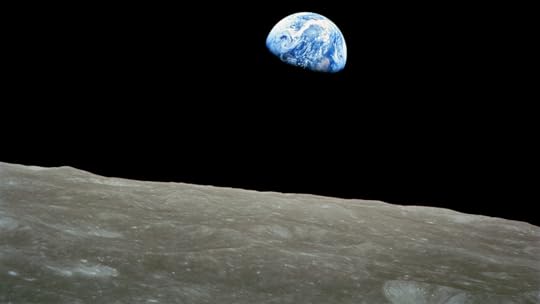
The first half of the book follows the events leading up to the launch of Apollo 8. It particularly follows the biography Frank Borman, the mission leader, and the general progress of the space program. The second half was the mission itself. This was the first time human eye saw the whole earth as a sphere. It was the first time eyes saw the far side of the moon. Crewman Bill Anders took the famous photo “Earthrise” on this mission:
The writing really drew me in for the most part. I really felt like I was there. I got teary reading about Apollo 1 despite knowing everything about it already; I could feel the g forces experienced during reentry; I felt the sense of wonder throughout.
The first half of the book follows the events leading up to the launch of Apollo 8. It particularly follows the biography Frank Borman, the mission leader, and the general progress of the space program. The second half was the mission itself. This was the first time human eye saw the whole earth as a sphere. It was the first time eyes saw the far side of the moon. Crewman Bill Anders took the famous photo “Earthrise” on this mission:
The writing really drew me in for the most part. I really felt like I was there. I got teary reading about Apollo 1 despite knowing everything about it already; I could feel the g forces experienced during reentry; I felt the sense of wonder throughout.

December 21, 2018
Excellent story and masterfully told.
This is one the best constructed popular non-fiction books I have read. I felt that instead of simply reading a narrative, I was everywhere Borman, Lovell, and Anders were.
Kluger adeptly interweaved the story of the astronauts, their families, and NASA employees alongside pivotal events of the late 1960s: the Cold War, the Vietnam War, political and civil unrest, and of course, the moonshot.
Highly recommended for space exploration aficionados, history buffs, and general readers alike.
P.s., I'm thankful to have finished reading it on the eve of the 50th anniversary of the launch of Apollo 8 (Dec 21, 1968)!
This is one the best constructed popular non-fiction books I have read. I felt that instead of simply reading a narrative, I was everywhere Borman, Lovell, and Anders were.
Kluger adeptly interweaved the story of the astronauts, their families, and NASA employees alongside pivotal events of the late 1960s: the Cold War, the Vietnam War, political and civil unrest, and of course, the moonshot.
Highly recommended for space exploration aficionados, history buffs, and general readers alike.
P.s., I'm thankful to have finished reading it on the eve of the 50th anniversary of the launch of Apollo 8 (Dec 21, 1968)!

November 3, 2017
This story was amazing! Although many of us know much about Apollo 11 and 13, I'd wager few could tell you what Apollo 8 was all about. In many respects it was the most daring and thrilling of them all. First humans to go to the moon, first to lay eyes on its backside, first to see the "earthrise" as they came around the vast grey darkness to gaze upon the gorgeous blue planet rising upon the moon's horizon. 230 thousand miles from home. Words can't really describe.....but Apollo 8: The Thrilling Story does a good job trying!

April 2, 2017
Outstanding. If you read this be sure to go online and watch the liftoff of Apollo 8 and the coverage of the mission. A great bit of history.

July 22, 2025
Informative. Engaging. Inspiring.
“Round the moon and back…”
Apollo 8
Mission Type: Lunar Landing Preparation
Crew: Frank Borman, James Lovell Jr., William Anders
Launch: Dec. 21, 1968
Splashdown: Dec. 27, 1968
This is a very insightful book about how we made it to the Moon by the end of the 1960s. It provides valuable background on the early space program, including the experiences of the Mercury missions in low Earth orbit and the Gemini program, which astronauts Frank Borman and Jim Lovell were part of before the Apollo 8 mission. Each program pushed humanity farther from Earth, building toward that historic achievement.
This mission is also known for the iconic “Earthrise” photograph taken by William Anders.
We’ve come a long way since the beginning of the space program, and it’s exciting to think about what lies ahead.
———————————————
Here’s a bonus content for my review. It’s not much but as a veteran, I really loved this part.
During the first rendezvous flight where Gemini 7 and 6 (yes, it’s in that order because of when they lifted off) were orbiting around each other, there was a playful moment between the two crews. It’s an “inside joke” with the military involving the Commander-in-Chief’s Trophy that dates back to 1972. The Commander-in-Chief’s Trophy is awarded to each season’s winner of the US collegiate football series but it can only be awarded to one of the three military academies; Army, Navy, and Air Force. After Gemini 6 completed another pirouette around Gemini 7, the right-hand window of Gemini 6 was covered with a sign. Wally Schirra had smuggled aboard a piece of blue cardboard bearing bright white letters that read, BEAT ARMY. When one of the academies play another academy there’s a saying that is used that ’s become so popular. If you’re a fan of the Air Force, you would say “GO AIR FORCE, BEAT NAVY” or ARMY. Borman was Army. Lovell, Schirra, & Thomas Stafford were all Navy so he was outnumbered on this one.
———————————————
Quotes to remember from the book:
“But death was always a part of the piloting calculus, and this time would be no different.”
“Our rockets can fly from place to place, but only the mind of man can cross the new frontiers of space.” - Lyndon B. Johnson
“There was the ongoing problem of how a man preserves his last scrap of privacy—to say nothing of dignity—in a spacecraft with no proper toilet facilities. Urinating in space was not a problem, and the doctors, it turned out, had decided that they would need only occasional samples. This meant the men could usually relieve themselves into a tube and then vent it through a small port on the exterior of the spacecraft, where it would instantly burst into a shower of glittery crystals, a phenomenon Wally Schirra had dubbed the constellation Urion."
“Round the moon and back…”
Apollo 8
Mission Type: Lunar Landing Preparation
Crew: Frank Borman, James Lovell Jr., William Anders
Launch: Dec. 21, 1968
Splashdown: Dec. 27, 1968
This is a very insightful book about how we made it to the Moon by the end of the 1960s. It provides valuable background on the early space program, including the experiences of the Mercury missions in low Earth orbit and the Gemini program, which astronauts Frank Borman and Jim Lovell were part of before the Apollo 8 mission. Each program pushed humanity farther from Earth, building toward that historic achievement.
This mission is also known for the iconic “Earthrise” photograph taken by William Anders.
We’ve come a long way since the beginning of the space program, and it’s exciting to think about what lies ahead.
———————————————
Here’s a bonus content for my review. It’s not much but as a veteran, I really loved this part.
During the first rendezvous flight where Gemini 7 and 6 (yes, it’s in that order because of when they lifted off) were orbiting around each other, there was a playful moment between the two crews. It’s an “inside joke” with the military involving the Commander-in-Chief’s Trophy that dates back to 1972. The Commander-in-Chief’s Trophy is awarded to each season’s winner of the US collegiate football series but it can only be awarded to one of the three military academies; Army, Navy, and Air Force. After Gemini 6 completed another pirouette around Gemini 7, the right-hand window of Gemini 6 was covered with a sign. Wally Schirra had smuggled aboard a piece of blue cardboard bearing bright white letters that read, BEAT ARMY. When one of the academies play another academy there’s a saying that is used that ’s become so popular. If you’re a fan of the Air Force, you would say “GO AIR FORCE, BEAT NAVY” or ARMY. Borman was Army. Lovell, Schirra, & Thomas Stafford were all Navy so he was outnumbered on this one.
———————————————
Quotes to remember from the book:
“But death was always a part of the piloting calculus, and this time would be no different.”
“Our rockets can fly from place to place, but only the mind of man can cross the new frontiers of space.” - Lyndon B. Johnson
“There was the ongoing problem of how a man preserves his last scrap of privacy—to say nothing of dignity—in a spacecraft with no proper toilet facilities. Urinating in space was not a problem, and the doctors, it turned out, had decided that they would need only occasional samples. This meant the men could usually relieve themselves into a tube and then vent it through a small port on the exterior of the spacecraft, where it would instantly burst into a shower of glittery crystals, a phenomenon Wally Schirra had dubbed the constellation Urion."

June 2, 2024
This is probably one of three nonfiction books I've read my entire life and may I say, what a captivating story. I've always been a big big fan of the great unknown, and reading this story was a wonderful look into a world so far away. Phenomenal writing, if you're considering a read, do it!

March 13, 2024
If you are looking for a factual but still exciting book on the lesser known Apollo 8 mission, this book cannot be beat. Wished there was a little more technical information but that’s just the engineering nerd in me

March 20, 2018
Apollo 8: The Thrilling Story of the First Mission to the Moon is by Jeffrey Kluger, veteran reporter from Time magazine. This is his second book about the Apollo program. His earlier book was Lost Moon (aka Apollo 13), where he was co-writer with Apollo 13 commander Jim Lovell.
Lost Moon may be credited first to Lovell, but I believe Kluger was the primary writer of that book. No disrespect to Lovell, but the book has the hallmarks of a seasoned journalist. The writing is exceptional, and the mission is covered in appropriate detail in all phases. The epilogue study of the Apollo 13 accident is also one of the book's high points. Of all the many Apollo books I've read over the years, I consider it one of the best.
For many years, there was a woeful lack of serious coverage of Apollo 8, a mission I personally consider one of the greatest in history--possibly even more so than Apollo 11, the first human landing on the moon. Apollo 8 is only the second book devoted to the first human trip around the moon. I had read Robert Zimmerman's Genesis--the first book covering that mission--many years before. Genesis is very good in a number of ways, but it was also lacking in a number of ways, too. Zimmerman is earnest in his assessments of the historical significance of the mission, and drills down to a couple of reasonable conclusions. One of those conclusions follows a solid investigation of which Apollo 8 astronaut took the famous 'earthrise' photo, which has become one of the most significant photographs in history. Zimmerman also goes a bit overboard with his contextualizing, his comparison of cold war superpowers, and his justification of why the Apollo 8 crew read from the Book of Genesis.
Zimmerman's book is good--sometimes very good. But the writing is kind of pedestrian, and probably needed a stronger editor to refine the book's organization and develop parts that were left kind of thin. The storyline should have been more linear--for example, he opened the book with a description of launch day, which to me was a bit premature. Instead, the writing jumps around and digresses off-topic a bit too much. While Zimmerman's book was a welcome contribution to the history of this monumental but not-well-documented mission, it was also an invitation for a better writer to fill the empty spaces the author left.
For years, I lamented that none of the Apollo 8 astronauts seemed interested in taking on this opportunity. At one point, I sent an e-mail to the Lovell family through their restaurant in Chicago, asking that Mr. Lovell consider documenting this mission in a similar manner to Lost Moon. I was sent back a nice but noncommittal, generically signed note in return, perhaps wary that I might have been hinting at a collaboration (suffice it to say, it was not meant that way).
That was many years ago. Around the turn of 2017, Jeffrey Kluger, Lovell's collaborator on Lost Moon, tweeted that he was preparing to publish his own book about Apollo 8. Finally, this mission would have coverage from a professional journalist. I was thrilled, knowing that Kluger was probably the best writer for this task. I looked forward to its release date, and I picked up the new book soon after its publication.
This is a saved draft. Full review is pending.
Lost Moon may be credited first to Lovell, but I believe Kluger was the primary writer of that book. No disrespect to Lovell, but the book has the hallmarks of a seasoned journalist. The writing is exceptional, and the mission is covered in appropriate detail in all phases. The epilogue study of the Apollo 13 accident is also one of the book's high points. Of all the many Apollo books I've read over the years, I consider it one of the best.
For many years, there was a woeful lack of serious coverage of Apollo 8, a mission I personally consider one of the greatest in history--possibly even more so than Apollo 11, the first human landing on the moon. Apollo 8 is only the second book devoted to the first human trip around the moon. I had read Robert Zimmerman's Genesis--the first book covering that mission--many years before. Genesis is very good in a number of ways, but it was also lacking in a number of ways, too. Zimmerman is earnest in his assessments of the historical significance of the mission, and drills down to a couple of reasonable conclusions. One of those conclusions follows a solid investigation of which Apollo 8 astronaut took the famous 'earthrise' photo, which has become one of the most significant photographs in history. Zimmerman also goes a bit overboard with his contextualizing, his comparison of cold war superpowers, and his justification of why the Apollo 8 crew read from the Book of Genesis.
Zimmerman's book is good--sometimes very good. But the writing is kind of pedestrian, and probably needed a stronger editor to refine the book's organization and develop parts that were left kind of thin. The storyline should have been more linear--for example, he opened the book with a description of launch day, which to me was a bit premature. Instead, the writing jumps around and digresses off-topic a bit too much. While Zimmerman's book was a welcome contribution to the history of this monumental but not-well-documented mission, it was also an invitation for a better writer to fill the empty spaces the author left.
For years, I lamented that none of the Apollo 8 astronauts seemed interested in taking on this opportunity. At one point, I sent an e-mail to the Lovell family through their restaurant in Chicago, asking that Mr. Lovell consider documenting this mission in a similar manner to Lost Moon. I was sent back a nice but noncommittal, generically signed note in return, perhaps wary that I might have been hinting at a collaboration (suffice it to say, it was not meant that way).
That was many years ago. Around the turn of 2017, Jeffrey Kluger, Lovell's collaborator on Lost Moon, tweeted that he was preparing to publish his own book about Apollo 8. Finally, this mission would have coverage from a professional journalist. I was thrilled, knowing that Kluger was probably the best writer for this task. I looked forward to its release date, and I picked up the new book soon after its publication.
This is a saved draft. Full review is pending.

December 28, 2019
Переміститись до США, потрапити в 60-ті роки, у розпал Холодної війни та космічних перегонів, облетіти навколо Землі і, вирвавшись з її орбіти, попрямувати до Місяця...
⠀
Хочете?
⠀
Читайте книгу!
І ця вражаюча мандрівка полонить вашу уяву.
⠀
Перед тим як Ніл Армстронг лишив на Місяці відбиток своєї ступні, була ще одна місія: перша вилазка на Місячну орбіту.
⠀
Вперше в історії люди покинули орбіту Землі і здолали відстань більш ніж у 300 тисяч кілометрів, щоб побачити Місяць зблизька.
⠀
🔽Я не усвідомлювала, наскільки тісно це було пов'язано "холодним" протистоянням між США та СРСР, а цей контекст — ключовий тут.
⠀
🔽Я не знала про програму "Джеміні", яка перед польотами на Місяць випробовувала людину: виводила автронавтів на орбіту Землі і збирала інформацію про вплив космосу на організм.
⠀
🔽Я не знала про те, що під час підготовки програми "Апполон" в ході однієї місії стався нещасний випадок під час запуску, що спричинив загибель астронавтів.
⠀
Я стільки всього не знала!
І ця книга — захопливий мікс історії космічних досліджень, особистих історій астронавтів та документальних фактів.
⠀
Вона настільки жива, що іноді вам буде здаватися, що ви читаєте художній роман, але всі факти тут — реальні.
⠀
Автор працював з першоджерелами, архівами NASA, стенограмами, звідки брав діалоги для книги. А кольорова вкладка з фотографіями доповнює документальність видання.
⠀
Мені цікаво було все!
⠀
✨як злітає ракета
⠀
✨як тренують астронавтів
⠀
✨як керують польотом на Місяць із Землі, як почувають себе астронавти у космосі
⠀
✨які там виникають проблеми
⠀
✨як живуть дружини космонавтів
⠀
✨як триває кар'єра людини, котра потрапляє у космос
⠀
✨як розжарений космічний корабель прослизає крізь нашу атмосферу та падає у Тихий океан
⠀
І ще сотні деталей з роботи NASA та розвитку космічної програми.
⠀
Складно відірватись
від такого тексту!
⠀
Моє суперпозитивне враження від книги доповнює ще якість видання: читати таку книгу надзвичайно комфортно, її хочеться гортати, нюхати, пригортати до серця і... Перечитати.
⠀
Маствхев мої полиці і однозначний топ цього року!
⠀
Хочете?
⠀
Читайте книгу!
І ця вражаюча мандрівка полонить вашу уяву.
⠀
Перед тим як Ніл Армстронг лишив на Місяці відбиток своєї ступні, була ще одна місія: перша вилазка на Місячну орбіту.
⠀
Вперше в історії люди покинули орбіту Землі і здолали відстань більш ніж у 300 тисяч кілометрів, щоб побачити Місяць зблизька.
⠀
🔽Я не усвідомлювала, наскільки тісно це було пов'язано "холодним" протистоянням між США та СРСР, а цей контекст — ключовий тут.
⠀
🔽Я не знала про програму "Джеміні", яка перед польотами на Місяць випробовувала людину: виводила автронавтів на орбіту Землі і збирала інформацію про вплив космосу на організм.
⠀
🔽Я не знала про те, що під час підготовки програми "Апполон" в ході однієї місії стався нещасний випадок під час запуску, що спричинив загибель астронавтів.
⠀
Я стільки всього не знала!
І ця книга — захопливий мікс історії космічних досліджень, особистих історій астронавтів та документальних фактів.
⠀
Вона настільки жива, що іноді вам буде здаватися, що ви читаєте художній роман, але всі факти тут — реальні.
⠀
Автор працював з першоджерелами, архівами NASA, стенограмами, звідки брав діалоги для книги. А кольорова вкладка з фотографіями доповнює документальність видання.
⠀
Мені цікаво було все!
⠀
✨як злітає ракета
⠀
✨як тренують астронавтів
⠀
✨як керують польотом на Місяць із Землі, як почувають себе астронавти у космосі
⠀
✨які там виникають проблеми
⠀
✨як живуть дружини космонавтів
⠀
✨як триває кар'єра людини, котра потрапляє у космос
⠀
✨як розжарений космічний корабель прослизає крізь нашу атмосферу та падає у Тихий океан
⠀
І ще сотні деталей з роботи NASA та розвитку космічної програми.
⠀
Складно відірватись
від такого тексту!
⠀
Моє суперпозитивне враження від книги доповнює ще якість видання: читати таку книгу надзвичайно комфортно, її хочеться гортати, нюхати, пригортати до серця і... Перечитати.
⠀
Маствхев мої полиці і однозначний топ цього року!

July 17, 2017
Very engaging book about the early Apollo missions, focusing on Frank Borman, the commander of Apollo 8. I learned a lot about the missions - in many ways number 8 may have been as important as number 11. A must read for "space nerds".
September 20, 2019
What a journey! What an adventure! Absolutely Awe-inspiring and utterly remarkable. First men of the moon! ❤

July 25, 2021
This was a real page-turner, a feel-good look back at the days when US White Men Did Heroic Things. Well written with just the right amount of background information, Kluger's book is indeed a thrilling read. Yet the larger context is missing. While Kluger occasionally mentions civil rights protests and the American war in Vietnam, his look at the space race does not question for a moment the environmental, social, and geopolitical price this country paid for its achievements. I know I am idealistic to imagine there was an alternative to the Cold Warrior mentality that guided NASA, but we have too little earth left to burn 20 tons of kerosene and hydrogen fuel per second in such endeavors. Even as I enjoyed the book, I kept thinking of that Gil Scott Heron poem, "Whitey on the Moon."
Displaying 1 - 30 of 809 reviews