What do you think?
Rate this book


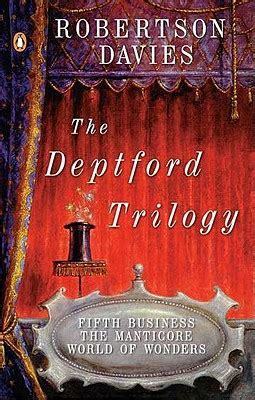
All three books in Robertson Davies’s darkly witty Cornish Trilogy collected in one volume. The destinies of this remarkable cast of characters come together in The Rebel Angels, What’s Bred in the Bone, and The Lyre of Orpheus.
The Rebel Angels. Set in motion by the death of eccentric art patron and collector Francis Cornish, a goodhearted priest and scholar, a professor with a passion for the darker side of medieval psychology, a defrocked monk, and a rich young businessman who inherits some troublesome paintings are all helplessly beguiled by the same coed.
What’s Bred in the Bone. This worthy follow-up goes back to Cornish’s humble beginnings in a spellbinding tale of artistic triumph and heroic deceit. It is a tale told in stylish, elegant prose, endowed with lavish portions of Davies’ wit and wisdom.
The Lyre of Orpheus. The Cornish Foundation is thriving under the directorship of Arthur Cornish when Arthur and his beguiling wife decide to undertake a project worthy of Francis Cornish. Hulda Schnakenburg is commissioned to complete E.T.A. Hoffmann’s unfinished opera Arthur of Britain, or The Magnanimous Cuckold; and the scholarly priest Simon Darcourt finds himself charged with writing the libretto.
1146 pages, Kindle Edition
First published January 1, 1991
The Rebel Angels ***So all in all, rather a good innings for the last of Davies' three trilogies, though personally I have a real soft spot for the first one, the "Salterton Trilogy".
What's Bred in the Bone***** (one of his VERY best!)
The Lyre of Orpheus****
‘Be not another, if you can be yourself.’ — Epigram by Paracelsus.Consisting of three related titles – The Rebel Angels (1981), What’s Bred in the Bone (1985), and The Lyre of Orpheus (1988) – the Cornish trilogy joined two other completed series from Robertson Davies. Preceded by the Salterton and Deptford titles, the Cornish series similarly presents three narratives, each of which could theoretically work as a standalone but which work best if read in order.
The Rebel Angels
Robertson Davies’ The Rebel Angels is an engaging and energetic novel with a vigorous sense of humor. The novel reads quickly and never feels weighed down by ideas or seriousness. This is deceptive.
[return][return]Davies gives us a novel populated by Medieval and Renaissance scholars. Their intellectual landscape is thus not unnaturally populated by Paracelsus and Rabelais, two constant figures in the dialectic of the novel. Of the two, Rabelais seems the most significant. He is a figure frequently claimed by both sides of the numerous arguments in the novel. He provides a lens through which we see into the characters a bit more deeply than they might hope. Parlabane and McVarish make him a model of vulgarity and misogyny, or perhaps more accurately, misanthropy. To Hollier, he represents an object for his own academic ambition. For Maria and Darcourt—and Davies—he is a model of the best sort of scholar, as we hear from Maria:
[return][return][return]Rabelais was gloriously learned because learning amused him, and so far as I am concerned that is learning’s best justification. Not the only one, but the best.
[return]
It may be wrong to include Darcourt here—as a priest scholar, his greater reference is St. Augustine:
[return][return][return]Conloqui et conridere et vicissim benevole obsequi, simul leger libros dulciloquos, simul nugari et simul honestari.
[return]
In Maria’s translation:
[return][return][return][return]Conversations and jokes together, mutual rendering of good services, the reading together of sweetly phrased books, the sharing of nonsense and mutual attentions.
[return]
This erudite amusement is a hallmark of everything I have yet read by Davies, and it is tempting to think that the best part of what Davies gives us in this novel is Davies, himself. Davies is more wise than a mere intellectual, and more alive than a modernist. He brings with him the Middle Ages and the Renaissance, and with these life fuller than which we are accustomed today.
[return][return]What we get from Davies is not a hair shirted historicism, but a sense of wholeness for a consciousness which is fermented in the broadness of human experience. Maria says of Hollier that he studies the Middle Ages because they are truly middle—a vantage from which he can look backward to antiquity, and forward to our post-Renaissance present. This dynamic of looking backward and forward, contrasting each with the other, is at the very heart of The Rebel Angels, a book which makes attractive Paracelsus’ “second paradise.”
[return][return][return]The striving for wisdom is the second paradise of the world.
[return]
What's Bred In The Bone
[return][return]to follow...
[return][return]The Lyre Of Orpheus
[return][return]to follow...