

What do you think?

Master Humphrey's Clock
A lonely old man in early nineteenth-century London hits upon the idea of inviting acquaintances over to read their manuscripts together. The friends gather one night a week between 10 p.m. and 2 a.m., and with the formation of their fictional literary club, Charles Dickens launched Master Humphrey's Clock, a weekly periodical that he published from 1840 to 1841.
Recounted with the author's customary flair for humor and pathos, the tales range from the confessions of a child murderer and an account of a rebel's secret burial to lighthearted exchanges between a pair of talking statues. This collection marked Dickens' establishment of characters from his forthcoming novels The Old Curiosity Shop and Barnaby Rudge. He also reintroduced popular personalities from The Pickwick Papers, adding Mr. Pickwick, Sam Weller, and Mr. Weller to the narrators. Generations of readers have delighted in the warmth and humanity of these lesser-known tales by a master storyteller.
Recounted with the author's customary flair for humor and pathos, the tales range from the confessions of a child murderer and an account of a rebel's secret burial to lighthearted exchanges between a pair of talking statues. This collection marked Dickens' establishment of characters from his forthcoming novels The Old Curiosity Shop and Barnaby Rudge. He also reintroduced popular personalities from The Pickwick Papers, adding Mr. Pickwick, Sam Weller, and Mr. Weller to the narrators. Generations of readers have delighted in the warmth and humanity of these lesser-known tales by a master storyteller.
128 pages, Paperback
First published January 1, 1841
About the author
Charles Dickens
13.4k books32.3k followersCharles John Huffam Dickens (1812-1870) was a writer and social critic who created some of the world's best-known fictional characters and is regarded as the greatest novelist of the Victorian era. His works enjoyed unprecedented popularity during his lifetime, and by the twentieth century critics and scholars had recognised him as a literary genius. His novels and short stories enjoy lasting popularity.
Dickens left school to work in a factory when his father was incarcerated in a debtors' prison. Despite his lack of formal education, he edited a weekly journal for 20 years, wrote 15 novels, five novellas, hundreds of short stories and non-fiction articles, lectured and performed extensively, was an indefatigable letter writer, and campaigned vigorously for children's rights, education, and other social reforms.
Dickens was regarded as the literary colossus of his age. His 1843 novella, A Christmas Carol, remains popular and continues to inspire adaptations in every artistic genre. Oliver Twist and Great Expectations are also frequently adapted, and, like many of his novels, evoke images of early Victorian London. His 1859 novel, A Tale of Two Cities, set in London and Paris, is his best-known work of historical fiction. Dickens's creative genius has been praised by fellow writers—from Leo Tolstoy to George Orwell and G. K. Chesterton—for its realism, comedy, prose style, unique characterisations, and social criticism. On the other hand, Oscar Wilde, Henry James, and Virginia Woolf complained of a lack of psychological depth, loose writing, and a vein of saccharine sentimentalism. The term Dickensian is used to describe something that is reminiscent of Dickens and his writings, such as poor social conditions or comically repulsive characters.
On 8 June 1870, Dickens suffered another stroke at his home after a full day's work on Edwin Drood. He never regained consciousness, and the next day he died at Gad's Hill Place. Contrary to his wish to be buried at Rochester Cathedral "in an inexpensive, unostentatious, and strictly private manner," he was laid to rest in the Poets' Corner of Westminster Abbey. A printed epitaph circulated at the time of the funeral reads: "To the Memory of Charles Dickens (England's most popular author) who died at his residence, Higham, near Rochester, Kent, 9 June 1870, aged 58 years. He was a sympathiser with the poor, the suffering, and the oppressed; and by his death, one of England's greatest writers is lost to the world." His last words were: "On the ground", in response to his sister-in-law Georgina's request that he lie down.
(from Wikipedia)
Dickens left school to work in a factory when his father was incarcerated in a debtors' prison. Despite his lack of formal education, he edited a weekly journal for 20 years, wrote 15 novels, five novellas, hundreds of short stories and non-fiction articles, lectured and performed extensively, was an indefatigable letter writer, and campaigned vigorously for children's rights, education, and other social reforms.
Dickens was regarded as the literary colossus of his age. His 1843 novella, A Christmas Carol, remains popular and continues to inspire adaptations in every artistic genre. Oliver Twist and Great Expectations are also frequently adapted, and, like many of his novels, evoke images of early Victorian London. His 1859 novel, A Tale of Two Cities, set in London and Paris, is his best-known work of historical fiction. Dickens's creative genius has been praised by fellow writers—from Leo Tolstoy to George Orwell and G. K. Chesterton—for its realism, comedy, prose style, unique characterisations, and social criticism. On the other hand, Oscar Wilde, Henry James, and Virginia Woolf complained of a lack of psychological depth, loose writing, and a vein of saccharine sentimentalism. The term Dickensian is used to describe something that is reminiscent of Dickens and his writings, such as poor social conditions or comically repulsive characters.
On 8 June 1870, Dickens suffered another stroke at his home after a full day's work on Edwin Drood. He never regained consciousness, and the next day he died at Gad's Hill Place. Contrary to his wish to be buried at Rochester Cathedral "in an inexpensive, unostentatious, and strictly private manner," he was laid to rest in the Poets' Corner of Westminster Abbey. A printed epitaph circulated at the time of the funeral reads: "To the Memory of Charles Dickens (England's most popular author) who died at his residence, Higham, near Rochester, Kent, 9 June 1870, aged 58 years. He was a sympathiser with the poor, the suffering, and the oppressed; and by his death, one of England's greatest writers is lost to the world." His last words were: "On the ground", in response to his sister-in-law Georgina's request that he lie down.
(from Wikipedia)
Ratings & Reviews
Friends & Following
Create a free account to discover what your friends think of this book!
Community Reviews
Displaying 1 - 30 of 52 reviews

November 29, 2019
“WHERE THERE IS CARRION, THERE THE CROWS WILL GATHER.”
There are many times in my recent life, after the crows have once again picked my bones clean, that I’ve turned to this beautiful old book for relief:
And from it drawn a semi-sacred solace.
Wonderful comfort from this Victorian author (especially in the sentence from this book that graces its title) in faith, shared with Tennyson...
And yet we hope that good
Will be the final result of ill!
For it has been In Real Love Incarnate that I have, through Dickens’ amazingly vivid stories, found my refuge and my strength. He Himself is the author of my lead-in epigraph, and also Dickens’ own refuge and strength throughout his own far-too-stormy life.
So it was for me in 2005...
Crushed and dismembered among the cinders of my workplace burnout, I could see not a single live coal with which to find warmth.
Until I picked up this book...
Where I got it, heaven knows - as heaven also knows what angelic aid was involved in quietly secreting this 19th century livre à poche in my library. And more accurately, perhaps, in truth, that angel was my eternal soulmate and own ange gardienne, my wife, from one of her trips to Value Village!
Anyway, fascinated by its unwonted place among my books, I took it down and started reading it - its soft leather cover comforting to my cold (it was midwinter) fingertips.
Ah, what a story!
For Master Humphrey - in every respect my doppelgänger - is an old, worn out, disabled reject of a codger who, for a reason you will discover when you read this delightful book, keeps a collection of close friends’ (of which Mr Pickwick is my fave) books hidden away in his dusty old grandfather clock.
Every reading of a story (you have to imagine disabled Mr. Humphrey reading aloud to them) comprises a section of this marvellously inventive gushing Stream of Stories, like the Water of the Spirit gurgling out of this old man’s hidden - and very, very happy - heart.
These stories will Fascinate you! The song they will awaken in you is just like the song of the robin who serenaded our quiet street at sunset in warmer weather, as I lingered this summer on the porch with my e-reader in the dim spring sunlight before locking up...
A song like the saviour who rescues us from the Promethean dismembering of those pesky crows.
And if you, like AW Tozer, Master Humphrey and myself have had the temerity to Talk Back to the Devil throughout your long, hard life - And have not only been eaten by, but have eaten Crow for your reward -
The sheer grace of this book will give you an eternal Rainbow of Hope for your Pains...
The same glad omen God Himself gave to Noah.
There are many times in my recent life, after the crows have once again picked my bones clean, that I’ve turned to this beautiful old book for relief:
And from it drawn a semi-sacred solace.
Wonderful comfort from this Victorian author (especially in the sentence from this book that graces its title) in faith, shared with Tennyson...
And yet we hope that good
Will be the final result of ill!
For it has been In Real Love Incarnate that I have, through Dickens’ amazingly vivid stories, found my refuge and my strength. He Himself is the author of my lead-in epigraph, and also Dickens’ own refuge and strength throughout his own far-too-stormy life.
So it was for me in 2005...
Crushed and dismembered among the cinders of my workplace burnout, I could see not a single live coal with which to find warmth.
Until I picked up this book...
Where I got it, heaven knows - as heaven also knows what angelic aid was involved in quietly secreting this 19th century livre à poche in my library. And more accurately, perhaps, in truth, that angel was my eternal soulmate and own ange gardienne, my wife, from one of her trips to Value Village!
Anyway, fascinated by its unwonted place among my books, I took it down and started reading it - its soft leather cover comforting to my cold (it was midwinter) fingertips.
Ah, what a story!
For Master Humphrey - in every respect my doppelgänger - is an old, worn out, disabled reject of a codger who, for a reason you will discover when you read this delightful book, keeps a collection of close friends’ (of which Mr Pickwick is my fave) books hidden away in his dusty old grandfather clock.
Every reading of a story (you have to imagine disabled Mr. Humphrey reading aloud to them) comprises a section of this marvellously inventive gushing Stream of Stories, like the Water of the Spirit gurgling out of this old man’s hidden - and very, very happy - heart.
These stories will Fascinate you! The song they will awaken in you is just like the song of the robin who serenaded our quiet street at sunset in warmer weather, as I lingered this summer on the porch with my e-reader in the dim spring sunlight before locking up...
A song like the saviour who rescues us from the Promethean dismembering of those pesky crows.
And if you, like AW Tozer, Master Humphrey and myself have had the temerity to Talk Back to the Devil throughout your long, hard life - And have not only been eaten by, but have eaten Crow for your reward -
The sheer grace of this book will give you an eternal Rainbow of Hope for your Pains...
The same glad omen God Himself gave to Noah.

February 9, 2024
I have the Obscure Reading group to thank for my discovery and reading of Master Humphrey’s Clock. Part of Dickens’ large collection of stories, this grouping is set around an older man who gathers friends, old and new, into what becomes a regular gathering to share stories. And they also share themselves. The clock in question is the receptacle for these stories and an important part of Master Humphrey’s home. The narrative voice is comfortable and pleasant as it introduces tales of fantasy, humor and some danger. Humphrey’s thoughts echo many of the social concerns raised by Dickens in his novels. A recommended addition for anyone who enjoys Dickens.

January 4, 2009
 https://www.gutenberg.org/ebooks/588
Opening: The reader must not expect to know where I live. At present, it is true, my abode may be a question of little or no import to anybody; but if I should carry my readers with me, as I hope to do, and there should spring up between them and me feelings of homely affection and regard attaching something of interest to matters ever so slightly connected with my fortunes or my speculations, even my place of residence might one day have a kind of charm for them. Bearing this possible contingency in mind, I wish them to understand, in the outset, that they must never expect to know it.

February 8, 2024
“We are men of secluded habits, with something of a cloud upon our early fortunes, whose enthusiasm, nevertheless, has not cooled with age, whose spirit of romance is not yet quenched, who are content to ramble through the world in a pleasant dream, rather than ever waken again to its harsh realities.”
An unusual and relatively obscure little Dickens gem.
Written as a weekly periodical, Dickens provides a frame story about Master Humphrey, the Deaf Gentleman, Mr. Pickwick and others, forming an interesting little group of friends who get together and read each other’s stories. In one, the giants Gog and Magog of Guildhall come alive to share yarns of their own. In another, we hear of a witch hunt that doesn’t go quite the way you might expect. And a third story allows us to eavesdrop on a similar group of friends swapping tales in Master Humphrey’s kitchen.
Two complete novels were also included in the original serial: The Old Curiosity Shop and Barnaby Rudge.
I’m a little confused about the trajectory. I believe Dickens published Master Humphrey including the two novels as a weekly periodical from 1840-1841, and then instead of publishing the book as a whole, decided to publish The Old Curiosity Shop by itself first, later putting out Master Humphrey's Clock as an introduction to Barnaby Rudge, all within a year or two.
So they’re at the same time together and separate, which is confusing but also mind-blowing, how much Dickens was capable of producing in such a short period of time!
This may be my favorite so far of the author’s lesser-known works. Storytelling, friendship, and aging are all given the Dickens touch, and my heart feels a little warmer after reading it.
An unusual and relatively obscure little Dickens gem.
Written as a weekly periodical, Dickens provides a frame story about Master Humphrey, the Deaf Gentleman, Mr. Pickwick and others, forming an interesting little group of friends who get together and read each other’s stories. In one, the giants Gog and Magog of Guildhall come alive to share yarns of their own. In another, we hear of a witch hunt that doesn’t go quite the way you might expect. And a third story allows us to eavesdrop on a similar group of friends swapping tales in Master Humphrey’s kitchen.
Two complete novels were also included in the original serial: The Old Curiosity Shop and Barnaby Rudge.
I’m a little confused about the trajectory. I believe Dickens published Master Humphrey including the two novels as a weekly periodical from 1840-1841, and then instead of publishing the book as a whole, decided to publish The Old Curiosity Shop by itself first, later putting out Master Humphrey's Clock as an introduction to Barnaby Rudge, all within a year or two.
So they’re at the same time together and separate, which is confusing but also mind-blowing, how much Dickens was capable of producing in such a short period of time!
This may be my favorite so far of the author’s lesser-known works. Storytelling, friendship, and aging are all given the Dickens touch, and my heart feels a little warmer after reading it.

July 27, 2019
Yet to come across anything Dickens that is unreadable or unlikeable. As always, the writing is of high quality, and the characters and stories are simple yet endearing (the murder story in the middle was like a landmine in a field full of tulips, though).
I take pleasure in the coincidence that I started reading this book when I was staying right next to St. Paul's, the tolling of whose bells is referred to in various pages.
Want to give this 3.5, don't want to give it 3, so I'll settle for 4.
I take pleasure in the coincidence that I started reading this book when I was staying right next to St. Paul's, the tolling of whose bells is referred to in various pages.
Want to give this 3.5, don't want to give it 3, so I'll settle for 4.

March 29, 2018
A collection of stories from a fictitious club of writers, including the hilarious Mr. Pickwick, who share various anecdotes and short stories amongst the members of the club. These lead into the serialized novels of "Ye Olde Curiosity Shop" and "Barnaby Rudge", serving as an introduction for fictional narrators of those stories.
Some of the anecdotes are creepy and ghostly, some are funny, some are historical. Some have tragic romance, or supernatural witches. Some are just lively tales of everyday life.
They are all certainly interesting and varied, but so disconnected and strangely unfinished that I couldn't really enjoy them.
Most of them don't have satisfactory endings, and I like a story to have a point to it. Why go through all that set-up and adventure and emotional drama if there's no reason, no point, no ending to the whole thing?
I'm not particularly impressed with the stories, although the writing is good.
Some of the anecdotes are creepy and ghostly, some are funny, some are historical. Some have tragic romance, or supernatural witches. Some are just lively tales of everyday life.
They are all certainly interesting and varied, but so disconnected and strangely unfinished that I couldn't really enjoy them.
Most of them don't have satisfactory endings, and I like a story to have a point to it. Why go through all that set-up and adventure and emotional drama if there's no reason, no point, no ending to the whole thing?
I'm not particularly impressed with the stories, although the writing is good.

August 31, 2012
Since The Mystery of Edwin Drood was only half a story, the volume that Ernie gave me at our last Gentlemen's Book Club included Master Humphrey's Clock at the back, I suppose as a kind of compensation.
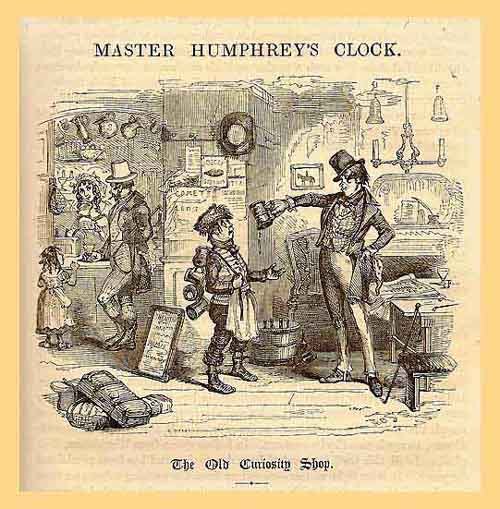
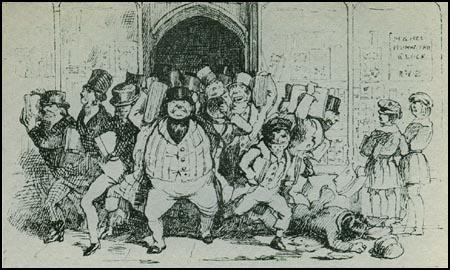
Dickens originally wrote it as a weekly periodical between April 1840 and December 1841. The illustrations, which I loved, were by George Cattermole and Hablot Browne, better known as Phiz.
Master Humphrey is a lonely, crippled old man who lives in London. He keeps manuscripts in an antique clock by the chimney. He decides to start a little club, Master Humphrey's Clock, at which the members — eventually six in total, including Mr Pickwick — would write and read out their manuscripts to the others. A mirror club in the kitchen, Mr. Weller's Watch, includes Master Humphrey's maid, the barber, and Sam Weller. The collection serves also as an introduction to The Old Curiosity Shop and Barnaby Rudge.
I can hardly express how my admiration of Dickens's writing has grown since embarking on my stuttering journey through his works. It's early days, and perhaps some disappointment yet awaits me, but I am already convinced of the man's genius.
As one may expect in a series of short anecdotes there is no central theme, nor one storyline apart from those of the little club itself, but allow me to make some observations, not only about the work but about Dickens himself.
The first concerns Master Humphrey's self-introduction. This isn't the first time I've noticed Dickens use ugliness or deformity to embody goodness. Master Humphrey explains that he lives alone, that he is old and crippled, that he has never married or had children, but that he has nevertheless no bitterness and no enemies. Indeed, he spends time elaborating how people treat him with some suspicion at first and how, bit by bit, he gains their trust through kindness and a smile.
But it is his story of how he dealt with all these things as a small child that touched me. In one remembrance he is with a group of other children at his mother's house, possibly at a birthday party, admiring a picture of a group of 'infant angels'.
There were many lovely angels in this picture and I remember the fancy coming upon me to point out which of them represented each child there, and that when I had gone through my companions, I stopped and hesitated, wondering which was most like me. I remember the children looking at each other, and my turning red and hot, and their crowding round to kiss me, saying that they loved me all the same; and then, and when the old sorrow came into my dear mother's mild and tender look, the truth broke upon me for the first time, and I knew, while watching my awkward and ungainly sports, how keenly she had felt for her poor crippled boy.
Of course, not all good people are ugly and not all bad people are handsome, but I am reminded nonetheless of my previous comments about Dickens's love of caricature. In this instance he makes a strong case, yet again, for judging a man by a his deeds rather than by his outward appearance. I shall come back to this thought momentarily.
Another observation concerns Dickens's sense of humour. It is indirect and gentle. It is always present, especially in his dialogue, ready to surprise me. While reading I smile constantly.
Take the example of Mr Weller, a corpulent old man. He has a strange way of speaking, being a commoner among toffs whom he tries hard to emulate with limited success. He mixes up his v's and w's, for example, and occasionally inserts a superfluous syllable into some of his larger words.
He also imagines that Master Humphrey's housemaid has taken a liking to him as, in his vast experience of such things, women are often wont to do. He knows not why he is so irresistible, but there it is. He warns his son, whom he calls 'Samivel', of the need for care in such circumstances. The last thing he needs, he declares, is 'inadwertant captiwation'.
This is not a laughing-out-loud comedy, nor is it pointing fingers, mocking, or even direct. It is the slightest raising of the eyebrow and the faintest broadening of the mouth's corner, ever so gentle, ever so pleasant. It's as if, while writing, Dickens looks unremittingly for the fun. This is refreshing.
Occasionally, however, he loses his sense of the comic completely. It is rare, so to quote an example I need, with your indulgence, to take you back to The Mystery of Edwin Drood. Mr Honeythunder — yet another wonderful caricature with a marvellously apt name — is the president of the Society of Philanthropy, an organization with values supposedly held high, but falling short of them. Dickens reserves some particularly choice words for him.
Always something in the nature of a Boil upon the face of society, Mr Honeythunder expanded into an inflammatory Wen in Minor Canon Corner. Though it was not literally true, as was facetiously charged against him by public unbelievers, that he called aloud to his fellow-creatures: 'Curse your souls and bodies, come here and be blessed!' still his philanthropy was of that gunpowderous sort that the difference between it and animosity was hard to determine. You were to abolish military force, but you were first to bring all commanding officers who had done their duty, to trial by court-martial for that offence, and shoot them. You were to abolish war, but were to make converts by making war upon them, and charging them with loving war as the apple of their eye. You were to have no capital punishment, but were first to sweep off the face of the earth all legislators, jurists, and judges, who were of the contrary opinion. You were to have universal concord, and were to get it by eliminating all the people who wouldn't, or conscientiously couldn't, be concordant. You were to love your brother as yourself, but after an indefinite interval of maligning him (very much as if you hated him), and calling him all manner of names.
Dickens was a Christian. He gave a copy of the New Testament to each of his children when they left home and he wrote a volume, published posthumously, about the life of Jesus. However, he had no truck with the Old Testament nor with the ideas of the Virgin Birth or Communion. To him, the dogma, bigotry, doctrine, and rabid religiosity of established Christianity were not Christian at all; they were hypocritical, self-serving, and, above all, un-English. Mr Honeythunder epitomized the enemy and Dickens used him to spell out the perils of righteousness.
Rather, Dickens's Christianity focused on good works and on the example of Jesus in this respect. A more unchristian book than the Old Testament and a more humourless god than Jehovah would be hard to find. Dickens, being fond of both kindness and a smile, can be forgiven for dismissing both. The meek must not only inherit the earth; they must also be bequeathed a sense of humour.
Master Humphrey dies, quietly, dignified, happy, sitting next to his fire with his walking-stick next to him. His clock is allowed to wind down, his fire goes cold, while the great machinery of St Paul's Cathedral's clock never stops. The metaphor is unmissable.
Recollections of the past and visions of the present come to bear me company; the meanest man to whom I have ever given alms appears, to add his mite of peace and comfort to my stock; and whenever the fire within me shall grow cold, to light my path upon this earth no more, I pray that it may be at such an hour as this, and when I love the world as well as I do now.
Master Humphrey's Clock is a little masterpiece, and I loved it. More especially, I have learned to appreciate the peacefulness, goodness, and inherent kindness of Dickens, while I have received at his hand something of the art of not destroying but recognizing and treating their opposites with restrained disdain. Read it.
Dickens originally wrote it as a weekly periodical between April 1840 and December 1841. The illustrations, which I loved, were by George Cattermole and Hablot Browne, better known as Phiz.
Master Humphrey is a lonely, crippled old man who lives in London. He keeps manuscripts in an antique clock by the chimney. He decides to start a little club, Master Humphrey's Clock, at which the members — eventually six in total, including Mr Pickwick — would write and read out their manuscripts to the others. A mirror club in the kitchen, Mr. Weller's Watch, includes Master Humphrey's maid, the barber, and Sam Weller. The collection serves also as an introduction to The Old Curiosity Shop and Barnaby Rudge.
I can hardly express how my admiration of Dickens's writing has grown since embarking on my stuttering journey through his works. It's early days, and perhaps some disappointment yet awaits me, but I am already convinced of the man's genius.
As one may expect in a series of short anecdotes there is no central theme, nor one storyline apart from those of the little club itself, but allow me to make some observations, not only about the work but about Dickens himself.
The first concerns Master Humphrey's self-introduction. This isn't the first time I've noticed Dickens use ugliness or deformity to embody goodness. Master Humphrey explains that he lives alone, that he is old and crippled, that he has never married or had children, but that he has nevertheless no bitterness and no enemies. Indeed, he spends time elaborating how people treat him with some suspicion at first and how, bit by bit, he gains their trust through kindness and a smile.
But it is his story of how he dealt with all these things as a small child that touched me. In one remembrance he is with a group of other children at his mother's house, possibly at a birthday party, admiring a picture of a group of 'infant angels'.
There were many lovely angels in this picture and I remember the fancy coming upon me to point out which of them represented each child there, and that when I had gone through my companions, I stopped and hesitated, wondering which was most like me. I remember the children looking at each other, and my turning red and hot, and their crowding round to kiss me, saying that they loved me all the same; and then, and when the old sorrow came into my dear mother's mild and tender look, the truth broke upon me for the first time, and I knew, while watching my awkward and ungainly sports, how keenly she had felt for her poor crippled boy.
Of course, not all good people are ugly and not all bad people are handsome, but I am reminded nonetheless of my previous comments about Dickens's love of caricature. In this instance he makes a strong case, yet again, for judging a man by a his deeds rather than by his outward appearance. I shall come back to this thought momentarily.
Another observation concerns Dickens's sense of humour. It is indirect and gentle. It is always present, especially in his dialogue, ready to surprise me. While reading I smile constantly.
Take the example of Mr Weller, a corpulent old man. He has a strange way of speaking, being a commoner among toffs whom he tries hard to emulate with limited success. He mixes up his v's and w's, for example, and occasionally inserts a superfluous syllable into some of his larger words.
He also imagines that Master Humphrey's housemaid has taken a liking to him as, in his vast experience of such things, women are often wont to do. He knows not why he is so irresistible, but there it is. He warns his son, whom he calls 'Samivel', of the need for care in such circumstances. The last thing he needs, he declares, is 'inadwertant captiwation'.
This is not a laughing-out-loud comedy, nor is it pointing fingers, mocking, or even direct. It is the slightest raising of the eyebrow and the faintest broadening of the mouth's corner, ever so gentle, ever so pleasant. It's as if, while writing, Dickens looks unremittingly for the fun. This is refreshing.
Occasionally, however, he loses his sense of the comic completely. It is rare, so to quote an example I need, with your indulgence, to take you back to The Mystery of Edwin Drood. Mr Honeythunder — yet another wonderful caricature with a marvellously apt name — is the president of the Society of Philanthropy, an organization with values supposedly held high, but falling short of them. Dickens reserves some particularly choice words for him.
Always something in the nature of a Boil upon the face of society, Mr Honeythunder expanded into an inflammatory Wen in Minor Canon Corner. Though it was not literally true, as was facetiously charged against him by public unbelievers, that he called aloud to his fellow-creatures: 'Curse your souls and bodies, come here and be blessed!' still his philanthropy was of that gunpowderous sort that the difference between it and animosity was hard to determine. You were to abolish military force, but you were first to bring all commanding officers who had done their duty, to trial by court-martial for that offence, and shoot them. You were to abolish war, but were to make converts by making war upon them, and charging them with loving war as the apple of their eye. You were to have no capital punishment, but were first to sweep off the face of the earth all legislators, jurists, and judges, who were of the contrary opinion. You were to have universal concord, and were to get it by eliminating all the people who wouldn't, or conscientiously couldn't, be concordant. You were to love your brother as yourself, but after an indefinite interval of maligning him (very much as if you hated him), and calling him all manner of names.
Dickens was a Christian. He gave a copy of the New Testament to each of his children when they left home and he wrote a volume, published posthumously, about the life of Jesus. However, he had no truck with the Old Testament nor with the ideas of the Virgin Birth or Communion. To him, the dogma, bigotry, doctrine, and rabid religiosity of established Christianity were not Christian at all; they were hypocritical, self-serving, and, above all, un-English. Mr Honeythunder epitomized the enemy and Dickens used him to spell out the perils of righteousness.
Rather, Dickens's Christianity focused on good works and on the example of Jesus in this respect. A more unchristian book than the Old Testament and a more humourless god than Jehovah would be hard to find. Dickens, being fond of both kindness and a smile, can be forgiven for dismissing both. The meek must not only inherit the earth; they must also be bequeathed a sense of humour.
Master Humphrey dies, quietly, dignified, happy, sitting next to his fire with his walking-stick next to him. His clock is allowed to wind down, his fire goes cold, while the great machinery of St Paul's Cathedral's clock never stops. The metaphor is unmissable.
Recollections of the past and visions of the present come to bear me company; the meanest man to whom I have ever given alms appears, to add his mite of peace and comfort to my stock; and whenever the fire within me shall grow cold, to light my path upon this earth no more, I pray that it may be at such an hour as this, and when I love the world as well as I do now.
Master Humphrey's Clock is a little masterpiece, and I loved it. More especially, I have learned to appreciate the peacefulness, goodness, and inherent kindness of Dickens, while I have received at his hand something of the art of not destroying but recognizing and treating their opposites with restrained disdain. Read it.
January 19, 2022
This was a gorgeous short novel from which a multitude of charming characters (each with their own fantastical life stories) pours forth.
Their tales (in an almost Chaucerian manner) range from the sinister, to the romantic, to the adventurous.
I also had the pleasure of reading the ending to a learned crow I encountered on my afternoon walk. We both solemnly agreed the work to be great show of delicate skill on Mr Dickens' part.
Their tales (in an almost Chaucerian manner) range from the sinister, to the romantic, to the adventurous.
I also had the pleasure of reading the ending to a learned crow I encountered on my afternoon walk. We both solemnly agreed the work to be great show of delicate skill on Mr Dickens' part.

June 24, 2020
“We are men of secluded habits, with something of a cloud upon our early fortunes, whose enthusiasm, nevertheless, has not cooled with age, whose spirit of romance is not yet quenched, who are content to ramble through the world in a pleasant dream, rather than ever waken again to its harsh realities…. Spirits of past times, creatures of imagination, and people of to-day are alike the objects of our seeking, and, unlike the objects of search with most philosophers, we can insure their coming at our command.”
This isn’t really a book; it’s all there is of the ultimately abandoned project by Dickens to publish a weekly periodical, early in his career. The frame of Master Humphrey and his story-telling friends, were to hold a series of disparate short stories together. But things got out of hand as fans who know their Dickens history are aware. After a time, Dickens brought Master Humphrey’s Clock to an abrupt close. And that’s a pity, because this frame narrative is magic.
Dickens managed to make Master Humphrey and his friends so alive, I felt like they were in the room with me – or more accurately, I was in the room with them. Adding to the fun, in this world Mr. Pickwick is a real person, whom people know about from having read his published adventures. Partway through MHC, Mr. Pickwick becomes one of their group, whose habit it is to gather by the old Clock to share stories. (Note: Newcomers to MHC should read The Pickwick Papers first for full enjoyment.)
The inventiveness of this small story astounds me, just as Dickens’s creativity with language never stops astounding me. I enjoyed this one very much.

September 16, 2023
So happy it's over!
Noted down some annotations, however, I didn't like it.
Took me some time to finish it mainly because I got lost at the beginning and just couldn't get myself to understand it better.
Noted down some annotations, however, I didn't like it.
Took me some time to finish it mainly because I got lost at the beginning and just couldn't get myself to understand it better.

July 2, 2026
Not my favourite Dickens, but it is a classic example of the way he writes and devices he loves to use (story within a story within a story). I will have to look up when and where it was first written because it ties in mentions of the Old Curiosity Shop and Barnaby Rudge.

February 12, 2024
"The Master's Clock" is part of Charles Dickens' "The Pickwick Papers."
It was an enjoyable read.
It was an enjoyable read.

July 12, 2016
In April of 1840 Dickens began his own weekly periodical, Master Humphrey's Clock, using the set-up of a small circle of elderly gentlemen gathering around the grandfather clock at Humphrey's house once a week to share tales. The first such tale concerns the statues at London's Guildhall of the giants Gog and Magog, fabled protectors of London, coming alive at night to swap tales themselves to pass the time. Fairly amusing, I thought. Though this section is titled "First Night of the Giant Chronicles", Dickens never returned to the theme.
Other parts include Master Humphrey describing his life and how he gathered together his small circle, which includes some quality pathos; the centuries-old confession of a child murderer, middling; some correspondence received, briefly; the secret burial of an executed rebel, also middling; and the re-introduction from The Pickwick Papers fame of Mr. Pickwick, Sam Weller, and Mr. Weller, in which the Wellers create their own "downstairs" version of the storytelling society, in my opinion not successfully - they do not recapture their magic in this new setting and the whole attempt seems rather embarrassing.
Dickens seems to have thought all this not worth pursuing very far, as the serial first morphs into weekly installments of The Old Curiosity Shop, with interruptions of other material quickly fading, and then into Barnaby Rudge, with no interruptions at all. The whole conceit was then quickly wrapped up at the conclusion of Barnaby Rudge in November 1841, the pressure of a weekly serialization schedule cancelled, and Dickens went off to visit America and take a rest from publishing.
This "rating/review" is only for those parts of Master Humphrey's Clock exclusive of the two novels, which Dickens later wished to be considered independent of their origin.
Other parts include Master Humphrey describing his life and how he gathered together his small circle, which includes some quality pathos; the centuries-old confession of a child murderer, middling; some correspondence received, briefly; the secret burial of an executed rebel, also middling; and the re-introduction from The Pickwick Papers fame of Mr. Pickwick, Sam Weller, and Mr. Weller, in which the Wellers create their own "downstairs" version of the storytelling society, in my opinion not successfully - they do not recapture their magic in this new setting and the whole attempt seems rather embarrassing.
Dickens seems to have thought all this not worth pursuing very far, as the serial first morphs into weekly installments of The Old Curiosity Shop, with interruptions of other material quickly fading, and then into Barnaby Rudge, with no interruptions at all. The whole conceit was then quickly wrapped up at the conclusion of Barnaby Rudge in November 1841, the pressure of a weekly serialization schedule cancelled, and Dickens went off to visit America and take a rest from publishing.
This "rating/review" is only for those parts of Master Humphrey's Clock exclusive of the two novels, which Dickens later wished to be considered independent of their origin.

May 18, 2020
Please read alongside Old Curiosity Shop or it can get real confusing towards the end.

August 17, 2011
G.K. Chesterton's review says it all about Master Humphrey's Clock: "As a triumph of Dickens, at least, it is not of great importance. But as a sample of Dickens it happens to be of quite remarkable importance. The very fact that it is somewhat more level and even monotonous than most of his creations makes us realise, as it were, against what level and monotony those creations commonly stand out."
Originally a regular magazine written entirely by Charles Dickens, Master Humphrey's Clock uses an elderly gentleman named Master Humphrey as a frame for a number of stories. It starts out in the style of 1,001 Nights with stories within stories, which works reasonably well. But as Dickens worked, one of this "stories" turned into the full length novel The Old Curiosity Shop and another into Barnaby Rudge. As a result, reading Master Humphrey today (which omits these two novels) becomes increasingly too much frame relative to the stories.
Master Humphrey's Clock is also the only Dickens work where characters reappear from other works -- specifically Pickwick and some of his friends. The reappearance is much flatter than the original and might explain why Dickens did not go the route of Balzac in populating his novels with overlapping characters and incidents.
Originally a regular magazine written entirely by Charles Dickens, Master Humphrey's Clock uses an elderly gentleman named Master Humphrey as a frame for a number of stories. It starts out in the style of 1,001 Nights with stories within stories, which works reasonably well. But as Dickens worked, one of this "stories" turned into the full length novel The Old Curiosity Shop and another into Barnaby Rudge. As a result, reading Master Humphrey today (which omits these two novels) becomes increasingly too much frame relative to the stories.
Master Humphrey's Clock is also the only Dickens work where characters reappear from other works -- specifically Pickwick and some of his friends. The reappearance is much flatter than the original and might explain why Dickens did not go the route of Balzac in populating his novels with overlapping characters and incidents.

May 28, 2015
In 1840, Charles Dickens began to publish his own weekly paper in which he showcased his ongoing work to the public under the tightest of deadlines. He managed to pull this off for 80 consecutive weeks before he called it of, admitting that it was compromising the quality of his writing.
Master Humphrey's Clock was a venerable timepiece, a gentleman's society, and a publication dedicated to their 'histories and proceedings, our quiet speculations or more busy adventures'.
Master Humphrey himself is an aged cripple, his closest friend and fellow original member of the club is a similarly decrepit dead man. Perfect characters for Dicken's peculiar blend of the sorrowful and the sentimental.
That said, strip away the two novels that came to pad out the bulk of the content, Barnaby Rudge and The Old Curiosity Shop, you find yourself left with a porridge thin enough for even Oliver Twist to forego any request for a further helping.
As such it's a bitty amalgam of bookended stories, correspondence and insights into the society members, only really enlivened when Mr Pickwick joins, bringing Mr Weller and son with him, who briefly establish their own, rival club.
Nothing here is prime Dickens, but it's still as snuggly as a Victorian fireside.
Master Humphrey's Clock was a venerable timepiece, a gentleman's society, and a publication dedicated to their 'histories and proceedings, our quiet speculations or more busy adventures'.
Master Humphrey himself is an aged cripple, his closest friend and fellow original member of the club is a similarly decrepit dead man. Perfect characters for Dicken's peculiar blend of the sorrowful and the sentimental.
That said, strip away the two novels that came to pad out the bulk of the content, Barnaby Rudge and The Old Curiosity Shop, you find yourself left with a porridge thin enough for even Oliver Twist to forego any request for a further helping.
As such it's a bitty amalgam of bookended stories, correspondence and insights into the society members, only really enlivened when Mr Pickwick joins, bringing Mr Weller and son with him, who briefly establish their own, rival club.
Nothing here is prime Dickens, but it's still as snuggly as a Victorian fireside.
January 1, 2016
This was more of a framing device for a magazine of stories and novels than anything else. In what may be the earliest example of bringing back an old character to salvage a failing series, Dickens brings back Mr. Pickwick from the Pickwick Papers (much like DS9 adding TNG's Worf). It didn't work. Master Humphrey's Clock lasted just a year and a half.

March 22, 2017
An absolute delight.
January 10, 2025
This is not the edition I read - mine had 3 books in one, and Master Humphrey's Clock is the only book in that volume which I read, so I picked this one, since it had the same amount of pages as the one I read.
This is the book I read:
https://www.goodreads.com/book/show/6...
(I also hesitate to call this a classic, having never heard of it before, but since it is written by a classical author, I have labeled it as such.)
I really did not like this book - it seemed very disjointed, with random disconnected stories, that centered around a group of men that got together to share their writings, which were stored in the clock. It took me most of they way through the book, before I actually realised that. Some of the stories seemed pointless, and one was very evil - the murder of a child. Additionally, one of the men in the main story told of his little grandson immitating him drinking and being drunk, and told it with great hilarity and pride. In my opinion, both of these (the murder of a child, and the child imitating drinking and drunkenness) were of no literary worth or value.
I did enjoy some of Dicken's descriptions of people, descriptive and true-to-life, making me chuckle. And the final chapter of the book was a nice ending.
Overall, though, I would not read this again, nor recommend it.
This is the book I read:
https://www.goodreads.com/book/show/6...
(I also hesitate to call this a classic, having never heard of it before, but since it is written by a classical author, I have labeled it as such.)
I really did not like this book - it seemed very disjointed, with random disconnected stories, that centered around a group of men that got together to share their writings, which were stored in the clock. It took me most of they way through the book, before I actually realised that. Some of the stories seemed pointless, and one was very evil - the murder of a child. Additionally, one of the men in the main story told of his little grandson immitating him drinking and being drunk, and told it with great hilarity and pride. In my opinion, both of these (the murder of a child, and the child imitating drinking and drunkenness) were of no literary worth or value.
I did enjoy some of Dicken's descriptions of people, descriptive and true-to-life, making me chuckle. And the final chapter of the book was a nice ending.
Overall, though, I would not read this again, nor recommend it.

April 7, 2024
A collection of short stories embedded within a frame story in which an elderly Master Humphrey, sitting near his beloved grandfather clock as a fire glows and crackles in the background, reads the manuscripts that he and his friends have written for the purpose of entertaining one another. The stories shared range from fantasy to crime to witchcraft hysteria. While these tales were interesting, I enjoyed the larger story of Master Humphrey and his friends much more. My favorite chapters were the last two in which Master Humphrey ruminates on life and death, being alone vs. loneliness, and charity and acts of kindness. This charming book is filled with everything readers have come to expect of Dickens - enchantingly colorful and memorable characters, vivid descriptions, humor, tenderness, social commentary, and moral lessons. It is hard to believe Dickens was only 28-29 years old at the time it was conceived and written.
Note: The edition I read is the now-approved version, which excludes the novels ‘The Old Curiosity Shop‘ and ‘Barnaby Rudge’ that were originally published as part of Dickens’ weekly periodical ‘Master Humphrey’s Clock’ and whose storylines were once intertwined with the others. This abridgment may create confusion for readers and certainly left me feeling like something was missing. In hindsight, I may have preferred to read the original.
Note: The edition I read is the now-approved version, which excludes the novels ‘The Old Curiosity Shop‘ and ‘Barnaby Rudge’ that were originally published as part of Dickens’ weekly periodical ‘Master Humphrey’s Clock’ and whose storylines were once intertwined with the others. This abridgment may create confusion for readers and certainly left me feeling like something was missing. In hindsight, I may have preferred to read the original.

April 21, 2025
"Master Humphrey's Clock" was a periodical featuring recurring characters who wrote columns and gathered together to listen as Master Humphrey read aloud stories from a collection that he had received and kept in his clock. This format is somewhat reminiscent of "Mr. Pickwick’s Papers." Notably, Mr. Pickwick and his servant Sam Weller are among the members of this club. In addition to short stories, two novels—"The Old Curiosity Shop" and "Barnaby Rudge"—were published in serial format within the periodical. However, neither of these novels is included in the current collection, which consists mainly of columns and short stories. While there may not be significant literary merit in these pages, the stories can be entertaining. It was enjoyable to see Sam Weller and his father again, and one story even features one of Sam’s children. This illustrates how characters can continue to live on after their original tales have concluded. Overall, I wouldn’t highly recommend it to most, but it might appeal to Dickens purists.
April 22, 2025
Published in collected form in 1841 from the weekly periodical of the same name. The character Master Humphrey previously appeared in Dickens’ novel Barnaby Rudge, where he narrated the early chapters of the book and then disappeared at the whim of the mercurial author.
The tales are a callback to Dickens’s early fiction pieces collected as Sketches by Boz and his first long-form manuscript The Pickwick Papers. The illustrious Mr. Pickwick himself narrates the tales, along with his three faithful companions Master Humphrey, Jack Redburn and Owen Miles.
From the preface to the first volume: “…[Dickens] revived Mr. Pickwick and his humble friends, not with any intention of re-opening an exhausted and abandoned mine, but to connect them in the thoughts of those whose favourites they had been.”
Thank you to Project Gutenberg for making this rare volume available.
The tales are a callback to Dickens’s early fiction pieces collected as Sketches by Boz and his first long-form manuscript The Pickwick Papers. The illustrious Mr. Pickwick himself narrates the tales, along with his three faithful companions Master Humphrey, Jack Redburn and Owen Miles.
From the preface to the first volume: “…[Dickens] revived Mr. Pickwick and his humble friends, not with any intention of re-opening an exhausted and abandoned mine, but to connect them in the thoughts of those whose favourites they had been.”
Thank you to Project Gutenberg for making this rare volume available.
December 28, 2020
I love reading Dickens but this was my least favourite. There was no real plot or character development as it became ostensibly a series of short stories very loosely strung together. As soon as you invested in any particular element it was too late and therefore felt disjointed and harder than usual to get into the flow. It was fascinating to understand how two of his books were written within this framework, and this helps to understand how some themes here were never completed list as they were in other works.

September 8, 2020
This work was not written as a book, so it was a bit strange to read it as a stand-alone piece. Master Humphrey’s Clock was a weekly periodical whose installments revolved around Master Humphrey and his friends who met to share manuscripts. The Old Curiosity Shop and Barnaby Rudge were both serialized in the periodical, and this book contains the material that was interspersed around these two longer stories.
December 3, 2021
Apparently part of the intended narrative to Old Curiosity Shop, Barnaby Rudge etc. Some moments of brilliance, but the narrative or story line, like so many if Charles Dicken's books is hard to follow. "Hunted Down" is good, "Holiday Romance" a bit of fun but unremarkable, "George Silverman's Explanation" is superb, if only for the echo of Engels at the start talking about the miserable condition of poverty many had to contend with in the early 1800s.

April 23, 2022
Though as ever Charles Dickens creates interesting characters, there seem to me to be no central premise to this tale. Rather it is a vehicle for Dickens to try out several writing techniques and tinker with some sub-plots. Nevertheless there are a couple of touching moments: when Master Humphrey is accepted despite thought he seems strange to the people around him and when he imagines the family that might have been.

July 4, 2022
This book was actually printed as a serial in a newspaper before it became the book. Master Humphrey and several friends meet together in the room that contains his grandfather clock. He and these friends read to each other the stories they have written. The stories cover a variety of topics and do include a bit of romance, murder, and witchcraft. Mr. Pickwick, from another of Dicken's writings, shows up in this writing, too. The book is also connected with The Old Curiosity Shop.

December 8, 2023
3.5 stars. This is a framing device for a few short stories, The Old Curiosity Shop, and Barnaby Rudge. Now I want to read both of those novels, as well as Pickwick Papers (Pickwick enters into the story). I very much enjoyed this short work. It reminded me of how much I love to read Dickens. Just a warning, this isn’t a novel. There isn’t a lot of plot. It really is mainly a framing device.
The edition I read was just Master Humphrey’s Clock (minus Old Curiosity Shop and Barnaby Rudge).
The edition I read was just Master Humphrey’s Clock (minus Old Curiosity Shop and Barnaby Rudge).
June 7, 2025
Master Humphrey’s Clock is a framing narrative that Charles Dickens used in the serialized publications of The Old Curiosity Shop and Barnaby Rudge. I’m in the process of reading the former in serialized publication order beginning this past April 2025 and concluding in February 2026. These were originally published in novel format in 1840 in three parts and I am fortunate to own this set. A privilege to read this in the way the author intended.

November 19, 2025
Such a great storyteller, writing about a group of storytellers gathering together to tell stories. Very relaxing to read these a little at a time, I fitted them in around other books - like a sorbet between courses. It's been a very long time since I read any Dickens, & I'd like to read more, but there are just so many books & not enough lifetime.
Displaying 1 - 30 of 52 reviews