From an editor at the popular humor site Cracked.com and one of the writers of the bestselling You Might Be a Zombie and The De-Textbook, a rollicking look at vice throughout history, complete with instructions for re-creating debauchery at home.
Part history lesson, part how-to guide, A Brief History of Vice includes interviews with experts and original experimentation to bring readers a history of some of humanity's most prominent vices, along with explanations for how each of them helped humans rise to the top of the food chain. Evans connects the dots between coffee and its Islamic origins, the drug ephedra and Mormons, music and Stonehenge, and much more. Chapters also include step-by-step guides for re-creating prehistoric debauchery in your modern life based on Evans's firsthand fieldwork. Readers won't just learn about the beer that destroyed South America's first empire; they'll learn how to make it.
I received a copy of this book for free through a Goodreads First Reads Giveaway.
If you are familiar with Cracked magazine and enjoy it, you might enjoy this general overview of vice in history. It covers everything from drug use (a lot of different types of drug use) to sex. The humor is sophomoric, which is what you'll find in the magazine, which got tiresome.
My biggest issue with the book was no bibliography/list of cited works. The author mentions some of his sources, but not all. When reading a book based on the work of others, I feel it's imperative to give each of them the recognition they deserve.
Basically if you enjoy low brow humor in a readable format, and history, you'll probably enjoy this book.
Are you looking for a funny, somewhat decently researched book about sex and drugs and trash talking, with some trivia that will impress your friends and step by step guides to getting high like people in ancient times? If that is what you seek, then this is the book for you.
In contrast to the impression one might get from the title, there is, admittedly with a few exceptions, little information on how the vices explored in the book have formed civilization. Sure, Churchill and Stalin, who couldn't stand each other, became BFFs after getting drunk together and then they planned their invasion of their common enemy. I'll also grant that coffee is good for alertness which I suppose maybe results in a better civilization, but the author doesn't tell us how BDSM, getting high from mushrooms, or salamander brandy has helped form our society. This is not something that bothered me when I read the book, though. But if you expect to gain deep lessons about how you can use drugs and be a jerk and at the same time build a better society, then you might end up disappointed.
Much of the charm of this book, and it is a very charming book, comes from the willingness of Robert Evans to expose himself, or his friends and acquaintances, to ancient drug recipes and "cures" for various ailments. For instance, he tries to make beer by following the oldest known beer recipe (not a hit), he tries communal pot smoking (a moderate hit), and he tries to drink his own waste products to help self-inflicted, cheese induced, constipation (could be judged either way depending on your criteria). Evans keeps reassuring the reader that he did not do certain things and did not try certain drugs because "that would have been a felony" - an argument that makes me a little suspicious. Thankfully, the author always seems to have some "friends" who can provide him with whatever knowledge gaps the law prevents him from exploring in himself.
This book is entertaining to be sure. It will also give you a whole new arsenal of trivia to show off at your next party. The information seems relatively well researched. Evans makes references to scientific studies, even if he may be cherry picking a bit. Sometimes Evans prefers a theory because it is just more awesome which, as long as you are honest about it, is fine with me.
Taken together, I would say that this book was well worth the time it took to read it. I may not have learned a ton, but I did learn some new things. Above all, this book was funny, and I think, an assessment I think >90% of all readers will agree with. Recommended
Kao što i sam naslov sugeriše, radi se o kratkoj istoriji fenomena koji je, kako sam autor navodi, stariji od samog čoveka, ljudske vrste. Naime, hipoteza o "pijanom majmunu" nudi teoriju da je "redovno piće donosilo znatne blagodati našim krznatim precima". Nadalje, u ostalim poglavljima, Evans piše o muzici, obožavanju poznatih ličnosti, "nevaspitanom ponašanju", prostituciji, odnosno o nekim temama za koje ne bih mogao da kažem su integrali deo ove simpatične knjige. Ostatak, odnosno poglavlja posvećenja kafi, čaju, cigaretama, marihuani, raznim narkoticima itd. bila su interesantnija iz prostog razloga što je jedna od ključnih mana ove zbirke tekstova navedena u naslovu - kratkoća. Autor pomalo olako prelazi preko nekih podataka, iznoseći neka interesantna istraživanja kao gotove činjenice, te je i sam sklon tome da lakomisleno donosi zaključke. Zbog toga sam i pomenuo, grupisao poglavlja u dve kategorije, jer su ona iz prve više prožete takvim tretmanom. Kao primer bih naveo poglavlje koje mi je najviše zasmetalo – ono o prostituciji. Taj liberalno-kapitalistički nazor, stav koji se može iščitati u podtekstu, navodi na to da se radi o poslu, kao da komodifikacija ženskog tela nije imanentno svojstvo tog “zanata”. Ali da ne grešim dušu, knjiga sadrži i dosta interesantnih, neobičnih podataka, činjenica zbog kojih bih istu preporučio i drugima. Robert Evans je, pored toga što je istraživao šta su sve naši preci koristili kako bi se lečili i opijali, ujedno i konzumirao, koristio recepte kako bi saznao kakav je efekat istih. Od drevnog leka za stomačne tegobe koji sadrži mokraću, luk i duvan, pa sve do ritualnog “čišćenja” Skita, čina koji podrazumeva bacanje tridesetak grama marihuane na užareno kamenje kako bi, po verovanju pomenutog plemena, došlo do kolektivnog kupanja. Verovali su, posledicom nedostatka vode, u to da će se na taj način nabolje očistiti od prljavštine. Uglavnom, ako želite neku ozbiljniju literaturu o npr. duvanu, preporučujem “Cigarete su uzvišene”. Uroš Đurković mi je preporučio “Istorija sveta u šest pića”, tako da verujem da je i ta knjiga vredna čitanja
An ok but mostly forgettable book. It's really just meant to be fun, and that's fine. Human vices contributed some things to society, but it's really an exaggeration to say vice "built civilization." It's just wishful thinking, really. The title is like the book version of clickbait. It worked, it drew me in, I clicked the link, read the book, and now I feel somewhat had. Much of the book is about the author trying to recreate ancient traditional ways of getting fucked up and mostly not exactly succeeding and that's fine, but in the month since I read this, I've mostly forgotten it. Although it's perfectly enjoyable like a cracked.com article, I would not say this is worthy of most people's time.
"Kartka istorija poroka" je zaista sjajna knjiga, zabavna, interesantna i poučna. Možda najviše podseća na putopse Bila Brajsona (koje takođe od srca preporučujem, "Tamo dole" sam, na primer, pročitao dva puta i svaki put umirao od smeha). Naravno, Bil Brajson je mnogo temeljniji i ozbiljniji, dok je "Kratka istorija poroka" dosta neformalnija i opuštenija literatura.
Autor u knjizi objašnjava kako su raznorazni opijati doprineli nastanku čoveka i razvoju civilizacije, a onda pokušava da napravi sve te droge ili pića i obeznani se od njih (ima u knjizi dosta preciznih recepata kako napraviti sumersko pivo ili kako se uduvati kao pravi Skit).
Bavi se takođe i psovkama, ružnim rečima, uobraženom i sebičnom ponašanju, hejtovanju na netu, obožavanju selebritija... kao fenomenima iza kojih se krije nastanak i razvoj čovečanstva i civilizacije kakvu znamo. Opčinjenost selebritijima je, na primer, bilološki imperativ koji je blizak i drugim primatima. A iza hejtovanja na netu stoji prirodni impuls koji nam je nekada, dok smo pešačili Afrikom, spasavao živote.
Za nas ovde posebno je interesantno da je autor u potrazi za rakijom od daždevnjaka potegao čak u Sloveniju. A u Sloveniji je čuo da Hrvati i Srbi prave rakiju od svega i svačega tako da je svoj istraživački rad nastavio širom Bosne i Srbije.
Autor nam u ovoj knjizi takođe objašnjava zašto je lepa srpska reč "jebivetar" veliki doprinos napretku civilizacije.
The book isn't very well titled since it doesn't stick to or make that point, but it is an interesting look at vice through history. Evans is (was?) a writer for Cracked.com, but there's not as much sarcastic humor as I would have expected. He was quite staid for the most part with enough humor to keep it interesting. If you're into mind altering substances, this is a really good primer on some fairly exotic & legal ones.
The best part was his personal attempts to try out the legal recipes for mind altering chemicals. He traveled far & went well beyond what a normal human being would. This included drinking a concoction made in part of his own pee to cure self-imposed constipation & getting friends to try other homemade drugs while he noted their reactions.
As usual with anything from Cracked, I wondered at some of the historical fact. It's true, but usually only part of the story. In this case, some of his history on opioids was off or lacking. I wouldn't have known it, but I recently read about them in another book. Several of the researchers were trying to make opium 'better', not for the high, but to do the job without creating the addiction. Needless to say, they failed, but that's not what I would have taken away from this book. He did make that point well with many psychedelics, though.
I really liked his take on our current Christian view of vice. Instead of legalizing & making a ritual out of them, we're constantly trying to make them go away. It's a ridiculous notion. They haven't & won't. Instead, we've created black markets & subcultures devoted to them that are policed with Gestapo-like glee by over-controlling, ignorant government forces.
A great book to end the year with. Very well narrated & definitely recommended.
Evans is an editor at Cracked.com, and how much you enjoy this book is closely related to how much you can tolerate their house style. The premise is pretty simple, pop science focusing on sex, drugs, and rock and roll, looking at how people in the past got high, and how you can do the same. The story moves from primates metabolizing alcohol to ancient brewing, temple prostitution, and then the medical uses of painkillers and MDMA. The book closes with an epic quest to find Slovenian Salamander Brandy, a semi-legendary drink containing toxic salamander secretions. Not a great book, but pretty fun.
*I listened to this as an audiobook, and the narrator did a great job despite some problems with Spanish words.
I was pleasantly surprised by this book. Not my kind of topic I would have thought; but the colourful and occasionally witty language was enjoyable to me
i've never indulged in any kind of mind-altering drug, nor indulged much in alcohol so I must be one of the least experienced readers of this book. I found some of the history/pre-history quite fascinating
So, this was written by a guy from Cracked and it reads like a book-length Cracked article. Which is not a criticism, just a note. And beneath all the dick jokes there's a thoughtful book that delves into the role of ritual in the use of illicit substances, how things like music can be a drug and the fact that drinking schnapps with salamander poison can indeed knock you on your butt. Funny, interesting and well-researched.
Good, well-researched book about how a variety of vices (drugs, sex, parties, etc.) were instrumental to the creation of civilization -- e.g, people settled down from hunter-gatherers to agriculture so they could reliably grow grain for brewing beer (it wasn't otherwise superior to the foods available), and to have lavish feasts as a form of payment pre-economy. Well presented and engaging.
An amusing, not-terribly-serious history of vice: sex (prostitution), drugs (alcohol, caffeine, marijuana, LSD, ayahuasca, etc), and rock and roll (music).
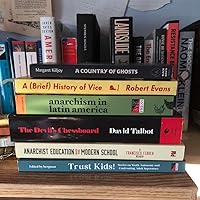
I'll be honest, I've read my fair share of drug lit (I have a whole bookshelf dedicated to it: [here], knock yourself out - ehhh literally, perhaps) so I would say I'm probably more familiar with the history - and indeed, the contributions to civilization made by - vices than most. But some was new to me (I found the music chapter re: Stonehenge particularly fascinating - I love Neolithic shit about as much as I love vices).
And on the whole, it's just an interesting thought experiment, to spend some time mulling over how much of the greatest contributions of humanity have been created by, created around, or at least facilitated by vices. They are, perhaps, unfairly demonized.
I'd like to extend a personal thanks to the author of this book for doing experiments in ancient drugs so we don't have to: like drinking concoctions of tobacco, urine, and garlic; fasting for days followed by drinking a soup of pennyroyal, sprouted barley, wine, and goat's cheese; consuming beer made with human spit; and taking potentially deadly fly agaric mushrooms, among many other things. He really took one for the team, and we salute you.
The author of this book, Robert Evans, really undersold the intellectual endeavors that were pursued when he described the book on his podcast. Extremely well researched, A Brief History of Vice takes a look at how people have been altering their consciousness with everything from alcohol to Stone Henge and everything in between. But Evans doesn't stop there! Like a modern Hunter S. Thompson, Evans takes it upon himself to try some of the various methods and processes on himself (as well as some of his consenting friends!) and recording the results. By the end of the book you really appreciate not just the research that Evans put in, but the risks to his health he endured, both physical and mental. Whether you're an experienced pyschonaut or a straight edge teetotaler just looking to satiate your curiosity, you'll walk away from this book with a new perspective on drugs through history.
A word to the wise: if you're ONLY looking to this book to "get f*'ed up" in new ways, you are gonna be in for more urine drinking then you expect.
Absolutely love Robert Evans’ podcast, Behind the Bastards. When I heard he authored a pair of books and I had to look into them. He writes exactly as he talks on the pod, full of humour and analogies. It made for a perfect vacation read. He pulls hard facts and thorough research into the realm of humour in a way few else do.
A sarcastic and supremely dry humored review of all the things you will probably not learn in history classes. Also, what happens to nowadays-people if they get f*cked up on ancient ritualistic drugs? (ER's are what happens.)
From the Introduction: “We literally started building towns and, eventually, cities so that we could throw cooler parties.” [“literally”? really?]
Last sentence, Chapter 5 (How Bad Behaviour Saved Civilisation): “A douchebag lives in all of us, coded into our very genes. And we all owe that fuck-wind a great debt.”
This book lists a series of “vices”, examines them briefly, states that we are genetically structured to indulge in those vices, and that our civilisation developed as a result of that indulgence. In the historical searches for instances in the past, references to possible indulgence in some vices leads our intrepid author to investigate and experiment with original (or where these are not available, more or less equivalent) ingredients, in order to provide the reader with “recipes” which they can try at home, to replicate something equivalent to the original experience. Ten of the fifteen chapters of this book contain such recipes. Should a person find this approach irresponsible, there is no need to worry: the last sentence of this book urges the reader to “Enjoy your vices, but respect them, too.” — so it should all be okay then. Personally I think that those who think that it would be a good idea to try out these so-called recipes for themselves are merely making themselves potential candidates for achieving a distinction in any current nominations for the Darwin Awards.
There is an air of boyish insouciance about how Evans writes about these things, and this can be infectious. It is only if one tries to analyse his message that problems arise. Not the least of these problems is in arriving at what the definition of “vice” is. Evans includes music, coffee, sex, alcohol and drugs (mostly dealing with their hallucinatory qualities) as vices. Admittedly not every vice could be incorporated; but it is obvious from the entries provided that the term “vice” does not apply willy-nilly to every aspect of them. It appears that the word as Evans uses it is applicable only to those activities that someone else or some other group has identified as something to be controlled, or avoided, declared as dangerous, or banned. Thus, any form of societal rejection of these activities appears to be the basis of what determines something to be called a “vice” — and Evans’ response is that, since these activities are inherent in our genetic make-up, we should therefore reject such warnings and prohibitions, and instead wilfully indulge in them.
This verges more on a simple type of cynical anarchy against societal norms of any kind whatsoever. The individual, and individual freedom, seems to be claimed as superior and natural. But this appears to be a simplification of reality: innocence, natural curiosity, and ignorance of actual or potential harm, especially for the young and the naive, can and will have dire consequences. Surely part of the function of a responsible society is to reduce such dire consequences for the overall good — and this usually means that as a result individual liberties and freedoms might need to be curtailed during the early years of a person’s development until they reach maturity. Obviously such an approach does have problems associated with it, but it does not mean that we must therefore abrogate all responsibility in this regard. Of course Evans at least pays lip service to that aspect of responsibility, but the overriding message is “Don’t say No to any Vice; instead give it a go!”
Another problem lies in the selection and reporting of historical events as back-up to Evans’ overall thesis. This reportage can cover thousands of years of human development, and the instances referred to can only be minimal in detail; specific events and interpretations are cherry-picked “for the sake of the argument” — but again, that does not mean that the information thus provided (regardless of how amazing or interesting it might appear to be) necessarily represents the only interpretation that is available. The absence of any bibliography or Index only serves to make it all the more difficult to follow up on deeper understandings or interconnections between different subjects. Instead, what we are presented with serves only to create the illusion that a wide-ranging and deep analysis forms the basis of Evans’ argument — something which is far from the truth (in my opinion).
In the end, however, the same message is given over and over again: vices (however they might be defined) are innate in us, and indulgence in them is what our civilisation is about. Every one of the fifteen chapters in this book essentially argues the same identical point. But simple monotonous repetition of the same message does not make it necessarily true, educational or even illuminating. In the end I found the repetition of the same message tiresome and even tedious.
A final question: if, as the sub-title of the book tells us, bad behaviour builds civilisation, what, then, might good behaviour build?
Robert Evans not only researched the history of bad habits, he recreates and indulges in them; then writes A Brief History of Vice. This is a fine example of gonzo journalism and deeply committed research methods. I can see it being read as preparation for either field. I even have a certain respect for the author’s 100% determination to speak in first person about the possible effects of consuming various proto-concoctions. For all of this I found his determination to remind us that his background is as an editor and contributor of the humor magazine cum web site, Cracked to be distracting. So this is a balance between 3 and 4 stars with my eventual irritation with his humor having me favor 3.Throughout his assumption is that you are not deterred by drug or alcohol consumption and are willing to skirt a variety of laws about such things. A brief History is not for the kids and may be best read as a guilty pleasure.
The conceit driving the book is that throughout human history we did or preferred a lot of what is now considered bad things and by these bad things civilization was built. We need not agree with what is only just barely a serious hypothesis, but it has its merits. Many ancient religions had sex workers, so called temple prostitutes and certainly there are a variety of religious and civil traditions with chemical or alcoholic inebriation adjunct or central to their practices. In Judaism there remains a barely mentioned tradition of drunkenness at some celebrations, down to a weekly ritual of blessing the wine. Certain American tribal practices are allowed to include hallucinogenic mushrooms.
There is a certain in admitting to our collective naughty side. A more seriously intended scholar could start here and ask us to be more honest about who we are and how selective we –collectively- are about separating our mythical self-image with our real selves. This is to argue that Evan’s is pretending to make these serious arguments and asking for serious introspection. Mostly he is not. He is in it for the fun, at to achieve the most historically accurate and unlikely buzz.
Given how nasty some of his concoctions and experiments are it is hard to properly represent the kinds of things he does. A milder example: Having established that beer is one of the earliest beverages; he also demonstrates that a common ancient production process involved chewing and spitting out the mash to be fermented. Upon learning that in the Wari Empire, roughly modern Peru prized a form of beer in part because only women were allowed to do the spitting; Evans estimates the nearest possible recreation of the process. Then conducts a blind taste test among his fellow spitters to determine which, male only spit or female only spit made the better brew. BTW the female spit beer was preferred.
As for the matter of law, Evans seeks out, re-mixes and ingests a variety of ancient mind altering drugs. Nowhere does he advocate doing this where it is not legal. In every case he goes first to the source and then to a location where he would not be acting against the local law.
That said is usually provides the exact formula for making your own mix of these same items. Rather like saying “I have done this silly, risky, often revolting and sometime illegal thing so you do not have to”. Oh, and here is how to do it yourself.
Throughout he maintains a banter intended to be funny. Asides, more or less related observations and most often playing to common prejudices. Given he is writing for fans of Cracked, this is understandable. I found it distracting.
Does A Brief History of Vice prove that civilization is the child of bad behavior? He does make an interesting case. The argument against cannot avoid the fact that sin was usually in at the beginning. But Evans is more likely to be out sampling some local micro-brew than hanging around pretending to defend his hypothesis.
What this book is not: An in-depth and academically cross-referenced anthropology book that is dry yet informative. It is not a graduate thesis on anything, and it is not impartial in its views.
What this book is: An amusing, anecdotally-laden and well-enough-researched book that will give a bunch of interesting factoids that you can absorb and enjoy for what they are, or use as a jumping off point for more specific research into the topic.
It is definitely entertaining, informative, and worth a read. <-- to be 100% fair, I listened to the audiobook rather than reading the printed version, so the commitment of time was a little less as I could clean and do simple chores while listening.
I'm at this book for not being academic. Full of references like "anthropologists believe" or "most archaeologists think" with absolutely no sources to back up these claims. Fun read, but lots of unsupported claims.
I love Robert Evans a whole lot, I especially love his podcasts Behind the Bastards, and It Could Happen Here. And Cool Zone Media as a whole is awesome. Sufficed to say, I’m biased. But I enjoyed this book a great deal, and when I picked it up today I hardly expected to finish it very quickly, yet here we are. There’s a subset of ‘good books’ that I think should exist and be talked about more where all books go that are easy as hell to read and comprehend. They’re the kind of books that you can’t stop thinking about, you’re compelled by the powers that be, of writing and the author’s personality in this case, to keep picking it up and to not set it down. Maybe the books that you read in a day aren’t the best books. Maybe they aren’t the most informative. But you get a lot out of them, you gain a new perspective on something that people in general think a lot about. I’m reminded of another book I read this year that belongs in the ‘kind of good books that you just keep thinking about and can’t put down’ category of books-namely, Cultish by Amanda Montell. Like this book, Montell’s book had a topic oft thought of by a given person, but something that the average person might not have a broad understanding of, or a specific philosophy on. This book is a concise and authoritative overview of things deemed ‘bad behavior’. I’m used to hearing Robert Evans deliver his jokes through the audio medium, and I have to say I do prefer that, but still this book has his patent charm and good humor, and I love it.
I was surprised that this was a bit better and more in-depth than I was expecting, but I had extremely low expectations for this book in the first place, so that's not saying much. Even if he did not mention where he worked, it would have been obvious that the author works for Cracked or Vice or one of those other sort of semi-edgy sensationalist semi-journalistic places.
In addition to the overly informal conversational style (one can take it or leave it, but it usually makes me feel mildly manipulated — that might be my own issue), the most irritating part of this is how the author makes everything into a little "experiment", by which I mean he ingests a bunch of intoxicants either alone or with a small group of people, then describes something like his experience. It was unnecessary and only serves to build a personal narrative, which again I feel is an attempt to manipulate me into overlooking flaws in the book.
That said, I have read a bunch of books like this in the past — basically long-form listicles tenuously related by some core concept. Maybe 10% of the time they are really good and 50% of the time they are awful — poorly researched, shallow stories that I've also heard a million times. This book at least seemed better researched than most of its counterparts, and the author seems to have at least a decent skeptical eye and was willing to dismiss things that would otherwise be a good story.
For me, the most fun hour of sheltering-in has been going for a long walk while listening to Robert Evans' Behind the Bastards podcast. His A Brief History of Vice is in the same bantering vein. Evans researches, aggregates, and synthesizes topics and then peppers them with jokes and witty observations. It's an approach that works well, and the human propensity for sex, drugs, and rock-n-roll fits neatly into it. There's not much intellectual rigor here, but props to Robert and the gang for experimenting with early recipes for drugs and booze.
Fun book of a guy telling the history (and trying himself!) and development of all different sorts of vice - drugs, drinking, sex, whatever. People have been trying just about anything to get high forever! I also like how he kind of showed that a lot of what we think of as a vice isn’t really that big of a deal but just some random rule gets put in somewhere along the way. Emperors outlawing coffee or tea or tobacco out of nowhere for some reason and everyone just going with it for a long time, very similar to a lot of drug laws today.