In Woolrich's iconic tale, Detective Tom Shawn saves a lovely young woman from a suicide attempt one night, and later hears her story. She is in despair because the death of her wealthy father has been predicted by a confidence man seemingly gifted with the power of clairvoyance; a man whose predictions have unerringly aided her father in his business many times before.
Shawn and a squad of detectives investigate this dire prediction and try to avert the millionaire businessman from meeting his ordained end at the stroke of midnight.
Cornell Woolrich is widely regarded as the twentieth century’s finest writer of pure suspense fiction. The author of numerous classic novels and short stories (many of which were turned into classic films) such as Rear Window, The Bride Wore Black, The Night Has a Thousand Eyes, Waltz Into Darkness, and I Married a Dead Man, Woolrich began his career in the 1920s writing mainstream novels that won him comparisons to F. Scott Fitzgerald. The bulk of his best-known work, however, was written in the field of crime fiction, often appearing serialized in pulp magazines or as paperback novels. Because he was prolific, he found it necessary to publish under multiple pseudonyms, including "William Irish" and "George Hopley" [...] Woolrich lived a life as dark and emotionally tortured as any of his unfortunate characters and died, alone, in a seedy Manhattan hotel room following the amputation of a gangrenous leg. Upon his death, he left a bequest of one million dollars to Columbia University, to fund a scholarship for young writers.
'Night has a Thousand Eyes' is an unusual example of noir fiction. A young, brave detective meets a beautiful rich girl in distress under a starry sky. Naturally, the detective must save the girl right away. And so the story slowly unfolds and this is not a typical crime story from 194o-s. Instead, the author focuses on fate and the inevitability of predestination in our life. If one was aware of one's future, what temptations would he/she have to fight? What choices would one face and make?
I had some time in a car, had just read some Serious Literary Fiction (a Tolstoy story) and thought I might want a little escape into dark mystery, into the world of a guy Raymond Chandler called "the best idea man in the business." Before there was film noir, there was the "roman noir," and Conrad Woolrich was right there at its beginnings. Woolrich is in the same category as Dashiell Hammett, Raymond Chandler, James Cain, and Jim Thompson: Noir novelists, and all great in their own ways.
Some people call H. P. Lovecraft the twentieth century Edgar Allan Poe, but some people also say this about Woolrich, a kind of master of suspense and mystery. I had read his Rear Window (the inspiration for Hitchcock’s film) and The Black Angel and liked them very much. Woolrich shares with Lovecraft and Poe “heightened emotions” and ornate (sometimes stuffy?) language, both of which can be over the top and either great for what you are looking for. . . or a bit much.
Woolrich is known for his “gutter poetry,” language pertaining to those who are down and out, but there are still some examples of writing here that called attention to themselves a little too much for me, such as:
*”’No,’ he said mutedly.” (Adverbs abound profusedly.) *Ornate language. He feels compelled to use words like “quiescence” and “incommoded” everywhere. (Use less to impress, CW!) *”Brandy? Yes! Bring the full decanter! Set it by the door. . . “ And then, “to make the past recede,” drink it all down: “It burns! More!” *”I felt a curious quickening in my heart.” (Poe, much?) *’The darkness was darker for her than it seemed. The darkness came from the inside, not out.” (Okay, noir is about blackness, darkness, so I’ll give him a pass here.) *”A small, owner-less dog.” *”It felt like a cake of ice around my heart.
And so on.
I general like over-the-top noir writing, as I like pulpy campy fifties comix, and I read this hoping for another Black Angel or Rear Window but this novel turns out to be more horror than crime story. Not his fault, I know. And Woolrich knew it was different; he published it under one of his pseudonyms, George Hopley, It’s way too long, it has too many diversions, spends too much time on the police procedural, but for a noir tale, it’s still inventive and good, especially in the first third. Maybe call it gothic noir?
In Woolrich's tale, Detective Tom Shawn saves Jean Reid from a suicide attempt on a bridge, and then hears her tale about how she got there. She is in despair because the death of her father has been predicted by a man with clairvoyance. Shawn and his fellow detectives try to help Dad avert his prophesied end at the stroke of midnight "at the jaws of a lion."
This is not the best novel ever written, but it is unique in combining philosophical questions with detective fiction. A thriller asking questions about fate and predestination.
A Thousand Eyes? Uh, stars, fate.
It’s as melodramatic as its title suggests, but if you relax a bit, it’s pretty fun.
This post WWII suspense novel takes a long while to get started but then it...uh, still takes another long while to get where it's going. Although Woolrich is known for having many of his works adapted into classic film noirs he lacks the name recognition and attention from modern readers enjoyed by many of his peers, perhaps due to his writing style which is both overly dramatic and excessively drawn out.
Whoa. This wasn't what I expected from my first dip into the writings of noir master Cornell Woolrich. I knew there would be darkness, certainly, but I figured that would probably just be a wrapper to some otherwise hard-boiled crime fiction. Wrong. Instead, Night Has a Thousand Eyes is a tale of predestination, clairvoyance, and madness that comes straight out of the Twilight Zone.
The set up is cinematic and delicious: a detective, walking along the river late one night, rescues a wealthy young woman from a suicide attempt. But why would someone who has everything -- youth, money, looks, brains -- want to do herself in? And why does she fear the stars in the night sky? The story that unfolds over the mammoth second chapter (120 pages in my edition!) is one of wrenching emotion and slowly rising hysteria, delivered through detailed, almost poetic prose from Woolrich. His descriptions of competing light and darkness add to the thick atmosphere, and the tortured physical poses his characters always seem to find themselves in create a sense of unease and agony.
The remainder of the book alternates between the protagonists' long, dark night of the soul and a police procedural that hums along nicely. Woolrich keeps the reader guessing right up to the end: are his characters trapped by inhuman, unchangeable Fate or merely the victims of an elaborate con game? And once fear has them all in its grasp, does it even matter anymore?
“Arrest those stars out there, officer. Put handcuffs on them. Hit them with a blackjack.”
Jean Reid is one of the lucky ones: she is young, beautiful, rich, intelligent. Why then is she trying to jump from a bridge in the middle of the night and why is she terrorized by the cold glance of the thousand stars shining in the night sky? Detective Tom Shawn of the Murder Bureau happens to pass by the river side on his way home from a hard day’s job. He pulls the girl back from the brink of the abyss and takes her to an all night restaurant to try to make her tell her story. And it’s a real whopper!
Darkness and fear and pain, doom and death.
Cornell Woolrich is a true poet of anguish. He has been compared with Edgar Alan Poe and with H P Lovecraft. The first chapter of the story bears witness of this: lyrical, strange, romantic and very very dark. And it will only get darker from this point onward. Darkness is the very point of the genre, a reaction against the cosy murder mysteries of elegant people drinking cocktails in country mansions or on boats in exotic locations. Noir goes down into dark, smelly, deadly alleys and finds despair there instead of hope. Some say this is written in the stars and, no matter how hard you struggle, you cannot outrun your destiny.
“It wouldn’t have been any use. Anything you do, you have to do, and there’s no getting out of it.”
This is the essence of the girl’s story: she is told by a maid in her house that her father should not board a plane to the West Coast because it will crash on the return trip. At first, Jean Reid laughs at the prophecy of doom and sacks the maid from her service. Yet, as the hour of the return flight approaches, the girl gets more and more disturbed. Why should she take chances with her beloved father’s life? Her terror reaches crippling new heights when the plane does crash as predicted, but it turns out her father received a mysterious telegram and didn’t board the plane. In search of answers, Jean and her father seek out the girl, and find out in her building a man who claims to have the gift, or maybe it is better to call it the curse, of precognition. He reluctantly predicts several unlikely events in the new future for the rich businessman, all of them coming true, until at last he tells the man the hour, the day and the manner of his death. The rest of the book is a race against the clock to prove the prophecy wrong, while Mr. Reid’s sanity is going down the drain fast.
I heard his voice behind me, but it was dark. Dark before, and dark behind, and dark on every side. “Don’t fight, poor heart. There isn’t anything that can be changed.” It seemed to me that it was dark, but whether it was my own darkness brimming outward or an outer darkness bearing inward, I couldn’t tell.
I have no patience with the supernatural mumbo-jumbo here, and the story of Jean Reid is laying it down rather thickly, to the point of becoming an annoyance. I tried to read on for the quality of the writing and for the persistent gloomy atmosphere created by Woolrich. I tried to read it not as a crime story but as a soft science fiction horror book dealing with the supernatural. It helped a lot that, about the midway point, as the girl is finishing the recount of events that led her at midnight on a high bridge over troubled waters, detective Reid is taking things in hand and brings the police in on the case. His boss, Captain McMahon is the skeptical person I identify most readily with: he suspects a dirty trick from crooks that are after the rich man’s money and mobilizes his whole team to fact check the predictions of the tenement guru. The whole second half of the novel alternates between the detectives following leads and Tom Shawn acting as bodyguard inside the house of the Reids as the fatal hour approaches.
I’m not going to spoil these events in my review, but the central theme is about the effects of fear on sanity. A man goes completely unravelled at the thought that his death is coming at the precise toll of midnight in a few days. This is the object of study here, all the rest of the police procedural and the merits of precognition are trimmings. And Woolrich really lets go, firing from all guns he has in his arsenal to raise the stakes to near impossible odds.
This little wheel runs true to the other, bigger one. You think this is just a wooden gambling wheel. It isn’t; it’s my wheel of life. I’ve got to win just once, before it is too late.
This comes to a point in a memorable scene (for me) of playing roulette in order to pass the time and to take the cursed man’s eyes off the beating clocks.
The imagination, you know, is always more terrible than the reality.
>>><<<>>><<<
So, four, maybe even five stars, for the writing and for the turning of the screws on sanity. One, maybe two stars, for the muddled ending that tried to have it both ways for the skeptics and for the believers in forces greater than our rationality.
Irrelevant to the plot, but I liked the minor cameo of a Romanian actress wearing a diamond watch as leg suspender and I plan to watch the 1948 movie version because it has Edward G Robinson in it, another Romanian connection.
This had an intriguing concept -- about a newly-acquainted man and woman attempting to change the hand that fate has dealt them, even though every move they make further ensures that preordained fate -- but is unfortunately let down by overly-wordy narration that sucks any potential for suspense right out of the story. Much of the novel is told from one person to another in a coffee shop, yet is so descriptive and with such perfect recall about every minute, trivial detail, that my suspension of disbelief was broken multiple times.
There were a few suspenseful moments that crossed over into supernatural horror territory, which I liked, and the exploration of free will vs. determinism was interesting, but it wasn't enough to save this from being a slow-going, laborious read, which is the last thing I'm looking for in a noir novel. I do wish that more writers of the 40s and 50s had been willing to combine noir or hardboiled elements with horror (the underrated John Franklin Bardin is the only one I can think of), as I'd like to read more in this vein, even if this one wasn't entirely successful for me.
I read this book twice; it was the second time through that pushed my appreciation to a higher level. It's a damn good novel even though it has some jarring moments, but when you sit and think about what's underneath the surface of this story, it's downright frightening.
Francis M. Nevins, who wrote the introduction to this edition of Night Has a Thousand Eyes, notes that a fragment left behind in his papers after the author's death "explained why he wrote as he did." Woolrich wrote that
"I was only trying to cheat death...I was only trying to surmount for a little while the darkness that all my life I surely knew was going to come rolling in on me some day and obliterate me."
As early as age eleven, he began to understand that death was unavoidable, noting that he had a "trapped feeling,
like some sort of a poor insect that you've put inside a downturned glass, and it tries to climb up the sides, and it can't and it can't, and it can't."
Nevins also reveals that Woolrich was "haunted by a sense of doom that never left him." For me, Night Has a Thousand Eyes most keenly conveys the author's angst regarding that inevitable "darkness," his "sense of doom," and his attempt through his writing to "cheat death," given that an obsession with death and an attempt to outmaneuver fate are key elements of this story.
Beware -- there is nothing happy going on here; then again it's noir so that should come as no surprise. It is indeed, as Nevins notes,
"the kind of waking nightmare that lies at the heart of noir..."
and really, what could be more nightmarish than the idea that there is no escape?
recommended to serious noir readers and readers of darker fiction. Read it twice.
The title refers to the stars in the sky. The main character becomes phobic about them, which is original, memorable and slightly understandable. This weirdly overlong book was published (at different times) under both Woolrich's pen names, George Hopley and William Irish. Thoroughly about psychic gifts and fate.
8/2014
I now see that Cornell Woolrich's writing tends to teeter between clunky and sublime. This book is no exception. The supernatural element stands out from the other Woolrich I've read.
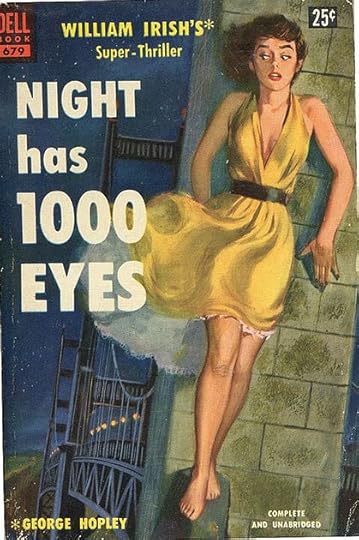
On the cover of my Dell paperback edition of "Night Has a Thousand Eyes" (with a cover price of 25 cents), the author is listed as William Irish, with an asterisk next to the name. At the bottom of the cover, next to the footnote asterisk, is another name: George Hopley. This should not fool any prospective readers, though. Both names were pseudonyms of Cornell Woolrich, the author whom Isaac Asimov called "THE Master of Suspense"; whom his biographer, Francis Nevins, Jr., called "the Edgar Allan Poe of the 20th century" (hey, wait a minute...I thought that H.P. Lovecraft was considered the Edgar Allan Poe of the 20th century!); and who is considered one of the fathers of literary film noir. Many of Woolrich's novels and stories have been famously filmed, "Rear Window," "The Bride Wore Black," "Phantom Lady," "Deadline at Dawn" and "Mississippi Mermaid" being just a sampling. "Night Has a Thousand Eyes" (1945) was turned into a 1948 Edward G. Robinson movie that supposedly has little in common with the book. That's a shame, as the book is a marvelous piece of eerie suspense writing that could have made a smashing film. In Woolrich's tale, Detective Tom Shawn saves Jean Reid from a suicide attempt one night, and later hears her tale. She is in despair because the death of her wealthy father has been predicted by a man seemingly gifted with the power of clairvoyance; a man whose predictions have unerringly aided her father in his business many times before. Shawn and a squad of detectives investigate this death prediction, and try to avert the millionaire businessman from meeting his ordained end at the stroke of midnight "at the jaws of a lion." The reader will never guess how things turn out, or how Harlan Reid eventually winds up. Woolrich writes with a superabundance of detail, which slows things down a little but also ratchets up the suspense factor. We get more and more nervous as that midnight hour approaches, while Woolrich teases us by describing how the milk looks in one of the character's coffee, and by giving us the minutiae of a bridge game. Hitchcock himself could not have drawn more suspense out of the book's brilliantly sustained final third. It is a bravura example of a writer anticipating what his reader wants, and holding it tantalizingly out of reach....
I came to this book after having read of it in Newman & Jones' overview volume entitled "Horror: 100 Best Books." As "Night Has..." progressed, I found myself thinking that the book isn't all that scary; extremely suspenseful, yes, and in parts a bit eerie, but certainly not a horror book. But upon finishing the novel, the reader will inevitably realize that the characters in "Night Has a Thousand Eyes" have no free will at all. Everything is preordained, and human beings are trapped in this master plan. The thousand star-eyes of the title look down on us, mercilessly and aloof. No wonder poor Jean Reid can't bear to look at them. Woolrich's vision of a relentless, bleak and deterministic universe turns out to be a pretty horrifying thing after all!
While I generally prefer newer novels (Night Has a Thousand Eyes was first published in 1945), if one accepts the time context, this noir/paranormal/mystery is an excellent read with many twists. Woolrich does a great job of maintaining the suspense. Readers will find the activities with which the crucial night is passed of particular interest.
Recommended to noir, science fiction, and mystery readers.
Night Has a Thousand Eyes is a hauntingly beautiful novel that may have been too ambitious in its construction. The theme here is whether things happen because of coincidence or fate and it is a philosophical issue of whether one has free will or not.
The story plays out when Homicide Detective Tom Shawn takes a walk along the river on his way home from work and sees a woman (Jean Reid) who is about to drown herself in the river despite the fact that, on the surface, she has or seems to have everything going for her. She is in despair and sees a thousand eyes staring at her. When we hear her backstory, we learn that she is the only daughter and motherless at that of a wealthy man, Harlan Reid. A recluse can predict the future and has proved capable of predicting various business opportunities. The recluse, Thompson, also predicts Harlan Reid will die at the stroke of midnight from the jaws of a lion, a rather particular and obscure means of death. Thereupon, Detective Shawn and a squad of detectives set about investigating whether Thompson is a fraud who preys on the wealthy or whether they can prevent Reid’s impending death. The final forty-eight hours are an awful strain on Reid and his daughter with Shawn trying to protect him, gun at the ready as the clock on the wall literally ticks toward Reid’s impending and predicted death.
Woolrich plays with some rather interesting themes here such as predestination and fate. Are we trapped by fate or is something else at work where we can burst out of our predicted paths. In other words, does it make a damn bit of difference what we do or are we stuck on the same path no matter what.
Nevertheless, while the set up itself is terrific, the means by which Woolrich tackles these themes is a bit awkward and oft-putting to the casual reader.
Cornell Woolrich is one of the principal ‘Film Noir’ writers. Many of his idiosyncratic books have been filmed as was “Night has a Thousand Eyes”. There are parts of this book that sparkle just like the title but there are other places that it slows down mostly in the police investigation sections when the main protagonist, police officer Tom Shawn, isn’t involved. The first 30% of the book is bang on, a real page turner; vintage Film Noir. The scene: A rich beautiful girl in distress, under the moonlight, scattering money, precious jewels, and expensive cars until Shawn, the working stiff aka a policeman, comes to her rescue. The two retire to a Hopperesque diner to get out of the San Francisco fog and to discuss our heroine Jean Reid’s plight.
Jean is desperate because of a horrible prediction about her father’s fate. This is where Shawn and his buddies get to work to try and figure out the fortune hunter’s angle, how he seeks to benefit from the Reids’ vast wealth. And during the depression a lot of people will do a lot of things to survive. The cops need to find out quickly how to prevent Reid’s preordained death. As often with Film Noir the themes are fate, the occult and the inevitability of a horrible death. I’m not sure how this book would have read to contemporaries (1945) but from a modern view point there are parts that seem very farfetched. Yet I can’t help but reflect that some of the current genre books about vampires and zombies are just as fanciful. The vampires are just swapped out for different boogie folks in “Night” so suspend your disbelief and enjoy the ride. This is a fun book. I’m glad Woolrich is being re-printed.
Included is a preface by Francis M Nevins revealing Woolrich’s two other pen names and some of his personal back story, his years as a film writer in Hollywood and his retreat back to New York to live with his cantankerous mother, his brief marriage. His most familiar movie is Hitchcock’s “Rear Window”.
This review is based on an e-galley provided by the publisher.
So I finally finished this as a Literary Darkness group read … My gut reaction is that I liked it, and that there is a lot to admire about Woolrich’s intention (even if his execution failed him in certain areas).
Published at the end of the Second World War, in a socio-political context where humanity seemed doomed to endless conflict and eventual mass extinction, Woolrich’s obsession with predestination and fate surely reflected the zeitgeist of the day.
Today we call such a novel a genre ‘mash-up’ or a literary ‘hybrid’. Here we have an ambitious conflation of the hard-boiled detective novel with something that teases tantalisingly with the supernatural.
I particularly liked the fact that Woolrich even offers a perfectly rational explanation for events at the denouement … but of course we cynical modern readers don’t believe a word of it.
Where the novel fails is that Woolrich seems to draw out certain sections, especially on the police procedural side, while rushing others: If you blink, you might miss the ending, for example. There is a lot of cringeworthy and questionable gender politics here as well, but that is because Woolrich is a product of his era.
What is perhaps more interesting is how this novel alludes to the misogyny inherent in the ‘noir’ genre itself (where the women always seem to be damsels in distress, to be saved by strong, no-nonsense, square-jawed men).
Woolrich goes one better in adding some quite queasy Freudian undertones in the Jean/Harlan father/daughter relationship, which turns into something of a literal ménage à trois when square-jawed Shawn enters the picture.
I truly loved the ending, which is cynical and bloody in just the right combination. This novel is a fascinating snapshot of both an evolving genre, and a changing world.
A dark atmospheric book that is infused with dread. There is really only two endings it could have and it picked the right one.
Here we have a story similar to a more modern novel The Immortalists by Chloe Benjamin - a death is predicted by a pretty reliable fortune teller. The novel is essentially an exploration of how the protagonists react to this prediction (being Roman Noir you can probably guess they are not too happy about it). Can the police do anything about it? Is it just a scam? Or is the prediction itself a self-fulfilling prophecy. Read and find out.
Warning this book is written in the 1940s and is shockingly classist, sexist and even a little racist in places. How the police treated a former prostitute in order to aid a rich man is just one example. However, if you are willing to overlook these faults you have a gripping Roman Noir where the hero is going to rescue his Dame come hell or high water.
“The night seemed darker than it was; the darkness was on the inside, not the out; I could barely see her face; there before me. Will, volition, was like a flickering candle flame going out in all that darkness, going lower, lower, lower, guttering to an end. Leaving the eternal, rayless night of fatalism, of predestination, to suffocate us, herself and me alike.”
A pitch black perfect noir opening where moonlight and the scattered remnants of a wrong doing haunt the pages, whispering murderous nothings on the chilled night air. Woolrich extends the beautifully poetic scenery and introspection to build tension coiled tight, the words like springs ready to snap, threatening to turn the mood from nervous apprehension to realised horror.
Woolrich does noir as it should be done. The characters of 'Night Has a Thousand Eyes' are depressing, self serving, and in need of misery for company. Despite Jean Reid's care for her father, whose death is foretold, her sense of belonging and personal grief, the 'what-if's' of a life alone, shadow the immediate threat to her father's life. Even the most optimistic of Woolrich's characters fall into a common shade of gray. This works very well for the theme of the novel where death is a but a clocks tick away, each sun up and sun down is one less fore a determined reaper is coming. Jean, and the police, are equally helpless to intervene.
Jerry Tompkins whose gift outweighs his nondescript appearance “just a farm boy, a lifelong misfit, embittered by the burden of something he wasn’t equipped to cope with.” is a mere cameo to the Reid's and adds little despite the prophetic plot bestowed upon him. The agent for Tompkins' vision, Eileen, the Reid's housemaid, who conveyed the vision to Jean is treated in a fashion which is undeserving yet right for the tone of the novel. The do-gooder punished for her open heart.
Woolrich delivers contrasting emotions depicted through light – a shining, sparkling wineglass; the reflected warmth radiating against the owners hand, the rays caressing his face as he extends the glass closer to his lips. Sunlight dancing through netted curtain, a clear blue sky unstained by cloud envelopes the character in a golden mist. The polar opposite drenching Jean in a vale of water streaming through a black night, tears and rain cascading down long gone make-up, the vision is a sad clown with little prospect for smiles. My interpretation of the mood and the delivery by which Woolrich depicts the contrasting and at time conflicting emotions were the highlight of the novel.
Despite best intentions, the novel was always going to head in one direction. Encompasing elements of the police procedural, albeit somewhat unorthodox, Woolrich attempted to diversify the counting clock linear plot only to detract from the awkward relationship and interesting unravel of Mr. Reid as he waited for death.
Into the lions den, death in a literal or figurative sense is to be served by one of the worlds fiercest hunters. Can Jean save her father and change fate? Will the words of a faded man prove true or do little more than to kill Jean's father one minute at a time? Read 'Night Has a Thousand Eyes' to find out.
Mở đầu với một vụ tự sát bất thành và sau đó là câu chuyện kể về một nhà triệu phú bị lời nguyền ''chết trong miệng sư tử''. Truyện khởi đầu chậm rãi nhưng nhịp độ tăng dần, nửa sau là một cuộc chạy đua của cảnh sát nhằm ngăn chặn thảm kịch trong khi đó nhà triệu phú tâm lý ngày càng suy sụp. Văn phong kì bí tuyêt vời đã khiến người đọc dần bị cuốn vào câu chuyện và hồi hôp ngày một tăng. Mình cũng linh cảm được cái kết nhưng nó đến thật bất ngờ, làm mình ngỡ ngàng. Đúng là chỉ có Woolrich mới viết được những truyện như vậy.
Một truyện trinh thám kì lạ đậm chất siêu thực nhưng rất thú vị. Nhưng có lẽ ai chưa từng đọc Woolrich có lẽ sẽ hơi khó thẩm thấu ý nghĩa của nó.
Cornell Woolrich’s Night has a Thousand Eyes puts the reader right into the conflict at the beginning. A policeman (Shawn) rescues a distressed young woman (Jean Read) from attempting suicide. When he gets her aside, Jean, looking up at the stars, says see wants to get away from “them.” Confused, and wanting some answers, Shawn takes her aside to a coffee shop. There, she relates an unbelievable experience, one involving fate, predestination, and premonitions about her father.
In addition to the lyrical quality of Woolrich’s writing, he can also create a sense of immediate and permeating darkness and bleakness in ambience: “Will, volition, was like a flickering candle flame going in all that darkness, going lower, lower, lower, guttering to an end. Leaving the eternal, rayless night of fatalism, of predestination, to suffocate us…”
Cornell’s novel incorporates several methods: it is an effective noir, a mystery and tense suspense, at points even shifts to a police procedural. Perhaps one major question that is explored within the framework of the major conflict: To what extent are we in control of our fates?
As the deadline approaches, this question comes more into focus.
Quite a bit of symbolism exists also in Night has a Thousand Eyes. Time, fate, the stars all come to take on a reference to various characters in the story. The novel’s title has a suggestive meaning as well based on events and workings of the plot.
Overall, this was a very solid, yet very dark, experience. There is quite a bit of tension for the most part. Perhaps the only blot, in my opinion, comes early in Part 2, when the police procedural tends to drag the plot a bit. There’s a bit of momentum lost here, but otherwise, it picks right back up. There’s also a brilliant introduction in this edition. Francis M. Nevins writes of Woolrich: “He was the Poe of the twentieth century, the poet of its shadows, the Hitchcock of the written word.” Lofty words, indeed, but based on what I’ve read of Woolrich, I think it might be an accurate assessment.
By Cornell Woolrich Narrated by Angela Brazil Published by Blackstone Audio, Inc., 2012 Classic Noir Genre Written in the 1930’s
3 Stars
A young woman is preparing to leap to her death. A police detective, on his way home, sees her, rescues her and spends the rest of the night talking to her, trying to understand why such a beautiful woman, in her 20’s and obviously wealthy, would want to end her life. She had been warned by her maid that her father’s life would end on an upcoming cross country flight. She dismisses the idea as someone who has devious aspirations and fires the maid. Over time however, the idea takes hold of her as doubt in her logic creeps in and she becomes frantic. “What if it is true?” Her father is all she has known all her life since her mother passed away when she was young. The daughter is determined to find out who made the prediction, why was she told and why her father? The police get involved, although no real law was broken, to determine if there is something criminal in the works. The predictions of various natures are told, some favorable, until the ultimate fortune is told no one wants to be hear: the date and time of someone’s death. The character’s self destruction begins as time move closer.
There is a con man working his trade, but what about the predictions? Are they real? Fabricated to complete the con game? You need to read this and come to your own comclusions.
This is the first of Cornell Woolrich’s books I’ve read and it will not be the last. The characters are believable, the setting is fine and the stroy was unique and had promise. There is plenty of suspense, and it has an eerie quality which reminded me of Rod Serling’s “Twilight Zone” TV series. However, the novel could have been much better by reducing the lengthy detail leading up to the final crisis. I ended up having to fast forward ahead to get through the monotonous repetition. Since I have become fascinated by the Noir Genre, I will read more of Mr Woolrich and other novels from the 1930’s, ‘40’s and ‘50’s.
More than most authors Woolrich enjoys playing with his reader. His work is almost always to do with fate, and it is with that theme that the great writer has his fun; though it is as terrible here as it is effective.
A young detective, the protagonist, comes across an attractive young woman attempting suicide. He manages to stop her, but she is desperate and terrified. Her wealthy father has been threatened, in that a man who claims to be psychic has told her that her father will die at an appointed time and cannot be saved; this psychic is never wrong.
When the mysterious prediction materialises the police, who had previously ignored the threat, discover a tacky love triangle involving the psychic, the victim, and the girl’s late mother, and put the incident down to extortion and revenge. This scenario now allows Woolrich to do his thing, pump up the terror as the suspense grows twist by twist.
Unusually Woolrich is a bit wordy, and it takes more pages than usual to get going. Maybe his publisher wanted the extra weight..
I will see the film, which is a classic of noir, but many reviewers I respect have said it is slight in its impact by comparison to the book.
Woolrich's oeuvre is large, and almost all of his work is disturbing and succinct. A few trims early on might improve this, but either way it is right up there with his best.
A disappointment. Starts off tremendously well, but once the direction of the plot is established it mostly just spins its wheels and spends a ridiculous amount of time describing the spinning. Dramatically it makes no sense for anything to really happen before a certain time of a certain day so there is virtually no suspense. There is some nice noir-ish depiction of predestination vs free will and of someone giving up the will to live once informed that he is to die, but too much time is given over to irrelevant detail, especially during the police's attempts to get to the bottom of things. I'll still keep reading Woolrich because this is the only misfire of his work that I've read so far.
Il romanzo del 1945 di Cornell Woolrich ha un titolo davvero suggestivo: "LA NOTTE HA MILLE OCCHI". Quali sono gli occhi con cui la notte ci scruta? Perché è così misteriosa e potente da poter disorientare le passioni umane? "LA NOTTE HA MILLE OCCHI" non è un invocazione alla luna di stampo leopardiano, ma è l'inizio di un mistero che riempie di domande il lettore e lo avvolge con il millenario fascino dell'ignoto. Il noir "LA NOTTE HA MILLE OCCHI" ha riscosso moltissimo successo quando è stato pubblicato, così tanto da essere trasformato in un film che, però, non ne uguaglia la grandezza e la molteplicità di significati dell'opera letteraria. Chi è che tesse il nostro destino? Chi ci guarda attraverso le stelle? Perché la notte è un arco temporale denso di dubbi e ansie? Perché durante la notte tutto appare pericoloso e oscuro? A tali domande cerca di dare risposta la squadra investigativa che decide di smascherare quella che sembra essere una sensazionale truffa ai danni di un uomo molto ricco e della sua famiglia. Tutto inizia fortuitamente, cioè con un incontro casuale. Il ventottenne Tom Shawn, della squadra Omicidi di New York, è un solitario. Non gli piace intrattenersi in una birreria con i colleghi a fine turno. A lui piace camminare lungo il fiume e fantasticare sulla sua vita, mentre ammira le stelle, sue uniche compagne nei momenti di solitudine e riflessione. Per lui, nelle stelle non c'è niente di pericoloso, ma deve ricredersi. E con lui forse anche il lettore. Dopo aver incontrato la bella Jean Reid, Tom Shawn non guarda più alle stelle con gli stessi occhi. La bella e giovane Jean Rein è una donna misteriosamente affascinante: una perfetta femme fatale per un perfetto noir. La sua storia è così assurda ed inverosimile che lui, da poliziotto, non può fare a meno di volerne dimostrare l'insensatezza. È così che inizia la storia tra la donna, che si voleva suicidare, perché aveva paura delle stelle, e l'uomo che le amava a tal punto da volerne dimostrare la purezza e lo splendore.
Night Has a Thousand Eyes is a noir with supernatural elements, published in 1945. It’s a blend of awful and great, which led to me giving it 3 stars.
Some of the scenes in this book are truly brilliant. And some, not so much, with Woolrich taking forever and a day to get to the actual blessed point of a boring scene. Some of the sentences are so excessively dramatic and repetitive, not achieving the intended effect at all. And then some sentences are incredible! In particular, the way Woolrich uses light, or the absence of light, to create atmosphere is really unusual and visually satisfying as a reader.
The book itself has a great plot skeleton that is fascinating and unique. I could definitely see Night Has a Thousand Eyes as being the inspiration for Stephen King’s The Dead Zone. Despite that solid skeleton, readers have to endure lots of waiting in between plot beats for the next one to occur. And while the story starts off strong, it feels like it falls apart towards the end.
Despite all of its flaws, it is very unique in its innovative blend of noir and philosophy. While I can recommend it for research purposes, I can’t recommend it other than that, as most readers will simply be too bored to enjoy it.
Woolrich’s predestination thriller (one of only two books he published under the name George Hopley) combines two staples he used quite often in his work: the race-against-time story and the detective story. The plot involves an aristocratic father and daughter who come in contact with a man who convinces them he can see the future, something the father turns to his financial advantage until one day being informed that he will die in a few weeks time, at the stroke of midnight, at the jaws of a lion. Convinced without a doubt that the information is true, and moreover that he is helpless to prevent it, he disintegrates into a doom-ridden, despondent, emaciated ghost of his former self, surrounding himself with ticking clocks that he watches with hypnotic intensity as he waits out the remainder of his waking nightmare of a life. If the novel were told from his perspective, it would approach the type of dread that marks I Married a Dead Man, but instead it switches between a number of different perspectives, as the police get wind of the situation and are skeptical that something criminal is brewing instead, and the result is a book that is half doom-ridden noir and half police procedural. In fact, none of the book is told from the father’s perspective; most of it is told from the third-person perspective of a young detective who rescues the daughter from an attempted suicide, with an entire hundred-page chapter devoted to her back story, told in first person as she relates the complete transformation of her very worldview, no longer believing in her own autonomy but in the notion that her fate, like that of her father’s and everybody else’s, is written in the stars.
What’s great about the novel is, as usual, Woolrich’s intense descriptiveness; a sense of despair and terror comes alive through his moody prose and in particular the titular metaphor of twinkling stars of night as piercing eyes that watch these characters like pawns in a giant tableau in which they are helpless to escape their destinies. In some respects the switching between perspectives that increases with greater speed as the dreaded hour nears mirrors the sense of being watched by thousands of omniscient eyes, though the main purpose is to prolong the ambiguity of whether this man really can see the future or if he is just a brilliant charlatan.
Written before his two greatest works, Rendezvous in Black and I Married a Dead Man, Night Has 1000 Eyes feels like a slightly experimental novel, as its structure begins with a long, descriptive first-person flashback that later shifts to a series of briefer third-person snippets from the present. By taking us out of the thick sense of dread that pervades the father’s mansion, Woolrich gives us space to breath but sacrifices some of the intensity that defines his best works.
This is my second go with Woolrich (after 'Rendezvous in Black') and I suspect what Raymond Chandler said of him may be true: "He's the best idea man in the business." But it also seems to me that, to appreciate Woolrich to the fullest, you must be willing to go the full length of the eccentricity expressed as he displays his ideas - and humor him in his writing.
The description given here of this novel is not accurate. The psychic in this story is not a con man. Rather, he is a pitifully humble fellow seemingly cursed at birth with a 'gift' As he grows into a man, he has more and more reasons to stay away from people and keep to himself. The thing is, a few people know of his ability and occasionally word gets around ...and he is sought out.
As this story unfolds, he falls into the lives of a couple of skeptics - and the twisted tale of their acquaintance begins.
The first third of this novel is by far the best part. It's tense, full of question marks, and the suspense involved is milked to the max. (This section also contains a few delicious surprises.) Once that's over ...since one of the main characters is a cop, a procedural takes over - and, from there, a sort of frustration sets in, as the POV changes a number of times, and you start to wonder if the author is in full command of where he is leading. (Ultimately he is - especially at the conclusion - but the way there can sometimes be irksome.)
Woolrich has been criticized for his writing style - but it's best to remind yourself that he deals in heightened realities. If the writing - and especially the dialogue - were always completely realistic, it's likely that that would not serve the purpose of the author's intent. He means to whip you into a frenzy and that's where Woolrich, 'warts and all', succeeds (even if this novel in particular can seem slightly over-written).
Woolrich has more on his mind here than suspense. He has much to say about the nature of belief, as well as the nature of flat-out doubting everything that is not believable in practical terms. He also delves into the pitfalls of being rich (and pompous).
I rather enjoyed the novel's wrap-up; it helps in making everything much more of a logical piece.
I've loved Woolrich for decades. I first discovered his writing in the early 1980s via some short story reprints in EQMM and AHMM. Then I found several of his books at a used book store and I loved his work right away.
Woolrich was not always the greatest writer... his prose was quite bloated and purple, but he was, in the words of Raymond Chandler, "The best idea man in the business." What can you say about the man who INVENTED noir. Before there was film noir, there was the "roman noir," French for Black Novel, and those were named as such because of Woolrich's use of the word "Black: in he titles of his best novels: The Bride Wore Black, The Black Angel, The Black Curtain.
Night Has a Thousand Eyes is a superb noir novel, filled with Woolrich's amazing sense of doomed predestination.
If you love noir like I do, this is one of the touchstone source novels.
Point Blank Podcast Review (pointblankpodcast.com)
This novel is existentially lonely, but the writing is so heavy handed. In trying to squeeze so much noir atmosphere, so much grim melancholy into his descriptions, Woolrich loses focus on what matters, which is whether the reader will want to turn the page.
I found myself, repeatedly, not wanting to turn the page, not because I was afraid, but out of boredom.
This book was an odd little story. It started off so strong. I was hooked. I enjoyed the plight of the characters. But somewhere in the middle the momentum stalled and then the rambling began. I was wondering what happened. I wish the initial momentum could have been sustained. I still wanted to see how things got wrapped up. It was predictable, but still an interesting read.
A fascinating and beautifully written story about fate, paranoia and fear of death that features some truly cinematic imagery. What struck me in particular is Woolrich's masterful ability to communicate a character's state of mind through spot-on descriptions of body language.
There's normal crime and punishment stories where someone commits a heinous crime and if all goes well eventually suffers the consequences for being a crime committing kind of person.
Then there's the Cornell Woolrich kind of crime and punishment tale where the crime is being born in the first place and the punishment is for the world to snuff you out like Godzilla stepping on Bambi, but in slow motion so you're well aware of the crushing doom that is bearing down on your head with remorseless inevitability. At least there's almost a romance in this one, even if everyone is too busy wrestling with inexorably strangling fate to really give it the attention it deserves. But whose day planner isn't packed solid these days?
As usual Woolrich is a writer that may not immediately come to mind but if you're a film buff there is a very good chance you've seen something that he had a hand in. The big draw is that he wrote the story that "Rear Window" was based on but this one is probably up there as one of the more well-known adaptations. Filmed in 1948 it starred Edward G Robinson and gave us a jazz standard in the main theme (far, far jauntier than anything associated with this book deserves . . . hearing it in my head while reading this was a strangely disorienting feeling) but even a quick perusal of the movie's plot after reading the book shows that they really went out of their way to brighten it up as best they could. Granted since the book is pitch black even a major brightening makes it a sickly kind of grey but its better than triggering an existential crisis in your audience. Because if you're in the wrong mood this book can do that to you, unless you find the idea of futilely struggling against your unchangeable fate relaxing even in the face of its certainty. And some people probably do. But those people are probably in cults.
It starts normally enough, at least for a noir. Police officer Shawn is talking his usual after-work walk along the river when he encounters a young woman attempting to commit suicide by jumping off a parapet. Fortunately for her she's slow at it and he manages to rescue her before she hits the pavement. Understandably she's a little distraught but at the same time weirdly panicked over the fact that stars are in the sky. It seems like she's been through a lot already. Alas, for her the story is really only half over.
Turns out she's rich, the only daughter of Harlan Reid, a widowed rich dude. Strangely enough for rich people in noirish novels they're surprisingly normal and well-adjusted at the start of things, having a good father-daughter relationship and seemingly at least decent to everyone they meet. Why is poor Eileen bugging out over stars then? Is this one of those "reefer madness" scenarios?
Nope. She's freaking out because people keep telling her things that come true. Specifically one of their servants passes a message along that her father should take a different way back from his recent business trip because the plane might run into some trouble. When that turns out to be entirely accurate Eileen goes to discover the source of these predictions and finds out that one of the neighbors of her servant (well, she former servant after she fires her in the time honored fashion of rich people everywhere hearing stuff they don't like) appears to have the gift of prophecy. Like an uncontrollable gift for it, like an overflowing bathtub or, perhaps more apt for this story, like an semi-automatic weapon with safety not only off but intent on doing the opposite of what safeties are supposed to do. Needless to say, collateral damage is an afterthought.
Interestingly Woolrich turns the screws slowly on this one, at least at first, and he lays out the scenario so deliberately that you may start wondering what all the fuss is about, especially when Eileen spends pages agonizing over whether to tell her father to come back via a different way than his allegedly doomed airplane. Woolrich wrings all the tension he can out of it until you're torn between page-turning and wondering if the poor girl is being a bit hysterical.
Turns out she's not, but that's when it gets worse.
Her father insists on meeting this strange seer, whose name is Tompkins and over the course of several conversations finds his advice, reluctant as it is, does help him make some sound business decisions. Unfortunately for poor Harlan he asks one question too many and if there's any moment where "don't ask questions you don't want answers to" might apply, its here, as Tompkins tells him there's very little point in making long term plans. In fact even making short term plans might be out of the question too. In true "you are doomed" fashion, he gives him a date and a time and even a place, even if the place itself doesn't make too much sense (lions?). Harlan, like all doomed people, doesn't take this well at all and neither does Eileen. Fortunately for her, she's decided on an interesting path to getting the attention of the police. Unfortunately for her there's going to be nothing they can do about it. But boy does everyone spend the next couple hundred pages trying really hard.
Its unusual to find a book that features so many people that would really prefer to be anywhere else but the book they are currently inhabiting. For the police I guess it’s a nice break from their usual duties although it seems weird to assign what feels like half the force just because a rich guy got a dire prophecy but its one of those quirks you just learn to go with. It does turn the book into a bit of a police procedural, if you enjoy cop shows where literally everything they do is pointless wheel spinning because merciless fate cannot be deterred. For all the cover copy deems Tompkins a con-man he clearly would like to being doing anything but telling people about the terrible futures he keeps glimpsing (though some of his clairvoyance seems odd, at one point Harlan keeps asking him stock advice but if its preordained you would think it doesn't matter what Tompkins says, unless that's just part of the skein) but like the rabbit with the batteries attached he can't help but tell people exactly what's going to happen (sometimes in eerie detail) with a palpable misery. But then I guess if his entire existence is basically "spoiler alerts" I wouldn't be too thrilled either.
Woolrich novels are no stranger to people on the slow road to total oblivion but there's just something a little . . . extra about this one. Maybe it’s the weird see-saw structure in the beginning, maybe it’s the switch between first and third person (with a fiendish degree of intensity in the first person sections), maybe it’s the slight supernatural edge without any real explanation. Is Tompkins causing these things to happen or is he just seeing how the motors of the universe mesh together? The book seems to lean toward the latter, that he's the puppet who can see the strings as the naked blue guy once said, but there's an element of "does it really matter?" And that's really a good question, one the book isn't interested in answering, or at least not in a way that's remotely optimistic. Much like by some yardsticks blowing up a house is technically the same as renovating it, just in a really final way, Woolrich seems to suggest that avoiding your fate is the same thing as walking right into it since its all going to the same place anyway.
Thus cue the feverish pitch that an ocean of Tylenol isn't going to bring down. Once the plot really kicks into gear and the police start fanning out to figure out how to stop a murder that seems inevitable, has no suspects and their only clues are gibberish we get to watch the equivalent of ants trying to crawl out of a clear sided glass jar with the sun beating on it. Nobody stops trying but there hardly seems to be any doubt as to how this is going to go. But even as the police are chasing down every random lead Harlan Reid is rapidly unraveling at home, winding clocks and counting down the minutes to what he presumes are going to be his final moments. Remember how terminally ill patients are often credited for how well they handle being dealt a bad hand in their remaining days, with quiet grace and poise? . . . yeah, that's not Harlan and Woolrich gives us an unflinchingly uncomfortable glimpse of a man given unexpected news and then completely falling apart, which is probably what ninety percent of people would do in that situation.
At the center of it are Shawn and Eileen, two people thrown together randomly and trying to make the best of it . . . its often hard to find actual human beings in Woolrich novels as everyone just seems like a pawn of forces outside their control but these two do their best here and I think the ultimate tragedy of the novel wouldn't come across as powerfully if not for their unexpectedly strong characterizations (a dinner bordering on farce demonstrates how well they play off each other as the situation itself gets increasingly seasick). They're honestly trying to save someone they like and it helps the book feel like there's actual stakes involved as opposed to watching lemmings shuffle off a cliff. Thanks to them you feel there's a chance that this might all come out okay and their fight against an all-encompassing invisible smothering force known as the universe is what makes the book so stomach churning in parts. You want these people to win but its like wanting your grandmother to live forever. There are some things that just aren't going to happen, no matter how much anyone wishes otherwise.
But they try. They try really hard, in fact and if there's any small humanity in this book its that a whole bunch of people get together to save this terrified older man from a fate he's convinced is heading right for him, not because they want to be rewarded but because it’s the right thing to do. Honestly noble people are somewhat rare in Woolrich novels, typically everyone seems compromised in some way but what makes this hard at times is that Harlan genuinely doesn't seem to deserve any of this. But good people get bad breaks everyday . . . it just feels so obliviously callous here, like a giant rolling over in his sleep and accidentally crushing you. Harlan can't win, but then ultimately nobody does. This time it was just his turn.
So Shawn and Eileen have a plan, the police have a plan . . . random criminals also have a plan, weirdly enough (it doesn't go well, in one of the more chilling sequences in the book, where Tompkins seems less a pawn of forces beyond his control than a vessel for something that isn't possible to name). Unfortunately for everyone involved here Woolrich also has a plan and "bright sunny days" aren't a part of it. The atmosphere gradually gets more oppressive to the point where you start hearing ticking clocks counting down the moments to your own demise (they play a game of roulette to pass the rapidly diminishing time and of course it goes somewhere freakishly extreme) and you feel that the page numbers in the book should start going backwards as you get nearer the end.
Its all tense, wound extremely tight. You know how its going to end. You hope it defies your expectations. But in the end its just so futile (he even left-fielded me on the lions thing . . . although I think we all knew he wasn't going to end up as zoo lion chow) with nothing but a handful of bodies to show for everyone's efforts. In a genre not known for its effervescent cheer, this one is simply pitch-black. Harlan is doomed before the book even starts, he just has the curse of someone telling him how its going to go. Some people might find that empowering, to finally know. Woolrich treats it as he seems to have treated death in general, a final slide into a nothingness of being that had to be held off as long as possible, even if you have to rip your fingernails to bloody pieces to keep yourself from being dragged all the way down into the complete and eternal annihilation of self that he was sure waited for him. Look, when it comes to this genre my heart is probably always going to lie with Phillip Marlowe's sun-drenched underbelly of mid-century Southern California. But this isn't like anything I've ever read. As an exercise in sustained mood its impressive enough but there's this soul-shattering terror of certainty underlying it that makes it more than just a gimmicky suspense novel. There's real fear here, the kind that takes you past a cold sweat and into another mode of thought completely, a realm that you don't want to dwell in for too long unless you want to start perceiving the world and existence in a way that's no longer comfortable. But reading this, it feels like just a sliver of what Woolrich felt all the time, every waking moment of every day (and maybe in his dreams) for all the years of his life before the final release he had strived so desperately to avoid. It doesn't sound like a healthy place to be (I know I don't want to be Cornell Woolrich, I'm not even sure I would have wanted to meet him) but the fact that he was able to reach into that place inside himself that was no doubt sure everything was pointless and eventually dust and articulate even a portion of how that felt is fascinating to me. It almost feels too personal, like we got a glimpse too far and he showed us what we weren't meant to see. There are moments where it very much feels that way to me. And yet he didn't even publish it under his own name.