#1 New York Times bestselling author and illustrator, Tony DiTerlizzi, has been creating children’s books for twenty years. From fanciful picture books like The Broken Ornament and The Spider & The Fly (a Caldecott Honor book), to chapter books like Kenny and The Dragon and The Search for WondLa, DiTerlizzi imbues his stories with rich imagination. With Holly Black, he created the middle-grade series, The Spiderwick Chronicles, which has sold over 20 million copies, been adapted into a feature film, and translated in over thirty countries. He teamed up with Lucasfilm to retell the original Star Wars trilogy as a picture book and his collaboration with celebrated author Mo Willems created the bestseller The Story of Diva & Flea. The Norman Rockwell museum’s retrospective, “Never Abandon Imagination”, featured artwork from the beginning of DiTerlizzi’s career as a contributing artist for Dungeons & Dragons and broke attendance records. He has been featured in Time magazine, USA Today, CNN, PBS, NPR the BBC and The Today Show.
It is funny and has a sort of sad feel too. It’s seems to be about an only child, a boy, and perhaps his single father. At least they are the only two family members who make an appearance. And the father has given games to his son for his birthday but he has nobody to play them with, which I found poignant.
But the child meets Ted, who becomes a friend, a friend his father says is an imaginary friend, mentioning in passing that he once had an imaginary friend too.
All the various troubles that these two manage to get into are things with which kids will identify, even though they’re more extreme and dramatic than the experiences most kids will actually have, yet they’re not fantasy or otherwise out of the realm of possibility.
How the father comes to see the kid’s side of things and how he gets reacquainted with the joy of playing, is very sweet.
I wasn’t sure about the pictures at first, but so many of them are so funny that they really grew on me.
This is a wonderful book for adults & kids to read together.
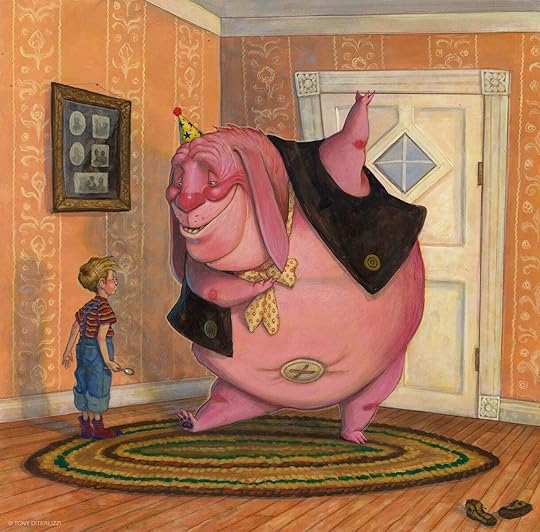
When a huge, pink, raspberry-loving creature named Ted knocks on his door one day and introduces all sorts of fun activities into his life, the young boy-narrator of this entertaining picture-book finds his loneliness abating. His busy father however, does not believe in Ted, and blames all the mess they create on the boy, getting more and more angry. It is only when it is revealed that Ted was also once friends with the father, who knew him as Ned, that matters between father and son are put to rights...
An engaging picture-book about the idea of imaginary (or not) friends, and the relations between fathers and sons, Ted offers quite a satisfying conclusion, one in which father, son and Ted all play a game together. There is something simultaneously heartwarming and humorous in that final scene! The artwork here is classic DiTerlizzi - beautiful, a little bit creepy, and a lot bit amusing. Recommended to anyone looking for children's stories about imaginary friends and play, or that address feeling neglected and/or misunderstood by one's busy parents.
An imaginary being causes problems for a small boy, before bringing him closer to his overly-busy father. This was funny, sweet, and heartwarming. Ted is unforgettable.
Ted by Tony DiTerlizzi Simon & Schuster Books for Young Readers in 2004. The book is 40 pages long and the genre is fiction. This book best accommodates students age 5 to 8, in Prekindergarten to 3rd grade. The lexile level is 230 and the guided reading level is L. Ted is about a boy who is quite lonely because his dad is always working and impossible to play with. His birthday had just happened and it went by so fast that nothing exciting happened. Finally the boy gets a visit from a certain raspberry colored imaginary friend, Ted. The boy and Ted begin to get into a lot of trouble through their shenanigans as their time together goes on. It finally gets to a point where the pair gets decides to run away and hide because the father doesn’t believe that Ted is real. When the father finds the pair outside the boy tries to explain to his father that Ted is really his imaginary friend from when he was small, Ned. The father finally believes them when they dig up an old toy of his and they all go home and play together. I would use this book in a second or third grade classroom. We would each draw out what our imaginary friend would look like or already looks like. Then we would complete a descriptive writing about our imaginary friends. Finally after completing our descriptive writings I would have the students read their descriptive writings to a partner while the partner draws the imaginary friend and then finally they would compare drawings when finished. CCSS.W.3.3 Write narratives to develop real or imagined experiences or events using effective technique, descriptive details, and clear event sequences.
Ahhhhhhhhh. This book starts off by reminding me of the old movie Drop Dead Fred. Except in this case the imaginary friend is Ted. And he gets his buddy in to all sorts of trouble. But it turns out imaginary friends can be inherited, and it just takes jogging Dad’s memory to bring back playtime.
This is a fun story about an imaginary friend that gets a little boy in a pack of trouble with his dad. The ending is very sweet and the book really reminds me of the old 90s flick, Drop Dead Fred starring Phoebe Cates and Rik Mayall. It was such an odd story, but I really liked it.
The illustrations in this book are sweet and very humorous and each part or "chapter" of the story shows another example of how Ted gets the little boy deeper and deeper into trouble. This book was read to us at a library program for school-age children on Spring break at a local library and we enjoyed listening to it together.
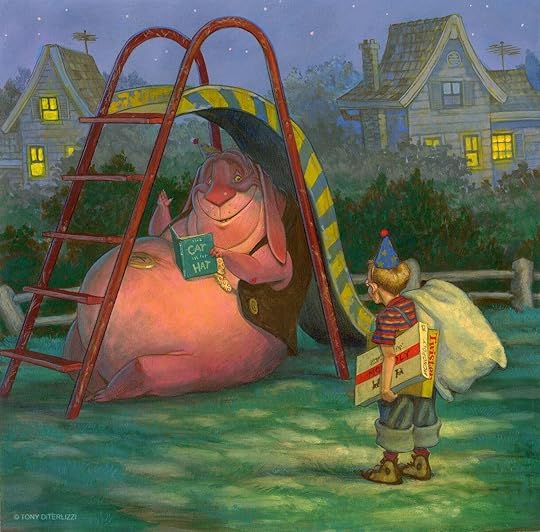
A lonely boy whose father is too busy to play games with him receives a visit from Ted, a raspberry-loving creature who seems to know a lot about the boy. Ted encourages the boy to do some ill-conceived things, like painting on the walls and creating a indoor swimming pool in his dad’s study. Finally, his father forbids the boy from playing with Ted, so Ted returns to his old playground. It is there that the boy discovers that Ted also knew his father when he was a boy ... only his father called him Ned.
With a nod to The Cat in the Hat, this is a story to delight lonely children everywhere.
Ted tells the young story of a boy and his imaginary friend. Throughout the story we see Ted and the main character getting into all sorts of trouble. Once he is caught by his dad his dad gets mad at him and tells him that Ted is not real. The illustrator uses bright colors on Ted but muted colors throughout the book to show how Ted is a little bit of happiness in the main characters normal everyday life.
I am a fan of Tony DiTerlizzi, but, um, not of this book. It is definitely a product of its time with bizarre adult-themed nostalgia and way too much text. And, sorry, but Ted is pretty hard to look at. I do like the ending. I don't think it holds up well, but check it out for yourself. Spoiler alert: I definitely love the twister-monopoly idea!
The illustrations are wonderfully weird, and the story is full of mischief and nostalgia. Parents may want to preview this if their kids tend to "get ideas" to re-enact things they see--the trouble Ted and his human friend get into will likely curl their hair! As long as kids know better than to try and create an actual "in-house swimming pool," TED is wacky fun.
Genre: modern fantasy Grade level: 2 This book is about a kid with an imaginary friend who gets him into trouble. I absolutely love this book with all my heart. It was one of my favorites. The illustrations are so creative and detailed that make the imaginary friend look so fun. This book would be fun to read aloud or as an independent read.
Hmm, as an adult I'm not sure how much I like that Ted, the imaginary friend, says that "Sometimes, when people grow up, they forget how to have fun." I don't think adults forget how to have fun. I think that they what is fun to them changes. - what was once fun is not longer fun - and adults discover new kinds of fun. Fun that kids may not see as fun.
Such a great book! The art, in my opinion, is the best part about this. The story is very charming, and has heart. The main idea is about never losing that sense of fun, or never disconnecting from your own inner child, and how important that is no matter how old you are.
This is a very creative book about a little boy and all of the trouble he gets into with his imaginary friend. The ending is really cute as the little boys dad remembers his imaginary friend. The boy and the dad start spending more time together.
Ted is about a little boy and his imaginary friend. It shows how his father doesn't like the imaginary friend until he realized that it is the same imaginary friend he had when he was his son's age. This is important because it shows that our parents are a lot more like us than we think.
Cute book about a boy and his imaginary friend causing all sorts of mischief, which ends up helping his dad add a little more fun to his life. Fun twist at the end too.
For more in-depth reviews of excellent children's literature, visit www.thestoriedchild.org.
In Ted, a lonely and bored boy is visited by an extremely large, flop-eared, bubblegum-pink creature in search of raspberries. Despite his uncanny entrance and unusual appearance, the boy lets him in:
"He looked harmless enough. . ."
The boy is particularly upset that his father never has time for him. But Ted is eager to play and coaxes the boy into playing all sorts of new games.
At first, is father seems to be fine with the arrangement:
"An imaginary friend, huh? I had one of those back when I was your age. Just try not to get into any trouble."
Almost immediately after this conversation, the games hilariously escalate into messy and fairly destructive play. The adventures they have together are drawn with marvelous detail and a light heart that are sure to delight readers of any age. But the fun and games end when the duo turn the living room into a swimming pool. This gets Dad's undivided attention and he declares Ted off limits.
The boy is devastated and feels he must choose between Ted and his father. Ted explains:
"'Oh, don't blame your father," he said. "Sometimes when people grow up, they forget how to have fun.'"
After the fateful night and a plot twist, the boy, his father, and their imaginary friend are brought back together. The father undergoes a transformation where he remembers his childhood imaginary friend and accesses his own playful and imaginative nature. This change leads him to re-engage with his son.
Toni DiTerlizzi's comical and rich illustrations convey the fantastic nature of the events. (The belly button on Ted says it all!) Judging from the looks of the television and phone, Mr. DiTerlizzi set the story in the 1950's. The nostalgic nature of the illustrations set the stage for adult readers to remember our own childhoods and perhaps revive our own capacity for play.
But I think the story says something important about the potential role of imagination for kids and grownups. Consider this: What the father, the boy and Ted are in some ways aspects of the same person, as the illustration with the father, son and Ted looking into the mirror together seems to suggest.
In Ted, the imaginary friend leads the boy into naughty behaviors that elicit attention from the distracted father. Ted's games are creative and fun, but painting walls and turning the hose on in the living room cross the line.
What is striking is that it isn't until the father's suggestion that an imaginary friend might lead you into trouble that the trouble actually begins.
This convenient timing raises the question as to whether the father, perhaps unconsciously, hopes for the inevitable crisis to occur. Perhaps there is a childlike part of him that wants to break the isolating pattern in the house. Something needs to happen to shake him out of his stifled role. The appearance of the imaginary friend, who "might lead you into trouble" gives rise to the conflict that forces the father to step out of his accustomed role and embrace his forgotten child.
Likewise, Ted serves a purpose for the boy beyond simply being a fun playmate. In my last post, I posited that an imaginary friend gives voice to aspects of ourselves that we can't express. This boy loves his father and doesn't want to anger him or blame him for his lack of engagement. But Ted's entrance and subsequent activities bring the division between the father and his son to the fore. When his father presents the ultimatum of giving up the imaginary friend or defy his father, the boy chooses the imaginary friend and forces the father into action. The extreme games initiated by the imaginary friend are the catalyst for the boy to get his emotional needs met by his very real father.
The resolution is for the father to remember his own childhood and, in doing so, reignite his capacity for play. In the end, the imaginary friend brings the boy and his father back together again.
This story shows how solutions to problems can begin in the imaginal realm, sometimes without our conscious intention. If it hadn't been for Ted, we can imagine that the boy and his father would have continued in the same pattern for years. Hence DiTerlizzi's tagline, "Never abandon imagination."
This is an adorable story about the friendship between a boy and his imaginary friend, Ted. Ted arrives one morning on the boy's birthday and he is so happy to find someone who will play and do all sorts of things with him-things his dad doesn't have time to do with him anymore. The boy and Ted get into an abundance of trouble, coloring the walls, making a swimming pool in the house, shaving and getting a haircut. One day the dad has enough and tells the boy to tell Ted to never come back. The boy sneaks out of the house to the playground and finds Ted. Ted informs the boy that he was the dad's imaginary friend when he was younger except he was called "Ned." When the dad arrives at the park to find his son, the boy let's his father know about the information he has learned. Ted, the father, and the boy all go home together and play a fabulous game of twister.
This book was great! I really enjoyed seeing the friendship between the boy and Ted and how it ended up bringing the father and son closer together. I think that my students would really giggle with the different situations that happened in the story. Also, students in my classroom could relate if they have imaginary friends of their own. This is a non-print text.
An imaginary friend seems to just be causing trouble, but is actually bringing a father and son together.
The pictures in Ted look very realistic, well except for the big pink imaginary friend. It almost seems like the pictures were based on actual photographs, because they are very practical. The little boy and his dad look like they were taken from the 50’s and the objects also go along with that time frame. The TV, phone, slide and the furniture look like they belong in an antique store. The thing that makes this furniture seem fictional is not the appearance, but the size. The little boy seems to be swimming in a pool when he actually taking a bath. I think the illustrator did this to make Ted (the imaginary friend) seem to fit right in, since he is rather large.
This book is like a cross between Dr. Seuss and Robert Munsch. A little boy has a strange friend arrive a week after his birthday, this friend named Ted knows how to have fun and shows the young boy a good time. But every time they try something different the young buy gets in trouble. Soon the boy is being yelled at by his father saying that he is not allowed to play with Ted anymore. If Dad was not always busy maybe he could play with the boy. This was a wonderful book, and it will remind parents of the importance of play and telling children that they are loved. Another great book by DiTerlizzi.
Read the review and with links to other reviews of books by the author on my blog Book Reviews and More.
I have been trying to find a copy of this picture book for years and was so excited when I finally found it at my local library! It was as good as I thought it would be, i.e. a zany and funny picture book done by the fabulously talented author and illustrator Tony DiTerlizzi. Ted is the pinkish-purply imaginary friend of a young boy, and they get up to some pretty crazy adventures, which the boy's dad does not appreciate. That is until the boy realizes that Ted knows his dad (was in fact his imaginary friend named Ned) and the dad rediscovers his sense of fun and spends his time playing with Ted and his son.
I love stories about imaginary friend. I think they are wonderful because I have not met one child who hasn't had an imaginary friend or person in their life. I love that the imaginary friend is not just a person, it is actually something that a child has made up all on their own. This things makes them happy and keeps them satisfied for as long as they need to until they feel comfortable. It is also a really good book to helps parents relate to their kids when they are going through a time like this. This would even be a great read on the first day of class when the kids are a little shy and vulnerable.
This is the story of a boy's imaginary friend and the trouble he gets said boy into with his father. The illustrations are fun and beautiful, the plot made me tear up with happiness (just a little) at the end. It's told with a few short 2-3 page (big children's book writing) sections, so depending on how much energy you have come bedtime you could tackle the whole thing (totally doable) or split it up. My man likes it because it's also about the father - there's not so many books where the father gets to be the one who makes you feel squishy at the end.
Ted is a pink, raspberry loving, game playing creature who might or might not be real. But he is real enough to the little boy he befriends. They play Monopoly Twister and have fun with everything they do. Too bad the boy's father does not believe in "imaginary" friends. Or does he? I loved this book. It is short and simply but strikes right at your heart. You quickly get the just of the story - a little boy greatly in need of some fun and a friend and whose father is too distant for either.
A week after his birthday, a lonely little boy makes a new (and his father insists is imaginary) friend, Ted. Ted has lots of great ideas, but they seem to keep getting the little boy into trouble. After his father tells him he's not allow to see Ted anymore, the little boy runs away to live with Ted, where he learns that his father had an imaginary friend as a boy named Ned (sound familiar?) The mention of Ned and a long lost toy helps his father to remember what it was like to be a young boy in search of fun, adventure, and friends (even imaginary ones).
I have a special place in my heart for Tony Di'Terlizzi. I absolutely adore his art. My family has grown with this author, and have read his books for older readers "Kenny and the Dragon" and the Wondla series. This story is sweet, and lead to fun discussions about imaginary friends, and how grown ups often forget what it's like to be creative and fun. This book is one you can read over and over to enjoy the story, great vocabulary, and beautifully detailed artwork. Great family read.
I like this book, because I think the message is really applicable for adults--especially parents. I learned it often in my "Proclamation" class in child: "It's NOT quality time, it's QUANTITY time." I think this story illustrates that in a humorous, fun way. Not sure how well children will connect with the message at the end, but I think they'd enjoy the story overall. Worth a try in storytime. Should get a couple of laughs.
I LOVED this story of a lonely little boy and his "imaginary" friend Ted. It's very Calvin-and-Hobbes-esque in that the little boy's father doesn't see Ted, but he certainly see the chaos caused by him. The father forbids the boy to ever play with Ted, much to the little boy's anguish. In the end there's a wonderful twist and everything ends happily.