A BIZARRE MURDER PLUNGES THE HAPLESS AUSTRALIANS INTO A QUEER WORLD OF BRITISH ARISTOCRACY, INTERNATIONAL POLITICS, SCANDAL, SPIES and FASCIST BLACKSHIRTS.
A WORLD WHERE GENTLEMEN ARE NOT ALWAYS WHAT THEY ARE DRESSED UP TO BE.
The Fifth Book of the Acclaimed Rowland Sinclair Mysteries
Handsome, the epitome of stoicism and dignity, wry and witty despite his impeccable manners, protagonist Rowland Sinclair is an Oxford educated gentleman artist in his late 20s who enjoys being the black sheep of his conservative and wealthy family.
Rowland has narrowly escaped Germany, damaged – physically and emotionally. Having spent time in Germany as a young man in the 1930s, he is horrified by the changes that have come about under the Nazi government. The country which he knew as the centre of modern art and culture is now, under Hitler, oppressed and brutalised. For the first time, he is moved to take a stance, to try and sway the political thought of the time. He doesn’t really know what he is doing, or what should be done, but he is consumed with a notion that something should be done.
Aristocrats with secrets. Scandalous rogues clad in tailcoats and sensational gowns. Danger is formally dressed. And Edna, siren, emancipated sculptress, the object of Rowland’s deepest, unspoken desires, is by his side and yet out of his reach.
Once upon a time, Sulari Gentill was a corporate lawyer serving as a director on public boards, with only a vague disquiet that there was something else she was meant to do. That feeling did not go away until she began to write. And so Sulari became the author of the Rowland Sinclair Mysteries: thus far, ten historical crime novels chronicling the life and adventures of her 1930s Australian gentleman artist, the Hero Trilogy, based on the myths and epics of the ancient world, and the Ned Kelly Award winning Crossing the Lines (published in the US as After She Wrote Hime). In 2014 she collaborated with National Gallery of Victoria to write a short story which was produced in audio to feature in the Fashion Detective Exhibition, and thereafter published by the NGV. IN 2019 Sulari was part of a 4-member delegation of Australian crime writers sponsored by the Australia Council to tour the US as ambassadors of Australian Crime Writing.
Sulari lives with her husband, Michael, and their boys, Edmund and Atticus, on a small farm in Batlow where she grows French Black Truffles and refers to her writing as “work” so that no one will suggest she get a real job.
THE WOMAN IN THE LIBRARY, Sulari’s latest novel will be released on 7 June 2022.
5★ “The incarceration and abuse of dissidents in the Dachau concentration camp was scorned as left-wing propaganda.
‘You didn’t actually enter the camp did you, Mr. Sinclair? I think you’ll find that reports of mistreatment are vastly exaggerated. Our delegations to Germany have come back with only praise for the order of German society.’”
Yeah, right. 1930s London. Rowland, Edna, Milton, and Clyde have escaped – just – from the Nazis who were determined to keep Rowly in Germany to suffer for his sins against the Dear Leader with his paintings. Rowland has a broken arm, which hinders him all through this book, making it hard to fight off attackers.
This is the kind of series where we can be pretty sure our main band of friends should make it to the end of each episode alive, so I’m not giving anything away to say they are in London. The publisher’s blurb on Goodreads and elsewhere tells more of the back story than I like to read before I’ve read the book, so I’ll leave it to you to investigate if you want to know more.
In a word, they are all artists. Rowland is suave (portrait painter), Edna is svelte (“the sculptress”), Milton is radical (“the poet”, fond of quoting others without attribution), and Clyde is rustic (excellent landscape painter from a rural family who love him but don’t really “get it”). At home in Sydney, they live together at wealthy Rowly’s expense in the family mansion., much to the despair of his older, very conservative brother, Wilfred. Rowly secretly adores Edna, as do all men who meet her.
“Edna stepped out of her bedroom, in a simple navy evening dress which skimmed gently over the curves of her figure. Her dark copper tresses were caught in a coil at the base of her neck. She smiled. Rowland forgot about Wilfred.”
In Europe, the friends remain in character, like a family, looking after each other. His three friends try to convince Rowly to rest and recuperate, as he is suffering badly from nightmares and what we now know as PTSD, something he’s loathe to speak of. His older brother, Wilfred, who runs the family property and business ventures in Australia, is in London with his family.
Wil is attending the London Economic Conference as a delegate, so we see a bit of the politicking and behind-the-scenes wheeling and dealing that’s going on pre-WW2. We also cluck and tut-tut as we hear the arguments for appeasement and against worrying too much about Hitler.
There is a murder (of course there is a murder, that’s what this series thrives on), and then there are eye-opening experiences for farm-boy Clyde, and hair-raising ones again for Rowly. I loved their visit to a nightclub unlike anything Clyde had ever seen.
‘You see, no one actually comes here for the show—well, not the one on the stage.’ Milton started to laugh. Clyde’s lips were pressed tightly together but Rowland could see the Lord’s Prayer in his eyes. . . . ‘Clyde, old boy, are you all right?’ Rowland whispered as Buchan sauntered off with Milton. ‘You look a trifle unwell.’
‘Of course I do.’ Clyde shook his head. ‘Why don’t you?’
‘I was at Oxford,’ Rowland replied, shrugging. ‘Englishmen, you know. I’m sorry, mate, I should have realised this was not an ordinary dance.’
You can say that again! And their travels include a hatbox with a wax head from Mme Tussaud’s wax museum of the murder victim – always fun. Each chapter is introduced with a newspaper clipping, shared as an illustration.
Clipping from The Queenslander ,1938
They have occasion to go to Bletchley Park, famous today for housing the codebreakers of WWII (including Alan Turing), but this story takes place many years earlier.
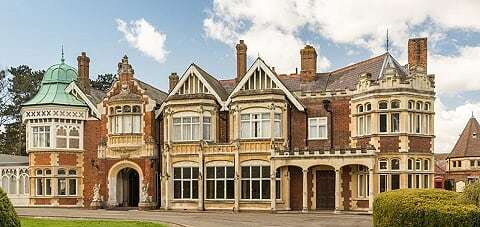
“Bletchly Park was, to put it politely, architecturally interesting. . . or the original architect was mad. . . It stood like a vast monument to asymmetrical inconsistency. . . like a precocious child playing in its mother’s clothes – ludicrous but somehow endearing for its folly.”
After reading that, I had to find a photo. Lest you think the description is an exaggeration, have a look. Bletchley Park, (date unknown)
Gentill excels at blending fiction with fact, characters and real historic figures. Evelyn Waugh made a nuisance of himself.
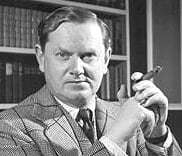
“Physically, Waugh was as Rowland remembered him: intense, piercing eyes that seemed to glare at the world as a matter of course. His features were fine and the natural curve of his mouth could be mistaken for a sneer. Waugh was, as far as Rowland could tell, sober.” Evelyn Waugh
Waugh may have been a nuisance, but he made Rowland’s artistic fingers itch.
“He drew with loose strokes: the thin upswept brows, the almost manic eyes and a strained sarcastic smile.
Clyde watched the likeness develop. He laughed. ‘Waugh! I thought you’d have had enough of him.’
Rowland smiled. ‘He’s got quite an interesting face, don’t you think?’”
Our artists do everything they can to convince the English that what’s happening in Germany is real and horrifying, and the last chapter is particularly interesting in that regard. It’s difficult to stir people out of complacency without sounding like a conspiracy theorist. We know what happened. Another World War happened.
Meanwhile, I’m looking forward to seeing more of the 1930s with Rowland and Edna, hoping they will “get together” one day. Sigh . . .
I am really loving this whole series and I am very glad there are still more books for me to read!
Rowland Sinclair is the perfect main character for this kind of historical fiction. He is very rich, well educated, well connected, good looking. intelligent, kind...…. you get the picture! He is also pretty tough and quite prepared to fight for the things he believes in. After five books I am also rather attached to his friends, Edna, Milton and Clyde.
Gentlemen Formerly Dressed (the wordplay in the title is very apt) is set in England in 1933 a time when some people, including Rowly, can foresee the threat of Hitler's Germany. Regrettably most of the important people at the time could not or would not believe it. There are delightful name dropping moments when Rowly meets people of the day such as Evelyn Waugh, H.G. Wells and even Winston Churchill who was out of favour at the time. He even has a very bad experience with William Joyce, the man who, during the war, broadcast German propaganda and became known by the British as Lord Haw Haw.
Well done Ms. Gentill for another totally absorbing book in this lovely series. I recommend it to all lovers of historical fiction, but make sure to start at book one and let the delightful characters grow on you!
Beaten and tortured by Germany's Brown Shirts, Rowland (Rowly) Sinclair and his friends have narrowly escaped being charged with murder and have fled to London via Paris. There he encounters his brother Wil who has arrived for the 1933 London Economic Conference. Although Wil wants Rowly on the first boat back to Australia, Rowly wants to first meet with some influential politicians to tell them about the horrors he saw in Germany and get them to take the threat of rising facism seriously.
This is another excellent episode in this entertaining series. With a murder of a lord in Rowly's hotel and a young woman wrongfully arrested for the murder, Rowly has his hands full trying to clear her name. To do this he must enter the world of England's aristocracy including exclusive Gentlemen's only clubs where cross-dressing is part of the scene.
As with previous books, the author's historical research and content makes for a very engaging series. Each chapter opens with a short extract from a newspaper of the time highlighting an aspect of culture or politics related to the chapter and many famous characters are given bit parts in the novel including H.G Wells, Winston Churchill, Stanley Bruce (Australian High Commissioner and ex PM 1923-29), Prince George and William Joyce, a member of the British fascists who after he defected to Germany made Nazi propoganda broadcasts to Britain during the war under the pseudonym Lord Haw-Haw.
Rowland Sinclair and his loyal companions - Edna, Milton and Clyde – settled into their penthouse apartment in Claridges in London after their narrow escape from the Nazi extremists, prepared to spend a short while relaxing before departing for Sydney. When Rowland’s brother Wilfred appeared on the scene, much to his shock, Rowland wasn’t to know much was about to go wrong for him and his friends.
First a strange murder which had both Wilfred and Rowland on hand, then the arrest of someone who Rowland firmly believed wasn’t the murderer. So it was up to him to find the real killer – which would put him in danger of his life before their time in England was up…
Gentlemen Formerly Dressed is the 5th in the Rowland Sinclair Mystery series by Aussie author Sulari Gentill, and another excellent addition to this fabulous series! Rowly – poor Rowly – always gets himself into the most disastrous of scrapes. And Ed, Clyde and Milt rescue him time and again, while Wil looks on in disgruntled disgust at the antics of his brother. Such an entertaining series, with Gentlemen Formerly Dressed another to highly recommend.
Gentlemen Formerly Dressed is the fifth book in the Rowland Sinclair series by award-winning Australian author, Sulari Gentill. Following a narrow escape from Nazis in Munich and gendarmes in Paris, gentleman artist Rowland Sinclair surprises his artistic friends by not wanting to get on the next ship home to Australia.
Rowly feels strongly that he must let someone in Her Majesty’s government know about what he saw whilst in Germany. But even with the help of his influential brother, Wilfred, and Australia’s High Commissioner, this proves both less that simple and frustratingly unproductive, as advisors to the PM repeatedly dismiss his concerns.
What he saw in Germany, in addition to his broken arm, bodily disfigurement and other injuries, has had a detrimental effect on Rowly’s wellbeing. Nor is being limited, in polite company (because of the plaster cast on his arm), to consuming consommé, helping his mood. Fellow artist, Clive Watson-Jones recognises in him what would now be diagnosed as PTSD; his solution is straightforward and a lot more effective than Horlicks.
During their stay in London, Rowly and his friends find themselves involved, much to Wil’s irritation, a number of awkward or dangerous situations, the first being the discovery of a very dead peer of the realm in an exclusive London Club. Trying to prove the innocence of a certain young lady whilst encumbered with a plaster cast takes much of Rowly’s energy.
Nevertheless, he still manages to attract a royal proposition by proxy, go for an unscheduled dip into the Thames, and be kidnapped. His paintings are stolen, a bundle of threatening letters is received, he gets caught in a police raid, incites a brawl, is beaten up more than once and is passionately kissed in public, twice.
Gentill delivers plenty of interesting historical detail, giving several famous (and infamous) figures cameos (and some, significant roles), and includes, among the twists and red herrings: Madame Tussaud’s Waxworks, eugenics, cross-dressers, mannequin limbs as weapons, and the Salvation Army.
Quotes from press articles of the time that preface the chapters cleverly serve the purpose of providing information connected to the text that follows. As always, Gentill perfectly captures the era. Once again, an outstanding dose of historical crime fiction. Readers who enjoy it will be pleased to know they can look forward to a further five (at least) instalments of this award-winning, addictive series, beginning with A Murder Unmentioned.
Gentlemen Formerly Dressed is the 5th book in the Rowland Sinclair series and picks up from the near miss that Rowley and his friends escape from in tumultuous Germany (Paving the New Road). Hampered by a broken arm, a horribly disfiguring burn on his chest and nightmare-inducing memories, the initial aim is to head for Australia after a brief stop in London.
Before he was to depart for warmer, safer shores, though, he feels it’s his duty to report what’s really going on in Germany to someone in authority in the UK. He can see that trouble is brewing and war is a definite possibility in the not too distant future. An altruistic and largely misguided hope that someone will listen to him that seems to be typical of Rowland’s unrealistic outlook on life, it seems.
Unfortunately, the person his brother Wilfred was able to line up to talk to, a peer of the realm, is found in the private suite of a gentleman’s club, run through with a ceremonial sword whilst wearing a frilly nightie. Also in the room is the man’s niece who is also his secretary. Her hands are covered in blood, she’s hysterical and inconsolable and, of course, the first person the police look to when coming up with a prime suspect.
Rowland’s not having it and leaps to her defense, becoming determined to get to the bottom of the murder regardless of the fact he has not one skerrick of evidence to prove her innocence.
While conducting his own extremely informal investigation, Roland encounters the British Union of Fascists (BUF), numerous members of the peerage class, a group of spies and the occasional German who may have recognised him from his recent encounters on the Continent. His boxing prowess is tested yet again and, inevitably, he pushes his luck as his obstinance lands him in hot water yet again.
One of the joys of the Rowland Sinclair series is the mix of fictional characters and real life luminaries from the early twentieth century that are added together to add spice to the story. H.G. Wells, Evelyn Waugh, Stanley Bruce, Prince Edward, Wallis Simpson and even the thought-to-be-all-washed-up Winston Churchill among others liven up this rollicking adventure set in Britain in the early 1930s. And, just in case there are any historical figures you didn’t recognise, there’s a great summary of each to provide you insights into their lives and roles after encountering Rowly and his friends.
This is just a pleasant trip back in time weaving engrossing mysteries through some of the more turbulent moments in history. Rowland, Edna, Milton and Clyde have their idiosyncrasies that can be, in turn, endearing and frustrating but they always manage to make their scrapes highly entertaining.
Gentlemen Formerly Dressed is another thoroughly enjoyable entry in the Rowland Sinclair series sweeping us through the upper classes in grand style. The hints of danger are tempered with good manners, style and controlled fury. The in jokes continue to roll on through as the seminal quartet carry on their easy friendship, something that ensures an overall light-heartedness to these books.
Gentlemen Formerly Dressed is the fifth book in the Rowland Sinclair series by award-winning Australian author, Sulari Gentill. The audio version is narrated by Rupert Degas. Following a narrow escape from Nazis in Munich and gendarmes in Paris, gentleman artist Rowland Sinclair surprises his artistic friends by not wanting to get on the next ship home to Australia.
Rowly feels strongly that he must let someone in Her Majesty’s government know about what he saw whilst in Germany. But even with the help of his influential brother, Wilfred, and Australia’s High Commissioner, this proves both less that simple and frustratingly unproductive, as advisors to the PM repeatedly dismiss his concerns.
What he saw in Germany, in addition to his broken arm, bodily disfigurement and other injuries, has had a detrimental effect on Rowly’s wellbeing. Nor is being limited, in polite company (because of the plaster cast on his arm), to consuming consommé, helping his mood. Fellow artist, Clive Watson-Jones recognises in him what would now be diagnosed as PTSD; his solution is straightforward and a lot more effective than Horlicks.
During their stay in London, Rowly and his friends find themselves involved, much to Wil’s irritation, a number of awkward or dangerous situations, the first being the discovery of a very dead peer of the realm in an exclusive London Club. Trying to prove the innocence of a certain young lady whilst encumbered with a plaster cast takes much of Rowly’s energy.
Nevertheless, he still manages to attract a royal proposition by proxy, go for an unscheduled dip into the Thames, and be kidnapped. His paintings are stolen, a bundle of threatening letters is received, he gets caught in a police raid, incites a brawl, is beaten up more than once and is passionately kissed in public, twice.
Gentill delivers plenty of interesting historical detail, giving several famous (and infamous) figures cameos (and some, significant roles), and includes, among the twists and red herrings: Madame Tussaud’s Waxworks, eugenics, cross-dressers, mannequin limbs as weapons, and the Salvation Army.
Quotes from press articles of the time that preface the chapters cleverly serve the purpose of providing information connected to the text that follows. As always, Gentill perfectly captures the era. Once again, an outstanding dose of historical crime fiction. Readers who enjoy it will be pleased to know they can look forward to a further five (at least) instalments of this award-winning, addictive series, beginning with A Murder Unmentioned.
The author has her series bubbling along to a set formula. A murder, a lot of famous names, Rowland gets bashed/robbed/almost murdered, a narrow escape, simmering sexual tensions with Edna, a specific event of the 1930s and a murder solved. This time the location is London, Ex-PM Stanley Bruce, HG Wells, Madame Tussards, Winston Churchill and the Prince of Wales/Wallis Simpson are all featured. The series is getting a little too predictable.
Another excellent entry in this series. The blurb (from the back of the paperback edition) lays out the plot but skimps on the emotion. While not as dark in tone and mood as the previous book ('Paving the New Road'), this story is steeped in the politics of the day. It is now June 1933--Rowland and his friends have made it safely to London. All breathe a sigh of relief--but if they thought life would be calm and restful--no such luck. Rowland wants to talk to someone in the government about what they had seen in Germany and is steered to Lord Pierrepont. Rowland and his brother Wil (hi Wil, fancy meeting you in London!) arrive for their meeting, only to find Pierrepont very dead. So, of course, Rowland has to stick his nose in--especially when Pierrepont's young niece is arrested and it is obvious that Scotland Yard is not going to do a thorough investigation. In the course of their stay in London, the gang crosses paths with several notable figures. H.G. Wells makes a cameo appearance, as do Evelyn Waugh and Winston Churchill. Rowland also manages to come to the attention of the British Union of Fascists, especially William Joyce (who is quite scary). Their stay is brightened by meeting Ethel Bruce, wife of the Australian Resident Minister to the UK. She rather gleefully agrees to help in their investigation into Pierrepont's murder. I do hope the real Mrs Bruce was as delightful as she is portrayed here. The author also drags in the very real Admiral Sir Hugh Paget Sinclair, at that time head of British Intelligence, making him a distant cousin of Wil and Roland. He is almost too interested in keeping an eye on Rowland--but why? One of the threads running through the first part of the story involves Rowland's emotional state. He can't really sleep, has nightmares when he does manage to drift off--a rather natural reaction to being tortured and almost killed. We learn a little more about Edna's early life as she tries to help him cope with his demons. (I love Edna, I really do). The mystery is finally solved, but not before the murderers try to kill Rowland. Poor Rowland!
I do hope that in the next book Rowland is injury-free; I think the author has subjected him to enough physical abuse to last for many years.
Another good entry in this series. I read it out of order, but it didn't matter. In the previous book, Paving the New Road, Rowland and his friends are in Germany and he is seriously wounded by the end, before they flee. This book begins in Paris, where they barely escape again and make their way to London. In London, they become involved in the murder of Lord Pierrepont, trying to prove that His Lordship's niece did not kill him. As usual, Sulari Gentill begins each chapter with interesting historical tidbits. And she includes real historical figures, such as Winston Churchill.
Edna wiped the single tear which had made its way past her resolve not to cry in front of Wilfred. “Who else would take Rowly, Mr Sinclair?” Wilfred took the handkerchief from his breast pocket and handed it to the sculptress. “In my experience, Miss Higgins, Rowly acquires enemies the way you ladies acquire hats…
Set in 1933, the fifth book in the Rowland Sinclair series opens with Australians Rowly, Edna, Clyde and Milton leaving Paris for London. Rowly was abducted, roughed up and nearly killed in Munich by Nazis and has his arm in plaster, which does not prevent his being abducted, roughed up and nearly killed in London. His brother Wilfred is in London to attend an economic conference and staying with the Australian High Commissioner Bruce and his wife. In an attempt to draw the attention of the Nazis to the authorities the two brothers go to a gentlemen’s club in Mayfair to speak to a peer of the realm, finding him dispatched by a ceremonial sword and dressed in a nightie. The niece is arrested as main suspect.
I was in two minds about this one: I like the way the author injects her characters into the lives of luminaries of the age – in this case Arnold Deutsch – the Soviet spy who recruited the Cambridge 5, writers Herbert (H G ) Wells and Evelyn Waugh, and Winston Churchill who was out of favour at the time. I did not at first catch on to black-shirt William Joyce and Bletchley Park, but it all fell into place. I also liked the snippets of newspapers of the time – her signature – and the epilogue explaining how stones from the old Waterloo Bridge found their way across the globe, and are present in the bridge over Lake Burley Griffin in Canberra.
On the minus side there is a clichéd bumbling Scotland Yard detective, a Latin-spouting solicitor and yet another dead-sh*t character from Rowly’s Oxford days - I’d had my fill of that in Miles Off Course. Not tiara-bashing, but I find the foibles and proclivities of the Royal Family and British peerage only marginally less interesting than Hollywood A-listers. But then I am probably not among the intended readership. The reference to the “Queen Mother” threw me as Queen Alexandra died back in 1925.
Rowland and friends, battered but unsubdued, make their way into Paris with the Germans hot on their trail. Brother Wilfred again shows up at the crucial moment and handles things as they all manage to get to London. Somehow Rowland is determined to tell the influential men in British Government about what he experienced and saw in Fascist Germany, but few are interested and many are fascists themselves. In the middle of this, a murder of a prominent Lord occurs and as usual Rowland becomes involved. Fascists, spies, Madame Tussard waxworks, murder, eugenics, and old Oxford chums add to the mix which of course leads Rowland into more danger.
This is a great series. I love the history and the way famous figures are introduced into the story. Rowland is the ultimate gentleman, and his loyal friends continue to support him and keep him somewhat safe. Even more touching is his brother Wilfred, who obviously deeply cares about Rowland, but usually displays this with lectures and shouting. Yet when things are blackest Wil drops everything to rescue Rowly. Just beautiful.
I don't know why I rated the others in this series 4 stars, because I really like them. I think my 4's and 5's are interchangeable, and it depends more on me on the day! Sulari has written a great cast of characters, blends in world (and Australian) history beautifully and includes a bit of the wilder and/or bohemian lifestyles every age is known for in some way. Set in the delectable 1930's, with the world leading up to WW2, eugenics is a popular subject worldwide and fascism is seen by many to be the way forward. Love your work, Sulari. You're right up there with my favourite authors.
Ok, it's official, I'm in love with Rowland Sinclair- although he still has eyes only for Edna. Love the twists & turns, love that Rowly is just a little more physical on this outing, and love the increased, yet still subtle, humour. A great read.
There’s something about these books that is starting to annoy me. Don’t get me wrong -- I enjoy the breadth of the author’s research behind the plotting of her books, and the quality of the writing and characterization is superb. What’s starting to grate is the growing expectation that Sinclair is going to get roughed up/then beat up/nearly killed in every single one. That’s what certainly happened in the book before this, and what’s happening to Rowly and his band of merry friends in this one, as he comes up against members of the “brown shirts,” the Oswald Mosley group in Britain that advocated fascism and anti-Semitism -- and which might have succeeded if Hitler hadn’t put a kibosh on those plans. This is all a sidebar to the murder of a socially prominent peer, found in a compromising position.
Certainly names are dropped again -- H.G. Wells, the aforementioned Mosley, his henchman William Joyce, the male members of the royal family, ergo of course Mrs. Wallis Simpson(!), Evelyn Waugh (whom the author seems to have taken a particular dislike to), even Winston Churchill. They all figure in one way or another to further the storyline -- which mentioning here would amount to a spoiler. Suffice it to say that the denouement of the reasons for the murder and its aftermath is rather distasteful, even if it has a basis in history. Much is explained in the epilogue and the author’s afterword.
Thankfully, Sinclair and his friends are on their way back Down Under at the end of the book. Where he will no doubt find something else to nearly lose his life over.
Thanks to the publisher and NetGalley for the copy of this book, in exchange for this review.
Rowland, Edna, Milton and Clyde are back in London biding their time before returning to Australia. Nothing can possibly go wrong. Claridge's Hotel becomes there home away from home and trouble soon follows. Woven through the story are snippets of social and international history. Sit down with a coffee and be taken into the world of the weird upper classes in Britain.
This book was lent to me by a friend as both she and another mutual friend had enjoyed it. Otherwise I don't think I would have discovered Sulari Gentill and the Rowland Sinclair mysteries. This book is the fifth in the series and follows directly on from the previous book set in Nazi Germany in 1933, from which Rowland has escaped with a broken arm and swastika-shaped cigarette burns on his chest. Rowland is a wealthy Australian artist, travelling with three companions, Edna, Milton and Clyde. They arrive in London and take over the penthouse suite at Claridge's. It doesn't take long for a murder to happen and for the niece of the deceased to be wrongfully arrested. Determined to clear her name the Australians become embroiled in a case involving Blackshirts, the aristocracy and a variety of colourful characters from all walks of life.
I thought this book was a real blast! It is as one of the reviewers on the back cover says 'a lighthearted romp through 1930s high and low British society'. Although it deals with the rise of fascism and the effects of the Great Depression, it is a delight to read. The author has a pleasing style and a fondness for the bizarre. I loved the humour and the characters. The wife of the Australian prime minister, Ethel Bruce proves to be a great ally as she is intrigued by the scandal surrounding the murder and having friends in high places is able to use her influence to help Rowland. I thought she was great fun! The murder victim was having a waxwork model make at Madame Tussaud's but only the head had been completed before his demise and Rowley and co end up with it on the sideboard in their suite, often engaging in (one way) conversations with it.
The author skilfully weaves real events and characters into the story - H G Wells and Winston Churchill both appear. This was very well done and I felt she had done her research. I also liked the 1930s setting, as this was such an interesting period of world history. Each chapter is preceded by part of an article from a newspaper or periodical (predominantly if not all Australian) which has some relevance to the chapter - another interesting device.
All in all I thoroughly enjoyed Gentlemen Formerly Dressed. The story was great and moved along at a fast pace, yet I found myself taking my time with it, enjoying the various settings and being in the company of the engaging characters. I would happily read more in this series. A great recommendation!
This entire review has been hidden because of spoilers.
I would like to thank Netgalley and Poisoned Pen Press for a review copy of Gentlemen Formerly Dressed, the fifth novel to feature Australian painter Rowland Sinclair and his friends, Edna, Milton and Clyde.
Having barely escaped Nazi Germany with his life Rowlie and the gang are leaving Paris for London where he is determined to expose the Nazis' behaviour when they are almost caught. Once in London Rowlie is delighted for once to meet his brother, Wil, and enlist his help. Unfortunately the man Wil chooses to meet, Lord Pierrepont, is murdered before they can talk and it is they who find the body.
I thoroughly enjoyed Gentlemen Formerly Dressed which is another fine addition to a fascinating series. I love the mixture of historical detail and characters with an exciting adventure and the extracts from contemporary newspapers at the start of each chapter.
It is difficult to discuss the plot without issuing spoilers but it starts with a gory murder and widens into an adventure with a topical motive for the era. I admire the way Ms Gentill effortlessly weaves a very strong sense of era and the hot topics of the time into an exciting read. No reader can come away from the novel without a much better understanding of mid thirties Britain, the gossip, the politics, the economics and the thinking. The plot itself is faintly ridiculous to modern eyes with the liberal Rowlie tangling with the Right Wing in its many guises. I was glued to the pages as he slowly unravels Pierrepont's murder at some personal cost.
Much of the enjoyment in this series comes from the strong bond between Rowlie and his artistic friends, Edna, Milton and Clyde. It is rather muted in this novel as Rowlie is firmly centre stage, taking most of the action himself and leaving the others in a supporting role, except on one amusing occasion when Edna steps in.
Gentlemen Formerly Dressed is a good read which I have no hesitation in recommending.
I would give this two and a half Stars if I could, but since I can't I'll leave it at 2. These books just increasingly go beyond the point where I can suspend disbelief, and I find the weaving of real life characters into the plots annoying. I was glad that "Mrs Ernest Simpson" was not actually more than a referred to character, but I could just feel the author crowing about dropping her in there to see if her readers are as history savvy as she is. Kind of condescending. I will continue to read this series because I can get the books on Libby, but it's not a series I would want to reread.
Always interesting to be back with Rowly and company. They manage to escape to London and try to tell someone in the government about what was happening in Germany, no luck, they're aiming for appeasement. That conference was interesting as was the bits about the English Black shirts and the different sects among the eugenics. Good mystery weaving its way through all what's going on. One thread not answered is what would happen to the baby. Love the epilogues in this series.
Gentlemen Formerly Dressed is the fifth book in the Rowland Sinclair series by Sulari Gentill. These books are always a little exaggerated, and the characters regularly stumble across famous historical figures who become entwined in the story, but that is part of the charm. They are fun, easy reads. This instalment is set in London and is a little darker in places, but still delivers a solid murder mystery. I am definitely looking forward to book six.
Gentlemen Formerly Dressed is the fifth book in Gentill's Rowland Sinclair mystery series.
GFD picked up where Paving the New Road left off - with Rowly and his friends fleeing 1933 Germany to reach London, battered and bruised but alive to tell their tale.
However, London turns out to be not so safe after all. Fascists have infiltrated London society and a bizarre murder sees Rowland and his friends embroiled in intrigue and danger once again.
The fifth book in this series once again doesn't disappoint. I love the way she uses the backdrop of the 1930s to set her intriguing plots, peppering her cast with real historical characters. One small quibble in this one though, I don't think she's aware that giving a hot drink to someone suffering from hypothermia can be fatal. Aside from that, I thoroughly enjoyed the delightful characters and clever plotting. I'm also very relieved to know that there's another book in the pipeline.
This series continues to delight and intrigue, revealing aspects of history that I had very little knowledge of before! I love the clever use of different settings and weaving in important historical details and figures. While there has been some character development, particularly for Rowly, it would be great to see more, particularly in the Rowly's excellent friends.
Just a fun read with likable characters from the previous books. I enjoyed the history that was spread throughout the book in a way that fit with the story and characters. There were some nasty characters and I hate that Rowly will meet up with some of them Again.
I've enjoyed this series, but it's becoming formulaic, and I don't know if I'll read another book if the author releases it. The author is talented, her voice is original, and her writing is strong. But the characters haven't developed since book 1 (and I've read all five books), and the protagonist—Rowland Sinclair—is becoming a bit of a sap for his continued adoration of the unresponsive Edna.
I also have a minor problem with a technical detail in this book, something that confirms that the author might be running out of tricks and is resorting to things about which she knows little. In a dinner-table scene, a character pokes fun at her "brother" by saying that any bird (pheasant, I think) that he shoots wil be full of buckshot, so diners need to be careful of their teeth. The "sister," rumored to be quite a markswoman, says that the right way to kill a bird is to shoot off its head.
As an avid upland gamebird hunter, I promise that NO ONE tries to shoot the head off a bird. It's simply not done. You shoot the bird, aiming a little high if it's flying away, a little low if it's one of the rare (stupid) birds that flies at your gun.
But it's details like this, plus the repetitive storyline and lack of character development, that make me think that the author's imagination might be spent.
"Gentlemen Formerly Dressed" is a mystery set in June and July 1933 in England. This is the fifth novel in a series. This story referred back to events that happened in previous books, especially the fourth book. The events that happened in Germany still impact the characters during this book, so I'd recommend reading that story before this one.
The main characters were interesting, caring people. Since an innocent girl was being accused of murder, they asked questions despite being warned off by people trying to hush up the crime. Since the murdered man was found in a woman's nightgown, they looked into a possible homosexual connection. There were enough clues that I could guess whodunit shortly before Rowley. The main characters also tried to warn people in Britain about Hitler and what's going on in Germany. Interesting historical details were woven into the the story and touch on the crime.
There was some bad language (if you're American) to a fair amount of bad language (if you count British/Australia bad words). There were no sex scenes. Overall, I'd recommend this interesting novel.
I received a free ebook review copy of this book from the publisher through NetGalley.