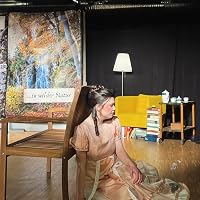
New York runt år 1900. Upper East Side, Metropolitan Museum - Edith Wharton, författare till bland annat romanen Oskuldens tid, tar oss i Kvicksand med till det aristokratiska, gamla Manhattan. Denna mångbottnade novell bjuder på oväntade vändningar och ironiska efterdyningar, och är ett triangeldrama mellan en distingerad mor, hennes passionerade son och hans fritänkande käresta.
Mrs Quentin sjönk ned på bänken och sträckte ut en hand till flickan. "Sätt er hos mig", sade hon. Miss Fenno damp ned bredvid henne. Hos båda kvinnorna var den känslomässiga anspänningen så stark att de inte fick fram ett ord. Flickan skälvde fortfarande, och det var mrs Quentin som först återfick fattningen. "Ni säger att ni har plågats", började hon till sist. "Tror ni inte att jag har det?"
Edith Wharton emerged as one of America’s most insightful novelists, deftly exposing the tensions between societal expectation and personal desire through her vivid portrayals of upper-class life. Drawing from her deep familiarity with New York’s privileged “aristocracy,” she offered readers a keenly observed and piercingly honest vision of Gilded Age society.
Her work reached a milestone when she became the first woman to receive the Pulitzer Prize for Fiction, awarded for The Age of Innocence. This novel highlights the constraining rituals of 1870s New York society and remains a defining portrait of elegance laced with regret.
Wharton’s literary achievements span a wide canvas. The House of Mirth presents a tragic, vividly drawn character study of Lily Bart, navigating social expectations and the perils of genteel poverty in 1890s New York. In Ethan Frome, she explores rural hardship and emotional repression, contrasting sharply with her urban social dramas.
Her novella collection Old New York revisits the moral terrain of upper-class society, spanning decades and combining character studies with social commentary. Through these stories, she inevitably points back to themes and settings familiar from The Age of Innocence. Continuing her exploration of class and desire, The Glimpses of the Moon addresses marriage and social mobility in early 20th-century America. And in Summer, Wharton challenges societal norms with its rural setting and themes of sexual awakening and social inequality.
Beyond fiction, Wharton contributed compelling nonfiction and travel writing. The Decoration of Houses reflects her eye for design and architecture; Fighting France: From Dunkerque to Belfort presents a compelling account of her wartime observations. As editor of The Book of the Homeless, she curated a moving, international collaboration in support of war refugees.
Wharton’s influence extended beyond writing. She designed her own country estate, The Mount, a testament to her architectural sensibility and aesthetic vision. The Mount now stands as an educational museum celebrating her legacy.
Throughout her career, Wharton maintained friendships and artistic exchanges with luminaries such as Henry James, Sinclair Lewis, Jean Cocteau, André Gide, and Theodore Roosevelt—reflecting her status as a respected and connected cultural figure. Her literary legacy also includes multiple Nobel Prize nominations, underscoring her international recognition. She was nominated for the Nobel Prize in Literature more than once.
In sum, Edith Wharton remains celebrated for her unflinching, elegant prose, her psychological acuity, and her capacity to illuminate the unspoken constraints of society—from the glittering ballrooms of New York to quieter, more remote settings. Her wide-ranging work—novels, novellas, short stories, poetry, travel writing, essays—offers cultural insight, enduring emotional depth, and a piercing critique of the customs she both inhabited and dissected.
She sat gazing rigidly forward, her eyes on the pictures, speaking in the low precipitate tone of one who tries to press the meaning of a lifetime into a few breathless sentences.
In true Wharton fashion, this is a tale of emotional insight laced with humor and pathos. Told impressively in a circular pattern, it demonstrates the circularity that occurs in families and in life. Just beautiful.
This is the short but complex story of a mother and member of Manhattan's "high society" a century ago, who goes to great lengths to guarantee a good life for her son, and is now faced with some difficult decisions what to advise the young woman her son wishes to marry -- and in the process to confront her own past.
Loved this story. Quicksand was an entirely apt name when when one analyses how one step on unsteady, immoral ground can lead to another until you barely recognize the person you’ve become from the choices you’ve made.
At first, Mrs. Quentin seems like a mother who has her son at the centre of her world, almost fading into the background herself. But as the story unfolds, we discover the woman she once was, her virtues, and how she got caught up in a life she hadn’t quite imagined for herself. There’s so much feeling in this story, beautifully brought out in her conversations with a young woman who might be heading down the same path.
She ignored her own conscience-until she saw it in another. °❀⋆.ೃ࿔*:・
As she navigates the constraints of marriage, social expectation, and fleeting passions, Wharton exposes the quiet tragedies that emerge from indecision and longing. 𖣂
⭑.ᐟ The story’s tension lies not in dramatic events, but in the slow, inevitable suffocation of a life unmoored, drawing the reader into a narrative as inescapable as the title itself.
Wonderful short story about the keeping of ideals and ethics and the compromises women have to make along the way and opens up the question whether they should. The Quicksand is truly an apt name to describe it.
This story gives insightful ideas about what a relationship and life of a committed couple means particularly to a woman, as well as to a man, as seen by a woman. These views are shared in the conver-sations of a mother and the hopeful partner of her son. This story gives necessary lessons that should be read. To men it opens a new world of meaning to what the woman sees, hopes for, expects, and believes. Women can more clearly see and analyze their own feelings and motives. It is fascinating to shed light on that elaborate fantasy we call love.