THOMAS BRUCE WHITE was his full name, but everyone call him "Tom." He was born in a log house in Texas in 1881 and he died in El Paso in 1971. During his ninety years, he was a Texas Ranger ... F. B. I. investigator ... Warden at Leavenworth ... and Warden at La Tuna. This informal biography tells of the career of a man who devoted his life to "law and order " and who remained a humanitarian through it all.
The author is Verdon Adams, who knew Tom White intimately during the last years of his life and who has told Tom's story with care and candor, with sensitivity and sincerity, with admiration and affection for his subject.
Readers will find this work interesting and inspiring, for it tells the life story of a man of integrity-a quality which many claim is all too rare in our century when even the idea of law and order is severely challenged. The book has been edited and indexed by Professor Joseph M. Ray, The University of Texas at El Paso.
I tracked this down after finishing Killers of the Flower Moon by David Grann. I was lucky enough to hear him give a lecture on KotFM and afterwards asked if he had any recommendations for further reading on the FBI agent responsible for bringing some of the murderers to justice and he named this small memoir.
Written by a family friend, this is clearly a loving account of the career of Tom White. While far from hard-hitting journalism, Mr. Adams does give a detailed account of his friend's time in law enforcement, from the Texas Rangers, to the FBI, to the warden of Leavenworth and more. It's a fascinating life and a quick read to learn more about it. If you enjoyed KotFM and want to read beyond what Grann was able to include, then I highly recommend this title if you can find it!
As previous reviewers, I came here not from interest in White personally, but neither from interest in Osaga Indian murders, although I am not completely fed up by their narrative as from others more mandatory=more annoying Victims-in-Chief, but have almost no desire to know more. Panzram brought me here. But before there was a very meaningful stream/conversation between John Borowski and Kenneth M. LaMaster which initially pointed me to this book.
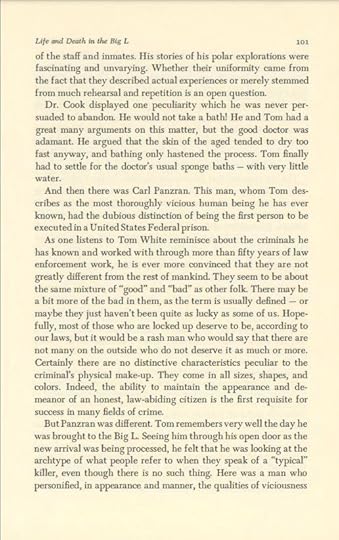
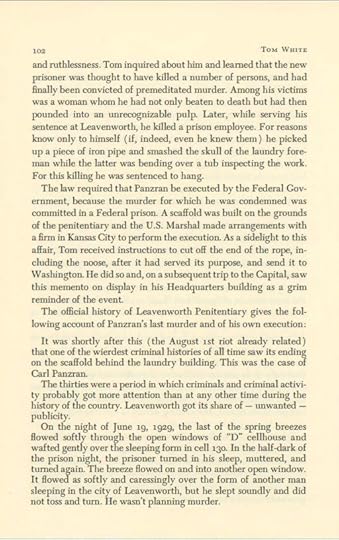
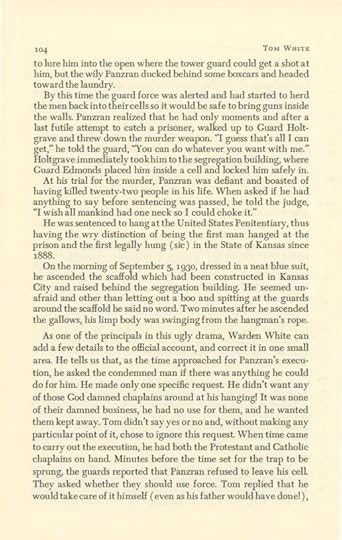
White's version of events was intriguing because it differ from what as; 'Hurry up, you Hoosier bastard, I could kill ten men while you're fooling around!', make many decades later it's own way in every kind Most famous last words. I present here all this 5 pages concerning Panzram (or, how White or Adams, don't know to whom attribute this mistake, call him Panzran) from 101 to 105.
I don't know in which mental folder truth/not truth I can put this version, because we really don't know which phrase exactly was said, yes, despite books, films or even newspapers reports right after execution which only mentioned that Carl "cursed", if there was Henry Lesser or Carl Menninger and testified, I would believe them. But Thomas Bruce White... While reading his biography, especially first three chapters, where he is more stick up to his personal/family life and more intimate affairs known only to him, rather then widely lighted through different sources Atlanta investigation, Leavenworth prison break and Osaga murders, it feels like reading religious hierography or political prospect—and yes, I did mean lie under those words. I do not doubt most of fact told by him, but how exactly all this happened, how it sounded, how everyone look and looked... that's I'm quite sure, will be different story.
After reading “Killers of the Flower Moon” by David Grann, I wanted to read more about the fascinating life and career of Tom White. Sadly, just because a life is fascinating, doesn’t mean a book about that life will be.