Franz Kafka was a German-speaking writer from Prague whose work became one of the foundations of modern literature, even though he published only a small part of his writing during his lifetime. Born into a middle-class Jewish family in Prague, then part of the Austro-Hungarian Empire, Kafka grew up amid German, Czech, and Jewish cultural influences that shaped his sense of displacement and linguistic precision. His difficult relationship with his authoritarian father left a lasting mark, fostering feelings of guilt, anxiety, and inadequacy that became central themes in his fiction and personal writings. Kafka studied law at the German University in Prague, earning a doctorate in 1906. He chose law for practical reasons rather than personal inclination, a compromise that troubled him throughout his life. After university, he worked for several insurance institutions, most notably the Workers Accident Insurance Institute for the Kingdom of Bohemia. His duties included assessing industrial accidents and drafting legal reports, work he carried out competently and responsibly. Nevertheless, Kafka regarded his professional life as an obstacle to his true vocation, and most of his writing was done at night or during periods of illness and leave. Kafka began publishing short prose pieces in his early adulthood, later collected in volumes such as Contemplation and A Country Doctor. These works attracted little attention at the time but already displayed the hallmarks of his mature style, including precise language, emotional restraint, and the application of calm logic to deeply unsettling situations. His major novels The Trial, The Castle, and Amerika were left unfinished and unpublished during his lifetime. They depict protagonists trapped within opaque systems of authority, facing accusations, rules, or hierarchies that remain unexplained and unreachable. Themes of alienation, guilt, bureaucracy, law, and punishment run throughout Kafka’s work. His characters often respond to absurd or terrifying circumstances with obedience or resignation, reflecting his own conflicted relationship with authority and obligation. Kafka’s prose avoids overt symbolism, yet his narratives function as powerful metaphors through structure, repetition, and tone. Ordinary environments gradually become nightmarish without losing their internal coherence. Kafka’s personal life was marked by emotional conflict, chronic self-doubt, and recurring illness. He formed intense but troubled romantic relationships, including engagements that he repeatedly broke off, fearing that marriage would interfere with his writing. His extensive correspondence and diaries reveal a relentless self-critic, deeply concerned with morality, spirituality, and the demands of artistic integrity. In his later years, Kafka’s health deteriorated due to tuberculosis, forcing him to withdraw from work and spend long periods in sanatoriums. Despite his illness, he continued writing when possible. He died young, leaving behind a large body of unpublished manuscripts. Before his death, he instructed his close friend Max Brod to destroy all of his remaining work. Brod ignored this request and instead edited and published Kafka’s novels, stories, and diaries, ensuring his posthumous reputation. The publication of Kafka’s work after his death established him as one of the most influential writers of the twentieth century. The term Kafkaesque entered common usage to describe situations marked by oppressive bureaucracy, absurd logic, and existential anxiety. His writing has been interpreted through existential, religious, psychological, and political perspectives, though Kafka himself resisted definitive meanings. His enduring power lies in his ability to articulate modern anxiety with clarity and restraint.
Birth is a curse, and existence is a prison - The Good Place
Kafkaesque, the word sends an eerie feeling through our hearts whenever we happen to hear it. What it actually means is that when you enter a surreal world in which all your control patterns, all your plans, the whole way in which you have configured your own behavior, begins to fall to pieces, when you find yourself against a force that does not lend itself to the way you perceive the world. You don't give up, you don't lie down and die. What you do is struggle against this with all of your equipment, with whatever you have. But of course you don't stand a chance. That's Kafkaesque. As put up by Friedrich Karl.
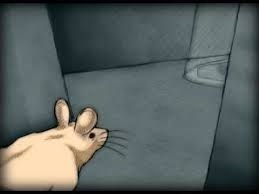
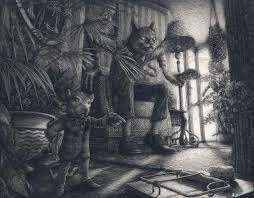
A little fable is a typical example of Kafkaesque. A mouse talks about how his world is getting narrower everyday, the demonic forces of his world are crushing it through hellish forces. He is out of clue, and runs either and thither, looking for way out, however only to fall in to the cruel jaws of the eventual fate.
The story may be short but it may be applicable to our day-today lives. We, as most civilized and proud species on the planet, suffers from this dilemma of cat and mouse. Our whole life revolves around our struggle to strive hard for achieving seemingly prized benefits, which muddles our head and we run to look for divine solutions which may help us out to some sort to enlightenment. What we really forget here is that life itself is a random event, there is no such thing to be attained which can provide us the salvation. The whole universe (or multiverse) aroused out of a random event and may be end by a random event too.
There is no divine pattern to look upto. But we, as conscious beings, find hard to accept it. Since our ego (super-ego as per Freud) does not permit us to accept fate as random as life itself is. And we spend our entire life looking for some sort of well-laid and structured design. There is the process, we may find some distractions which, claim to be suggesting us about celestial motifs, however only to find out later that eventual fate of all those motifs/ ways is same- a certain death. But what if it’s not death at all. What if there is no birth on the first place. It is just transformation of energy from one form to another. And, we, human beings, have written thousands of scriptures about (claiming to understand it), only to become dust eventually as those so called scriptures will also become eventually.
We have been already doomed, in fact our very birth marks our destruction. All our humongous achievements, all our ‘prized’ attainments are going to meet the same fate. No matter how much you achieve, death will put you down. But why we are running like mad after all these realizations then. Do the all hope, which we seemingly find, is just a devilish illusion. Perhaps, we human beings need these games to bear our existence or probably we don’t understand it in first place.
Death is inevitable so we must make the most of whatever time we have got in our ‘doomed’ existence. The rodent has consumed his time on earth fixating on how he can get away from death and when he was going to bite the dust, he just whined about his circumstance. Perhaps, we must strive to enjoy this time out here rather than be worried about any divine pattern, which is waiting to be solved by some ‘enlightened’ being.
Kafka's humor could be sensed from the story, we may call it dark humor- that the horrific struggle to establish a human self results in a self whose humanity is inseparable from that horrific struggle, as put out by David Foster Wallace in his speech on Kafka. However, we generally find it hard to get that humor, perhaps we are conditioned to not to perceive that as humor rather as tragedy. As Wallace says that we come to art to forget ourselves- to pretend for a while that we're not mice and all walls are parallel and the cat can be outrun — it's no accident that we're going to see 'A Little Fable' as not all that funny.
The story can be categorized in flash fiction rather than a vignette. For, I think flash fiction is a fully encapsulated narrative arc, with all the trimmings, only many of the trimmings and details are suggested, planted between the words, encouraging the reader to work these out for him or herself, but certainly not forgotten. A vignette leaves details out. It is a part of a story. It may be a character focus or setting study, a section that would function as an aside to a fuller narrative arc. For the linguists, think of the flash fiction as a fully functioning clause without all the adverbial modifiers and phrases. Vignettes step away from the action momentarily to zoom in for a closer examination of a particular character, concept, or place.
You will find that each word is written with a careful and measured precision wherein you can’t miss even a single word since the effect of whole narrative would have changed. It’s like gospel of human existence which should be read as a careful meditation of human condition.
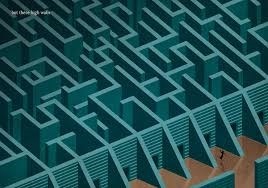
"Alas," said the mouse, "the whole world is growing smaller every day. At the beginning it was so big that I was afraid, I kept running and running, and I was glad when I saw walls far away to the right and left, but these long walls have narrowed so quickly that I am in the last chamber already, and there in the corner stands the trap that I must run into." "You only need to change your direction," said the cat, and ate it up.
A mouse, on a verge of his death, talked about how everyday the world he lived in got smaller. He spent his life running until the only place he hasn't been is the corner with the cat's trap.
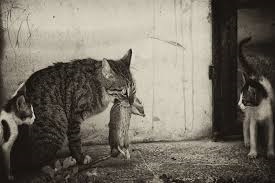
What the rat has said is applicable to the life we live. We spend all of our lives working hard for our benefit but we will find out in the end that death is waiting for us like the cat is waiting for the mouse. We are already doomed before anything even began. Great men have achieved so much in their lives yet death put them down. The cat gave an advice to the mouse, he said "You only need to change your direction." and it gives a sense of hope to the reader. But the cat ate the mouse shortly after the advice, which meant that no matter how hard we try to live forever in this world, in every effort we make we will encounter death one way or another.
Death is inevitable so we must make the most of our lives. The rat has spent his life obsessing over how he can escape death and when he was about to die, he only complained about his situation. We must not be the rat who did nothing but worry about dying, instead, we must be persons who aspire to be better and remember every good memory we will have so when we are on our death beds, we will not be filled with regret and sadness.
The Narrowing Room: On Kafka’s “A Little Fable” and a Summer of Dissolution
It was the summer of 2013, and everything felt too much. Too bright, too loud, too endless. I was twenty-something, caught in that phantom zone between ambition and apathy, a quiet sort of drowning that no one around me seemed to notice. I remember the heat being relentless that year, like the sun had decided to squat on the city and watch us sweat in slow motion. Fans creaked. Walls radiated heat back like accusations. The evenings offered no solace.
And into that sweltering disquiet, I slipped into Kafka.
Not gently, mind you—there’s no gentle way to enter Kafka. His world isn’t one you visit so much as fall into. Like a well with no echo. I had started with The Metamorphosis—of course, the gateway drug—but I soon found myself obsessing over the lesser-known, denser, more parabolic works. And that was when I stumbled upon A Little Fable.
At first glance, it is almost insultingly short. Barely a few paragraphs. You can read it in the time it takes your tea to steep. But if you’re not careful, those lines lodge inside you like a shard of broken glass. You move differently after.
In A Little Fable, there is a mouse. There is motion. There is a wall. That’s all I’ll say about the story itself. But what struck me, almost brutally, was the way it compressed despair into something so starkly inevitable. It was a fable without comfort. A story without escape. And yet, I felt seen.
That summer, I was the mouse. And the room was closing in.
I was teaching at a new institution then—my first big “proper” job. The kind with an ID card, faculty meetings, and little polite nods in air-conditioned staffrooms. I should’ve felt proud. Instead, I felt like I was being slowly vacuum-sealed into some inescapable future. The corridors felt narrow. The syllabi felt heavier than they should. The laughter around me seemed canned. I had dreams—I was going to write, maybe even publish—but every week that passed, the room shrank a little.
Kafka, it turns out, doesn’t offer answers. But he does offer echoes. And sometimes, that’s enough. Reading A Little Fable, I realized that I wasn’t alone in this bizarre internal claustrophobia. That someone, almost a century earlier, had felt the same slow suffocation and given it shape.
The beauty—if you can call it that—of Kafka is that he never screams. He whispers. He deals in suggestion and silence. He trusts the horror to be implicit. And that’s what I learned from him that summer. That dread doesn’t always look like disaster. Sometimes it’s just a quiet hallway, narrowing. A desk job. A lingering sense that the ceiling is just a little lower than it was yesterday.
But I didn’t stop reading. In fact, I couldn’t. Kafka became my strange, spiritual companion from 2013 to 2015. I read The Trial under flickering tube lights, In the Penal Colony in the back benches of dull seminars, The Castle on trains that smelled of rust and coconut oil. Each story was like walking into a dream where I already knew the ending, but not how I got there.
A Little Fable, however, remained my touchstone. Its brevity meant I revisited it often—sometimes weekly. It felt like a philosophical koan, something you don’t solve but live with. I even taught it once, slipped it in between T.S. Eliot and Camus. The students looked baffled. One boy raised his hand and asked, “But sir, why doesn’t he turn around?”
I didn’t have an answer then. I’m not sure I do now.
Eventually, the Kafka haze lifted. Life, as it does, shifted. I moved cities. I wrote more. Loved better. Laughed louder. The room didn’t feel so narrow anymore. But that mouse? He’s still in me somewhere. That summer still simmers beneath my skin. And A Little Fable—that tiny tale of inevitability—remains etched like a warning or a truth I never asked for but needed.
Because sometimes, all a story needs to do is say: Yes, the walls are moving. No, it’s not just you.
And sometimes, that’s the only kind of comfort we get.
In a few lines, almost in poetry, Kafka provokes us in the text form of a fable, told by a mouse, that reflects about the change of perception that it has of its existence.
And then the history reveals us for who the mouse is venting. This is one of the secrets of the story.
The mouse gets its answer, short, wise and deep. But the absurdity of life shows itself once more: tragic, ruthless and beautiful.
A thought provoking short-story on the inevitability of death.
The idea of mortality paralyses us into a state of perpetual fear. Before we know it, we are at death’s doorstep and a life full of apprehension has passed us by.
Though the narrowing of the mouse’s world anticipates one outcome, Kafka illustrates the importance of accepting life’s fleetingness—something the mouse comes to realise too late.
Esta fábula la tuve que leer como 5 veces para comprenderla al 100% y no irme con lo primero que entendí. Y analizando el texto es que a pesar de cómo la rata iba creciendo todo se iba haciendo “pequeño” hasta que de repente por así decirlo ve que el único camino que le “quedaba” era pasar por la ratonera hasta que el gato que busque otro camino y al momento de hacer eso el gato se la comió. Ósea que la rata ya estaba destinada a morir no importaba el camino que recorriera.
I like to see this as a metaphor for life and depression, and societal constraints, having to fit in, yearning for freedom, whatever that means.
Though, also, just the inevitability of death. That at the end of your life will you wonder if your life amounted to anything? Or did you just exist to run away, to fear?
Had to read it for school. I guess it’s nice because it can be interpreted in many ways? Although I do have to admit that I don’t think I would necessarily reach out for his books if it wasn’t for like school purposes or through recommendations.
We,as humans,aren't aware of how lucky we are. Not until we lose those perks. For example, a mouse is so scared of how big and wide the world is,but in the end, he wouldn't die if it weren't for the world getting narrower every day.