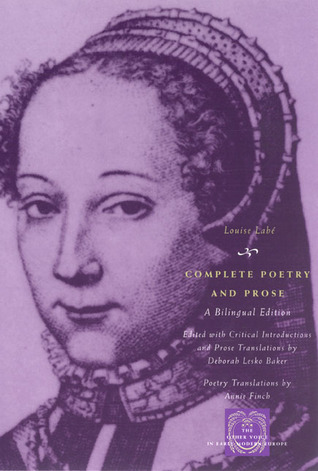
Thanks to her acclaimed volume of poetry and prose published in France in 1555, Louise Labé (1522-66) remains one of the most important and influential women writers of the Continental Renaissance. Best known for her exquisite collection of love sonnets, Labé played off the Petrarchan male tradition with wit and irony, and her elegies respond with lyric skill to predecessors such as Sappho and Ovid. The first complete bilingual edition of this singular and broad-ranging female author, Complete Poetry and Prose also features the only translations of Labé's sonnets to follow the exacting rhyme patterns of the originals and the first rhymed translation of Labé's elegies in their entirety.
The precise date of Louise Labé's birth is unknown. She is born somewhere between 1516 (her parents marriage) and 1523 (her mother's death). Both her father and her stepmother Antoinette Taillard (whom Pierre Charly married following Etiennette Roybet's death in 1523) were illiterate, but Labé received an education in Latin, Italian and music, perhaps in a convent school. At the siege of Perpignan, or in a tournament there, she is said to have dressed in male clothing and fought on horseback in the ranks of the Dauphin, afterwards Henry II. Between 1543 and 1545 she married Ennemond Perrin, a ropemaker. She became active in a circle of Lyonnais poets and humanists grouped around the figure of Maurice Scève. Her Œuvres were printed in 1555, by the renowned Lyonnais printer Jean de Tournes. In addition to her own writings, the volume contained twenty-four poems in her honor, authored by her male contemporaries and entitled Escriz de divers poetes, a la louenge de Louize Labe Lionnoize. The authors of these praise poems (not all of whom can be reliably identified) include Maurice Scève, Pontus de Tyard, Claude de Taillemont, Clement Marot, Olivier de Magny, Jean-Antoine de Baif, Mellin de Saint-Gelais, Antoine du Moulin, and Antoine Fumee. The poet Olivier de Magny, in his Odes of 1559, praised Labé (along with several other women) as his beloved; and from the nineteenth century onward, literary critics speculated that Magny was in fact Labé's lover. However, the male beloved in Labé's poetry is never identified by name, and may well represent a poetic fiction rather than a historical person. Magny's Odes also contained a poem (A Sire Aymon) that mocked and belittled Labé's husband (who had died by 1557), and by extension Labé herself. In 1564, the plague broke out in Lyon, taking the lives of some of Labé's friends. In 1565, suffering herself from bad health, she retired to the home of her friend Thomas Fortin, a banker from Florence, who witnessed her will (a document that is extant). She died in 1566, and was buried on her country property close to Parcieux-en-Dombes, outside Lyon. [edit:]Debated connection with "la Belle Cordière" From 1584, the name of Louise Labé became associated with a courtesan called "la Belle Cordière" (first described by Philibert de Vienne in 1547; the association with Labé was solidified by Antoine Du Verdier in 1585). This courtesan was a colorful and controversial figure during her own lifetime. In 1557 a popular song on the scandalous behavior of La Cordière was published in Lyon, and 1560 Jean Calvin referred to her cross-dressing and called her a plebeia meretrix or common whore. Debate on whether or not Labé was or was not a courtesan began in the sixteenth century, and has continued up to the present day. However, in recent decades, critics have focused increasing attention on her literary works. Her Œuvres include two prose works: a feminist preface, urging women to write, that is dedicated to a young noblewoman of Lyon, Clemence de Bourges; and a dramatic allegory in prose entitled Debat de Folie et d'Amour, which draws on Erasmus' Praise of Folly. Her poetry consists of three elegies in the style of the Heroides of Ovid, and twenty-four sonnets that draw on the traditions of Neoplatonism and Petrarchism. The Debat, the most popular of her works in the sixteenth century, inspired one of the fables of Jean de la Fontaine and was translated into English by Robert Greene in 1584. The sonnets, remarkable for their frank eroticism, have been her most famous works following the early modern period, and were translated into German by Rainer Maria Rilke.
I have wished a thousand times for Death to ease my mood. My love, your absence is terribly wrong; it has kept me in this state two whole months long, not living, but dying of desire; and it makes me pay every time it kills me — ten thousand times a day! 29 Come back right now, if you ever want to see me alive again. But if it has to be that death finds its way to me before you do, and takes away this soul, which so loves you — find me once, at least. Dress yourself all in black. Come circle around my tomb: forward, then back.
— — —
Ah! The soft looks of your so beautiful eyes are tiny gardens growing amorous flowers; Love’s dangerous arrows nestle in their bowers, and my eye has been arrested by the prize. Ah! Your violent heart is so rude and cruel: it lies, and binds me with such unrelenting powers that my tears pour down in oh, such languorous showers, at the torture of my ripe heart’s ardent cries! My eyes, you have discovered such great pleasure, so much good fortune in his two eyes’ treasure — but my heart, the more you see the eyes’ condition, the more you languish, the more you feel the pain. Do you think that I feel easy, that I gain, when I feel my eyes and my heart in opposition?
— — —
Kiss me again, rekiss me, and then kiss me again, with your richest, most succulent kiss; then adore me with another kiss, meant to steam out fourfold the very hottest hiss from my love-hot coals. Do I hear you moaning? This is my plan to soothe you: ten more kisses, sent just for your pleasure. Then, both sweetly bent on love, we’ll enter joy through doubleness, and we’ll each have two loving lives to tend: one in our single self, one in our friend. I’ll tell you something honest now, my love: it’s very bad for me to live apart. There’s no way I can have a happy heart without some place outside myself to move.
Let me say that I LOVE Louise Labé's work. Her sonnets are both simple and breathtakingly deep in their passion and brilliance. But this translation does no justice to that. I studied Labé in college, and spent a semester translating and finding myself transfixed by her ability to capture so many emotions in such few words, and in such a structured way. But as I read the English translation, my disappointment grew. Labé's words are often twisted, sometimes completely convuluted in the translator's attempt to retain the form and meter of the sonnet. In the end, it becomes less of a genuine attempt to bring an amazing writer's work to a new audience and more of a translator's chance to prove themselves clever. The result is a boiled down version of what was once a hearty, passionate collection. Form won over function, and I for one mourn the loss.
Louise Labe wrote in the early C16th in Lyon, France. Associated with the French Pleiade school (du Bellay, Ronsard, Marot) she may or may not have been the lover of Oliver Magny. Whatever the relationship between her private life and her writing, she is one of the most emotional, raw and honest poets - or at least has the skill to make her writing appear emotionally authentic and sincere.
Blending the Petrarchan tradition with Latin erotics, she reminds me very much of Catullus: mainly short poems which almost shock with their intensity. Of course, like Catullus, she is also a supreme poet, and her metrics are immaculate, an argument against 'sincerity'.
However you may want to read these - as slices of 'real life' or as sophisticated and literarily self-conscious imitations of classical models - Labe is addictive, assured and engaging.
Labé’s writing is wonderful, and kudos to this volume of the series for really actually trying with the poetry translations. Even if I wasn’t always a fan of Finch’s choices, at least an effort was made to preserve the poetic character of the sonnets.
Louise Labé rocks but these translations are not my fav so idk what to rate this. How are you gonna totally shift the lines and also make up a title for each sonnet when Labé didn’t?
Witty and musical, simply beautiful. Felt like Labe was laughing at my face throughout my reading! I particularly enjoyed "Sisters, Do Not Reproach Me".