Jump to ratings and reviews
Rate this book

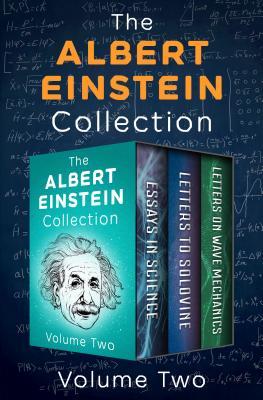
The Albert Einstein Collection Volume Two: Essays in Science, Letters to Solovine, and Letters on Wave Mechanics

Rate this book
From revealing, personal letters to brilliant essays on the nature of science, these three volumes demonstrate the breadth of Einstein’s thought.

The man who became famous for conceiving of the equation E=mc2 kept his mind sharp through stimulating correspondence and applied his intellectual acuity to a number of important scientific issues. The second volume of the Albert Einstein Collection offers a fascinating window into how he developed his ideas.
 
Essays in Science: In these sixteen essays, written at the height of his intellectual powers, Einstein sets out his views on scientific knowledge, its relationship to human experience, and the underlying principles of any scientific pursuit. He discusses his own work in theoretical physics and its basis in field theory, as well as the many achievements of other scientific thinkers—including Johannes Kepler, Isaac Newton, James Clerk Maxwell, Max Planck, Niels Bohr, and others.
 
Letters to Solovine: This collection of personal letters from Einstein to his longtime friend and translator Maurice Solovine offers a rare glimpse into the evolution of his thought, as well as a revealing portrait of the man himself. Spanning Einstein’s career and ranging from philosophical discussion to personal gossip, these letters are presented in English translation alongside the German text, with facsimiles of the original letters also included.
 
Letters on Wave Mechanics: In this stirring collection of correspondence, four of the twentieth century’s greatest minds—H. A. Lorentz, Max Planck, Erwin Schrödinger, and Albert Einstein—discuss, debate, and refine Schrödinger’s then-nascent theory of wave mechanics. As the physicist Karl Przibram states in his foreword to this edition, “little needs to be added to the letters; they speak for themselves. Apart from their essential content, they reveal something of the personalities of the four men of genius.”
 

337 pages, Kindle Edition

Published April 30, 2019

5 people are currently reading
17 people want to read

About the author

Albert Einstein

873 books9,644 followers
Special and general theories of relativity of German-born American theoretical physicist Albert Einstein revolutionized modern thought on the nature of space and time and formed a base for the exploitation of atomic energy; he won a Nobel Prize of 1921 for his explanation of the photoelectric effect.

His paper of 1905 formed the basis of electronics. His first paper, also published in 1905, changed the world.
He completed his Philosophiae Doctor at the University of Zurich before 1909.

Einstein, a pacifist during World War I, stayed a firm proponent of social justice and responsibility.

Einstein thought that Newtonion mechanics no longer enough reconciled the laws of classical mechanics with those of the electromagnetic field. This thought led to the development. He recognized, however, that he ably also extended the principle to gravitational fields and with his subsequent theory of gravitation in 1916 published a paper. He continued to deal with problems of statistical mechanics and quantum theory, which led to his explanations of particle theory and the motion of molecules. He also investigated the thermal properties of light, which laid the foundation of the photon.

Best known for his mass–energy equivalence formula E = mc2, dubbed "the world's most famous equation," he received "for his services to theoretical physics, and especially for his discovery of the law of the photoelectric effect". The latter was pivotal in establishing quantum theory.

He visited the United States when Adolf Hitler came to power in 1933 and went not back to Germany. On the eve of World War II, he endorsed a letter, alerting Franklin Delano Roosevelt, president, to the potential development of "extremely powerful bombs of a new type" and recommending that the United States begin similar research. This recommendation eventually led to the Manhattan project. Einstein supported defending the Allied forces but largely denounced the idea of using the newly discovered nuclear fission as a weapon. Later, with Bertrand Russell–Einstein manifesto highlighted the danger of nuclear weapons.

After the rise of the Nazi party, Einstein made Princeton his permanent home as a citizen of United States in 1940. He chaired the emergency committee of atomic scientists, which organized to alert the public to the dangers of warfare.

At a symposium, he advised:
"In their struggle for the ethical good, teachers of religion must have the stature to give up the doctrine of a personal God, that is, give up that source of fear and hope which in the past placed such vast power in the hands of priests. In their labors they will have to avail themselves of those forces which are capable of cultivating the Good, the True, and the Beautiful in humanity itself. This is, to be sure a more difficult but an incomparably more worthy task... "

("Science, Philosophy and Religion, A Symposium," published by the Conference on Science, Philosophy and Religion in their Relation to the Democratic Way of Life, Inc., New York, 1941).

In a letter to philosopher Eric Gutkind, dated 3 January 1954, Einstein stated:
"The word god is for me nothing more than the expression and product of human weaknesses, the Bible a collection of honorable, but still primitive legends which are nevertheless pretty childish. No interpretation no matter how subtle can (for me) change this."


(The Guardian, "Childish superstition: Einstein's letter makes view of religion relatively clear," by James Randerson, May 13, 2008)

Great intellectual achievements and originality made the word "Einstein" synonymous with genius.

The institute for advanced study in Princeton, New Jersey, affiliated Einstein until his death in 1955.

More: http://en.wikipedia.org/wiki/Albert_E...

http://www.nobelprize.org/nobe

Ratings & Reviews

What do you think?
Rate this book

Friends & Following

Create a free account to discover what your friends think of this book!

Community Reviews

5 stars
0 (0%)
4 stars
0 (0%)
3 stars
0 (0%)
2 stars
0 (0%)
1 star
0 (0%)
No one has reviewed this book yet.

Can't find what you're looking for?

Get help and learn more about the design.