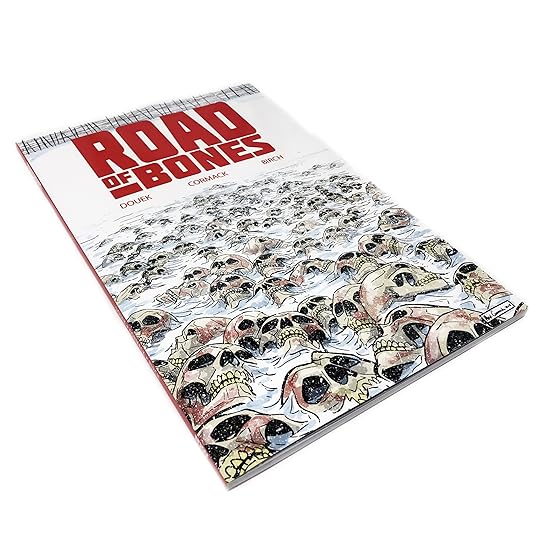
From the despair of imprisonment without hope for reprieve, the path to freedom is often filled with as much blood and grime and fealty to darkness as was required for one to be imprisoned in the first place. Freedom depends on stretching beyond the limits of human compassion, ere none is extended to the hopeful.
ROAD OF BONES is full of heavy-handed drama, occult gore and clumsy visual storytelling but generally regales readers with the tale of one man's attempt to escape the Siberian gulag. The timing of events coincides with the death of Stalin, but this coincidence has no real thematic bearing on the story itself. Roman Ivanovich Morozov is doing 25 years of hard labor and makes the acquaintance of a few fellow inmates. Together, the three men hatch an escape plan during a riot, only to find themselves listless and freezing in the mountains.
Roman is one of those fellows whose sense of hope hinges on an unreal and imperial understanding of just how hopeless things really are. Not unlike the man's fascination with appeasing the fantastical, mythical spirits he imagines ensure his survival, Roman's grasp of what is worth saving, what is worth forgetting, and what facets of his humanity are worth refusing each grind him down as his time in the mountains grinds on. Is there a hunting lodge over the next ridge? Will the group have enough food to last through the storm?
ROAD OF BONES goes to sleep praying for hardship and jolts awake acquiescing to a never-ending nightmare. The comic puts its claim on demonology, the waning throes of human sanity, and the violence bred betwixt men of ill intention. It's a lurid and bloody affair. This comic is less about Roman and his cohorts' escape from the gulag so much as it is their inevitable confrontation with the more dangerous, naked truths that await them at the end of their miserable lives.
The art is integral for how or to what degree readers may enjoy this title. The background detail is delightful; dangerous mountain crevasses, smatterings of conifers, and supple night skies beholden to the endless torment of these men's lives on the run. Also, the fiery contrast of a victim's bloodshed against the agonizingly pure snow of the mountainside surely qualifies for fine art.
On the other hand, ROAD OF BONES also traffics in a salty array of indiscernible campfire shadows, whispered groveling at dusk, and the mayhem of multiple people speaking at the same time in almost every scene. As a result, it's nearly impossible to tell the characters apart from panel to panel, much less from scene to scene. The creative team attempted to resolve this by assigning clothing accent colors to certain characters, but orange shoulder pads don't show up in the nighttime and it's impossible to tell apart green from black in a skirmish. And when it's hard to tell one character from the next, the story becomes far less interesting than one had first thought.
ROAD OF BONES is a curious little horror story that feels far less linear and straightforward than it really is, but this is largely on account of asynchronous and ineffective visual storytelling.