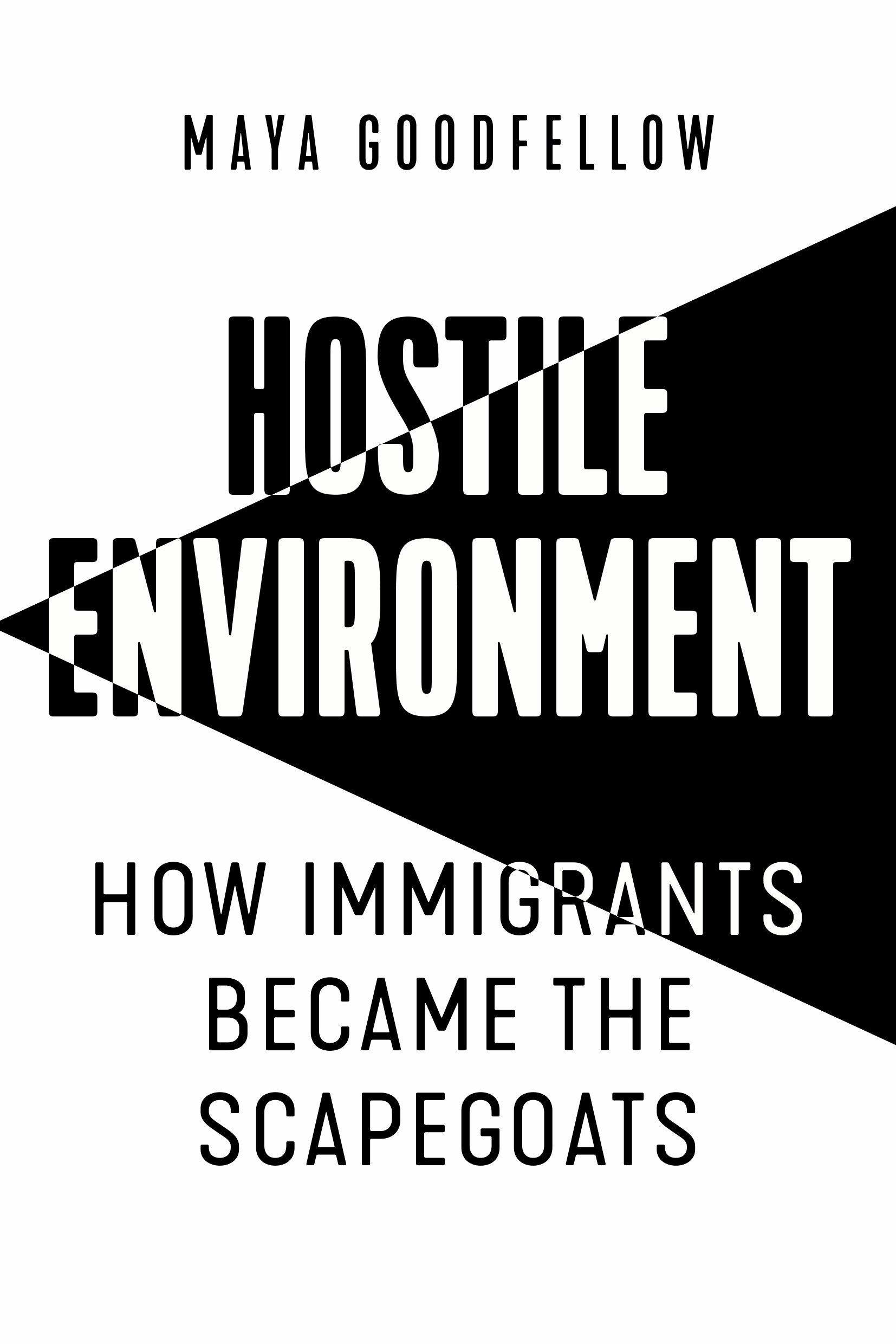
How migrants became the scapegoats of contemporary mainstream politics.
While refugees risked their lives crossing the Mediterranean, the UK government introduced immigration policy after immigration policy aimed at creating what it proudly called a 'hostile environment'. Alongside this, the British people voted to leave the EU while politicians from all parties unashamedly blamed immigrants for all the country's ills. Study after study has confirmed that immigration has not damaged the UK's economy, nor put a strain on its public services, yet concerns about immigration continue to be deemed "legitimate" across the political spectrum, with few exceptions.
How did we get here? Maya Goodfellow offers a compelling answer. Through interviews with policy experts, politicians, immigration lawyers, and migrants themselves, Goodfellow exposes the dark underbelly of contemporary immigration policies and the damage done by our obsession with borders. A nuanced analysis of the UK's immigration policy from the 1960s onwards, Legitimate Concerns links the rhetoric and policies of the recent Labour, Conservative, and Coalition Governments to the UK's colonial past and its imperialist present. Critical of the approach mainstream political parties have taken, Goodfellow shows that distinct forms of racism and dehumanisation have directly resulted from inhumane immigration policies and reminds us of the human cost of anti-immigration politics.
It is sometimes thought that Theresa May's 'hostile environment' and the Brexit vote were watersheds in anti-immigrant feelings and policies, aberrations against years of relatively liberal attitudes towards immigration. Goodfellow ably dissects a lot of these myths, demonstrating that, even in the case of the traditionally pro-immigrant and liberal Labour Party, attitudes towards immigration were driven by political expediency rather than convictions and a somewhat fatuous desire to appeal to glib arguments around how immigration erodes societal values. Goodfellow also explores how arguments against immigration are often rooted in emotions rather than reason and that these emotions are often driven by prejudices and racism; one only need to look at the difference in reaction between people who migrate from Australia and India and the fact that laws which made it easier for Commonwealth citizens to migrate to the U.K were targeted at white citizens of the commonwealth.
Goodfellow argues forcefully for a rational argument of not only the benefits of immigration, ranging from economic to cultural, but on placing greater emphasis on the human side of immigration, which is too often homogenises all immigrants under a single pejorative term-whether it be 'swarm' or 'mass' and forgets that at the heart of it most immigrants are human beings whose sole aim is to seek to improve their lot in life. 'Hostile Environment' is a well written dissection of 50 years of immigration policy and argues forcefully and factually on the benefits immigration can bring.
This is a really comprehensive overview of decades of policy & political events that have sustained the current hostile environment. Despite being pretty involved in migrant justice, I mostly only know about policy from the last few years & the current state of things, so it was really interesting to see that extrapolated out. (It keeps shocking me when I realise how recent detention centres are, and how they completely don't need to exist.)
“Borders are ideological: dividing citizens from non-citizens, laden with racial, class and all other kinds of distinctions, and determining who can and cannot belong. There is nothing natural about them, about the lines drawn between countries, the checks within them or the boundaries we erect between people. This is precisely why there is no need to passively accept their existence.”
An eye-opening look into the world of immigration in the UK. You may think you know what happens because of what you hear and read in the news, but behind the scenes, there is so much more going on and there are things that will surprise you, and depending on your opinions, disappoint you as well. I especially liked how the book is interspersed with stories from people who have experienced what it's like to be in the 'system', which gives the book a more personable feel and broke up the more informative/statistical sections of the book. So overall, I liked this book and I would happily recommend it.
Incredible book. I loved the intersectional approach on immigration in the UK, exploring first hand experiences of migrants, asylum seekers and refugees, exploring the devastating anti-immigration policies put in place by both the left and right parties in government and how the media maintains anti-immigration myths. I would definitely class this an essential read.
Comprehensive overview of, basically, British politics over the last century, including the decapitation of labour rights, Thatcher, new labour, the invention of the White Working Class with "legitimate fears" about immigration. Not much about HE but quite a lot about how we got here. 1 and a half ish stars removed for the enormous Guardian op-ed writing style of this
This book traces the persisting anti “immigrant” rhetoric and hostile environment we see today back to Conservative -led, Labour -endorsed legislation and public policy throughout time. In fact, Maya Goodfellow actually goes much further and boldly questions the uniquely insidious role which the Labour Party played in fortifying ideological borders, racialising undesirable peoples in the public mind (e.g. Roma asylum seekers in the 1990s), and stripping away state support for undocumented migrants.
For me, the most interesting development explored in the book was Labour’s attack on the asylum regime as a whole, all the way from dramatically increasing the number of detention centres (famously known as sites of mistreatment and misery), to introducing NRPF (no recourse to public funds) for undocumented migrants, and outsourcing responsibility for asylum support and accommodation to private corporations like G4S and Serco (which were complicit at the time in widely documented human rights violations, and yet government contracts kept running).
The situation today in 2022 is a whole lot worse, especially given the new frightening Rwanda deportation policy. For that reason alone perhaps, I think it’s important to grasp the roots of these policies, and what kind of political ideologies we need to be critically challenging today.
*disclaimer. I’m not wasting time writing about the obviously leading role of the Conservative party here. Assuming that goes without saying, but read the book for more on this.
Overall, this book is inquisitive, balanced, and includes interviews from many people who all have shocking lived experiences of Britain’s violent border regime. At its essence, it calls for the reader to revisit what we understand by “race” and “the border”, both being historically engineered constructs as opposed to naturally occurring categories - a message Goodfellow does well to remind us of throughout.
This was an absolutely stellar analysis of the cruel and unjust migration policies that have been enforced by successive UK governments, which certainly shows how a great deal of the discourse surrounding migration in Britain is based on hyperbole, prejudice, and outright lies. I greatly welcomed the debunking of a number of far too common myths surrounding migration, a sharp analysis which showed that even some arguments which I had taken for granted were untrue. I especially appreciated the author's assertion that the left should not simply concede the human rights of migrants to the right in order to score political points, as this will simply strengthen the already deeply institutionalised anti-migrant bias in common society.
I would have loved to see an analysis of the history of migration into the UK, and the common reasons behind the migration into the country. This could place into perspective the UK's role in upholding colonialism and imperialism throughout history, and creating the conditions which may have lead to the need for migration in the first place. Despite that slight criticism, I would wholeheartedly recommend this book, specifically to people living in the UK, who want to gain a more complete understanding of migration in the country, from a perspective which is not shaped by the interests of the conservative British media landscape.
In this book MG details the inception, development and impact of policies designed to create a hostile environment for *certain* migrants arriving in the UK. It's a clearly articulated, easy to follow political history that never loses sight of the real impact that these policies have / have had on individuals.
This really brought home the fact that our 'immigration crisis' is actually how as a society we perceive immigration, and the injustice behind a lot of the government's immigration rules. Having said that, I'm not sure I learned anything particularly new. I was also really hoping to read an offering for what a no-borders or limited borders UK could look like in reality, or how we could get there. That's probably beyond the scope of the book, but some optimism or ambition for the future would not have gone amiss. It is very bleak just reading about how government after government have churned out new anti-immigration rhetoric/policies whilst championing themselves as socially liberal, or at least 'not racist'.
"racism and xenophobia are not just individual character flaws; they are institutionalised constructs that are produced collectively. the UK's sense of self cannot be separated from its centuries of colonial domination"
essential reading for anyone who wants to understand some of the context around the events of this summer
A super important book that is so well researched and critiques both political parties involvement in the perpetuation of harmful immigration policy. So well articulated in how it deconstructs and challenges dominant rehetoric and easy to follow. V v good and super relevant
"A better understanding of why people are driven to migrate would help produce more welcoming and supportive socieites, where those arriving are not considered an unwanted burden or valued merely in terms of their economic contribution" [209]
Absolute must read if you want to understand the history of the UK’s immigration policies and how they are inextricably intertwined with racism & xenophobia.
This was a good with lots of important talking points and facts, Maya is a talented writer with clear convictions based on her experiences and backgrounds. Although some of the talking points might be exaggerated or one sided it was a good read
As an immigrant arriving in England in 2014 and just having gone through the dehumanizing process of gaining leave to remain, this book really resonated. The book doesn't shy away from the more deplorable moments in immigration politics, but it also fills in that space between the 'rivers of blood' speech, where Labour and Tories alike laid the groundwork for the deeply damaging policies that Priti Patel still carries on today as she promises to make deportations of Windrush citizens to Jamaica part of the regular rhythm of the home office business. A brave and captivating book, it ultimately argues a for a deeper humanity towards the topic of moving people, where they are not pawns in policy debates or valued only because of their economic and other contributions to society, but because they are people.
Here's what I think she's trying to say: tackling world poverty is the pressing issue, not immigration. But people in power won't give up their luxuries for others. The immigration debate has successfully become a scapegoat to keep the working class occupied by blaming each other rather than the people in power.
But me say this: just because it's an important topic, doesn't mean it's always well discussed. And this, unfortunately, felt like one of those occasions. I found a lot of this book poorly referenced, frustratingly articulated, randomly arranged and vague. Which is annoying because she probably does have some decent points behind all that.
I'd say start by reading chapter 3 on the early 2000s New Labour government's immigration narrative - that felt like the most coherent chapter. And then chapter 5 on racism. These do what the title claims to do, so that's a positive. After that it's maybe a better use of your time to scan the bibliography to see the topics that she talks about. (Although I must say, unfortunately the extent of most of her statistical citations are the BBC, Daily Mail and Twitter articles. Which doesn't instill much confidence in me that she's had the integrity to fact check what she's talking about. Especially when she preaches about politicians feeding narratives for popularity gain rather than truth telling. And people believing what they're told without critique. But doesn't seem to read a news article's sources or looked up official government statistics herself.) It sometimes felt like a compilation of essay headings that could be written. And I get that there's a lot she's trying to cover so maybe that's grand, it's just not what I expected. She also uses a lot of quotations from others' writing to make key points.
I'm also questioning who her target audience is. It doesn't seem like her goal is to communicate with people she disagrees with. She's happy to be biased against the anti-immigration side and careless with her use of language to describe them, which actively excludes them from the conversation. She's writing out of emotion. Maybe that is obvious going into the book, and also valid that she's angry, but it makes me question her intentions. She hasn't written a book that invites people with different viewpoints, who aren't already keen to understand her, into the conversation. I find that sad and confusing - why are you writing to an audience that already thinks like you? Why would I read this book if I already knew what you were going to say? Things like that just make me bored and sad because why do humans love feeding our societal divides by hurling insults at each other? Especially when, ironically, she's preaching against division and hatred. And she actually writes about how dangerous it is to assume that people can't change their minds. And how politicians want to keep us fighting each other rather than them when they have the power. But her book doesn't easily create space to practice that. I guess it's worth noting she does criticise the left and the right in her work.
And then she feels the need to prove her moral superiority every now and again which annoys me for the same reasons as above. Like how is randomly saying that she joined a protest against the invasion Iraq as a teenager a necessary addition to the book? Seems like the only purpose is to make sure that she is recorded in history as a good standing citizen?
There were, however, lots of interesting points raised and the book provided some things for me to research further. A good breakdown of how racialisation underpins the immigration discussion: white Brits are often only distrusted when guilt or bad intentions are proved. Whereas immigrants are often required to prove their innocence and contributions to society before being trusted. As if people who have had the ambition to travel, often treacherously, across the world for a better life or to fulfill their family's expectations of provision are lazy. The immigration system can make people fall behind on education and skills because it doesn't allow them to access that - there's a racism in deciding who is worth investing in. It's all so undignifying and dehumanising. And although she doesn't explain it in much depth, she notes that a history of colonisation and war has created and sustains our global economic divide and causes poverty. Money flows out of the poorer countries and into the richer ones. Erasing colonial history from education and controlling the narratives creates the entitlement we see amongst white British people. When really where you're born is a geographical lottery. The British Empire destroyed hundreds of international cultures and forced assimilation to their "civilised" culture. Which actually is in itself an amalgamation of international cultures - the Angles and Saxons came to England in the fifth century. The royal family came from Germany. Tea is grown in India and Sri Lanka. Yet people become scared of more change. Violence against women is an international patriarchal issue, not explicitly one brought by immigration.
There are also quite a few personal stories which I always enjoy. And specific examples of activism and protesting. I did learn a lot.
Overall, I'd love to read a revised version of this book where the author has sat with the content of the book for another year or so. To be stark, it often felt like she'd just read a lot of articles, taking out key quotes, done a lot of interviews, compiled them into this book and rushed to make a publishing deadline rather than writing from her own knowledge and confidence. Maybe with a bit more restructuring, it'd be less jumbled and less repetitive and she would have more space for depth?
The current climate of hostility towards immigrants is perpetuated by the dangerous discourse of sifting people into mere statistics and attempting to justify their presence within the country by economic incentive.
Goodfellow challenges the UK's political narrative and toxic capitalist culture which have shaped these sentiments. She reprimands the dehumanising effect of anti-immigration policy and legislation, in an informed and compelling way.
Hostile Environment is the first book I've read that examines UK immigration policy. Goodfellow does this through talking to politicians, immigration lawyers, immigrants. She dissects media coverage, examines Britain's colonial legacy and the impact our history has had on present day. This book is sometimes a dense read because it's not necessarily an easy subject matter, but it also has a lot of information drawn into it. However, as somebody who enjoys non-fiction, I thought this was such an informative and well-put together read. I found it easiest to read by sitting to read each section over a couple of hours and then taking breaks so it wasn't a quick read.
What I appreciated most about this book was that Goodfellow focused on both Conservative and Labour anti-immigration sentiment. She dug down into myths surrounding both parties and their supportors highlighting how flawed myths such as those "left behind" are the ones voting for Brexit and anti-immigration. The idea of solely working-class people being anti-immigration supporters is ignorant of the intersections of race, of community and how those intersect.
Her sections connecting colonial history and legacy to immigration policy are really quite important. She examines how points such as the Sri Lankan civil war resulted in the British government instituting visas in rssponse to people fleeing war. How those individuals who came over during Windrush were British citizens but we have long considered them still to be immigrants. How people of colour coming from the Caribbean and India and Pakistan helped to keep the NHS afloat particularly in the early days. How we have long ignored the damage of our colonial history.
She also had some interesting sections examining race and how we conflate whiteness and expats, and immigrants and people of colour.
There is a lot to unpack her writing and I believe there is a newly revised edition with a foreward following the impacts of COVID-19 if people wanted to read a more updated version. Whilst the book follows the time of the Brexit vote, it's much more than an examination of Brexit and immigration sentiment. It's an important non-fiction work that I highly recommend to anybody wanting to learn more on the subject matter.
When the Windrush Scandal was being played out during 2018, the political class - the commentariat as well as the politicians - decried the wrongful treatment of 'legitimate' British citizens and questioned how such an injustice was ever allowed to take place. The same politicians had enacted legislation which made these 'glitches in the system' all but inevitable, all the while being encouraged by the same journalists performatively horrified by the lack of humanity in Britain's immigration system.
Maya Goodfellow's book isn't just about the Home Office's Hostile Environment - or at least, not merely its iteration from 2012 onwards as enacted by Theresa May. Rather, Goodfellow details the long history of British immigration policy throughout the 20th and 21st centuries. The Windrush Scandal was, of course, not a glitch in the system, but the system's inevitable effects. Following decades of demonisation by the press and politicians of the right - while in the meantime politicians ostensibly of the left wouldn't dare risk their political capital to challenge the dominant discourse - immigrants (or indeed anyone but 'naturalised' Britons) became scapegoats.
Successive Labour and Conservative governments enacted legislation restricting the rights of refugees, asylum seekers and migrants. Turned into statistics that must be reduced, masses that starve 'our' public services, Goodfellow recovers the individual human stories through her narrative. The book is heavily footnoted but it is not a dry academic text. She uses interviews with a range of individuals to highlight the callous, dehumanising reality of being a non-naturalised Briton.
Hostile Environment is obviously a book about race and racism, but it's not a shallow liberal decrying of unfairness. It is a systemic critique. What Goodfellow demonstrates so well is how race intersects with class and within a system which perpetuates inequalities. It is a book which exposes hypocrisies and ultimately shows how the political class, for decades and decades, have fuelled racism amongst the public, enacted racist legislation in government and then stood back from the consequences.
The prose felt a little thin at the start, belabouring obvious points already well covered elsewhere, although that may mean it serves as a good primer for a general audience. With tedious details shoehorned in like "...he explains as he takes a bite out of the croissant that is sitting on the wooden table between us", this particular oevre won't be winning any prizes for lyricism. Goodfellow also has a tendency to veer into earnest activist diatribes.
These minor gripes aside, the central chapters were brilliantly argued, one of those texts where you want to note down all the arguments because they encapsulate better than you ever could why UK immigration policy is so odious. The afterword on how the covid pandemic hit documented and undocumented migrants alike touched on extremely important and current issues with alacrity. I may gift this to someone close to me who loves immigration but has also swallowed a bit too much of the "legitimate concerns". Another comment this person makes is that while the current system is clearly inhumane, "some form of control" is still needed. Reading it with him in mind, I was left wishing for a more constructive, specific vision of a borderless world. But I would still really recommend it to both those who want to deepen an existing interest in the issues discussed and those who don't yet understand what the problem is all about.
Finally finished this, it took me a really long time to get through, it’s a really difficult book to get through mainly because the cruelty demonstrated time and time again just makes me feel so angry and upset.
I feel burning rage for how this country (UK) and more treats these people, it disgusts me and makes me feel ashamed. We are so selfish as a society here and people blindly buy in to all the nonsense spouted from the Daily Mail, Farage, May, memes that comparing going on about “looking after our own” etc no one seems to have any critical thought anymore, I wish I was shocked but I’m not.
This book was published in 2020 and 5 years later we then see labour further attacking basic human rights and I just seethe at seeing things get worse with the rise of the far right and feeling so hopeless and powerless. It’s even more hurtful when “old school” family don’t seem to want to learn either and bike their issues on immigration.
I feel like every idiot who buys in to “they’re taking over”, “they’re a drain on nhs” “go back to where you came from” need to read this book and live their lives and see how they’d feel being treated like that.
This book is so informative, well written and sourced and helped me to learn more about this awful complex system.
'The country's bond on solidarity are weakened because more diversity erodes common culture and undermines what's needed for a cohesive society and welfare state'
'White and British become synonymous'
'The UK's sense of self can't be separated from it's centres of colonial domination'
A great book that draws on the political climate of the United Kingdom and how these have shaped the viewpoints of the people. It really goes to show how the prejudiced actions upheld by individuals in this society stem from fearmongering and reiterated biases. It's fascinating to see how these opinions are fed through the media and how the data is and has been skewed to portray a particular image.
I will forever stand with the immigrants that have had to leave the only space and community they know in order to strive for a better life. Everyone is deserving of life and to be treated as human beings.
'Why should we be shocked that people die trying to cross borders made perilous and has been criminialised for one human being to help another make the journey?'
Humanity must extend beyond those deceased along the paths for freedom. Race, class and gender structure our economy.
Interesting look at the history of migration in Britain and how immigrants have routinely been used as scapegoats for our societal ills. There was a lot of new information for me about immigration policy throughout the 20th century and how successive governments’ policies have culminated in today’s ‘hostile environment’ toward immigrants. It was well-researched and the author has spent a lot of time talking with people who are, or have been, caught up in the UK’s immigration system. There is a great argument here for migrants’ humanity, rather than the viewpoint taken by most politicians that they are worth only so much as they can contribute to the economy. Very timely, given the recent controversy over so-called ‘low skilled’ workers. On the downside, there were a few parts where I didn’t feel that anti-immigration views were challenged effectively enough - the clear assumption is that you’re already on the author’s side and don’t need persuading, but I don’t think the arguments as presented here would sway those not already in favour of immigration.