

What do you think?
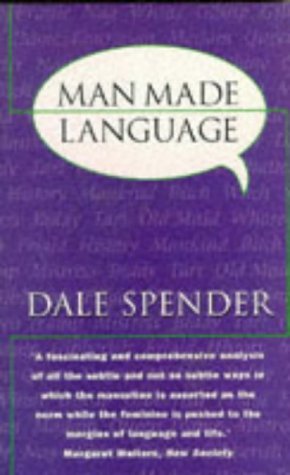
Man Made Language
Spender, Dale
250 pages, Paperback
First published January 1, 1980
About the author
Dale Spender
43 books59 followersDale Spender (born 1943) is an Australian feminist scholar, teacher, writer and consultant.
Spender was born in Newcastle, New South Wales, a niece of the crime writer Jean Spender (1901–70). The eldest of three, she has a younger sister Lynne, and a much younger brother Graeme. She attended the Burwood Girls High School, in Sydney. In her youthful days she was a Miss Kodak girl. In the later half of the 1960s she also taught English Literature at Dapto High School. She started lecturing at James Cook University in 1974, before going to live for a while in London and publishing the book Man Made Language in 1980.
She is co-originator of the database WIKED (Women's International Knowledge Encyclopedia and Data) and founding editor of the Athene Series and Pandora Press, commissioning editor of the Penguin Australian Women's Library, and associate editor of the Great Women Series (United Kingdom).
She is the author of a witty literary spoof, The Diary of Elizabeth Pepys, 1991 Grafton Books, London, a feminist critique of women's lives in 17th Century London, purportedly written by Elisabeth, the wife of Samuel Pepys.
Today Spender is particularly concerned with intellectual property and the effects of new technologies: in her terms, the prospects for "new wealth" and "new learning". For nine years she was a director of Copyright Agency Limited (CAL) in Australia and for two years (2002–2004) she was the chair. She is also involved with the Second Chance Programme, which tackles homelessness among women in Australia.
Spender was born in Newcastle, New South Wales, a niece of the crime writer Jean Spender (1901–70). The eldest of three, she has a younger sister Lynne, and a much younger brother Graeme. She attended the Burwood Girls High School, in Sydney. In her youthful days she was a Miss Kodak girl. In the later half of the 1960s she also taught English Literature at Dapto High School. She started lecturing at James Cook University in 1974, before going to live for a while in London and publishing the book Man Made Language in 1980.
She is co-originator of the database WIKED (Women's International Knowledge Encyclopedia and Data) and founding editor of the Athene Series and Pandora Press, commissioning editor of the Penguin Australian Women's Library, and associate editor of the Great Women Series (United Kingdom).
She is the author of a witty literary spoof, The Diary of Elizabeth Pepys, 1991 Grafton Books, London, a feminist critique of women's lives in 17th Century London, purportedly written by Elisabeth, the wife of Samuel Pepys.
Today Spender is particularly concerned with intellectual property and the effects of new technologies: in her terms, the prospects for "new wealth" and "new learning". For nine years she was a director of Copyright Agency Limited (CAL) in Australia and for two years (2002–2004) she was the chair. She is also involved with the Second Chance Programme, which tackles homelessness among women in Australia.
Ratings & Reviews
Friends & Following
Create a free account to discover what your friends think of this book!
Community Reviews
Displaying 1 - 21 of 21 reviews

February 24, 2013
I have long been fascinated by the topic of this book: how sexist language shapes our consciousness, our reality.
Published in 1980, this is not a light read, rather academic in style. Much of it was engaging, some of it was repetitive.
We learn of the many ways in which women have been silenced throughout history (the taking on of husbands' surnames, that women have been forbidden from discussing marital affairs with other women, that expressing an opinion isn't feminine, the letting slip 'out of print' of numerous works by female writers, etc).
The consequent muting and invisibility of women has allowed men to be viewed as the primary sex (with women as 'other' or 'deviant'). Reality for both women and men then is seen from the male perspective which, in turn, has shaped language.
Now that language describes male reality and not female reality, it can hold the patriarchy in place because it seems like the norm, and even women defend it. Females who object are seen as whining and unreasonable, whereas those females are simply suggesting that men be reasonable and give back what they have taken.
Men (and often women) insist that the terms 'mankind,' 'man,' and 'he' encompass women, that they refer to 'people.' But if we compare these two sentences, we see the lie:
--Man goes to war with his enemies
--Man breastfeeds his children
Up until recently sexual language (as well as all other language) was based on the male point of view. For example:
--Penetration. This is what the man does. The same act, from the heterosexual female perspective, could be described as 'enclosure.' That this seems absurd highlights the issue.
--Rape: The word means 'seize.' Rapacious (meaning 'greedy') comes from the same Latin root. This word conveys nothing of the painful, terrifying experience for a woman.
When the expressions 'sexist' and 'sexual harassment' entered the English language, this was ground-breaking. Women at last had some words they could use to describe their experience in their own terms.
This book didn't make me as angry as I'd expected (maybe because women are more liberated since 1980), but I'm still pissed off.
Published in 1980, this is not a light read, rather academic in style. Much of it was engaging, some of it was repetitive.
We learn of the many ways in which women have been silenced throughout history (the taking on of husbands' surnames, that women have been forbidden from discussing marital affairs with other women, that expressing an opinion isn't feminine, the letting slip 'out of print' of numerous works by female writers, etc).
The consequent muting and invisibility of women has allowed men to be viewed as the primary sex (with women as 'other' or 'deviant'). Reality for both women and men then is seen from the male perspective which, in turn, has shaped language.
Now that language describes male reality and not female reality, it can hold the patriarchy in place because it seems like the norm, and even women defend it. Females who object are seen as whining and unreasonable, whereas those females are simply suggesting that men be reasonable and give back what they have taken.
Men (and often women) insist that the terms 'mankind,' 'man,' and 'he' encompass women, that they refer to 'people.' But if we compare these two sentences, we see the lie:
--Man goes to war with his enemies
--Man breastfeeds his children
Up until recently sexual language (as well as all other language) was based on the male point of view. For example:
--Penetration. This is what the man does. The same act, from the heterosexual female perspective, could be described as 'enclosure.' That this seems absurd highlights the issue.
--Rape: The word means 'seize.' Rapacious (meaning 'greedy') comes from the same Latin root. This word conveys nothing of the painful, terrifying experience for a woman.
When the expressions 'sexist' and 'sexual harassment' entered the English language, this was ground-breaking. Women at last had some words they could use to describe their experience in their own terms.
This book didn't make me as angry as I'd expected (maybe because women are more liberated since 1980), but I'm still pissed off.

January 2, 2018
Probably the most intelligent book about language I have ever read. Do yourself a favour and read it: it will completely change your perspective on the English language (and, for my part, I can say that it works perfectly with Italian - my mothertongue - as well).

March 17, 2016
This is an amazing book. It is a great study on linguistics, language, sexism, stereotypes, and patriarchal society. It is also a relatively quick read for such an extensive study and very accessible for a non-scientific audience.
The book covers various different areas, but my favorite were the statistical analyses at the beginning, looking at different studies from a very objective standpoint and pointing out the biases in them. Although the picture painted by the book is bleak, since this was the 80s, it ends on a hopeful note. And although it is from the 80s, it is alarmingly still current.
The book covers various different areas, but my favorite were the statistical analyses at the beginning, looking at different studies from a very objective standpoint and pointing out the biases in them. Although the picture painted by the book is bleak, since this was the 80s, it ends on a hopeful note. And although it is from the 80s, it is alarmingly still current.

August 25, 2012
So, the writing style is to an extent an exercise in making interesting things boring, but really the content is fascinating enough for it not to matter.
February 26, 2025
i’ve gone down a socio-linguistic rabbit hole and this was so amazing. she wrote about how male-centric language is, how women are silenced, the exclusion of women from literature and how the naming of women’s oppression is power. an amazing book on language!

April 1, 2018
Thought-provoking. It's a bit long-winded, but great ideas.

July 23, 2019
very interesting and well put together - changes your perspective profoundly. just wish it was a little less repetitive.

April 7, 2020
Brilliant! (I skipped the last chapter because I've already read about the subject before, but I have no doubt it was just as good as the rest).
February 23, 2021
Excellent. A must read for everyone.
So many 'truths' dispelled as myths.
The unseen becomes seen after reading this book.
So many 'truths' dispelled as myths.
The unseen becomes seen after reading this book.

November 6, 2022
discusses the protection of existing hierarchies so well, absolutely fantastic
December 12, 2023
Excellent, excellent book, enveloping a wide range of topics (focused on language but not limited, as I first assumed, to the more specific bits about precise wordage that Spender mostly covers in the first chapter), with pleasant, academic (but not confusing, endlessly pontificating, or indecipherable), and eloquent prose. Actually, Spender's writing style is one of my favorites I've read in feminist nonfiction, and I would set her somewhere next to Denise Thompson in that regard.
About halfway through reading, I had a bit of a eureka moment, as Spender was referring back to the way language - society, patriarchy, humanity - categorizes people into plus-male and minus-male (the minus-male being women), and she was discussing how (male) grammaticians of the past set grammatical rules so that "he" would encompass both men and women and how women were "non-males", and it struck me, all at once, what exactly this reminded me of. I'd compared the situation I'm thinking of in my head to Simone de Beauvoir's ideas from The Second Sex, where she discusses how men see, and women are categorized as, the Other, male being the default, but it hadn't been as precise, hadn't pinned down the matter so exactly. And the situation I'm thinking of is the way, in present day, "queer" circles (and even those outside of them discussing "queer circles") no longer use the proper definition of lesbian (if they use it at all, which they rarely do, preferring "queer" or "sapphic" or "wlw" or, rather horrendously, something along the lines of wlwlnb, though I know that's not the exact phrasing)- a woman exclusively attracted to other women - but instead define lesbian as a "non-male" who is attracted to other "non-males". !!! Jesus fucking Christ. I, and I am not lying or exaggerating here, had to stop reading and stare with a gaping mouth at my wall for 20-or-so seconds when I realized just how perfectly the situation replicates what Spender describes. Male is the default, and women are defined around men, as non-men, or minus-men. You don't see "non-women" being used as a common phrase in "queer" circles, and coincidence is not the reason.
In any case! Very much enjoyed this book. I read it right after reading another one of Spender's books, For The Record: The Making and Meaning of Feminist Knowledge, which I also added to my "all time favorites" shelf, so you bet I will be reading more of her work. It's always very exciting to find prolific feminist writers whose work I unanimously love (like Sheila Jeffreys, whose books I've been gradually reading, till few are left), so I hope the record keeps up.
I recommend this for all and any people interested in the way misogyny is reflected in our language and in learning how deeply embedded it is in it. It clears up many misconceptions and shatters many beliefs, leaving one feeling enlightened afterward (and throughout reading). I'm surprised it's not more of a classic, but I suppose, as Spender herself says, feminist classics tend to insidiously fade from consciousness, memory, and print, and there's no telling how influential this was back in the day. I don't see it on that many "feminist classics" lists, though.
About halfway through reading, I had a bit of a eureka moment, as Spender was referring back to the way language - society, patriarchy, humanity - categorizes people into plus-male and minus-male (the minus-male being women), and she was discussing how (male) grammaticians of the past set grammatical rules so that "he" would encompass both men and women and how women were "non-males", and it struck me, all at once, what exactly this reminded me of. I'd compared the situation I'm thinking of in my head to Simone de Beauvoir's ideas from The Second Sex, where she discusses how men see, and women are categorized as, the Other, male being the default, but it hadn't been as precise, hadn't pinned down the matter so exactly. And the situation I'm thinking of is the way, in present day, "queer" circles (and even those outside of them discussing "queer circles") no longer use the proper definition of lesbian (if they use it at all, which they rarely do, preferring "queer" or "sapphic" or "wlw" or, rather horrendously, something along the lines of wlwlnb, though I know that's not the exact phrasing)- a woman exclusively attracted to other women - but instead define lesbian as a "non-male" who is attracted to other "non-males". !!! Jesus fucking Christ. I, and I am not lying or exaggerating here, had to stop reading and stare with a gaping mouth at my wall for 20-or-so seconds when I realized just how perfectly the situation replicates what Spender describes. Male is the default, and women are defined around men, as non-men, or minus-men. You don't see "non-women" being used as a common phrase in "queer" circles, and coincidence is not the reason.
In any case! Very much enjoyed this book. I read it right after reading another one of Spender's books, For The Record: The Making and Meaning of Feminist Knowledge, which I also added to my "all time favorites" shelf, so you bet I will be reading more of her work. It's always very exciting to find prolific feminist writers whose work I unanimously love (like Sheila Jeffreys, whose books I've been gradually reading, till few are left), so I hope the record keeps up.
I recommend this for all and any people interested in the way misogyny is reflected in our language and in learning how deeply embedded it is in it. It clears up many misconceptions and shatters many beliefs, leaving one feeling enlightened afterward (and throughout reading). I'm surprised it's not more of a classic, but I suppose, as Spender herself says, feminist classics tend to insidiously fade from consciousness, memory, and print, and there's no telling how influential this was back in the day. I don't see it on that many "feminist classics" lists, though.

November 20, 2023
Really interesting to read this (early 1980s') book now b/c a lot has changed in favor it. As a reading experience, it's a bit dry, but inherently 'deep.' The title's self-explanatory. Felt like it wanted too often to change reality. Like, the author, safely tucked in a quiet room in a first-world country, is afforded the time to complain at how things came to be. There's no denying that everything's male-dominated or male-centric, and that it's been that way since the dawn of time, in some sense, but then, things happened the way they happened because that is, I dunno, like, nature? In this book, Spender makes all these acute observations of how everything has been in favor of men and has relegated women to inferior statuses, but she never discusses war, and the cave-man days when it was all just primitive (and vital for men to assume control). I dunno, there are some holes or blind spots or areas that she too overlooks. But the whole point is not a stare at the rear-view mirror here. She wrote this decades before our gender-morphing generation. Readers today might find this book useful to expound upon in light of current events, and others might pick at it and critique it. I appreciated it but felt like it could've provided a foundational sense of the 'man-made' world. Talk about biology, anthropology, tribal stuff, cave-man days, like, give a sense for why things have led to a man-made language, rather than just listing in academic terms all the myriad defects. I don't think men, as a lot, have done these things intentionally to keep women down. I think, with us (men), well, as she discussed in her own book:
"Men compete for rewards and achievements. We compete for men. Men vie for worldly approval and status. We vie for husbands. Men measure themselves against standards of excellence and an established level of performance. We measure ourselves against one another." (137)
It's got layers to work with, but again, it's kinda outdated. There's still a lot of work to be done, a lot more progress to be had toward equality. The book's also got some funny stuff, like the stuff you'd see in a sitcom during the 1980s or 1990s, how men and women talk to & treat each other! I patted myself on the back for reading this, I wonder what she'd say of today's women's rights?
"Men compete for rewards and achievements. We compete for men. Men vie for worldly approval and status. We vie for husbands. Men measure themselves against standards of excellence and an established level of performance. We measure ourselves against one another." (137)
It's got layers to work with, but again, it's kinda outdated. There's still a lot of work to be done, a lot more progress to be had toward equality. The book's also got some funny stuff, like the stuff you'd see in a sitcom during the 1980s or 1990s, how men and women talk to & treat each other! I patted myself on the back for reading this, I wonder what she'd say of today's women's rights?
January 26, 2026
“It is a beginning, but it may not be a permanent gain. Women have begun writing for women and, initially, this poses little threat to patriarchal order, since such writers and readers are classified as the private domain and therefore do not count. It is akin to gossip, trivial talk about women’s business. But once it is recognized that women writing for women is not harmless, that it is not under male control, we can begin to expect a very different reaction. There will be resistance by men as there has been resistance to consciousness-raising. We will be urged in our writing to ‘extend our horizons’, to leave behind women’s business and to tackle topics of a more universal nature, that is, topics about men. The categories of private/public and female/male will be violated if women begin to be counted, and there is little reason to suspect that patriarchal order will be pleased by such developments. As June Arnold (1976: 26) has said, ‘The first feminist movement was briefly just as popular as ours, just as sought after’ by commercial presses, and it evaporated. There was more literature in the nineteenth and early twentieth centuries on ‘the woman question’ than there was on socialism and there was probably more feminist material then than there is, yet, today. But it ‘disappeared’. There is no reason that could not happen again.” p. 218
This entire review has been hidden because of spoilers.

June 27, 2026
My favourite feminist read so far, love you Dale Spender 💖 walked so Amanda Montell could run.
Once again, every mixed-gender conversation I have is back to feeling politically suspicious. A timelessly applicable read, which is in fact, when you think about it, terrible news.
Still, very motivational incentive for women to yap too close to the sun & remember their moral imperative to write, write, write 🫶
Once again, every mixed-gender conversation I have is back to feeling politically suspicious. A timelessly applicable read, which is in fact, when you think about it, terrible news.
Still, very motivational incentive for women to yap too close to the sun & remember their moral imperative to write, write, write 🫶

May 28, 2026
excellent, clear, thorough and groundbreaking book.
many of her points seem so obvious now, shoeing how influential her work is.
many of her points seem so obvious now, shoeing how influential her work is.

February 9, 2026
This is the kind of book that makes me remember just how essential second wave feminist texts still are. A lot has changed, but also much hasn't, and in some ways we're going backwards. Men still control language and the construction of meaning, and young women are being turned away from the theory and wisdom that would help them find their way out of androcentric reality and into their own knowing and forms of expression. Spender's work is invaluable.
August 12, 2020
I started this book when it was published, in the 80's, and quite a bit of it stuck with me. Now I am rereading it in full so I can let it go.
I was surprised at all the ways in which the dominant gender, ie men, have as Ms Spender says,
captured everyone's "language, thought and reality" through language constructs and other cultural devices, and still do. To say this another way in reference to the female population- if you are systematically eliminated from language, linguistically invisible, you are consequently eliminated from our thought systems and our reality.
The section on writers was particularly interesting to me as I had not tuned in to how the dominant culture influences women writers, and writing.
Unfortunately most of what the book reveals about silenced women and dominant male culture remains true today IMO. It is therefore all the more important to revisit the plethora of research into women's studies that illuminated so much of this topic referenced from the 1970's.
I was surprised at all the ways in which the dominant gender, ie men, have as Ms Spender says,
captured everyone's "language, thought and reality" through language constructs and other cultural devices, and still do. To say this another way in reference to the female population- if you are systematically eliminated from language, linguistically invisible, you are consequently eliminated from our thought systems and our reality.
The section on writers was particularly interesting to me as I had not tuned in to how the dominant culture influences women writers, and writing.
Unfortunately most of what the book reveals about silenced women and dominant male culture remains true today IMO. It is therefore all the more important to revisit the plethora of research into women's studies that illuminated so much of this topic referenced from the 1970's.
October 16, 2025
I loved this book. I wish another edition could be made with present day facts and figures, but the 70s is a very real part of its charm too. This book is totally readable, thought it is academic and felt somewhat like I was studying. Explores every facet of language and takes nothing for granted. Bravo to the author!
The one bad thing I have to say is I bought this 1980 book on eBay specifically because it's the only cited source for a certain fact and that fact did NOT appear after all :'( Maybe in a different edition than the one I read?
The one bad thing I have to say is I bought this 1980 book on eBay specifically because it's the only cited source for a certain fact and that fact did NOT appear after all :'( Maybe in a different edition than the one I read?

July 30, 2016
Why do we downgrade the female version of lord: lady, master: mistress, and so on?
Read this book in college when the focus of the semester was gender dynamics. It remains a favorite addressing the frustrating manifestation of patriarchy in our language.
Read this book in college when the focus of the semester was gender dynamics. It remains a favorite addressing the frustrating manifestation of patriarchy in our language.

March 15, 2012
the locus classicus of the thesis that language itself can be patriarchal. should be read with gilligan and tannen.

February 1, 2013
An absolute classic and essential reading if you are at all interested in how language can be used to establish and protect existing hierarchies.
Displaying 1 - 21 of 21 reviews