
What do you think?
Rate this book


What is at first believed to be falling stars or harmless meteorites turns out to be cylindrical Martian ships filled with nightmarish, tentacled invaders and their robotic war machines. When curious Englanders come to inspect the massive containers imbedded in the still-smoking countryside, metallic appendages emerge from the pits to kill every living thing in their path with strange heat rays. Then as the surrounding townships slowly devolve into chaos, the Martians begin constructing giant tripod war machines to track down and kill -- or capture -- as many of the human "inferior animals" as possible. The nameless narrator, trapped in a house almost completely crushed by the impact of a starship, watches in horror as the seemingly unstoppable Martians build their mechanical armies, kill hundreds with poisonous gas -- and begin snacking on captured humans!
Wells has been called the father of modern science fiction for good reason. Landmark works like The Time Machine, The Island of Dr. Moreau, The Invisible Man, and The War of the Worlds are just as compelling and wildly entertaining today as they were more than a century ago. Fans and historians of the science fiction genre who have yet to read Wells's classic tale of Martian invasion should definitely add this title to their reading lists. Paul Goat Allen
319 pages, Hardcover
First published January 1, 1898


The air was full of sound, a deafening and confusing conflict of noises – the clangorous din of the Martians, the crash of falling houses, the thud of trees, fences, sheds flashing into flame, and the crackling and roaring of fire. Dense black smoke was leaping up to mingle with the steam from the river, and as the Heat-Ray went to and fro over Weybridge its impact was marked by flashes of incandescent white, that gave place at once to a smoky dance of lurid flames. The nearer houses still stood intact, awaiting their fate, shadowy, faint, and pallid in the steam, with the fire behind them going to and fro.
Four or five little black figures hurried before it across the green-grey of the field, and in a moment it was evident this Martian pursued them. In three strides he was among them, and they ran radiating from his feet in all directions. He used no Heat-Ray to destroy them, but picked them up one by one. Apparently he tossed them into the great metallic carrier which projected behind him, much as a workman’s basket hangs over his shoulder.

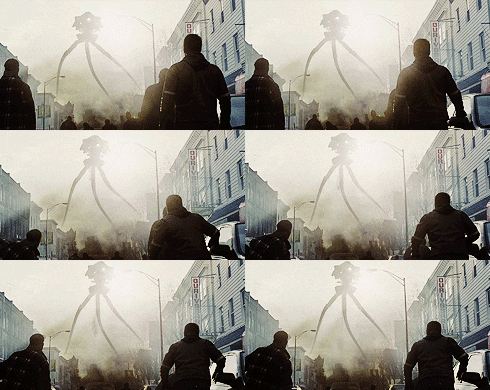


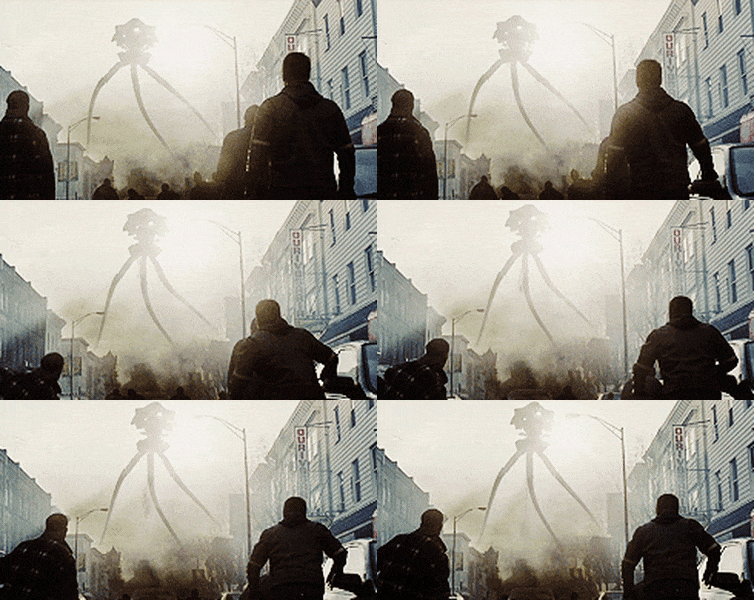
Suddenly the foremost Martian lowered his tube and discharged a canister of the black gas at the ironclad. It hit her larboard side and glanced off in an inky jet that rolled away to seaward, an unfolding torrent of Black Smoke, from which the ironclad drove clear. To the watchers from the steamer, low in the water and with the sun in their eyes, it seemed as though she was already among the Martians…They saw the gaunt figures separating and rising out of the water as they retreated shoreward, and one of them raised the camera-like generator of the Heat-Ray. He held it pointing obliquely downward, and a bank of steam sprang from the water at its touch. It must have driven through the iron of the ship’s side like a white-hot iron rod through paper…


 لتحرق و تدهس و تنشر الفناء و تسرق الامان.. و يلاحظ ان ويلز حرص على ان يكون الشر كامنا في باطن ارضنا..بيننا و ليس قادما من كواكب اخرى
 For that moment I touched an emotion beyond the common range of men, yet one that the poor brutes we dominate know only too well. I felt as a rabbit might feel returning to his burrow and suddenly confronted by the work of a dozen busy navvies digging the foundations of a house. I felt the first inkling of a thing that presently grew quite clear in my mind, that oppressed me for many days, a sense of dethronement, a persuasion that I was no longer a master, but an animal among the animals, under the Martian heel. With us it would be as with them, to lurk and watch, to run and hide; the fear and empire of man had passed away.


![Profile Image for [ J o ].](/_next/image?url=https%3A%2F%2Fi.gr-assets.com%2Fimages%2FS%2Fcompressed.photo.goodreads.com%2Fusers%2F1673171874i%2F4639825._UY200_CR4%2C0%2C200%2C200_.jpg&w=128&q=75)


