

What do you think?

The Circus
A real-life vanishing act leaves one man looking for his missing friend in this clever, Kafkaesque novel of psychological suspense from the acclaimed author of
The Room
and
The Invoice
The narrator of The Circus is perfectly content with his quiet life. He works at a bakery counter, and in his free time organizes (and reorganizes) his record collection. He's not up to much the day his old school friend Magnus invites him to a circus, and he's certainly not expecting the simple outing to change everything in his life. Because while participating in a magic trick Magnus vanishes--completely.
Struggling to piece together the events that led to his friend's inexplicable disappearance, the narrator comes to realize that even the most basic facts about his life are suddenly uncertain. His friend Jallo claims to have never met Magnus, even though they went to school together. Magnus's apartment seems deserted, but is the narrator at the right address? And who is the mysterious person who keeps calling him on the phone but never saying a word?
Sharply unsettling and clever, this subtle interpretation of a suspense novel is classic Jonas Karlsson.
The narrator of The Circus is perfectly content with his quiet life. He works at a bakery counter, and in his free time organizes (and reorganizes) his record collection. He's not up to much the day his old school friend Magnus invites him to a circus, and he's certainly not expecting the simple outing to change everything in his life. Because while participating in a magic trick Magnus vanishes--completely.
Struggling to piece together the events that led to his friend's inexplicable disappearance, the narrator comes to realize that even the most basic facts about his life are suddenly uncertain. His friend Jallo claims to have never met Magnus, even though they went to school together. Magnus's apartment seems deserted, but is the narrator at the right address? And who is the mysterious person who keeps calling him on the phone but never saying a word?
Sharply unsettling and clever, this subtle interpretation of a suspense novel is classic Jonas Karlsson.
179 pages, Hardcover
First published September 5, 2019
About the author
Jonas Karlsson
48 books269 followersSven Bert Jonas Karlsson is a Swedish actor and author. He won a Guldbagge Award for Best Actor in 2004 for the movie Details. He published his first book, a collection of short stories, in 2007.
Ratings & Reviews
Friends & Following
Create a free account to discover what your friends think of this book!
Community Reviews
Displaying 1 - 30 of 189 reviews

December 27, 2021
This is not about a circus.
It’s about friendship, and the illusion of it.
And other illusions.
Plenty to reflect on, especially mirrors.
“I’m getting this all muddled up. I’m not actually sure what order things happened in, to be honest. But I do know what happened.”
The narrator is invited to the circus by a friend from childhood. They’re late 30s or early 40s, and he find this friend annoying, but he reluctantly goes with Magnus. He leaves... alone.
“I hate it when people disappear inside mirrors and don’t come back.”
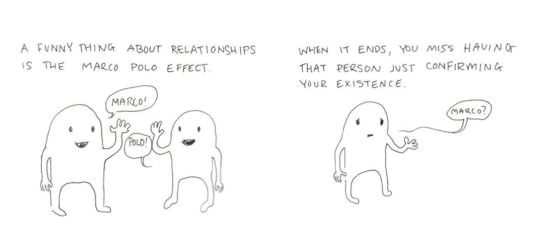
Image: "A funny thing about relationships is the Marco Polo effect. When it ends, you miss having that person just confirming your existence." Selected cells from Marco Polo by Emily Bernstein (Source)
The story is about what happens next. Mostly, not much.
But there’s plenty of reflection on his childhood and how he and Magnus were bullied at school. Too much. It’s not graphic, but it felt disproportionate. The narrator played along with pranks and took the blame, whereas Magnus, “a parenthesis”, was invariably alone, except when he was being beaten up. The many references to 1980s music fit the story better.
There is a constant undercurrent of slight unreality and people not being who they should be. Is it the world that’s crazy, or the narrator? Towards the end, it suddenly develops a Haruki Murakami vibe, and is the better for it.
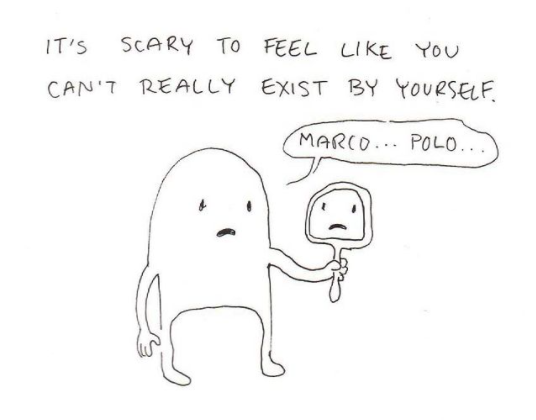
Image: "It's scary to feel like you can't really exist by yourself." Selected cell from Marco Polo by Emily Bernstein (Source)
Quotes
• “I learned at an early age that most things only got worse the more you talked.”
• “We were sitting by the marsh with empty silence ringing in our ears.”
• “I found myself wondering what sort of person I would have been if Marcus hadn’t existed.”
See also
This was my third Karlsson novella this year. His style and protagonists are now familiar: poignant humour, with men who are probably on the autistic spectrum (and often obsessed with music), in Kafkaesque situations, but with more alternative reality or magical realism than Kafka. I enjoyed this one rather less than the other two, but I think the underlying concept was the best of the three.
• The Room, 4*: see my review HERE.
• The Invoice, 3*: see my review HERE.
I’m rating this 2.5*, but rounded down, so I can see a clear ranking of the stories in the years ahead.
It’s about friendship, and the illusion of it.
And other illusions.
Plenty to reflect on, especially mirrors.
“I’m getting this all muddled up. I’m not actually sure what order things happened in, to be honest. But I do know what happened.”
The narrator is invited to the circus by a friend from childhood. They’re late 30s or early 40s, and he find this friend annoying, but he reluctantly goes with Magnus. He leaves... alone.
“I hate it when people disappear inside mirrors and don’t come back.”
Image: "A funny thing about relationships is the Marco Polo effect. When it ends, you miss having that person just confirming your existence." Selected cells from Marco Polo by Emily Bernstein (Source)
The story is about what happens next. Mostly, not much.
But there’s plenty of reflection on his childhood and how he and Magnus were bullied at school. Too much. It’s not graphic, but it felt disproportionate. The narrator played along with pranks and took the blame, whereas Magnus, “a parenthesis”, was invariably alone, except when he was being beaten up. The many references to 1980s music fit the story better.
There is a constant undercurrent of slight unreality and people not being who they should be. Is it the world that’s crazy, or the narrator? Towards the end, it suddenly develops a Haruki Murakami vibe, and is the better for it.
Image: "It's scary to feel like you can't really exist by yourself." Selected cell from Marco Polo by Emily Bernstein (Source)
Quotes
• “I learned at an early age that most things only got worse the more you talked.”
• “We were sitting by the marsh with empty silence ringing in our ears.”
• “I found myself wondering what sort of person I would have been if Marcus hadn’t existed.”
See also
This was my third Karlsson novella this year. His style and protagonists are now familiar: poignant humour, with men who are probably on the autistic spectrum (and often obsessed with music), in Kafkaesque situations, but with more alternative reality or magical realism than Kafka. I enjoyed this one rather less than the other two, but I think the underlying concept was the best of the three.
• The Room, 4*: see my review HERE.
• The Invoice, 3*: see my review HERE.
I’m rating this 2.5*, but rounded down, so I can see a clear ranking of the stories in the years ahead.

July 7, 2021
Do you see the cover of this book? It illustrates how I felt while reading it. An almost total disconnect.
Far too many references to music sullied the stew for me, but if that's your bag, it might very well enhance the read for you. Recording artists, album titles, names of songs, categories. My preference would have been more circus and more mirror.
Far too many references to music sullied the stew for me, but if that's your bag, it might very well enhance the read for you. Recording artists, album titles, names of songs, categories. My preference would have been more circus and more mirror.
November 17, 2019
Thank you, Netgalley and Random House for sending me a digital ARC, in exchange for an honest review.
What a quirky and charming novel. I absolutely loved every second of it. The writing is simple and yet sentimental. It definitely tugged on my heartstrings. I didn't want it to end. I was completely enamored with the offbeat plot, and that awesome twist the author threw in towards the end...WOW, I'm speechless. I'm usually pretty good at guessing a twist but this one was unexpected and made me second guess everything. I had to go back after I was finished and re-read certain chapters. It's also the kind of book that is nearly impossible to write a comprehensive review on because you don't want to reveal all the well-placed clues. The only thing I can really say is I enjoyed the overall message. "The Circus" touches on the complexities of friendship, isolation, loneliness, and childhood trauma. I had such a great reading experience. Short and sweet. Reads more like a novella than a traditional novel. Beautifully written and eye-opening. I can't stop thinking about it.
Release date: January 28, 2020
What a quirky and charming novel. I absolutely loved every second of it. The writing is simple and yet sentimental. It definitely tugged on my heartstrings. I didn't want it to end. I was completely enamored with the offbeat plot, and that awesome twist the author threw in towards the end...WOW, I'm speechless. I'm usually pretty good at guessing a twist but this one was unexpected and made me second guess everything. I had to go back after I was finished and re-read certain chapters. It's also the kind of book that is nearly impossible to write a comprehensive review on because you don't want to reveal all the well-placed clues. The only thing I can really say is I enjoyed the overall message. "The Circus" touches on the complexities of friendship, isolation, loneliness, and childhood trauma. I had such a great reading experience. Short and sweet. Reads more like a novella than a traditional novel. Beautifully written and eye-opening. I can't stop thinking about it.
Release date: January 28, 2020

September 17, 2020
2.5 stars -- this was perfectly fine, but there was something about this that felt somewhat slight for a novel. Maybe as a mood piece as a movie this would have been more successful or landed better? I could see some interesting visuals as helping to beef this up
May 22, 2026
eh boring 😴

September 16, 2022
Top-notch speculative fiction. The author immediately joins the pantheon of must-read ones!
The Room
It's so spot on the wonders and miracles of the corporate hell that it almost didn't faze me.
I've long since felt that sometimes people do just what the MC did when they go to catch some zzzzzs on the toilet. (I'm not kidding, that's unisleep for you, baby!)
I've also once hid in a restroom to do a much needed super extra urgent piece of work during a fire alarm. (I'm not proud of that and I've been kicking myself since 'cause had there been real fire I would've had to jump from 10th floor or smth, worse probably. All for the sake of a model that neededfiretuning and an email I needed to fire off ASAP, as always.)
Disappearing in certain places (ie less used conference rooms or restrooms)...
Doing work after hours since concentrating when there are dozens of people milling around (and not just that, having whole full-blown meetings, getting hysterical, watching films, having calls, walking in rounds for hours on end, etc etc) is not really doable.
Being obtuse and having such colleagues, sometimes both at once.... Oh, the joys and sorrows. the pride and prejudice that corp work inspires...
The Invoice
Sometimes I feel like I live in that world.
The Circus
Oh my Lord, Jallo! I feel like cheering this guy.
Q:
He never bore grudges. He was bound to have forgotten our row about “real friends” already. Nothing ever seemed to bother him. He just brushed himself off and carried on. He regarded every setback as an exciting challenge, and was only interested in how to move on from any given situation. He could turn on a sixpence and go off in completely the opposite direction without slowing down at all, as if it was the most natural thing in the world. Success didn’t seem to affect him either. Everything was just “exciting” or “cool,” and nothing was too insignificant not to warrant in-depth exploration. He could spend ages staring at you in silence, as if he was expecting something more. As if nothing was ever quite enough for him. As if there was always something he wanted to change. (c)
Q:
It didn’t matter what you said, he always followed up with another question.
“Why are you in such a hurry?”
“I don’t want to be late.”
“What for?”
“A class.”
“Why not?”
“I don’t want to miss the start.”
“What difference would that make?”
“I’d get a black mark.”
“Why would that matter?”
“It’s not a good idea to get black marks.”
“Why not?”
“Leave off!” (c) Fellow soulmate. Imagine meeting up. We would never stop.
Q:
Whenever you said something, he would nod, and you’d assume you’d reached some sort of agreement. Then he’d make a completely different decision instead. (c)
Q:
These days he was renting office space to run some sort of clinic, as well as various other questionable activities. (c) What's so questionable about that, I wonder?
Q:
I didn’t like the way Jallo went about things. He always saw so many different ways of approaching a subject, the possibilities seemed endless. If you lost your wallet, for instance, and the police couldn’t help you, why not try hypnosis? Or a Facebook group? Everything seemed equally valid to him. (c) LOL! Now, that's out of the box universe kinda thinking.
Q:
“I knew someone who disappeared.”
“Oh?” ...
“And I mean properly disappeared,” ... “He became invisible.”
“What do you mean by invisible?”
“He stopped being visible.” (c)
Q:
The shirt in the back room, with its armpits and associated body, and the head with the long thin hair, slowly began to move, until eventually the whole package was standing in front of me, breathing heavily. (c) Oh, Lord! Now, this is too... over the board.
The Room
It's so spot on the wonders and miracles of the corporate hell that it almost didn't faze me.
I've long since felt that sometimes people do just what the MC did when they go to catch some zzzzzs on the toilet. (I'm not kidding, that's unisleep for you, baby!)
I've also once hid in a restroom to do a much needed super extra urgent piece of work during a fire alarm. (I'm not proud of that and I've been kicking myself since 'cause had there been real fire I would've had to jump from 10th floor or smth, worse probably. All for the sake of a model that neededfiretuning and an email I needed to fire off ASAP, as always.)
Disappearing in certain places (ie less used conference rooms or restrooms)...
Doing work after hours since concentrating when there are dozens of people milling around (and not just that, having whole full-blown meetings, getting hysterical, watching films, having calls, walking in rounds for hours on end, etc etc) is not really doable.
Being obtuse and having such colleagues, sometimes both at once.... Oh, the joys and sorrows. the pride and prejudice that corp work inspires...
The Invoice
Sometimes I feel like I live in that world.
The Circus
Oh my Lord, Jallo! I feel like cheering this guy.
Q:
He never bore grudges. He was bound to have forgotten our row about “real friends” already. Nothing ever seemed to bother him. He just brushed himself off and carried on. He regarded every setback as an exciting challenge, and was only interested in how to move on from any given situation. He could turn on a sixpence and go off in completely the opposite direction without slowing down at all, as if it was the most natural thing in the world. Success didn’t seem to affect him either. Everything was just “exciting” or “cool,” and nothing was too insignificant not to warrant in-depth exploration. He could spend ages staring at you in silence, as if he was expecting something more. As if nothing was ever quite enough for him. As if there was always something he wanted to change. (c)
Q:
It didn’t matter what you said, he always followed up with another question.
“Why are you in such a hurry?”
“I don’t want to be late.”
“What for?”
“A class.”
“Why not?”
“I don’t want to miss the start.”
“What difference would that make?”
“I’d get a black mark.”
“Why would that matter?”
“It’s not a good idea to get black marks.”
“Why not?”
“Leave off!” (c) Fellow soulmate. Imagine meeting up. We would never stop.
Q:
Whenever you said something, he would nod, and you’d assume you’d reached some sort of agreement. Then he’d make a completely different decision instead. (c)
Q:
These days he was renting office space to run some sort of clinic, as well as various other questionable activities. (c) What's so questionable about that, I wonder?
Q:
I didn’t like the way Jallo went about things. He always saw so many different ways of approaching a subject, the possibilities seemed endless. If you lost your wallet, for instance, and the police couldn’t help you, why not try hypnosis? Or a Facebook group? Everything seemed equally valid to him. (c) LOL! Now, that's out of the box universe kinda thinking.
Q:
“I knew someone who disappeared.”
“Oh?” ...
“And I mean properly disappeared,” ... “He became invisible.”
“What do you mean by invisible?”
“He stopped being visible.” (c)
Q:
The shirt in the back room, with its armpits and associated body, and the head with the long thin hair, slowly began to move, until eventually the whole package was standing in front of me, breathing heavily. (c) Oh, Lord! Now, this is too... over the board.

October 6, 2019
This book had me at Circus. I literally can’t resist a circus story or, it seems, even a story featuring one. And here, circus is just a place where the main event occurs, the vanishing of the protagonist’s best friend, Magnus. This serves as a catalyst for this short novel. Not only does it upend the main character’s plain predictable orderly existence, but it might make him question his very reality. Or not…because there’s something very comfortable about the blanket of deliberate ignorance. So basically this is a very quiet novel about a very quiet person. Not literally quiet, he’s too fond of music for that. In fact, music plays a huge role in this story and a great deal of the book’s fairly minimal page count is dedicated to it. Music is how the main character (unnamed until the end) gets through life, ever since he was in school, he streamlined tunes from his portable music player into his ears and watched the world go by as a series of scenes set to a soundtrack. Not completely divorced from reality, he does have a couple of friends, an apartment and a very unambitious job in a bakery department, but mainly it’s all about music. Creative, but very structured (and probably quite limiting) way of relating to the world. I do the same with books to a great extent. So throughout the novel our music loving protagonist organizes his record collection, ponders his friendships and looks for Magnus. In the night his phone rings (landline, wouldn’t you know it) and there’s silence on the other end. Eventually this communication evolves into a musical connection, a conversation held through songs. It’s especially poignant because of how much it comes to mean to the main character. Which is to say that this is essentially a novel about loneliness and isolation and difficulty of establishing and maintaining personal connections of any significant meaning. About creating your own way of relating to the world. Something a lot of readers I imagine might be able to relate to. I know I did. And that and the book’s writing (succinct matter of factness I’ve come to associate with Scandinavian authors) made for a very enjoyable reading experience. To be fair, the ending plot twist such as it was (this is, mind you, not a sort of thing where you'd even expect a twist) was fairly predictable and has been done before, but that was probably the only detractor here and a fairly minor one at that, because this was a book where the writing outshines the story. I’d be interested to read more of author’s work. It’s always good to expand one’s international reading range. So even if you’re not crazy about circuses or synth music or completely taken in by the whimsical charm of the cover, give this one a try. It’s such a quick read and it’s well worth the time. Recommended. Thanks Netgalley.

Read
April 11, 2019„Račun“ Jonasa Karlsona je zbog sjajne ideje (običan, random, lik koji radi u video-klubu mora da plati, naizgled nelogično, ogroman račun za svu sreću koju je u životu imao) postao veliki hit. Činilo mi se da naredni roman „Cirkus“ ne može da nadmaši Karlsonov prvenac. Naročito što i ideja nije nešto posebna – tokom cirkuske tačke mađioničara u kojoj bi dobrovoljac iz publike trebalo da nestane, dobrovoljac zaista i nestane i sada njegov prijatelj traga za njim uglavnom kroz uspomene na zajedničke trenutke. Međutim, „Cirkus“ mi se mnogo više dopao. Možda zato što je kraj upečatljiviji nego kraj romana „Račun“ (koga se, btw, uz sav trud nikako ne mogu setiti.. što takođe dosta govori o tome). „Cirkus“ je rađen po istom ključu i u istom stilu kao i „Račun“, pitak je, šarmantan, duhovit (ako možete da ga uočite i nasmejete se severnjačkom humoru), sa sjajnim dijalozima (i tišinama između redova) i toplog i dirljivog sentimenta u pogledu na neka prošla vremena i zauvek prošla doba mladosti… Sve u svemu, zanimljiva i dobra knjiga. Preporuka. Više o samoj knjizi možete pročitati u posebnom tekstu na ovom linku: http://www.bookvar.rs/cirkus-sentimen...
July 24, 2022
Oh my Lord, Jallo! I feel like cheering this guy.
Q:
He never bore grudges. He was bound to have forgotten our row about “real friends” already. Nothing ever seemed to bother him. He just brushed himself off and carried on. He regarded every setback as an exciting challenge, and was only interested in how to move on from any given situation. He could turn on a sixpence and go off in completely the opposite direction without slowing down at all, as if it was the most natural thing in the world. Success didn’t seem to affect him either. Everything was just “exciting” or “cool,” and nothing was too insignificant not to warrant in-depth exploration. He could spend ages staring at you in silence, as if he was expecting something more. As if nothing was ever quite enough for him. As if there was always something he wanted to change. (c)
It didn’t matter what you said, he always followed up with another question.
“Why are you in such a hurry?”
“I don’t want to be late.”
“What for?”
“A class.”
“Why not?”
“I don’t want to miss the start.”
“What difference would that make?”
“I’d get a black mark.”
“Why would that matter?”
“It’s not a good idea to get black marks.”
“Why not?”
“Leave off!” (c) Fellow soulmate. Imagine meeting up. We would never stop.
Q:
Whenever you said something, he would nod, and you’d assume you’d reached some sort of agreement. Then he’d make a completely different decision instead. (c)
Q:
These days he was renting office space to run some sort of clinic, as well as various other questionable activities. (c) What's so questionable about that, I wonder?
Q:
I didn’t like the way Jallo went about things. He always saw so many different ways of approaching a subject, the possibilities seemed endless. If you lost your wallet, for instance, and the police couldn’t help you, why not try hypnosis? Or a Facebook group? Everything seemed equally valid to him. (c) LOL! Now, that's out of thebox universe kinda thinking.
Q:
“I knew someone who disappeared.”
“Oh?” ...
“And I mean properly disappeared,” ... “He became invisible.”
“What do you mean by invisible?”
“He stopped being visible.” (c)
Q:
The shirt in the back room, with its armpits and associated body, and the head with the long thin hair, slowly began to move, until eventually the whole package was standing in front of me, breathing heavily. (c) Oh, Lord! Now, this is too... over the board.
Q:
He never bore grudges. He was bound to have forgotten our row about “real friends” already. Nothing ever seemed to bother him. He just brushed himself off and carried on. He regarded every setback as an exciting challenge, and was only interested in how to move on from any given situation. He could turn on a sixpence and go off in completely the opposite direction without slowing down at all, as if it was the most natural thing in the world. Success didn’t seem to affect him either. Everything was just “exciting” or “cool,” and nothing was too insignificant not to warrant in-depth exploration. He could spend ages staring at you in silence, as if he was expecting something more. As if nothing was ever quite enough for him. As if there was always something he wanted to change. (c)
It didn’t matter what you said, he always followed up with another question.
“Why are you in such a hurry?”
“I don’t want to be late.”
“What for?”
“A class.”
“Why not?”
“I don’t want to miss the start.”
“What difference would that make?”
“I’d get a black mark.”
“Why would that matter?”
“It’s not a good idea to get black marks.”
“Why not?”
“Leave off!” (c) Fellow soulmate. Imagine meeting up. We would never stop.
Q:
Whenever you said something, he would nod, and you’d assume you’d reached some sort of agreement. Then he’d make a completely different decision instead. (c)
Q:
These days he was renting office space to run some sort of clinic, as well as various other questionable activities. (c) What's so questionable about that, I wonder?
Q:
I didn’t like the way Jallo went about things. He always saw so many different ways of approaching a subject, the possibilities seemed endless. If you lost your wallet, for instance, and the police couldn’t help you, why not try hypnosis? Or a Facebook group? Everything seemed equally valid to him. (c) LOL! Now, that's out of the
Q:
“I knew someone who disappeared.”
“Oh?” ...
“And I mean properly disappeared,” ... “He became invisible.”
“What do you mean by invisible?”
“He stopped being visible.” (c)
Q:
The shirt in the back room, with its armpits and associated body, and the head with the long thin hair, slowly began to move, until eventually the whole package was standing in front of me, breathing heavily. (c) Oh, Lord! Now, this is too... over the board.

March 10, 2021
Up until the last 25 pages or so I was pretty convinced that I was going to give this 3 stars, but the ending really pulled things together. This was such a weird book. It was very dream-like and just flitted from scene to scene almost randomly, but also in a way that made sense. Idk, it's hard to explain. It kind of reminded me of Helen Oyeyemi's books but with fewer magical realism elements. It also has the same vibes as Will Wiles's books since I was always a teensy bit bored, but also really engaged in the story.
While reading this I was pretty confused, but the more I think about the book the more I like/understand it. I definitely want to re-read it at some point. I think I'll enjoy it even more the second time around.
While reading this I was pretty confused, but the more I think about the book the more I like/understand it. I definitely want to re-read it at some point. I think I'll enjoy it even more the second time around.

October 20, 2019
The Circus is described as Kafkaesque, but I think it is more of a combo of Franz Kafka+Nick Hornby with a splash of Chuck Palahniuk. The book starts with the question “...is it possible to be friends with someone who listens to “Fix You” by Coldplay?” I was sold. The friend in question is Magnus, whom the narrator goes to the Circus with, but Magnus disappears. The timeline then goes from past to present as he tries to figure out what happened to Magnus. Sparse, strange, sometimes funny, and filled with music references.

Read
March 4, 2020Eh, this little book may not have changed my life, but it did enhance my Spotify playlist thanks to the narrator's Rob-Fleming-like music snobbiness. It also approaches the age-old question: "Is it possible to be friends with someone who listens to 'Fix You' by Coldplay?"
You also have to appreciate a book with a running gag involving princesstårtas.
You also have to appreciate a book with a running gag involving princesstårtas.

February 27, 2020
Cute, but quite possibly the most obvious twist ever should be evident well before you're halfway reading the story.

January 30, 2020
I spent half of my effort with The Circus reading and the other half convincing myself I liked it. As the mystery unfolded, I quickly found myself slipping; scanning, not reading, eventually glossing ahead. And then it was over.
It's worth emphasizing that the conceit of this book is a clever one. But whether due to translation or style, the stilted writing does little to add nuance to the story, which itself is little more than a premise. The nameless narrator represents an archetype I've rarely been fond of; a person whose personality is largely substituted with their hobby; an on-the-spectrum combination of wedged in namedrops and reference-filled quirks. So when his friend disappears during a magic trick at a local circus, it was a little arduous to have the narrative drop its focus in and out of an internal monologue, somehow making a novella feel overlong as it writes itself in circles around the twist you'll quickly see coming.
The Circus isn't without its charms. When it jumps to the backstory, it excels: beyond the mystery is an interesting character study. Unfortunately, it's too many disjointed parts together at once. With no room to breathe, it just doesn't work. In the end, it feels more like a pitch or premise than a proper plot.
I'm grateful that NetGalley gave me an early look at this book for an honest review in return. I just wish it lived up to the expectations I had going in.
It's worth emphasizing that the conceit of this book is a clever one. But whether due to translation or style, the stilted writing does little to add nuance to the story, which itself is little more than a premise. The nameless narrator represents an archetype I've rarely been fond of; a person whose personality is largely substituted with their hobby; an on-the-spectrum combination of wedged in namedrops and reference-filled quirks. So when his friend disappears during a magic trick at a local circus, it was a little arduous to have the narrative drop its focus in and out of an internal monologue, somehow making a novella feel overlong as it writes itself in circles around the twist you'll quickly see coming.
The Circus isn't without its charms. When it jumps to the backstory, it excels: beyond the mystery is an interesting character study. Unfortunately, it's too many disjointed parts together at once. With no room to breathe, it just doesn't work. In the end, it feels more like a pitch or premise than a proper plot.
I'm grateful that NetGalley gave me an early look at this book for an honest review in return. I just wish it lived up to the expectations I had going in.
July 31, 2021
This book had me struggling to get to the end. Now that I am finished with it, I realize I probably should have just put it down half way through and never picked it up again. I actually did stop reading it at the midpoint and read another book before finishing this one. I couldn’t really get close to the protagonist, and the characters obsession with music never really felt real in a way. Like it was trying too hard to make him seem extremely into music, but never really left that mark. The ending is something I could see coming throughout most of the book, and therefore left me feeling a bit let down.

April 26, 2022
Laat je verleiden door de cover en lees vooral niét de achterflap.
Eens te meer slaagt de 'samenvatter' van dienst erin het leesplezier op voorhand te vergallen.
Een circus, een platenwinkel, een spiegel. Synthpop vs. hardrock. Meer hoef je niet te weten voor je aan het boek(je) van de Zweedse acteur/auteur begint.
Kun je echt bevriend zijn met iemand die luistert naar 'Fix You' van Coldplay?
Laat je verleiden en verrassen.
En lees vooral niét de achterflap.
Eens te meer slaagt de 'samenvatter' van dienst erin het leesplezier op voorhand te vergallen.
Een circus, een platenwinkel, een spiegel. Synthpop vs. hardrock. Meer hoef je niet te weten voor je aan het boek(je) van de Zweedse acteur/auteur begint.
Kun je echt bevriend zijn met iemand die luistert naar 'Fix You' van Coldplay?
Laat je verleiden en verrassen.
En lees vooral niét de achterflap.

July 9, 2020
Sometimes you read a book and you know there is more going on underneath the written narrative. Clues of more things you should be paying attention to. But you are enjoying the book on it's surface and don't have the mental bandwidth to delve deeper. That is kind of where I am with this book. I probably should have gotten more out of it.

July 3, 2022
i'm not really sure what to make of this. it started as gogolian surrealism, turned into a coming of age tale, and then into something like fight club but with added layers of musical snobbery.

December 19, 2019
This was a music lovers dream, by Jonas Karlsson. It takes on more meaning to a person who loves music more than I do because I only new the American names of the groups. It plays out that Magnus knows that this person that calls and says nothing but plays music, maybe his old nemesis, but he doesn't know that. He keeps on wondering what happened to his friend Magnus at the Circus. He could have called the police to find out but didn't. Jallo could have been right, Magnus could have invented Magnus so he could always play music? It's a real brain teaser. I'm not into this type of music, so for me it was hard to follow. Let's hope it is easier for you to follow.
February 5, 2020
Jonas Karlsson does a great job of creating a storyline that is not only immersive, but completely bewildering. I really enjoyed all of the references to the music and the storyline overall, although I did feel as though it was a tad bit predictable. I also felt as though without knowing the nuances of synth and rock music and each song he mentions, I didn't get the full weight of what Karlsson was trying to convey. There were points in the novel where I had to put the book down for a second and really think about the information being presented and how it contributed to the ending overall. Throughout the novel when you discover the tells about the protagonist being Magnus himself, it seemed pretty obvious and made me want to stop reading. But right at the end when he received the letter from Magnus I literally put the book down and said " What the fuck". I think it was a nice short read and I appreciate the insight and inner monologue of Magnus in general. A few of my criticisms of this book would have to be the few times where the dialogue is unnecessary and the countless references to his record collection and where to put certain records don't seem to have any real influence over the story. Although I enjoyed the few twists and turns in the novel and the glaringly raw look into the social climate and bullying of young adults in school , as well as the increasing feeling of loneliness and involuntary isolation that Magnus is submitted to, I didn't feel like the book really made an impact of lasting impression. I love the cover design and it fits the theme of the book perfectly, but this is one book I doubt I will take another dive into.
This entire review has been hidden because of spoilers.

June 23, 2024
The actually “mystery” could have been solved in maybe 30 pages but it seems like the author wanted to use the other 144 pages to talk about the main character’s alphabetical record album? I closed the book feeling VERY confused??

May 3, 2021
2.5/5

Read
February 5, 2020Okay, I’m going to be honest. I requested this one on Netgalley because it said in the blurb, and on the cover, that this book was ‘by the author of The Room’ and it was late at night and I thought it was Emma Donoghue, who wrote Room, which is a very good book. When I went to read it, I realized I was wrong and it was by Jonas Karlsson. I hadn’t read anything by him before, and so I was a little nervous about taking a chance on it. But it was so good!
If you’ve spent some time on my blog, you probably know my love for Convenience Store Woman by Sayaka Murata – a quirky book about a misfit. This reminded me so much of that book! It was so different, and such a breezy read. It really drew me in. Both books feel almost like fever dreams, even though nothing too out of the ordinary happens. Just that feeling that things are surreal. It’s hard to explain! Just, if you’re into quirky books, read this. You won’t regret it.
There’s a ton of music references in it that music lovers are sure to delight in, too. Most of the music wasn’t my type of music, but I’m sure there’s plenty of people out there who would think the references are amazing. And if you’re like me, and barely know any music, they don’t take anything away from the story.
I recommend this for anyone who’s looking for a new read, or loves music. Bonus points if you like circuses.
If you’ve spent some time on my blog, you probably know my love for Convenience Store Woman by Sayaka Murata – a quirky book about a misfit. This reminded me so much of that book! It was so different, and such a breezy read. It really drew me in. Both books feel almost like fever dreams, even though nothing too out of the ordinary happens. Just that feeling that things are surreal. It’s hard to explain! Just, if you’re into quirky books, read this. You won’t regret it.
There’s a ton of music references in it that music lovers are sure to delight in, too. Most of the music wasn’t my type of music, but I’m sure there’s plenty of people out there who would think the references are amazing. And if you’re like me, and barely know any music, they don’t take anything away from the story.
I recommend this for anyone who’s looking for a new read, or loves music. Bonus points if you like circuses.

October 25, 2019
A man and his friend Magnus go to the circus together, but when Magnus volunteers to disappear in a magic trick, he never reappears--and his friend can't find out what has happened to him.
I absolutely loved this book. I can't figure out what to say about it that won't give things away--and I don't want to give one single thing away. I want it all to be revealed to you in this perfectly told story. If you like the dark kind of Nordic writing like I do--you must read this captivating book. My only complaint is that it ended too quickly.
I absolutely loved this book. I can't figure out what to say about it that won't give things away--and I don't want to give one single thing away. I want it all to be revealed to you in this perfectly told story. If you like the dark kind of Nordic writing like I do--you must read this captivating book. My only complaint is that it ended too quickly.

October 12, 2019
This is a remarkable book. The plot is less important than the extraordinary writing and layers of mystery within this Circus. While I figured things out before the end, that did not in any way diminish my enjoyment of this book, about which very little can be said without revealing spoilers. Reading The Circus takes one on a journey into what appears bizarre and mysterious, but once the layers are all peeled back, reveals itself, at its core, as a tale about the very circus that is one’s life.
Highly recommended. I received this book as an ARC from the publisher and NetGalley.
Highly recommended. I received this book as an ARC from the publisher and NetGalley.

March 10, 2020
This was a nice short book with a twist. I don't want to give spoiler alerts. I had to go back and read the information on this book, to make sure it was not a memoir. So many references in the book reminded me of my own son in high school when he was troubled and struggling. My son has high functioning autism and has always succeeded in academics (which would be different from Magnus, the main character of this story), but no one can ever see or know the pain he went through emotionally and socially, but as a mom, I felt it a lot. Some of the music references and other events mentioned took me back down a not so happy memory lane. So, I was kind of glad this was fiction on a personal level. I have read all kinds of books, and this is not a style I have ever experienced. I think it was done very well. Don't let the short length make you think it might be for middle or elementary. The topics are deep! And the ending made me sad. This book could be a jumping point for anti-bullying, special education rights, autism and so much more. Don't try too hard to solve "the mystery", or you won't enjoy the story.

September 29, 2019
Another fantastic book by Jonas Karlsson. His characters are always interesting and there's an element of mystery that seeps through the book but the character development is where the book shines. The friendships that the main character has with other characters were the driving force of the book. The story was interesting and intriguing and I'll be excited to see what comes next from Karlsson.
Thank you to Netgalley and the publisher for sending me a copy of this book in exchange for an honest review.
Thank you to Netgalley and the publisher for sending me a copy of this book in exchange for an honest review.

April 8, 2021
NOTE: this review is of The Invoice only.
The hero of Jonas Karlsson's The Invoice is pretty happy with his life. Other people "bought property, leased cars, borrowed money", but not him. He rents a small apartment, decorates it with favourite posters, fills the shelves with videos of movies and vinyl records. When he receives an invoice for 5,700,000 kronor, he assumes it's a fake, but it's not. It's the calculated value of his "Experienced Happiness" and must be paid.
The story is an easy read with likeable characters and gentle humour. Who hasn't phoned a help line to be told "You are currently number thirty-six in the queue. Waiting time is estimated to be two hours and twenty-five minutes"? It makes you think about happiness and materialism. Karlsson's protagonist doesn't need wealth, nor a career, nor expensive possessions. He doesn't brood on the past, nor worry about the future. "He’s almost a textbook example of the Live for today template". It's not a ground-breaking idea, but one that's worth repeating nonetheless.
The hero of Jonas Karlsson's The Invoice is pretty happy with his life. Other people "bought property, leased cars, borrowed money", but not him. He rents a small apartment, decorates it with favourite posters, fills the shelves with videos of movies and vinyl records. When he receives an invoice for 5,700,000 kronor, he assumes it's a fake, but it's not. It's the calculated value of his "Experienced Happiness" and must be paid.
The story is an easy read with likeable characters and gentle humour. Who hasn't phoned a help line to be told "You are currently number thirty-six in the queue. Waiting time is estimated to be two hours and twenty-five minutes"? It makes you think about happiness and materialism. Karlsson's protagonist doesn't need wealth, nor a career, nor expensive possessions. He doesn't brood on the past, nor worry about the future. "He’s almost a textbook example of the Live for today template". It's not a ground-breaking idea, but one that's worth repeating nonetheless.

January 3, 2021
I... hated this book
And it’s so disappointing because I thought I was going to love it! You could see the plot twist coming from a mile away, the main character was UNBEARABLE, and the set up was just sort of messy????
It was so hard to keep characters straight. Like the narrator talks about Jallo being a friend from school then in the end it seems like he’s his therapist. For a minute I was like oh did he make up Jallo being his friend as a kid or something? But it’s just.... he is also a therapist I guess? But the author just kind of throws information at you so you’re like okay I guess we’re going with this now?
And I’m also partially biased because I HATE music snobs. It was physically painful for me to read this character. Like, I fully wanted to kick his ass too—sorry bout it!
There is just... no redeeming qualities about this book. It’s been done before, and in way better ways. Don’t waste your time.
And it’s so disappointing because I thought I was going to love it! You could see the plot twist coming from a mile away, the main character was UNBEARABLE, and the set up was just sort of messy????
It was so hard to keep characters straight. Like the narrator talks about Jallo being a friend from school then in the end it seems like he’s his therapist. For a minute I was like oh did he make up Jallo being his friend as a kid or something? But it’s just.... he is also a therapist I guess? But the author just kind of throws information at you so you’re like okay I guess we’re going with this now?
And I’m also partially biased because I HATE music snobs. It was physically painful for me to read this character. Like, I fully wanted to kick his ass too—sorry bout it!
There is just... no redeeming qualities about this book. It’s been done before, and in way better ways. Don’t waste your time.
August 25, 2019
2.5 stars. I read the Dutch translation, which spoilered the plottwist on the back of the book -_-
Even so, the plottwist still could have worked, were it not for the fact that the MC was extremely apathetic and zombielike, and seemed not to care about his own life at all. So why should I? I really do not understand what the appeal of these kinds of characters is, but a lot of "Literature" has them...
The flashbacks to his schooldays were nice though, mainly because stuff actually happened in those chapters apart from just characters standing and having faux-deep nonversations. The MC even showed some agency and did things to try and improve his life, which instantly made him a better, more interesting character than main-timeline-MC.
Even so, the plottwist still could have worked, were it not for the fact that the MC was extremely apathetic and zombielike, and seemed not to care about his own life at all. So why should I? I really do not understand what the appeal of these kinds of characters is, but a lot of "Literature" has them...
The flashbacks to his schooldays were nice though, mainly because stuff actually happened in those chapters apart from just characters standing and having faux-deep nonversations. The MC even showed some agency and did things to try and improve his life, which instantly made him a better, more interesting character than main-timeline-MC.
Displaying 1 - 30 of 189 reviews