

What do you think?
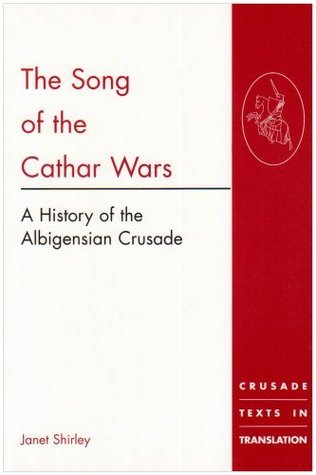
The Song of the Cathar Wars: A History of the Albigensian Crusade
This is the English translation of an early 13th-century Provencal poem which narrates key events before, during and after the Albigensian Crusade, which was launched in 1209. In Provencal, the poem is known as La Canso and in French, as La Chanson de la Croisade Albigeoise.
224 pages, Paperback
First published January 1, 1213
About the author
William of Tudela
4 booksWilliam of Tudela (in Occitan, Guilhem de Tudela; in French, Guillaume de Tudèle; fl. 1199-1214) was the author of the first part of the Canso de la Crozada or Song of the Albigensian Crusade, an epic poem in Old Occitan giving a contemporary account of the crusade against the Cathars.
Ratings & Reviews
Friends & Following
Create a free account to discover what your friends think of this book!
Community Reviews
Displaying 1 - 6 of 6 reviews

August 20, 2019
This epic poem in Old Occitan, one of the major sources for what happened during the Albigensian Crusade, is totally fascinating and inspiring, but also intriguingly mixed in terms of its verse. The first third or so was written by Guilhem de Tudela (or Guillaume de Tudèle, as he's usually known in French), a jongleur from Navarre, who covers the first few years of the Crusade and is generally pro-crusaders. After about 3000 lines, Guilhem suddenly stops, apparently because his patron was killed shortly afterwards following the Battle of Muret.
The story is then taken up by an anonymous troubadour, who fills in the remainder of the story up to the siege of Toulouse in 1219. But this writer is firmly Team Languedoc (though he assures readers that he himself is a good Catholic, not a Cathar), so when you read the poem you have this fascinating shift in perspective a third of the way through. And while Guilhem is quite a stodgy writer – his lines have a jangly quality, and tend to stick to the facts – the anonymous contributor is a brilliant poet, with a stirring sense of the romance of what is going on. In his section of the poem, the conflict is portrayed as the vast, tragic struggle of a southern civilisation on the point of being wiped out – a civilisation of courtly love and paratge, an oft-repeated word, cognate with ‘peerage’ but which means, here, a kind of romanticised sense of nobility and Occitanian values.
When, for example, King Pedro II of Aragon arrives to assist his Languedoc allies, this is presented near the end of Guilhem's section as a fairly dry matter of fact; but it's taken up by Anonymous as something like the elves turning up at the Battle of Helm's Deep (and indeed, the moment when a disguised Pedro is mortally wounded, and rips off his disguise to yell Eu so-l reis! ‘I am the king!’, is something straight out of Tolkien).
Perhaps the most enjoyable flourish of troubadourian irony is reserved for the epitaph to the Crusaders' leader Simon de Montfort, who is finally killed during the siege of Toulouse by a mangonel operated (according to the poem) by the women and girls of the city. His body is carried off to Carcassonne to be interred, under an inscription to the effect that he was a holy figure who will surely ascend to the kingdom of God. ‘And I'm sure this must be so,’ says our poet, before going on:
I've heard there are still some in Toulouse who have this off by heart. I would certainly like to believe it.
The story is then taken up by an anonymous troubadour, who fills in the remainder of the story up to the siege of Toulouse in 1219. But this writer is firmly Team Languedoc (though he assures readers that he himself is a good Catholic, not a Cathar), so when you read the poem you have this fascinating shift in perspective a third of the way through. And while Guilhem is quite a stodgy writer – his lines have a jangly quality, and tend to stick to the facts – the anonymous contributor is a brilliant poet, with a stirring sense of the romance of what is going on. In his section of the poem, the conflict is portrayed as the vast, tragic struggle of a southern civilisation on the point of being wiped out – a civilisation of courtly love and paratge, an oft-repeated word, cognate with ‘peerage’ but which means, here, a kind of romanticised sense of nobility and Occitanian values.
When, for example, King Pedro II of Aragon arrives to assist his Languedoc allies, this is presented near the end of Guilhem's section as a fairly dry matter of fact; but it's taken up by Anonymous as something like the elves turning up at the Battle of Helm's Deep (and indeed, the moment when a disguised Pedro is mortally wounded, and rips off his disguise to yell Eu so-l reis! ‘I am the king!’, is something straight out of Tolkien).
Perhaps the most enjoyable flourish of troubadourian irony is reserved for the epitaph to the Crusaders' leader Simon de Montfort, who is finally killed during the siege of Toulouse by a mangonel operated (according to the poem) by the women and girls of the city. His body is carried off to Carcassonne to be interred, under an inscription to the effect that he was a holy figure who will surely ascend to the kingdom of God. ‘And I'm sure this must be so,’ says our poet, before going on:
Si per homes aucirre ni per sanc espandir,
Ni per esperitz perdre ni per motz cosentir,
E per mals cosselhs creire, e per focs abrandir,
E per baros destruire, e per Paratge aunir,
E per las terras toldre, e per orgolh suffrir,
E per los mals escendre, e pels bes escantir,
E per donas aucirre e per efans delir,
Pot hom en aquest segle Jhesu Crist comquerir,
El deu portar corona e el cel resplandir!
If, by killing men and spilling blood,
And by damning souls and by sanctioning murders,
And by trusting evil counsel, and by setting fires,
And by destroying barons and by disgracing paratge,
And by taking lands with violence, and by succumbing to pride,
And by inciting evil and by suppressing good,
And by killing women and by slitting children's throats
One can conquer Jesus Christ in this world,
He must indeed wear a halo and shine forth from the heavens!
I've heard there are still some in Toulouse who have this off by heart. I would certainly like to believe it.

March 6, 2026
J'ai lu La Chanson de la croisade albigeoise pour mon cours de littérature française médiévale, et j'ai trouvé ce livre très intéressant. Avant ce cours, je na savais rien de la croisade albigeoise, mais je pense que ce livre souligne l'histoire entre le nord de la France et l'Occitanie -- qui deviendra plus tard le sud de la France.
Dans mon cours, nous avons discuté comment la croisade albigeoise pouvait être considérée comme une genocide médiévale, et cela semble le cas. L'intention des croisés était d'écraser les « hérétiques », les cathares, et cette éradication est la caractéristique déterminante d'une genocide.
Même si l'histoire était un peu répétitive, il restait très intéressant et éducative.
Dans mon cours, nous avons discuté comment la croisade albigeoise pouvait être considérée comme une genocide médiévale, et cela semble le cas. L'intention des croisés était d'écraser les « hérétiques », les cathares, et cette éradication est la caractéristique déterminante d'une genocide.
Même si l'histoire était un peu répétitive, il restait très intéressant et éducative.

April 24, 2014
Truly fascinating account of religious and ethnic persecution in the Middle Ages. One also gets a vivid account of the laws of war in this period.
Read
August 6, 2018By far the most readable primary source for the Albigensian Crusade.

July 6, 2025
Solid translation. Shirley accepts somewhat uncritically the idea of “Cathars,” but they almost irrelevant to the chivalric epic that constitutes almost the entire canso.
There are a few obvious gaps in the text, shown with a series of periods, and I would’ve appreciated some comments on them. My edition also had a few sloppy formatting errors.
It becomes much more readable about 1/3 of the way through when the authors switch. Unfortunately, not long after that point, the story gets very repetitive—Simon de Montfort (no, not that one) says he’ll take Toulouse or die trying, Count Raymond fends off his attack, and Montfort receives reinforcements and a new plan. As a piece of entertainment, it suffers from this and the long lists of knights (most of whom are named Guy or Raymond). As a history, I didn’t find it too enlightening as it was mostly “this castle changed hands and then the leaders talked about the situation”.
If you’re interested in learning what happened at a high level militarily during this time period from a contemporary source, it’s an invaluable resource. That just isn’t what makes this period so fascinating to me.
There are a few obvious gaps in the text, shown with a series of periods, and I would’ve appreciated some comments on them. My edition also had a few sloppy formatting errors.
It becomes much more readable about 1/3 of the way through when the authors switch. Unfortunately, not long after that point, the story gets very repetitive—Simon de Montfort (no, not that one) says he’ll take Toulouse or die trying, Count Raymond fends off his attack, and Montfort receives reinforcements and a new plan. As a piece of entertainment, it suffers from this and the long lists of knights (most of whom are named Guy or Raymond). As a history, I didn’t find it too enlightening as it was mostly “this castle changed hands and then the leaders talked about the situation”.
If you’re interested in learning what happened at a high level militarily during this time period from a contemporary source, it’s an invaluable resource. That just isn’t what makes this period so fascinating to me.

March 10, 2025
Very moving.
Displaying 1 - 6 of 6 reviews