Bernard Malamud was an American novelist and short story writer. Along with Saul Bellow, Joseph Heller, Norman Mailer and Philip Roth, he was one of the best known American Jewish authors of the 20th century. His baseball novel, The Natural, was adapted into a 1984 film starring Robert Redford. His 1966 novel The Fixer (also filmed), about antisemitism in the Russian Empire, won both the National Book Award and the Pulitzer Prize.
Refugees are a constantly divisive topic in recent years. It’s easy to lose sight of individuals. Little Alan Kurdi’s body, washed up on a beach in 2015 reminded us, and moved Khaled Hosseini to pen Sea Prayer (see my review HERE).
This short story also humanises the refugee experience by focusing on one person: Oskar Gassner, a German Jewish professor, newly arrived in New York. Malamud’s tender and tragic story doesn't preach or sentimentalise. It quietly shows the profound pain of having to abandon everything.
The narrator is a 20-year-old student who earns money by giving English lessons to refugees, all of them “accomplished men” who, “like most educated Germans… had at one time studied English”. That doesn’t make teaching easy. Oskar has the Sisyphean task of writing and delivering a lecture in a couple of months, and he is traumatised by losing his family, country, culture, and language. “To many of these people, articulate as they were, the great loss was the loss of language - that they could no longer say what was in them to say.”
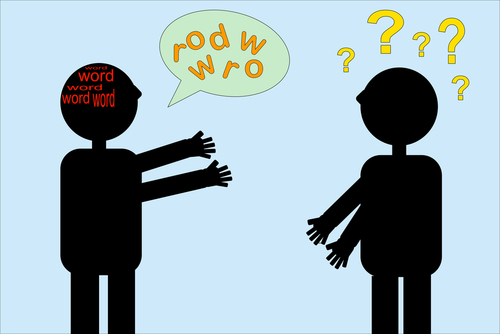
Image: Two stick figures: one saying things the other doesn’t understand (created for neurological loss) (Source)
The tutor develops a close relationship with his pupil, going above and beyond, as he fears for Oskar's mental health.
Translation tools on smartphones make basic communication easier now, but language and culture are viscerally embedded from birth. Refugees still feel the pain of that loss. “Could there be something more than a refugee’s displacement, alienation, financial insecurity, being in a strange land without friends or a speakable tongue?”
Eyes
• “His eyes, too, were heavy, a clouded blue; and as he stared at me after I identified myself, doubt spread in them like underwater currents.” • “He gazed at me with his cloudy eyes.” • When the tutor uses a mirror to demonstrate how to make particular sounds, “Oskar, uneasy, fearful, finding it hard to face either of us in the faded round glass.” • “His dull eyes looked as though they had been squirted with a dark dye.” • “He sat in his massive armchair with sick eyes, breathing like a wounded animal.” • “His blue eyes had returned to life.”
There’s no quick or easy solution, but I do think it’s worth reminding ourselves of individual stories of fellow human beings, including children. In addition to Hosseini’s Sea Prayer:
• The 2019 film, Midnight Traveler, in which a family film their journey to legal asylum in Europe, on phones, over a few years is fascinating, powerful, sad, funny, and uplifting. See imdb HERE, and Wikipedia HERE.
• Brian Bilston’s very clever poem, Refugees, has been published in illustrated form. You can read the whole poem and see some of the pictures in my review, HERE
Martin Goldberg, an American college student, is tutoring Oskar in English. Oskar was a noted Jewish journalist in Germany who can see how dangerous the situation is in Nazi Germany. He has come to the United States for a job which involves giving lectures. He is very depressed since he does not know English well, and he has traveled without his wife who refused to leave Germany.
Martin and Oskar spend many hours together, even outside the lessons, since Martin has fears for Oskar's mental health. I won't give away the ending, but the story shows the deep trauma that resulted from the Holocaust even among the refugees that escaped from Germany. They had to deal with survivor guilt. They also had to break their emotional connections when they left their loved ones, their culture, and their language.
My first Malamud. I thought his smilies were rather trite, but otherwise good storytelling. Sad story. Reminded me a bit of a story we read by Nabokov. Similar tone and setting.
This is a sad story, set in 1939, about a few educated successful Jewish refugees who escaped from Germany’s during Hitler’s reign. It focuses mostly on one of the men who is being tutored in English so that he can deliver a lecture on poetry in English. This short story is in a book I bought that contains the best short stories of various years. This story was published in 1964. I am currently working with refugees from Afghanistan who left to escape the Taliban. Many of them are also struggling to learn English.
How to reduce such a powerful story to just a short review?
This was the past week's selection in the GR Short Story Club. The club has introduced me to some excellent authors and short stories...I don't remember reading Malamud in the past but I think I might havd read a book or story in the past possibly in High School...
In this story, Oskar Gassner emigrated from Poland* to the U.S. a month before Kristallnacht, leaving behind his non-Jewish wife (who did not wish to join him) and his vehemently (actually she is described as violently) antisemitic mother-in-law. He has lost everything, his reputation, his dignity, his self-esteem. In the past he has attempted suicide. He suffers displacement, alienation, financial insecurity. Once a respected, successful journalist and historian, Oskar now lives in a tiny run-down apartment, cut off from the society of intellectual academia and tortured by his inability to master the English language. He has been offered to give a series of lectures in his field and toward this end he pays money he does not have to be tutored by Martin Goldberg, a young college student who earns a small living tutoring immigrants. Oskar is frustrated and unable to cobble together the first lecture due to be delivered one month later. The man is desperate and Martin goes beyond tutoring for the several hours a week that was scheduled, devoting much of his personal time to Oskar, trying to help him both with English and his scheduled lecture while also attempting to prop him up emotionally.
With the help of Martin, Oskar succeeds in eventually writing and delivering his first lecture, but it is too much for Oskar who tells Martin that he ‘has lost faith, no longer possessing his former self-esteem, in his life of too much illusion’ – ‘the Nazi’s are responsible for his loss of confidence and whatever else he has lost’. Malamud’s prose is brilliant, much of which caught me by the throat – Oskar sitting in his velours armchair that smothered rather than supported him, and the unbearable lightness in the letter he received from his bitterly anti-semitic mother-in-law, informing that his wife/ ‘her daughter was converted to Judaism by a vengeful Rabbi, after which time she was dragged out of the house by brown shirts, together with other Jews, and transported in lorries to a small border town in conquered Poland where it was rumored that she was shot in the head and toppled into an open tank ditch, with the naked Jewish men, their wives and children, some Polish soldiers and a handful of Gypsies’. “and a handful of Gypsies” chilled my bone, perhaps most in the description – as if tossed in as an afterthought to complete a recipe.
My heart broke for both Oskar and Martin, at the very tragic ending.
*although titled The German Immigrant, I clearly misread something because I understood that the character of the story emigrated from Poland.>
in a way, I suppose this story matches its characters, plot, and the like, stumbling about in murky gathering waters with no clear way out. the narrator fails to realize that by succeeding to springboard Oskar with his own two cents of, according to Oskar, failed perspective (Oskar failing to realize the benefit of these, but realizes the benefit as it demands his counter-perspective), he allows Oskar enough success to overcome his failure to inervate, thus allowing Oskar to succeed at failing to live with events, along with some clumsy twist on trading places, betwixt Oskar and his wife. Not a terrible two stars, but I've noticed myself giving out a string of three stars for tepid works, and the call for anti-inflationary measures was strident enough to rate accordingly.
An uncomfortable read that reminds one that the horrors of war follow even those who try to escape.
Language is a big feature in this story, and for educated articulate people, the loss of language is the biggest loss. With so much to say they are unable to communicate.
This is a sad story, dreary and burdened with a contagious sense of hopelessness — in 1939 this German refugee cannot bear to listen to the news.
5 stars for the measured weight of the prose, and for the contrast in characters: the thin young college student, who is the teacher, and the accomplished middle-aged journalist, who is the student, and how they merge and influence each other.
"The refugee fumbles for the light and stares at me, hiding despair but not pain." Painful to read until the last part knowing what is going to happen.