

What do you think?

The Ægypt Cycle #3
Dæmonomania
So it is for Pierce Moffett, would-be historian and author, who has moved from New York to the Faraway Hills, where he seems to discover—or rediscover—a path into magic, past and present. And so it is for Rosie Rasmussen, a single mother grappling with her mysterious uncle's legacy and her young daughter Samantha’s inexplicable seizures. For Pierce's lover Rose Ryder, another path unfolds: she’s drawn into a cult that promises to exorcise her demons. It is the dark of the year, between Halloween and the winter solstice, and the gateway is open between the worlds of the living and the dead. A great cycle of time is ending, and Pierce and Rosie, Samantha and Rose Ryder must take sides in an age-old war that is approaching the final battle…Or is it? Dæmonomania is a journey into the very mystery of existence: what is, what went before, and what could break through at any moment in our lives.
509 pages, Kindle Edition
First published January 1, 2000
About the author
John Crowley
121 books879 followersLibrarian Note: There is more than one author in the Goodreads database with this name. See this thread for more information.
John Crowley (1942-2026) was an American author of fantasy, science fiction, historical fiction, and non-fiction. Crowley studied at Indiana University and has a second career as a documentary film writer.
Crowley is best known as the author of Little, Big (1981), a work which received World Fantasy Award for Best Novel and has been called "a neglected masterpiece" by Harold Bloom, and his Ægypt series of novels which revolve around the same themes of Hermeticism, memory, families and religion. His novel Ka: Dar Oakley in the Ruin of Ymr (2017) won the Mythopoeic Award in 2018 and was nominated for the World Fantasy Award for Best Novel, while critics compared it in scope and ambition to Crowley's earlier works Little, Big and the Aegypt cycle.
Note: The John Crowley who wrote Sans épines, la rose: Tony Blair, un modèle pour l'Europe? is a different author with the same name. (website)
John Crowley (1942-2026) was an American author of fantasy, science fiction, historical fiction, and non-fiction. Crowley studied at Indiana University and has a second career as a documentary film writer.
Crowley is best known as the author of Little, Big (1981), a work which received World Fantasy Award for Best Novel and has been called "a neglected masterpiece" by Harold Bloom, and his Ægypt series of novels which revolve around the same themes of Hermeticism, memory, families and religion. His novel Ka: Dar Oakley in the Ruin of Ymr (2017) won the Mythopoeic Award in 2018 and was nominated for the World Fantasy Award for Best Novel, while critics compared it in scope and ambition to Crowley's earlier works Little, Big and the Aegypt cycle.
Note: The John Crowley who wrote Sans épines, la rose: Tony Blair, un modèle pour l'Europe? is a different author with the same name. (website)
Ratings & Reviews
Friends & Following
Create a free account to discover what your friends think of this book!
Community Reviews
Displaying 1 - 30 of 53 reviews

September 23, 2008
This third part of the Aegypt quartet deals with a Christian charismatic cult, witch-hunts (both contemporary and historical) and intolerance. Simultaneously, it picks up the fascinating tales-within-the-tale of John Dee, erstwhile magus to Queen Elizabeth and Giordano Bruno, heretic and master of symbol and memory.
The writing is gorgeous and compelling. Crowley picks up strands of plot from the first and second volumes and runs with them. His insights into Hermeticism, as well as the magic of everyday life, are powerful. The play of symbols is awe-inspiring and woven expertly into the narrative. There are musings on Little Nemo comic strips (depicted here as Little Enosh, with a gnostic twist) and the development of an ongoing Grail motif involving protagonist Pierce, standing in for Parsifal, who is both foolish and heroic. Central to this novel is the dilemma of loving someone who has become someone else entirely.
Sometimes you find a novel that speaks to your station in life, as if it were written just for you. Oddly, this is also a theme in the novels. John Crowley's Aegypt cycle came at just the right time for me. I can't recommend them highly enough. And, even as I am chomping at the bit to read the concluding volume, I just don't want this reading experience to end.
I can't recommend these books highly enough.
The writing is gorgeous and compelling. Crowley picks up strands of plot from the first and second volumes and runs with them. His insights into Hermeticism, as well as the magic of everyday life, are powerful. The play of symbols is awe-inspiring and woven expertly into the narrative. There are musings on Little Nemo comic strips (depicted here as Little Enosh, with a gnostic twist) and the development of an ongoing Grail motif involving protagonist Pierce, standing in for Parsifal, who is both foolish and heroic. Central to this novel is the dilemma of loving someone who has become someone else entirely.
Sometimes you find a novel that speaks to your station in life, as if it were written just for you. Oddly, this is also a theme in the novels. John Crowley's Aegypt cycle came at just the right time for me. I can't recommend them highly enough. And, even as I am chomping at the bit to read the concluding volume, I just don't want this reading experience to end.
I can't recommend these books highly enough.

October 26, 2011
What John Crowley does with words is so hard to put a finger on, let alone a review. A modern magician in disguise, from within the ordinary he conjures the ineffable that sustains us day by day. And by expertly blurring the borders that separate novelty from routine, he leaves us double guessing whether anything outside the norm actually even occurred. That’s my kind of magic; that’s my kind of book.

August 12, 2026
'You're not required to finish it...but you're not to give it up either.
Oh I see, he thought or breathed, his Sagittarian verb, the heart pierced by its own arrow: I see.
He picked up his pen, and on the unfinished page of his journal he wrote a new epigraph, not someone else's this time but his own, for a book not yet written and now unwritable.'
John Crowley continues his Aegypt quartet with this weighty entry into the smalltown of Arcady, NY, its narrative consistently weaving historical fiction and existential ponderings paired against a sentient cosmos. Crowley's majestic control of his open-air prose is a watermark of elegance and mystery, fantasy as the 'everyday' with a rare and soulful approach to characterization, none of them weighed down without the restrictive armor of fantastical heroics. Truly a soulful gem of a novel.
Crowley passed away last week, his Sagittarian soul a blessing to all us readers seeking meaningful escape.
Oh I see, he thought or breathed, his Sagittarian verb, the heart pierced by its own arrow: I see.
He picked up his pen, and on the unfinished page of his journal he wrote a new epigraph, not someone else's this time but his own, for a book not yet written and now unwritable.'
John Crowley continues his Aegypt quartet with this weighty entry into the smalltown of Arcady, NY, its narrative consistently weaving historical fiction and existential ponderings paired against a sentient cosmos. Crowley's majestic control of his open-air prose is a watermark of elegance and mystery, fantasy as the 'everyday' with a rare and soulful approach to characterization, none of them weighed down without the restrictive armor of fantastical heroics. Truly a soulful gem of a novel.
Crowley passed away last week, his Sagittarian soul a blessing to all us readers seeking meaningful escape.

March 22, 2022
Hey, demons! Now we're getting somewhere!
Er, or maybe not. While the title "Daemonania" suggests a book where everyone suddenly goes ga-ga for creatures from the Hot Place or we encounter a really serious fan club for that one 70s story of "Doctor Who" featuring Morris dancers, unfortunately for us neither of those things happen. Indeed, in line with most of the cycle's sources/influences, it’s a reference to a 16th century book by Jean Bodin about sorcerers and witchcraft persecutions. Apparently there's a copy in the University of Southern California's Special Collections section, in case you're ever down that way and want to see if they'll let you take a look at it. Or if you want to center a story about a weird apocalyptic hellscape being unleashed due to the book being there, the idea's there for the taking.
So, no demons but three books in matters do start to intensify slightly, which being you're three books in is a welcome development. Probably one of the mistakes in marketing this series is the publisher treating this like a teratology, which it very much is not. What it is, is a very large book divided into four parts and structured as such (the following book, and I'll get more into this when we reach there, is essentially all epilogue) so that anyone trying to read this as a series of small climaxes leading up to final revelations and resolutions is going to be confused and/or disappointed because the cycle defiantly refuses to even remotely adhere to that notion. Instead we get many small revelations and discoveries, minor shifts and changes over time, while the overall story itself gradually builds. It makes for an uneven experience if you try to mentally break it up because the first and last books seem to almost hover in place while all the action (such as it is) seems to congregate in the middle section. But as one continuous work, it makes perfect sense.
That said, we're still in the "John Crowley writes an intellectual psychological thriller" stage of things so for a lot of people this may be the most satisfying book because for a while it sure seems like a lot of stuff that has been building up is going to pay off. Most of that centers around Rosie Rasmussen's suddenly complicated domestic life . . . in the midst of divorcing her husband and dealing with her young daughter Sam suddenly manifesting a diagnosis of epilepsy she starts to realize that the group her psychologist soon-to-be-ex belongs to is actually a front for a religious cult called the Powerhouse, which despite sounding for some reason like a Bad Company tribute band, is one of those effectively shadowy cults that seem to have lots of resources to tap. What this means in practice: they try to buy a clinic and are able to fling lots of money at lawyers in order to get custody of Sam, who they seem to want for a kind of ritual (or at least they don't seem to want to know her opinions on which cartoons to watch). Needless to say, this causes no end of anxiety for Rosie.
Giving the series an actual villain, nebulous as it is, gives the plot a little more focus, or at least brings it down to earth for a bit. Crowley is still working the "Has the world changed or have I have changed" theme, but now its in service to an actual tangible problem that, as the best cults do, affects nearly everyone in the book. Poor Rosie gets the brunt of it, having to fight for her child against a force that has the ability to make the legal case in "Bleak House" seem like a study in brevity, but Pierce gets in on the action too. Still continuing writing his book that maybe six people are going to read (two of which probably are not his parents), he also keeps up his weird sexual dominance thing with the other Rosie in the book, only to discover that she's starting to find the Bible surprisingly gripping reading. This would be fine in normal circumstances, but it turns out she enjoys reading it as a group experience. All the time. Oh, and it seems like Pierce is falling in love with her. Not an opportune time, pal!
To add to the ominiousity, Spofford and a fellow Vietnam vet get the sense that Something Bad is about to happen and decide to go on a trek, which is not good for Rosie, who could use the moral support. Are things about to get heavy? Well, we're already inside a walking debate on the pros and cons of Hermeticism (itself based on a combination of Egyptian and Greek mythologies) so if you were hoping things were going to get a little less dense, I'm afraid that ship has long sailed, friend.
Thing is, giving us a slightly meatier plot to hang on all the philosophical examination does work to make the book more compelling because it finally seems like there's actual consequences to all these leisurely thought games. When Rosie and the Powerhouse finally get into conflict, there's real stakes involved and as self-centered as Pierce is, when you see the clash between his view of the world and the Powerhouse's (as demonstrated by his unraveling relationship with Rosie Ryder) you can start to see the blood trickling into the water. Maybe I don't have the background to argue for or against the Prisca theologia, but I know what a broken heart feels like (I don't have one now, I should say, before people start calling my wife asking what happened) and I know what its like to fight against something that big and huge and wrong and is probably going to still win despite all that. Suddenly, all the back and forths seem to matter that much more. When Pierce gets into a brief theological debate with Mike Mucho, its bracing even relayed after-the-fact, because its an encapsulation of part of what the book seems to be about for me, the conflict between people who want to define the world rigidly their way and dare you to prove them wrong (while putting forward arguments that aren't provable or disprovable) and the people who want to acknowledge that the world is weird and elastic and wonderful and awful and sometimes unexplainable.
Still, lest we forget about Ye Olde Metaphors, Crowley somehow manages not only to make time for the John Dee and his Traveling Angel Talkers Show but also gives it a little more relevance to what's going on in the main plot. As he focuses more on the latter part of Dee's life, things get a bit more poignant as we watch his life sort of fall apart in what might be a metaphor for England getting a bit less magical (and not in the "Jonathan Strange and Mr Norrell" manner but in more dogmatic way) and good ol' Giordano Bruno learns what its like to be a rare person in a world that would prefer you well done. Even if you're familiar with the biographies of these gentlemen, the fictionalized versions here have some weight and what earlier might have seemed like an academic exercise now feels like real people inhabiting a different world and learning how it feels to be on the border between two eras. As it turns out, it doesn't feel all that good.
Which is exactly what our heroes are discovering as it seems like the world is threatening to enter a transitional period. With Sam not with Rosie and everyone trying to converge before the Powerhouse does something Biblically crazy, the book finally takes on a sense of urgency . . . and then Crowley decides to pull out his "Resolutions by Asimov" card, giving us a climax that feels like a camera placed in another room while someone sends you a telegram about a fight breaking out somewhere else. It’s a climax that comes across as so deliberately anti-climatic, like a fan blowing gently on a puddle and dispersing all the droplets, that you have to wonder if there's some slight of hand going on here. But I think anyone walking into a Crowley novel and expecting a Dr Strange-esque magical battle was probably terribly misinformed in the first place.
But given how the tension was cranked up slowly over the course of this book and the last book it can't help but feel in the immediate aftermath a little deflating with how it resolves. You want someone to get a comeuppance, you want some kind of revelation, you want the bodies to hit the floor.
It doesn't work that way, not here and not in real life. Events don't often finish with a bang, with a dissipation, and not everyone learns a lesson. And if the lives of John Dee and Giordano Bruno teach us one thing, its that the guys that are the closest to being right don't always get to win. Not every era comes crashing to a close the way the dinosaurs experienced it, with a streak of light flashing from the sky and a soft explosion heralding a new world. Sometimes its as simple as turning a page or the day shifting into night . . . nothing seems different until you finally focus and find that everything has changed. The method of changing isn't that important, or even necessarily what the world might change into . . . in the settling that comes after there's a calming, a sense of a series of sharp vibrations gradually slowing and if nothing else it demonstrates Crowley's skill at poised precision, an uncanny ability to define exactly what a specific point in time and space feels like, how it differs from every hovering point around it. We get on in life by moving from one of those points to the next and if we're lucky there's enough of that specificity that we don't pass our lives in a blur. Crowley captures that and even better I think nails what matters more than delineating the changings in the world. Its not the changing itself that matters, although it does to everyone at the time inside of it. To change is important and essential but what's more is to end up in place where everything can someday change again, and again, and again, to something less than unrecognizable and more than we ever expect it to be.
Er, or maybe not. While the title "Daemonania" suggests a book where everyone suddenly goes ga-ga for creatures from the Hot Place or we encounter a really serious fan club for that one 70s story of "Doctor Who" featuring Morris dancers, unfortunately for us neither of those things happen. Indeed, in line with most of the cycle's sources/influences, it’s a reference to a 16th century book by Jean Bodin about sorcerers and witchcraft persecutions. Apparently there's a copy in the University of Southern California's Special Collections section, in case you're ever down that way and want to see if they'll let you take a look at it. Or if you want to center a story about a weird apocalyptic hellscape being unleashed due to the book being there, the idea's there for the taking.
So, no demons but three books in matters do start to intensify slightly, which being you're three books in is a welcome development. Probably one of the mistakes in marketing this series is the publisher treating this like a teratology, which it very much is not. What it is, is a very large book divided into four parts and structured as such (the following book, and I'll get more into this when we reach there, is essentially all epilogue) so that anyone trying to read this as a series of small climaxes leading up to final revelations and resolutions is going to be confused and/or disappointed because the cycle defiantly refuses to even remotely adhere to that notion. Instead we get many small revelations and discoveries, minor shifts and changes over time, while the overall story itself gradually builds. It makes for an uneven experience if you try to mentally break it up because the first and last books seem to almost hover in place while all the action (such as it is) seems to congregate in the middle section. But as one continuous work, it makes perfect sense.
That said, we're still in the "John Crowley writes an intellectual psychological thriller" stage of things so for a lot of people this may be the most satisfying book because for a while it sure seems like a lot of stuff that has been building up is going to pay off. Most of that centers around Rosie Rasmussen's suddenly complicated domestic life . . . in the midst of divorcing her husband and dealing with her young daughter Sam suddenly manifesting a diagnosis of epilepsy she starts to realize that the group her psychologist soon-to-be-ex belongs to is actually a front for a religious cult called the Powerhouse, which despite sounding for some reason like a Bad Company tribute band, is one of those effectively shadowy cults that seem to have lots of resources to tap. What this means in practice: they try to buy a clinic and are able to fling lots of money at lawyers in order to get custody of Sam, who they seem to want for a kind of ritual (or at least they don't seem to want to know her opinions on which cartoons to watch). Needless to say, this causes no end of anxiety for Rosie.
Giving the series an actual villain, nebulous as it is, gives the plot a little more focus, or at least brings it down to earth for a bit. Crowley is still working the "Has the world changed or have I have changed" theme, but now its in service to an actual tangible problem that, as the best cults do, affects nearly everyone in the book. Poor Rosie gets the brunt of it, having to fight for her child against a force that has the ability to make the legal case in "Bleak House" seem like a study in brevity, but Pierce gets in on the action too. Still continuing writing his book that maybe six people are going to read (two of which probably are not his parents), he also keeps up his weird sexual dominance thing with the other Rosie in the book, only to discover that she's starting to find the Bible surprisingly gripping reading. This would be fine in normal circumstances, but it turns out she enjoys reading it as a group experience. All the time. Oh, and it seems like Pierce is falling in love with her. Not an opportune time, pal!
To add to the ominiousity, Spofford and a fellow Vietnam vet get the sense that Something Bad is about to happen and decide to go on a trek, which is not good for Rosie, who could use the moral support. Are things about to get heavy? Well, we're already inside a walking debate on the pros and cons of Hermeticism (itself based on a combination of Egyptian and Greek mythologies) so if you were hoping things were going to get a little less dense, I'm afraid that ship has long sailed, friend.
Thing is, giving us a slightly meatier plot to hang on all the philosophical examination does work to make the book more compelling because it finally seems like there's actual consequences to all these leisurely thought games. When Rosie and the Powerhouse finally get into conflict, there's real stakes involved and as self-centered as Pierce is, when you see the clash between his view of the world and the Powerhouse's (as demonstrated by his unraveling relationship with Rosie Ryder) you can start to see the blood trickling into the water. Maybe I don't have the background to argue for or against the Prisca theologia, but I know what a broken heart feels like (I don't have one now, I should say, before people start calling my wife asking what happened) and I know what its like to fight against something that big and huge and wrong and is probably going to still win despite all that. Suddenly, all the back and forths seem to matter that much more. When Pierce gets into a brief theological debate with Mike Mucho, its bracing even relayed after-the-fact, because its an encapsulation of part of what the book seems to be about for me, the conflict between people who want to define the world rigidly their way and dare you to prove them wrong (while putting forward arguments that aren't provable or disprovable) and the people who want to acknowledge that the world is weird and elastic and wonderful and awful and sometimes unexplainable.
Still, lest we forget about Ye Olde Metaphors, Crowley somehow manages not only to make time for the John Dee and his Traveling Angel Talkers Show but also gives it a little more relevance to what's going on in the main plot. As he focuses more on the latter part of Dee's life, things get a bit more poignant as we watch his life sort of fall apart in what might be a metaphor for England getting a bit less magical (and not in the "Jonathan Strange and Mr Norrell" manner but in more dogmatic way) and good ol' Giordano Bruno learns what its like to be a rare person in a world that would prefer you well done. Even if you're familiar with the biographies of these gentlemen, the fictionalized versions here have some weight and what earlier might have seemed like an academic exercise now feels like real people inhabiting a different world and learning how it feels to be on the border between two eras. As it turns out, it doesn't feel all that good.
Which is exactly what our heroes are discovering as it seems like the world is threatening to enter a transitional period. With Sam not with Rosie and everyone trying to converge before the Powerhouse does something Biblically crazy, the book finally takes on a sense of urgency . . . and then Crowley decides to pull out his "Resolutions by Asimov" card, giving us a climax that feels like a camera placed in another room while someone sends you a telegram about a fight breaking out somewhere else. It’s a climax that comes across as so deliberately anti-climatic, like a fan blowing gently on a puddle and dispersing all the droplets, that you have to wonder if there's some slight of hand going on here. But I think anyone walking into a Crowley novel and expecting a Dr Strange-esque magical battle was probably terribly misinformed in the first place.
But given how the tension was cranked up slowly over the course of this book and the last book it can't help but feel in the immediate aftermath a little deflating with how it resolves. You want someone to get a comeuppance, you want some kind of revelation, you want the bodies to hit the floor.
It doesn't work that way, not here and not in real life. Events don't often finish with a bang, with a dissipation, and not everyone learns a lesson. And if the lives of John Dee and Giordano Bruno teach us one thing, its that the guys that are the closest to being right don't always get to win. Not every era comes crashing to a close the way the dinosaurs experienced it, with a streak of light flashing from the sky and a soft explosion heralding a new world. Sometimes its as simple as turning a page or the day shifting into night . . . nothing seems different until you finally focus and find that everything has changed. The method of changing isn't that important, or even necessarily what the world might change into . . . in the settling that comes after there's a calming, a sense of a series of sharp vibrations gradually slowing and if nothing else it demonstrates Crowley's skill at poised precision, an uncanny ability to define exactly what a specific point in time and space feels like, how it differs from every hovering point around it. We get on in life by moving from one of those points to the next and if we're lucky there's enough of that specificity that we don't pass our lives in a blur. Crowley captures that and even better I think nails what matters more than delineating the changings in the world. Its not the changing itself that matters, although it does to everyone at the time inside of it. To change is important and essential but what's more is to end up in place where everything can someday change again, and again, and again, to something less than unrecognizable and more than we ever expect it to be.

July 25, 2014
*Sigh* I realize that John Crowley is an acquired taste for many people but for me, he can write some of the most hypnotic and compelling prose I've ever read. When I come upon it, I sink right through the words into whatever world Mr. Crowley had decided to create. The problem, for this book, is that that writing is broken up by considerable stretches of the most pedestrian writing that brings you up short wondering what just happened.
But I have made it through three of the four books of the Cycle, so I can only hope the conclusion will sing like it should.....
But I have made it through three of the four books of the Cycle, so I can only hope the conclusion will sing like it should.....
August 28, 2007
The Aegypt sequence continues. The "darkest" book of the tetraology. Absorbing, if at times baffling. There are pages of hermetic/gnostic musings which can be difficult to parse, but Crowley is always a beautiful and engaging writer, so for my money it's worth it.

October 15, 2018
Crowley continues to show uncertainty about Pierce Moffett's age. On the opening page, he describes Pierce as "in the thirty-fifth year of his own age" (3), which would make him 34 years old. But later, before the novel has reached the point of that opening flash-forward, we are told "He was to be thirty-six." (246) These different ages would put the action of the novel in the autumn of either 1977 or 1978. In this same section we are given what I believe is the novel's only specific contemporary reference to this point when Pierce thinks about "This Ayatollah in Iran." (249) Either year is possible for this reference, but 1978 seem more likely.
Finally, on the last page of Pierce's story in this novel, Crowley gives us the date: "the twenty-second of December, 1979." (449) That would make Pierce 37! So, in action that covers approximately three months, from the autumnal equinox to the winter solstice, Pierce has been looking at turning 35, 36, and 37 years old on his December birthday. It's hard not to see this as intentional on the part of the author, but the reason is obscure.
But Pierce seems almost insane at various points in the narrative. In Love & Sleep he imagines having a son show up at his door and acts as if he really has a 13 year old boy present in his apartment. After attending the Powerhouse Bible Study, he imagines that Rose Ryder has been replaced by a possibly inhuman simulacra (a belief disavowed the following day). And then there are the events during his drive to Conurbana (407-410):
• Pierce stops for gas and has to pump it himself for the first time. He ignorantly fills his tank with diesel and is stranded on the highway. No he isn’t! He realized his error standing at the pump and got the correct fuel!
• While driving at 50 mph he pulls the hood release and smashes his windshield, bending the hood hinges. No he doesn’t! He wondered what the lever was for, but doesn’t press it!
• Pierce abandons his car at the side of the road and wanders into the woods where he takes up with a group of shepherds moving from summer to winter pasturage. No he doesn’t! He pulls over to the side of the road and imagines this scenario before driving off!
Jesus Christ, is that irritating! Even though each false narrative only lasts a paragraph or two. Though I wasn’t enamored of the practice, I got used to Crowley occasionally starting a chapter describing a dream – these quickly or eventually turn into some incredible scenario and then the dreamer wakes. But these fantasy scenarios being described as if they were actually happening was too much.
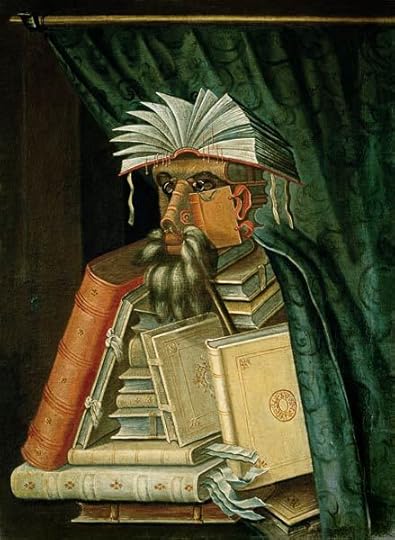
Such things especially bother me because Crowley crafts his story with great subtlety and attention to detail, connecting various parts of the tale both through broader themes and incidental details. In my review of The Solitudes I quoted a line concerning Fellowes Kraft's cottage, "one of those houses too that, to the right eye on the right evening, seemed to have a face"; in Daemonomania the master painter of double images, Guiseppe Arcimboldo, shows up s a character in Kraft's historical novel.
The novel-within-a-novel about John Dee and Giordano Bruno continues throughout this novel; late in the novel, the hint is offered that some of these sections may have been written by Pierce as a continuation of Fellowes Kraft's unfinished novel. Though these pages were not especially tedious, I found them an unwelcome distraction from the soap-opera of the present day characters, who in this novel have genuine drama disrupting their lives. The historical novel insets are written in a distinctly different style than the present day narrative and, in a way, I feel that Crowley achieves this by working with one hand tied behind his back: he doesn't bring his strong descriptive powers to bear on this material and consequently fails to produce the feeling of entering a real world that is very much the case with the present day episodes.
Elements I felt were sketchily presented toward the end of Love & Sleep are here fleshed out as fully as I could wish. (Almost the entirety of this novel takes place before Pierce's visit to his mother in Florida, which frames the events of the earlier novel.) Pierce's affair with Rose Ryder gets the emotional weight it was missing and the reader is given a fairly full account of the methods the Christian cult, The Powerhouse, uses to muscle its way into Blackbury Jambs and convert susceptible residents. One very strange omission, however, is why, if the action takes place in 1979, none of those alarmed by the cult, especially Pierce, think of the previous year's mass murder / suicide by Jim Jones' Peoples Temple.
Though the smiling but joyless leaders of The Powerhouse are obviously villains here (to make sure the reader gets that, they also promote Holocaust denial), Crowley cannot treat even these in purely black-and-white terms. There are a few characters who become Powerhouse adherents that a decade ago I would have considered unbelievably stupid or gullible, but reading it at this time am now entirely willing to accept as realistic depictions.
I haven't been very successful at guessing where Crowley is going with his story. It seems that in the next, and final, novel Pierce will go to Europe in the footsteps of Fellowes Kraft where we may get the Kraft backstory I've been expecting.
Second take - the next day
I finished the third, penultimate volume of John Crowley’s Aegypt sequence, Daemonomania .
As with the second volume, the good stuff kept getting better and the bad stuff worse.
Crowley is a terrific stylist – he weaves a rich world with his words – interesting, individual characters, land- and townscapes that feel like actual places to be explored, and interesting books real and imagined. Here the characters I’ve become attached to in the course of the sequence go through their most dramatic moments: a rocky love affair and a bitter child custody battle where one parent has become an adherent of a Christian cult who would forgo the child’s necessary medical treatment in favor of exorcism. But Crowley doesn’t handle these with typical novelistic melodrama – scenes are mostly underplayed or offstage, in the margins. Crowley’s art is one of hints and allusions.
But the bad – Crowley continues the historical novel-within-a-novel about John Dee and Giordano Bruno. These sections do maintain a certain narrative momentum, but every time I came to one I resented the disruption of the present-day characters’ soap opera. Because these sections take up so many pages, it also has come to seem unfortunate that Crowley has foisted these pages upon his fictional novelist Fellowes Kraft (with, it is now hinted, additional material by our protagonist Pierce Moffett). Crowley seems not to be a polystylist: he does not manage to craft a different but equally enchanting style for this historical narrative. Instead it seems to be a hobbled form of Crowley’s style – the wonderful evocations of place and atmosphere disappear, the characters for the most part are personages rather than persons.
And the worst – because of Crowley’s subtlety he demands an attentive reader. But I feel that he abuses this attentiveness with narrative feints and deliberate discontinuities that I find frustrating. In the previous book I mentioned a discrepancy in Pierce Moffett’s age; I thought this was negligence on Crowley’s part, but now believe it is deliberate, but for what reason or reasons I cannot conceive. At three different points in Daemonomania we are given information from which we can conclude Pierce is 34, 35, or 36 in the three month period during which the novel takes place. Even more irritating is when Crowley starts a narrative about one of his characters, mainly but not always Pierce, continues it for a paragraph or two to a crisis point and then reveals: it’s a dream! Or, even worse: that didn’t happen! Pierce only thought about it happening! There is a certain thematic relevance – the novel muses on the consequences of paths taken and to what results the alternatives might have led – but this does not seem the way to seriously handle the idea, alienating more than enlightening the reader.
Well, still considering the rewards greater than the irritations, I’ll stick it to the end and have moved on to the last volume, Endless Things.
June 6, 2025
While not as inspired as Aegypt, this volume continues the story in a satisfying way, and you begin to see how all the characters and plotlines will come together.
Crowley's prose continues to impress.
Crowley's prose continues to impress.
November 10, 2009
Like the two previous books in the Aegypt series, this one is monumental, riveting, exasperating. I rarely read books twice, but I have a feeling I am going to be reading this series again sometime, because so much eluded me the first time. Crowley's oblique, evocative, tantalizing style keeps you hooked but in the end I felt frustrated, wondering if I'd missed clues I should have picked up. To take just one example, what was the "quiet question" that Beau Brachman, posing as Jesus, puts to the Powerhouse fundamentalists? Apparently we are supposed to guess what it was? Whatever it was, it changed the world, so it seems kind of important!
To go from reading Little Dorrit to reading Daemonomania is like seeing the development of the modern novel in one swell foop. Dickens tries to write tales that feel like reality; Crowley is trying to convince you that reality is a tale (one of many possible tales, in fact). I like the metaphysical dimensions of the Aegypt cycle, but felt we were cheated on character (as we certainly never are with Dickens!). Only Pierce Moffett is deeply revealed to us; the others are all merely sketched. This was another area of frustration for me, because I wanted to get to know them better. I think the book could have sacrificed a few of its more high-flown metaphysical moments to give us more time with the main characters. But still...what a read.
To go from reading Little Dorrit to reading Daemonomania is like seeing the development of the modern novel in one swell foop. Dickens tries to write tales that feel like reality; Crowley is trying to convince you that reality is a tale (one of many possible tales, in fact). I like the metaphysical dimensions of the Aegypt cycle, but felt we were cheated on character (as we certainly never are with Dickens!). Only Pierce Moffett is deeply revealed to us; the others are all merely sketched. This was another area of frustration for me, because I wanted to get to know them better. I think the book could have sacrificed a few of its more high-flown metaphysical moments to give us more time with the main characters. But still...what a read.
This entire review has been hidden because of spoilers.

November 18, 2022
“Once, a universal animating spirit pervaded the whole universe, the reason why everything was as it was and not a different thing. Because of the continuity of the spirit within us and this universal spirit, thoughts could be transmitted from the operator’s spirit, via the star-powers, to the spirit of another, like a phone call bouncing off a satellite. Today too there are links and chains of causality, occult connections which can be manipulated in order to make changes and produce effects; that’s what science and technology do. One difference then was that anybody could play. If you could see, if you could feel, a connection, you had made one; the forging of connections was like the making of metaphors. No it was the making of metaphors, fusing tenor and vehicle into an ampersand of incandescent connection.”
There were so many intriguing threads in this book: witch hunts, Christian cults, werewolves, alchemy, and of course the personal dramas of the various characters we’ve followed through over a thousand pages at this point. And oh boy was it an absolute struggle to get through. I don’t want to totally discount it, because it was enjoyable and it feels like a whole big project that has a Big Thing to say, but I just didn’t enjoy this one as much. Disappointing!
There were so many intriguing threads in this book: witch hunts, Christian cults, werewolves, alchemy, and of course the personal dramas of the various characters we’ve followed through over a thousand pages at this point. And oh boy was it an absolute struggle to get through. I don’t want to totally discount it, because it was enjoyable and it feels like a whole big project that has a Big Thing to say, but I just didn’t enjoy this one as much. Disappointing!

June 2, 2021
worst first half of any of these books so far (overlong bdsm/"sex magick" sequence where crowley was pretty clearly getting off... it's not transgressive, it's not interesting, and it didn't move anything forward after the first ~10 pages)
worst surprise of any of the books so far (best part of the "powerhouse" cult was that, up until 2/3 of the way through this book, it was difficult to tell just how good/bad they were. he decides to make it clear they're unambiguously bad, breaking the spell and FIRMLY tying an otherwise timeless book to its time.)
best last ~100 pages, though. hope the final book picks up + delivers on the potential of the series so far.
worst surprise of any of the books so far (best part of the "powerhouse" cult was that, up until 2/3 of the way through this book, it was difficult to tell just how good/bad they were. he decides to make it clear they're unambiguously bad, breaking the spell and FIRMLY tying an otherwise timeless book to its time.)
best last ~100 pages, though. hope the final book picks up + delivers on the potential of the series so far.
This entire review has been hidden because of spoilers.
September 3, 2012
A tentative rating. I enjoyed this better than Love & Sleep, but in the end, how I feel about this book will depend on lot on how Endless Things turns out.

May 5, 2023
Crowley will generously and smoothly deliver so many different drinks to our table that it's time to take a bath. We will understand everything. and we will regret and justify our favorite heroes. And we experience their troubles with sorrows as our own. And the finale will be stunningly good, like the whole third book in general - you will not be sorry for the time spent on two thousand pages of the epic, I promise. As for me, I'm going to go further with the heroes in the very near future. Because there is a fourth novel, not translated into Russian, "Endless Things" Endless Things. I'll tell you how I read it.
Книга огня
Смерть на костре - жуткое зрелище, но умирать в пламени не так больно, как кажется: вопреки расчетам и надеждам ее устроителей, эта боль не ужасней всякой другой. Многие из получивших тяжелые ожоги говорят, что главная боль приходит гораздо позже; пока огонь вершит свое дело, они переживают ужас или еще более страшное неземное спокойствие, но не боль. Ангелы, встречая души сожженных на том, более прохладном берегу и вопрошая с сочувствием: ну как ты? ты как? - часто получают ответ: да вроде ничего.
"Дэмономания" - книга огня. И воздуха. Земли мало, вся холодная, бесплодная, козерожья, ни буйства Тельца, ни плодородия Девы. А воды почти совсем нет, даже безлошадная карета, сконструированная доктором Ди, едет. влекомая ветром в парусах, по суше. В "Маленьком, большом" вода и земля главные стихии, там ни огню, ни воздуху почти не находится места. Это сейчас к тому, что задуманная Пирсом Моффетом книга, которая должна была структурно перекликаться с двенадцатью домами зодиака и содержать в себе энергии четырех стихий - вещь, не осуществимая в принципе.
То есть, при достаточном уровне сноровки и отсутствии брезгливости, можно свалить в кучу любые эзотерические понятия. Мелко порубленные и пролитые соусом псевдокомпетентности, они способны снискать автору лавры престижных премий и легко проглатываются публикой. Что не отменяет факта: такого рода творение суть красиво завернутая пустышка, суррогат, симулякр. Пирс пишет настоящую книгу. А в ней возьмет верх та из стихий, какая наиболее полно и точно сочетает внутреннюю энергию истории с сущностным содержанием рассказчика. Стрелец (третий знак огня) Краули написал книгу о Водолее (третий знак воздуха) Джордано Бруно, сожженном на костре, а проводником истории в мир сделал своего героя Стрельца Пирса. Что до многократно упоминаемой сатурнианской сути Моффета, не было более изящного и простого способа связать героя с асцендентом в Козероге (управляемом Сатурном) с Бруно, чей Водолей под управлением того же Сатурна.
Понимаете, что я хочу сказать,в "Эгипте" все предельно точно и четко, всякая вещь на единственно ей предназначенном месте. Это даже не ружья, назначение которых выстрелить в третьем акте, здесь тонкое плетение нитей. обозначающих намерения и желания, людей и события, поступки и отношения. Нечаянно подожженный в детстве Пирсом лес, обжигает тем же жаром, каким опалило девочку Роуз, что подбрасывает охапку листьев в костер на заднем дворе. Это тот же пламень, что озаряет и опаляет Келли накануне удачи с пражским Великим деланием. И тот же, какой сожжет еретика Джордано Ноланца. А ветер, разметавший Непобедимую Армаду. возьмет начало из магического кристалла Джона Ди, позже он наполнит паруса чудесной повозки, и принесет неуклюжего неудачника Моффета в городок Блэкберри Откос. Странные приступы девочки Сэм, которые не есть эпилепсия, хотя подозрительно на нее похожи и явно связаны с опаловым шаром из ее "стародома". Манипуляции Рэя Медоноса сознанием паствы - все это воздух, ментальная составляющая.
"Дэмономания" перенасыщена энергиями страстного желания (огонь) и умствования лукавого (воздух), но фундамент системы ценностей практически отсутствует. Что до желания и умения понять чувства партнера, разобраться в побудительных мотивах, выстроить отношения, исходя не только из собственных, но и из его/ее интересов и ожиданий - все ее герои трагически глухи. Нет универсального растворителя преград - воды. Герои тычутся слепыми щенками в поисках целительной влаги, что утолит жажду, а получают соленый крекер чистого знания. - Тут очень хорошо, только ужасно жарко и хочется пить. - Этому горю помочь нетрудно, - сказала Королева, - Возьми сухарик. Алиса взяла сухарь и стала его жевать. Сухарь был ужасно сухой и она чуть не подавилась.
Но все, что я здесь говорю, не относится к читателям. К нашему с вами столу Краули щедро и бесперебойно доставит столько разнообразных напитков, что впору ванну принимать. Мы поймем все. и пожалеем, и оправдаем любимых героев. И переживем их беды с горестями, как свои. А финал окажется потрясающе хорош, как вообще вся третья книга - потраченного на две тысячи страниц эпопеи времени вам не будет жаль, обещаю. Что до меня, то в самое ближайшее время собираюсь отправиться с героями дальше. Потому что есть еще четвертый, не переведенный на русский, роман "Бесконечные вещи" Endless Things. Расскажу, как прочту.
Книга огня
Смерть на костре - жуткое зрелище, но умирать в пламени не так больно, как кажется: вопреки расчетам и надеждам ее устроителей, эта боль не ужасней всякой другой. Многие из получивших тяжелые ожоги говорят, что главная боль приходит гораздо позже; пока огонь вершит свое дело, они переживают ужас или еще более страшное неземное спокойствие, но не боль. Ангелы, встречая души сожженных на том, более прохладном берегу и вопрошая с сочувствием: ну как ты? ты как? - часто получают ответ: да вроде ничего.
"Дэмономания" - книга огня. И воздуха. Земли мало, вся холодная, бесплодная, козерожья, ни буйства Тельца, ни плодородия Девы. А воды почти совсем нет, даже безлошадная карета, сконструированная доктором Ди, едет. влекомая ветром в парусах, по суше. В "Маленьком, большом" вода и земля главные стихии, там ни огню, ни воздуху почти не находится места. Это сейчас к тому, что задуманная Пирсом Моффетом книга, которая должна была структурно перекликаться с двенадцатью домами зодиака и содержать в себе энергии четырех стихий - вещь, не осуществимая в принципе.
То есть, при достаточном уровне сноровки и отсутствии брезгливости, можно свалить в кучу любые эзотерические понятия. Мелко порубленные и пролитые соусом псевдокомпетентности, они способны снискать автору лавры престижных премий и легко проглатываются публикой. Что не отменяет факта: такого рода творение суть красиво завернутая пустышка, суррогат, симулякр. Пирс пишет настоящую книгу. А в ней возьмет верх та из стихий, какая наиболее полно и точно сочетает внутреннюю энергию истории с сущностным содержанием рассказчика. Стрелец (третий знак огня) Краули написал книгу о Водолее (третий знак воздуха) Джордано Бруно, сожженном на костре, а проводником истории в мир сделал своего героя Стрельца Пирса. Что до многократно упоминаемой сатурнианской сути Моффета, не было более изящного и простого способа связать героя с асцендентом в Козероге (управляемом Сатурном) с Бруно, чей Водолей под управлением того же Сатурна.
Понимаете, что я хочу сказать,в "Эгипте" все предельно точно и четко, всякая вещь на единственно ей предназначенном месте. Это даже не ружья, назначение которых выстрелить в третьем акте, здесь тонкое плетение нитей. обозначающих намерения и желания, людей и события, поступки и отношения. Нечаянно подожженный в детстве Пирсом лес, обжигает тем же жаром, каким опалило девочку Роуз, что подбрасывает охапку листьев в костер на заднем дворе. Это тот же пламень, что озаряет и опаляет Келли накануне удачи с пражским Великим деланием. И тот же, какой сожжет еретика Джордано Ноланца. А ветер, разметавший Непобедимую Армаду. возьмет начало из магического кристалла Джона Ди, позже он наполнит паруса чудесной повозки, и принесет неуклюжего неудачника Моффета в городок Блэкберри Откос. Странные приступы девочки Сэм, которые не есть эпилепсия, хотя подозрительно на нее похожи и явно связаны с опаловым шаром из ее "стародома". Манипуляции Рэя Медоноса сознанием паствы - все это воздух, ментальная составляющая.
"Дэмономания" перенасыщена энергиями страстного желания (огонь) и умствования лукавого (воздух), но фундамент системы ценностей практически отсутствует. Что до желания и умения понять чувства партнера, разобраться в побудительных мотивах, выстроить отношения, исходя не только из собственных, но и из его/ее интересов и ожиданий - все ее герои трагически глухи. Нет универсального растворителя преград - воды. Герои тычутся слепыми щенками в поисках целительной влаги, что утолит жажду, а получают соленый крекер чистого знания. - Тут очень хорошо, только ужасно жарко и хочется пить. - Этому горю помочь нетрудно, - сказала Королева, - Возьми сухарик. Алиса взяла сухарь и стала его жевать. Сухарь был ужасно сухой и она чуть не подавилась.
Но все, что я здесь говорю, не относится к читателям. К нашему с вами столу Краули щедро и бесперебойно доставит столько разнообразных напитков, что впору ванну принимать. Мы поймем все. и пожалеем, и оправдаем любимых героев. И переживем их беды с горестями, как свои. А финал окажется потрясающе хорош, как вообще вся третья книга - потраченного на две тысячи страниц эпопеи времени вам не будет жаль, обещаю. Что до меня, то в самое ближайшее время собираюсь отправиться с героями дальше. Потому что есть еще четвертый, не переведенный на русский, роман "Бесконечные вещи" Endless Things. Расскажу, как прочту.

June 25, 2018
This book was the hardest in the series for me to finish; here we see the darkness of magic. If our beliefs have the power to shift the meaning of the world, then the world can become a very terrifying place. The beliefs of others may transform the world into a place that is inhospitable to us, our own beliefs may carry consequences we didn't foresee, and ultimately it is difficult to know how the world becomes what it is at all. All these scenarios get played out by the various characters in the book, with plenty of cringe-inducing scenes. By the time Pierce was having a breakdown, I needed Rhea to comfort me too.
The book ends with the hope of winter solstice. The characters may fail and their story may end, but they exit into a new frame and a new story. This is the hope of renewing seasons: there is no final exit from the story of life and there will always be struggle and suffering, but there will also be awakening upon awakening.
I'm glad I made it through this book, and I'm ready for Endless Things.
The book ends with the hope of winter solstice. The characters may fail and their story may end, but they exit into a new frame and a new story. This is the hope of renewing seasons: there is no final exit from the story of life and there will always be struggle and suffering, but there will also be awakening upon awakening.
I'm glad I made it through this book, and I'm ready for Endless Things.
This entire review has been hidden because of spoilers.

November 3, 2023
The Ægypt Cycle is now really paying off for setting up so damn many thematic aspects that every plot event can feel like there’s a connecting thread and rhyme between everything else. There really is a new cohesion here compared to the last book (both in the Pierce world and the now-scantier historical sections). It involves suffering through one of my old literary nemeses (BDSM philosophizing), but even Pierce and Rosie Ryder’s adventures now have more of an “ah ha” to them than the “what’s going on here” feeling they did in Love & Sleep. A lot of this comes from the most normal real-world plot tension these books have introduced yet (including a genuinely loathsome antagonist) which manages to ground and humble Pierce. (A danger to this though: if you’re not fully indulging Pierce’s worldview, what is the meat of these books then?) In contrast though, this is the first book to really confirm through neutral narration that an actual world-changing is going on here. I’ve read that the final book is more of an epilogue than anything, which means it’s going to be hard to change my feelings from “wondering what’s coming” into a full retrospective. Onwards!

May 1, 2024
Far down in the night lands that are Death, down in the dark where Little Enosh is in Rutha's prison, there is an infinitesimal bright spark of knowing that could dissolve all the worlds, if it were ever to be released. But it might never be released.
A puzzle of a book. Dark, twisted, mystifying, occasionally frustrating, but always compelling.
Just as in Love & Sleep, Pierce's vices and the flavor of his melancholy/madness left me cold. Despite all his regrets and epiphany moments toward the end—and despite understanding (more or less) the symbolic role he plays in this tale—he's never redeemed, for me. (But maybe he doesn't have to be.) Besides that, this volume is probably the best yet in terms of its stakes. So many of the seeds Crowley planted in books one and two burst into life and make chaos, here. I wanted more of our wolf-girls being wolf-girls, more magic to undermine the realism, but at the same time it's a reader's game to find the line between fantasy and ordinary life in these books ... it's so very blurred and buried, which is part of the whole project's conceit. I'm always left wondering what's mere metaphor and what's not, moment to moment.
Still digesting the ending—I think I know what happened. One more book to go; we'll see if it makes any more sense of the rest than I've managed to glean.
Still get dizzy just from the impact of Crowley's writing at a sentence level.
June 16, 2025
I'm afraid I don't see the appeal. I think if there were (a lot) less John Dee and especially Bruno (I get the point, really I do), the book might have stood the test of time. The real interest is in the group in the Faraways and the metaphysical bits whirling about there. I could also have done without the whole Bobby thread (not to mention Robbie). I'll read Endless Things next, just as I've gone through each volume of this very long and wandering novel.
One curious thing: usually I read a book of short stories and a nonfiction book while I read a novel. I couldn't do that with this one. It just subsumed so much of everything I just got confused if the story or history I was reading elsewhere were really part of this book. I am already plotting what I am going to read once I have escaped the grasp of ol' Aegypt.
One curious thing: usually I read a book of short stories and a nonfiction book while I read a novel. I couldn't do that with this one. It just subsumed so much of everything I just got confused if the story or history I was reading elsewhere were really part of this book. I am already plotting what I am going to read once I have escaped the grasp of ol' Aegypt.
October 27, 2024
This series continues to just basically work for me at a really deep level. Unreservedly recommend to anyone interested in the Renaissance, and the idea of history as a thin wire along a vast plain of contingencies and alternatives.
Looking back at my highlights, I see I was completely taken by the lyrical descriptions of the paintings of Giuseppe Arcimboldo.
Looking back at my highlights, I see I was completely taken by the lyrical descriptions of the paintings of Giuseppe Arcimboldo.
December 19, 2020
Wären unter anderen Umständen möglicherweise 4 Sterne, momentan fehlt die Konzentration und Gelassenheit für eine solche Lektüre.
May 2, 2026
5 stars

June 2, 2013
When this book came out, Bantam Publishing thought it would be a terrific idea to not mention that this was third in a series of books. As a result of this choice, the publication of this series has been erratic and relegated to smaller publishing houses that can not reach a broader audience. This is because people bought this book thinking it was a standalone, and were understandably confused when characters showed up whose background was given in previous books. Who is that? Why are they important? Pierce is writing a book? What is it about? What is all this stuff about Dee and Kelley communicating with angels? Why is he not explaining any of this? Indeed, the background ideas of there being multiple histories is hardly touched on in this book...I mean, the reader should all ready know this stuff after reading the previous two, right?
It's interesting, this development in Daemonomania's publishing history... namely because it does encompass quite a bit of what the book is about. The passage-time between histories is drawing to a close, where the old world and all the other possible worlds pass beyond man's kin and a new world is set into place. What determines which world comes into being and which fades into that misty nether-realm beyond the West? Why, choices that are often made without thought and knowledge of the consequences. Choices like not saying this book is third in a series of four...or taking six years to write this book after the considerably more successful Love & Sleep. It is only after making these choices that we discover what is exactly at stake, and as we fight for what we care for, we find that the possibilities and options that seemed once so plentifully available to us are inaccessible... or have now become impossible. Autumn has come, transitioning the world from the summer of possibilities to the cold winter in which no work can be done.
Magic is much more plentiful in Daemonomania than in the previous installments. And yet, the world seems much more real in the stoic sense than in previous installments as well. It becomes brutally apparent that all the magical possibilities, all the supernatural experiences will mean nothing if the world that comes into being after the passage time has no place for them.
This is a bleaker novel then the previous two. Not bleak in any overly violent or gritty way... but in the way life often is bleak. That forces beyond our control because, perhaps, of choices that meant more then we could have imagined were made by us or by those we wish to protect. Irreversible courses are set and a new world is made... paradoxically not according to our desires but definitely by our choices.
It's interesting, this development in Daemonomania's publishing history... namely because it does encompass quite a bit of what the book is about. The passage-time between histories is drawing to a close, where the old world and all the other possible worlds pass beyond man's kin and a new world is set into place. What determines which world comes into being and which fades into that misty nether-realm beyond the West? Why, choices that are often made without thought and knowledge of the consequences. Choices like not saying this book is third in a series of four...or taking six years to write this book after the considerably more successful Love & Sleep. It is only after making these choices that we discover what is exactly at stake, and as we fight for what we care for, we find that the possibilities and options that seemed once so plentifully available to us are inaccessible... or have now become impossible. Autumn has come, transitioning the world from the summer of possibilities to the cold winter in which no work can be done.
Magic is much more plentiful in Daemonomania than in the previous installments. And yet, the world seems much more real in the stoic sense than in previous installments as well. It becomes brutally apparent that all the magical possibilities, all the supernatural experiences will mean nothing if the world that comes into being after the passage time has no place for them.
This is a bleaker novel then the previous two. Not bleak in any overly violent or gritty way... but in the way life often is bleak. That forces beyond our control because, perhaps, of choices that meant more then we could have imagined were made by us or by those we wish to protect. Irreversible courses are set and a new world is made... paradoxically not according to our desires but definitely by our choices.

February 27, 2013
I got stuck in the middle of this one for a long time, but once I came back and focused on it, it went by very quickly.
In some ways, the Aegypt series still feels tremendously unfocused. It is united by the new age magic and world-organizing principles that everyone in the book finds, guided by an endless supply of gurus (Cliff, Ray, Beau, even Pierce in his own way). There is no ideology, of course - in a Crowley novel, everything is about feeling and intuition, and the attempt to fit anything into an evidence-based logical order would burst all the bubbles. Crowley continues his always magnificent ability to distill momentary intuitive feelings we've all felt but never named. He really clarifies, in a truly earnest and respectful way, how things I think of as conspiracy theories and New Age bullshit could just make sense to someone, despite their relation to "truth."
The John Dee sections dragged quite a bit for me, and I was always eager to get beyond them. Pierce's descent into whatever manic symptoms he shows towards the end of the book is fascinating, and I'm very much excited to see how Crowley makes all of this make some kind of sense - I trust him immensely and imagine the conclusion to this vast story-conglomerate will be very satisfying. Dee's arc includes a bunch of things that just no longer made sense, new characters whose positions and motives I didn't really grasp (Burgi?), and a bunch of implied metaphysical business that went over my head. Perhaps that will be clarified by the end?
I don't get the animosity people express about Rose. Her character is fascinating to me, especially
In some ways, the Aegypt series still feels tremendously unfocused. It is united by the new age magic and world-organizing principles that everyone in the book finds, guided by an endless supply of gurus (Cliff, Ray, Beau, even Pierce in his own way). There is no ideology, of course - in a Crowley novel, everything is about feeling and intuition, and the attempt to fit anything into an evidence-based logical order would burst all the bubbles. Crowley continues his always magnificent ability to distill momentary intuitive feelings we've all felt but never named. He really clarifies, in a truly earnest and respectful way, how things I think of as conspiracy theories and New Age bullshit could just make sense to someone, despite their relation to "truth."
The John Dee sections dragged quite a bit for me, and I was always eager to get beyond them. Pierce's descent into whatever manic symptoms he shows towards the end of the book is fascinating, and I'm very much excited to see how Crowley makes all of this make some kind of sense - I trust him immensely and imagine the conclusion to this vast story-conglomerate will be very satisfying. Dee's arc includes a bunch of things that just no longer made sense, new characters whose positions and motives I didn't really grasp (Burgi?), and a bunch of implied metaphysical business that went over my head. Perhaps that will be clarified by the end?
I don't get the animosity people express about Rose. Her character is fascinating to me, especially

July 2, 2010
Again four stars, but this was a rougher one for me . . . it's really 3.5 with the scope of the whole series pulling it up a little. Mostly because I don't like Rose, and the more the book zoomed in on her the more irritated I got. I have a painfully low tolerance for people I want to slap, whether on the page or in real life, and there was definitely more than one moment of thinking "really? she's become this important? are you sure this is working, or are you just using her to nudge the plot along?"
And yet . . . to be honest, I hadn't expected to get so, well, involved with the characters at all . . . there is so much brain candy being offered that I sometimes forget there are also people being presented and described. In truth, for much of this volume I was more engaged in the Kraft novel; I think that because it is set in another time it is that much more transporting, while the main storyline is set in a past I can remember in my own life, however fragmented: familiar, and thus I gloss over the sensual details and zoom in on the conceptual knickknacks that litter the pages. If that makes sense. Anyway, now a quick detour through some overdue library books (one being Dr. Dee's journals, if nothing else this series is making me want to read all that has funneled into it, which is quite a lot) and then it's on to Endless Things.
And yet . . . to be honest, I hadn't expected to get so, well, involved with the characters at all . . . there is so much brain candy being offered that I sometimes forget there are also people being presented and described. In truth, for much of this volume I was more engaged in the Kraft novel; I think that because it is set in another time it is that much more transporting, while the main storyline is set in a past I can remember in my own life, however fragmented: familiar, and thus I gloss over the sensual details and zoom in on the conceptual knickknacks that litter the pages. If that makes sense. Anyway, now a quick detour through some overdue library books (one being Dr. Dee's journals, if nothing else this series is making me want to read all that has funneled into it, which is quite a lot) and then it's on to Endless Things.
April 28, 2014
На гудридсе пишут в описании этой книги:
In a perfect world, John Crowley would be universally recognized as one of our greatest living writers. ... We don't, of course, live in a perfect world, and so Crowley never has become a household name. He is, rather, the quintessential cult figure, the focal point of a relatively small, intensely devoted readership.
Bill Sheehan
На самом деле добавить мало что есть. Более того, кажется, что писать рецензии к каждой из книг бессмысленно, можно только написать рецензию на весь цикл. Так что писать мне нечего - всего три из четырёх взяты. Последняя не переведена на русский, так что придётся читать в оригинале. Несколько страшно.
Демономания - это одержимость демонами. Опять фигурируют Джон Ди и Джордано Бруно. Драмы Пирса и Роз, Роузи и дочки развиваются. Бобби, конечно же, опять появилась в повествовании. Эта часть, современная, всё такая же туманная и странная. Почему-то Пирс и Роз ведут себя как безмозглые курицы. Если бы не вся эта история, которую мы с ними пережили на протяжении последних пары лет, может я бы уже и отбросила эту книгу и этих героев. Но поскольку она третья из цикла, об этом, конечно, речи уже не идёт. Только вперёд, только узнать, чем всё кончилось.
Хотелось бы более больше Крафта в последней части.
In a perfect world, John Crowley would be universally recognized as one of our greatest living writers. ... We don't, of course, live in a perfect world, and so Crowley never has become a household name. He is, rather, the quintessential cult figure, the focal point of a relatively small, intensely devoted readership.
Bill Sheehan
На самом деле добавить мало что есть. Более того, кажется, что писать рецензии к каждой из книг бессмысленно, можно только написать рецензию на весь цикл. Так что писать мне нечего - всего три из четырёх взяты. Последняя не переведена на русский, так что придётся читать в оригинале. Несколько страшно.
Демономания - это одержимость демонами. Опять фигурируют Джон Ди и Джордано Бруно. Драмы Пирса и Роз, Роузи и дочки развиваются. Бобби, конечно же, опять появилась в повествовании. Эта часть, современная, всё такая же туманная и странная. Почему-то Пирс и Роз ведут себя как безмозглые курицы. Если бы не вся эта история, которую мы с ними пережили на протяжении последних пары лет, может я бы уже и отбросила эту книгу и этих героев. Но поскольку она третья из цикла, об этом, конечно, речи уже не идёт. Только вперёд, только узнать, чем всё кончилось.
Хотелось бы более больше Крафта в последней части.

January 5, 2010
On re-reading Aegypt and Love & sleep I was reminded of how much I love the Aegypt novels. Daemonomania, which I finally read for the first time, didn't disappoint. Just the fact that these books exist makes me staggeringly happy. I won't even try to describe them, James Hynes did that really well here: http://bostonreview.net/BR25.6/hynes....
Hynes sums up the genius of Crowley perfectly, talking about "the sense of spaciousness, of depth, of the boundlessness of his imagination" and his "ability to give the reader the feeling that at any point in these novels you could make a sharp left turn from the narrative and just keep going–there’s that much world and story and mystery out there that he’s simply not bothering to show you. It’s a majestic folly, to spend all these riches of language and imagination and erudition, all this effort and all this time, to create a work of art that will, I hope, in its final volume, lead Pierce Moffett, and maybe his author, and maybe even me, to a moment of perfect understanding."
Majestic folly indeed.
Hynes sums up the genius of Crowley perfectly, talking about "the sense of spaciousness, of depth, of the boundlessness of his imagination" and his "ability to give the reader the feeling that at any point in these novels you could make a sharp left turn from the narrative and just keep going–there’s that much world and story and mystery out there that he’s simply not bothering to show you. It’s a majestic folly, to spend all these riches of language and imagination and erudition, all this effort and all this time, to create a work of art that will, I hope, in its final volume, lead Pierce Moffett, and maybe his author, and maybe even me, to a moment of perfect understanding."
Majestic folly indeed.

March 8, 2012
I want to like John Crowley, really I do. I like Gene Wolfe (much of the time), and he's sort of tricky in his own way. I did like Little, Big, with effort, but even that title hints that Crowley's not going to make it so easy for you.
I'm a sucker for strong characters with defined needs (it's perhaps why I love so many musicals!), and Crowley's sort of aimless drifting, author-in-love-with-their-prose, dreamlike explorations of a world they created just doesn't do it for me. I didn't like the first book in this series equally as much, somehow missed the second one, then read this not realising it's the third in a trilogy, which shows perhaps how much of an impact the first one did not make upon me.
(5* = amazing, terrific book, one of my all-time favourites, 4* = very good book, 3* = good book, but nothing to particularly rave about, 2* = disappointing book, and 1* = awful, just awful. As a statistician I know most books are 3s, but I am biased in my selection and end up mostly with 4s, thank goodness.)
I'm a sucker for strong characters with defined needs (it's perhaps why I love so many musicals!), and Crowley's sort of aimless drifting, author-in-love-with-their-prose, dreamlike explorations of a world they created just doesn't do it for me. I didn't like the first book in this series equally as much, somehow missed the second one, then read this not realising it's the third in a trilogy, which shows perhaps how much of an impact the first one did not make upon me.
(5* = amazing, terrific book, one of my all-time favourites, 4* = very good book, 3* = good book, but nothing to particularly rave about, 2* = disappointing book, and 1* = awful, just awful. As a statistician I know most books are 3s, but I am biased in my selection and end up mostly with 4s, thank goodness.)

June 21, 2011
The scope of this quartet of novels is magnificent and awe-inspiring.
This third book in a tetralogy (The Aegypt Cycle) requires you to have read the first and second, to an even greater degree than many other series. If you've read the first and are debating reading the second, see my review here on Goodreads: here
The date I read this is approximate, but I'm sure it was within a few months of the release of the hardcover in the U.S. I had read the first and second books in paperback (the first in 1989 or 1990). At that time, I had no idea this would be a 20-year project for author John Crowley.
This third book in a tetralogy (The Aegypt Cycle) requires you to have read the first and second, to an even greater degree than many other series. If you've read the first and are debating reading the second, see my review here on Goodreads: here
The date I read this is approximate, but I'm sure it was within a few months of the release of the hardcover in the U.S. I had read the first and second books in paperback (the first in 1989 or 1990). At that time, I had no idea this would be a 20-year project for author John Crowley.

June 29, 2007
I have many more thoughts about the book this time around, having read the first and second books within memory. (Endless Things still unread) I liked it for similar reasons, and was frusrated for similar reasons. Beautiful writing, fascinating interludes. And then there's Pierce.
I'm finding Pierce to be pretty unsympathetic at this point. He's manipulative and whiny. He can barely take care of himself in any practical fashion. His main saving grace: his deep suspicion of Powerhouse. I'd have the same reaction. I'm hoping that he doesn't end up with Rosie. She can do better, surely.
And who is Beau? And what happens now that Bruno and Dee and Kelley are all "dead"?
I'm finding Pierce to be pretty unsympathetic at this point. He's manipulative and whiny. He can barely take care of himself in any practical fashion. His main saving grace: his deep suspicion of Powerhouse. I'd have the same reaction. I'm hoping that he doesn't end up with Rosie. She can do better, surely.
And who is Beau? And what happens now that Bruno and Dee and Kelley are all "dead"?
This entire review has been hidden because of spoilers.

July 15, 2009
This is my least favourite of the series so far - meandering, slow, kind of pointless, no movement until the very end. Meh.
It probably didn't help that my life was busy while I was trying to read this so I was reading it fairly slowly - it might have been better if I could have devoted myself to it for the better part of a day - but even allowing for that, it still felt like mostly filler.
I am going to move on straight to the fourth book in hopes that it will pick up the pace - it's shorter, at least. I fear if I don't read it right away, I won't, and I still have some high hopes for it.
It probably didn't help that my life was busy while I was trying to read this so I was reading it fairly slowly - it might have been better if I could have devoted myself to it for the better part of a day - but even allowing for that, it still felt like mostly filler.
I am going to move on straight to the fourth book in hopes that it will pick up the pace - it's shorter, at least. I fear if I don't read it right away, I won't, and I still have some high hopes for it.
June 9, 2008
Definitely more going on in Daemonomania, Volume 3 of the Aegypt series.
Still, I do wish someone would get to the bloody point in the book. At least this volume is moving at a faster pace than the first two volumes. I just wish that Crowley didn't feel the need to fill the reader in on things that went before in the previous volumes, as though he expects the reader to have a short memory. If you didn't bother reading the first two volumes, you shouldn't be reading this one.
Still, I do wish someone would get to the bloody point in the book. At least this volume is moving at a faster pace than the first two volumes. I just wish that Crowley didn't feel the need to fill the reader in on things that went before in the previous volumes, as though he expects the reader to have a short memory. If you didn't bother reading the first two volumes, you shouldn't be reading this one.
Displaying 1 - 30 of 53 reviews