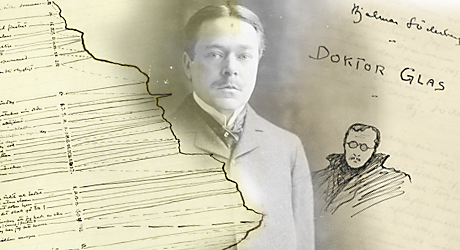
This book is invariably described as a love story - which is true as far as it goes, but it's an unusual example of the genre. The bare bones of the plot are soon apparent. Arvid, a diffident young man who has just moved from his provincial Swedish town to 1890s Stockholm, is smitten with Lydia, the beautiful daughter of a well-known artist. His feelings are reciprocated; there is some passionate kissing in the arbor, and Lydia says she will wait for him always. But this makes Arvid nervous, since he has no idea how long it will take him to accumulate enough money for marriage to be a possibility. He discourages Lydia, which deeply wounds her feelings. Then her father dies, and she impulsively marries a rich, much older man. Arvid also marries. Ten years later, they meet again by chance and cannot resist the temptation to begin an illicit affair.
In most books of this kind, the focus will be on the the intrigue - can things somehow work out for the star-crossed lovers? Failing that, it will be on the morality of the situation or on the main characters' feelings. But here, it's clear pretty much from the start that things can't possibly work out, and there is little talk of morals either. There is more about feelings: Den allvarsamma leken came out in 1912, the year before Un amour de Swann, and in some ways reminds me of it. Though Söderberg's analysis is in some ways rather different from Proust's; he is much more explicit about sex - shockingly so by the standards of the time - and one of the obvious reasons why things go wrong is that Arvid fails to understand how women can be just as interested in sex as men are. Söderberg's deadpan way of presenting this is nicely done, and I believe got him into a fair amount of trouble.
But, as with Proust, feelings aren't the central thing either. What both authors are most interested in motivation, and here Söderberg comes up with a striking way of presenting his answer. Arvid is a journalist at a major newspaper, and his work is described in considerable detail. Over and over again, we see that no one really controls what the paper publishes. People make solemn promises that articles will not be published, and then they turn up in the next day's number anyway. Solecisms are carefully corrected in the proofs, but despite everyone's efforts they reappear. No one is surprised: this is how a newspaper operates, and it's taken for granted that the editor's ability to enforce his will is very limited. And, just in the same way, Arvid and Lydia have no real control over their destinies. Arvid gets involved with her again, knowing that it will lead to disaster; she takes a lover, treats him badly, then bitterly regrets it; he writes a cruel and wounding letter that can only make her hate him, reads it through, then posts it.
Throughout most of the book the philosophy is kept in the background, but once or twice it briefly moves center-stage. There is a striking scene where an older colleague, seeing that Arvid is becoming involved with the woman he later marries against his better judgement, attempts to dissuade him. Arvid asks him why he thinks it's any of his business; Herr Rissler replies that, if he was going down the street and saw a runaway horse, he would grab hold of the reins before it overturned the carriage. Arvid replies mockingly that this is surely a mixed metaphor: he can't be the horse and the driver, can he? Oh, but you can! says Herr Rissler. Let's talk Kant: as phenomenon, als Erscheinung, you are the horse, but in the noumenal world, als Ding an Sich, you are the driver. Beware.
What a clever man Hjalmar Söderberg was. In just the same way, I think his novel is two things at the same time: als Erscheinung, it is a love story, but als Ding an Sich it is a philosophical treatise. Most authors who try this manoeuvre come unstuck, but he does it so well that hardly anyone even bothers to look past the beautiful appearances; he's at least as skillful as Sartre or Camus. Chapeau, monsieur. It's comforting to see that you are not forgotten, and that your works finally seem to be reaching a wider audience.
Or, at least, that was my reaction on first reading the book. But after considering it for another couple of days, I decided it was nonsense. You only have to think a little more about Kant's picture to see why it makes no sense: we can never know anything about the Ding an Sich, so it's not reasonable to say that the philosophy is the "real" book and the love story is the appearance. As Kant points out, we only ever have appearances: here, we have a book which sometimes appears as a love story, and sometimes as a work of philosophy.
I think this way of looking at it is rather closer to the truth. The author has divided himself between the two characters of Arvid and Herr Rissler, who respectively stand for the emotional and the philosophical ways of seeing what is happening. Arvid is interested in happenings and feelings; but Rissler, like Proust, is interested in why people do things, and, even more, how they write about them to turn experience into art. Proust seems to view art as an end in itself; Marcel's dream is to become an author, and life is mostly viewed as raw material for this process. But Söderberg reverses the process and views art as therapy for the pain of life. Goethe, says Rissler at one point, wrote Die Leiden des Jungen Werther to get over his own heartbreak and inflict it on his readers instead; Strindberg (very topical in early 20th century Sweden) put all his misery into his plays and novels, and was in private life a very happy person. Similarly, Söderberg himself is writing this book to avoid shooting himself after he has been abandoned by his beloved Gertrud. So it's not necessarily a work of philosophy masquerading as a love story; it's at least as plausible that it's a love story masquerading as a work of philosophy.
We do not perceive the true reality, as Chuang Tzu said in his celebrated parable of the butterfly and the Emperor...