Jump to ratings and reviews
Rate this book
Rate this book
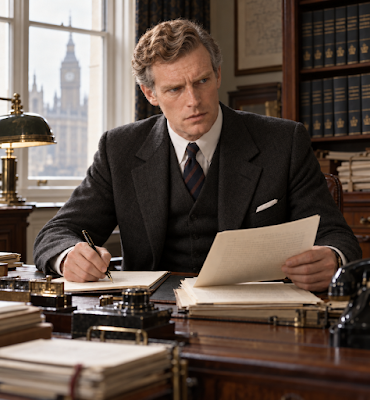
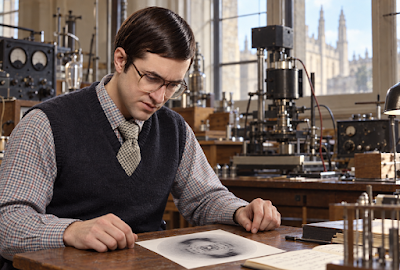
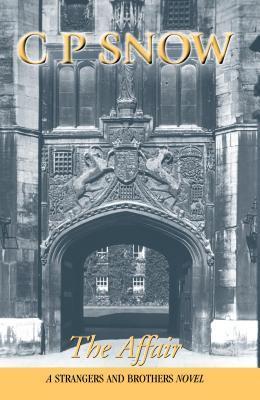
In the eighth in the 'Strangers and Brothers' series Donald Howard, a young science Fellow is charged with scientific fraud and dismissed from his college.

This novel, which became a successful West End play, describes a miscarriage of justice in the same Cambridge college which served as a setting for 'The Masters'.

360 pages, Paperback

First published January 1, 1960

Loading...
Loading...

About the author

C.P. Snow

114 books128 followers
Known British scientist Charles Percy Snow, baron Snow of Leicester, wrote especially his 11-volume series Strangers and Brothers (1940-1970).

See https://en.wikipedia.org/wiki/C._P._Snow

Ratings & Reviews

What do you think?
Rate this book

Friends & Following

Create a free account to discover what your friends think of this book!

Community Reviews

5 stars
64 (25%)
4 stars
103 (41%)
3 stars
64 (25%)
2 stars
12 (4%)
1 star
4 (1%)
Displaying 1 - 28 of 28 reviews
Profile Image for Barbara.
1,899 reviews5,376 followers
October 28, 2026


I first read C.P. Snow's 'Strangers and Brothers' series some time ago, and it became a favorite. The novels focus on an English barrister/civil servant, Lewis Eliot, who rises from poverty to a position of influence in the early-to-mid 1900s. Eliot is present in the entire eleven-book series, but he's not always the central character.

The Affair is part of the series, but it works fine as a standalone book.

The story takes place in 1953 and 1954, when narrator Lewis Eliot is a 48-year-old senior civil servant and an ex-Fellow of Cambridge University. Lewis still has close connections with his Cambridge college, especially because his brother Martin Eliot and his friend Francis Getfliffe are current Fellows.


Lewis gets drawn into a college scandal when one of the younger Fellows, physicist Donald Howard, is dismissed because of "a piece of scientific fraud." Howard is accused of manipulating a diffraction photograph used in his fellowship thesis and a published paper.


With the encouragement of his wife, Howard disputes the dismissal. He claims he found the photograph in the notes of his deceased mentor, Professor C.J.B. Palairet, a distinguished physicist and Fellow of the Royal Society.

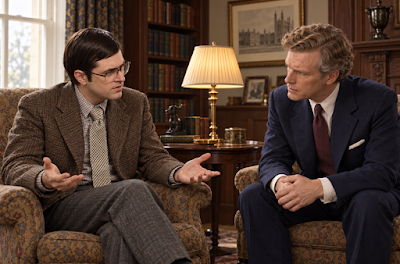
Lewis agrees to meet Howard, whom Lewis finds to be terse and unlikable. Moreover, Howard is an admitted Communist sympathizer, which makes him unpopular with the Cambridge Fellows. All that aside, Lewis is concerned with the evidence, and he asks Howard, "Did you know there are no signs of any such photograph in the whole of [Professor Palairet's] scientific notebooks?" Howard responds, "What I want to know is, who looked?"


And that turns out to be the crux of the matter.

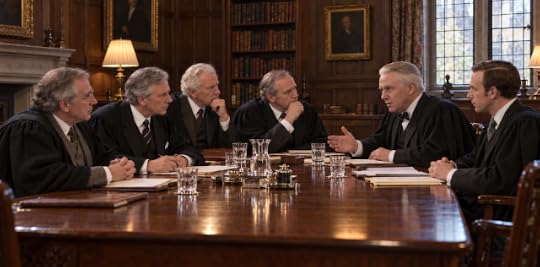
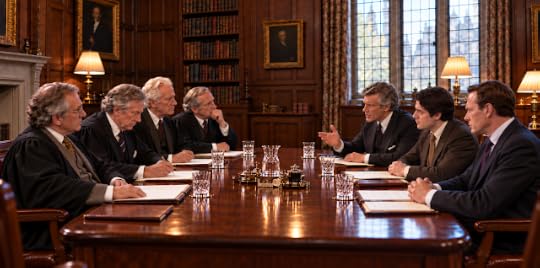
Two Cambridge scientists, Julian Skeffington and Francis Getliffe, ask the Court of Seniors - composed of the Master, Crawford; Winslow; Brown; and Nightingale - to reopen Howard's case. The court members are reluctant because they think Howard is guilty; they're anxious to avoid a public scandal; and they want to preserve Professor Palairet's reputation.


After an initial refusal, the Court of Seniors agrees to rehear Howard's case when one of Professor Palairet's notebooks is found to be missing a photograph. That is, there's a space where a photograph used to be. There's no proof it's the photograph Howard used, but it might be.

As things play out, there's a possibility someone DELIBERATELY removed the photograph that would prove Howard's innocence.

Howard has a couple of hearings, with the last one conducted as a trial, with barrister Gilbert Dawson-Hill representing the side that supports Howard's dismissal; and former barrister Lewis Eliot representing the side that wants Howard reinstated. Witnesses provide testimony, and are questioned by both barristers.


The novel has a good bit of drama before the final hearing, and the book is reminiscent of C.P. Snow's novel The Masters which also features a vote among Cambridge Fellows. In 'The Masters', the vote concerns electing the new college Master, but the dynamics are similar.

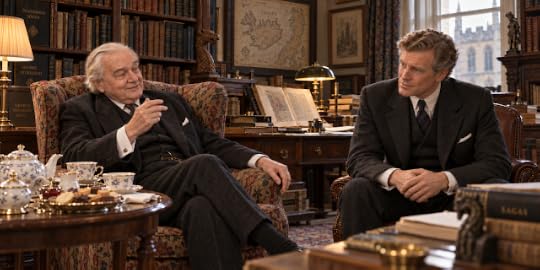
There are some light moments in the novel, provided by 96-year-old Professor Gay, a Senior Fellow who's renowned for his studies of Nordic sagas. Gay was not invited to participate in the Court of Seniors because - due to his age - he misidentifies people, falls asleep during proceedings, and would be an unreliable judge. The Master, Crawford, even suggested it would be "too much" for Gay. Gay considers this libel, and wants Lewis to help him take action against the college.


Gay tells Lewis, "That would teach them a lesson. I don't believe in being too genteel, my dear chap. That's why I've attained a certain position in the world. It's a great mistake, when one has attained a certain position in the world, to be too genteel about teaching people a lesson."

The college buys Gay off by resurrecting the eighteenth-century office of Moderator, and Gay gets to instruct the Fellows and barristers "to see that justice is done."

Gay has an amusing tic in his speech patterns, and over the course of the story he refers to: a drink and half; a gale and a half; a climate and a half; an action and a half; a surprise and a half; a purpose and a half; a case and a half; a question and a half; a luxury and a half; a book and a half; a term and a half; and a task and a half. One can't help but like the old fellow. 😊

While the depiction of Gay is amusing, descriptions of some characters in the novel are unflattering. For example, Lewis describes lecturer Tom Orbell - who got Lewis involved in the Howard case - as "A large young man, cushioned with fat, but with heavy bones and muscles underneath. He was already going bald...the skin of his face was fine-textured and pink, and his smile was affable, open, malicious, eager to please...his big light-blue eyes stayed watchful and suspicious."


Some of the women wouldn't be delighted with their descriptions either. For instance, Lewis notes that Nightingale's wife is a plump woman [whose] shoulders and upper arms were beginning to ham out with fat; her eyes were full, sleepy, exopthalmic.


And Lewis describes his brother Martin's wife as looking much more worn than her husband. Lewis goes on, "She had always been tall and big-framed, but recently her shoulders had rounded and she had put on weight; not only had her bosom got full and shapeless, but she had thickened through the middle."


Luckily, Lewis's wife Margaret has fine bones and looks youthful.


I found the story engaging and was anxious to learn the outcome of the trial at the Court of Seniors. Nevertheless, I'm hoping other books in the series don't involve voting by Cambridge Fellows.

You can follow my reviews at https://reviewsbybarbsaffer.blogspot.com
Profile Image for notgettingenough .
1,084 reviews1,421 followers
June 20, 2017
I have added to this here

Whitaker put up the challenge here recently (comment 7):

Hands up those of you that have allowed a deeply held and cherished viewpoint to be changed by someone whose views are opposed to your own. Hands up those of you who have publicly contradicted someone whose political views closely align to your own on most occasions and did not end up paying a price for that. Ultimately, the majority of us are tribal.


It could scarcely have been more apposite to find myself at the time reading my first CP Snow The Affair which deals in a small closed world with just this situation. A scientist disliked by all in his Cambridge college is accused of and found guilty of fraud by the internal mechanisms of the college. Next, one of the very people who had first investigated the claims comes upon a piece of evidence that indicates there must be serious doubts as to the guilty verdict. To make it worse, not only would the College Seniors have to accept that they had been wrong, but overturning the verdict would by implication incriminate a now deceased scientist of impeccable credentials.

The book describes in minute detail the machinations that ensured, the motivations of the various players, the belief structures, both religious and political that inevitably have some sway, not to mention the notion of tradition and even what one thinks of so and so’s wife.

It is sort of like Twelve Angry Men but whereas that was a jury, and a diverse collection of individuals all strangers to one another, The Affair is a situation where everybody goes way back and the differences between people are much smaller, though they loom large in the story.


rest here: https://alittleteaalittlechat.wordpre...
Profile Image for Albert.
604 reviews45 followers
July 12, 2026
Prior to reading this novel I had read nothing by C.P. Snow and was not even aware of him. C.P. Snow was trained as a scientist; very early in that career, a paper he had published was found to be incorrect. That experience changed the direction of his career. Intermixed with other jobs, he began writing fiction and non-fiction, and eventually writing became his career. His greatest success was with his ‘Strangers and Brothers’ series of eleven novels in which intellectuals in government and academic settings struggle with legal and ethical challenges. Lewis Eliot, who was trained as a lawyer but moves on to do other things in his career, is the character that appears in each story as the other characters change; he gives the series its cohesion. C.P. Snow was nominated multiple times for the Nobel Prize in Literature but never won.

The Affair is #8 in the ‘Strangers and Brothers’ series, and although there may be some benefit to reading the series sequentially, the novels are independent of one another and can be enjoyed regardless of the reading order. The Affair is set at the University of Cambridge in Cambridge, England in 1953. Donald Howard, a Research Fellow at one of the colleges of Cambridge (the specific college is not specified), is dismissed because of a fraud found in his thesis. A group of Fellows, some senior and some junior, believe him to be innocent and join forces to get the decision to dismiss him overturned. In this process some of the individuals trying to help him jeopardize their current positions or their future opportunities.

I found the story to be quite good, and the characters are very realistic. There is an element of mystery to the story which to my delight was never fully resolved. The author attempts to describe the logic, skills, and emotions that are inherent in a complex intellectual dispute in an academic setting. The strength of the novel is the insight provided into what the main characters are considering and feeling at various points in time, but the narrative gets bogged down when too much time is spent on the philosophical analysis on the characters’ positions and views. Also, some of the attributes ascribed to characters seemed to conflict, creating an image I had difficulty imagining.

Very few of my Goodreads friends have read anything by C.P. Snow, and in general there are not many ratings for these novels, so apparently the author is no longer widely read. I found this novel unique for the situation it described. I could see myself reading more of the series at some point.
Profile Image for Robert Ronsson.
Author 6 books31 followers
May 20, 2021
Goodreads and I now appear to be synchronised as far as the order of the books in the series is concerned. We agree that this is the eighth. My Penguin edition is different to those listed and was priced at 4/- (four shillings).
Either I am now wholly in tune with CP Snow's writing or, as I contend, he has become a much more relaxed writer over time. This book is another advance in terms of modern-ness but it has gone backwards as far as the dialogue is concerned. Backwards does not mean worse, because CP Snow is at his best when he is writing the stilted, guarded language of men (always men) of affairs conducting their business, be it in the rarified atmosphere of a Cambridge college (as in this book) or in the corridors of power (as in The New Men). I can't wait to find out how the dialogue changes in Last Things which covers a period after the 1960s when the country loosened its belt and people of both sexes from lowly backgrounds could climb the tree without aping their elders and 'betters'.
Of course, it wouldn't be CP Snow if it didn't contain the usual dubious descriptions of women and in this book this one stands out: She wore spectacles, like her husband, she had adopted a mid-Atlantic accent, she was cheerful, ugly, frogfaced and looked as if she enjoyed a good time in bed.
An editor these days would have pulled it apart for the construction alone. Does she wear spectacles as does her husband or does she speak with a similar accent to him? Commas are used to split sentences. Shouldn't 'frogfaced' be hyphenated? As for giving the appearance of enjoying a good time in bed, how does that work?
How about this for a typically CP Snow-ian description: The skin of his face was fine textured and pink and his smile was affable, open, malicious, eager to please and smooth with soft soap.! (My exclamation mark and bold emphasis.)
I'm making it sound as if I didn't like the book. You can tell from the stars that I regard it as among the best of the series. It has a good plot; it's set in a world removed from mine by time and by milieu and by CP Snow standards it fair rollicks along.
2,135 reviews17 followers
Read
September 28, 2020
I’ve come to the conclusion that The Masters, The New Men, and The Affair are the same novel, just with slightly different endings. Each is primarily Cambridge politics (set from the mid-1930s to the mid-1950s), characterized by an endless fascination with the minutiae of adhering to the rules, regulations and ceremonies of that academic community. First, Lewis is on the losing side; next he’s on the winning side, but late; finally, he wins. Sort of. The first and third might fairly never leave Cambridge—one, the politicking behind selecting the new Master for the college and other investigating a case of academic fraud. The stakes are raised in the middle installment: there, the challenge is to successfully create the atomic bomb before the Americans and (infinitely worse) the Germans. Each sustains a modicum of interest, though I wonder how they would strike a reader who is not also a university professor.
Profile Image for Lora Templeton.
76 reviews2 followers
March 26, 2021
I finished it! Amazingly, toward the end it became genuinely suspenseful and I actually ended up with a flashlight under the covers to read through the night! But what a long, dry desert of exposition to go through for that last oasis of plot propulsion and denouement!

It was apparently also a play on the West End and I would agree that the author’s best work was when he put a muzzle on the narrator’s interior passages of recollection and supposition and let other characters speak for themselves. Standouts include Tom Orbell, Nightingale the Burser, the somewhat tragic Paul Jago, and the truculent and defrocked fellow Howard who sets the plot in motion.
Profile Image for Stephen.
559 reviews23 followers
November 25, 2015
The latest story in the Strangers and Brothers series. In this story, the action returns to the Cambridge college that was the setting for The Masters. In it, a Fellow is accused of scientific fraud and deprived of his Fellowship. The story revolves around how that decision was questioned and over-turned.

There were some aspects of the book that I liked, but I can't honestly say that I see this as a central episode in the life of Lewis Eliot. Some former friends become enemies, whilst others with whom relations were a bit fraught become confidantes again. Perhaps this book is re-aligning the relationships in the biography for later stories?

I enjoyed the book. It is a nice whodunit tale, where an apparent injustice is overturned. It gives a glimpse of the college set a few years on, and reminds us of what it was that we liked about them in the first place. Well written, well paced, I can quite recommend it.
Profile Image for Jak60.
783 reviews21 followers
May 13, 2022
C P Snow's is the muffled world of intellectuals, academics, scholars, lawyers, civil servants, the high end of the British professional bourgeoisie of the mid XX century.
In The Affair C P Snow is the usual relentless explorer of the human soul, of its motives and passions; in this case the backdrop is the same college as the one featurd in The Masters, with all the rituals, political games and machinations typical of such a small, closed society. The story is nearly a cover of Emile Zola's L'Affaire Dreyfus, of which he borrows part of the title.
C P Snow offers at every book a vivid demonstration of how to turn simplicity into elegance; his prose is subdued, gentle, understated and yet, old fashioned as it might be, it can deliver substantial reflections and insights.
Profile Image for Jeremy Walton.
642 reviews1 follower
October 15, 2026
Fair enough
I've had most of the novels in CP Snow's "Strangers And Brothers" sequence on my shelf for many years, but had only read "The Masters" before I picked this one up to read on a lengthy train journey last week. It's set in the same (unidentified) Cambridge college as that other novel, and features many of the same characters - including Crawford, a "heavy, shortish, thickly made man who still, at the age of seventy-two, had a soft-footed, muscular walk" [p75], and Brown, whose manners when violently disagreeing with someone cause him to say things like 'I hope I don't understand you, as I am afraid I do' [p163] and 'You're asking me to to alter my behaviour in a position of trust. I oughtn't to have to tell you that I can't consider it' [p167].

Considered dialogue like this sets the tone of the story which, like "The Masters", revolves around a profound disagreement within a small, privileged but claustrophobic community. There's an emphasis on the politeness which oils the wheels of interaction - here, for example, are Brown and Crawford in the combination-room after dinner [p131]:

'[One] glass apiece [...] That's rather meagre for a beastly winter night and an old friend. I think I should like to ask permission, Master, to order another bottle.'

'Very generous of you, Senior Tutor, very generous indeed.'

Each person gets briskly described - perhaps not always as memorably as Crawford, but always illuminatingly (a don's wife, for example, "was cheerful, ugly, frogfaced and looked as if she enjoyed a good time in bed" [p121]). There's less on the scenery, with a few notable exceptions:

"In the greenhouse in the corner great carnations shone into the aqueous morning, into the green and grey." [p108]

A well-written, if somewhat old-fashioned (published in 1960, it's set in the early fifties) tale which I greatly enjoyed. I should be ranging further afield along that shelf in future.

Originally reviewed 6 December 2021
Profile Image for Shazia.
3 reviews17 followers
September 27, 2025
This is a surprisingly interesting read.A kind of courtroom drama and by the end you really want to see what the resolution is .

It is in an academic setting . A fellow at Cambridge is accused of scientific fraud.The college divides into factions for and against him.Most of the focus is on the personalities involved and how they interact with each other and how their politics liberal/ communist/ conservative color their judgments.

The writing is very oblique but instead of finding in annoying it was quite relaxing .Although some physical descriptions of how people change over time rang true but also seemed a bit too harsh.Particularly about the women. Maybe it was because of the time it was set in 1950s Cambridge University but all the men doing research and earning honors were men and the women were in the background supporting them or holding the back with hardly any other roles to play in their homes or outside . There was also a very strong current of how being religious is much more narrow minded than being an atheist . . I am surprised that with all these things in mind I liked the book as much as I did . The writing was very evocative at times and the personalities were very interesting .That is why I am giving it 3.5 stars rounded up to 4.
Profile Image for Seán.
217 reviews
May 30, 2024
The Affair is about an internal matter at a Cambridge College, wherein a Fellow of the College called Howard published a paper with a photograph that proved to be a fake. He is quickly fired, but later states that the photo was given to him by a venerable older Fellow who has since died. It seems unlikely, but eventually some evidence turns up that persuades some of the other Fellows. Our protagonist, Eliot Lewis, himself a lawyer and former Fellow, is asked by his friends to become involved in the grassroots case for Howard's reinstatement. The case is not strong, and to top it off Howard is a deeply unlikable and shifty character, who presents as a thoroughly unreliable defendant. As you can tell, the affair itself is not nail-biting at its heart, but the book reads like a carefully constructed and intricate structure, web-like in its interconnectedness as more and more of the Fellows are introduced.

When I picked up this book I was instantly hooked. I'd like to say that the feeling lasted, but unfortunately my enthusiasm did wane during the last hundred pages. The granular detail in the character descriptions start to drag, the pace slows where it should quicken, and the plot gets a bit bogged. By the end we get little satisfaction - the affair is resolved but we never discover the truth of who faked the evidence. I didn't expect we would to be honest, it wasn't really the point.

I see there are 11 books in this series, but I don't think I will pick up another any time soon. My Dad was reading this while we were on holiday in Ireland, and having heard a description of it I thought I'd give it a go.
This entire review has been hidden because of spoilers.
Profile Image for John.
Author 11 books15 followers
September 25, 2026
Set in a Cambridge college in 1953, the “affair” was about the falsification of a scientific experiment by the removal of a key photograph. Was it done by the highly respected Palairet now dead, or by his student, the left wing and disliked Howard? The Fellows of the college are split likewise hairs are split in their endless discussions about Howard’s guilt. I had read this years earlier but the pomposity and self importance got to me this time. Snow writes very well but like the times it is one-time academic speak, with a dictionary needed from time to time. Snow was very influential years ago, but he reads stiffly and formally today.
Profile Image for Alexander Vreede.
212 reviews3 followers
January 16, 2023
Having read ‘The Masters’ I decided to move on and read ‘The Affair’ for the 2nd or 3rd time. It is situated in the same Cambridge college, with a number of the same characters but about 15 years later (with the 2nd world war in between). The themes are largely the same but in comparison to ‘The Masters’ this is more lengthy and sometimes (too) slow. But near the end the tension increases and I had trouble putting it down. I enjoyed reading it very much but think that ‘The Masters’ in comparison is the better novel. Hence 4 stars and not 5.
33 reviews1 follower
March 20, 2021
I like these novels. CP Snow has an easy going yet educated writing style. This novel is really a 'courtroom drama' and is like his previous 'The Masters'. CP Snow draws you in to his world. Two more to go for the whole set! Each book is standalone but some back history would is useful for siting the characters in the narrative.
Profile Image for Chris.
428 reviews8 followers
May 17, 2021
One of the very best in the series, centred on a University disciplinary case about scientific fraud and a possible miscarriage of justice. For once, Snow's careful psychological insight is coupled with a courtroom drama featuring anger, spite, twists and tension - and there's a little more comedy than usual, too.
Profile Image for Tom Manning.
130 reviews2 followers
July 9, 2026
Found this weirdly enjoyable. The science affair stuff was pretty easy to follow although never felt like it had high stakes. The Cambridge side of things as well was a bit boring kind of like Evelyn Waugh without as much comedy. That being said, it was very readable and the characters were pretty interesting. This book was quite literally falling apart as I read it too which didn't help.
77 reviews
July 6, 2023
The Strangers and Brothers series develops book by book

In The Affair, we are treated to the very best of Snow‘s characterization and character development.

Maybe not the best book in the series, but in my top 3.
Profile Image for Timothy.
104 reviews1 follower
April 20, 2025
Three hundred and sixty pages of ponderous, turgid prose. Archaic language and somnambular characters. A leap into a deep vat of tepid molasses.
Profile Image for Chris.
1 review1 follower
September 19, 2012
A Cambridge college has dismissed a young Dr Howard for scientific fraud. At the start of the novel (1953), all Fellows of the college agree that the dismissal was justified; however, fresh evidence soon emerges and convinces some people that they have punished an innocent man. But others are not convinced, starting a bitter controversy that occupies the entire book.

Everyone dislikes Dr Howard, and even his supporters view him as an incompetent scientist whom they must support from a strict sense of duty. Dr Skeffington has this sense of duty - and is also tactless; Martin Elliot thinks he will certainly mishandle the case. Martin Elliot is more cynical ... "it's going to need a good deal of politics to put Howard in the clear" he remarks - he's tempted by the opportunity to enjoy using his own first-class political skills! Howard is almost a minor character, a pawn in the hands of others.

Any decision to reinstate him must be made by a "Court" of four senior fellows, three of whom are not physicists, and so do not understand fully the evidence about neutron diffraction. This illustrates a common problem in organising research. Even a world-class scientist is only a top expert in the narrow field they specialised in. So, anyone at the top of a research organisation is often making decisions on matters about which he/she is not the top expert; yet they have to try to make decisions that are "fair", and will be respected by the other experts. It's a serious problem, and my guess is that Snow wrote this novel as a vivid illustration of it.

Snow tries to describe the scientific evidence clearly enough for the average reader to understand; but he also portrays the characters who are not physicists as having difficulty in understanding the evidence (even though one of these non-physicists has won the Nobel Prize for Medicine). Of course it is impossible for any author to do both these things successfully, so the story gets a little implausible in places, but I regard this as a minor flaw in an interesting novel.

The novel is itself a "spoiler" as it refers to events in Snow's other novels, "The Masters", "The Light and the Dark", and "The New Men".

I enjoyed reading this novel, and have many times re-read my favourite passages in it.
Profile Image for Bettie.
9,973 reviews
November 29, 2011
8) 'The Affair'
blurbs - The 'affair' happened at the Cambridge college where Eliot had taught law before the war. Then, the college had scooped him up and resurrected his faltering career and had maintained a place in his affections ever since. In 1954, Eliot was semi-detached from the university and had his head down in co-ordinating the development of the British atom bomb. Indeed, it was atomic research that took him back to the college and dropped him into the midst of the affair that was pre-occupying the senior common room. It was pure Dreyfuss - like the famous affair of the French colonel, it was a miscarriage of justice perpetrated by unsound evidence and was as much based on prejudice as on fact. His brother, Martin, who had returned to Cambridge when he left Barford met him off the early train one April morning...

Dramatised by Jonathan Holloway from C. P. Snow's 1960 novel, "The Affair".

With David Haig [Lewis Eliot], Tim McInnerny [Martin Eliot], Jeremy Child [R. E. A. Nightingale], Hugh Quarshie [R. T. A. Crawford], Geoffrey Whitehead [Francis Getliffe], Jonathan Coy [Arthur Brown], Sean Barrett [Paul Jago], Peter Blythe [Dawson Hill], Clive Merrison [Godfrey Winslow], David Acton [Julian Skeffington], and David Tennant [Donald Howard]. 60 minutes
This entire review has been hidden because of spoilers.
Profile Image for Alex Lisle.
64 reviews1 follower
February 21, 2023
Loved this. Echoes of a bygone age that I never experienced but fancy I might have liked to, had I been bright enough or privileged enough. But on the other hand, no complaints about my 'oikish' state education. (Remember Secondary Moderns?) Thankfully, an English teacher who imparted a love for books that has only grown deeper over time. Thank you Mrs Mitchell.

But I can still appreciate the 'dreaming spires' and all that elevated academia stuff as a backdrop to a story about doing the right thing despite pressures to close ranks and protect reputations.

Have picked up half a dozen more 'Snows' since, so as to return again and again to the relative calm of some quintessential post-war Englishness, where hopefully I will find myself, at some point, in another fusty, book-filled room with the smell of a fire, while the mantleshelf clock ticks and the wintery sunshine falling on an oak sill; being introduced to some bright individuals with a sprinkling of cloistered quirkiness and eccentricity to add charm.
Profile Image for Trawets.
185 reviews1 follower
October 30, 2011
This is the first C P Snow novel I've read, and while it wasn't an easy read it was a really satisfying read.
The story set in the early 1950's concerns a research Fellow at Cambridge college dismissed for scientific fraud and his attempt to have his name cleared and be re-instated.
C P Snow gives us in-depth characters and and insight into college politics.
My first C P Snow, but definately not my last.
Profile Image for Mikee.
607 reviews
March 8, 2016
A surprisingly good book, chock full of all the petty minuitae of college life (Cambridge), but centered on a case of scientific fraud. Lots of innuendo and suspicion but not so much in terms of hard facts. This book is a charming exploration of the essence of human existence.
Profile Image for Virginia.
Author 7 books2 followers
March 1, 2010
A concentrated morality tale set in academia with the flavor of a psychological novel. I loved it.
Profile Image for molly.
287 reviews26 followers
November 23, 2021
it was kind of a fun story but pretty sexist and anti communist so :/ eh just not that fascinating reading about a bunch of men arguing about institutions created by and for men and all
Displaying 1 - 28 of 28 reviews