

What do you think?

The Last Days of Innocence: America at War, 1917-1918
n just 17 months, the U.S. federal government grew from one cog in the machinery of American life into a colossus. The Great War proved to be the gateway through which our grandparents passed from the relative innocence of the 19th century into our own troubled, uncertain era. The Last Days of Innocence combines archival material to present a fresh and modern evaluation of America's performance. Photos.
573 pages, Hardcover
First published January 1, 1997
Ratings & Reviews
Friends & Following
Create a free account to discover what your friends think of this book!
Community Reviews
Displaying 1 - 15 of 15 reviews

August 23, 2017
This book first published in 1997 tells the story of World War I from the American perspective. It brings particular focus on all the problems and disorganized efforts, first at mobilization and second in the actual fighting. The book provides such a long litany of inefficiencies and corruption that it's hard to believe that any mobilization occurred at all.
Then during the early battles in Europe the American troops were so poorly trained, equipped, and supported that's it hard to believe that they had any success. As time passed the kinks got worked out of the system and efficiencies improved. Lessons learned in WWI provided a blueprint for improved mobilization thirty years later for WWII.
From the American perspective the August 1914-April 1917 portion of the war was a distant event to avoid. However, avoiding the so called "distant" war didn't mean avoiding support of the Allied side through finance and trade (almost none with Germany because of British control of the seas).
President Wilson had won reelection as the peace candidate, and he was loth to enter the war. But Germany's decision to resume open submarine warfare on the high seas forced Wilson's hand. Wilson's cabinet had voted unanimously in favor of declaration of war a week prior to Wilson finally deciding to ask Congress for the declaration.
One detail pointed out by this book that I hadn't thought of before was that the abdication of the Czar on March 15, 1917 made a significant difference to Wilson because it allowed him the make a better moral case for war and use the phrase, "Make the world safe for democracy."
Virtually no steps had been taken by the USA prior to April 1917 in anticipation of possible mobilization. Thus it's not surprising that there were plenty of problems to overcome because of the late start. Consequently this book was able to provide a long list of mistakes made.
American forces were not in place until over a year later at the Battle of Soissons and Battle of Belleau Wood, but it can be argued that they arrived in the nick of time. German forces were making a successful thrust toward Paris and the French army was recovering from significant mutiny in the ranks.
Later in 1918 when terms of armistice were being negotiated the Brits and French were quick to downplay the significance of the American involvement and demand reparation payments. Wilson's 14 points probably ameliorated the terms a bit, but we all know now that reparation payments created economic conditions that contributed to Hitler's rise to power and then to the beginning of World War II.
American attitudes after the war shifted toward isolation, anger and cynicism. The following are some excerpts from the book taken from its discussion of American post war attitudes. I suggest readers of this review take special note of the final paragraph below which provides a stark description of the realities of war. Excerpts were taken from this link: https://delanceyplace.com/view-archiv...
http://eepurl.com/hM-vbf
Then during the early battles in Europe the American troops were so poorly trained, equipped, and supported that's it hard to believe that they had any success. As time passed the kinks got worked out of the system and efficiencies improved. Lessons learned in WWI provided a blueprint for improved mobilization thirty years later for WWII.
From the American perspective the August 1914-April 1917 portion of the war was a distant event to avoid. However, avoiding the so called "distant" war didn't mean avoiding support of the Allied side through finance and trade (almost none with Germany because of British control of the seas).
President Wilson had won reelection as the peace candidate, and he was loth to enter the war. But Germany's decision to resume open submarine warfare on the high seas forced Wilson's hand. Wilson's cabinet had voted unanimously in favor of declaration of war a week prior to Wilson finally deciding to ask Congress for the declaration.
One detail pointed out by this book that I hadn't thought of before was that the abdication of the Czar on March 15, 1917 made a significant difference to Wilson because it allowed him the make a better moral case for war and use the phrase, "Make the world safe for democracy."
Virtually no steps had been taken by the USA prior to April 1917 in anticipation of possible mobilization. Thus it's not surprising that there were plenty of problems to overcome because of the late start. Consequently this book was able to provide a long list of mistakes made.
American forces were not in place until over a year later at the Battle of Soissons and Battle of Belleau Wood, but it can be argued that they arrived in the nick of time. German forces were making a successful thrust toward Paris and the French army was recovering from significant mutiny in the ranks.
Later in 1918 when terms of armistice were being negotiated the Brits and French were quick to downplay the significance of the American involvement and demand reparation payments. Wilson's 14 points probably ameliorated the terms a bit, but we all know now that reparation payments created economic conditions that contributed to Hitler's rise to power and then to the beginning of World War II.
American attitudes after the war shifted toward isolation, anger and cynicism. The following are some excerpts from the book taken from its discussion of American post war attitudes. I suggest readers of this review take special note of the final paragraph below which provides a stark description of the realities of war. Excerpts were taken from this link: https://delanceyplace.com/view-archiv...
"As for the [American] survivors [of World War I], those neither killed nor seriously wounded, at the Armistice 1,980,654 men were in Europe, in transit, or in Russia. Another 1,689,998 were in camp in America. Getting home was the only thought in most men's minds. ... When the veterans finally did reach home, they looked for some recognition of what they had achieved, some understanding of what they had endured; but time after time they were disappointed. After the welcome parades, they returned to their hometowns -- to find, very often, that their jobs were gone. The special employment offices simply could not cope with the lines of veterans looking for work....Here's a link to an excerpt from the book:
"All around them, men who had stayed at home in war industries commanded what seemed like remarkable wages. The returnees were faced with astonishing price rises -- food, clothing, and home furnishings all at nearly double the prices they remembered --and a government that apparently grudged them any help in meeting the bills. The veterans of earlier wars could look to their war bonuses to give them a start in their new life. But this administration was determined to avoid the colossal expenditure of the past, and there was violent argument in Congress over the appropriate reward for veterans' services. Not until 1924 would any allocation of bonuses be finally agreed on, and no actual payments would be made until 1945.
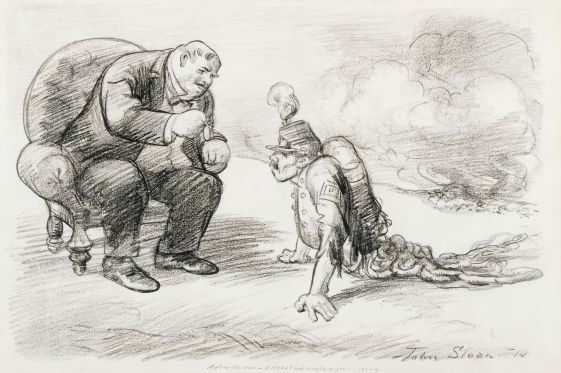
After the War a Medal and Maybe a Job, antiwar cartoon by John French Sloan, 1914
"Veterans' bitterness found its way into some of the best and most enduring writing of the period. Some older writers, such as Willa Cather, Edith Wharton, and others who had helped but not fought, still found it possible to revel in the romance of war, and the popular conceptions of heroism and adventure died hard. But for those who had been to Europe with the AEF or the ambulance services, such as John Dos Passos, e e cummings, and Ernest Hemingway, a far more typical reaction was to find creativity in anger, cynicism, and a kind of licensed rebellion. The scarred veteran, it was felt, was entitled to speak his mind. The writing of Laurence Stallings, who had lost a leg after injuries received at Belleau Wood, was powered at this stage, before nostalgia took a hand, exclusively by rancor. In his novel Plumes, the protagonist is obsessed by the secret treaties signed by America's allies, all the time 'trying to face the fact that he threw himself away [in] ... a brutal and vicious dance directed by ghastly men. It was the tragedy of our lives that we had to be mutilated at the pleasure of dolts and fools.'
"In Company K, William March attacked one of the standard texts of the old value system in his grotesque burlesque of an official letter of condolence:
Your son Francis, died needlessly at Belleau Wood. You will be interested to hear that at the time of his death he was crawling with vermin and weak from diarrhea. ... A piece of shrapnel hit him and he died in agony, slowly. ... He lived three full hours screaming and cursing. ... He had nothing to hold onto, you see: He had learned long ago that what he had been taught to believe by you, his mother, who loved him, under the meaningless names of honor, courage, patriotism, were all lies."
http://eepurl.com/hM-vbf

January 18, 2010
A meaty book with a narrow focus. You will learn a lot about America in WWI. The book adroitly interlaces chapters between Americans on the battlefield and Americans in the Homeland. It describes American political and cultural proclivities during the first few years of the war, while we as a nation were observing, and the Allies were engaged. It then discusses our entry into the war--mobilization, training, and fielding of Pershing's Army. It details the horror of battlefield maneuver. And it adequately explains the peace process and economic fallout from the war.
Personally--and despite that I'm an active duty Air Force officer--I find the homeland wartime experience a bit more interesting than battlefield contact. Combat is force on force, and no matter how many historians rework history, there is a limited amount of perspectives you can achieve about a specific battle or campaign. The Homeland predicament, however, provides the historian with a much larger theater of interpretation: economy, culture, politics, etc. You can find each in microcosm in the military, but the society at large is hundreds of millions of people acting on millions of institutions for hundreds of thousands of reasons, and this produces a much more complex picture of things. Mobilizing a nation is a thornier issue than mobilizing an army.
Things I learned:
--- Contemplating a draft competed with shortages of expected wartime labor
--- Race issue; enlisting in the Army was first seen as a way to black man's equality, but was followed by strong dissension in all races
--- Bolshevism in America spread rapidly and was looked upon, starry-eyed, by many classes
--- The US had a robust internal propaganda machine to support all aspects of the war effort, and their practices were highly questionable
--- Military intelligence routinely reported on levels of US patriotism
--- There were thousands of men employed as 'four minute men' whose only job was to tour the nation and give 'hurrah' speeches inbetween movies, at the street corner, rallies, town halls, parades, etc.
--- A large German-American population made for a strange kind of paranoia in small town America
--- The US propaganda machine created a spy-fever throughout America, which led to interesting bans and renaming of people and institutions
--- Sedition Act
--- Cultural phenomenon of vigilantism endorsed by the Justice Dept
--- The US single-handedly kept the Allies solvent by lending billions of dollars
--- The Communist scare in 1919 was the greatest in America since McCarthyism
--- Resurgence of the KKK
--- No agreed upon veteran benefits until 1924, and no cash payments until 1945
Personally--and despite that I'm an active duty Air Force officer--I find the homeland wartime experience a bit more interesting than battlefield contact. Combat is force on force, and no matter how many historians rework history, there is a limited amount of perspectives you can achieve about a specific battle or campaign. The Homeland predicament, however, provides the historian with a much larger theater of interpretation: economy, culture, politics, etc. You can find each in microcosm in the military, but the society at large is hundreds of millions of people acting on millions of institutions for hundreds of thousands of reasons, and this produces a much more complex picture of things. Mobilizing a nation is a thornier issue than mobilizing an army.
Things I learned:
--- Contemplating a draft competed with shortages of expected wartime labor
--- Race issue; enlisting in the Army was first seen as a way to black man's equality, but was followed by strong dissension in all races
--- Bolshevism in America spread rapidly and was looked upon, starry-eyed, by many classes
--- The US had a robust internal propaganda machine to support all aspects of the war effort, and their practices were highly questionable
--- Military intelligence routinely reported on levels of US patriotism
--- There were thousands of men employed as 'four minute men' whose only job was to tour the nation and give 'hurrah' speeches inbetween movies, at the street corner, rallies, town halls, parades, etc.
--- A large German-American population made for a strange kind of paranoia in small town America
--- The US propaganda machine created a spy-fever throughout America, which led to interesting bans and renaming of people and institutions
--- Sedition Act
--- Cultural phenomenon of vigilantism endorsed by the Justice Dept
--- The US single-handedly kept the Allies solvent by lending billions of dollars
--- The Communist scare in 1919 was the greatest in America since McCarthyism
--- Resurgence of the KKK
--- No agreed upon veteran benefits until 1924, and no cash payments until 1945

June 20, 2009
The Last Days of Innocence: America at War, 1917-1918 offers the reader a decent and balanced view of America's role and involvment in the Great War. If you wanted one book that would provide you with a detailed account of the United States' role in the Great War this is it. The author's cover every aspect of America's involvement in WW1.
This book covers everything from the gradual decline in civil liberties, the increase in Govt. agencies power over the individual, the war industry the training and arming of her armed forces to their final deployment on the European battlefield. Although America didn't get into the fighting until the last few months of the war she paid for the privilage with many young American lives.
This is a well researched and a well told story and every American should read the book to fully appreciate what their countymen did in 1917-1918.

June 28, 2022
Review title: Making America safe for empire
While Woodrow Wilson's tag line defined America's planned role in the first World War to "make the world safe for democracy," in the end its actual outcome was to raise America to global imperial prominence. This narrative of America's progress to and through the war in 1917 and 1918 by the husband and wife team Meirion and Susie Harries documents the political, cultural, economic, and military path Over There.
It was a faltering path at first. Isolated by geography and intent, with a political preference to avoid foreign entanglement and a military establishment focused on border protection and reduced from its Spanish-American war size, Europe ranked the US military as negligible (Germany sized it up as comparable to Romania in fighting strength, p. 65). President Wilson ran and won on his desire to keep us out of the war, and culturally, with many Americans having first or second generation roots in the combatant countries, neutrality seemed the best policy.
When the sinking of the Lusitania and the publication of the bombshell Zimmerman telegraph revealing Germany's promise of support for Mexican encroachment on us territory, the American people and the still small federal government swung into action with stumbling steps. The first national draft was unpopular and unsuccessful at creating a well-trained and unified army. "This jumble of colors, cultures, and languages, European, Asian, and Latin, mercilessly underlined the isolation of the black Americans who formed a large part of the intake." (p. 129). To win hears and minds to the war cause, Congress passed laws limiting dissent (notably the Trading with the Enemies Act, p. 166, and the Sedition Act, p. 302), and created propaganda boards to market the war and control information from the battlefields. "at that time America could still be cut off quite effectively from Europe, so that all news of the war would have to pas through official channels." (p. 166). Wilson himself, having switched so recently from neutrality, reacted with a "manic determination to reach his goals", documenting the famous Fourteen Points as his plan to end not just this war but establish conditions and controls to end all wars. (p. 222). He failed.
On the military front, the war was famously a battle of attrition fought against disease and new technologies that diminished the individual soldier's influence on outcomes. American soldiers took nearly a year to arrive on the ground, were poorly trained, and due to national disagreements in military tactics and political strategy were poorly deployed. Even though the fresh young boys Over There were needed to replenish French and British armies decimated by years in the trenches, American involvement their first major battles were "of more psychological than strategic importance." (p. 262) Then, after American men and materials (food, weapons, and transportation chief among them) did turn the tide, their allies moved to downplay the American contribution (p. 409) to keep control over the terms of surrender. In the end Wilson's Fourteen Points and League of Nations were a failure both in Europe and at home, an outcome that the authors' intriguingly assign to the suppression of free speech in the US that ensured that "his vision of a world governed by a 'League of Nations' would not be properly debated in the public arena. Few Americans thoroughly grasped, let alone supported, what Wilson hoped to achieve through his peace maneuvers." (p. 407)
The struggle to engage the country in an unwanted war and then fight it effectively necessitated new ways of working, organizing, thinking, leading, and living in America. While innocence is in the eye of the beholder (the Black soldiers drafted from a Jim Crow society into a military that retained and reinforced that racist violence would disagree with the characterization), the country that came out of those last days before the war was irreversibly changed for better and worse into the 20th century America that shapes our 21st century lives.
This is a readable narrative that tells the story of those years from many angles and not just the usual political and military focus. It is footnoted for documentation but written in a popular level for general readers. It could serve as a college freshman-level survey course on the war.
While Woodrow Wilson's tag line defined America's planned role in the first World War to "make the world safe for democracy," in the end its actual outcome was to raise America to global imperial prominence. This narrative of America's progress to and through the war in 1917 and 1918 by the husband and wife team Meirion and Susie Harries documents the political, cultural, economic, and military path Over There.
It was a faltering path at first. Isolated by geography and intent, with a political preference to avoid foreign entanglement and a military establishment focused on border protection and reduced from its Spanish-American war size, Europe ranked the US military as negligible (Germany sized it up as comparable to Romania in fighting strength, p. 65). President Wilson ran and won on his desire to keep us out of the war, and culturally, with many Americans having first or second generation roots in the combatant countries, neutrality seemed the best policy.
When the sinking of the Lusitania and the publication of the bombshell Zimmerman telegraph revealing Germany's promise of support for Mexican encroachment on us territory, the American people and the still small federal government swung into action with stumbling steps. The first national draft was unpopular and unsuccessful at creating a well-trained and unified army. "This jumble of colors, cultures, and languages, European, Asian, and Latin, mercilessly underlined the isolation of the black Americans who formed a large part of the intake." (p. 129). To win hears and minds to the war cause, Congress passed laws limiting dissent (notably the Trading with the Enemies Act, p. 166, and the Sedition Act, p. 302), and created propaganda boards to market the war and control information from the battlefields. "at that time America could still be cut off quite effectively from Europe, so that all news of the war would have to pas through official channels." (p. 166). Wilson himself, having switched so recently from neutrality, reacted with a "manic determination to reach his goals", documenting the famous Fourteen Points as his plan to end not just this war but establish conditions and controls to end all wars. (p. 222). He failed.
On the military front, the war was famously a battle of attrition fought against disease and new technologies that diminished the individual soldier's influence on outcomes. American soldiers took nearly a year to arrive on the ground, were poorly trained, and due to national disagreements in military tactics and political strategy were poorly deployed. Even though the fresh young boys Over There were needed to replenish French and British armies decimated by years in the trenches, American involvement their first major battles were "of more psychological than strategic importance." (p. 262) Then, after American men and materials (food, weapons, and transportation chief among them) did turn the tide, their allies moved to downplay the American contribution (p. 409) to keep control over the terms of surrender. In the end Wilson's Fourteen Points and League of Nations were a failure both in Europe and at home, an outcome that the authors' intriguingly assign to the suppression of free speech in the US that ensured that "his vision of a world governed by a 'League of Nations' would not be properly debated in the public arena. Few Americans thoroughly grasped, let alone supported, what Wilson hoped to achieve through his peace maneuvers." (p. 407)
The struggle to engage the country in an unwanted war and then fight it effectively necessitated new ways of working, organizing, thinking, leading, and living in America. While innocence is in the eye of the beholder (the Black soldiers drafted from a Jim Crow society into a military that retained and reinforced that racist violence would disagree with the characterization), the country that came out of those last days before the war was irreversibly changed for better and worse into the 20th century America that shapes our 21st century lives.
This is a readable narrative that tells the story of those years from many angles and not just the usual political and military focus. It is footnoted for documentation but written in a popular level for general readers. It could serve as a college freshman-level survey course on the war.

January 22, 2018
A very good overview of American in the years leading up to and during the Great War. In my continuing research into America in the First World War, this book gave me good information on many things I did not know about the war. I found it a interesting and well written account. A very good book on the subject.
January 21, 2008
social political history of making of the US military machine through the world war 1 MOBILIZATION. sad and illuminating. organization and power. a little longwinded in the american battle scenarios. got it. "American Expeditionary Forces" didnt know what they were doing but were very brave. the book's main point of intertwining the politics of the homefront is relentlessly argued to the benefit of the history of war in the twentieth century.

January 16, 2012
I read this to supplement my WW1 unit and found a ton of material to add to my lessons. I think I had just about every other page sticky noted! Of course there were some pieces I skimmed over once I realized I would not be adding it to my curriculum, but those pieces were very few actually.
I wish I read this during the summer when I had more time to dig into it more. I might pick it back up and do just that this summer. If you like historical text, this is a great read for you.
I wish I read this during the summer when I had more time to dig into it more. I might pick it back up and do just that this summer. If you like historical text, this is a great read for you.

September 7, 2018
I chose this book as a way of understanding more about World War I for research purposes. It was the most comprehensive book about that era that I have ever seen. It was also enjoyable to read...enjoyable in a sense that includes the sadness and dismay and even horror one feels when you read about war. The Last Days of Innocence was amazingly researched, and gave the reader a view of that time that no other book I have come across. But, this was not only about the war, it was about America in the years leading up to the war and how we almost succumbed to communism and socialism and why. It's about greed, and corruption and lies. It was about Wilson's Presidency, and about all the men who helped carve out the history of this time. I found it a timely read considering the news headlines we face today. How we repeat ourselves! It would be wise for more readers to take a hard look at history so that they may understand the present! The book was also a tribute to the brave men who went to fight in a land far away, with little training and even less resources. It broke my heart to read about all they went through. We should never forget their sacrifices!
March 29, 2021
Excellent book on the American experience in WW I. While it covers the military battles the U.S. fought in, it also addresses the impact of the war at home. The U.S. was totally unprepared to mobilize for war, especially economically, although the U.S. was providing vast support for the Allies, especially the British. Nevertheless, to go from an army of 125,000 in April 1917 to one of almost 4 million in November 1918 is quite an accomplishment.
Want to Read
December 28, 2022Hi there,
I am looking for this book in pdf format.
Do you know if it exists because I would like to acquire it paying of course?
Thank you for your answers.
I am looking for this book in pdf format.
Do you know if it exists because I would like to acquire it paying of course?
Thank you for your answers.

October 24, 2007
Great study of America in World War I. It discusses the run up to the war, the mobilization of the military and their subsequent baptism by fire in France, effects on the home front, and the depressing aftermath of it all. It will make you realize the US had little to gain by entering this conflict.
December 30, 2013
This was a very interesting look at the effect of the war on most of the US. It was easy to follow, covered enough of the other players to give it a broad view, and peppered in several interesting stories.

February 10, 2015
America's preparation, participation, and the aftermath of both, in World War I. (I saw here the glimmerings of what I would later see as huge problems in the way America goes about its war-fighting mission and preparation.)
September 26, 2015
Needs more than one map.

Read
December 18, 2016Good one-volume history of the American part of WWI.
Displaying 1 - 15 of 15 reviews