

What do you think?

The essential early work by the modern master of Japanese literary comics
Yoshiharu Tsuge is one of the most influential and acclaimed practitioners of literary comics in Japan. The Swamp collects work from his early years, showing a major talent coming into his own. Bucking the tradition of mystery and adventure stories, Tsuge’s fiction focused on the lives of the citizens of Japan. These mesmerizing comics, like those of his contemporary Yoshihiro Tatsumi, reveal a gritty, at times desperate postwar Japan, while displaying Tsuge’s unique sense of humor and point of view.
“Chirpy” is a simple domestic drama about expectations, fidelity, and escape. A couple purchase a beautiful white bird with a red beak. It is said that the bird will grow attached to its owners and never fly away. While the girlfriend is working as a hostess, flirting with men for money, the boyfriend decides to draw a portrait of the new family member, and disaster strikes.
In “The Swamp,” a simple rural encounter is charged with sexual tension that is alluring but also fraught with danger. When a young woman happens upon a wing-shot goose, she tries to calm it then suddenly snaps its neck. Later, she befriends a young hunter and offers him shelter, but her motivations remain unclear, especially when the hunter notices a snake in the room where they’ll both be sleeping.
The Swamp is a landmark in English manga-publishing history and the first in a series of Tsuge books Drawn & Quarterly will be publishing.
Yoshiharu Tsuge is one of the most influential and acclaimed practitioners of literary comics in Japan. The Swamp collects work from his early years, showing a major talent coming into his own. Bucking the tradition of mystery and adventure stories, Tsuge’s fiction focused on the lives of the citizens of Japan. These mesmerizing comics, like those of his contemporary Yoshihiro Tatsumi, reveal a gritty, at times desperate postwar Japan, while displaying Tsuge’s unique sense of humor and point of view.
“Chirpy” is a simple domestic drama about expectations, fidelity, and escape. A couple purchase a beautiful white bird with a red beak. It is said that the bird will grow attached to its owners and never fly away. While the girlfriend is working as a hostess, flirting with men for money, the boyfriend decides to draw a portrait of the new family member, and disaster strikes.
In “The Swamp,” a simple rural encounter is charged with sexual tension that is alluring but also fraught with danger. When a young woman happens upon a wing-shot goose, she tries to calm it then suddenly snaps its neck. Later, she befriends a young hunter and offers him shelter, but her motivations remain unclear, especially when the hunter notices a snake in the room where they’ll both be sleeping.
The Swamp is a landmark in English manga-publishing history and the first in a series of Tsuge books Drawn & Quarterly will be publishing.
256 pages, Hardcover
First published January 1, 1966
About the author
Yoshiharu Tsuge
61 books130 followersInfluenced by the adventure comics of Osamu Tezuka and the gritty mystery manga of Yoshihiro Tatsumi and Masahiko Matsumoto, Yoshiharu Tsuge began making his own comics in the mid-1950s. He was also briefly recruited to assist Shigeru Mizuki during his explosion of popularity in the 1960s. In 1968, Tsuge published the groundbreaking, surrealistic story "Nejishiki" in the legendary alternative manga magazine Garo. This story established Tsuge as not only an influential manga-ka but also a major figure within Japan's counter-culture and art world at large. He is considered the originator and greatest practitioner of the semi-autobiographical "I-novel" genre of making comics. In 2005, Tsuge was nominated for the Best Album Award at Angoulême International, and in 2017 a survey of his work, A World Of Dreams And Travel, won the Japan Cartoonists Association Grand Award.
Ratings & Reviews
Friends & Following
Create a free account to discover what your friends think of this book!
Community Reviews
Displaying 1 - 30 of 69 reviews

March 31, 2021
Yoshiharu Tsuge is a master of manga; the first volume of his mature work from 1965-66 is collected heree, short stories that include both autobiographical comics and genre-based stories. We see some of the pulpy work ranging to more slice of life stories. The idea is to tell a good story via comics and he does this very well. Gegika, or slice of life stories for adults, which is to say, not necessarily for children, mostly serious themes, character-based, generally.
A sample of what is included, a wide range of content, types and qulaity:
“A Phony Warrior,” is about two samurai, one of them with legendary status, who meet at an inn near Mt. Fuji. The legend indeed has legendary skills, but is less than noble, greedy, trying to make money on his famous status, eliciting pity, not rage, from our narrator.
“Watermelon Sake” presents two guys, one of whom has an idea of getting rich selling watermelon sake, except they drink as they dream. Sweet/funny.
“Destiny” features a struggling couple who can’t afford to have a child, though they want one; they choose at last, in poverty, what they see as a noble end--suicide, though it is also clear they love each other and don’t really want to do it. The man, a samurai, sells his sword so they can have a feast for a last dinner. As they prepare for the act, they learn they are to be visited by an old friend, so they wait, also learning from the area police that a thief, carrying a baby, is in the area; you can already predict what happens, as the thief, their friend, also desperately poor, is shot and the couple get a baby. They see this as destiny that they get happy news for their future just as they were ready to end it all.
“The Swamp” features a mysterious woman who takes in a traveler as her husband is gone. The woman has a snake in a cage that for some reason incites the traveler to attempt to strangle the woman. Seems symbolic, somehow. When the husband arrives in the morning she tells him about the traveler, and sees that the traveler and the snake are gone. The husband is seen shooting his gun into the trees in the last image. Fewer words, letting the images create the mystery.
“The Ninjess” is a one of the longer ones about a woman sent to kill a ruthless guy, who kidnaps her for several years, though she is determined to fulfill her contract, even after she gets pregnant. There are a couple surprises in this one.
Satisfying comics storytelling in a classic period style, sometimes evoking earlier historical periods.
A sample of what is included, a wide range of content, types and qulaity:
“A Phony Warrior,” is about two samurai, one of them with legendary status, who meet at an inn near Mt. Fuji. The legend indeed has legendary skills, but is less than noble, greedy, trying to make money on his famous status, eliciting pity, not rage, from our narrator.
“Watermelon Sake” presents two guys, one of whom has an idea of getting rich selling watermelon sake, except they drink as they dream. Sweet/funny.
“Destiny” features a struggling couple who can’t afford to have a child, though they want one; they choose at last, in poverty, what they see as a noble end--suicide, though it is also clear they love each other and don’t really want to do it. The man, a samurai, sells his sword so they can have a feast for a last dinner. As they prepare for the act, they learn they are to be visited by an old friend, so they wait, also learning from the area police that a thief, carrying a baby, is in the area; you can already predict what happens, as the thief, their friend, also desperately poor, is shot and the couple get a baby. They see this as destiny that they get happy news for their future just as they were ready to end it all.
“The Swamp” features a mysterious woman who takes in a traveler as her husband is gone. The woman has a snake in a cage that for some reason incites the traveler to attempt to strangle the woman. Seems symbolic, somehow. When the husband arrives in the morning she tells him about the traveler, and sees that the traveler and the snake are gone. The husband is seen shooting his gun into the trees in the last image. Fewer words, letting the images create the mystery.
“The Ninjess” is a one of the longer ones about a woman sent to kill a ruthless guy, who kidnaps her for several years, though she is determined to fulfill her contract, even after she gets pregnant. There are a couple surprises in this one.
Satisfying comics storytelling in a classic period style, sometimes evoking earlier historical periods.

July 1, 2020
A pleasant surprise. As I expected, Tsuge's art is typical of manga of the period, with cartoony figures and some lovely detailed landscapes and texturing; see for example the title story. But I love his quiet, matter-of-fact approach to storytelling. The short pieces here are mostly slices of working class life, some set in the past (complete with samurai, of course!), some in an unspecific modern period. The characters deal with realistic problems and harsh conditions, and story arcs often have quiet twists and unexpected outcomes.
"The Phony Warrior" sets up the intimidating samurai figure, only to tear him down at the end in a thoughtful way. "Destiny" starts quietly, with a young samurai and his wife getting ready for a meal. Tsuge quietly reveals that they were desperately poor, and the samurai had just sold his sword so he and his wife can eat a scrumptious last meal, before they commit suicide. Whoa. Then things take an unexpected turn, and the ending is not what I expected at all for '60s manga. In "The Secondhand Book", we accompany the main character in his confusion and agonizing, en route to another quietly surprising ending.
These are all shorter stories from 1965-66. The introductory essay describes other pieces that sound really interesting; I hope they'll be in a future volume of this series. A quote from Tsuge in the essay:
It's pretty interesting to be reading this together with Michael Seidlinger's Dreams of Being. Other than the Japanese themes, Seidlinger's novel is also about the challenges of one's creative practice. Tsuge's quote referred to his experiences in the early to mid 60s, probably right before he produced the stories in this collection. I was trying very hard to read Seidlinger's novel not as autobiographical; just a few years before, he had written one of my favorite novels of the period, My Pet Serial Killer. I could rattle off some cliche about suffering and art, but I won't.
"The Phony Warrior" sets up the intimidating samurai figure, only to tear him down at the end in a thoughtful way. "Destiny" starts quietly, with a young samurai and his wife getting ready for a meal. Tsuge quietly reveals that they were desperately poor, and the samurai had just sold his sword so he and his wife can eat a scrumptious last meal, before they commit suicide. Whoa. Then things take an unexpected turn, and the ending is not what I expected at all for '60s manga. In "The Secondhand Book", we accompany the main character in his confusion and agonizing, en route to another quietly surprising ending.
These are all shorter stories from 1965-66. The introductory essay describes other pieces that sound really interesting; I hope they'll be in a future volume of this series. A quote from Tsuge in the essay:
Like some kind of writer's cramp, even drawing just a single panel made my hand shake and gave me the sweats. A ball of black anxiety would well up unpleasantly in my guts, and my head hurt so bad I thought it would crack open.
It's pretty interesting to be reading this together with Michael Seidlinger's Dreams of Being. Other than the Japanese themes, Seidlinger's novel is also about the challenges of one's creative practice. Tsuge's quote referred to his experiences in the early to mid 60s, probably right before he produced the stories in this collection. I was trying very hard to read Seidlinger's novel not as autobiographical; just a few years before, he had written one of my favorite novels of the period, My Pet Serial Killer. I could rattle off some cliche about suffering and art, but I won't.

June 23, 2020
A varied mixed of short stories. Some are very influenced by Tezuka, short goofy stories with lots of animation. Others hint towards the direction he'd take later one, more similar to Mizuki and Tatsumi with pathos and less plot focused.
My favourite was perhaps the story of a young couple about to commit suicide over their money troubles. They hear of a thieving ronin on the run with a young child. Later the wife discovers the child and decides to adopt him. Abandoned in the grass as the ronin fled with a mortal injury. It turns out all the gold this ronin had stolen was placed inside the child's clothing.
My favourite was perhaps the story of a young couple about to commit suicide over their money troubles. They hear of a thieving ronin on the run with a young child. Later the wife discovers the child and decides to adopt him. Abandoned in the grass as the ronin fled with a mortal injury. It turns out all the gold this ronin had stolen was placed inside the child's clothing.

July 11, 2020
New-to-me groundbreaking manga artist’s collection of short stories. Beautiful art, realistic backgrounds on which more cartoony characters act. But these are not silly kids stuff, rather psychological and often bizarre slices of a life not often seen in comics, certainly not when these were originally published in Japan in the mid-‘60s. Great stuff!

April 13, 2020
My manga education continues with this collection of early short works by the counterculture provocateur Yoshiharu Tsuge. Much calmer and more naturalistic than the Junji Ito horror books I’ve been reading lately, the detailed backgrounds and cartoony figures in these comics immediately reminded me of Shotaro Ishinomori’s “The Legend Of Zelda: A Link To The Past” comics that were serialized in Nintendo Power magazine and that I absolutely adored as a kid. The focus on these stories are often traditional motifs like poverty-stricken samurais or struggling craftsmen but you can sense Tsuge trying to break free from the constraints of the medium at that time. Like a newborn foal learning to walk, the comics in “The Swamp” are the tentative first steps towards a greater adventure.
FAVORITES:
“Destiny” - A suicidal samurai and his equally despondent wife discover that fate has a different plan for them.
“Chirpy” - A poor couple buy a small bird that helps lift their downtrodden spirits until a tragic accident changes things.
“The Secondhand Book” - A penniless student yearns to buy an expensive book that he can’t afford until a small ill-gotten fortune falls into his lap.
FAVORITES:
“Destiny” - A suicidal samurai and his equally despondent wife discover that fate has a different plan for them.
“Chirpy” - A poor couple buy a small bird that helps lift their downtrodden spirits until a tragic accident changes things.
“The Secondhand Book” - A penniless student yearns to buy an expensive book that he can’t afford until a small ill-gotten fortune falls into his lap.

May 10, 2025
Yoshiharu Tsuge's first collection of stories translated into English is an excellent compilation of short stories spanning the years 1965–1966.
The genres are diverse: there are samurai stories, a thriller and action tale where a cop is chasing a criminal, dramas between couples, revenge stories, comedies, and even a story with an erotic-violence theme (The Swamp). Although the entire collection is in black and white, as is typical of most Gekiga manga. each story has its own unique "color" and voice, each revealing a different facet of human nature.
I really enjoyed the stories and was glad to read this as I continue exploring Gekiga creators.
I can easily see why Tsuge is considered one of the best.
The genres are diverse: there are samurai stories, a thriller and action tale where a cop is chasing a criminal, dramas between couples, revenge stories, comedies, and even a story with an erotic-violence theme (The Swamp). Although the entire collection is in black and white, as is typical of most Gekiga manga. each story has its own unique "color" and voice, each revealing a different facet of human nature.
I really enjoyed the stories and was glad to read this as I continue exploring Gekiga creators.
I can easily see why Tsuge is considered one of the best.

May 20, 2020
I've been waiting for this book for a long time. But the stories within are actually kind of a mixed bag. Tsuge was still finding his way in these early stories (published in the mid-60s). Many of them are historical plot-heavy potboilers. But several of them approach the idea of the modern short story that Chekhov pioneered. They are essentially plotless, do not seek a neat resolution, etc. Because Tsuge came out of the world of kashihon manga (comics that were rented, usually with very "pulpy" contents), a publishing regime that didn't encourage artistic ambition, his short stories in a way recreate the historical evolution of the prose short story all in one career. It's a remarkable evolution to see in a single artist. The reason his work evolved is certainly because Tsuge was a great artist, but it was also because his potential was recognized by an older master, Sampei Shirato, who invited him to contribute to what was probably the first "underground" comic in the world, Garo. Garo gave its artists exceptional freedom and allowed the Chekhov inside Tsuge to emerge. I can't wait to see how this develops in future volumes in this series.

September 4, 2024
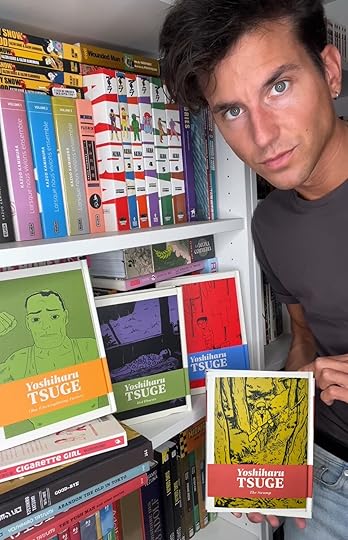
Drawn and Quarterly is publishing a very neat collection of manga books with the legendary and super influential work of Yoshiharu Tsuge, translated by the ever-reliable Ryan Holmberg.
Today I’ve read the first short stories collection The Swamp. I’ve enjoyed it a lot, Tsuge’s style and sense of humor is reminiscent of Tezuka, Tatsumi and Matsumoto. The title story already hints at the mysterious, dreamy, surreal, alienating, even disturbing vibes he is particularly known for !
On to the second book ! And we mustn’t forget his brother ! (This collection had one of Tadao’s as well)
I show D&Q's Tsuge Collection so far in this video:
https://youtu.be/89DA85l8R2E

July 3, 2023
Pierwsza część serii D&Q zbierającej dokonania jednego z najważniejszych twórców mangi dla dorosłych i jednego z najważniejszych autorów tworzących dla magazynu „Garo”. Historie z połowy lat 60-tych najpierw tematycznie zahaczają o historyczną Japonię i jako takie mogłyby się spodobać fanom Usagiego, gdzie bardziej chodzi o przesłanie, przedstawienie elementów kultury i drugie dno, niż zadziwienie czytelnika efektowną akcją, jednak za chwilę Tsuge sięga do kontekstu powojennej Japonii i wtedy robi się dużo ciekawiej. W porównaniu z dorobkiem brata – Tadao – dokonania Yoshiharu wydają się tu jeszcze dosyć niewinne. W czasach ich powstania posądzano je o depresyjny charakter i oburzano się na obrazy choćby kompletnie pijanej kobiety, ale z dzisiejszej perspektywy formalnie i treściowo nie jest to coś, czego byśmy się spodziewali słysząc określenie „eksperymentalna manga” - na odważniejsze kroki przyjdzie podobno czas w tomach z kolejnych lat twórczości.
Czym jest zatem „The Swamp”? Kolekcją bardzo dojrzałych miniatur z kilkoma dylematami moralnymi zawartymi w treści, ze sporą dawką smutku i sygnałami świadczącymi o tym jak trudna i okrutna bywała rzeczywistość powojenna w „kraju kwitnącej wiśni”. Tsuge przez większość życia borykał się depresją, dodatkowo bardzo długo szukał własnej drogi jako artysta, nie godząc się na płynięcie z głównym prądem w czasach, gdy w mandze dominowała tematyka kierowana do dzieci. Uznaje się, że to jeden z pierwszych mangaków, którzy wprowadzili do gatunku wątki autobiograficzne, co widać chyba najbardziej w „Chirpy”, ale także „The Phonny Warrior”, gdzie historia nieszczerego i dbającego głównie o własny wizerunek Smuraja jest odzwierciedleniem dylematów twórczych samego autora. W ogóle te opowiadania nabierają dużo ciekawych znaczeń, gdy odnieść je do biografii Yoshiharu, co świetnie pokazuje Mitsuhiro Asakawa w obszernym posłowiu. Bardzo dobry i ambitny zbiór, choć wymagający od czytelnika zgłębienia choćby minimum kontekstu, w jakim te historie powstawały.
Czym jest zatem „The Swamp”? Kolekcją bardzo dojrzałych miniatur z kilkoma dylematami moralnymi zawartymi w treści, ze sporą dawką smutku i sygnałami świadczącymi o tym jak trudna i okrutna bywała rzeczywistość powojenna w „kraju kwitnącej wiśni”. Tsuge przez większość życia borykał się depresją, dodatkowo bardzo długo szukał własnej drogi jako artysta, nie godząc się na płynięcie z głównym prądem w czasach, gdy w mandze dominowała tematyka kierowana do dzieci. Uznaje się, że to jeden z pierwszych mangaków, którzy wprowadzili do gatunku wątki autobiograficzne, co widać chyba najbardziej w „Chirpy”, ale także „The Phonny Warrior”, gdzie historia nieszczerego i dbającego głównie o własny wizerunek Smuraja jest odzwierciedleniem dylematów twórczych samego autora. W ogóle te opowiadania nabierają dużo ciekawych znaczeń, gdy odnieść je do biografii Yoshiharu, co świetnie pokazuje Mitsuhiro Asakawa w obszernym posłowiu. Bardzo dobry i ambitny zbiór, choć wymagający od czytelnika zgłębienia choćby minimum kontekstu, w jakim te historie powstawały.

December 3, 2021
A great collection of short stories that explore some part of the human psyche or the challenges that poor people in Japan face. Some of the stories feel like they could use another page of two to "finish" them by wrapping up the story more. However, looking at a simple situation that real people face and then moving on is very much Tsuge's style; I have come to enjoy it and do prefer it to the works of similar artists, like Yoshihiro Tatsumi. The artwork is also enjoyable. Though the drawing is similar to other manga for that period, there is an interesting mix of styles in these stories, which is explained in the essay at the end of the book.

December 2, 2020
I can see why Tsuge is considered such an important manga artist—his work is strange and deeply personal, dealing with topics not covered in manga when these were published in the mid-1960's.
The Swamp is a collection of his early work, which was interesting to read after his most seminal work, The Man Without Talent.
I preferred The Man Without Talent over this book, but still very good. "The Swamp" itself was my favorite story in this collection, followed closely by the story of the boy who desires a used book, and what happens at the bookshop.
The Swamp is a collection of his early work, which was interesting to read after his most seminal work, The Man Without Talent.
I preferred The Man Without Talent over this book, but still very good. "The Swamp" itself was my favorite story in this collection, followed closely by the story of the boy who desires a used book, and what happens at the bookshop.

December 2, 2020
This is a collection of 11 short manga stories from Yoshiharu Tsuge. They range in quality, but are overall quite well done. Some are rather short, like "Mushroom Hunting" and "Watermelon Sake," both of which are also light-hearted. Others, however, explore some of the darker side of humanity, like "Chirpy" and "A Strange Letter." Considering when these were written, Tsuge is a pioneer in his storytelling. I enjoyed this historical collection and look forward to the next six to be published by Drawn & Quarterly.

May 27, 2021
A great collection of gekiga-style manga from a master. A good mixture of different types of stories from light supernatural/yokai stories to period pieces of unscrupulous/struggling samurai. D+Q is doing a great job with these translations and I look forward to each one.

October 15, 2020
Wonderful short stories. Can't wait to read more.

December 1, 2020
Full review coming soon!

August 6, 2021
THIS IS MY SWAMP

July 17, 2026
Hardly peak Yoshiharu Tsuge, but that’s the point — and the comic “Chirpy,” about a man hiding a pet bird he accidentally kills from the bar-girl girlfriend to whom it has brought him closer, is an absolute banger. The concluding essay, translated by the great Ryan Holmberg but not nearly as detailed as the master’s work, shows how Yoshiharu reached this point of transition. Good stuff, albeit a bit lightweight, with even the better stories (like the used book with the 1000 yen note inside, put there by the girl who desperately wants the sad scholarly boy to buy it) lean heavily on literary conventions vs, slice of life vignettes. “Handcuffs” features primarily Tadao Tsuge art, so there’s that, too!
December 25, 2023
I quickly fell in love with Tsuge's style. These are collected works from the 1960s but it still feels current and vital. It is a fascinating look at the early days of manga as we know it as well as just being good literature.

September 6, 2022
Featuring Tshuge’s early stories published between 1965-1966 in the experimental manga magazine Garo, this first English-translated volume published by Drawn & Quarterly displays his exploration of the lengths the medium could go to in strange, delightful, and depressing ways. I’m excited to move to the next volume (The Red Flowers) and see his work continue to evolve. I appreciated the concluding essay which provides a lot of context for us American readers trying to get an idea of the manga landscape of the past. It describes Tshuge as an asocial, miserable, and impoverished artist whose work was mostly unappreciated in its time. Ah, such is sadly the case with many of the comic greats!

June 5, 2020
A collection of short stories originally published in the 1960s in Garo magazine, each story expresses some short of philosophical message within each unusual setting. Each one of the stories was an engaging gripping to me as a reader because the protagonist is either impacted with poverty or has got involved with a strange scenario. For example, one of the stories, An Unusual Painting, illustrates about a poor samurai who wishes he had more money to drink sake (a Japanese alcoholic drink) at the many izakayas (Japanese bar) that he passes by during his walks. However, he soon discovers a hanging art scroll with an unusual painting that he believes is a map that eventually leads to events of good fortune whilst finding the location on the “black booger-like dot” on the map.
If you are familiar with Gegege no Kitaro (a famous yokai and horror themed manga series by Shigeru Mizuki from the 1960s) you may recognise the art style illustrated because Yoshiharu Tsuge worked as an art assistant to draw Mizuki’s characters. There’s even a cameo of what I believe is Nezumi Otoko (Rat Man) from Gegege no Kitaro in the Phony Warrior story, along with what appears to be Osamu Tezuka with his distinctive beret in the same story as Tezuka was a great influence to the young Yoshiharu Tsuge when he started drawing manga.
In summary, not everyone will enjoy reading these stories as there are rather simple, sometimes depressing and can leave a pondering cliffhanger. However, what I love about theses stories are that they express originality, sometimes unseen plot twists and the realism of the struggles in life like poverty, guilt and loss of a love one, which many are based on the author’s personal life.
If you are familiar with Gegege no Kitaro (a famous yokai and horror themed manga series by Shigeru Mizuki from the 1960s) you may recognise the art style illustrated because Yoshiharu Tsuge worked as an art assistant to draw Mizuki’s characters. There’s even a cameo of what I believe is Nezumi Otoko (Rat Man) from Gegege no Kitaro in the Phony Warrior story, along with what appears to be Osamu Tezuka with his distinctive beret in the same story as Tezuka was a great influence to the young Yoshiharu Tsuge when he started drawing manga.
In summary, not everyone will enjoy reading these stories as there are rather simple, sometimes depressing and can leave a pondering cliffhanger. However, what I love about theses stories are that they express originality, sometimes unseen plot twists and the realism of the struggles in life like poverty, guilt and loss of a love one, which many are based on the author’s personal life.
January 24, 2021
The story I like most here is the one about the two wasters 'inventing' watermelon saké. It made me laugh.
Many of the others are tales of grinding povery that remind of the Yoshihiro Tatsumi books. I enjoy those ones less.
A couple of other stories such as The Swamp and Mushroom Hunting do have elements of the poetry that runs through The Man Without Talent.
This book is a really interesting look at Tsuge's early years. I'm excited to read Red Flowers in a few months, to see where he went next on the road towards The Man Without Talent.
The Swamp by Yoshiharu Tsuge
#comicbooks #comics #manga #drawnandquarterly #yoshiharutsuge
Many of the others are tales of grinding povery that remind of the Yoshihiro Tatsumi books. I enjoy those ones less.
A couple of other stories such as The Swamp and Mushroom Hunting do have elements of the poetry that runs through The Man Without Talent.
This book is a really interesting look at Tsuge's early years. I'm excited to read Red Flowers in a few months, to see where he went next on the road towards The Man Without Talent.
The Swamp by Yoshiharu Tsuge
#comicbooks #comics #manga #drawnandquarterly #yoshiharutsuge

February 6, 2020
I've only read the title-tale, The Swamp, in a gorgeous issue of the Italian magazine Linus. Stephen King famously stated that a short story should be like a kiss from a stranger, and I believe that this definition perfectly fits The Swamp. It's short, mysterious and fascinating.
If I had to say what it's about, I'd say that it's a meditation upon apathy, the will to suffer and die that it can bring, and what happens when this desire is fully satisfied.
If I had to say what it's about, I'd say that it's a meditation upon apathy, the will to suffer and die that it can bring, and what happens when this desire is fully satisfied.

May 22, 2020
I’m largely unfamiliar with manga, especially literary manga. So when I learned Drawn and Quarterly would be reprinting Yoshiharu Tsuge’s work I was excited. Exploring literary comics in America was a treat I was very curious to see how Japan would tackle it. Tsuge fulfilled my expectations. This collection of short stories features excellent art and story telling and I’m excited to see how he progresses through the next D+Q collections.
8/10
8/10

August 7, 2020
I thought nearly all of these early stories were close to perfect. Some of them have a twist ending that could easily be construed as ‘cornball-ish’, but I think the set-up and gentle Humanity of the characters and their situations makes them endearing and memorable. Tsuge seemed to really care for the situations his characters are in and it shows here how that might have led to longer works like ‘Man Without Talent’.

April 11, 2021
Really great manga collection of short stories published originally in the 60's. Over the past couple years, I've come to really enjoy this kind of "alternative" manga that has more of a literary bent. These stories are simply thoughtful and well done. When I started reading this kind of stuff, I don't think I ever expected to like these kinds of stories that are lacking swords or fights or horror or whatever, but this book is just high quality.

July 27, 2020
After the revelation of The Man Without Talent, it was a treat to see Tsuge's earlier works. You can see his talent in a young form as he tackles stories that just weren't being told by anyone else at the time. These are all from 1965-66. A worthy read for anyone interested in the works of early gekiga artists.

December 14, 2020
This manga was utterly awesome. Tsuge took the "I-novel" to the next level by writing things inspired by Japanese mythology and history during a time when Japan was turning away from celebrating themselves due to loss, imperialism, and fear. If you're looking for a manga that strays away from catgirls and overly superpowered grade school students, look no further, this manga is great!

August 8, 2020
Great collection of short stories of varying genres.
Huge problem with the book though, it goes from page 208 to 225. I’m missing 17 pages, the end of a the Ninjess and the beginning of the next story. 😒
Huge problem with the book though, it goes from page 208 to 225. I’m missing 17 pages, the end of a the Ninjess and the beginning of the next story. 😒

February 5, 2021
A collection of short stories each with their own depths and charms. Either cultural differences or just me not ‘being in the level’ meant a lot of it felt... Odd. But, an enjoyable oddness, an enhancing oddness.

March 22, 2022
3.9 stars but good enough that I rounded up.
This is my first work by him, but Tsuge seems to just be riding on the popularity of other mangakas of this time… but he had some really solid stories in this short volume, and I’m definitely going to read more from him!
This is my first work by him, but Tsuge seems to just be riding on the popularity of other mangakas of this time… but he had some really solid stories in this short volume, and I’m definitely going to read more from him!
Displaying 1 - 30 of 69 reviews