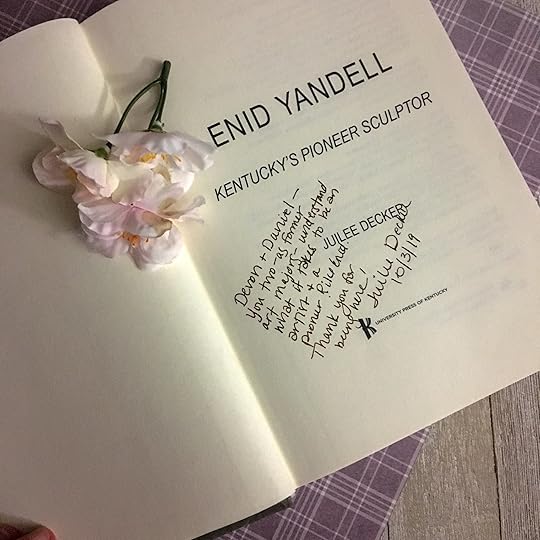
Louisville-born and nationally renowned sculptor Enid Yandell (1869–1934) was ahead of her time. She began her career when sculpture was considered too physical, too messy, and too masculine for women. Yandell challenged the gender norms of early-twentieth-century artistic practice and became an award-winning sculptor, independent artist, and activist for women's suffrage.
This study examines Yandell's life and how she grew from a young, Southern dilettante― the daughter of a Confederate medical officer―into a mature, gifted artist who ran in circles with more established male artists in New York and Paris, such as Frederick MacMonnies and Auguste Rodin. At the World's Columbian Exposition in Chicago in 1893, she was one of a select group of women sculptors, known as the White Rabbits, who sculpted the statues and architectural embellishments of the fair. As a result of her success in Chicago, Yandell was commissioned to create a twenty-five foot figure of Pallas Athena for Nashville's Centennial Exposition in 1897. Newspapers hailed it as the largest statue ever created by a woman. Yandell's command of classical subject matter was matched by her abilities with large-scale, figurative works such as the Daniel Boone statue in Cherokee Park, Louisville. In 1898 Yandell was among the first women to be selected for membership in the National Sculpture Society, the first organization of professional sculptors formed in the United States.
Presented to coincide with the 150th anniversary of her birth, this study demonstrates the ways in which Yandell was a pioneer and draws attention to her legacy.
This is a beautifully written book that draws together gender, art, and history in the life of the relatively unknown sculpture Enid Yandell. Her work reflected her times and the book is revelatory. Indeed, her life was fascinating and Decker does justice to it in this carefully researched biography.
I finished out the year, finishing a masterwork from my former professors about one of my favorite Artists from studying art history in school. Unfortunately, I didn't annotate my copy, so I don't think I can give a review that could give the book proper justice.
I would recommend this historical biography, for those who have an interest in "Pioneer" artists of history in a time when the public sculpture was a man's dominion. Latter parts of the historical narrative were a little more circuitous than my preferred linear style, but I loved it nonetheless.
2019 was a great year to celebrate the 150th Birthday of Enid Yandell's underappreciated legacy.
"Throughout her life, from 1869 to 1934, even as Enid navigated varied geographic, educataional, occupational, and social, she was--literarally--a pioneer...Her ties to Kentucky are espeically evident in her treatment of Daniel Boone and a self-confidence that came from hard-fought victories over the decades of her life, culminating in her self-actualization as Kentucky's sculptor."
As a Chicagoan, I’ve been fascinated with the White Rabbits for years and truly appreciate this incredibly thorough and much deserved examination of Enid Yandell’s life.
When Linda Nochlin asked in 1971 “why have there been no great women artists?” she didn’t realize she had an enormous blind spot: great women artists we just didn’t know about. We must continue to tell the stories of these lost and forgotten women artists, and in the process, change the narrative of art history.
A literal pioneer in the arts!! Did you know her sculpture of Daniel Boone has gone on to inspire many more renditions of him? Also so much of history is lost without letters between friends and scrapbooks so this is my reminder to all to start writing!