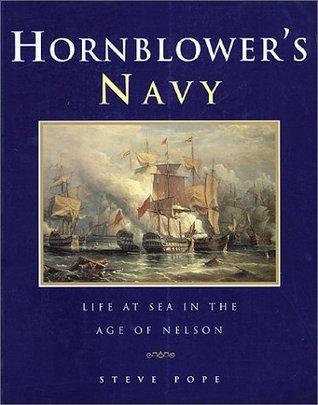
A vague and facile overview largely featuring information that can be gleaned by context when reading the Hornblower novels. The choice to use only contemporaneous artworks is interesting in some ways, and many of the paintings in particular are marvelous, but the complete lack of useful maps, schematics, uniform designs, blueprints, and so on, smacks of cheapness on the publisher's part and leaves some complicated explanation - such as the rank system on board - in the butter-fingered hands of the disinterested author. (A cursory glance at the Wikipedia page on Royal Navy ranks during the period provides a clean, legible schema of all the ranks Pope tediously describes verbally, and in an unhelpful order.) Also, there is no information here whatsoever about seamanship (the one thing a Hornblower fan arguably needs more insight into) and very little on naval tactics.
The work is redeemed somewhat by an unwanted but moderately interesting account of the Navy's role in the war, tacked on at the end in place of more pertinent or detailed information, or an expanded glossary. References to Hornblower and Forester are scant and often faintly derogatory; fine details are equally rare, suggesting a quick cash grab from a reluctant writer more interested in Nelson. Overall quite mediocre as a reference work for such an interesting period, and much poorer as a companion to a beloved literary series.
A great overview of life and warfare during the Napoleonic era. Ships, crew, battles, etc. Slim, but informative, and well-illustrated. Nice as a companion to Hornblower novels.
This is a good overview of the British Royal Navy during the Napoleonic wars, richly illustrated with period prints and paintings. It places the British navy in the context of other world power navies in the late 18th and early 19th centuries, and provides reasons for its unparalleled excellence during this time. The wealth of the British empire was a primary reason for its ruling of the waves, but the fighting spirit of the British was arguably an even more important aspect. By and large, most officers and hands were eager for battle and tended to seek it out unless the opposing vessel was much larger, or much smaller. Of course the Articles of War meant that any captain might have to answer "at your peril" for avoiding battle and the death penalty for doing so, or for any perceived mismanagement of the combat, was occasionally enforced, although less so as the 19th century progressed.
Occasionally the writer author appears to cave to a misplaced desire to be politically-correct, particularly in describing ships as floating death-traps. The standard of cleanliness was generally much more commendable than on shore, with the ship itself, even the lower decks, scrubbed out regularly, and the hands required to wash their clothing, typically once a week, as well as muster themselves, clean, sober, and freshly shaved, on Sundays. Additionally the use of lime-juice to prevent scurvy was an innovation peculiar to the British navy. And contrary to popular belief, the men weren't starved nor fed poor rations intentionally. It is true that fresh water quickly turned green and that hard tack was generally infested with weevils, but they generally ate meat four times a week or more, and were allotted a gallon of beer per day to make up for the undrinkable water aside from the famous rum rations in foreign waters. To many sailors, this was a good deal better than anything they could have purchased on land.
Given that a man o' war was staffed by hundreds of common hands and possibly less than a dozen officers, compliance was an absolute necessity. The quality of life of the common hand was generally superior to what they might have had on shore, although admittedly many of them joined up specifically for that reason - to escape crippling poverty, illegimate children, criminal conviction (this was an era in which theft of even a single shilling often meant the gallows), unwanted wives, and so forth. Even so, we can't judge their circumstances using modern parameters. A boy of 12 of a poor family would have been working either as a farm laborer or a domestic servant, probably under conditions far worse, or at least equivalent to, his life as ship's boy. The risk of death was much higher than on land, of course, largely from disease and shipwreck, although battle did claim its toll. But even common hands were accorded a social status unheard-of prior or since, as guardians of the kingdom and barriers between the British Empire and the hated French tyrant.
The author has a few curious notes about C.S. Forester's sexist, racist writings, which I found odd given that the book appears to be somewhat of a tribute to his famous creation, Horatio Hornblower. I suppose it's only natural to look at books published in the 1930s by 2000s standards, but yes, the world was much more racist and sexist then than it is today, but not sure it behooves any non-fiction writer to harangue Forester for being a product of his time, particularly because his books do not contain any outright sexism or racism. I do not think writing historical fiction which illustrates that the life of an 18th century woman or a black man did not offer the same opportunities as it does today is necessarily a hallmark of racism or sexism.
Additionally the author several times mentions Lord Nelson's character flaw: his adulterous relationship with Lady Hamilton. That seems a bit harsh considering that he appears to have loved her deeply and in fact his dying words were to take care of her (instructions which the British government ignored; she died in poverty). Again by today's standards, when almost everyone in the Western world is free to marry for love, adultery may seem a wicked sin, but the Georgians had a much higher tolerance for it, given that few marriages were true love matches and that divorce, which Nelson contemplated in order to marry Lady Hamilton, was difficult to secure. It is true that Nelson flaunted his affair more than was seemly for the era, but the author's criticism of Nelson's romantic life seems overly prudish, and more or less irrelevant to "life at sea in the age of Nelson."
Overall this is a well-written, nicely-illustrated book that was a pleasure to read. It's a slim volume, but worth it for the illustrations alone.
Doing research for a model build in the very near future. I've wanted to build Horatio Hornblower's HMS Lydia for a long time now. I've just seen an amazing model of a similar ship online and now I just have to do it!
Good book. It gives a good overview of the history that is only briefly mentioned in passing in the Hornblower books.