

What do you think?

The Silence in the Garden
The Whitbread Award–winning author “demonstrates a master’s touch” in this tale of an aristocratic Irish family’s ruinous path toward modernity (The New York Times). An island estate off the coast of county Cork, Carriglas has been in the Rolleston family for centuries. Sarah Pollexfen, a distant relation of little means, remembers the magical summer she spent there as a child in 1904. But much has changed in Ireland since then. And when Sarah returns nearly thirty years later, she finds Carriglas much changed as well. World War I and the Irish Troubles have taken their toll on the Rollestons. Sarah’s cousins, who once seemed to sparkle with beauty and wit, have grown dour and withdrawn. And as Sarah uncovers the tragedies they’ve endured, she’ll also discover the terrible truth about that seemingly idyllic summer in 1904.
212 pages, Kindle Edition
First published January 1, 1988
About the author
William Trevor
175 books806 followersWilliam Trevor, KBE grew up in various provincial towns and attended a number of schools, graduating from Trinity College, in Dublin, with a degree in history. He first exercised his artistry as a sculptor, working as a teacher in Northern Ireland and then emigrated to England in search of work when the school went bankrupt. He could have returned to Ireland once he became a successful writer, he said, "but by then I had become a wanderer, and one way and another, I just stayed in England ... I hated leaving Ireland. I was very bitter at the time. But, had it not happened, I think I might never have written at all."
In 1958 Trevor published his first novel, A Standard of Behaviour, to little critical success. Two years later, he abandoned sculpting completely, feeling his work had become too abstract, and found a job writing copy for a London advertising agency. 'This was absurd,' he said. 'They would give me four lines or so to write and four or five days to write it in. It was so boring. But they had given me this typewriter to work on, so I just started writing stories. I sometimes think all the people who were missing in my sculpture gushed out into the stories.' He published several short stories, then his second and third novels, which both won the Hawthornden Prize (established in 1919 by Alice Warrender and named after William Drummond of Hawthornden, the Hawthornden Prize is one of the UK's oldest literary awards). A number of other prizes followed, and Trevor began working full-time as a writer in 1965.
Since then, Trevor has published nearly 40 novels, short story collections, plays, and collections of nonfiction. He has won three Whitbread Awards, a PEN/Macmillan Silver Pen Award, and was shortlisted for the Booker Prize. In 1977 Trevor was appointed an honorary (he holds Irish, not British, citizenship) Commander of the Most Excellent Order of the British Empire (CBE) for his services to literature and in 2002 he was elevated to honorary Knight Commander of the Most Excellent Order of the British Empire (KBE). Since he began writing, William Trevor regularly spends half the year in Italy or Switzerland, often visiting Ireland in the other half. He lived in Devon, in South West England, on an old mill surrounded by 40 acres of land.
In 1958 Trevor published his first novel, A Standard of Behaviour, to little critical success. Two years later, he abandoned sculpting completely, feeling his work had become too abstract, and found a job writing copy for a London advertising agency. 'This was absurd,' he said. 'They would give me four lines or so to write and four or five days to write it in. It was so boring. But they had given me this typewriter to work on, so I just started writing stories. I sometimes think all the people who were missing in my sculpture gushed out into the stories.' He published several short stories, then his second and third novels, which both won the Hawthornden Prize (established in 1919 by Alice Warrender and named after William Drummond of Hawthornden, the Hawthornden Prize is one of the UK's oldest literary awards). A number of other prizes followed, and Trevor began working full-time as a writer in 1965.
Since then, Trevor has published nearly 40 novels, short story collections, plays, and collections of nonfiction. He has won three Whitbread Awards, a PEN/Macmillan Silver Pen Award, and was shortlisted for the Booker Prize. In 1977 Trevor was appointed an honorary (he holds Irish, not British, citizenship) Commander of the Most Excellent Order of the British Empire (CBE) for his services to literature and in 2002 he was elevated to honorary Knight Commander of the Most Excellent Order of the British Empire (KBE). Since he began writing, William Trevor regularly spends half the year in Italy or Switzerland, often visiting Ireland in the other half. He lived in Devon, in South West England, on an old mill surrounded by 40 acres of land.
Ratings & Reviews
Friends & Following
Create a free account to discover what your friends think of this book!
Community Reviews
Displaying 1 - 30 of 76 reviews

December 21, 2016
This book was my first by Trevor, and while I was reading it, I read in the NYTimes that he had died, age 88.
We’re on a small island off the coast of County Cork, Ireland. The story spans most of the 1900s but the main action begins around 1930. The island is within sight of a small town on the mainland and a bridge is being built that will likely change their lives, but no one seems to be excited by the bridge or to even care. That seems to be a fundamental theme of this novel. Trevor portrays the inhabitants as placid, joyless people with no drive and an air of hopelessness.

Most of the action takes place on a run-down estate on the island. An elderly matriarch, a widow and a Protestant, runs things with her three grown children, two men and a woman, and with a few servants and workers. One of the live-in servants at the start of the story is a main character. She's a young woman who is a poor relation of the family hired as a governess to the children.
Both brothers also come back to the island after school in England and you wonder: why?
Another main character, really the most consistent character threaded throughout the novel, is a boy at the start of the story, the son of a maid. He acts as an errand boy for the matriarch and a gopher around the estate. He was born out of wedlock by a stroke of bad luck.
There is not a lot of plot to the story beyond what is already outlined if you read the spoilers. The main happening is the daughter’s wedding. But at the end of the story there’s a startling twist:
Trevor’s quiet, understated prose, beautiful prose really, parallels the quiet unassuming low-key lives of these folks. There are some quirky characters and even some humor. “Holy Mulligan” is a schoolboy who acts like a priest and preaches to the fatherless boy about 'his stain.' A Bishop comes to the wedding and says to the governess “Sarah, I would not raise this subject with you if we had not come to know each other well in the last few minutes, as indeed I believe we have.”
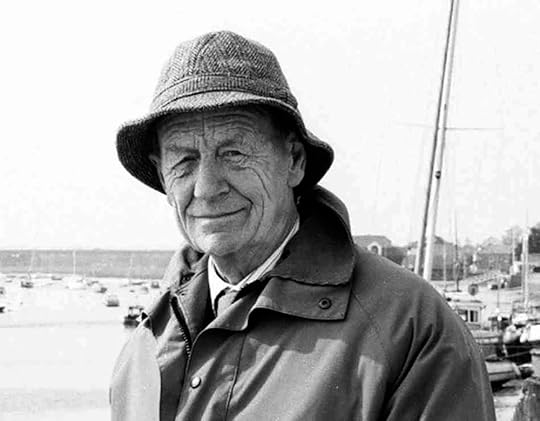
William Trevor is one of my favorite authors and I have read about 15 of his novels and collections of short stories. Below are links to reviews of some others of my favorite novels of his:
Mrs Eckdorf in O'Neill's Hotel
After Rain
The Hill Bachelors
Fools of Fortune
Nights at the Alexandra
The Children of Dynmouth
Top photo of Kinsale in County Cork from vrbo.com
Poto of the author by Jerry Bauer from theparisreview.org

September 29, 2016
5 "elegant, understated, masterful" stars !!
4th Favorite Read of 2016
Goodness! I finished this book and sat with my Earl Grey tea listening to Bach's Solo Suites for Cello.I pondered, sighed and stroked the cat on my lap. I grieve the ending of this book and so I got up in a fit of agitation and put on my duckies, my windbreaker and went out into the cool windy rain and walked briskly and reflected on the perfection of this book.
I have read many excellent books but this book entered into my core, not because of the plot or the characters or even beautiful or profound passages but because Mr. Trevor was able to capture the essence of life, the essence of death and most of all the permutations of grey between the two, the land of shadow where most of us live.
At first I was so charmed by the Irish island, village and its inhabitants as they went about their business, eking out an existence, falling in love, having children, attending church, gossiping, conversing, reading, dreaming of cities in Italy or France. The rich are living like paupers in big homes, the middle class are garish and the poor as always remain poor. Affairs are had, men bet on horses, women pine for affection, children yearn for more free time. Histories are vague, people complain and hail marys are recited. Kindness is frequent, cruelties are harsh, judgements and stonings are cast.
Slowly however the fairy tale ends and becomes a discovery of what lays within tormented souls.
Time passes and people become ill, secrets are discovered and then hidden again. A bastard boy is ostracized, a woman punishes herself for a crime of childhood, a nursemaid dies in unrequited love. A middle class lady seduces a young gentryman and loses herself in desire and his disdain. A kind old matriarch makes amends for the evils of her progeny. The cycle of life and death repeat in perpetuity.
Mr. Trevor understands the Irish. Mr. Trevor understands existence. Mr. Trevor has written a masterpiece.
Also a big thanks to Fionnuala whose review inspired me to read this author who was unknown to me.
4th Favorite Read of 2016
Goodness! I finished this book and sat with my Earl Grey tea listening to Bach's Solo Suites for Cello.I pondered, sighed and stroked the cat on my lap. I grieve the ending of this book and so I got up in a fit of agitation and put on my duckies, my windbreaker and went out into the cool windy rain and walked briskly and reflected on the perfection of this book.
I have read many excellent books but this book entered into my core, not because of the plot or the characters or even beautiful or profound passages but because Mr. Trevor was able to capture the essence of life, the essence of death and most of all the permutations of grey between the two, the land of shadow where most of us live.
At first I was so charmed by the Irish island, village and its inhabitants as they went about their business, eking out an existence, falling in love, having children, attending church, gossiping, conversing, reading, dreaming of cities in Italy or France. The rich are living like paupers in big homes, the middle class are garish and the poor as always remain poor. Affairs are had, men bet on horses, women pine for affection, children yearn for more free time. Histories are vague, people complain and hail marys are recited. Kindness is frequent, cruelties are harsh, judgements and stonings are cast.
Slowly however the fairy tale ends and becomes a discovery of what lays within tormented souls.
Time passes and people become ill, secrets are discovered and then hidden again. A bastard boy is ostracized, a woman punishes herself for a crime of childhood, a nursemaid dies in unrequited love. A middle class lady seduces a young gentryman and loses herself in desire and his disdain. A kind old matriarch makes amends for the evils of her progeny. The cycle of life and death repeat in perpetuity.
Mr. Trevor understands the Irish. Mr. Trevor understands existence. Mr. Trevor has written a masterpiece.
Also a big thanks to Fionnuala whose review inspired me to read this author who was unknown to me.

April 1, 2024
The Silence in the Garden is a chronicle of unhappiness… Sadness and sarcasm are intermingled…
Old miss Sarah dies and she leaves behind her diaries… And her writings are the witnesses of the time past…
She first arrives at the estate in 1908 as a governess of a young girl…
Then the Great War and a lot of changes intervene… But after experiencing much misfortune in 1931 she returns… The former girl is fully grown up now…
However during her absence the inhabitants of the estate had their share of misfortune too… Life goes on and the young woman is going to be married… Her fiancé is a solicitor and he is much older than she… Everything culminates in the farcical wedding… Miss Sarah wants to leave but there is no place to go to…
Some lives are like campfire sparks – they fly and fade away without a trace.
Old miss Sarah dies and she leaves behind her diaries… And her writings are the witnesses of the time past…
She first arrives at the estate in 1908 as a governess of a young girl…
The strangely intense eyes were fixed on my hat, which was grey and low in the crown. They proceeded slowly downwards to my face, lingered without interest, and then passed over my grey tweed coat. The distant cousin who had come to be a governess was poorly attired and plain, her manner affected by a diffidence that stifled charm, quite unlike her brother: unwavering in their stare, the eyes alertly reflected all they saw.
Then the Great War and a lot of changes intervene… But after experiencing much misfortune in 1931 she returns… The former girl is fully grown up now…
She was dressed in green, a tweed skirt and blouse, a cameo brooch at her throat. When she spoke she did not raise her voice but projected it through the warm foliage, over pots and ornamental urns. Her looks were certainly striking now, her skin like porcelain, her pale hair silky, her eyes as they had ever been.
However during her absence the inhabitants of the estate had their share of misfortune too… Life goes on and the young woman is going to be married… Her fiancé is a solicitor and he is much older than she… Everything culminates in the farcical wedding… Miss Sarah wants to leave but there is no place to go to…
‘The place would fall to pieces after I’ve gone,’ the old woman said the day I came back. ‘Thank you for returning, Sarah.’ But at dinner and in the drawing-room I feel trapped by my own weakness, more than ever I was trapped in the boarding-school or in my father’s rectory. I should leave Carriglas, but I cannot find the courage.
Some lives are like campfire sparks – they fly and fade away without a trace.

January 4, 2017
Carriglas, just love the name, the ancestral home of the Rollestons, located on an island off the coast of County Cork. Sarah Pollenfax, an impoverished daughter of a clergyman and a distant relative, arrives as governess to the three children of the widowed Colonel Rolleston. This is 1905 and Sarah is naïve, innocent and bowled over by Carriglas. The troubles will eventually end the wealth and health of this magnificent estate and family.
This author has wonderfully taken me to a different time and place. Much of this story is related through the journals of Sarah and it is through her we learn of a tragic happening that changes the lives of the three children, now adults, leading them to acts of self punishments in strange ways. We see the changes to the staff,, especially a young housemaid, pregnant, soon to marry the family butler and through the years her son Tom. I just loved this young character, who has much to deal with, and loved the man he became.
This is a quiet, often charming, but thoroughly engaging novel of a time gone by. The declining fortunes of a family and a young woman who will spend most of her life in the background, yearning for something that can never be expressed. Often sad, melancholy but beautiful too.
This author has wonderfully taken me to a different time and place. Much of this story is related through the journals of Sarah and it is through her we learn of a tragic happening that changes the lives of the three children, now adults, leading them to acts of self punishments in strange ways. We see the changes to the staff,, especially a young housemaid, pregnant, soon to marry the family butler and through the years her son Tom. I just loved this young character, who has much to deal with, and loved the man he became.
This is a quiet, often charming, but thoroughly engaging novel of a time gone by. The declining fortunes of a family and a young woman who will spend most of her life in the background, yearning for something that can never be expressed. Often sad, melancholy but beautiful too.

Read
September 5, 2015William Trevor makes you think hard about point of view.
You don’t notice how he deploys it at first, or to what purpose, but as you read through this quiet book, you recognise that you are in the hands of a master craftsman, someone who knows exactly the angles required to carve a story of great dignity from a massive block of less than dignified history.
Some sections of this novel are in the form of diary entries by a character who is little more than a shadow for most of the book; the incidents she records viewed as if by an off-stage camera, the characters and events seen obliquely. Yet her diary entries control the playing out of the plot in a very subtle way.
Many sections of the book are written in a third person omniscient voice which is like a camera panning over the entire scene, offering the reader a wide-angled but slightly fuzzy view. From time to time, the omniscient voice gives way to a limited narrative viewpoint allowing the reader to see details through the eyes of certain characters, the camera recording not only what they see but also their thoughts about what they’ve seen, what they’ve experienced and what they’ve imagined experiencing. Then the camera pans out again and we are back to the third person omniscient point of view, and we hardly notice the shift, so expert is Trevor’s control of the narrative.
The variations in viewpoint, along with the diary sections, allow Trevor to cut and splice the episodes as in a film. We never see all of the action, and we are aware that many scenes remain on the cutting-room floor, but we have the feeling that the ones that really count have made it into the final version.
And we love the final version.
You don’t notice how he deploys it at first, or to what purpose, but as you read through this quiet book, you recognise that you are in the hands of a master craftsman, someone who knows exactly the angles required to carve a story of great dignity from a massive block of less than dignified history.
Some sections of this novel are in the form of diary entries by a character who is little more than a shadow for most of the book; the incidents she records viewed as if by an off-stage camera, the characters and events seen obliquely. Yet her diary entries control the playing out of the plot in a very subtle way.
Many sections of the book are written in a third person omniscient voice which is like a camera panning over the entire scene, offering the reader a wide-angled but slightly fuzzy view. From time to time, the omniscient voice gives way to a limited narrative viewpoint allowing the reader to see details through the eyes of certain characters, the camera recording not only what they see but also their thoughts about what they’ve seen, what they’ve experienced and what they’ve imagined experiencing. Then the camera pans out again and we are back to the third person omniscient point of view, and we hardly notice the shift, so expert is Trevor’s control of the narrative.
The variations in viewpoint, along with the diary sections, allow Trevor to cut and splice the episodes as in a film. We never see all of the action, and we are aware that many scenes remain on the cutting-room floor, but we have the feeling that the ones that really count have made it into the final version.
And we love the final version.

January 22, 2017
I have a passion for books and stories set in Irish Manor homes or as they are affectionly known in Ireland as The Big House. When I saw the cover of The Silence in the GardenI was drawn by the image and the premise of the story.
Family secrets take their toll on the children of an old Irish family
In the summer of 1904 Sarah Pollenfax, the daughter of an impecunious clergyman, arrives at Carriglas, an island off the coast of Cork, to act as governess for her distant cousins. It's a magical time in a magical place. But when she comes back almost thirty years later, after the First World War and the Irish Civil War have taken their toll, she discovers that there were things going on during that apparently idyllic summer which now horrify her and which cast a long shadow over the remnants of the family.
William Trevor's prose and attention to detail are always evident in his novels and I do love his ability to develop characters and his wonderful sense of time and place. However while I enjoyed the writing and the beautiful descriptions I came away from the novel with a feeling that I didn't quite understand what exactly had happened in the story and this was a little disappointing as I had read a previous novel by Trevor and was aware that I needed to pay close attention but still this one had me puzzled. I did a little research and confirmed what I had assumed took place in the story but the confusion spoiled the experience a little for me.
However I did enjoy the book and was glad I had the opportunity to read it and will certainly add another of Trevor Novels' to my reading list for reading in 2017.

October 26, 2016
I feel more than ever that I live in a cobweb of other people’s lives and do not understand the cobweb’s nature. These are the people I know as children; this is the same house; trees and shrubs are as they were. I remind myself of that when everywhere I sense what I can only call distortion; I know no better word. I tell myself that John James suffers from his wounded leg, that it’s his brother’s choice to live a peasant’s life, that other girls have married sticks for husbands.
I have tried but I am unable to write a review on this wonderful book as I love it too much.
All I can say is that the story begins in 1908 and is based on the island of Carriglas, just off County Cork in Ireland. Sarah is a poor relation of the Rolleston family and goes there as a governess. There are three children, Villana and the two brothers, John James and Lionel who are at school in England. When they are both grown up, each demonstrates in their own way their proclivities which are rather intriguing. Sarah’s brother Hugh finally gets engaged to Villana and then everything goes rather wrong and the engagement is suddenly broken off. There are secrets and these will not be discovered until Sarah in 1971 finally realizes that these secrets need to be known by Tom, the illegitimate son of the former butler of the household who will finally inherit Carriglas. Her diaries will reveal all to him.
Tom is indeed the catalyst who holds the threads of this novel together. He notices everything. His attention to detail is rather remarkable. There are some unforgettable sections in the books such as Villiana’s wedding which was remarkable and the book is also rather amusing which certainly appealed to me.
The sensitivity in the writing style of Trevor is unsurpassed and this is a book that I really cherish. Why is it that whenever I really love a book I cannot write about it? It’s rather as if I have a secret myself and I don’t want to share it. Bizarre on reflection.
The descriptions are remarkable and I especially remember the fuchsia hedges, as quoted in the book, from when I was in Ireland last year. The vivid red rather captivated me. All of the local people make up the fabric of this book with the minimum of words which Trevor is so good at. This book has a magical quality that is hard to describe. I’m sitting here looking at my Waterford shamrock sitting on my desk and I know that I have a gem in this book.
All I can say is that I want to read all of William Trevor’s books and he wrote rather a lot. Quite an undertaking.
I have tried but I am unable to write a review on this wonderful book as I love it too much.
All I can say is that the story begins in 1908 and is based on the island of Carriglas, just off County Cork in Ireland. Sarah is a poor relation of the Rolleston family and goes there as a governess. There are three children, Villana and the two brothers, John James and Lionel who are at school in England. When they are both grown up, each demonstrates in their own way their proclivities which are rather intriguing. Sarah’s brother Hugh finally gets engaged to Villana and then everything goes rather wrong and the engagement is suddenly broken off. There are secrets and these will not be discovered until Sarah in 1971 finally realizes that these secrets need to be known by Tom, the illegitimate son of the former butler of the household who will finally inherit Carriglas. Her diaries will reveal all to him.
Tom is indeed the catalyst who holds the threads of this novel together. He notices everything. His attention to detail is rather remarkable. There are some unforgettable sections in the books such as Villiana’s wedding which was remarkable and the book is also rather amusing which certainly appealed to me.
The sensitivity in the writing style of Trevor is unsurpassed and this is a book that I really cherish. Why is it that whenever I really love a book I cannot write about it? It’s rather as if I have a secret myself and I don’t want to share it. Bizarre on reflection.
The descriptions are remarkable and I especially remember the fuchsia hedges, as quoted in the book, from when I was in Ireland last year. The vivid red rather captivated me. All of the local people make up the fabric of this book with the minimum of words which Trevor is so good at. This book has a magical quality that is hard to describe. I’m sitting here looking at my Waterford shamrock sitting on my desk and I know that I have a gem in this book.
All I can say is that I want to read all of William Trevor’s books and he wrote rather a lot. Quite an undertaking.

February 16, 2019
”But, my dear girl, we can all do perfectly well without happiness,...The other side of the coin, my dear, is that no one can do without love. It is the greatest of all deprivations not to know love in some wise, either to give or to receive. It hardly matters which.”
Our story begins on an island in Ireland, with World War I dancing on the horizon, when Sarah Pollexfen, a distant relative of the Rollestons, comes to the estate of Carriglas to serve as governess to the youngest child. There is a magical summer and then she leaves to nurse her ailing father. The story continues some twelve to fifteen years later, when she returns to Carriglas after her father’s death.
Carriglas is decaying, even at the beginning of this story it is losing ground, figuratively and literally. The family who owns the estate is crumbling as well, but throughout the novella we never quite know why. What we do glean, almost immediately, is that it has something to do with the murder of their butler, who has left behind an illegitimate son. For me, it was this boy, Tom, who gave the story emotional pull.
This is Ireland, and there is the usual Irish question of Catholicism vs. Protestantism. The religious figures pictured here are sometimes unforgiving and malicious, and the mistreatment of the illegitimate boy tugged at my heart. In fairness there is also a priest who seems to me to be the picture of what a priest should be.
While this story and situation may be uniquely Irish, the tragedy at the heart of this book is completely universal. It is rooted in what it is to be a human being who has been denigrated and what it is to be a part of a class that stands apart, and purportedly above, another. Trevor writes with such preciseness and detail that he gives you a true sense of the people and the places, and the sadness that so often haunts a life.
Our story begins on an island in Ireland, with World War I dancing on the horizon, when Sarah Pollexfen, a distant relative of the Rollestons, comes to the estate of Carriglas to serve as governess to the youngest child. There is a magical summer and then she leaves to nurse her ailing father. The story continues some twelve to fifteen years later, when she returns to Carriglas after her father’s death.
Carriglas is decaying, even at the beginning of this story it is losing ground, figuratively and literally. The family who owns the estate is crumbling as well, but throughout the novella we never quite know why. What we do glean, almost immediately, is that it has something to do with the murder of their butler, who has left behind an illegitimate son. For me, it was this boy, Tom, who gave the story emotional pull.
This is Ireland, and there is the usual Irish question of Catholicism vs. Protestantism. The religious figures pictured here are sometimes unforgiving and malicious, and the mistreatment of the illegitimate boy tugged at my heart. In fairness there is also a priest who seems to me to be the picture of what a priest should be.
While this story and situation may be uniquely Irish, the tragedy at the heart of this book is completely universal. It is rooted in what it is to be a human being who has been denigrated and what it is to be a part of a class that stands apart, and purportedly above, another. Trevor writes with such preciseness and detail that he gives you a true sense of the people and the places, and the sadness that so often haunts a life.

February 23, 2016
The Silence in the Garden is a masterclass in the art of the novel. In its 200 pages William Trevor creates a detailed tapestry of a story that has a multitude of threads. That they seem to be heading nowhere in particular but then reveal a final detailed picture is a testament to Trevor's supreme skill. He is the greatest chronicler of Ireland's secrets and lies, of the psychological scars of past turmoil and present doubt. I'm very glad to see that Penguin are republishing all of his early novels in a handsome new edition. I'll be looking out for them.

July 30, 2022
Set in Ireland, the Rolleston family’s large estate, Carriglas, is located on an island off the coast of county Cork. The characters are the Rolleston family members, their household staff, a few visitors, and several townspeople. It has a strong sense of place. There is a family secret, but I would not call it a typical mystery. The storyline is influenced by the Troubles in a variety of ways, including the past murder of the family’s butler. Decades later, a distant relative comes back to the now run-down estate and recalls memories of her childhood visit in 1904. I enjoyed the writing style and the characterization but there is not much resolution to be found. It is a little too nebulous for me (and I am pretty comfortable with ambiguity).

December 22, 2016
I read William Trevor's Summer and Love some time ago and can't remember much about it except I didn't understand what all the fuss was about. But now I'm going to go back and re-read it, because I happened to pick this up, really because of William Trevor's recent death, and my goodness, I LOVED this.
I love its understated quiet story about Irish aristocrats gone to seed. There is a mystery, but interestingly this isn't at the heart of the book, when all is revealed at the end there was no big aha! moment, and I liked the book all the better for it.
I love the focus on the detail - the building of the bridge that will join the island Carriglas sits on to the mainland, the blousey boardinghouse landlady who counts her money, Tom who hides in the trees and watches the wedding guests, and tries to avoid 'Holy Mulligan' who says no one will want to touch Tom because he is illegitimate.
The novel meanders slowly upstairs and down, over the island and across to the mainland, so lazily, so beautifully.
I would like to reread this immediately, but first I'm going to go and find Summer and Love.
www.clairefuller.co.uk
I love its understated quiet story about Irish aristocrats gone to seed. There is a mystery, but interestingly this isn't at the heart of the book, when all is revealed at the end there was no big aha! moment, and I liked the book all the better for it.
I love the focus on the detail - the building of the bridge that will join the island Carriglas sits on to the mainland, the blousey boardinghouse landlady who counts her money, Tom who hides in the trees and watches the wedding guests, and tries to avoid 'Holy Mulligan' who says no one will want to touch Tom because he is illegitimate.
The novel meanders slowly upstairs and down, over the island and across to the mainland, so lazily, so beautifully.
I would like to reread this immediately, but first I'm going to go and find Summer and Love.
www.clairefuller.co.uk

November 16, 2019
I started to read William Trevor’s books in the late 1990s and consider him as one of my favorite authors. His fiction and short stories are equally good. I joined GoodReads about 2 months ago and wanted to start to build up my library/books read here, since I do enjoy reading.
I being a huge William Trevor fan had to get the hardcover edition of this book. Has blurbs on back of dustjacket by Thomas Flanagan, Doris Grumbach, Jonathan Yardley (he wrote a really good memoir, We Never Had it so Good), Robert Towers, and John Fowles.
Gave it an A+!
I being a huge William Trevor fan had to get the hardcover edition of this book. Has blurbs on back of dustjacket by Thomas Flanagan, Doris Grumbach, Jonathan Yardley (he wrote a really good memoir, We Never Had it so Good), Robert Towers, and John Fowles.
Gave it an A+!

December 18, 2022
‘The other side of the coin, my dear, is that no one can do without love. It is the greatest of all deprivations not to know love in some wise, either to give or to receive. It hardly matters which.’
But what the novel didn’t say was that love left an emptiness behind that was as cold as frozen snow.
The twist at the end was a shock to me. It was clear all along that the children had something to do with the butler's death, but it turned out to be a nested guilt - their sins that led to another's, a personal guilt that turned political. I think we are fascinated by childhood cruelty because it's the most secretive, dark, and primal of its kind, and also because there is the sense of permanent stain, emanating from such a deep place that it makes up the "core" of the person. Because of how they behaved at that time, before they could really understand what they were doing, none of the Carriglas children could ever stop punishing themselves or see themselves as worthy of happiness. It reminded me of this quote from Sally Rooney's Normal People:
cruelty does not only hurt the victim, but the perpetrator also, and maybe more deeply and more permanently. You learn nothing very profound about yourself simply by being bullied; but by bullying someone else you learn something you can never forget.
A slight snag for me was that in the Carriglas case, where the adults knew what was happening and repeatedly shamed and punished the children, the children continued to behave cruelly - in the open. I can believe in group madness, particularly in childhood, where people secretly give into their cruelty as if in a dream, but it seems implausible that they should continue once woken. Especially since none of them appear to be sociopathic. It may be an allegory for Catholic-Protestant relations that I am not getting.
‘No matter how it was, it belongs to the past now.’
‘The past has no belongings. The past does not obligingly absorb what is not wanted.’
I have been reading some anti-natalist philosophy this past week, and the ending of this novel coincidentally overlapped. A trauma is passed back and forth until guilt leads one party to punish themselves, stop procreating, and die out.
their punishment of themselves seems terrible, yet a marvel also.
But what the novel didn’t say was that love left an emptiness behind that was as cold as frozen snow.
The twist at the end was a shock to me. It was clear all along that the children had something to do with the butler's death, but it turned out to be a nested guilt - their sins that led to another's, a personal guilt that turned political. I think we are fascinated by childhood cruelty because it's the most secretive, dark, and primal of its kind, and also because there is the sense of permanent stain, emanating from such a deep place that it makes up the "core" of the person. Because of how they behaved at that time, before they could really understand what they were doing, none of the Carriglas children could ever stop punishing themselves or see themselves as worthy of happiness. It reminded me of this quote from Sally Rooney's Normal People:
cruelty does not only hurt the victim, but the perpetrator also, and maybe more deeply and more permanently. You learn nothing very profound about yourself simply by being bullied; but by bullying someone else you learn something you can never forget.
A slight snag for me was that in the Carriglas case, where the adults knew what was happening and repeatedly shamed and punished the children, the children continued to behave cruelly - in the open. I can believe in group madness, particularly in childhood, where people secretly give into their cruelty as if in a dream, but it seems implausible that they should continue once woken. Especially since none of them appear to be sociopathic. It may be an allegory for Catholic-Protestant relations that I am not getting.
‘No matter how it was, it belongs to the past now.’
‘The past has no belongings. The past does not obligingly absorb what is not wanted.’
I have been reading some anti-natalist philosophy this past week, and the ending of this novel coincidentally overlapped. A trauma is passed back and forth until guilt leads one party to punish themselves, stop procreating, and die out.
their punishment of themselves seems terrible, yet a marvel also.
This entire review has been hidden because of spoilers.

July 21, 2015
Mysterious story about the Rolleston family of the Carriglas estate in Ireland; the people they employ; and their "poor relations". A story about decrepitude, and also morals.
I love William Trevor for his nuanced intrigue and storytelling prowess. But this particular story was a bit heavy-handed with the elegant obfuscation, I felt like it kind of buried the mystery. While I always love the sound of Trevor's stories, especially the darkness of them, with this one I could have used some more illumination.
I love William Trevor for his nuanced intrigue and storytelling prowess. But this particular story was a bit heavy-handed with the elegant obfuscation, I felt like it kind of buried the mystery. While I always love the sound of Trevor's stories, especially the darkness of them, with this one I could have used some more illumination.
February 13, 2011
This is William Trevor at his most depressing best. A story that can haunt for ever with so little uplifting that I can't remember a single light hearted line.
I don't think I've read any book that I enjoyed so much while being made so utterly miserable.
I don't think I've read any book that I enjoyed so much while being made so utterly miserable.

May 31, 2026
Several weeks ago I attended an author talk by Elizabeth Strout, one of my favorite contemporary authors. She identified William Trevor as her favorite author, whom I hadn’t read for many years. Thus, my odyssey begins with “Silence in the Garden,” published in 1988.
Like most of Trevor’s writing, the setting is Ireland, and more specifically, an island off the coast, reached only by ferry in the early years. The novel opens in 1971, establishing a few important facts…”The home that has been provided for Sarah Pollexfen for so long is still a provision that is necessary. She and a one-time maid, Patty, and Tom - illegitimate son of the Rollestons’ last butler - are left at Carriglas, the place that once was magical for her.”
Much of the story of Carriglas and those who lived there is told through Sarah’s diaries beginning in 1904, when Sarah, nineteen-years-old and a vicar’s daughter, arrives to the estate as a governess. Her age and background greatly mold her views of this wealthy, influential famly. She notes the class differences without judgment, dismisses town gossip, focusing on the family’s past and present generosity to tenants on their land, seeing their family life as carefree, idyllic, young people running freely, strong bonds connecting them all. She returns home to care for her parents, bound by duty always.
World War I takes a terrible toll on the family. When Colonel Rolleston is killed, his mother steps in to run the estate. Sarah is asked to return to Carriglas in 1931, “a kindness shown to her by Mrs. Rolleston,” when her father dies, and she has no where else to live.
Secrets come to light slowly over the years when she returns, shared through her diaries. Love valiantly given up…unrequited love…love never acknowledged…secret affairs…Mrs. Rolleston’s support of others. The story threads reflect Trevor’s compassion and empathy for the characters he has created - the child born out of wedlock is protected by Mrs. Rolleston, maintaining a special place held for him on the estate depite the never ending gossip among the villagers…the devastating consequences of the Troubles…the significance of a bridge being built that will make the ferry obsolete, dividing the classes even more, changing the island’s “nature.” The adult children - John James, Lionel, Villana - reflect a changing Ireland. “The picnic was over, she (Mrs. Rolleston) thought; twilight was giving over to darkness.” As Mrs. Rolleston is dying , she asks Sarah to record the darkest secret of it all so that it will be remembered, not buried as Sarah and her children might wish. As many secrets are, this one had been buried, whitewashed, but had affected them all.
The last chapter reflects the day of Sarah’s death in 1971, the remaining family reading her diaries as she requested. Their reflections as they go about their business, thinking about what she has written so carefully and honestly, conjure so many memories, all the changes in their lives and Ireland, what was and could have been. “Absence has gathered in the rooms, and silence in the garden.” Sigh…
Like most of Trevor’s writing, the setting is Ireland, and more specifically, an island off the coast, reached only by ferry in the early years. The novel opens in 1971, establishing a few important facts…”The home that has been provided for Sarah Pollexfen for so long is still a provision that is necessary. She and a one-time maid, Patty, and Tom - illegitimate son of the Rollestons’ last butler - are left at Carriglas, the place that once was magical for her.”
Much of the story of Carriglas and those who lived there is told through Sarah’s diaries beginning in 1904, when Sarah, nineteen-years-old and a vicar’s daughter, arrives to the estate as a governess. Her age and background greatly mold her views of this wealthy, influential famly. She notes the class differences without judgment, dismisses town gossip, focusing on the family’s past and present generosity to tenants on their land, seeing their family life as carefree, idyllic, young people running freely, strong bonds connecting them all. She returns home to care for her parents, bound by duty always.
World War I takes a terrible toll on the family. When Colonel Rolleston is killed, his mother steps in to run the estate. Sarah is asked to return to Carriglas in 1931, “a kindness shown to her by Mrs. Rolleston,” when her father dies, and she has no where else to live.
Secrets come to light slowly over the years when she returns, shared through her diaries. Love valiantly given up…unrequited love…love never acknowledged…secret affairs…Mrs. Rolleston’s support of others. The story threads reflect Trevor’s compassion and empathy for the characters he has created - the child born out of wedlock is protected by Mrs. Rolleston, maintaining a special place held for him on the estate depite the never ending gossip among the villagers…the devastating consequences of the Troubles…the significance of a bridge being built that will make the ferry obsolete, dividing the classes even more, changing the island’s “nature.” The adult children - John James, Lionel, Villana - reflect a changing Ireland. “The picnic was over, she (Mrs. Rolleston) thought; twilight was giving over to darkness.” As Mrs. Rolleston is dying , she asks Sarah to record the darkest secret of it all so that it will be remembered, not buried as Sarah and her children might wish. As many secrets are, this one had been buried, whitewashed, but had affected them all.
The last chapter reflects the day of Sarah’s death in 1971, the remaining family reading her diaries as she requested. Their reflections as they go about their business, thinking about what she has written so carefully and honestly, conjure so many memories, all the changes in their lives and Ireland, what was and could have been. “Absence has gathered in the rooms, and silence in the garden.” Sigh…

September 2, 2019
Set in a once opulent Anglo-Irish estate on an island off the shores of County Cork, Ireland beginning in1904 and ending in 1971, much of this intriguing and masterfully written novel centers around something strangely ominous that took place long before the opening paragraph of the narrative.
When Sara Pollexfen, distant relative of the Rolleston family, arrives at their estate to serve as a governess she is enchanted with what she finds. Several decades later, Tom, the illegitimate son of their butler together with a former maid have inherited the property along with a stack of Sarah’s leather bound diaries that she had instructed them to read after her death.
Gradually, through a series of flashbacks that are interspersed with often short and sparce diary accounts we learn that something terrible happened at the estate around the time of the Irish Troubles and that it was connected somehow to the death of the family’s butler who had been killed by accident by the IRA. The butler was the father of Tom who suffered all his life from the stigma of being born before his father and mother had a chance to marry.
Much of the novel is related by a third person omniscient narrator revealing bits and pieces of the story from different points of view –which, together with Sara’s diary entries serve to draw us further into the mystery without ever disclosing everything we’d like to know. Even Sara is left in the dark for most of the book. “I feel more than ever I live in a cobweb of other people's lives and do not understand the cobweb's nature,” she says at one point. And neither do we for most of the book. It isn’t until the death of the grandmother of the children Sara looked after that some of those answers begin to emerge. But only in bits and pieces that the reader is left to puzzle over and try to make sense of.
In the hands of a less skilled writer, this book would probably have failed to engage me since it required a fair amount of confused effort on my part to follow the narrative thread.. It wasn't always easy and I was often left wondering whether I’d missed something. But it was well worth the effort largely because William Trevor is such a brilliant author.
When Sara Pollexfen, distant relative of the Rolleston family, arrives at their estate to serve as a governess she is enchanted with what she finds. Several decades later, Tom, the illegitimate son of their butler together with a former maid have inherited the property along with a stack of Sarah’s leather bound diaries that she had instructed them to read after her death.
Gradually, through a series of flashbacks that are interspersed with often short and sparce diary accounts we learn that something terrible happened at the estate around the time of the Irish Troubles and that it was connected somehow to the death of the family’s butler who had been killed by accident by the IRA. The butler was the father of Tom who suffered all his life from the stigma of being born before his father and mother had a chance to marry.
Much of the novel is related by a third person omniscient narrator revealing bits and pieces of the story from different points of view –which, together with Sara’s diary entries serve to draw us further into the mystery without ever disclosing everything we’d like to know. Even Sara is left in the dark for most of the book. “I feel more than ever I live in a cobweb of other people's lives and do not understand the cobweb's nature,” she says at one point. And neither do we for most of the book. It isn’t until the death of the grandmother of the children Sara looked after that some of those answers begin to emerge. But only in bits and pieces that the reader is left to puzzle over and try to make sense of.
In the hands of a less skilled writer, this book would probably have failed to engage me since it required a fair amount of confused effort on my part to follow the narrative thread.. It wasn't always easy and I was often left wondering whether I’d missed something. But it was well worth the effort largely because William Trevor is such a brilliant author.

May 13, 2022
a rather melancholic story of an estate and the family who lives there - the unrequited love of a poor relative, used as a teacher first, as a companion later on - unpleasant people around them, and the catholic and protestant background of ireland -
the only "innocent" person is a young, innocent boy (Tom), considered as a pariah because he is the illegitimate son of the murdered butler -
there is always some bitter tone in William Trevor's stories, this is not different - this is the 2nd book i read by the author, and it will probably not be the last one
the only "innocent" person is a young, innocent boy (Tom), considered as a pariah because he is the illegitimate son of the murdered butler -
there is always some bitter tone in William Trevor's stories, this is not different - this is the 2nd book i read by the author, and it will probably not be the last one

November 27, 2023
Put simply the most mournful , most melancholic book I think I have read . This book moved me beyond anything I’ve read in years .

January 13, 2011
I don't like the way that five stars translate to "it was amazing." There's something about saying "it was amazing" that feels flippant when you're talking about a William Trevor book. I'd rather not give stars at all (to any book). It's too small and easy and arrogant, somehow. But is this book worth reading? Oh, yes. Does it set you adrift in a lonely and yet populous world? Yes. Are the characters at the mercy of each other and yet, somehow, the recipients of mercy? Yes. There's nothing I'd rather do than read William Trevor.

Read
November 30, 2019The mysteries of an Irish manor and the small village it neighbors are revealed in a series of nested narratives, as sin and misfortune slowly work their way through several generations. William Trevor is, as I've had occasion to note, an absolutely masterful writer, marrying subtle but fabulous prose with a natural grasp of narrative rarely found outside of genre fiction. This is, like the ten-odd other books I've read by him this year, fabulous.

July 13, 2021
Trevor is dark and mysterious in this story of a falling Big House on an island off the Irish coast. The story spans most of the 20th century, with the bulk set in the 1930s. Trevor explores how the Protestant estate of the town's wealthiest is home to a dark secret - and how the family and town work through the reprecussions. I can say no more. (And honestly, Trevor obscures things almost too much for a casual summer read. This might be a much better winter deep thinker than a hammock read!)

February 3, 2025
I’ve enjoyed every book I’ve read by William Trevor, but this one I wouldn’t recommend. It wasn’t a nice story at all. Not one character to like, not engaging at all. I had to force myself to finish it.

January 26, 2023
i have read more than a few of William Trevor's novels and short story collections. This novel is set on an island connected by ferry to mainland Ireland. The Rolleston family, Anglo Irish Protestants are the principal residents of the island. The action takes place over 60 years but the bulk of the story is set in the 1930's.
Trevor creates interesting characters and weaves their stories together seamlessly. There is a reveal of a hidden secret toward the end of the novel but it has more to do with the legacy of violence in Ireland then anything else.
Trevor writes in an old world style but he keeps the readers attention here.
Trevor creates interesting characters and weaves their stories together seamlessly. There is a reveal of a hidden secret toward the end of the novel but it has more to do with the legacy of violence in Ireland then anything else.
Trevor writes in an old world style but he keeps the readers attention here.

November 27, 2018
The Silence in the Garden offers further proof that William Trevor never wrote a sentence undeserving of praise. This gently persuasive novel from 1988 chronicles the slow demise of the Rolleston clan of Carriglas, an estate situated on a small island off the coast of County Cork. The Rollestons have seen their ranks thinned by misfortune—Colonel Rolleston’s wife died giving birth—when poor relation Sarah Pollexfen arrives in 1908 to take up duties as unofficial governess and companion to the child Villana and her two older brothers, Lionel and John James. Sarah approaches Carriglas as the enchanted place of her childhood memories. However, nothing could be further from the truth: though the outward trappings of prosperity are visible, the property and family are already in decline. Years pass, the children grow up, and Sarah returns to England to tend to her father, a clergyman. Following the death of her father in 1931, Sarah returns to Carriglas at the behest of the Colonel’s now elderly mother. The intervening years have taken a toll. The Colonel was killed in the Great War. Ireland’s troubles are in full swing, and the family has suffered first-hand from the violence with the murder of their butler, Linchy. Each of the Rolleston children has followed a peculiar path: the pragmatic Lionel is a loner who devotes himself to farm work, John James has lost himself in an erotic liaison with an alcoholic boarding house proprietor, and Villana has raised eyebrows by agreeing to marry a fussy, etiolated accountant many years older than her. The story comes to us via numerous perspectives and narrative voices, each one sympathetic and drawn with uncanny precision. Chief among these is Tom, the illegitimate son of the kitchen maid (later Chief Cook) Brigid and the dead butler Linchy. Tom’s outsider perspective is crucial to our understanding of the Rollistons and their waning fortunes, and to life on the island and the nearby town. Many more years pass, the Rollistons have all left the scene—Villana, Lionel and John James have failed to produce a further generation—and the only people living in the house at Carriglas are Tom, the maid Patty, and Sarah, whose death in 1971 sets the story into motion with the discovery of her diaries. The novel has a melancholy, wistfully nostalgic atmosphere. The Rolliston’s story is primarily one of loss, lucklessness and poor choices made for obscure reasons. But there are also many instances of profoundly bittersweet human comedy. Trevor was never a flashy writer. But his ability to burrow under the skin of his characters and sketch their lives, loves and motivations in a few lines of elegant prose is nothing short of astounding.
May 30, 2026
William Trevor is an author where I know if I am struggling, the fault lies with me. This is the kind of meandering book that requires more brainpower and focus than I currently have. A beautiful, delicate sense of place.

May 25, 2010
The theme of the "Big House" and the decline and ultimate fall of the Anglo-Irish "Protestant Ascendency" have long been staples of William Trevor's fiction, both in novels and short-stories. And Trevor is uniquely placed amongst living Irish authors in relating them: born in 1928 to a lower middle-class Protestant household in that "interregnum" that was the Irish Free State (between the War of Independence/Civil War and 1937 Constitution leading ultimately to a Republic), his father was a bank clerk who was transferred from banch-to-branch during Trevor's childhood. How does a colonizing minority, those once in a position of power and privlege, adapt to a new popularism? Especially a minority who have been thoroughly assimilated. Unlike the European "colonists" of Africa and Asia—who always considered "home" to be the mother-country, regardless of how many generations were born and bred there—the Anglo-Irish experience is more complex and nuanced. "More Irish than the Irish" is the old saying: intermarriage with the indigenous gentry, a connexion with the land that rivalled (and sometimes surpassed) the "natives", sometimes a sense of noblese oblige—all these add layers of complexity to the experience. And such is Trevor's subject in The Silence in the Garden.

March 3, 2013
I've read several of William Trevor's books and thoroughly enjoyed them. This one not so much. I had a hard time getting into it, then I had a hard time sticking with it. I was wondering what my problem was. By the time I finished it, I decided it wasn't me. This book is just plain boring. I finished it a few days ago and can't recall much of the plot nor the characters.
Since I had enjoyed The Story of Lucy Gault, Felicia's Journey, and Death in Summer (I highly recommend these), I definitely plan to read more novels by this author.
Since I had enjoyed The Story of Lucy Gault, Felicia's Journey, and Death in Summer (I highly recommend these), I definitely plan to read more novels by this author.
July 24, 2009
Gothic in its structure--old mansion, family secret--this is partly told in the form of one character's diaries and spans 1908 to 1971. It takes place on an island somewhere in Northern Ireland, and incorporates "the Troubles" and the rigid social mores of a small town. Trevor lets the mystery slowly unfold. The honey-suckle-filled island is irresistible in its emotional pull (at least for someone who spent childhood summers on Fire Island!)

December 29, 2015
As far as I'm concerned there is still a silence in the garden. Unless I missed something, the dark secrets hinted at throughout the book were never revealed. Added to which, the erratic swings in point of view and switching back and forth in time just added to my confusion.
Displaying 1 - 30 of 76 reviews