

What do you think?

Selfies
Taking selfies is not the exclusive preserve of millennials.
In Selfies, Sylvie Weil gives a playful twist to the concept of self-representation: taking her cue from self-portraits by women artists, ranging from the 13th c. through the Renaissance to Frida Kahlo and Vivian Maier, Weil has written a memoir in pieces, where each picture acts as a portal to a significant moment from her own life and sparks anecdotes tangentially touching on topical issues: from the Palestinian question to the pain of a mother witnessing her son’s psychotic breakdown, to the subtle manifestations of anti-Semitism, to ageism, genetics, and a Jewish dog...
In Selfies, Sylvie Weil gives a playful twist to the concept of self-representation: taking her cue from self-portraits by women artists, ranging from the 13th c. through the Renaissance to Frida Kahlo and Vivian Maier, Weil has written a memoir in pieces, where each picture acts as a portal to a significant moment from her own life and sparks anecdotes tangentially touching on topical issues: from the Palestinian question to the pain of a mother witnessing her son’s psychotic breakdown, to the subtle manifestations of anti-Semitism, to ageism, genetics, and a Jewish dog...
- GenresNonfictionMemoir
160 pages, Paperback
Published June 25, 2019
About the author
Sylvie Weil
29 books5 followersSylvie Weil earned degrees in classics and French literature at the Sorbonne. She was a professor of French literature and is the author of several award-winning works of fiction for adults and for young adults, including two novels published in the United States: My Guardian Angel and Elvina’s Mirror.
Ratings & Reviews
Friends & Following
Create a free account to discover what your friends think of this book!
Community Reviews
Displaying 1 - 5 of 5 reviews

June 21, 2019
I feel that everything concerns me and all my photos are selfies.
...
Everyone takes selfies, it’s a way of going unnoticed
Selfies is translated by Roz Schwartz from Silvie Weil’s book of the same name.
It is published by the wonderful small independent Les Fugitives, known for their short, cinematic, beautifully translated books by francophone female authors, often award-winning in the original but previously unavailable in English or in the UK. (https://www.lesfugitives.com/about/)
Selfies consists of a series of auto-biographical (or auto-fictional?) vignettes from Weil’s life.
Each chapter begins with a verbal description (around a page) of an historical self portrait by a female artist. With one exception the pictures themselves aren’t included in the text, which worked well as it both compelled me to focus on the text and imagine the picture for myself, but then to search for the actual picture on the web and learn more about the artists involved.
Weil then responds to this with a verbal description of an imagined self-portrait, or selfie, of her own, inspired by the original, and a snapshot of a moment in her life. And this in turns leads to the related anecdote, typically a few pages long.
To take one of my favourite examples, in the second chapter.
Weil is the daughter of the famous mathematical Andre Weil, co-founder of Bourbaki, (as well as niece of the philosopher Simone Weil), which plays an important role.
She takes her inspiration for this tale from Gwen John’s 1907 self portrait with letter:
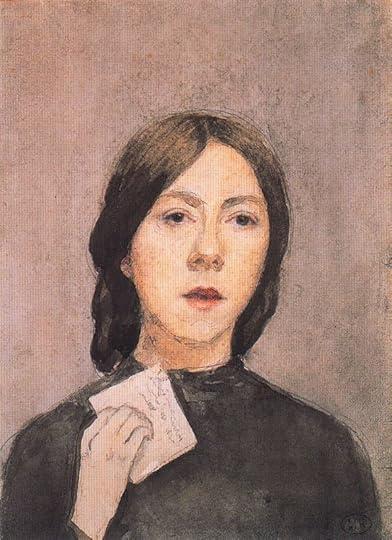
and Weil then pictures herself similarly clutching a postcard to herself.
The story that follows is of a rather bizarre romance with an American mathematician. He asks to meet her, via a mutual friend, when he is in Paris, seemingly more interested in her as daughther of her late father than as herself. But after just three days he proposes marriage, then abruptly flies back to America from where he sends only a rather formal postcard inviting her to New York. There, on their first night together, he takes her to a top restaurant but then mid-meal, struck by inspiration, pulls out his notebook and starts working on a proof, suggesting she might like to read a book. Gradually she sees that her future would be to be in his - and his work’s - shadow.
Another vignette is inspired by a 1632 painting by Judith Leyster of herself at work, which Weil points out would have been used to promote her work to prospective clients.
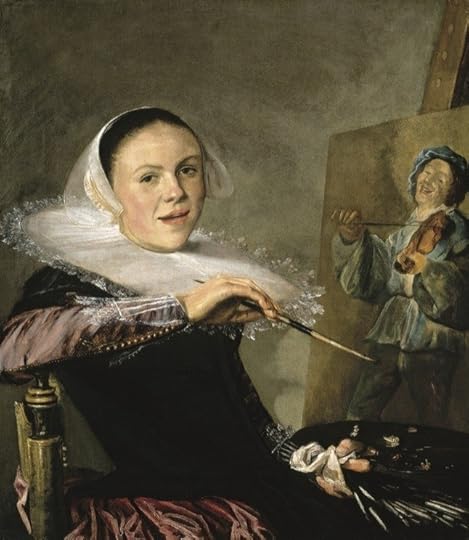
Weil pictures herself, sitting behind a table of her novels at a book festival, unsuccessful and increasingly desperate as readers fail to queue up to buy signed copies of her book, while the other authors prove much more popular.
Others are rather more intense: one has her son committed to a mental hospital when he suffers a sudden psychological background and others touch on her family background - her French roots, her American childhood (her father having fled occupied France in the War) and her Jewish heritage.
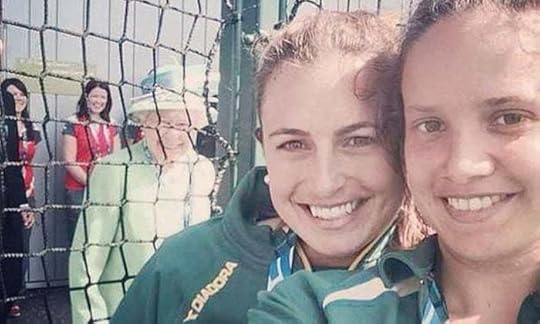
The self portraits referenced range from 16th century paintings to severa; early 20th century works, two by Frida Kahlo, a self portrait inserted into the letter 'Q' by a German illustrator called Claricia into a 12th Century psalter, a self-photograph by Vivian Maier (subject of the recent novel Vivian), included on the cover, and even the Queen’s photobombing of a picture by two Australia athletes at the Commonwealth Games.
It all hangs together beautifully - an examination of ‘selfies’ over the centuries, and a highly varied account of the author's own life, linked by the imagined selfies of her own, and with a nice balance of humour and genuine pathos.
Highly recommended. 4.5 stars
Commended reviews from two of my favourite bloggers:
https://kaggsysbookishramblings.wordp...
https://winstonsdad.wordpress.com/201...
...
Everyone takes selfies, it’s a way of going unnoticed
Selfies is translated by Roz Schwartz from Silvie Weil’s book of the same name.
It is published by the wonderful small independent Les Fugitives, known for their short, cinematic, beautifully translated books by francophone female authors, often award-winning in the original but previously unavailable in English or in the UK. (https://www.lesfugitives.com/about/)
Selfies consists of a series of auto-biographical (or auto-fictional?) vignettes from Weil’s life.
Each chapter begins with a verbal description (around a page) of an historical self portrait by a female artist. With one exception the pictures themselves aren’t included in the text, which worked well as it both compelled me to focus on the text and imagine the picture for myself, but then to search for the actual picture on the web and learn more about the artists involved.
Weil then responds to this with a verbal description of an imagined self-portrait, or selfie, of her own, inspired by the original, and a snapshot of a moment in her life. And this in turns leads to the related anecdote, typically a few pages long.
To take one of my favourite examples, in the second chapter.
Weil is the daughter of the famous mathematical Andre Weil, co-founder of Bourbaki, (as well as niece of the philosopher Simone Weil), which plays an important role.
She takes her inspiration for this tale from Gwen John’s 1907 self portrait with letter:
and Weil then pictures herself similarly clutching a postcard to herself.
The story that follows is of a rather bizarre romance with an American mathematician. He asks to meet her, via a mutual friend, when he is in Paris, seemingly more interested in her as daughther of her late father than as herself. But after just three days he proposes marriage, then abruptly flies back to America from where he sends only a rather formal postcard inviting her to New York. There, on their first night together, he takes her to a top restaurant but then mid-meal, struck by inspiration, pulls out his notebook and starts working on a proof, suggesting she might like to read a book. Gradually she sees that her future would be to be in his - and his work’s - shadow.
Another vignette is inspired by a 1632 painting by Judith Leyster of herself at work, which Weil points out would have been used to promote her work to prospective clients.
Weil pictures herself, sitting behind a table of her novels at a book festival, unsuccessful and increasingly desperate as readers fail to queue up to buy signed copies of her book, while the other authors prove much more popular.
Others are rather more intense: one has her son committed to a mental hospital when he suffers a sudden psychological background and others touch on her family background - her French roots, her American childhood (her father having fled occupied France in the War) and her Jewish heritage.
The self portraits referenced range from 16th century paintings to severa; early 20th century works, two by Frida Kahlo, a self portrait inserted into the letter 'Q' by a German illustrator called Claricia into a 12th Century psalter, a self-photograph by Vivian Maier (subject of the recent novel Vivian), included on the cover, and even the Queen’s photobombing of a picture by two Australia athletes at the Commonwealth Games.
It all hangs together beautifully - an examination of ‘selfies’ over the centuries, and a highly varied account of the author's own life, linked by the imagined selfies of her own, and with a nice balance of humour and genuine pathos.
Highly recommended. 4.5 stars
Commended reviews from two of my favourite bloggers:
https://kaggsysbookishramblings.wordp...
https://winstonsdad.wordpress.com/201...

January 1, 2020
This book is published by Les Fugitives, a small publisher “dedicated to publishing short works by award-winning francophone female authors previously unavailable in English”.
Translated by Ros Schwarz, it is written by someone described on the inside front cover as “daughter to Andre, a brilliant and renowned mathematician; niece to Simone, a brilliant and renowned philosopher” and whose most acclaimed works (as per the inside back cover) are a memoir “At Home with Andre and Simone” and her writing for young adults.
And I think that serves as an introduction to this brilliantly conceived and strongly executed piece of auto-fiction. The writer, largely defined by her relation to others, instead uses the camera of her memory to reveal something of herself and her life – albeit that life itself still has strong resonances from her famous father and from her relationship with a young adult – her troubled son.
Each of the 13 chapters starts with a famous female self-portrait: examples range a 17th century Dutch portrait artists advertisement, to Frida Kahlo with a dog, to Vivian Maier to the Queen’s famous photobombing of two Australian athletes at the 2014 Commonwealth games. (As a small aside the book features the Maier on its front cover but none of the photos in the text, which while understandable from a cost view is I think to the detriment of the book).
The author in turn imagines herself in an equivalent self-portrait (the title of the chapter showing the aspect she particularly wants to bring out – for example Self-Portrait as an author, Self Portrait with a Dog, Self-Portrait in fugitive mirrors, Photobomb selfie – in the examples above).
This then in turn forms the (almost Proustian) start of a memory and anecdote of her life, mainly proceeding from the scene where the imagined self-portrait was taken.
These chapters are often deeply moving – some particular examples that I found especially strong.
A brilliant tale (starting with a self-portrait sent as a postcard) of a rapid (in its commencement and dissolution) relationship with an American professor of mathematics who sees her as, and her paternal reputation, as a purely functional adjunct to his life, he in turn offering her comfort and a role which emulates that of her mother – something she finds initially strangely attractive in its familiarity.
A piece when she visits her son’s in-laws (and takes pictures of everything she sees, only to later edit them to delete all but the portraits of her son), a story which reminded me in its brilliance of Elizabeth Strout and her character Olive Kitteridge at her best.
A heart-wrenching scene with her son in a mental hospital when he develops a paranoia about Jewish persecution and other existential threats.
A scene of misunderstanding when she visits a childhood friend of her recently departed mother – Sylvie looking for comfort from memories of her mother’s idyllic childhood only to be confronted with a view (based on letters) of her mother’s life as a refugee in America (with her father) which is completely at odds with her own memories of her mother’s angst at her nomadic existence as an exile.
Even a symbolic scene when her friends adopt a dog who simply does not fit their conceptions (and experience) of how a dog should behave, a dog she sees as a kin, but who they put down.
Highly recommended - 4.25 stars rounded down for the lack of actual selfies.
Translated by Ros Schwarz, it is written by someone described on the inside front cover as “daughter to Andre, a brilliant and renowned mathematician; niece to Simone, a brilliant and renowned philosopher” and whose most acclaimed works (as per the inside back cover) are a memoir “At Home with Andre and Simone” and her writing for young adults.
And I think that serves as an introduction to this brilliantly conceived and strongly executed piece of auto-fiction. The writer, largely defined by her relation to others, instead uses the camera of her memory to reveal something of herself and her life – albeit that life itself still has strong resonances from her famous father and from her relationship with a young adult – her troubled son.
Each of the 13 chapters starts with a famous female self-portrait: examples range a 17th century Dutch portrait artists advertisement, to Frida Kahlo with a dog, to Vivian Maier to the Queen’s famous photobombing of two Australian athletes at the 2014 Commonwealth games. (As a small aside the book features the Maier on its front cover but none of the photos in the text, which while understandable from a cost view is I think to the detriment of the book).
The author in turn imagines herself in an equivalent self-portrait (the title of the chapter showing the aspect she particularly wants to bring out – for example Self-Portrait as an author, Self Portrait with a Dog, Self-Portrait in fugitive mirrors, Photobomb selfie – in the examples above).
This then in turn forms the (almost Proustian) start of a memory and anecdote of her life, mainly proceeding from the scene where the imagined self-portrait was taken.
These chapters are often deeply moving – some particular examples that I found especially strong.
A brilliant tale (starting with a self-portrait sent as a postcard) of a rapid (in its commencement and dissolution) relationship with an American professor of mathematics who sees her as, and her paternal reputation, as a purely functional adjunct to his life, he in turn offering her comfort and a role which emulates that of her mother – something she finds initially strangely attractive in its familiarity.
A piece when she visits her son’s in-laws (and takes pictures of everything she sees, only to later edit them to delete all but the portraits of her son), a story which reminded me in its brilliance of Elizabeth Strout and her character Olive Kitteridge at her best.
A heart-wrenching scene with her son in a mental hospital when he develops a paranoia about Jewish persecution and other existential threats.
A scene of misunderstanding when she visits a childhood friend of her recently departed mother – Sylvie looking for comfort from memories of her mother’s idyllic childhood only to be confronted with a view (based on letters) of her mother’s life as a refugee in America (with her father) which is completely at odds with her own memories of her mother’s angst at her nomadic existence as an exile.
Even a symbolic scene when her friends adopt a dog who simply does not fit their conceptions (and experience) of how a dog should behave, a dog she sees as a kin, but who they put down.
Highly recommended - 4.25 stars rounded down for the lack of actual selfies.
January 26, 2020
This book was not as I expected, but I loved it and was sad to reach the end. I wish it was longer or that the author had written another volume.
Sylvie Weil starts each chapter describing a self portrait painted by a female artist or, in the case of Vivienne Maier, a photograph. She then goes on to describe the self portrait she would make of herself in a similar situation. And then describes an episode from her life from which the self-portrait would be a snapshot.
It is a really interesting concept, but so beautifully written and described (well done to the translator as well on that point). It would not normally be the type of book I read, but I am trying to broaden my reading and this was a perfect choice.
Highly recommended and will probably be one of my favourite books of the year.
Sylvie Weil starts each chapter describing a self portrait painted by a female artist or, in the case of Vivienne Maier, a photograph. She then goes on to describe the self portrait she would make of herself in a similar situation. And then describes an episode from her life from which the self-portrait would be a snapshot.
It is a really interesting concept, but so beautifully written and described (well done to the translator as well on that point). It would not normally be the type of book I read, but I am trying to broaden my reading and this was a perfect choice.
Highly recommended and will probably be one of my favourite books of the year.

January 24, 2024
This is not the kind of book I usually read, but then I became interested in mathematicians and wanted to know more about André Weil, Sylvie's father. I finished his autobiography (which is beautifully written) and then ended up curious about Sylvie's books and wanted to see if I could find out more about him through them... which led me to Selfies 😊
I'm not going to lie: I wasn't expecting to like it, but not only do I love it, I also wish it was longer and had a sequel. I really couldn't stop reading it and I feel very sad and empty when it ended.
I love how she organized the story, first by introducing a famous self-portrait (often a painting), then describing how she would make one of herself, and finally she tells a story about an event of her life related to the theme of the self-portrait. I thought it was very creative and fun, and the stories were very diverse and engaging. I liked them all, my favorites being those about her son and the final one.
The only thing I'm a bit ambivalent about is the lack of pictures. I had to google the paintings described in each chapter, but on the bright side, it allowed me to picture it in my head first instead of "spoon-feeding" me the images. Maybe it would've been nicer if they had been included in the end of the book, but I guess it would make it more expensive too.
Now I hope I'll get the chance to read "At Home with André and Simone Weil" someday. Like her father, Sylvie is a very good writer, has a very unique style, and displays a lovely sense of humor and way to see and describe the world and her experiences.
PS.: Spoiler ahead:
I'm not going to lie: I wasn't expecting to like it, but not only do I love it, I also wish it was longer and had a sequel. I really couldn't stop reading it and I feel very sad and empty when it ended.
I love how she organized the story, first by introducing a famous self-portrait (often a painting), then describing how she would make one of herself, and finally she tells a story about an event of her life related to the theme of the self-portrait. I thought it was very creative and fun, and the stories were very diverse and engaging. I liked them all, my favorites being those about her son and the final one.
The only thing I'm a bit ambivalent about is the lack of pictures. I had to google the paintings described in each chapter, but on the bright side, it allowed me to picture it in my head first instead of "spoon-feeding" me the images. Maybe it would've been nicer if they had been included in the end of the book, but I guess it would make it more expensive too.
Now I hope I'll get the chance to read "At Home with André and Simone Weil" someday. Like her father, Sylvie is a very good writer, has a very unique style, and displays a lovely sense of humor and way to see and describe the world and her experiences.
PS.: Spoiler ahead:
This entire review has been hidden because of spoilers.

December 9, 2019
A dazzling intertwining of descriptions of self-portraits by artists with the author's own experiences.
Displaying 1 - 5 of 5 reviews